The Iran Conflict Is Becoming a Russia-Ukraine Proxy War
Both Russia and Ukraine are trying to use the U.S.-Israeli war against Iran to their own advantage. With Russia profiting from the war while backing Iran, and Ukraine arming the Gulf states, the Middle East has become a new front in the war between Kyiv and Moscow.
By experts and staff
- Published
 Max BootCFR ExpertJeane J. Kirkpatrick Senior Fellow for National Security Studies
Max Boot is the Jeane J. Kirkpatrick senior fellow for national security studies at the Council on Foreign Relations. He wrote this piece from Kyiv, Ukraine.
It has become common for major conflicts to become proxy wars, with outside powers intervening to help their friends and hurt their foes. The Soviet Union, for example, supplied North Korea and North Vietnam in wars against the United States. The United States returned the favor by supplying the Afghan mujahideen during the 1980s in their war against the Red Army.
The Iran war is no different. Both Russia and Ukraine are trying to use the Middle East conflict, which pits Israel and the United States against Iran, to their own advantage.
Russia has a long-standing alliance with Iran, so it is natural that Russian President Vladimir Putin has been aiding the Islamic Republic by reportedly providing it with satellite imagery and drones. Ukrainian President Volodymyr Zelenskyy wrote on social media that, according to Ukrainian intelligence, Russian satellites had “imaged,” among other sites, the joint U.S.-United Kingdom military base on the island of Diego Garcia in the Indian Ocean, Kuwait International Airport, Prince Sultan Air Base in Saudi Arabia, and Al Udeid Air Base in Qatar—the largest U.S. military installation in the Middle East. If Zelenskyy’s claim is accurate, it is surely no coincidence that Iran has targeted many of these same facilities.
An Iranian attack on March 27 against Prince Sultan Air Base damaged several U.S. aircraft on the ground. A valuable E-3 Sentry AWACS command and control plane was destroyed on the tarmac. Other Iranian strikes have hit at least ten early warning radars used by the United States and countries in the Persian Gulf to defend against Iranian drone and missile strikes. The Iranian attacks have been so extensive that, according to the New York Times, “Many of the thirteen military bases in the region used by American troops are all but uninhabitable.”
It is hard to see how Iran, which lacks satellites of its own, could have struck so many of these targets so accurately were it not for Russian, and possibly Chinese, assistance.
In the past, Russia has been a recipient of Iranian military largesse—Iran provided the Shahed drones that are now being used en masse by Russia to attack Ukraine. But Russia has been manufacturing its own versions of the Shahed drones, including one that is equipped with a jet engine rather than a turboprop. There are widespread reports that the supply chain is now running the other way, with Russia sending its drones to Iran.
You would think that U.S. President Donald Trump would be perturbed by the aid Russia has offered Iran to target U.S. troops, but, ever solicitous of Putin, the president appears serenely unperturbed. During a television interview on March 13, Trump said that “I think he [Putin] may be helping them a bit, yeah,” but went on to excuse Putin’s actions by saying that “He probably thinks we’re helping Ukraine. They do it, and we do it.” Yet at the same time that Trump is making excuses for Putin, he is raging against the United States’ European allies for not helping to reopen the Strait of Hormuz—which was closed as a result of the war that Israel and the United States launched.
Far from punishing Putin for his aid to Iran, Trump has relaxed sanctions on Russia. This move, combined with the soaring oil prices caused by the war, has the potential to deliver a major financial windfall that Russia can use to finance its war of aggression against Ukraine. Indeed, the Kremlin has reportedly dropped plans for budget cuts in anticipation of more oil revenues.
Because the United States isn’t curbing Russian aggression, Ukraine has been forced to take matters into its own hands. For the past week, long-range Ukrainian drones have been pounding Russian oil export infrastructure on the Baltic Sea coast six hundred miles from Ukraine. Those strikes have reportedly cut Russia’s oil shipping capacity by 40 percent, thereby reducing, at least temporarily, Russia’s oil profits.
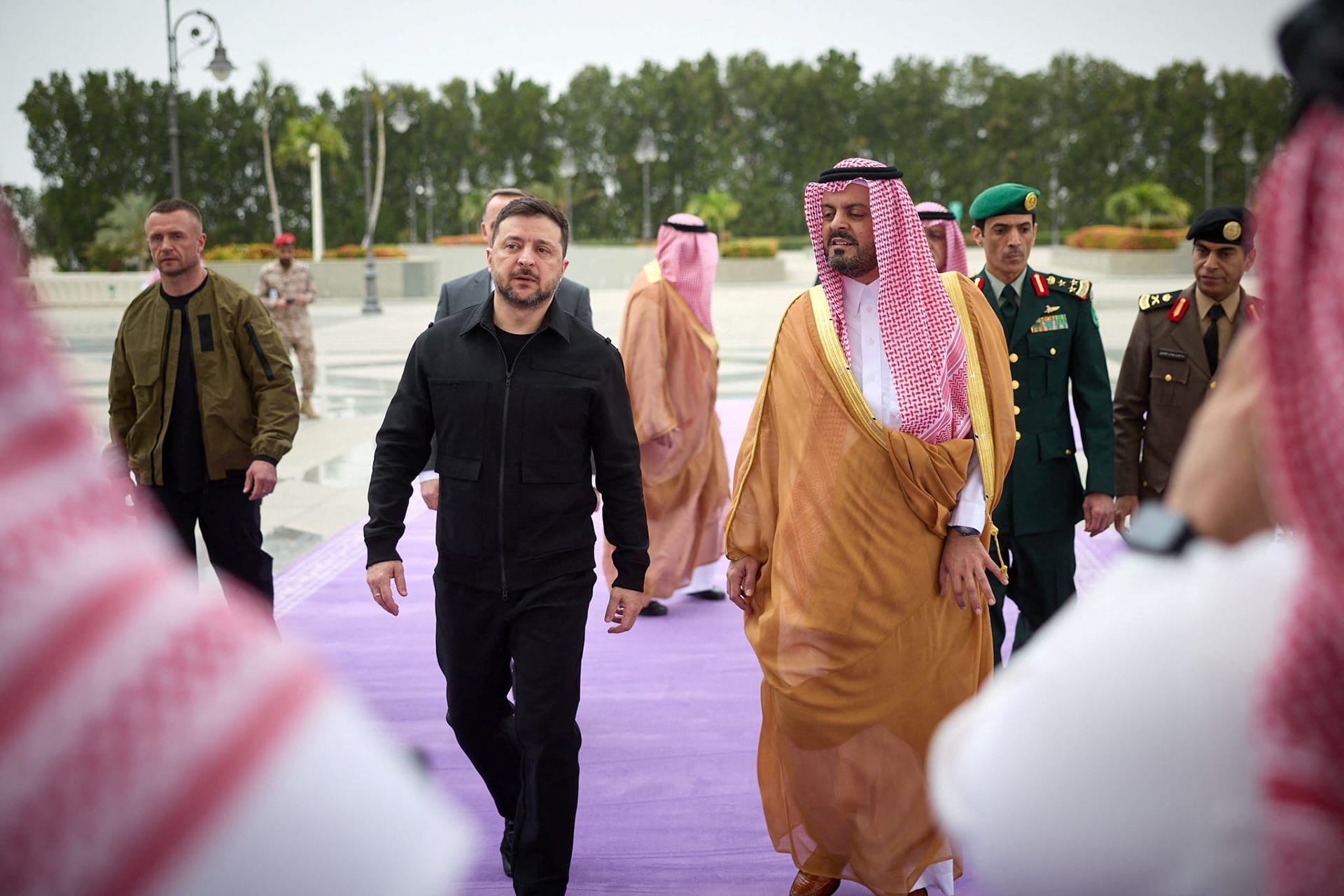
Meanwhile, Zelenskyy has sent Ukrainian air-defense specialists to help the Persian Gulf states fend off Iranian drone attacks. Last week, Zelenskyy himself traveled to the Middle East to conclude security cooperation agreements with Saudi Arabia, the United Arab Emirates, and Qatar. Those countries now realize that firing Patriot missiles—which can cost $3.7 million each—to shoot down Iranian drones costing between $20,000 and $50,000 is neither practical nor sustainable. Ukraine will reportedly provide Gulf states with its air-defense interceptor drones, which cost as little as $1,000, along with the expertise to detect and neutralize drone threats.
In return, Ukraine could receive badly needed investment in its drone industry, which has been expanding at an exponential pace and could grow even faster with more funding. At the moment, roughly 60 percent of Ukraine’s drone-manufacturing capacity remains unused. Ukraine’s goal is to manufacture seven million drones this year, and it can expand production even faster with an influx of funding from the Gulf states.
Overall, Russia is a major beneficiary of the Iran war—not only because it is receiving more oil revenue but also because the United States is expending scarce munitions, such as Patriot interceptors, that, therefore, will not be available for sale to Ukraine. But Ukraine is doing its best to negate the Russian edge in this proxy war.
This work represents the views and opinions solely of the author. The Council on Foreign Relations is an independent, nonpartisan membership organization, think tank, and publisher, and takes no institutional positions on matters of policy.