What’s Behind the Protests and Riots in France, and What Comes Next
Massive protests have swept across France since mid-September as students have rallied against the country’s education system and rising living costs. But the chaos could be a boon for France’s more extreme parties before next year’s elections.
On September 17, teachers at the Antoine de Saint-Exupéry High School in Créteil, a southeastern suburb of Paris, went on strike to draw attention to staff shortages. The teachers, joined by students and parents, blocked the school entrance. Videos of the blockade spread on social media, and soon protests expanded to high schools across the nation.
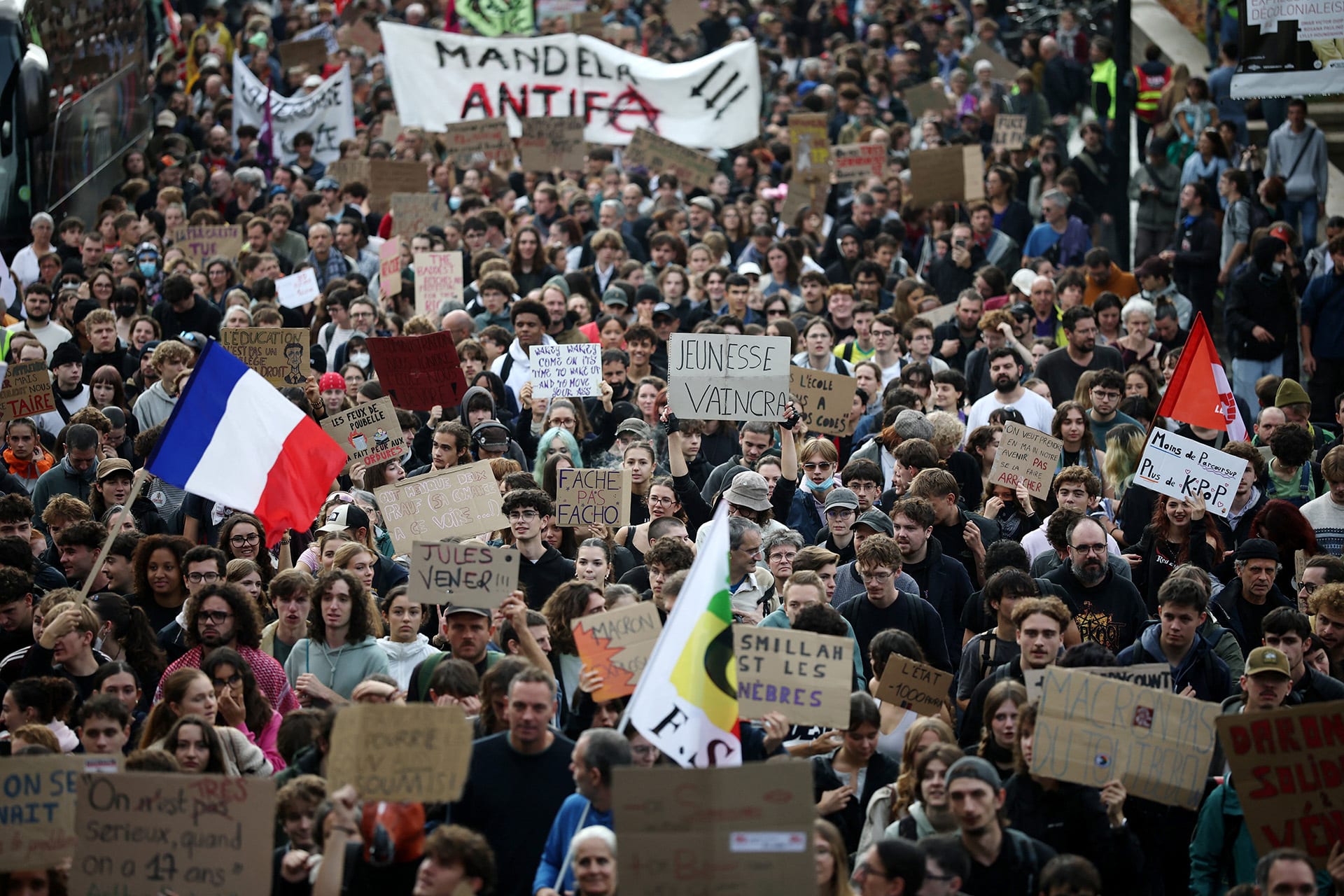
The protests have continued throughout October, affecting more than one thousand of France’s approximately 3,700 high schools and drawing hundreds of thousands of protesters. As the movement grew, the list of grievances expanded beyond the failings of the public school system to encompass broader economic, political, and social dissatisfaction. Teachers, parents, university students, and left-wing politicians also joined.
A poll from October 7 found that 55 percent of French respondents supported the movement. However, the protests descended into violence on October 17, and French authorities have responded with security crackdowns, curfews, and mass arrests when clashes grew particularly heated.
The unrest occurs against the backdrop of France’s upcoming presidential election in April 2027. With the students’ concerns being eclipsed by scenes of violent riots, the far right’s law-and-order stance could propel it to victory for the first time in France’s modern history. The far left, which is popular among young voters, could also benefit electorally from the student movement, setting up a contest between the two extremes.
What’s driving the French protests?
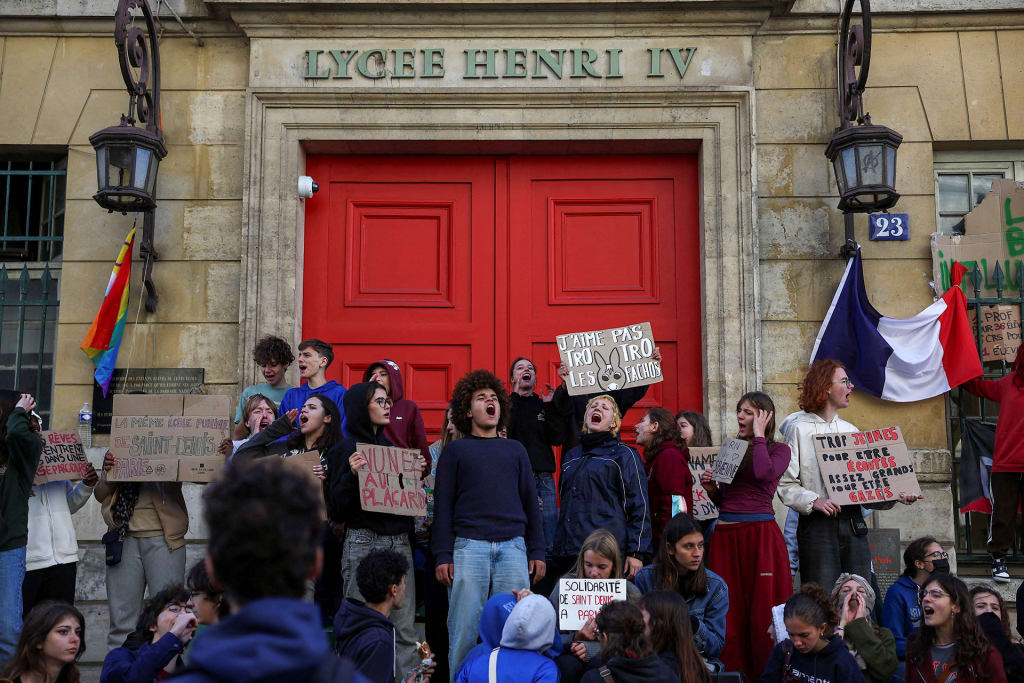
After the Créteil demonstrations, high schoolers in Lyon, Marseille, Paris, and other major French cities began barricading their schools and protesting in the streets against the lack of teachers, overcrowded classrooms, overpacked schedules, and their schools’ crumbling infrastructure. They also called for an overhaul of the university admissions platform, Parcoursup, saying it is too complex and opaque.
French classrooms are filled to the brim. Excluding vocational schools, the average size of a high school class is about thirty students, while nearly 20 percent of classes have between thirty-five and thirty-nine students. Meanwhile, schools have struggled to fill teacher vacancies. At the beginning of the 2026–2027 academic year, more than half of high schools and middle schools in France lacked at least one teacher. More than nineteen million hours of secondary school classes were not taught during the 2023–2024 academic year, largely because of insufficient substitutes. Recruitment has become difficult because of stagnant pay and increasing physical threats against teachers.
Meanwhile, fewer than 15 percent of French school buildings have been renovated in the last decade. Rising temperatures and more frequent heat waves in recent years have also presented an issue, as many schools lack sunshades, air conditioners, thermal insulation, and other mechanisms to cool overheated buildings. Last summer, millions of students took their final exams in classrooms lacking air conditioning, and one school set up a testing center in an underground parking lot to escape the heat. These issues tend to be exacerbated in poorer, immigrant-heavy neighborhoods, like Créteil.
The protests come at a moment of crisis for the French public school system. Although France spends more than other high-income countries on secondary education, the results for the 2025 Program for International Student Assessment rankings showed French students’ standardized test scores in math, science, and reading dropped to their lowest point since tracking began in 2000.
In 2018, Minister of National Education, Youth, and Sports Jean-Michel Blanquer led an overhaul of the high school system and baccalaureate exam—a rite of passage in France. The Blanquer reform introduced more subject concentrations, shortened the final exam, and placed greater emphasis on grades. But critics argue the abundance of concentration options exacerbated social stratification and made school days longer. French high schoolers often have gaps in their timetables and regularly finish school at 6:00 p.m. Student protesters have called on the government to address these issues as well.
What other factors are at play?
A generational divide is fueling these protests, too. In a country where youth unemployment is high and where pensions account for roughly 14 percent of GDP, many young people feel that older voters remain the government’s priority. A government report from mid-October indicates that 32 percent of the education ministry’s budget goes toward the pension system.
As the demonstrations grew, their focus expanded beyond issues with the school system to include concerns about affordability, diesel prices, and general dissatisfaction with the government. The movement also brought together students with trade unions, such as the General Confederation of Labor, and the Yellow Vests, a grassroots organization that led anti-government protests in 2018. The breadth of the demonstrations was also reflected in protesters’ signs. Some signs criticized the far-right National Rally party, while others expressed support for the Palestinian territories or warned about the risks posed by climate change and artificial intelligence.
So far, the government has responded by deploying three thousand additional substitute teachers, rescinding its proposal to introduce tuition fees for certain technical programs and preparatory classes, and rolling out an online platform where young people can express their concerns. On October 26, the government proposed additional measures, including making changes to Parcoursup by 2027 and fully replacing it by 2028. Later that day, representatives of the student movement met with Prime Minister Sébastien Lecornu and hailed this progress, while still calling for “continued mobilization.”
Have the protests been violent?
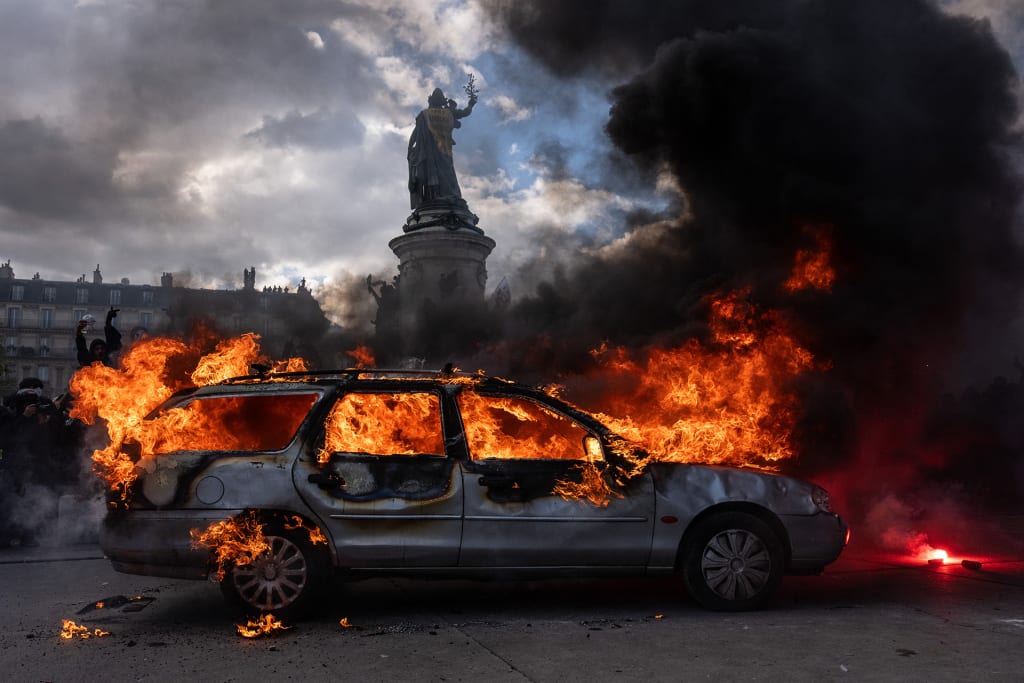
Although the government has acknowledged students’ concerns are “legitimate,” demonstrators have been met with a heavy police response, and violence has been present from the start on both sides. Students have set trash cans ablaze near their schools. Videos of police assaulting teenage protesters have gone viral on social media, and mass arrests have occurred. Between September 28 and October 5, more than six thousand people were arrested and five thousand detained; close to 90 percent of detainees were minors. These numbers are unprecedented and eclipse the number of arrests during the Yellow Vests protests.
October 17marked a major escalation in the demonstrations, with some experts calling them the worst riots in recent years. An estimated between 550,000 and 800,000 people across France—including 110,000 in Paris alone—took to the streets, but the demonstrations were hijacked and turned into violent riots in many French cities. In Marseille, rioters stormed city hall, and in Limoges, they set the town hall on fire. Three thousand shops, including French luxury brands as well as many small local businesses, were looted.
Local and national authorities reacted swiftly, putting in place curfews, including in the center of Paris, and instating local bans on protests. More than a thousand police officers were injured, while 2,700 people were arrested and more than 200 were jailed.
French President Emmanuel Macron condemned the violence and the actions of those “who sought to bring down the Republic.” He drew a distinction between the students and the “ultra-left” rioters whom he accused of wreaking havoc across the country.
How could the protests shape France’s presidential election?
The student protests are poised to play a pivotal role in France’s presidential election, with the first round set to take place in April 2027 and a runoff scheduled for the following month if no candidate secures more than 50 percent of the vote.
Most of the French political establishment, including the prime minister, has blamed the far-left party France Unbowed for fueling violence and using the protests to gain electoral advantage. The far left, which garners strong support among youth, especially those from immigrant backgrounds, has stood by the students from the start. Jean-Luc Mélenchon, the party leader and a presidential candidate, joined the protests in early October and described the police response as “ferocity [that] is irresponsible with an obvious racist aftertaste.” After October 17, he condemned the violence on national television but blamed the government for what ensued, and he called on Macron to address the grievances of the French people.
In contrast, Marine Le Pen, the presidential candidate of the far-right National Rally party, has expressed support for police forces, deemed the government’s response inadequate, and blamed the far left for stoking violence. At the same time, Le Pen, who has focused her campaign on the cost of living, has empathized with protesters’ “legitimate social demands.” Some in Le Pen’s party have also blamed immigration for the issues plaguing French schools.
The scenes of chaos appear to be helping the far right, Matthias Matthijs, a CFR senior fellow for Europe, explained. “As the riots can be blamed on extremist elements of the far left, Marine Le Pen’s far-right National Rally can lay claim to be the party of law and order, and position itself as the only realistic governing alternative for French citizens who want to see radical change,” he said. After the October 17 escalation, polling showed Le Pen maintaining her lead, with more than 30 percent of voter support. In the same poll, Mélenchon jumped to second place, with 17 percent, setting the stage for a showdown between the two extremes next spring.
What’s next?
Additional protests have been planned for Halloween weekend, and the movement is unlikely to subside anytime soon. Instead, experts say it will likely intensify. On October 23, a man killed a child and injured five people in what was reportedly a racially motivated shooting meant to avenge the looting on October 17. A day later, between 410,000 and 800,000 people protested again nationwide, in some cases even defying local protest bans. Although the demonstrations were calmer, some clashes erupted in the evening and more than a thousand people were arrested.
With a debt crisis on his hands and his term ending in a few months, Macron has limited options for meeting protesters’ demands, and the unrest has further eroded his credibility. Macron was already viewed as a lame duck because he cannot run for office again, Liana Fix, a senior fellow for Europe at CFR, explained, but “after the protests, he is seen as a lame duck that has lost control of his country and connection to his people.” In a poll asking who was to blame for the violence on October 17, 81 percent of respondents blamed the government.
The country’s political extremes, for their part, appear intent on riding this wave of discontent all the way to the Élysée.
This work represents the views solely of the author(s). The Council on Foreign Relations is an independent, nonpartisan membership organization, think tank, and publisher, and takes no institutional positions on matters of policy.