Why Taiwan’s Local Elections Matter for Deterring China
As gray zone pressure from China grows, local resilience efforts will play a critical role in the island’s response to an emergency. That will matter for the United States, too.
By experts and staff
- Published
 Katie SizemoreCFR Expert2026-27 International Affairs Fellow in National Security, sponsored by Janine and J. Tomilson Hill
Katie Sizemore is a national security and crisis management professional with more than a decade of experience across the Department of Homeland Security, the Federal Emergency Management Agency, and the Department of Justice.
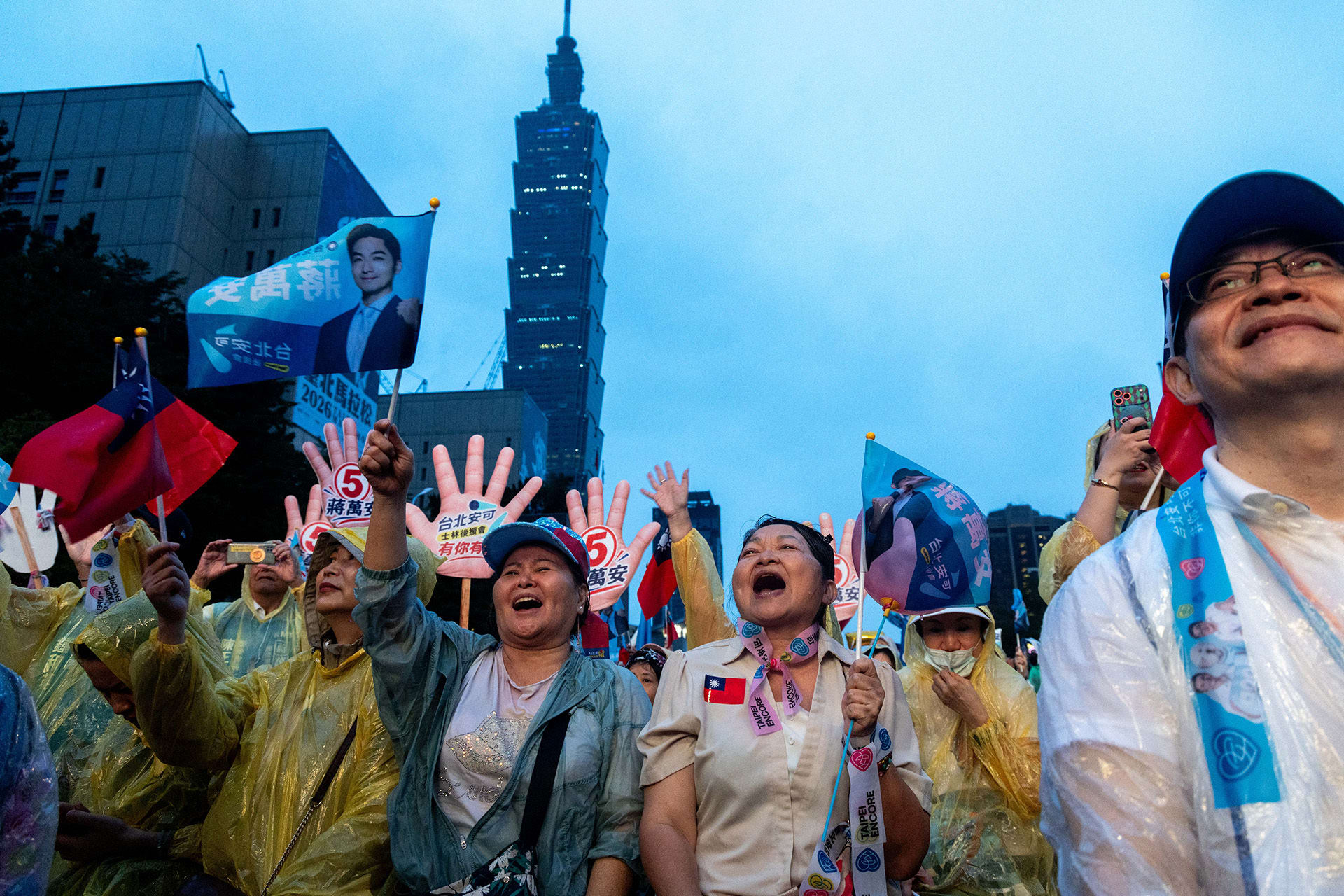
Taiwan goes to the polls for so-called nine-in-one elections on Saturday, November 28 amid mounting pressure from China. And while the elections this weekend are local races, including the widely watched Taipei City mayoral contest, they will determine who is responsible for translating national resilience priorities into the local capabilities that will make a difference in a crisis with the mainland.
Already this month, there have been reports of Chinese military aircraft entering Taiwan’s air defense identification zone, balloon activity, radio broadcast clashes and a surge in military vessels around the island, all part of what has been described as heightened gray-zone activity. But Taiwan’s ability to withstand Chinese coercion will depend on much more than its military readiness. Under a quarantine or a blockade, Taiwan could see major energy supply disruptions, an overwhelmed medical system, degraded communications, and food supply concerns. Maintaining essential services and navigating these disruptions fall first and foremost to the local governments.
The mayors and county officials elected this month will guide their communities through potential crises, and their capacity to handle them shapes Beijing’s calculus for initiating one. This makes Taiwan’s local elections relevant well beyond the island. The U.S.-Taiwan relationship is increasingly tied to Taiwan’s ability to withstand a blockade or attack and keep society running under pressure. A strong and resilient Taiwan protects supply chains on which the United States depends. Taiwan’s domestic resilience buys time, reduces immediate vulnerabilities and can make external support more effective and targeted.
In a recent Foreign Affairs essay, Rebecca Lissner and Mira Rapp-Hooper argue that the United States should recommit to deterring Chinese coercion, which they warn could escalate to a quarantine or blockade in late 2028 or early 2029 if Beijing concludes the window for peaceful unification is closing. Their recommendations focus on Washington, but deterring conflict short of war also depends in large part on whether Taiwanese local officials, institutions, and civil society can keep communities functioning under major disruption.
Taiwan’s central government sets national priorities, but city and county governments play a critical role in the island’s Whole-of-Society Defense Resilience strategy by deciding how to allocate individual civil defense budgets. This includes everything from training residents and organizing sheltering operations to evacuation planning, and stockpiling emergency equipment. All this means that translating high-level societal resilience priorities depends on local buy-in, coordination, and trust.
Whether responding to a natural disaster or man-made crisis, resilience depends on local capacity. This is true all over the world, but especially in Taiwan, where typhoons and earthquakes can rapidly cut off access to communities. In my four years bringing delegations from the U.S. Federal Emergency Management Agency to Taiwan, we saw resilience-building efforts up close as we discussed exercise scenarios and translated response operations concepts to hundreds of local first responders, health officials, and civil society leaders.
Testing times
A Chinese blockade would quickly overwhelm the ability of local governments to manage lifesaving and life-sustaining services on the densely populated island, including by creating shortages and disrupting infrastructure. If local systems failed, Beijing could amplify fear and panic through disinformation and psychological pressure. This is why this year’s Urban Resilience exercises tested how the central and local governments, as well as civil society, can keep the essential functions of government running.
The exercises introduced several operational shifts, including a deliberate slowdown of the mobile network, mutual aid and resource-sharing drills between jurisdictions, and civilian coordination alongside military drills. These efforts reflect important transformations in Taiwan’s readiness planning.
Taiwanese local elections have historically been a testing ground for Chinese influence and disinformation campaigns. Beijing’s attacks have grown more targeted and voluminous, with Taiwan’s National Security Bureau estimating an average of 2.6 million cyber intrusion attempts per day against government and critical infrastructure networks in 2025. On November 18, Taiwan’s Criminal Investigation Bureau said it is investigating thirty cases of suspected foreign interference in the elections and more than 250 nationwide reports of election-related disinformation. These activities matter beyond the election because, during a crisis, they could be used to undermine confidence in government messaging and directions from local officials, complicating emergency response and exacerbating the resulting harm.
The Taipei City mayoral race in particular intersects with civil defense efforts. The Democratic Progressive Party (DPP) candidate, Puma Shen, who cofounded Kuma Academy—Taiwan’s best-known civil defense nongovernmental organization—was placed under investigation by China’s Chongqing Municipal Public Security Bureau in 2025. Kuma’s civil preparedness, first-aid, and disaster-planning workshops directly reinforce President Lai Ching-te’s Whole-of-Society Defense Resilience core focus areas. China’s targeting of him underscores how Beijing is paying attention to Taiwan’s resilience planning and how intertwined civil preparedness is with broader political debate.
The DPP and the Kuomintang (KMT) have differing approaches to cross-strait relations and on how closely to integrate wartime scenarios into civilian planning. However, both parties have an interest in increasing Taiwan’s resilience and emergency preparedness. Although the Whole-of-Society Defense Resilience priorities are DPP-led, preparations for disasters or potential conflict should be undertaken regardless of party affiliation. Taiwan’s second-largest city, Taichung, is a good example—the KMT’s Lu Shiow-yen is the current mayor, but the city participated in the 2025 Urban Resilience exercise.
Staying local
The United States, for its part, should not view support for Taiwan solely through the lens of military sales and security cooperation. It should also invest in the civilian institutions and civil society organizations that would allow Taiwan to withstand a crisis, not least because partnering with Taiwan on civil resilience activities is less politically sensitive than U.S. defense cooperation.
In practice, this could mean technical exchanges, with the United States continuing to share expertise on emergency communications, disaster response, community preparedness, and continuity of operations and government. U.S. officials could also encourage more city-to-city cooperation, which better mirrors the scale and scope of local jurisdictions. This creates a durable foundation for practical engagement that benefits Taiwan, the United States, its Pacific territories, and its allies.
Supporting Taiwan’s ability to withstand Chinese coercion requires investing in those in charge of keeping society functioning under pressure. Partnering with the new locally elected leaders can help make Taiwan’s resilience an enduring capability, one that supports the future of U.S. deterrence strategy.
This work represents the views solely of the author(s). The Council on Foreign Relations is an independent, nonpartisan membership organization, think tank, and publisher, and takes no institutional positions on matters of policy.