Workshop

2026 College and University Educators Workshop
Thursday and Friday, February 19–20, 2026

The workshop offers a unique opportunity for college and university faculty to engage directly with CFR experts, delve into pressing foreign policy issues, and strengthen their teaching of global affairs. Participants will explore the extensive teaching and research resources provided by CFR and Foreign Affairs, exchange ideas through expert-led briefings and hands-on policymaking simulations, and share innovative strategies and tools for bringing global issues into the classroom.

 The full agenda for the workshop can be found here.
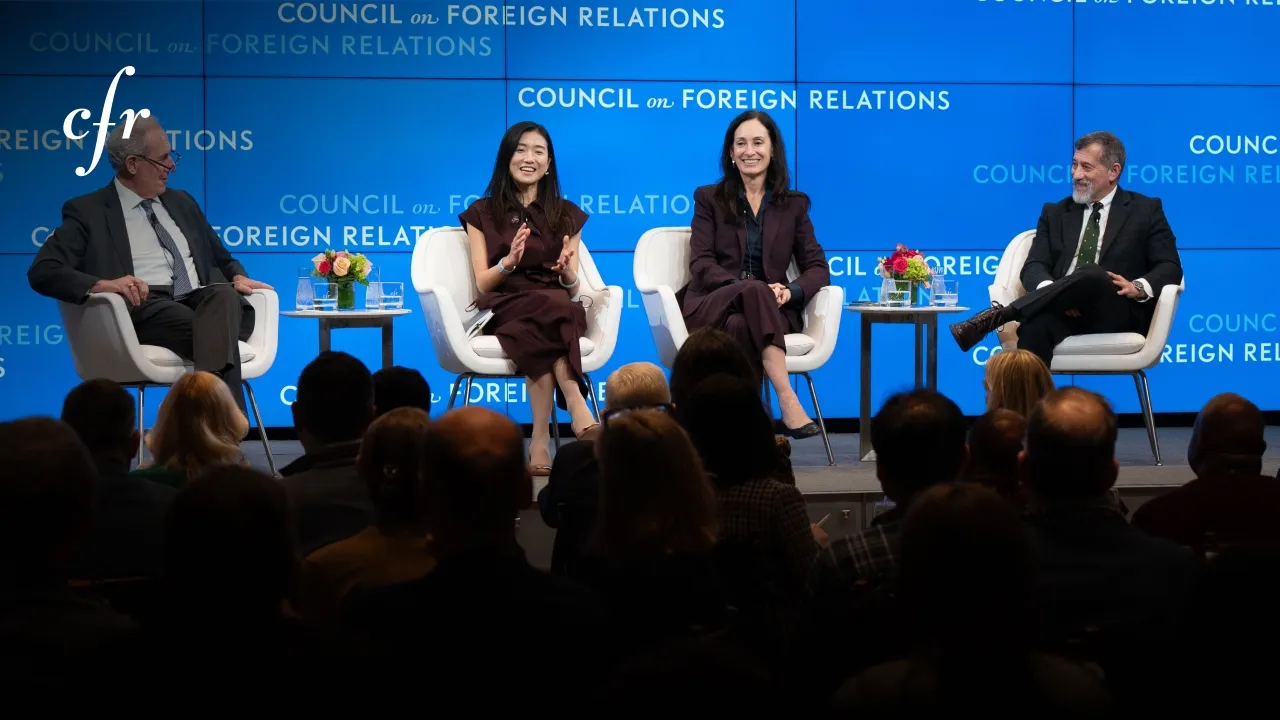
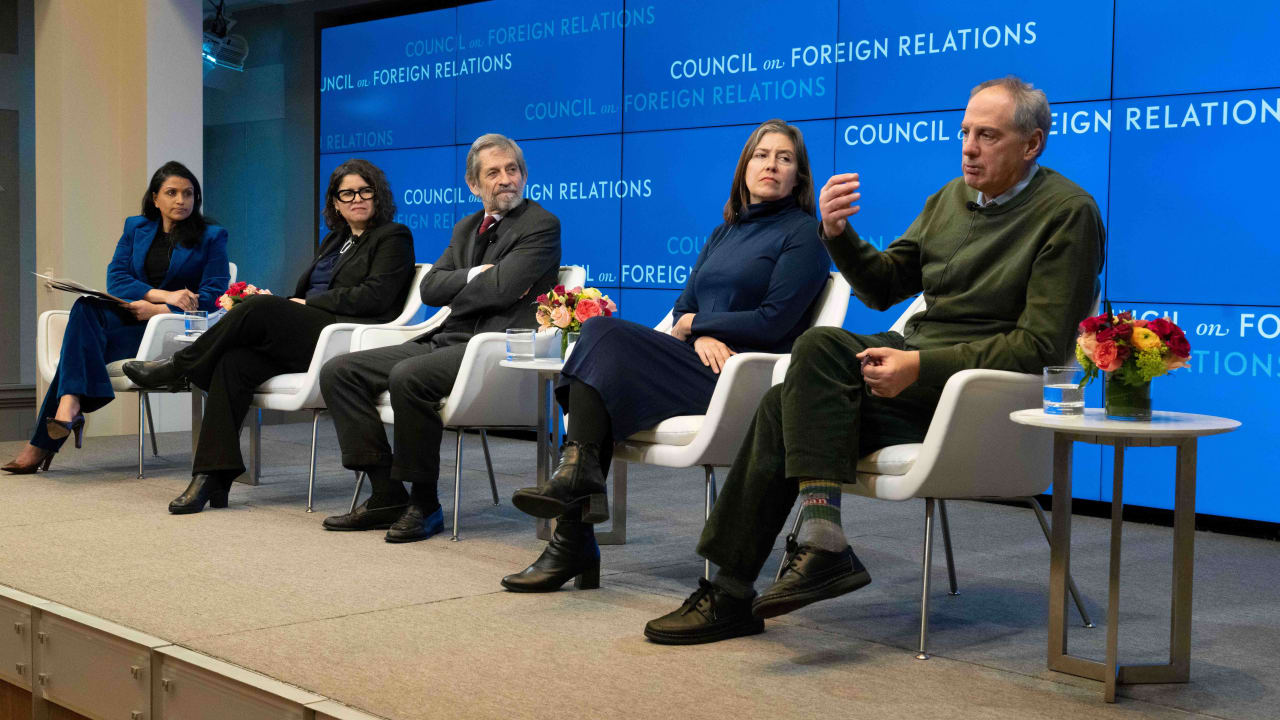
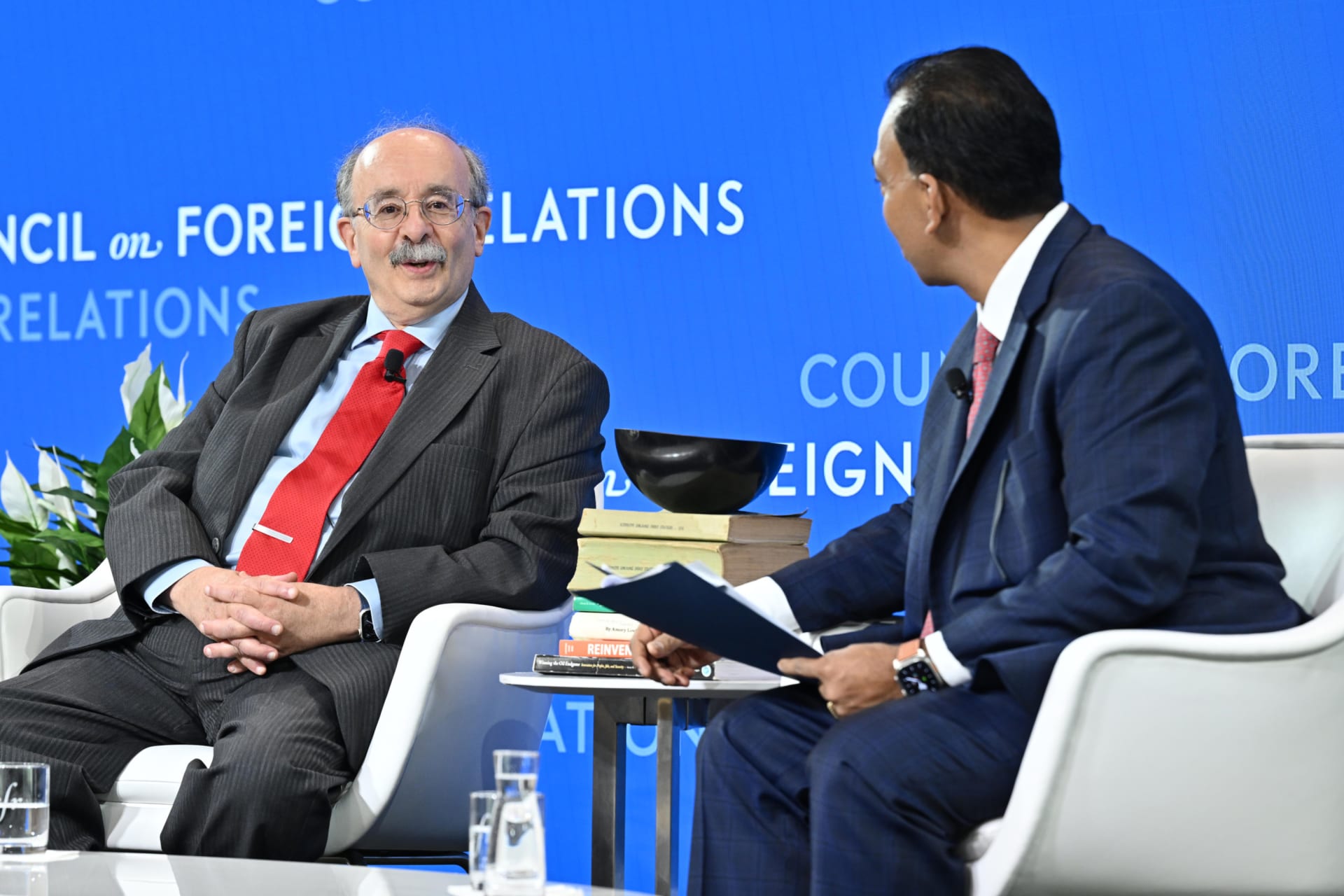
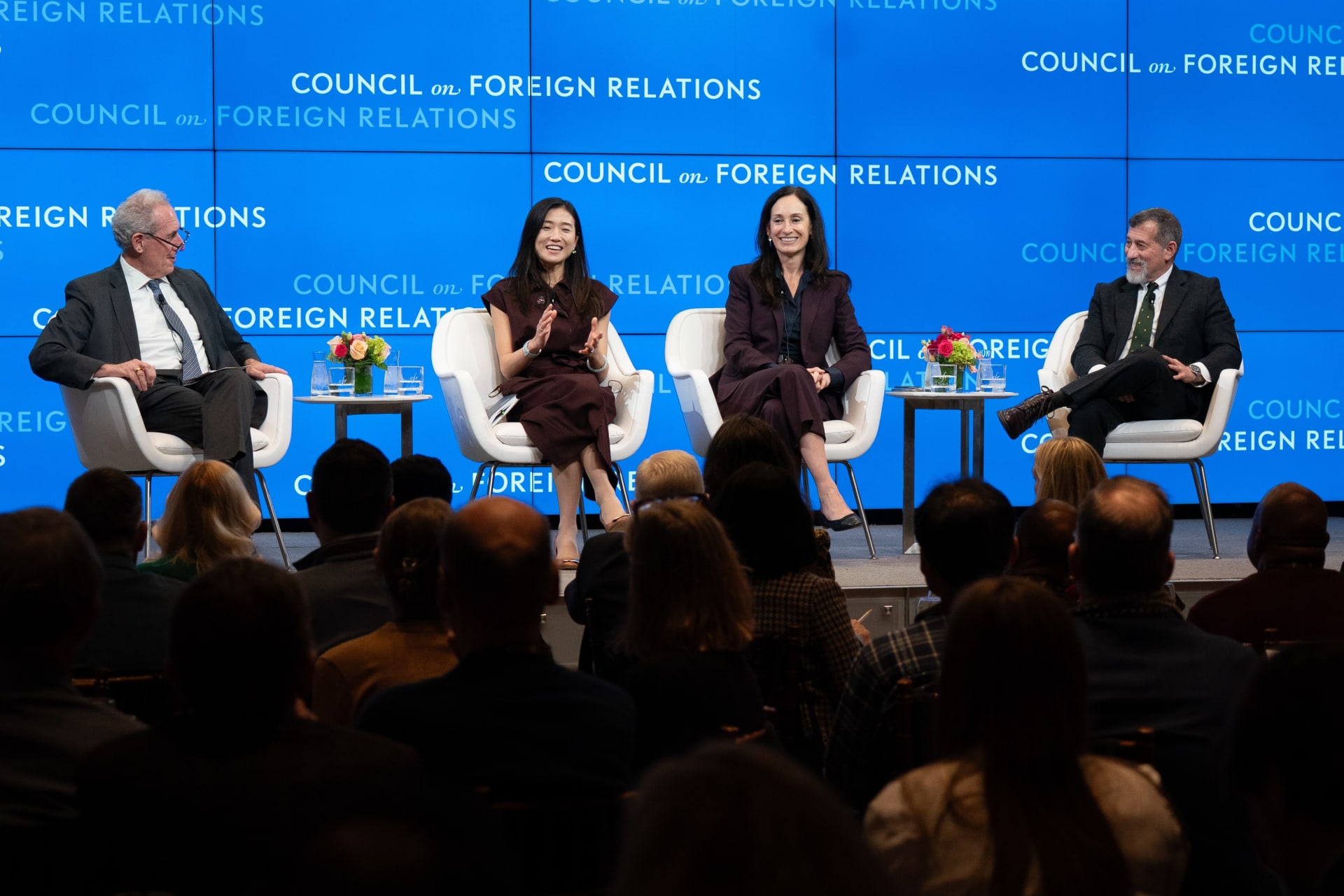
FROMAN: All right. Hello, everybody. Welcome. Welcome to the Council. Welcome to New York, for those who’ve traveled from far and wide. We’re delighted to have you here for this—for this workshop. I’m told we have ninety-seven educators from forty-eight states and Washington DC. So, who’s from Washington, DC? There we go. (Laughter.) All right. Nobody from the Marshall Islands? Nobody from Puerto Rico? OK, but great to have you here. And I really hope this day and a half or so, that you get as much as you possibly can out of us, and our resources, and the relationships that you make here, and that we can be a source of support for you going forward when you get back home to your colleges and universities. 

I’m Mike Froman. I’m president of the Council. Which means basically I’m the caterer. (Laughter.) So, any complaints about the food, you can bring them to me. We’re delighted to have this session on the United States in Focus, which is just a general discussion of a whole range of issues. Give you a feel for the range of expertise that our fellows have. And you’ll be seeing it over the course of the next day as well. We’ve got three very, very distinguished fellows here. Let me introduce them.  

Next to me is Zoe Liu, who’s our Maurice R. Greenberg senior fellow for China studies. 

Shannon O’Neil, who’s senior vice president for studies and the Maurice R. Greenberg chair, where she oversees the think tank part of CFR. As you know, CFR is a think tank. It’s a publisher. It’s educational organization. It’s a membership organization. Shannon’s in charge of all the smart stuff that gets produced here. So, she’s the content creator, oversees about a hundred fellows in total. 

And Bruce Hoffman, the Shelby Cullom and Kathryn W. Davis senior fellow in counterterrorism and homeland security.  

I’m going to start with a conversation with them for thirty, thirty-five minutes, and then we’ll open it up to questions from all of you. This is on the record. It is not being livestreamed, but it is being recorded. So, anyway. When we get to the questions I’ll ask you to stand, identify yourself, come up with a question, not a lecture. (Laughter.) And I know you’re used to talking in forty-five minute, you know, increments, but we’ll try and do it somewhat shorter tonight, and have a good conversation.  

Maybe let me start with—let me start with Shannon. And I start with Shannon purposely because in December, the Trump administration issued its National Security Strategy. And one of the most innovative, interesting elements of this year’s National Security Strategy compared to previous administrations is it made the Western Hemisphere the number-one priority of the administration. It related it to homeland security, to things around the border, to the flow of migrants and drugs into the United States. And that is—and we then saw, a few weeks later, the action in Venezuela to remove and arrest Maduro, and to follow on—to follow on from there. So, let me do open-ended question, Shannon. How do you assess this prioritization of the Western Hemisphere and the administration’s approach, current approach, to Western hemispheric issues? 

O’NEIL: Yeah, well, thank you. That’s a good question. And welcome, everyone. It’s great to have you here. You know, this is a pretty significant turn. And, you know, I’ve been looking at Latin American issues for many, many years. And, you know, many, many countries, officials in the region, scholars and the like, you know, bemoan that the United States doesn’t pay enough attention to Latin America. And here’s a be careful what you wish for. (Laughter.) And so, you know, you have seen this shift—I mean, yes, we’ve had—you know, obviously there’s been, you know, strikes in Iran and other places in the world. But I would, you know, dare to say that we’ve seen sort of the most interest and influence and action really in the Western Hemisphere, over this last year. 

And some of it has been kinetic, right? We have seen almost three dozen strikes against boats, both in the Atlantic—or, the Caribbean, as well as the Pacific. You know, killing over 100 people. So, sort of part of the—you know, the U.S. much more muscular and, you know, active, unilateral approach to kind of the drug war. We’ve seen—as, you know, Mike said, you know, we’ve seen the removal of a head of state in Venezuela. We have seen, over these last few weeks, a blockade, basically, of Cuba—not allowing any oil or other, you know, kind of products into Cuba. We’ve seen threats against, you know, Greenland.  

And then we’ve also seen involvement in the domestic politics of many of these countries. So whether it is, you know, tariffs to try to convince the Brazilians to not prosecute a former president, a $20 billion swap to kind of influence midterm elections in Argentina. So we’re on the, you know, favorable side. You know, threatening to revoke the visa of the Colombia president because didn’t like what he said to some people. You’ve really seen it. And you also in the region, as we look forward to 2026, we’re going to see a number of elections coming up. And the U.S. has opinions that they’re sharing somewhat strongly about sort of who gets elected and what the politics. So, I think this is a really fundamental change where, you know, a United States, that was often involved in the Western Hemisphere but much more distant, has taken a much more kind of unilateral, at times transactional, but also domestic politics-oriented approach.  

Now, what does this all mean? You know, sort of, TBD, sort of what happens. It does mean—I mean, what we found is, you know, in some ways, the U.S. is a hegemon, right? If the U.S. decides it wants to do something, it can do something, even up to removing a head of state without a lot of—at least so far—blowback. But I’d also say, you know, the Western Hemisphere, you know, this is a region—there’s kind of a, you know, joke in Mexico that, you know, the—you know, the Americans think too little of history, and Mexicans think too much of it. But there’s sort of long tails to these actions. And, you know, while there have been tactical successes, I would say, in sort of the strategy of the administration, right, to, you know, remove the Venezuelan president—that really nobody liked—and bring back Venezuelan oil, at least, to start, to the, you know, global markets. But the U.S. really in the lead on where that goes and how that goes.  

While there’s been sort of these tactical successes, I’d say, you know, how this develops and what it means for, you know, U.S.-Latin America relations or bilateral relations is a much longer tail. And I think some of the long-term historical suspicions of the U.S., of sort of U.S. overreach and the like, those aren’t gone from the Western Hemisphere—any parts of the Western Hemisphere. 

FROMAN: Yeah, on that point, I was a little surprised that the reaction was really quite muted about getting rid of Maduro. I mean, he was not popular in the region, among his fellow— 

O’NEIL: Right. It’s hard to find almost any global leader less popular than Maduro. (Laughs.) 

FROMAN: Yes. Maybe the Ayatollah. We’ll find out about that in the next forty-eight hours. 

O’NEIL: Yeah. (Laughs.) 

FROMAN: So but, you know, for countries that that relish their sovereignty, where there’s been this history of U.S. intervention over the years, I was a bit surprised that no Latin American leader really stood up and said, this is inappropriate. And the one that did, I guess, Petro from Colombia, immediately apologized and came to Washington, and had to make up with President Trump. There’s the Trump corollary to the Monroe Doctrine, or the Donroe Doctrine. How is that being received in the region? And do you think this is a longstanding new doctrine for the United States that will outlast Donroe? 

O’NEIL: So, I think in the short term it’s being received either with, how can one take advantage? And there are a good number of countries that are, sort of, you know, jumping on the Trump bandwagon, right? So, Milei in Argentina or Bukele in El Salvador, right? Those who are sort of likeminded in ideology are, like, what can we—how can we benefit from this? And they are benefiting, right? Milei, you know, received money to help bail him out from a very dicey kind of peso situation right before his election that was quite important. You know, Bukele has gotten significant funds to take migrants and put them—you know, house them or contain them in El Salvador prisons, that have been, you know, real revenue flows. And there’s other countries as well. So, some are turning to be, you know, friends with him, find ways to take advantage of this.  

I think those who probably are less ideologically inclined, there’s some fear here, right? You know, the United States has shown if they don’t like you that they can actually bring down a particularly significant hammer that’s difficult for you. And there are—you know, some of these presidents are up for reelection, or for elections—their parties are up for election. Like in Colombia, there’s an election. Petro can’t run, but there are—you know, there are elections, and he has his preferences. Lula is up for reelection this year and hopes to win again. So I think that the balance of you don’t want to take on the biggest country here.  

And then the last thing I would say, you know, what’s interesting is while lots of Latin American countries over the years have tried to kind of assert their independence and their sovereignty and the like, and, you know, justifiably so, when things come together in groups in Latin America, when you see sort of cohesion and unity around issues, it’s usually almost always the United States is part of it and is helping lead that. So, when you see—when there have been moments where Latin American countries have come together around particular issues, it’s rare that the United States isn’t part of bringing that together.  

These are—you know, while there are, last time I counted, almost twenty different organizations about Latin American integration over the years, most of them really don’t get anywhere beyond sort of a photo-op. You almost need the United States to sort of step in and bring people together. And so I think that too is a challenge, sort of the inertia and the lack of ability. That integration has always been an aspiration, but not really a reality for Latin American countries.  

FROMAN: One last Latin America question before we move on. The chatter is that, based on this great success in Venezuela, and based on, as you said, potentially cutting off the energy supplies to Cuba, that Cuba is on the edge. That finally, after sixty-five years, we may well see regime change there. Unfinished business from the Bay of Pigs finally get—finally getting done. How do you see this playing out? And is it going to require a kind of action like against Venezuela, or will—is it more likely that Cuba just collapses under its own weight? And what is likely to happen then on the island? 

O’NEIL: Yeah. So there are a few different scenarios. I mean, if you look at the Venezuela scenario it was leadership change, but not regime change. And, you know, by sort of public accounts and some of, you know, chatters and rumors that does seem to be what perhaps the Trump administration is looking for in Cuba. Is not necessarily—is leadership change, but not necessarily regime change, right? There’s conversations that, you know, supposedly the Trump administration is having conversations with, you know, Raul Castro’s grandson and some other folks. But these are people who are very tied to the military complex in Chile—I’m sorry—in Cuba. So, this is not a real change.  

I think that there’s a couple differences from Venezuela in the Cuba scenario. One is, you know, Venezuela has an asset that is an internationally—global commodity that really is—you know, at one point, when Venezuela was a diversified economy, was about 60 percent of the economy. You know, once Chavez came in and the rest of the economy kind of shrunk, it was 95 percent of the economy. So, you know, oil is something that’s tradable. Cuba doesn’t really have that, right? It has tourism, but that really means establishing a different kind of—you know, a widespread rule of law and all kinds of stuff. It has some other commodities, but it’s much more dispersed. Like, there’s not a lot of—like, there’s not something you can take and make revenue off quickly. So, that’s one challenge, is how do you actually revive an economy? It’s very hard to do.  

The other challenge, domestic challenge, in Cuba is, you know, it has been decades and decades, as you say, since Bay of Pigs. (Laughs.) There just isn’t a governing structure. There aren’t any opposition parties. There’s not really much civil society. There’s some artists and some other sorts of things, but there’s just not anything to turn to that would be a difference from this regime. So, even if you want regime change, where do you go? And then the third aspect is the international side, which is that you have a whole group of Cubans in the United States, right? Miami Cubans, but beyond Miami obviously, that have a big thought and stake. And that’s a challenge for, you know, if they come back to a place where people have been living almost seventy years, you know, do they want their house back? You know, there’s people who’ve been living there for seventy years. Is it their house? Whose house is it? You know, there’s sort of those challenges. 

But there’s also a challenge—and here, I think, for the Trump administration there’s sort of a question of, like, where do the Miami Cubans—do they allow—are they satisfied with leadership change and not regime change? You know, I would say under almost any other Republican president, they would not be satisfied with just leadership change and not regime change. But I am always—it is interesting to me that, you know, the Trump administration—or, Trump has been able to get away with things that other Republicans have not been able to get away with in these things, right? Reset the rules. And so perhaps the Miami Cubans would be OK with leadership change and not regime change, as long as someone named Castro is no longer the head. So I think this is sort of a TBD. 

Last thing I’ll say. If you saw sort of a fragmentation, right, if it’s not just leadership change, it’s regime change, it’s very hard to find. You know, the Delcy Rodriguez, or even the, you know, Maria Corina Machado who would come in, there’s really not that Cuban from the inside or outside. You know, a scenario is that you see just kind of an implosion, and then you see migration. I mean, you’ve already seen over the last few years 20 percent of Cuba’s population leave. So, you already have seen mass migration. 

FROMAN: True for Venezuela too, right?  

O’NEIL: And Venezuela, but the sort of percentage has been shocking in just a short period of time from Cuba. It’s a smaller population, right? It’s ten million people, not thirty million people. But it’s been a huge exodus. And I think you could see more of that if you just see fragmentation of the governance structure. 

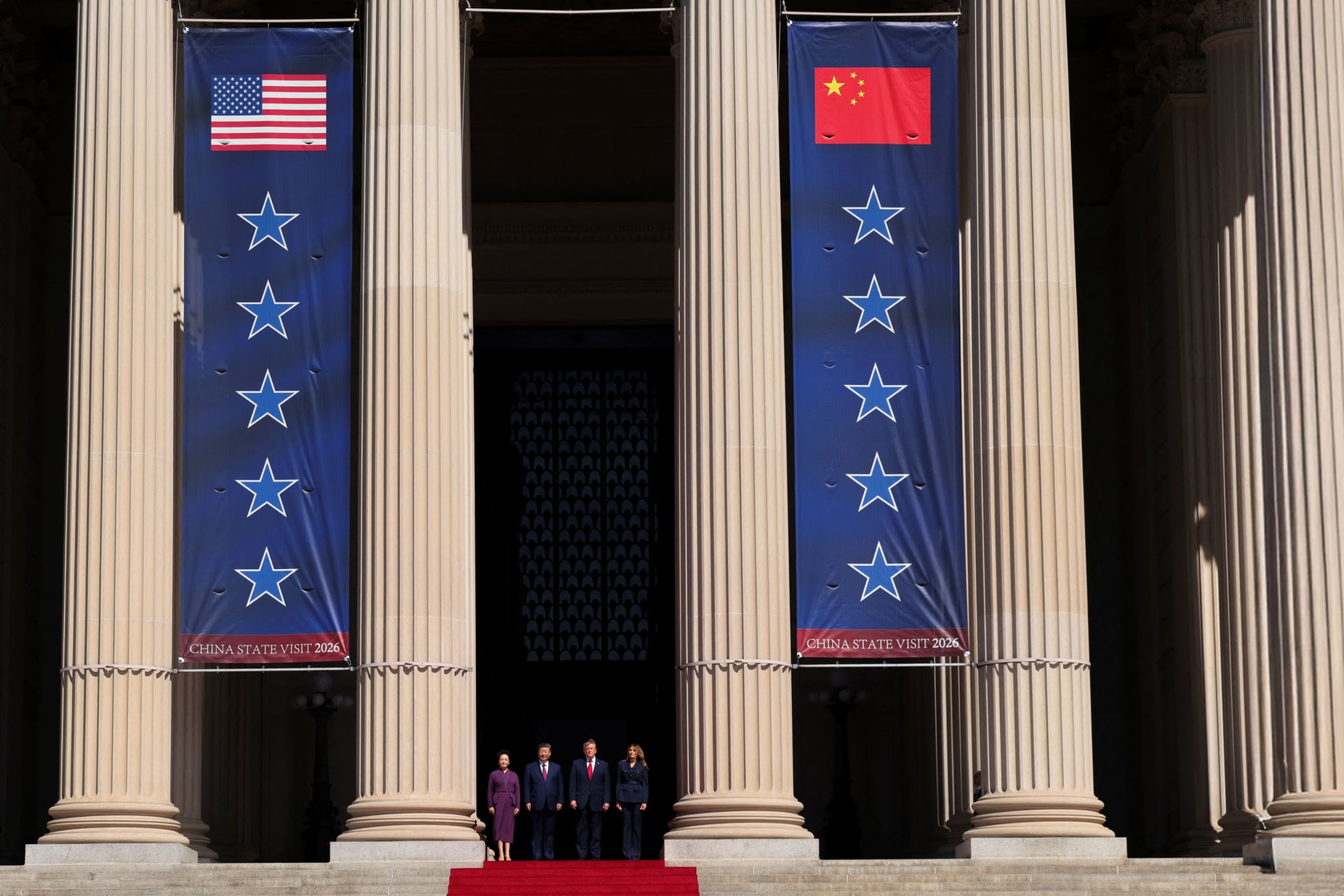
FROMAN: OK. Zoe, let’s switch to China. Some people believe Trump is a hawk on China. Some people believe he’s dovish on China, and wants to have some big deal, particularly a commercial deal. We’ve got potentially four summit meetings coming up this year between President Trump and President Xi. The first one in April. How do you characterize this administration’s China policy? And what would you expect them, or what would you advise them to try and get done in these summits that are likely to happen this year? 

LIU: Yeah, sure, Mike. Before I answer your question, I just wanted to thank you all for coming to CFR and for sharing your time with us. I know that in February it’s not necessarily a good time to come to New York City, because, you know, too cold, or flight get canceled, and things like that. So, thank you all for making the trip. 

Mike, to answer your question, I wanted to sort of combine two movies that I recently watched among many other movies. But these two movies stands out to me in terms of characterizing Trump’s policy with regard to China. It almost feels like you see Everything Everywhere All At Once, clashed into The Godfather. (Laughter.) And the reason is because it almost feels like there is a theatrical chaos aspect of that, and that you can—you can see that as a classic Trump fashion. But it’s almost unfathomable why he would implement tariff policies the way that he did if the goal was to build a wall—now I’m quoting a Hadestown. Why do we build the wall? We build the wall to put away the poverty and to defend ourselves. If that’s the case, then why you are putting tariff on our allies, and even ahead of China? So, from that perspective, I’d say it is everything everywhere all at once.  

However, the way that China retaliated, very calculated. They have a playbook. And they retaliated so precisely and retaliated without losing their tactical flexibility. That basically means Trump basically rushed into a chaos without really having the endgame. So, from that perspective, I’d just say, unfortunately, so far our China policy, whether it is cohesive or not, whether there is a big, grand strategy or not, it doesn’t matter anymore. That it has already become a moot point. And the reason is because, ever since 2017 when President Trump visited China for the first time, he came back with the first trade war and followed with a global campaign—tech campaign against Huawei and ZTE.  

So from that moment on, you ended up having a domestic alliance between the business community, between the tech community, and the party. Meaning not just the party emphasizing self-sufficiency, it’s the entire tech community emphasizes self-sufficiency now. So from that perspective, whether we wanted to do a more accommodative policy towards China, whether we want to constrain China, it doesn’t matter. Because China is going to continue with its pursuit of self-sufficiency. And a very important part of that is going to be continued investment in manufacturing competitiveness. 

FROMAN: Anybody who goes to China comes back with these stories of just how remarkable it is what’s going on there, the factories that are, you know, huge, almost without anybody working there, robotics, the manufacturing center. Today I heard about a whole new effort to build a biotech city on the edge of Hong Kong and Shenzhen that they fully intend to make the leading biotech facilities in the world. It’s easy to paint China as being twelve feet tall, but you know better than almost anybody they’ve had some really inherent problems. Demographic problems, they’re graduating a lot of students from the universities who can’t find jobs, you have high youth unemployment, you’ve had these quiet protest movements—what do they call it, laying down movements in China over the last couple years. How you assess, on one hand, the tremendous strengths that they demonstrate, and then these inherent underlying weaknesses? And how should—how should President Xi think about managing these inherent weaknesses? And is there anything he can do about it?  

LIU: Right. I like my job. I wouldn’t want to trade my job with President Xi Jinping’s job. (Laughter.) I’d just say— 

FROMAN: And I wouldn’t want President Xi to be a senior fellow at the Council on Foreign Relations. (Laughter.) 

LIU: No. Yeah, we wouldn’t hire him. 

FROMAN: Yeah. 

LIU: Thank you. So that’s in my job security there. (Laughs.) 

FROMAN: Your job is secure. Your job is secure. 

LIU: So I would say, yes. It is very easy to paint China as a giant. And in many ways, China is. You know, if we only look at economic numbers the Chinese economy is over $18 trillion. And by any measures—you know, IMF just published its new assessment of China. And some analysts on the street who are saying that the renminbi is at least 23 percent undervalued. So, by China not doing anything, just overnight appreciated the currency, the Chinese economy is already going to be the number-one economy in the world. So from that perspective, looking only at the GDP numbers, is very easy to exaggerate China’s strength.  

And if you only look at technological innovation, the number of IPs, to what extent the Chinese dominance in EVs (electric vehicles), in cobalt, in rare earth, to what extent they can wreak pain on American business, yes, China is not just big, China is also fearful—a nation to be feared. And as President Xi Jinping just demonstrated that, throughout its retaliation against America and forced America, perhaps, for the very first time since Soviet Union, not just to stop the tariff against China, but forced America to come into accommodation. So from that perspective, President Xi Jinping has all the reasons to feel confident—confident about his ability to exercise coercive economic statecraft without having to suffer too much blowback domestically.  

But that doesn’t mean China is domestically, you know, fair weather, all good. The framework that I have consistently been using to evaluate the Chinese political economic strength is four Ds. I think we talked about this in different—in other sessions. But the four Ds that I consistently use include demand. Which is not just export, but more importantly domestic demand. And domestic demand, weak consumption, demographic challenges are all huge problems.  

And then the second D would be demographics. And that is a headwind. And demographics not just matter in terms of rising health expenditure, things like that, it also has medium-term implications because lower family formation ratio, less Chinese people—less young people getting incentivized to get married, because marriage is extremely expensive. The guys would have to put down houses. And houses remain very expensive. So, the lack of family formation ratio leads to lack of demand for housing, period. And housing still consists of about 30 percent of the Chinese GDP.  

So, that’s that. So, we had demand, demographics. Then the third one would be decoupling or de-risking. Decoupling or de-risking sort of fit into this broader strategy of China’s pursuit of self-sufficiency, but it has a huge cost. And this comes at a time when growth is stagnating. And then at the same time, the government would have to incentivize and put in a lot of money in high costly—highly costly capital incentives and also highly risky R&D. So from that perspective, decoupling or de-risking is not necessarily a good message for the Chinese economy to grow going forward.  

So overall, I’d say the Chinese economy has tremendous strength, but it also has a lot of weakness. So from that perspective, does that mean the party has no choice managing—or, has no options managing its current domestic weakness? I would say no. If you look at the Fourteenth Five-Year Plan, the bet is very clear. We are betting on innovating their problems—innovating out of the current economic problems. And they are betting on artificial intelligence making up for demographics. They are also betting in artificial intelligence to improve corporate efficiency. We are backing on artificial intelligence to make the Chinese manufacture not just smart, but also globally dominating. And this is, sort of, a huge bet, to what extent this is going to be successful? I’m going to quote Shannon, it’s TBD. 

FROMAN: For years, we tried to influence China by engaging in dialogue with them, having engagement to try and convince them to move, as you said, from an export-led model to a domestic-demand model of growth, with very little progress, I’d say. Now we’re trying to shape the external environment for China by proposing tariffs to put pressure from outside. Can the U.S., can the West, have any influence over China’s economic trajectory? Or should we just give up?  

LIU: Well, I mean, we certainly shouldn’t give up. But can we force China to change? I’d say no. The short answer is, no. I know that might be not a—that might be a controversial opinion, but we just cannot force China to change. It’s like you cannot force a horse or you cannot force a cow to drink if the horse or the cow refuse to do so. (Laughter.) And if you look at— 

FROMAN: This is the year of the horse, right? (Laughter.) 

LIU: Right. (Laughs.) And if you look at how the Communist Party changes or manages its policies, latest example, would be marriage and, or for that matter, housing. The government changed domestic civil laws to protect women, and the government also started to give the incentives to incentivize young people to get married. Although they still do not, there has been evidence suggesting their policy is working. The reason why we are changing is not necessarily because the West forced them to, is not because they are willing to, but because a lot of these fundamental issues become urgent problems to obstruct the realization of China’s growth in the longer term. And then on top of that, with demographics shrinking, it also means that there is going to be—there is going to be a huge generational—intergenerational wealth transfer.  

If you look at the one child generation, you ended up having at least three generations of wealth concentration to this one person. So to your point, the fact that the Chinese one child generation, or the generation who were born after 2008 global financial crisis, they are able to lie flat simply because they can afford to do so. So, if you have a generation of people like this, then government policies is going to be—the government would have less ability to influence their behavior. So from that perspective, our pressure to change the Chinese Communist Party’s behavior is not going to work. And President Xi Jinping already showed that he have tight grip on the Chinese economy.  

But his challenge is to how to make sure that the strategic sectors that were not the SOEs. You know, it used to be the case that the steel company, the aerospace, the nuclear company, those are strategic sectors governed by SASAC (State-owned Assets Supervision and Administration Commission). However, the AI companies, the digital platforms, they are not SOEs (State-Owned Enterprises). So, how the party manage demographic change, manage their relationship with these private entrepreneurs, who the government identified as the strategic sector. And yet, these are also a generation—these are also entrepreneurs who are very globalist and very capitalist. How the party manages this relationship is going to matter, not just for Xi Jinping but also for the party going forward. 

FROMAN: Hmm. Bruce, change tack here a little bit. It’s 2026. It’s the twenty-fifth anniversary year of 9/11. Probably many of these folks, students, were born after that. Don’t know what 9/11 is. It’s not a conscious part of their political and policy upbringing. That was the beginning of the War on Terror. We hardly talk about terrorism anymore. Did we win the war on terror? (Laughter.) 

HOFFMAN: Well, that was, I think, the problem, is that it should have been a war on terrorism. Because the “ism” means something that’s political. A war on terror is anything that scares us and anything that causes fear and anxiety. You can see with such a concept we shifted very quickly from a war to overthrow the Taliban and take down al-Qaeda, to invading Iraq. So, firstly, I don’t think you can win a war against an emotion. You can’t win a war against a tactic either, with terrorism. So, we were always, I think, asking the wrong questions. 

When I look at this landscape of terrorism today, it conforms to just the historical pattern. There’s a period of intense terrorist activity. And we respond defensively. And then there’s generally a period where we weaken the terrorist group, we degrade their capabilities, and we move on. They haven’t left. And that’s, I think, the fundamental problem. You know, if you think back to the 2020 presidential election, I would argue there’s only one issue that President Trump and Vice President Biden agreed on during that campaign, and that was ending the endless wars. But I also am reminded of what then-commander of Central Command, James Mattis said in 2013, is that the enemy always gets a vote.  

And from their perspective, especially when we look at al-Qaeda and ISIS, the two principal terrorist movement there, they interpret their struggle as divinely ordained. So therefore, it’s not up to mere mortals to lay down their arms, to leave the playing field. And General Mattis famously said, the enemy always gets a vote. And we’re seeing that in their own thinking about the twenty-fifth anniversary. Unfortunately, they’re still there. Maybe we overreached in 2001 and 2002 and thought—and I remember this very clearly. Secretary of State Colin Powell said that we were going to eliminate terrorism the way we eliminated, as a society, piracy and slavery. (Laughter.) Well, piracy, unfortunately, still exists. There are some places that there are people that are in enslaved as well. It’s much better. So, I think that’s how we have to view it, as, unfortunately, a fixture. Not even a feature. It’s once been a feature of international security. It’s now become a fixture.  

And I’ll end by saying, look at al-Qaeda. They were created in 1988. Who would have imagined that three decades later they’d still—they’d still be here? Even in the case of ISIS, it took a ninety-country coalition five years to take down the Islamic State. They’re still, in their belief system, looking ahead. Their vision is that one day they’ll resurrect it, because the fundamental conceit of terrorists is all they need to do is carry out one spectacular terrorist incident and, once again, they’ve thrust themselves and their cause back into the spotlight, and they’re in business. In other words, generating global concern, fear, and anxiety. And that’s, I think, the conceit that they hold on to. If they can just do one big thing. Nowadays it may not have to be another 9/11, but an attack on the train, such as that happened in March 2004 in Madrid, on subways and busses, such as in London in 2005. You know, I think it would be foolish to say that’s outside terrorist capabilities nowadays. 

FROMAN: The security environment in the Middle East has changed quite substantially over the last couple years, with Iran proxies being degraded, Hamas, Hezbollah, I forget the one in Yemen—Houthis. The Houthis. They’ve been substantially degraded. There were attacks on other Iranian-supported proxies around the region. How has that—how has the changing dynamics of the Middle East, between the U.S., Saudi Arabia, UAE, the isolation of Iran, the hurting of these proxies—how does that change the environment in which these terrorists operate? 

HOFFMAN: Well, I think that’s a very good point. It’s certainly much more difficult for many of these Middle Eastern terrorist groups, and especially ones that were either proxies or minions of Iran, to function. There certainly has been degraded effort there. But I have to say, we have to balance that out. There’s also enormously degraded counterterrorism effort in the West as well. We’ve been victims, I would argue, of our own success. And what I’ve said, President Trump and Vice President Biden both saying ending the endless wars, I mean, we’ve seen in the United States, firstly, not just, I think, a diminution of terrorism is a threat. And that was articulated by Secretary of Defense Mattis in 2018, with the new National Defense Strategy. But also, we’ve seen a tremendous change of focus domestically, where people we know—this is documented—being pulled off of counterterrorism and counterintelligence, and they’re focused either on the border or on immigration issues. A lot of people have left government. At the risk of understatement, a lot of people have left government in the past year. A lot of expertise, institutional knowledge, everything that was painstaking built up during the past two decades, is gone.  

Now, arguably, we’ve learned from the 2000s, invading and occupying countries was not a game winning campaign. But by the end of the twenty-teens we found that positioning overseas small numbers of U.S. military personnel, especially special operations, intelligence assets, was very effective at enabling our allies and enabling host countries to counter budding threats. They’re all being withdrawn. Right now we’re withdrawing our forces from Syria, for example. We’ve never gotten back to the modest number of U.S. military in Somalia, for example, up until 2016. So, all the successes we’ve had against terrorism, which have been significant, we’re now sort of deciding that even those modest commitments are a luxury we can no longer afford, or that the threat isn’t as salient as it once was. But, you know, just as the Taliban said, and no one believed them in 2010, you may have the watches, but we have the time. (Laughter.) And the terrorists are always playing the long game. 

FROMAN: It’s sort of ironic, because the administration has been—as evidenced by their focus on the Western Hemisphere—has really been focused on homeland security. You know, America First, we want to secure our borders, we want to make sure we’re safe here at home as a top priority. And clearly, domestic terrorism is another issue. And you’ve written a great book about some of the movements behind—and some of the risks of domestic action. How do you think about homeland security in the new context? Is our biggest threat from Middle East-inspired terrorism? Or how do you think about our domestic terrorist threat? 

HOFFMAN: Gosh. The data shows there’s only been, since 9/11, one successful terrorist attack in the United States orchestrated, directed, and commanded by a foreign terrorist group using someone who had been previously radicalized. And that was in 2019 at the Naval Air Station in Pensacola, where a trainee pilot, who had already been radicalized and recruited by al-Qaeda in the Arabian Peninsula, carried out a shooting attack just before Christmas. Every other attack was homegrown. People inspired, motivated, ultimately animated to carry out attacks. There’s been, to my knowledge, no documented cases of immigrants carrying out terrorist operations as sleepers. But there is the problem, of course, that we’ve seen people being radicalized once they are here. And that remains a salient one.  

I liked Zoe’s cinematic reference so much I’ll use my own. Think about 1995’s Independence Day, which sort of the climax of it was the White House being destroyed by aliens. And we all laughed at that, the White House being destroyed. But think about the film two years ago, Civil War, where one of the climactic scenes was the White House under attack. After January 6, that’s not so far from being believed. And that, I think, shows the difference in really the political landscape in the United States. I would say—I would caution—you know, the then-Director of Central Intelligence Bob Gates said the trouble with intelligence analysts is they smell flowers and immediately think funeral and not wedding. I think it’s the same with terrorists analysts. We’re kind of in a pre-terror phase here. 

FROMAN: That’s a good line. 

HOFFMAN: And what worries me is, firstly, the rise in assassinations over the past seven years, on both sides. I mean, a Republican congressman showing up for a baseball practice on an early June morning in 2017, two attempts on President Trump’s life, an attempt on Speaker of the House Pelosi that seriously injured her husband, the cruel murder of the former Speaker of the House in Minnesota Melissa Hortman, and her husband. So, this has become bipartisan.  

FROMAN: Charlie Kirk.  

HOFFMAN: Charlie Kirk as well. What about our representatives? I was—maybe I shouldn’t have been so astonished, but I guess it’s good there are things that still surprise me. The number of threats to members of Congress has risen over threefold in the past five years. It was about 3,000 or so in 2020. It’s over 14,000. And think about it. In the past six months, you had very serious threats against Marjorie Taylor Greene. She said that’s reason she’s not running for office again. Just a couple of weeks ago, you had, you know, obviously someone who was mentally unhinged, but doesn’t matter, but obviously had a political motive. You would think Ilhan Omar, given the years of threat she’s endured, would have, like, a ring of security around her. But of course, politicians, they have to interact with their constituents. And then you have someone who tried to attack her with a syringe filled with vinegar. That could have been a lot worse. 

But you’ve got people in the American political spectrum at both extremes. I’ll just say the rise in threats and attacks to journalists. I mean, almost a third of journalists in the United States report some physical threat to them. Another third say that they’re harassed. CEO of companies being targeted, boards of trustees. And then lastly, what—which, once again, I have to say that astonishes me and I wish it wouldn’t, of course, we all talk about the enormous rise of antisemitism in the United States. About a 900 percent increase in the past ten years. 2024 was a record year for Islamophobic incidents. There were—the number of attacks on churches in the United States since 2018 has gone up 800 percent. So, it’s like all faiths are being targeted. And, you know, this is the environment that terrorism eventually will feed off of, or will thrive off of, even if we don’t, fortunately, see it manifesting itself now in the U.S. 

FROMAN: Right. We can’t end on such a dire note. So, we’re going to—I’m going to ask one more question to all of our panelists for quick answers, and then open it up to the floor. And that’s about artificial intelligence, which we’re doing a lot of work on here at the Council. It really affects all of our regions, all of our—all of our issues. Zoe, how does the race in AI, to be first to achieve alternative general intelligence, or whatever it means to win the AI race, how is that affecting U.S.-China relations? 

LIU: The darkest scenario would be artificial—the superintelligence have control over nuclear weapons, and an accident or a malware or some system glitch might just annihilate the world. I guess that’s the darkest scenario. But I don’t think that’s where we are now. And I believe that the two countries would have enough smarts to prevent us going there. However, I would say they are—the two countries are running two different AI races.  

Here, we are focusing on building the best model. And we are protecting—we do not provide open sources, whereas the Chinese are running their AI like utilities. And they are encouraging elementary school students to use artificial intelligence to do robotics, to experiment with all sorts of coding experiments. So, from that perspective, I’d say that AI is not really about who builds the best models. It’s really about who gets to dominate market first. Market, not just domestic market, international market. And who dominates the market first means we are going to have the upper hand setting global AI standard and governance. 

FROMAN: Bruce, how concerned are you about nonstate actors, terrorist groups, others, using AI as part of a weaponization program? 

HOFFMAN: I think the good news is right now, and probably for the foreseeable future, the advantage is with governments, in some cases for better or worse, in surveillance, but also, generally speaking, the power of government computational abilities just completely eclipses the terrorists. At the same time though, as I said earlier, terrorism never occurs in a vacuum. And it reflects our own interests in society. And if you look at the terrorist statements and propaganda, there’s certainly so much saber rattling of how AI will improve their capabilities. I mean, a lot of it is hot air, but what concerns law enforcement and intelligence officials the most is that artificial intelligence will close the operational loop. In other words, it will in some way facilitate the terrorist planning and execution of attacks, which means that the window of time that the authorities have to interdict those attacks will shrink.  

And I suppose the parallel I think about, in the 2000s the United States, like, owned the drone warfare world. I mean, we used those for targeted assassinations against al-Qaeda for ISIS, we dominated that field. And look what’s happened in recent years. I mean, drones have just migrated to, you know, almost anyone who can use them. The NYPD is looking for authorities to counter drones in advance of the World Cup coming here this summer. So, it’s like all weapons that we’ve seen that migrated from the battlefield to terrorists, they will eventually harness AI in some fashion. But as I said, the most immediate threat, I think, from it will be closing their operational loop and facilitating and hastening terrorist attacks. 

FROMAN: Shannon, you’ve written something recently that draws the connection between immigration policies, tariffs, and the race on AI. How do you see that playing out? 

O’NEIL: As we hear, you know, Zoe talking about, sort of, the race between China and the U.S. And, you know, in the United States, right, we have these frontier models and where we’re, you know, moved ahead, perhaps, on some of the technology and the advances. But, you know, one of the biggest challenges we have in doing that is we need much more compute power. In order to have compute power, we need more datacenters. We need lots of chips, and servers, and rows and rows, and we need more energy, right? We need more electricity. And that is really where the bottlenecks are. And what’s interesting is, you know, there are other reasons there, and sort of—you know, and we’ve seen a Trump administration really has leaned into the AI companies as champions, right? It’s gotten away lots of permitting and regulations. It’s opened up federal lands for datacenters. It’s really giving sort of carte blanche to allow these companies to grow.  

And the argument I made is, sort of, you know, two of the other policies, though, are going to hold back this growth. And one is tariffs. And in part, because of this tariff structure just makes everything coming into the country more expensive. And the exemptions that—you know, there are exemptions given, and some have been given for the electronics that go into datacenters, but not into the kinds of things that actually build the electricity grid. And in fact, some of the highest tariffs are on, you know, steel and aluminum. So, the transformers, and transmission lines, and the copper, and things that you just need to build out, you know, your overall electricity grid. All that has to come from outside. So, it’s, you know, 25, 50 percent more expensive on some of those parts for companies to build up the electricity grid. So, tariffs are making it more expensive and harder to build out electricity grids.  

And the other side, interestingly, is immigration policies. You know, we think a lot about—you know, you think about AI, well, you need lots of, you know, scientists. And you need lots of engineers. And, yes, we’ve made it harder for, you know, high-end visas and the like, to come in. But you really just need—for datacenters and electricity grids, you just need basic construction. You need electricians. You need HVAC people. You need, sort of, the basics, you know, of building out and breaking ground and, you know, setting up all of these structures. And, you know, today in the United States, you know, 25-plus percent of the people who work in construction are immigrants. And one in seven are undocumented. And, you know, as you shut down the avenues for any of those people to come in, as you send many of those people back, or as you make those who are here scared to go to their workplace, you slow down overall construction. And there have been surveys done over this last year. And the number-one challenge for construction companies has been the lack of labor and these labor shortages. And so as we continue—if we continue these immigration policies, these tariff policies, it may actually be, you know, the Achilles heel in this AI race. 

LIU: And, for China, to Shannon’s point, I think immigration policy is also driving away some of our American-trained foreign AI experts, including some of the Chinese. So, this is where the—although you might have the restriction on hardware, but the talent flow cross-border. And this is, in the long run, not in America’s advantage. 

FROMAN: All right. A reminder, this is on the record. We have microphones, I believe. Yes. Here we go, right here in front. There’s a microphone coming. Identify yourself. Tell us where you’re from. 

Q: Thank you. Karina Korostelina, Carter School for Peace and Conflict Resolution, George Mason. 

I will do something unthinkable for academics. I will ask one sentence question. (Laughter.) 

FROMAN: A good example.  

Q: So, what is your opinion about the new Board of Peace and its impact? 

FROMAN: The Board of Peace? To anybody in particular? Instead of having everybody answer every question, who would like to take that one? Bruce—(laughter)—you’re favor of peace. 

HOFFMAN: OK. (Laughs.) Yeah. Well, nothing else has really worked when we think about the Middle East. One of the few bright spots in the Middle East is that the Abraham Accords, much maligned when they were enacted, problematical in many respects, but have remained intact. Which I think I’ll grasp on any shards of hope. So, you know, we need to give it a chance. You know, anyone who tells you they’re optimistic about anything in the Middle East I think is probably overstating their case. But I think a different approach, a new approach. But I think we’ll see. But one, I think, has to keep an open mind. 

FROMAN: I’ll just add to that. One of the concerns about the Board of Peace that’s been articulated is that it’s an effort to circumvent or replace the UN, and the UN Security Council. I think it’s a legitimate debate to have, but when President Trump went to the UN General Assembly in September and said, the UN has not lived up to its potential, it’s kind of hard to argue with that. I mean, the UN hasn’t been—I mean, there’s some great things about the UN I think they’re operating agencies, UNICEF, UNHCR, World Food Program, do amazing work. But as a political body to keep peace in the world and resolve conflicts, they are absent. Whether the Board of Peace is the right answer to it, you know, I think remains to be seen. But certainly, as in so many areas, I think he’s identified a real issue. And now the question is how best to deal with it.  

Next question. The gentleman over here. 

Q: Ivan Blum from Fairfield University. 

When we talked about the Western Hemisphere, we didn’t talk about our previously closest confidant, Canada. What do you see going forward with our relationship with Canada? 

O’NEIL: Yes. The poor Canadians, right? (Laughs.) You know, it’s funny, as you look around the—Mike and I were just at the Munich Security Conference. And we were hearing a lot of European, you know, angst and also positioning, and sort of thinking how they become more autonomous and independent, and sort of come together. And I think, of all of the sort of former, you know, allies and partners, Canada has been the most—or feels the most betrayed, I think, of all of them. And has had sort of maybe the most visceral reaction. And, you know, I was up in Canada recently. And, you know, you do really see boycotts, right? And they continue on. You see a prime minister there who is trying to move the economy away from such great dependence on the United States to, you know, be able to engage with other countries.  

You know, Mark Carney took a trip to China and has, you know, opened the market, at least to some extent, to some EVs and some other, you know, trading relationships. You have seen Canada going to other Southeast Asian countries trying to form trade agreements. They just, I think, today or yesterday, just, you know, offered to broker bringing the EU into the CPTPP (Comprehensive and Progressive Agreement for Trans-Pacific Partnership), you know, sort of the big, you know, Pacific trading arrangements. So, they really are trying to expand and move beyond, and find another space. And, you know, as you know, Mark Carney at Davos sort of presented this, you know, different view.  

I also think, of almost any country in the world, it will be harder for Canada than almost any other country to find that independence and autonomy from the United States. It’s just—its economy is too dependent. It is, you know, too tied to the United States. You know, most of Canada’s population lives within a hundred miles of the U.S. border. And you have those links. And so, you know, what happens to Canada? I mean, we’ve seen these periodic from the Trump—from Trump himself to, you know, annex Canada. That, I think, is probably not going to happen, but the tensions there—and what’s interesting to me, and, you know, I watch what happens the Western Hemisphere, and particularly North America. And, right, this year, in the next few months, we have the—well, right now we have the renegotiations of the USMCA (United States-Mexico-Canada Agreement), the sort of follow-on from NAFTA, the trade agreement under review. And they’re supposed to come to some sort of agreement before July to keep it, you know, fully going on.  

And most of the—you know, the poking and sort of the questioning has been directed at Canada and not at Mexico, right? And so even though Mexico, lots of, you know, issues of immigration or of drug trafficking or crime are more serious there, it’s really Canada that some of the, you know, ire and animosity has been directed. So, I think that just suggests, at least for this administration, a very tense relationship will continue throughout the next years.  

Q: Do you think we’ll open the Gordie Howe International Bridge, finally? 

O’NEIL: Yeah. Well, we did see a walking back from closing that, right? You know, we’ll see. But, you know, and as, you know, Prime Minister Carney reminded Trump, is that Canada paid for that whole bridge. So, you know, and they used U.S. steel. So hopefully, they resolve that. (Laughs.) 

FROMAN: But there’s—you know, there’s rumors that they may do the USMCA without the CA, and just have a U.S.-Mexico agreement going forward, without Canada. Which is rather—which would be rather strange. 

Yes, this gentleman here. 

Q: Patrick Chester, I’m a professor at Stevens Institute of Technology, across the river. So, I had a question for Zoe. My specialization is on Chinese politics as well.  

So I visit—I had the opportunity to visit Taiwan recently, and meet with Ministry with the Foreign Affairs officials over there. And he had two questions for me, which I’m going to relay to you. First, what is—is Xi preparing to attack Taiwan? And, second, is the Trump administration likely to intervene, if that scenario occurs? (Laughter.) 

FROMAN: That’s all? Yeah, OK. (Laughter.) 

LIU: See, I just said I like my job. I don’t want to change jobs. (Laughter.) I think the—is President Xi Jinping preparing to attack Taiwan? I think it depends upon what do we mean by “attack.” If attack means it’s a military invasion or military attack, I think China is ready. He definitely wants to and he’s sure that the PLA is combat ready, especially with regards to a Taiwan contingency. But does he have the capacity or manpower to do it? And what are the escalation levers leading him to do that is a different question. Now, with all the military purchase, we can all speculate what the intention was or is. But at least as a result of it, is that the—two results, I would say. The first one is the operational capacity of the PLA probably is very weakened. He needed time to find the people to execute orders, unless he bet everything on drones. Then secondly, any decision with regards to action against Taiwan, at this particular moment, means he is going to be the only person to be held responsible or to be blamed. And that is not a safe position to be in.  

And then finally, I’d say, unless he can be fully confident the Chinese economy is going to endure a Russian-style economic sanction, he won’t necessarily be willing to risk that because, fundamentally, right now, the social construct—the social contract between the party and the people remains to be delivering economic prosperity. And now that, the social contract, has been weakening. So, from all those perspectives, I just say his options are very much limited. Before he take—go directly to military action, very unlikely he would do that unprovoked. But if he—if he was provoked, or there was a mistake or miscalculation, then he would have to make sure that the PLA is ready, the economy can endure the pain. And none of those conditions exist.  

And then finally, I’d say the demographics is another challenge, which is, you know, if you ask the question to Chinese people, mainlanders oftentimes respond to you in two ways. One is, why Westerners are so obsessed with Taiwan? Secondly, they would ask why Chinese people would want to fight against the Chinese people. So, you have generational differences. Finally, just to put up—put a conclude there, why would you want your people to have three children to sustain economic growth, prosperity, and all that, while, at the same time risk their lives in a war that you might not win? So, from all that—from all those perspectives, I’d say he is preparing to win, but he’s not necessarily there yet. 

FROMAN: And on the U.S. piece, I just—the National Defense Strategy, as you know, while being relatively warm to China, talking about a balance of power, close economic relations, it does reinforce that our strategy is to defend the first island chain. Which is the traditional sort of comments around Taiwan. So, we’ve maintained that. And, as far as I know from our conversations with the U.S. military, nothing’s really changed. They’re doing the same exercises, preparing the same materiel, doing the same pre-positioning that they were doing under the Biden administration when it comes to preparing for the defense of Taiwan. And in fact, we’ve seen some fairly significant arms sales to Taiwan over the last couple of months as well. Yes, this gentleman here, and then we’ll go to one of these. 

Q: Thank you for the wonderful panel discussion. My name is Michael Bufano. I’m a professor with ETSU, East Tennessee State University.  

This question is on terrorism in the Sahel region. I was in Mauritania doing research on human trafficking and slavery. And that country’s seen a lot of cuts to its U.S. aid over the last year. And, you know, it’s easy to write off a lot of these terrorist organizations as being a bunch of ideological radicals, but part of what drives them is poverty, ethnic inequality, political repression. And, of course, with a lot of aid getting cut to some of these countries, this might impact the ability as well of the United States to be able to influence their policies on—when it comes to terrorism. How do you see cuts to soft power, to foreign aid in the region—to Sahel countries like Mauritania, Sudan, and others, Niger, Mali—how do you see that as affecting our ability to influence that problem within the Sahel?  

HOFFMAN: Absolutely disastrous. I mean, this is, I think, the steps—gigantic steps backward we’re taking. Compared to having finally got it right in the twenty-teens, we’re just completely mortgaging the—well, firstly, we’re mortgaging a lot of what we did in counterterrorism. But we have to begin with the—you know, with the admission that the soft power dimension, you know, a lot was talked about, spoken about it. There was a lot of discussion but it was never resourced nearly to the extent that the kinetic, military side was. And that’s because killing, capturing terrorists, destroying assets is something that’s tangible, that’s measurable. There’s no metric for changing someone’s mind, for altering someone’s soul. And therefore, because you couldn’t prove cause and effect, the rhetoric was never matched by action. So, it was never great to begin with. 

But you make exactly the right point. I mean, the U.S. Agency for International Development doesn’t exist anymore, which was enormously important in the war on terrorism. Radio Europe, Radio Liberty, Voice of America, which played very key roles, have all seen their resources and their personnel drastically scaled back. This is what worries people like me that tend to see a glass half empty because of an omnipresent terrorist threat, is that the conditions, as you very eloquently described it, that give rise to terrorism are clearly there, and are multiplying, after a period when they perhaps weren’t eliminated, but we were certainly making progress. I would say, first and foremost, it’s the corruption of governments and our failure to change those governments that also was a factor that sapped our patience in many places throughout the world, and sapped even the patience of those local governments. But you’re right. We’re on a very dangerous path now. 

If only because all of these groups, even if they’re local threats now, unfortunately are part of a broader network. And even al-Qaeda central, or ISIS central, has been seriously degraded, and part of their strategy for survival was devolving operation authority to their local franchises or branches, many of which they didn’t create—existed for exactly the reasons you described, and then for one reason or another decided to hitch their fortunes to these groups. So, these local toeholds, unfortunately, in the vision of these groups and their parent organizations that once again aspire to be threatening on the global state, their goal is to turn these local toeholds into regional ones. And then to be part of the ideology that—you know, a global ideology that is also now, even more so than the past, motivated by revenge and retaliation.  

I mean, right now we have a completely new generation of—it wasn’t just students who weren’t born on 9/11. There are terrorists out there, especially in the regions you described, who were not born on 9/11, or as committed to these organizations as they were before. And our failure to break that cycle means that the terrorist threat will never completely disappear.  

FROMAN: Yes. Right here. 

Q: Thank you. My name is Clyde Wang. I’m a professor at Washington and Lee University. And I, myself, study Chinese politics. So, I have a question for Zoe.  

So, one point that you mentioned when you talk about lying flat in China that I find really interesting is that there’s a concentration of wealth, as you mentioned, in the one-child generation, which allows them to, kind of, you know, they can—they can afford lying flat. But at the same time, you know, there are a lot of problems in China that you mentioned that actually were born out of the condition that they don’t—they actually don’t have enough money, right? Don’t want to get married because they don’t have enough money to get married. They don’t want to have kids because, you know, having kids are expensive. So, I guess you know how people understand their economic conditions, you know, in this generation can really go either way. So, yeah, the question is just how—what’s your take on this apparent, you know, contradiction? 

LIU: Right. With Shannon and Mike’s approval, I’m actually currently working on book related to this exact— 

O’NEIL: It’s going to be a great book.  

FROMAN: It’s going to be a great book. Wait for the movie. (Laughter.) 

LIU: So, this is—going back to Mike’s original point—you know, it’s very easy to imagine China as a giant. But internally there are a lot of inconsistencies. And to your—as you eloquently pointed out, in a way, you know, China actually is—has a lot of rich families. If you just look at the numbers, China has slightly more numbers of billionaires than the United States. But the U.S. and China combined have—(inaudible)—percent of the global riches. So, this is where you see transnational—sort of this wealthy class. But at the same time, as former—the late Premier Li Keqiang, oftentimes would say, across China there are many families living below $100 per month, right? So, from that perspective, the biggest challenge to the legitimacy of the Communist Party is how to govern a country that increasingly grows at two different speeds, and increasingly the gap between wealth also increasingly getting wider and wider.  

So, if this is not managed properly, you ended up having the rich get richer and the poor get poorer. So, that is a phenomenon where you put China in a very similar domestic condition as the United States. So, from that perspective, Chinese leaders actually are very lucky, because they get to see what is happening here in the United States. They get to see the increase in wealth, in income inequality, wealth inequality. They also get to see how an unregulated internet and unregulated social media platforms get to play into society. So, from that perspective, it becomes increasingly difficult to make an argument to say that authoritarian regimes are not good for societies, for family values. And you increasingly even see, not just the Silicon Valley people, who say the China model is better. You started some—of the American right started to use these examples. So, from that perspective, I would say, the party, if they play their cards right, and for America, if we are willing to shoot ourselves on the feet, we are likely to see America make more compromises, and compromising more ground in unexpected ways. 

FROMAN: Let me make sure I’m not missing people in the back. That woman there. Her hand’s up, by the pillar. There we go. 

Q: Tamra Young—old knees. (Laughs.) Tamra Young, Georgia State University’s Perimeter College.  

In addition to talking about the soft power that we’re losing externally, I was going to ask Bruce, because there’s reports now that in this drive to ramp up immigration exits, that folks from the FBI and the Justice Department and others who have been tasked to be—and are experts in things like terrorists, terrorism domestically, and international terror activity inside the country, are being pulled off those jobs, that they know best, about to go to Home Depot and try to round up a few people, to get the numbers up. So, you’re taking people who have vested connections and training and years of success at things like fighting terrorism or human trafficking or child pornography, or all those really difficult areas that really take expertise, and they’re moving them off of those jobs that are so very important. How concerned are you, and particularly on the national security piece of it, about these people being moved out of their jobs and nobody taking these jobs over? 

HOFFMAN: Very concerned. It’s impossible not to be concerned. You just have to read what’s in the newspaper, that those, you know, resignations of people in the Department of Justice who worked in the National Security Affairs Division. If you saw the Sunday New York Times Magazine a few weeks ago, there are about two dozen FBI agents profiled, many of whom had counterterrorism expertise but other expertise as well, very senior people that were forced out on a whim. And you’re right about this shift in resources, that has gone away from certain priorities. Less so violent crimes in the FBI, but certainly more so in domestic terrorism and in other agencies as well.  

But I think, to really put it depressing note on this, this is not just the United States. 

FROMAN: I don’t know why we invite Bruce to these things. (Laughter.) Such a downer. 

HOFFMAN: I mean, in the wake of the—you know, the terrible tragedy at Bondi Beach in Sydney, Australia, in December, on Hanukkah, information came to light that the same thing was happening in Australia. That the Australian Security Intelligence organization, roughly their equivalent to the FBI, not exactly, but had seen this outflow of people who specialized in counterterrorism. Same thing I know is happening in the United Kingdom as well. And it’s, I think, because, thank God, there, fortunately, has not been any spectacular terrorist incident, not just a 9/11 but let’s say the transit ones that I described.  

And there’s been—I think it’s not just a U.S. phenomena, although I think the immigration and the border issue has driven that much more. And I’m not making an editorial statement. You can look at the figures, but ISIS had an enormous upsurge in recruiting efforts and in new people. I mean, it’s a much larger agency than it’s—than it’s being before. I think most things in life, and especially in national security, you need some kind of a balance. You have to prudently allocate resources. But that’s not—that doesn’t mean pulling them completely off of one account to another, on the assumption that that threat is over. It may have paused, it may be in abeyance, but it doesn’t mean that it’s over.  

And, of course, in the aftermath, when eventually there will be some big terrorist attack, well, everyone will—whether in the United States or elsewhere—will ask, why wasn’t it preempted. Why wasn’t it prevented? Where was the intelligence that should have stopped this attack? And, you know, we see—we make choices today that have profound implications in the future. 

FROMAN: Yes. Right here in the middle. It’s coming to you.  

Q: Hello. My name is Xóchitl Bada, department of Latin American and Latino studies, University of Illinois, in Chicago.  

My question is for Zoe and for Shannon. One of the inconsistencies that I hear on the Donroe Doctrine is that they are equally pulling out, this administration, from USAID in the entire region. So, this is a Western Hemisphere attitude towards creating opportunities of integration. And Shannon mentioned that twenty-eight initiatives that have happened throughout historically in the region of Latin America has never led to any serious integration. So, my question is, to what extent China can continue their expansion in Latin America, through the Confucius Institute, through their expansion of the industrial relationships, especially in Mexico, keeps on bringing more and more facilities in factories for the domestic Mexican market. So, to what extent, like, China can substitute this USAID hole that is being left in the region, or manufacturing, or whatnot, to put either a leverage or create a wedge for this Donroe Doctrine? 

FROMAN: OK. 

O’NEIL: I’ll start. And you know, I—this administration, I don’t see them trying to create integration across Latin America. I see them dealing with countries unilaterally—or bilaterally, right? They are—you know, divide and conquer is more of the strategy. 

And I see them—as you obviously or rightly point out, you know, they are turning away from sort of the more soft power or, you know, they’re turning away from a prioritization of democracy, a turn away from a prioritization on development, a prioritization on citizen security. You know, it’s a much harder, more muscular approach to, you know, narcoterrorists, as they call them, you know, and drug trafficking, you know, on the, you know, movement, you know, of oil or other kinds of, you know, transactional approaches. And also in many ways U.S. advantage, whether it’s in, you know, renegotiating of trade agreements that, you know, the United States has many in the region, including USMCA. So, I think on that side, it is sort of a more dictating terms in many ways and less about providing opportunities. You know, similar to your question on the Sahel, this is all pulled back and what’s left behind. 

At the same time, they have begun to be—and I think as we get into this next year in 2026—been pretty forceful in the Western Hemisphere, more than perhaps other regions, on their feelings about China in the hemisphere and wanting to move China out of the hemisphere. They’re not bringing carrots or, you know, goodies to provide that, but they are bringing sticks that are sort of anti-Chinese sticks, right? We’ve seen this in Mexico in particular, you know, working with the Mexican government is one way to put it, but asking them to, you know, not have sort of an influx of Chinese goods as well as Chinese investment. And Mexico, in fact, has raised tariffs on 1,500 different goods against non-trade partners. That affects, you know, South Korea and Japan, but mostly it affects China. We saw China as part of the, you know, in Venezuela. They went down to the new Venezuelan, you know, leadership and said, you know, you need to get rid of China, and Delcy Rodriguez says, yes, I will do that. You’ve seen the Trump administration go to Peru and to the—you know, well, I would say the president but no longer the president, now probably the new president when the new president comes in, but you know? But you know, saying, you know, we don’t like this big port of Chancay, which, you know, the Chinese built and controlled, and so we are going to have—you know, we’re going to put tariffs on you; we’re going to do things on Peruvian exports unless you do something about that. And I think we will continue to see that. You’ve seen it— 

FROMAN: Panama. 

O’NEIL: —in Brazil talking about, you know, critical mineral mines and the like. You’ve seen, yes, Panama, a big part about, you know, having China, and Panama’s Supreme Court resolved that issue, it seems, for now by saying that the, you know, extension of those Chinese contracts was, you know, not done in a transparent and open way, and were therefore unconstitutional. 

But I do think—you know, so to your point, I think the United States, what they want to do is not provide any, you know, carrots and tell countries what to do. And part of that will be telling them to keep China out. 

Now, then the question is, you know, what does China do in response and what do Latin American governments do in response as well? And you know, what’s interesting is, you know, we have seen, you know, the big boom, I would say, of loans and sort of, you know, Belt and Road Initiative kind of things was really in the 2010s. You know, the last four or five years we actually have seen a decline in the money coming into Latin America from China. That said, where we have seen China—now, Zoe, please, you know, elaborate—we have seen China using some of its influence as, you know, the number-one trading partner and, really, export destination for almost all South American countries and the like, using that sort of influence to make sure that their companies get a good shake in all kinds of efforts. So whether that’s energy investments which they’re doing, particularly in data and, you know, telecom grids—you know, we had sort of a standoff where, you know, just in Brazil, you know, President Bolsonaro said, you know, I’m going to side with Trump, and Trump won, and now I’m going to be anti-China. And then, you know, China said, OK, well, we’re actually not going to buy any more of your soybeans and other things. Oh, sure then Huawei can come to the, you know, auction, and indeed Huawei is, you know, one of the providers for the Sao Paulo, you know, telecom grid. And so, you see some of this back and forth. And so there I think those commercial ties, as much as the United States may do national security on particular critical infrastructure, on the ports, some of those things, I think it’s going to be much harder. 

But I’d also just say, you know, as the United States is focusing so much on the Western Hemisphere, it’s not a big part, I think, of China’s overall geopolitical strategy. Yes, it matters; and it’s, you know, Global South and emerging markets. But I think—you know, and I’ll defer to Zoe on this—but as I look at where they’re putting their bets and they’re putting their foreign direct investment, the Western Hemisphere is a small percentage of that. They’re really focused on Asia. They’re focused on—you know, they’re very interested in European markets. They’re, you know, growing in Africa. And Latin America is a little bit less of a priority for them, even if it is a priority for Latin America. 

LIU: I agree with Shannon. And if you—it’s very easy to think about China’s approach especially where China put its money, either in terms loans or investment, very easy to think of it as a coherent economic statecraft or with a grand strategy behind it. But I think as the case in Venezuela revealed, it’s very much more of a pragmatic, transactional approach rather than a coherent foreign grand strategy. 

And to Shannon’s point, just I guess a footprint there around when we think about China’s investment in Latin America or oil-backed loans, a lot of those money dried up after 2014 and really, really—really, really went down to zero after 2016. And that has a lot to do with the dry out of Venezuela’s oil production, right? So from—and from that perspective, I’d say if you ask the question about to what extent President Xi Jinping or China Development Bank, they are concerned about the situation in Venezuela with the capture of Maduro, I think their concern would be, well, as long as we are—as long as our financial exposure is very limited it’s not really that much of money they couldn’t even burden. From market expectations saying that the overall exposure of China to Venezuela, for example, is somewhere—at most $10 billion. That’s nothing for the CBD, for example. 

If you think about to what extent China could potentially facilitate regional integration, I think that’s not really China’s foreign policy agenda. What really, what China may unintentionally facilitate might be through providing infrastructure, whether it is a port, highways, or railways—it connects a lot of those countries, from Argentina, Brazil, Chile. But to what extent these countries can form an economic bloc that would facilitate China’s domestic economic growth/industrial strategy, that’s a different issue. Part of the reason, exactly what Shannon was saying, they might want to have this—China might suffer from this backlash. But then on top of that, China is—at least for 2026, China’s overall economic strategy, at least for now, is to boost domestic consumption, manage these domestic and international imbalances, rather than going full ahead trying to buy more from Latin America. 

But on the currency front, I do think Brazil/Argentina plays a very important role for China in terms of broadening their use of renminbi in international trade, especially for the use of renminbi in commodity trading and commodity pricing. 

FROMAN: Well, I know I stand between you and the bottles of wine on your table. (Laughter.) Some of you have already begun drinking; I don’t blame you, based on this discussion. (Laughs.) 

But first, let me just add to what Zoe said. Thank you very much for taking the time to be here, for coming to New York. It’s incredibly valuable to us to get your feedback on our education effort. You’ve met Irina. You’ve met Cary. You know how important this is to the Council. Very much look forward to spending some time with you all tomorrow and hearing from you, those of you who have been using our materials in your classrooms, those of you who have questions about it. You’ll be exposed to some of the materials, I believe, tomorrow in the simulations. And very much look forward to your feedback both during this workshop but also on an ongoing basis. Once you’re part of the CFR family, you’re always part of the CFR family. So, I hope you will continue to view us as a resource. 

Thank you for this. Let me—join me in thanking our panelists for a great start. (Applause.) And enjoy dinner. 

(END) 

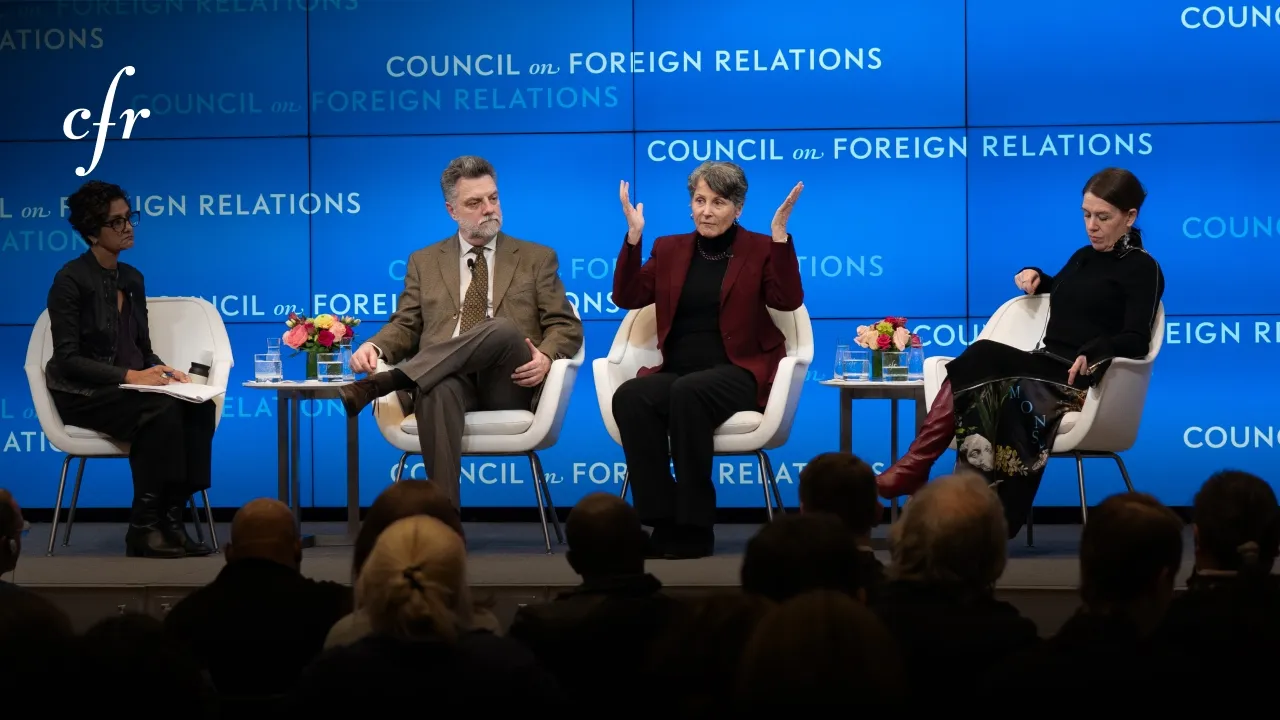
World in Turmoil: Navigating Complex Conflicts
Michelle Gavin, Thomas Graham, Carolina Jiménez Sandoval, Ray Takeyh
Reena Ninan

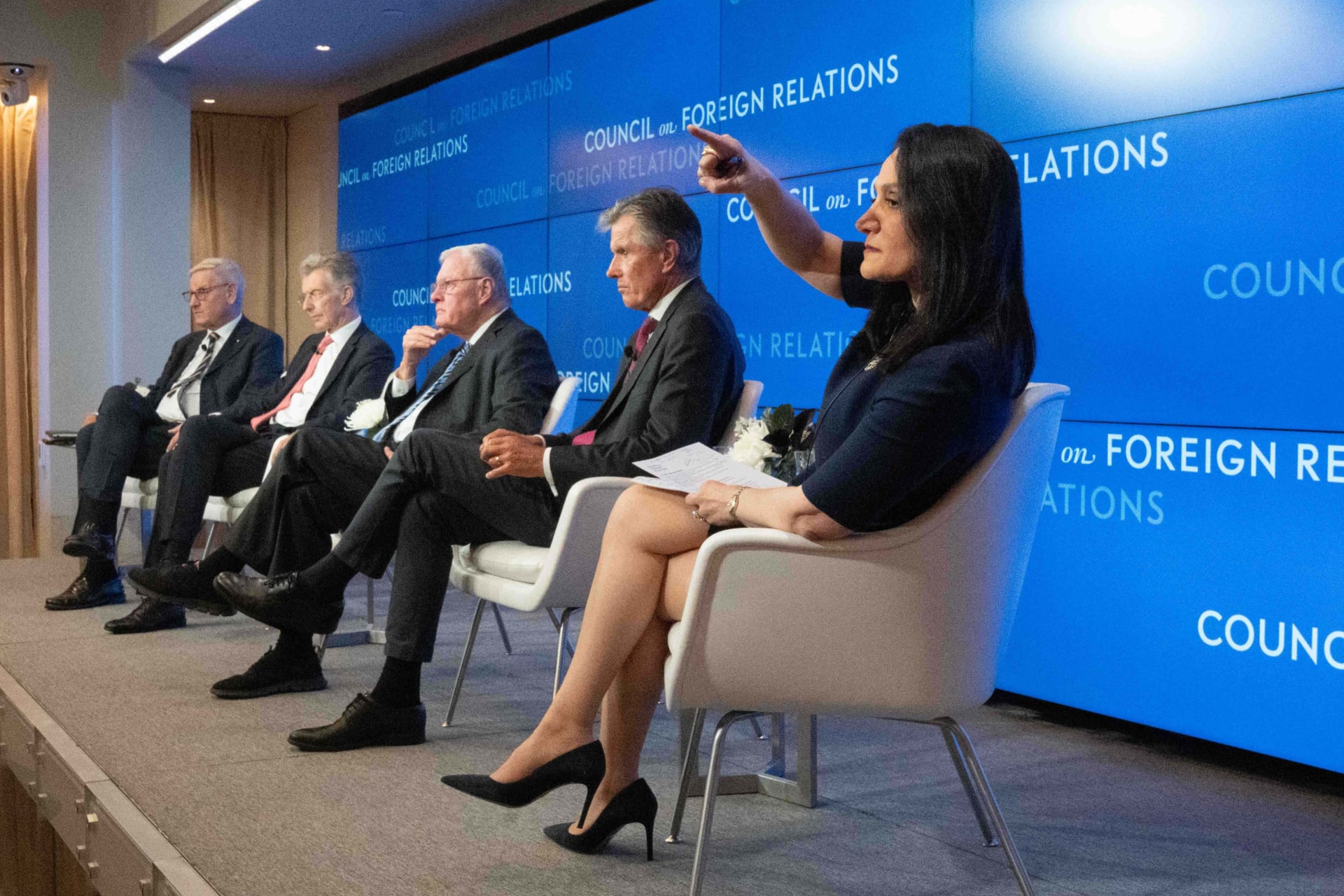
NINAN: Good morning, everybody. Bright and early on a rainy day in New York City. I guess it’s better than the snow.

Thank you all for joining us for our conversation today where there is so much to talk about—the World in Turmoil: Navigating Complex Conflicts—we’re excited to have all of you here.

I just want to introduce my panel quickly. You’ve got some information on their bios, but to my left right here I’ve got Carolina, who is an expert in Latin America who’s going to give us her take on the situation there.

Next to Carolina, I’ve got Thomas Graham, who’s going to talk about Russia, and then I have Michelle Gavin and Ray Takeyh. So, they’re all going to join us here in a vast conversation about where we’re headed globally.

Ray, I want to kick it off with you first because we are hearing the drumbeat of war out in the Gulf, U.S. assets positioned. I guess my question to you, which I’m not sure if you can answer, how far away are we from war with Iran?

TAKEYH: You’re right. I can’t answer that question. (Laughter.)

So, but here’s—well, here’s what I think. I think at this stage, being attacked by the United States or Israel is no longer considered an existential threat in Iran. For twenty years, these two countries threatened to go to war. Then they kind of did in June, and what the Iranian regime got out of that experience is they can actually survive an altercation of significance with the United States.

So, barring an invasion, reoccupation, and reconstitution of that government, which I don’t think is in the cards, a military strike, how extensive, is no longer an existential threat—nobody wants to get bombed.

But the other thing is sort of a decapitation of the leadership, or extraction, as was done in Venezuela, the Islamic Republic is not a personalized dictatorship. It is a multilayered elite system that has penetrated all levels of society, and so, they can regenerate the leadership, as you saw before.

So, there is a possibility of a military strike. Its significance, I’m not sure. But it’s no longer that thing that had never happened and you kind of imagine what it will be like, and then you come out.

So, I think when the American delegation visited Iran in Oman and later in the Oman embassy in Geneva, they assumed they would find a group of supplicants. What they found is a group of people that thought of themselves as survivors, and that’s the dissonance that you’re seeing today.

NINAN: Mmm hmm. Ray, you not only are an expert in Iran but you lived through the 1979 revolution.

TAKEYH: Yeah, that’s right.

NINAN: So you’ve got personal experience on this.

TAKEYH: Yes. I was young, but yes. Yeah.

NINAN: I’m just curious about this moment because so many are holding hope, especially those who are dying in Iran, their families, that this is going to be a pivotal moment for change.

Can you tell us what makes revolutions succeed and what makes them fail?

TAKEYH: Yeah, that’s a—that’s a very big question. I lived through it and I have tried to study it, and I wrote one book on it, a second one. Kai Berg (ph) [JG1] [DH2] tells me that I keep writing about the Iranian revolution hoping the outcome is different. (Laughter.) They always show up.

A revolution is an impossible phenomena to predict ahead of time. You don’t always know you’re living through it when you’re living through it and, as I have found out, it’s impossible to retrospectively chronicle and understand it because the conclusion that I have come to—it’s not a remarkable conclusion nor is it an original one—is revolution is, at the end of the day, a psychological phenomenon.

It has proximate trigger points—economic decline, vulnerabilities within the regime, losing a war. All those factors are evident in other societies. All those factors were evident in Iran before.

Yet, the revolution is a convulsive psychological movement that happens. The hardest thing for any citizen to do is go from a disgruntled citizen to a dissident and, finally, to an active revolutionary, and to me—this is my opinion—to complete that psychological cycle, you have to perceive vulnerabilities within the regime.

For that mass to grow, you have to perceive a regime’s vulnerability and, therefore, immunity for yourself. That’s when participating in the revolution by fence sitters becomes advantageous because it’s both self-validating but also safe.

So, the Islamic Republic’s ability to maintain its internal cohesion as it did after losing a war and facing an uprising reflects a certain degree of resilience, elite cohesion, and security services that discharge their obligations.

We don’t know if there was dissent and defection within the system; there always are in situations like this. However, that dissent and disaffection was insufficient for the regime not to discharge its obligation. By—the statistics on this very—in 1979, always the casualty figures are reported erroneously—the regime itself says 3,100 people were killed. Some reputable human rights groups put the figure at about 8,000.

Whichever figure you take, more people died in a concentrated period of time, in about three—in about a week in a three-week period, than they did during the entire Iranian revolution, which unfolded over a year and a half. That’s the concentration of—and, therefore, the regime, in my opinion, has come out of this particular challenge stronger than it went into it, because it proved that it could lose a war abroad and hold its position at home, and it proved that it’s willing to kill a large number of people in order to stay in power.

There’s so much comfort food out there. The fear barrier is broken and all that. I don’t know how you kill 8,000 people and the fear barrier has become broken. Revolutions only succeed when people believe that they can essentially express themselves and their grievances and join this validating movement without necessarily being held accountable for it in a real way.

NINAN: Mmm hmm. Right. Right. Thank you.

Carolina Jiménez Sandoval, I want to ask you about Latin America. One of the big events this year on January 3 was an attack on Venezuela and the extraction of their leader. We’re seeing the buildup in the Gulf around Iran. We saw the same buildup in the Caribbean leading up to January 3. Were you surprised?

SANDOVAL: I was, yes, and I think all Venezuelans were, and I think all Latin Americans were.

Indeed, since September 2025, people were surprised when we saw the first military attack against so-called narco-vessels, and those attacks continue, first in the Caribbean and then in the Eastern Pacific, and it was very clear that an attack was coming because the military buildup was huge in the Caribbean.

NINAN: Right.

SANDOVAL: Fifteen thousand troops, et cetera. But most analysts, including me, thought that if there was going to be an attack it was going to be a very targeted attack, perhaps an attack on cocaine labs in isolated places in Venezuela, maybe against military places, again, in isolated places in Venezuela.

But to see in the twenty-first century a U.S. military attack on a South American capital was a shock.

NINAN: And it had been decades before the U.S. had done something.

SANDOVAL: Yes. I mean, the last, you know, unilateral U.S. attack was in Panama in 1989. So, yes, I mean, first we see in decades but, certainly, the first one we see in the twenty-first century. So, I think it has been a major shock, not only for Venezuela but for the whole region and for the world.

NINAN: You know, when you have an attack on a country, no authorization from Congress, a unilateral strike, this is usually a declaration of war for the country that’s attacked.

Have the other Latin American countries felt that way? Why haven’t we seen more pushback on the strike?

SANDOVAL: Well, I would say several reasons.

First of all, the U.S. did not declare war and Secretary Rubio has been very strong on this. The U.S. is not at war with Venezuela. This was a law enforcement operation, which is, I mean, hard to—hard to justify legally, but that has been the justification the White House has given, saying, well, Nicolás Maduro is a drug trafficker and we went to Venezuela to extract him, which, you know, under international law is illegal but that’s the justification given.

At the same time, I mean, there has been a lot of, you know, reaction from Latin American leaders, but I do have to say this. If there was an unpopular leader in Latin America that would be Maduro, and if there was an unpopular leader in Venezuela that would be Maduro. Why? Because he’s—I mean, let’s face it, an illegitimate leader. Venezuelans voted in 2024 to oust him peacefully.

He decided to violate the will of the Venezuelan people and he stayed in power. A very repressed—he’s led a very repressive regime. Twenty-five percent of the Venezuelan population have fled the country in ten years. Many—1 million migrants are here in the U.S. but there are 3 million migrants in Colombia, 2 million migrants in Peru. So, a country losing 25 percent of its population in a decade is unusual.

So, I do think that, in a way, you know, Venezuela was a low-hanging fruit and I think it’s very difficult for many leaders in the region to defend Maduro. That said, many feel that—and this is, perhaps, the biggest paradox—January 3 is a major breach of international law, and it’s a breach of international law and it’s a violation of the United Nations charter.

But for Venezuelans, it also represents a glimmer of hope, the possibility of a democratic transition. But I do think that it sets a very dangerous precedent for Latin America because now people are somehow relieved that an unpopular and a repressive leader is out.

What will happen if the U.S. decides to do the same thing with a democratically elected Latin American leader that is inconvenient to U.S. interests, and that’s an open question and, you know, the answer is a dangerous one.

NINAN: I apologize. I just wanted to let everybody know—I should have said this at the beginning—this is a session that’s on the record so that means it can be quoted and used publicly, and I guess it’s more for our panelists here, which I have told you guys ahead of time, but I wanted everyone to know because in a few minutes we’ll open up to questions, and I hope all of you will ask.

One quick question before we turn to Africa. Carolina, I want to ask you, this is the first U.S. secretary of state that we have had that is Hispanic.

SANDOVAL: Correct.

NINAN: Do you think that’s made a difference in where this administration has looked across the globe?

SANDOVAL: I think that’s an excellent question because Marco Rubio is not only, you know, the first Hispanic secretary of state. He was also for fourteen years a senator from Florida.

NINAN: That’s right.

SANDOVAL: So, I think that makes a huge difference in many ways. I mean, he was a big champion of Hispanic issues including, you know, bringing democracy to Venezuela, Nicaragua, and Cuba, and he’s very well known to his constituencies there. I think he’s very fluent in Spanish. He’s bicultural and bilingual.

So, I do think that, you know, the way the U.S. is now so focused on the Western Hemisphere does seem to respond, you know, to Secretary Rubio’s interests. What I think is also a reflection of his own way of thinking and also, of course, of the administration is that, unfortunately, there are clear double standards.

We can agree that Nicaragua and Venezuela are authoritarian regimes, but I will also say that so is El Salvador, right? But because Nayib Bukele is an ally, then his authoritarian regime is OK.

So, that—I mean, you do have that type of problem in the way they view their current allies and enemies.

NINAN: Yeah.

SANDOVAL: But I do think that Rubio is making an incredibly strong difference the way the State Department—

NINAN: Interesting—an interesting take.

Michelle, I want to turn to you and go over to Africa at this point. I feel like this is a continent that often gets ignored in media. You’re an expert here. What do you want this audience to know this moment about Africa?

GAVIN: Two things. I would say, first, I would want people to be aware that Africa figures quite prominently in the grand strategy of China. It’s a huge part of Russia’s attempt to reassert itself on the global stage. It is part of the strategic vision of the Gulf actors, the Turks, and it merits three uninspired paragraphs in our own National Security Strategy.

So, the first thing I would want people to know is we’re really behind the curve when it comes to a part of the world. Here’s the second thing I want you to know that’s going to account for 25 percent of the global population in just a few years. Africa has an extraordinary demographic profile.

So, while this continent is vast and diverse with different political economies and cultures and histories, there’s a throughline that you can find throughout the continent that relates to demographics.

You know, Africa is tremendously young and growing and urbanizing, and when you think about what that might mean for politics, there’s a lot of change afoot on the continent.

NINAN: You know, one of the worst humanitarian crises right now in the entire world is happening in Sudan.

GAVIN: Right.

NINAN: We’ve seen USAID completely shut down. They played a huge role in Africa. Tell me a little bit about what you’re seeing when it comes to humanitarian crises.

GAVIN: It’s really hard to overstate how grave the crisis in Sudan is. Not only are we talking about widespread atrocities including acts of genocide, sexual violence as a weapon of war, we’re also talking about famine—a really deliberately imposed famine that could threaten millions of lives.

So, our system for reacting to that kind of humanitarian crisis was always imperfect, and Sudan is actually kind of a prime example of a place that could manipulate that system to its advantage. The Sudanese did this during the north-south civil war and again in the current civil war that pits essentially two pieces of fruit from the same poison tree of Omar Bashir’s NCP (National Congress Party) regime against each other, and that allows them to force the international community to play kind of “Mother, may I” save lives.

May I get a visa for this person to come in to help manage the logistics of moving food into areas where it’s possible to get it? No, you may not.

So, Sudan both shows us some of the flaws of the old regime, but the scale of suffering also shows us what happens when the world draws back, because the coordinated appeals for Sudan are not getting even, you know, two-thirds of the funding that they need, and it’s fascinating to me that so many international actors are engaged in providing weapons and financial support to the warring parties in Sudan and it is—it is a long list of external actors who are enabling this war to continue.

And yet, the world can’t really muster a tremendous amount of energy to help the citizens who rose up to overthrow the Bashir regime, something U.S. foreign policy had hoped to do for decades and failed, and now are banding together to assist each other in emergency response rooms and local committees that are really on the front lines of dealing with crisis.

So, it’s—the mismatch sort of between the will to fight this war and the will to help the citizens is incredibly disheartening.

NINAN: You know, when you look at the front lines and where the Trump administration is focused in Africa, the Democratic Republic of Congo, why has there been such attention given to this from this administration, especially when there have been UN peacekeeping troops for quite some time?

What do you see? What do you make out of it? What do you read from that?

GAVIN: Well, I will say the administration is very clear that what they’re really interested in are critical minerals and securing U.S. supply chains, which is a legitimate national security concern, and because Congo is so incredibly rich in mineral wealth and, frankly, so vulnerable, a very weak and fragile government engaged in conflict not just with the Rwandan-backed M23 in the eastern part of the country, there are well over a hundred armed groups operating in eastern Congo, which is why there’s only so much that can be accomplished by any kind of negotiation between the Congolese government and the M23.

But it is not so different, I think, from some of the language we hear around Venezuela. It’s about securing resources and the administration’s vision that by making business deals, peace will follow; you’ll create a set of incentives for actors to be peaceful because you make more money that way and, you know, that’s their theory of the case.

We’ll see. I think it’s really difficult, particularly in Congo, given just how many actors there are engaged in conflict.

NINAN: Great point. I want to turn to Russia.

Tom, this has been a focal point for you for quite some time, and you’ve seen the different iterations of relationships from administrations. I want to focus on sort of the Russia-Ukraine, the obvious spot right now.

When you look at this, it seems like the deal or whatever deal Trump is putting forward might be the best that Russia would ever get at this point. Why hasn’t that happened yet and do you agree with that?

GRAHAM: Well, I mean, certainly it is the best deal. Look at what demands were at the beginning of the conflict. He’s, in fact, achieved most of what he had hoped to achieve. I think the reason this conflict continues from the Russian standpoint is that there’s a small piece of territory in Ukraine that’s in the Donetsk Oblast that still hasn’t been overtaken, seized by Russian military forces, and that’s important to Putin personally in part because he justified the invasion of Ukraine back in February of 2022 on the grounds that the Ukrainians were repressing ethnic Russians—Russian speakers in this region—and that he had to send in the troops to liberate that territory. So, liberating that territory, I think, is still personally important to Putin.

You know, that said, you know, there is a growing recognition, I think, within Russia, within the Russian political elites, that they have achieved most of what they need to achieve in Ukraine.

But even if they’ve achieved what they’ve achieved in Ukraine, that the conflict overall has been damaging to Russia’s long-term standing in the world. The economy is under tremendous stress at this point. Russia is—

NINAN: What are the pressure points, Tom? When you say the economy is under stress, where do you see it most?

GRAHAM: It’s in the non-military parts of the economy, which basically is in recession. Inflation is high. Interest rates are extremely high. The economy is not growing. Russia is not investing in the cutting-edge technologies.

NINAN: Can I ask you a dumb question now that I asked Ray? If the economy is where average citizens feel it the most, right, why aren’t people uprising? Why aren’t there pushback to Putin?

GRAHAM: Because it’s Russia. (Laughter.)

NINAN: I told you it was a dumb question. Tom, I told you it was a dumb question.

GRAHAM: It’s not a dumb question because in a strange way, many, many Russians have benefited from this conflict so far up to this point. The economy has grown in the military sector. That has provided a tremendous amount of employment across the country.

The people who are fighting on the front lines are, largely, volunteers, and they are paid tremendous amounts of money compared to what average salaries are to go to the front lines. There are just significant benefits that they receive. There are significant benefits their families receive if they die on the front lines.

So, I can see a lot of wives pushing out their husbands to say, you need to go to the front lines because we’re going to be better off if you die.

NINAN: A new marriage strategy after twenty years of marriage.

GRAHAM: Right, exactly. And so in a strange way, a large segment of the population has benefited from that—from the conflict so far. That said, there is also this long tradition of Russian passivity. What you try to do in dire circumstances is survive and not rise up.

If you go back and look at the late Soviet period, it wasn’t so much the widespread poverty and economic problems that led to the rising as much as it was a sense that things could get better and so we’re going out into the streets, rising expectations that provide a foundation for that. You’re not seeing that in Russia today.

NINAN: Where are we, Tom, at this moment when it comes to negotiations? Could you just give us a little primer on where we stand?

GRAHAM: You know, we are in the midst of the most serious negotiations to end this conflict since it began over four years ago. We’ve had three rounds of discussions in Abu Dhabi and just recently in Geneva.

You know, what I hear from people who are close to the negotiations is that they’re tough but they’re serious. They’re talking about real issues. They’re still far apart on the two critical issues that have to be resolved—the territorial issue, which I’ve already discussed. If you’re in Kyiv, you’re not about to give up territory that the Russians haven’t seized militarily.

And then there’s the question of security guarantees for Ukraine, going forward, where Ukraine would like to see what they ask—what they call ironclad guarantees from the West, which may include troops from NATO countries on the ground in Ukraine. Russia is adamantly opposed to any NATO presence in Ukraine. So, those are the two sticking points.

All that said, the negotiations are serious. I think we’re in a what I would call a make-or-break moment in the sense that either you get to a ceasefire out of these negotiations or each side reaches the conclusion we’ve made our best offer. It isn’t going to work. We can’t bridge the gaps, and then we’re looking at one or two years of continued warfare.

NINAN: Are you confident that they’ll reach a negotiation, a ceasefire? And are you confident that there will ultimately be an end to this war?

GRAHAM: Well, I’m confident there will be an end to the war.

NINAN: It feels like it’s never going to—endless war.

GRAHAM: But it probably won’t last a hundred years. But, you know, people do get exhausted and things die down. You know, when you’re looking at Russia, Russia-Ukraine, you shouldn’t predict anything with a great deal of confidence.

You know, all I would say is that they are serious. This is the best moment they have. If a sufficient segment of the Russian political elite is prepared to act on the notion that this conflict has achieved much of what it can and that the consequences, going forward, are dire for Russia’s standing in the world, that creates a political context in which Putin is going to have to back off his maximal demands and move towards a solution.

A final point on this. Even if you get the ceasefire, there are a tremendous amount of problems that are going to have to be dealt with, none of which people are adequately addressing at this point. Russia is not going to go away.

We’re going to have to figure out how we’re going to manage relations with a country that’s going to remain a rival for decades into the future. Nobody’s giving serious thought to what you do with Ukraine, which desperately wants to become part of Europe, and the Europeans have been quite supportive of Ukraine up to this point.

But when you get into the details of membership in the EU, what the socioeconomic consequences of that are going to be for the current members, a rapid path into the EU doesn’t look likely.

NINAN: Mmm hmm. I want to ask you one more question. What do we know about the relationship between Trump and Putin at this very moment?

GRAHAM: You know, the short answer is very little. You know, certainly the prevailing view in the West is that Putin has something on Trump, that he’s dragging out these negotiations in the hopes of achieving his maximal demands without suffering any severe repercussions from President Trump.

I think if you widen the aperture it looks a little bit different and particularly as you take sort of the broad geopolitical sweep of this. I don’t know whether this is a deliberate policy on the part of the Trump administration. I tend to doubt it, given sort of the dysfunction.

But if you look at what Trump is doing in the Middle East, for example—and Ray has already talked about that—where’s Russia? This was a region that Putin declared he can’t solve any problems without Russia at the table. Well, it turns out that we can do certain things without Russia.

If you look at Venezuela, Putin’s great ally, right, what happened there? They were not to be seen. Putting pressure on Cuba—what is he doing towards Cuba? Nothing. We’ve had our vice president trying to move forward a reconciliation between Armenia and Azerbaijan. That’s Russia’s backyard.

And even if you look at Europe where people would argue that the transatlantic rift plays to Russia’s favor, to a certain extent it does. But on the other hand, we’re seeing for the first time in decades a serious effort by the Europeans to develop the hard geopolitical—hard power capabilities, develop some strategic autonomy.

Europe gets its act together, it is going to dwarf Russia—population, wealth, and power potential. It’s hard to see how Russia comes out of this conflict in a better geopolitical position than it went in. Putin wanted a multi-polar world, he’s getting his multi-polar world, but he’s going to find out that Russia’s not at the top of the heap.

NINAN: And I have to tell you, I was in Davos in January and Christine Lagarde, so many European leaders, were saying this very thing, that now is the time for us to get together and figure out, and they’re moving towards that. They are definitely moving towards that.

Tom, you’ve teed me up perfectly. I’m going to open it up to questions in just a moment. But I want to do a quick one lightning round to ask you guys your take on Trump’s foreign policy in the regions that you guys are experts in.

How do you think that his relationship has or has not changed the outlook in the regions of what you guys see?

Ray, if you don’t mind I’d like to start with you. Have things changed under Trump drastically in the way we looking at Iran?

TAKEYH: Generally, I think Trump sort of gets the Middle East instinctively. You know, it’s a region where rulers have absolute power, where the difference between private enterprise and public affairs are kind of not that well defined. You can make a deal with an individual ruler as opposed to worrying about parliaments and liberal parties and all that.

So he kind of—he’s our kind of first Middle Eastern president. (Laughter.) So he kind of gets the region instinctively, yes. And power—that what matters is power, not idealism, and that’s what that region is about.

NINAN: Michelle?

GAVIN: I think the transactionalism sort of at the core of the Trump administration’s approach to Africa is out of step with the changes that we’re seeing on the continent.

So, this sort of big man politics era is, you know, not what African publics necessarily want, or if they do they want that big man to be able to deliver, and these elite transactions are unlikely to trickle down to better job opportunities for Africa.

NINAN: Tom?

GRAHAM: I would repeat what Ray said. You know, if nothing, Russia understands power. Trump is interested in power. So, there’s a common vocabulary and that has enabled Trump, I think, to open up these negotiations over Ukraine in a way that the Biden administration never—

SANDOVAL: You know, I lead an organization, WOLA—the Washington Office on Latin America—that for many years, we pushed for the U.S. to pay more attention to Latin America and now we feel we need to be careful what we wish for. (Laughter.)

So, you know, I mean, the Western Hemisphere, as I said earlier, has become central to U.S. foreign policy, certainly not in the way we wanted. So, the war on drugs has become a new paradigm for military intervention, as we—as January 3 showed.

Military—the threat of military action is no longer a threat. January 3 showed that the U.S. is willing to use military force unilaterally to achieve foreign policy objectives.

The use of tariffs—

NINAN: Yeah, good one.

SANDOVAL: —to achieve policy goals, again, has been a key issue for Latin America. Brazil and Mexico are cases in point, and Colombia. Meddling in elections have also been very troubling in Latin America.

Both presidential elections in Honduras basically changed in a matter of two weeks after President Trump posted his endorsement of one candidate, and legislative elections changed in Argentina after he endorsed President Milei’s party.

So, these are just examples of how things are changing at the national and the regional level in Latin America due to the influence of the U.S., and this is very likely to continue.

NINAN: I want to ask you one more question, Carolina.

When you’re talking about the Nobel Prize laureate, Maria—

SANDOVAL: Corina.

NINAN: —Corina Machado, she is in exile right now. What’s your sense about what happens next in Venezuela? I believe elections—do you think she would win if she were to come back?

SANDOVAL: Well, the first problem is that so far we don’t see elections in the near future happening, although I think people are demanding elections. Maria Corina Machado has stated that she believes elections should take place this year, which is—you know, that means elections should take place in nine, ten months at the—at the maximum—while the regime says no elections.

We will see. And, unfortunately, the U.S. is not—doesn’t seem very keen on elections either. But even the—

NINAN: Even though she gave her Nobel Prize to Donald Trump.

SANDOVAL: The medal, the—

NINAN: The medal, you’re right. (Laughter.)

SANDOVAL: Yes, you cannot transfer the prize. Yes. Yes.

NINAN: Good point. Good point.

SANDOVAL: But the—I do think, and the polling shows that she’s the most important political player in the country, and if the elections were tomorrow there is no—there is no doubt that she will win the election.

NINAN: Really? It’s very interesting to watch. Very interesting.

I want to open it up to questions from our audience. We have a couple mics floating around. If you don’t mind raising your hand if you’ve got a question. And if you can say your name and the university or college you’re with so we can get to know you a little better. Yes, over there in the back.

Q: So, my question to the panel is—

NINAN: Can you tell us who you are, your name, and—yeah, thank you.

Q: Oh, I’m sorry. David Monda, CUNY—City University of New York. So, I’m a local.

So, my question revolves around the Donroe Doctrine to the extent that we can define that, and I’d like the panel generally in terms of a world in crisis to speak to this move away from a rules-based international order, the post-Washington consensus towards a more hegemonic, transactionalist, and unilateralist view in terms of U.S. foreign policy.

What are the challenges and what are the opportunities in relation to this and a world in crisis?

NINAN: Challenges and opportunity of Donroe. Who wants to take that? (Laughter.)

GAVIN: Well, I could certainly say that I think this—you know, the rules-based international order that we were maybe a bit precious about in the last administration, you know, those rules were, of course, written without an awful lot of countries at the table, certainly most African states, and so I think that it was clear that order needed significant reform to avoid just an increasing number of countries exiting, opting out, essentially.

But a world with no rules of the road, I would posit, gives you situations in which to achieve political or military ends. You have actors starving civilians en masse, and I don’t think that collectively any of us would actually choose that world.

So, yes, change was necessary. This kind of might makes right and everybody else just has to suffer I don’t actually think is what anyone would pick if they were, you know, behind some kind of Rawlsian veil.

TAKEYH: Can I just say one thing about this sort of casual approach to use of military force?

Honestly, I don’t understand why we’re bombing Iran. (Laughter.) I mean, Iran’s a country. It’s a real place. It’s got 90 million people. We’re kind of treating it like Quang Tri Province in Vietnam, free-fire zone.

You know, this kind of a—this use of force without caution or circumspection, it works until it doesn’t work, and when it doesn’t work it has ramifications which unfold in a negative way for both societies.

That’s sort of been kind of you park an armada in a country’s periphery and you make demands. If they don’t acquiesce to those maximalist demands, you bomb them. That’s unusual. (Laughter.)

GRAHAM: And I’ll just make one final point here.

A world without rules is great when you’re the preeminent power. It doesn’t work so well when you’re not, and if you look back at the history, you know, one of the reasons we created these institutions, tried to create some rules, is that back in the late 1940s, 1950s, I think there was an understanding that the United States, while it would remain an important country, wouldn’t necessarily be able to dominate the global environment, and we wanted to create a world in which there were some rules that would constrain the use of power that would actually help us preserve our own prosperity and security in a world that we could no longer dominate.

SANDOVAL: Well, I do want to highlight that power is always relative. Power is never absolute, and I’ll take the case of Brazil, for example. Trumpism was a strong ally of Bolsonarismo. Bolsonarismo is the political movement of Jair Bolsonaro, the former president of Brazil, who is now in prison for attempting a coup d’etat.

Bolsonaro is a far-right leader who tried to kill President Lula, who is a—(laughter)—left-wing leader, and Lula and Trump are, you know, totally different in the ideological arc, et cetera. So, we never thought they will get together and become allies, right?

But now they are, because that’s politics. So, the question is what brought them together, and I think it’s mutual needs, mutual benefits. After the U.S. imposed sanctions on Brazil and sanctions on the judge that brought Bolsonaro to prison, they met.

And the U.S. imports beef, and when the U.S. stopped importing beef from Brazil, the price of beef in the U.S. was increased, and that’s not good for consumers and that’s not good for popularity. So, among other things that the U.S. was importing from Brazil, all these prices increased, people were upset, et cetera.

There are many reasons why Trump decided that it was better to have good relationships with President Lula da Silva than to, you know, support an ex-president who was going to jail.

So now, one of the main leaders of the Latin American left is an ally of Donald Trump. The same goes for Mexico. The president of Mexico is also one key leader of the Latin American left, Claudia Sheinbaum. She’s not Donald Trump’s enemy. They have a good working relationship. It’s a very tense one, a very difficult one.

But Mexico is the country with the largest border of the U.S. What happens if Mexico decides to stop tending—you know, well, taking care of that border? What will migration look like for the U.S.? So, they benefit from migration cooperation. I don’t think Mexico cooperates. I think Mexico is forced to put, you know, thousands of guards to keep that border sealed.

What I mean is that I don’t think U.S. power is absolute. I think, like in any other scenario, you have to negotiate with partners and I think middle powers have more power than they realize, and they do know how to use it these days.

NINAN: Great point. Is there anything with the Donroe Doctrine that you think forever changes our approach with U.S. foreign policy?

GAVIN: Nothing’s forever. (Laughter.)

NINAN: So this can be changed.

TAKEYH: Well, I will say one thing. The Trump presidency is so unusual, in a sense. Sometimes it’s assertive. Sometimes it’s isolationist. Sometimes it’s restrictive. So, in a post-Trump period, all tendencies of the Republican foreign policy will draw something from it and they say they’re representing the true Trump.

Whether it’s interventionism, whether it’s a recalibration toward Latin America, whether it’s a different relationship with Russia, different segments of the Republican Party that have been held together under the overarching power of Donald Trump’s personality, they will all kind of justify themselves by picking from this menu, which is a different thing on a different day.

NINAN: Right. Next question.

Let’s see, right over here, sir. Yes.

GRAHAM: Do you need a microphone?

NINAN: Oh. Oh, sorry, sir. I apologize. I was just—I’ll get to you next. It was just the gentleman right there in the back. I can see how you thought I was pointing at you. I apologize.

Q: Good morning. David Leiva, University of Alaska Anchorage.

In November, we’ll have the ten-year anniversary of Fidel Castro’s death.

Tom, my question for you is what happens when Putin dies?

NINAN: Great question. Great question, Tom.

GRAHAM: Well, first of all, he will die at some point. I think we’re quite confident of that, although he’s talking about living for a hundred and fifty years.

SANDOVAL: How old is he?

GRAHAM: Look, you know, a couple of things I would say at this point.

Obviously, it’s—a lot of it’s speculation at this point. One, you’re going to have a period of instability inside Russia while they sort out who’s going to be the top leader. This is something that has happened throughout history when you go from one leader to another within the Russian political system.

Second, I think it is quite likely that you will get a new political leader who falls more within the parameters of traditional Russian foreign policy thinking than Putin does at this point. That is someone who is pragmatic, believes in realpolitik, can calculate balances of power, and is not inclined to take undue risks to advance Russia’s national interest.

It will still be a national interest and in many ways runs counter to what our goals might be in the world. But I think it will be a leadership with which we can come to some sort of pragmatic understandings. It will have a coexistence, it can be competitive, but it can also be stable.

That I think is sort of the best outcome that you could hope for. I tend to think it’s less likely that we’ll get a very aggressive nationalist leader who will try on the basis of a fairly weak economy to try to aggressively expand Russia’s territorial expanse, certainly in Europe but even elsewhere in the world.

NINAN: Yes, sir. Can we get a mic over here in the front?

Yes, if you could just tell us who you are and—yeah.

Q: (Off mic.)

NINAN: Oh, sorry, you’ve got a mic there so we can—yeah.

Q: I have a very quick question: Could you tell us what you think about the current state of the Russian-Chinese alliance and the future of it?

GRAHAM: Absolutely. I think it’s overstated on the Russian part. It’s clear that the strategic alignment has brought certain benefits to Russia. But if you play this out even short term but certainly over the long term, there’s a tremendous asymmetry in power between the two countries.

The economic gap is growing. The technological gap is growing. I mean, who thinks of Russia as a leading player in AI, for example? The Chinese are our rivals. There are historical grievances. All that is going to come to play to erode this strategic alignment at this point.

Even now—and I hear this from my Russian colleagues—there’s growing concern about what China is up to. China has not invested in Russia, contrary to what Putin had hoped after the West withdrew its investment because of the Ukraine events.

Yes, the trade has grown, but that has pretty much plateaued at this point. I think you can make an argument that what are the things that even Putin is thinking about at this point is the need to normalize the relationship with the United States in order to create a counterbalance to China.

He doesn’t want a rupture but he wants to go to the bargaining table with other options than simply adhering to what Chinese strategic or economic interests might be at the moment.

NINAN: Right. Other questions?

Over here in the middle. Yes, so—yeah.

Q: Thank you. Is this on?

NINAN: Yeah.

Q: Oh, there we go. My question—Julia Santucci. I’m from the University of Pittsburgh.

My question is for you, Ray. And sort of in thinking about what comes next with U.S.-Iran relations, and I think the administration’s view of the Venezuela operation is while there is not regime change in Venezuela, we benefited from it, we, the United States.

So, if there is an operation against Iran that does not result in regime change even if it’s leader decapitation, what do U.S.-Iran relations look like after a potential strike? Do we—do we see a more conciliatory Iran or what does that sort of balance look like?

TAKEYH: Well, I will say there’s so much discussion about succession to the office of the supreme leader. He’s eighty-six. It’s a high-stress job. I think that in practice, succession has already happened. I think they’re making decisions without necessarily his participation. That’s a more complicated argument. But that’s why it takes them so long to make a decision.

Number two, a decapitation strike. I think this—(inaudible)—self-generating and actually assume control over the country. In terms of—the Iranians are actually at this point trying to do two things that are kind of difficult. They’re trying to sustain their red lines while accommodating American red lines, and American red lines are fairly maximalistic.

They’ve been very pragmatic in their approach to the United States, offering suspension of uranium enrichment at home and so on and so forth, and like most international actors, are trying to figure out Donald Trump.

So, they usually refrain, usually, from criticizing him directly. They try to pretend that in June, he didn’t bomb them. They just blamed the Israelis. They kind of—they talk—their foreign minister goes on Fox. The president goes on Tucker Carlson’s podcast to communicate with. They may offer him an Islamic Republic peace prize—(laughter)—the first American to get it, and no American in forty-seven years has ever gotten it. (Laughter.) Jimmy Carter was nominated a few times but, you know, just didn’t get there.

So, they’re trying to appeal to his sense and they’re looking for a deal in these negotiations—they’re not just prolonging them. But American demands are for elimination of indigenous enrichment, but there’s no enrichment taking place in the country because the president said in June that the facilities were obliterated. There’s nothing happening.

So, they don’t want to concede the principles so they’re essentially conceding the reality. But that does not seem to be good enough for us at this point.

NINAN: More questions? Yes, all the way in the back over there. Yeah.

And, sir, we’ll get to you next.

Q: Hello, everyone. Good morning. I’m Christine Sixta Rinehart, University of South Carolina.

My question is for Carolina about Cuba. There currently is a huge humanitarian crisis going on because of the oil embargo. What are your thoughts on the Trump administration’s plan for that and where is it going, and what do you think will be the fallout?

So, I did that in the reverse order but however you’d like to answer it. Thank you.

SANDOVAL: Thank you. I think Cuba is, to be honest, perhaps one of Marco Rubio’s main, you know, pet—

NINAN: Even during his time in Senate.

SANDOVAL: Yes, even—he’s descendant, right, of Cuban—of Cubans. So, I think they knew that the Venezuela—the attack on Venezuela was going to have a huge impact on Cuba. Venezuela was one of the few countries delivering oil to Cuba. That stopped, of course, after January 3. Mexico was the other country sending oil to Cuba; that has also almost stopped completely. So, Cuba is, as you said, in—really facing a terrible humanitarian crisis.

What we know is that, indeed, the State Department is negotiating with some Cuban authorities. We can no longer say the U.S. will not attack a country militarily in Latin America but I don’t think the U.S. will attack Cuba militarily.

I think the Cuba—I think the U.S. is betting on regime collapse because I don’t think Cuba has faced a crisis like it is facing now, not even during the special period when the Soviet Union dissolved and Cuba went through this, you know, very difficult humanitarian emergency back then. This is by far worse than what we saw before.

So, the problem with Cuba is that, unlike Venezuela, it has a much more fragmented leadership. You could say in Venezuela that you took the leader out. You extracted Nicolás Maduro and you had a—you know, another regime in place to negotiate with.

But in Cuba, Miguel Díaz-Canel is the president but the—it’s the whole Communist Party that has different functions. So. it’s very difficult to know who is your interlocutor, who is the person that, you know, you can negotiate with—negotiate with to start a transition, and it seems the State Department is negotiating with Raúl Castro’s grandson. So, very symbolic, right?

NINAN: What do we know about him?

SANDOVAL: A Castro.

NINAN: What do we know about Raúl Castro’s grandson?

SANDOVAL: He’s in politics, he’s young, he’s known in the party, but it doesn’t seem that he holds enough influence, you know, to lead that transition. So, Cuba is much more complex than Venezuela because it’s a one-party system where the Castros held so much power.

But, you know, Fidel is dead ten years now, Raúl is incredibly old, and then his children never achieved the level of political influence as the Castro brothers.

NINAN: Why do you think that is?

SANDOVAL: They did not have the interest and they did not have the charisma and were not politically formed in a revolution, like—you know, they did not fight the revolution.

NINAN: Carolina, we were talking back with Ray in the green room about so much of U.S. policy, often in U.S. foreign policy, we’re going to have regime change, and as a foreign correspondent who covered Iraq, who was in Gaza, you know, this concept of, oh, yeah, we’re going to do regime change, it’s not so easy.

Are you confident that with Cuba this could be different?

SANDOVAL: No. I think the U.S. now is—has transformed the idea of regime change into regime management, right? I mean, I think that’s what—

NINAN: It’s a big difference.

SANDOVAL: It’s a big difference. I think that’s what he’s doing in Venezuela and that’s what many analysts are saying. Before he wanted to, you know, swipe regime, change everything and install a new regime.

But when you see what’s happening in Venezuela, I mean, yes, Maduro is out, but his vice president became the president and you have pretty much everything in place. The repression apparatus in Venezuela is intact, which is honestly horrible to see if you are a Venezuelan, and I think in Cuba, they may be betting on the same—on changing key figures of the regime, bringing a young Castro that could be the hope for a transition and managing a new regime that will slowly transition to change.

I think that’s sort of a new concept in U.S. foreign policy and one that avoids the chaos that you saw in Iraq or Afghanistan, something that Trump has always criticized.

NINAN: Great, great points. Great points.

More questions? Yes. Yes, OK.

Q: Thank you. Yinghong Cheng from Delaware State University.

I have a quick question for Michelle. Early on, you mentioned the U.S. role historically in Sudan, right? So, my question is, do you think the United States is playing a very active role trying to alleviate humanitarian crisis?

That’s the question. Thank you.

GAVIN: Historically, we have been the most important actor for the humanitarian response to the crisis. We seem—you know, we’ve abandoned a lot of our tools and kind of tossed them into the dumpster to get that done and, you know, you have a situation where the Trump administration has close relations with the United Arab Emirates, with Saudi Arabia, with Egypt, and those entities are backing different sides in the Sudanese conflict.

So, is it possible that the U.S. could use its leverage to bring an end to some of this military support? It’s possible, but is it likely? I don’t think it is because, you know, the Biden administration didn’t do it either and I think the Trump administration feels it has even bigger fish to fry with deep-pocketed Gulf actors that they are making deals with both on behalf of the United States and the family business, I suppose.

NINAN: Next question. How about up here in the front? Yes, sir.

Q: It’s Edoh Agbehonou from great Bethune-Cookman University from Florida, Daytona Beach.

My question is twofold, and the first one is in 2012 we have the United Nations-backed resolution that led NATO to assassinate Muammar Qadhafi. We saw what happened after Qadhafi now creating a lot of turmoil, a terrorist group in the Sahel region now moving to the south, in the northern part of my country, Togo, Nigeria, and so on and so forth. I don’t want to even talk about Burkina Faso, Niger, and Mali.

We have created a power vacuum there and have no means to back that up. Now what is happening in the Western Hemisphere, in Latin America, do you think U.S. has the means to sustain the aftermath of what is going on?

Now we have Maduro is gone. Cuba is on the line, and don’t you think that can create some kind of, you know, radicalization among the youth that are coming that can create also some rebellion and terrorist group in that place?

The second part of the question is that do you think the current structure of the United Nations Security Council has been—you know, prolonged or protect those conflicts, especially Ukraine and Russia, if a U.S. veto power and Russia veto power, and the charter of the United Nations is to maintain world peace and security, and those two people are in trouble.

So what do you think? Does the structure need to be changed? That’s the question.

NINAN: Why don’t we start with Michelle and then go to Tom?

GAVIN: OK. So, I think you’re right, as we talked about in different contexts that the jump-ball moment, right, when the longstanding leader moves on, however it happens, is a fragile one.

It lends itself to instability, and there is no question that Libya’s sort of state collapse has contributed significantly to this metastasizing security crisis across the Sahel where, you know, by the way, that’s where more people in the world are killed by terrorist attacks than in any other place. But we don’t seem to talk about it very much in the media.

So, you know, do I think that running around decapitating regimes is likely to lead to stability? No, I definitely don’t think so. But I also think that even if it’s, you know, natural causes, right, when Qadhafi went it would not have been I think smooth sailing in that transition. There’s just a fundamental kind of built-in structural weakness in regimes like that.

GRAHAM: Security Council is an easy answer. As long as the United States and Russia are on different sides, it’s not going to be a body for promoting peace around the world and I think we’ve seen that in various conflicts.

You know, the role it can play is legitimating certain agreements that are already reached. We saw it play that role in Gaza back in the fall. If there is a resolution to the Russia-Ukraine war, I would imagine both Kyiv and Moscow will want that to go to the United Nations Security Council for—to legitimate it.

So, it can play a role when the conflict is resolved. It plays very little role in actually pushing conflicts towards resolution at this point because of the opposition, primarily between Russia and the United States, but also the Chinese are a factor here as well.

NINAN: Yes, ma’am, right here. Yeah.

Q: Thank you. Thank you very much. My name is Lady Yartey-Ajayi from Utah State University, and my question is for Michelle.

Given the layered political, ethnic, and regional dynamics of the Sudan conflict, as well as the terrible humanitarian crisis this has created, could you please—what are your thoughts on what are some of the forms of international engagements to ensure sustainable peace rather than unintentionally reinforcing power imbalances within the region? Thank you.

GAVIN: Thank you. And we could do, you know, a day-long symposium on that but I promise I won’t. I would say, you know, broadly, a peace that accommodates only the interests of the two main warring parties, which are fractious—it’s really a misnomer to talk about the Sudanese Armed Forces as if it’s one entity, right?

It’s Sudanese Armed Forces, it’s old NCP, it’s some Islamists. It’s a real mishmash, and I think that if they had full control they’d probably start fighting each other.

So, I think, you know, to leave out civilian voices would be a mistake. But it’s also very easy then to start picking and choosing the civilians one wants, which is what’s going to make this transition so incredibly difficult.

But I do think there are civilians who have demonstrated in incredibly difficult circumstances a commitment to the well-being of their countrymen and women, and so they’re not hard to find and they’re deserving of support. So, I think that’s a huge piece.

The other sort of potential I see for resolution comes in the incredibly dangerous situation we’re getting into in the Horn of Africa writ large where Sudan’s conflict and the external actors involved are also becoming involved in conflict with Tigray and Eritrea and Ethiopia, and these are—and then Somalia and Somaliland, and you’re having a set of tripwires being laid across an incredibly fragile and strategically very important part of the world.

And I think if actors become seized with just how dangerous this is and how badly wrong this could go, it might help to stop, you know, laying out more of these wires and help us begin to disentangle some of these interests.

NINAN: Another question? The gentleman against the wall over here in the tie, yeah.

Q: Hi. Andrew Szarejko from Wartburg College in Waverly, Iowa.

I have a question for Ray. With respect to the complex conflicts the Trump administration is navigating, one of those is the Israeli-Palestinian conflict. What do you think of the Trump administration’s policy in that space?

TAKEYH: My impression is that for the conceivable future, Gaza is going to be basically managed by the Israelis. I don’t think I see international donors coming nor an international force coming because it’s so unsettled, and what the Israelis have done is actually cordoned off half the Gaza population, in that sense. So, it’s going to be sort of a large refugee camp, subsisting on probably a greater degree of international aid.

But I don’t think reconstruction aid and a multinational force is likely to go there. So, it’s going to be a festering wound for a very long time with great humanitarian displacement and under the security umbrella of the Israeli Defense Forces.

NINAN: Ray, do you—we’ve talked a little bit about how a lot of these leaders of these countries we’re all, you know, looking at are older. You look at Mahmoud Abbas, who’s been there, late eighties.

TAKEYH: Correct.

NINAN: Who would be his successor? And do you think that there could be a change in the Palestinian Authority there?

TAKEYH: Well, the problem with Palestinian Authority is nobody has any confidence, and most particularly Israelis, and they would have to have a buy-in on that. The Israelis at this point don’t trust the Palestinian authorities. They don’t trust other nations to have a role in it because of their own complex history with the UN. And so, it’s hard to see how any of that could actually function.

And the question for the Israelis are going—is going to be future how much of West Bank are they going to continually expropriate, and whether eventually Palestinian Authority breaks down also, because at this point, the Palestinian Authority basically polices that, in conjunction with Israelis, that particular enclave.

And that’s another—as you see significant encroachment on the West Bank by Israeli settlement movement, the question is going to be what happens when that collapses, so.

NINAN: Right. Next question.

Sir, I’m going to take one over here. Yes, ma’am?

Q: Hi. I’m Jane Cramer from the University of Oregon.

I was wondering what we know about Iran and the bomb, because some people say they could’ve had a bomb, but they didn’t get one for religious reasons. Other people say that they’re too far away—I think they’re too far away now, but that they will get one as soon as they can because it might have helped, and other people say it wouldn’t help. So, those are some things I’d like you to speak to.

TAKEYH: Well, they’re far away from it now. (Laughter.) There was discussion after the June and even—in the aftermath of the October 7 war in Gaza, where there was this body of opinion with Iran as exemplified by their press publications that essentially was saying that given the fact that the Israelis are suggesting the rules of the game have changed we should change the rules of the game ourselves as well.

For whatever set of reasons, they decided not to consider that judgment. That’s one of the reasons Khamenei has been sidelined, because the thirty-five-year project that he had—two projects—one, seed the region with proxies that would essentially advance Iran’s interests—second, bring the country to the threshold of the bomb without crossing the line—they both have been, let’s say, significantly degraded. That was a thirty-five-year project that went up in smoke.

So, this is—now there’s a lot of regret in the country for not having it cross the threshold when they could have. Right now, their intelligence forces are so penetrated, or they see—(inaudible)—and their air defenses are so compromised, and both the combination of Donald Trump’s unpredictability and Benjamin Netanyahu’s bellicosity actually caused restraint at this point.

They offered a three-year suspension, seemingly. What happens after three years? Whose term expires after three years? (Laughter.) And they have offered continuation of enrichment in the aftermath of that suspension to be at 2 percent, which is below President Obama’s deal that capped enrichment at 3 (percent). So, they’re trying to give Donald Trump lines of success that he can brand. I got—they were suspended on my term, and, you know, I got a deal that President Obama couldn’t get, even if that—so.

But at this point, the other thing I would say is two things—and I don’t want to go too long—is if you see proliferation in Iran now, it’s not going to look like the last time—large and exposed, vulnerable installations. Nor are they going to bury deep in the mountains, because they have demonstrated that American ordnances can penetrate that. So, there’s going to be a lot of plans doing the same thing to essentially forestall intelligence. It would be an intelligence challenge more so than a logistical challenge.

The second is we have made proliferation in Iran today subject to kinetic action—see something, bomb something. And essentially, diplomacy has been diluted as a way of dealing with this problem.

NINAN: Ray, do you have a sense of how Iran might retaliate?

TAKEYH: I don’t think they’re in a position to retaliate, but they have to be—politically to do something. This is—this is why this particular conflict can get out of hand. So far in previous altercations with Iran we always have had escalation dominance but we didn’t exercise it. We always stopped first. And they come out with a narrative of success, saying, we didn’t stop; they stopped. (Laughs.) So, so far we haven’t used escalation dominance. But if there is an Iranian retaliation that kills American soldiers, if there is an Iranian missile that gets through and kills a daycare center or elderly home in Tel Aviv, Jerusalem, Haifa—

NINAN: We have one more final question before we have to wrap it up. And, yes, sir, why don’t we take it over here?

Q: Thank you. So my name is Matthew Clary. I’m at Auburn University.

My question is—you know, in my head the whole time we’ve been talking all these different regions, the only time that Europe ever comes up really is the discussions with Ukraine. And they seem to kind of be on the outside looking in, even on that. So, I guess my question is, what’s the role for middle powers, whether it’s Europe collectively, Europe—so UK, France, Germany? Is there a role for them in your respective regions to make inroads here? And what can they do moving forward, given their limited influence? But I think that we—Europe’s kind of left out of the conversation, even, and maybe rightfully so. But I think it’s worth noting.

NINAN: Tom, do you want to take that?

GRAHAM: Yeah. No, sure, and other people can—

NINAN: Yeah, everyone can weigh in. Yeah.

GRAHAM: Europe will not have significant influence as separate middle powers. If they come together and stop being middle powers, then they can have some influence and I think that’s sort of the process we’re looking at today, whether they can overcome the historical tensions within Europe itself, break down the national barriers that preclude the formation of an effective European military force defense industrial sector, development of an independent nuclear deterrent.

If they can’t do that, then they’re going to find that they’re on the outside of these negotiations among Russia, Ukraine, and the United States. If they can do that or make a credible case that they’re moving in that direction, then all of a sudden there’s a reason for both Washington and Moscow to talk to the Europeans.

But we’re not there yet.

NINAN: Before we wrap up, I want to ask you one final lightning question.

Carolina, I think I’m going to start with you. If you were twenty years old today, the year 2026, a college student, what part of the world would you choose to focus on and study based on where you see the trajectory over the coming decades—where you believe the trajectory will go?

SANDOVAL: What makes you think I’m not twenty? (Laughter.)

Well, I was born and raised in Venezuela and I’m also a Mexican citizen, and when I was twenty, I was a student in a country that was a democracy and that it then lost its democracy, and the price of losing a democracy is enormous.

I don’t think people know, and I say this to Americans: Fight for your democracy. (Laughter.) Because losing—I mean, having democracy, and then losing your democracy, and then trying to get it back, it’s due to January 3. So it’s such a precious thing.

I mean, you know, the other day—and I’m sorry, the other day one TV station in Venezuela—one TV station—mentioned Maria Corina Machado’s name. That was news because Venezuelan TV stations cannot say her name. That became the news, that one TV presenter—

NINAN: And he actually mentioned her.

SANDOVAL: Mentioned her.

NINAN: Yeah. Yeah.

SANDOVAL: So, that’s the level of censorship we have.

NINAN: Good point.

SANDOVAL: So, if I were to focus on that region, I would focus on Latin America because I think the struggle for democracy is so present in our history, and it remains today—

NINAN: Great answer.

SANDOVAL: —and I love fighting for it.

NINAN: Great answer.

Tom?

GRAHAM: I’d focus on the Moon—(laughter)—because it would bring together great power competition.

NINAN: Right, in technology, with you and Elon and SpaceX.

GRAHAM: In technology. Everything falls together.

SANDOVAL: You would be the new Elon Musk.

GRAHAM: It’s actually a great prism to look at the current great power politics.

NINAN: I love it, Tom.

GAVIN: Yeah, I’m going to stick with Africa. There’s no region more dynamic. It is the future. It’s the growing part of the world and endlessly interesting.

TAKEYH: Well, when young people ask my opinion, and they usually don’t—(laughter)—say, if I had to, I would actually echo Africa because it’s the—we always think of Africa as derivative of great power competition.

First, there was the Cold War, now it’s China, and so on. But it’s a region. It’s a continent of extraordinary diversity culturally, politically, socially. It’s just a fascinating—and I think once Africa emerges on the global scene, it’s going to be very important, if not the central.

So, I would say—my short answer would be Africa.

NINAN: I want to thank the Council on Foreign Relations for gathering all of you guys together. I’m a huge advocate of foreign policy so love that you guys are all here, and thank you for the work you’re doing.

Ray, Michelle, Tom, and Carolina, thank you guys for your perspective. We’re going to take a fifteen-minute break and then you’re going to resume with Inside CFR Education: Bring Global Affairs to Life in the Classroom. That’ll start at 10:00 a.m.

Thank you for your time.

GAVIN: Thank you. (Applause.)

Inside CFR Education: Bring Global Affairs to Life in the Classroom
Ian Gilchrist, Caroline Netchvolodoff

FASKIANOS: All right. So this next session we’re going to explore CFR Education with my colleagues Caroline Netchvolodoff and Ian Gilchrist, and so I’m going to invite them onto the stage.

(Pause.)

Everybody, let’s—grabbing your attention—we love—we love all the conversations that are happening. I’m going to turn the stage over to Caroline Netchvolodoff.

NETCHVOLODOFF: Good morning, everyone. I’m not sure if my mic is on yet—

STAFF: It’s on.

NETCHVOLODOFF: Is it? OK, great.

Good morning, everyone. Louder? I don’t think it’s on. Is it on? OK, great. OK, everybody, I feel like a teacher here.

It’s great to see everyone. I think when I spoke yesterday, I glanced around the room, and I thought I’d probably met and spoken, briefly at least, to about 30 percent of you, and I think I’m up to about 70 (percent), so if I haven’t spoken to you, I’m really eager to do so. Just find me, and I look forward to meeting you. But, again, welcome. Thank you for making the trip to this rainy day in New York. You’ve already shared so much with us, and we’ve learned already from you.

But we want to dig a little bit deeper into the way CFR Education can support you in integrating global expertise into your classrooms. Then, in about forty-five minutes, as you know, you are going to step into policymaker roles yourselves when you dive into a simulation.

So just—we love to do the hand raising. It really helps us to see—I’d love to see a show of hands. How many of you were familiar with CFR Education’s programming and content before you arrived here yesterday? OK, so most of you—all right, great.

There are a few things that we know to be true. Some of them: the first is that global issues are complex, they are political, and they are fast moving. The second is that we know that educators are very busy. And the third is that we know that students—and we talked about this this morning—students need durable skills, not just fact, so critical thinking, persuasive speaking, carefully listening and collaboration skills.

CFR Education aims to address these truths by providing free foundational—accessible is another way of saying it—foundational, nonpartisan resources that build knowledge, skills, and perspective—what we at the Council on Foreign Relations refer to as global affairs literacy. So I’m going to throw a question out to the audience, and I’d love to hear from two or three of you. This crowd is in a good position to answer this question: Why is it crucial for students to understand and engage effectively in today’s world? Anybody want to field that question? Why is it crucial for students to understand and engage in today’s world?

(Pause.) (Laughs.)

Q: So—(off mic).

NETCHVOLODOFF: Yeah.

Q: (Off mic.)

(Comes on mic.) Oh. It’s why I’m an anxious person—you know, you can’t watch the world today and not be anxious, but that’s—it would be convenient if I could just put my head in the sand—but teaching them how to—where they fit in, how they fit in, how it impacts them.

So, you know, for example, at Auburn, we have a lot of non-political-science students that we end up teaching these same topics to, like engineers, and engineers—they are often like, why is a political scientist at an engineering school? And then I explain to them and they’re like, oh, I get it now—but, you know, explaining to them that what they’re inventing, what they’re innovating, what they’re—where they are going to live is going to impact the world, and they need to understand what that is, and there is value in that.

Q: And if I can just add, it really gives them agency and voice. And this is very important because then we are moving from them as a—(inaudible)—subject of—(inaudible)—to subject of action, and this is very important.

NETCHVOLODOFF: Great. I saw a couple of other hands up.

(Pause.)

Here.

Q: Michael Bufano, East Tennessee State University.

So democracy I think is the kind of simple answer to that question. You know, democracy is more than just showing up to vote every couple of years, right? It’s about getting citizens engaged in the public space, and part of that, of course, is understanding what’s going on in the world, and then being able to discuss those things, think critically, and contribute to those discussions. And from a foreign policy perspective, democracies are correlated with far less likely to go to war with each other, more likely to engage in peaceful negotiations, more likely to—less likely to get involved in militarized interstate disputes. So here in the United States and elsewhere, we want to encourage students to have those types of discussions and feel empowered to be able to do so.

NETCHVOLODOFF: That’s great. I mean, all of these things are true and so much more. We don’t live in a gated community here in the United States. We talked about this at—we had an ambassador breakfast this morning—we’ll talk about ambassadors in a minute. But we had an ambassador breakfast this morning.

What happens across the world affects students’ daily lives, and I think you made—that’s really—these are some of the many reasons that CFR Education provides the resources and programming that we do—to help you strengthen those connections and build global affairs literacy.

So, as you can see, we cover a wide range of topics that align with many higher-ed classes. How many of you cover some of these topics in your classes? Yeah, I think most everybody does. We offer close to one thousand multi-media learning resources including readings, videos, timelines, charts, maps, press—it goes on—most of which come—actually, I think all of which come with companion teaching resources. They are appropriate for a variety of classes: history, economics, political and environmental sciences, more, and I know some of you teach classes that I’ve not just mentioned and use our resources, so engineering would be an example.

We’ll soon be rolling out content to help you teach about big foreign policy moments that have occurred since the signing of the Declaration of Independence, 250 years ago, a timeline of those events, and then a focus on about six or so of them. You can be on the lookout for that the first week in March.

We offer also innovative teaching resources to support your use of CFR materials in your classrooms—thank you—as well as virtual and in-person professional development workshops. These are created by our in-house teaching staff. I’m not sure if Abby Meert is here or if you met her, but she is a higher-ed faculty member herself. She develops our teaching supports for our higher-ed resource users.

For those of you who are interested in receiving a certification in global affairs literacy or climate literacy, we partnered with Coursera to offer full courses on their platform—happy to talk to you and share more about that if you are interested.

And then finally we have a robust library of simulations that invite students to step in the roles of United Nations Security Council and National Security Council members to debate and deliberate those hypothetical and historical foreign policy decisions. Some of you are familiar with the effectiveness of simulations; if you are not, I encourage you to try—of course try ours, but there are other simulations out there. But they build not just the knowledge, but the durable skills and the open-mindedness that we’ve been discussing during this conference. We’ll be developing about a dozen or so more in the coming year that represent regional and topical diversity as well as some that address breaking news, so also be on the lookout for those.

Now I’m going to introduce you to Ian Gilchrist, who is our content director. We have a very small content team that Ian leads fearlessly. He’s going to walk you through how to leverage knowledge to develop the skills and perspective through simulations. And I know you are all assigned to simulations—we’re going to move to those pretty soon, but Ian is going to help you kind of get in the mood for that.

GILCHRIST: Hi, everyone. It’s really great to see all of you here today. And thanks, Carrie, for teeing this up.

So I’m going to tell you a bit more about our simulations, how they can help your students, and also just set the stage a little bit for the exercises that you are all going to get to do in just a few moments. Just to start out with, though, a quick show of hands—how many of you have run a CFR simulation or any kind of simulation in your classroom? Wow! (Laughs.) I have to say I was not expecting so many of you. That’s really great to see. So I’m sure you all can appreciate the value that they bring, and for any of you who haven’t tried them yet, I hope we can inspire you today to give them a try.

You know, as you know, I think for developing global literacy skills, these are an incredibly powerful tool. They’re a hands-on learning experience. Rather than just absorbing information, students are, you know, experiencing the depth and the nuance of foreign policy making, and actively weighing tradeoffs. They are building consensus, they’re developing skills, and that lets students develop far deeper knowledge—excuse me, sorry—excuse me—that lets students develop far deeper knowledge than they get from—excuse me, sorry—sorry, I’m just so excited to talk about simulations with you today. (Laughter.)

So students are developing skills. They are building critical thinking skills, they are weighing competing priorities, they are building consensus with each other, they’re debating, they’re working on persuasive skills. They’re learning to evaluate other perspectives, and they are collaborating. So when we are talking about global issues, those are really valuable skills to develop with wherewithal to understand the world around you. They are also—excuse me—they are also just a really great way to develop skills broadly in any context.

So what do CFR simulations look like? Our simulations put students in the role of policymakers facing critical foreign policy questions in either hypothetical scenarios, scenarios based on real-world events, or moments in foreign policy history. So typically our simulations put students in the shoes of either the U.S. National Security Council or the UN Security Council. And we’re also developing simulations that will get other perspectives, either beyond these two bodies—like NATO’s North Atlantic Council or other countries beyond just the United States.

What do simulations actually look like for CFR? It starts with prep, so we provide simulation materials that you probably have already seen that give a high-level overview of the situation at hand, and they set up a decision point. So for those of you simulating the, say, what is space governance simulation, that decision point involves an increase in launches into outer space and the challenges with governance that that brings up. From there we also provide a set of possible policy options that students can debate and build upon. Each student is also assigned a role, either on the United States National Security Council, or the UN Security Council, or whatever decision-making body that they are simulating, and part of that prep process is then to learn about that role, learns about the perspectives that that role brings to the simulation, and embody that unique perspective.

We of course encourage additional research, so students can do as much or as little preparation as possible to develop outside knowledge, bring that to the simulation. But I want to emphasize that simulations that we provide can be run out of the box, so you can use the materials that we provide and run a successful simulation based on that.

After the preparation process ends, then comes the role play. That’s really the heart of the simulation so that’s where students come together and debate, deliberate, try to build consensus, and they will just flesh out the nuances that they’ve considered in the preparation process. I mean, as before, I want to emphasize that that can be flexible. That can take one policy or one class session, or as many as multiple weeks.

So finally, after the simulation is done, after that role play is done, there is a debrief, so this is where students can really solidify their learning. This is where they can build upon what they discussed during the simulation and apply it to their areas outside that one policy focus.

So you get to do one of these today, which I’m really excited about, and I just want to give you a bit more information on what to expect. Hopefully you’ve all seen the briefing materials that we sent out to you and gotten to look over those, but just a little bit of information about how the role play is going to go today.

So we are going to follow what I think of as a pretty traditional debate structure, which is three rounds, opening statements, closing statements, and then a debate in the middle. And each of those—you know, in the opening statements you will get to state your initial position. We’ll transition to a round of kind of open debate, really to flesh out your agreements and disagreements, to come to a decision. At the end you’ll get one final chance to make your positions clear, state your final thoughts, and then we will move to—as in a real National Security Council meeting, we’ll move to a presidential decision.

So you are advisors in this situation, and hopefully the president listens to their advisors, but as in the real world, they don’t necessarily always to so. So just to give you a little bit more information of what to expect, each of you will have a role—hopefully by now you know what that is—and just out of curiosity, how many secretaries of State do we have in the room today? Quite a few—probably more than is legally allowed in the real world. And you might have noticed, for some of you, there are more secretaries of State than there are simulations that we’re running, so larger groups will be in teams. This is how we recommend classes run simulations with larger class sizes as well, so this is a good experience for how they can work in your classes.

For that team process, just a reminder: we emphasize that you will be in teams for the opening and closing statement rounds where you will deliver a joint statement, but during that middle round, we encourage you to act as individuals when you are debating, so feel free to disagree with your co-secretaries as much as you like.

Finally, we’ll have facilitators in each room so the—you know, in normal simulations in classroom setting that would be you, the instructors. But today we get to have—since we have our fellows with actual expertise in the areas that you will be discussing leading these sessions, so they will be acting in the role of the National Security Advisor for this body, and they will be leading you through the simulation. We’ll also have members of CFR staff on hand to help, you know, guide and facilitate, and answer process questions as they arise.

Lastly, I’ll just say, you know, we have about an hour and a half to do—or around fifteen minutes to do this simulation, so that’s roughly a good analog for what a single class session would look like, but be mindful of the time because it does go quite quickly. You’ll be surprised, I’m sure.

So I’m really looking forward to running these simulations with you today and, you know, I hope that you will take a lot from them and get some good ideas that you can bring back to your classes.

But I’ll pass back to Carrie now for a few final words, so thank you all. (Applause.)

NETCHVOLODOFF: Thank you, Ian.

So we’ve talked a little bit about the products that CFR Education provides to help you bring global affairs to life in your classrooms. I want to turn quickly to a conversation about CFR Education’s programming, and more specifically our cadre of ambassadors. And I’m really sorry to do this to you because I know you stood up yesterday and that you have red dots on, but I want—if you could stand up if you are an ambassador so that folks can see one more time who you are and then be able to find you for the remainder of the conference, that would be great.

But these folks—let me—each year, through a competitive application process, we select a cohort of about eighty higher-ed faculty to participate in the CFR Education Ambassador program, and I think there are eleven—eleven, twelve of you here today. And you can learn details about the program on our website, but I think the best way to understand it is to speak to the folks who have actually been participating, so I hope you will find an opportunity to do that.

Our ambassadors teach at a range of schools across the country—community colleges, research universities, small and large liberal arts schools, HBCUs, and so forth. They convene virtually with the CFR team throughout the academic year to participate in workshops and discussions, and they serve—ambassadors serve as an invaluable feedback loop for us as we develop our content and programming. And they share best practices with one another during each workshop and outside of the workshops. They have developed a network. I know that this has happened in years past. We also have ambassador alums, so there’s a real community there.

We’ve recently introduced an initiative where we’ve deputized ambassadors to present about CFR Education at local and regional conferences, and we’ve also established a small group of distinguished ambassador alums who spearhead bigger events. For example, we’re cohosting a big event with the College Debates and Discourse Alliance at Indiana University Southeast in April. If any of you are interested in participating there, let us know. And faculty from surrounding schools in Indiana, Kentucky, and Ohio will participate in the event where respectful civil discourse will be modeled—we hope, we’re sure.

I hope everybody here today will feel free to talk to me, talk to Rania, Ian—any of the CFR Education team, Irina and her team—about the ambassador program. The applications will be open for the 2026-27 academic year in April. Those are on our website.

So it’s just about time for you to step into the roles of policymakers as you participate in the simulation. And the hope, as Ian said, is that this will help you—really, it will make it easier for you to run a simulation in your classes that work for you and are good fit for you students.

But before we scatter to do that, I just wanted to open the floor up for about ten minutes of questions about CFR Education content and programming.

Sure, gentleman in the front here. I think there’s a mic for you.

Q: Thank you so much for this opportunity you have given to us.

How can we get—if we are not selected for CFR Ambassadors program, and how can we get those ambassadors to come to our school to help us with our different program, and also expand CFR’s, you know, visibility.

NETCHVOLODOFF: That’s a great question. The short answer is that you should contact us through—there’s an education portal we can give you. I’ll find you and give you the address for that, but you can lob those questions—those requests and questions into our question portal. We’d love to—we’d love to see some of that happening next year, and I imagine it would be somebody from a school nearby.

Yes?

Q: I’m wondering if the—oh, sorry. I’m Julie Mueller from Southern Maine Community College.

I’m wondering if the materials online include resources for using them in online, asynchronous classes.

NETCHVOLODOFF: Not specifically. You know, I think that’s a really good question and something that we need to consider. We have not developed that, but thank you for asking the question because that gives us food for thought here.

Yes?

GILCHRIST: (Off mic)—things on how to run them asynchronously, and we have a few—oh, I actually—thank you. We have a few blog posts actually that ambassadors have written in the past detailing how they run them asynchronously, so definitely take a look at some of the instructor resources on our website. You’ll find some ideas.

NETCHVOLODOFF: And I almost mentioned simulations, but I think that we can do a better job of making sure that all of our resources—we have about, you know, seven-hundred-some standalone resources that we could also address in that way, so we look forward to doing that.

Q: Hello, I’m Frank Griggs from the University of Connecticut, Avery Point, and one of the questions I’m thinking about is my assessment—doing assessments is pretty binary.

You participated or you didn’t because of time or just the number of students, so I welcome input, perhaps from colleagues here of if you have a more nuanced way of assessing, grading student participation in these assessments which, you know, hands down the feedback that I get from students is that they love them, in the sense of better understanding theory and just more getting to interact with each other. So assessments and grading, I welcome input from others. Thank you.

NETCHVOLODOFF: Well, in addition to the audience, who may have input for you, Abby Meert is over here, and I’m sure that she would be happy to talk to you about that as well.

Great. Yes, back here.

Q: Yunus Orhan from Denison University.

I am wondering are you anticipating to develop your own CFR-trained LLM or Chatbot because there’s a tremendous resource and sometimes it becomes very difficult to find out which is more appropriate for my purposes.

NETCHVOLODOFF: Yeah, great question. In fact, it’s one of the things that the Council writ large is working on. We have an AI workshop next week. The leadership team is working on that, and certainly we are, in the Education department, focused on that specifically. And the answer is that, yes, we will have—we will have that available. It will be when the CFR Education site moves to the mothership, if you will. Great question.

Yes?

Q: My name is Seema, and I’m from University of North Florida.

I have a kind of related question. When he was talking about ambassadors coming to the departments or different universities, I was just wondering, like, there were fascinating discussions yesterday and today morning, and like political violence, terrorism, how those are related, and it was really fascinating. I was wondering if there is a possibility of your in-house experts being able to deliver possibly Zoom lectures to our classes. Is there a possibility of doing that?

NETCHVOLODOFF: There is a possibility. Irina and her team really organize those opportunities. I’ll let her field that question.

FASKIANOS: Yes, so we can definitely talk to you about doing that, and we have set up Zooms with fellows in classrooms and that kind of thing, especially if you assign their books, they can come in and—(laughter)—Carrie’s team develops, works with them to develop the discussion questions, so that’s always a good way to get to leverage the time.

And then, as you know, we have the Global Affairs Expert Webinar series that we run every—we do twelve to thirteen a year during the semester which is a great way for your students and you to engage with our experts, and we try to repeat those topics. So I would—they are on at a certain time, daytime, but you can always—they’re posted on our website so you can have your students listen to them after the fact, and then continue conversation, but you will lose—your students won’t be able to ask them directly questions.

NETCHVOLODOFF: Thank you. Anyone else?

(Pause.)

OK, good. Well, I think we’re just about ready to break and head to your new roles on National Security Council or UN Security—oh, we’ve got a question here before we go. Yeah. Oh, great.

Q: Checking the headlines—we were cheating a little bit and looking at the headlines very briefly to see what’s going on in the world just in the last hour or so. Fifteen minutes ago, the Supreme Court struck down the tariff laws in a six-three decision.

NETCHVOLODOFF: Wow! Thank you—bulletin, news flash!

Q: This is breaking news. Sorry.

NETCHVOLODOFF: No, no, that’s great. No, we’re all swept up in our conversation. Thank you. (Applause.) I won’t be offended that you weren’t listening to every single word that we were saying—(laughter)—and I’m deeply grateful for the news flash.

So, OK, another question back here.

Q: This is Yunus again.

It just popped up in my mind: Is it possible to organize an undergraduate-level event—I mean, national event under CFR inviting the students that previously experienced CFR simulations in our class and come here and—you know?

NETCHVOLODOFF: We have it definitely in our pipeline. I don’t know whether it will be during the 2026-27 academic year—I hope so—but that is one of our ambitions, for sure. In fact, we have simulation tournaments in mind, too, so—and then the stars from those different regional simulations would come to the Council for a big event, sort of as an award or prize.

FASKIANOS: And if I can just pipe in here, too, we do host groups of students to CFR, so if you are bringing your students for Model UN to New York, you can request—the minimum is twenty students, and they can—we have them interact with an expert, and then there is an HR component. So last year we had students from—about eight hundred students come through our doors, both in DC and New York, so that’s also a possibility. I understand that’s not directly tied, but if you are planning those trips, it’s a good opportunity.

NETCHVOLODOFF: Just because we maybe have one extra minute, I do have a question—curiosity—how many of you, when you run—if you’ve run a CFR Education simulation, how many of you download and print, and then use the resource that way, as opposed to sort of having your students go online? What does that look like? And—that’s part one, and part two, have any of you run an asynchronous simulation? Yes? The asynchronous simulation? Yes.

Q: Thank you. I download and print—

NETCHVOLODOFF: You do.

Q: —because I don’t want my students to be on their devices in the class, and there have been some simulations where the roles I have assigned, there’s sort of like secret motivations, so I don’t want them to be on our resource where they are looking at the motivations for other roles. So it sort of helps keep it self-contained if it’s all printed out and they have the information right in front of them.

NETCHVOLODOFF: One of the challenges that we face is we don’t have a registration requirement, and so tracking the use of simulations, we really are not able to do much in that regard, and the reason to do it is not to stalk people, but it’s to collect information about which are the most popular, how much are they used, how many students are exposed to them. And so we’re trying—we’re trying to figure that out with this new website—how we can better track the use and the popularity, and so any information that you all have about that, we’d love to hear.

And with that, you now get to go role play. Thank you so much.

Beyond Borders: Governing Climate, Water, and Technology
Kat Duffy, Alice C. Hill, David Michel
Somini Sengupta

SENGUPTA: Hi, everyone. We are very pleased to be here. Sorry to be interrupting your lunch, snack break. As the mom of a soon-to-go-to-college teenager, thank you, I am very happy that you all are here. Thank you for your service, in advance. What an extraordinary time to be an educator. We hope to be of some service to you as you go back from here to your classrooms. I am very pleased to be here with these very illustrious experts and scholars. I am going to let them more or less introduce themselves, because their bios are extensive.  

Kat Duffy, on the very end, is a senior fellow for cyberspace policy and digital stuff at CFR, so she’s an expert on AI, the world of AI that we all live in. Alice Hill is a senior fellow for energy and environment here at CFR. And David Michel is the senior fellow for water security with the Global Food and Water Security Program at the Center for Strategic and International Studies. There, I’ve introduced you all, contradicting myself.  

I want to start by asking really a lightning rod question that it would be great if you could just take a couple of minutes to answer this, each of you. And that question is, what three things are absolutely critical for their students to know as they get out into the workforce. Top three things. If there’s only one, mention one. You want to start, David? 

MICHEL: Three things? The first thing, I guess, is we’re going to need a bigger boat. But rather than three items I would say three aspects or three spectrum, maybe. First, we often talk about food and water resources and their components as natural resources, natural resources management. But our food and water systems are really social, ecological systems, that human and social systems are deeply, extensively embedded in our food and water systems. Think of how we intervened in the genetics of the entire animal and vegetable kingdom. Over 90 percent of all of the mammal biomass on Earth is livestock. And we’re intervening just as extensively in the hydrological cycle, so much so that all of the water that we are pumping up from underground, from underground aquifers, removing that mass from underneath the surface of the Earth, it’s actually tilting the Earth’s rotation on its axis.  

So a related point would be spectrum of scale, from the highly local, and the even personal—we are all individual consumers of food and water resources—to the global. We are intervening, disrupting, altering food and water systems at a global scale. And finally, a management, or a politics, or governance spectrum from cooperation around the management of water resources, food resources, managing contending priorities across sectors across independent users, to conflict. There are many different degrees of cooperation and conflict, many of which revolve around managing those two other aspects that I mentioned, the scale from the local to the global, and the systemic interdependence, from the human social to the natural. 

SENGUPTA: Alice, your top three. 

HILL: Number one, climate change is happening. Despite what you might hear, we are in for more extreme droughts, more extreme precipitation, hotter temperatures, higher temperatures, sea-level rise, and flooding, and other cascading impacts from those types of climate changes. So that’s number one. Climate change is happening. Number two, decision making is occurring around the climate impacts that are happening. We can’t ignore them anymore. And so decisions are being made. The decision may be not to do anything, but that will have a consequence because it’s an altered climate. It’s no longer a stable climate. And there will be decisions made.  

And if they want to have influence in their careers, in their communities, they should learn about climate change. They should educate themselves so that they can educate others as to what is already occurring and what’s ahead. But not having education or knowledge about climate change will, in my opinion, hurt their ability to influence others, because this is here and it’s accelerating. So it’s time to engage on the topic. 

SENGUPTA: Excellent. Yeah. 

DUFFY: Much like climate change, AI is happening. It’s here. It’s coming. The antidote to anxiety is curiosity. And so I think encouraging your students to be as curious as possible is great in the heightened moment of anxiety—understandable anxiety, for many of them. The second thing that I would say is that the youth is at an uncommon advantage in this moment, because so much is happening with AI so quickly that we are seeing a lot of advantage accrue to those who have less to unlearn, right? Unlearning is hard work. And your students right now have the virtue of seeing a world of possibility that might actually be achievable that has never been achievable before, because they have never learned that that was not possible. And so I would also urge all of you as you’re working with your students, we always want to encourage them to be innovative and think big. But do not discount how much is sitting in the realm of possibility right now that did not, even a year ago. It is extraordinary.  

And the third thing that I would make sure they understand is that AI is a lateral. It is not a vertical. AI is an all-purpose technology, much like electricity, OK? You don’t major in electricity. You’re not going to major in AI. You don’t govern a power grid, the same way that you govern a power outlet, right? These are considerations. And so, if you think of AI as an all-purpose technology, then you need to understand—and this phrase is courtesy of my friend Jordan Tigani—AI is not a cheat sheet for critical thought. AI is not a cheat sheet for critical thought. You will never be good at using AI and doing it powerfully if you are not fundamentally good at critical thought to begin with. And so in that respect, it doesn’t matter what’s happening with the technology. Those fundamentals do not change. 

SENGUPTA: Thank you for that reminder that youth is an advantage. I’m just going to go and, you know, cry over my cup of tea. (Laughter.) I think what you said about the laterality of AI is so interesting because all of these issues—AI, climate, and water—are lateral problems, and crises, and challenges to contend with. So I want to throw the first question to you, Alice. You know, we think of climate change as a problem that can be solved with global cooperation, and can only be solved through global cooperation. There’s not a lot of that right now. So what does that mean? Does that mean game over? Does that mean that there are other platforms, other venues, where cooperation is happening? Does it mean, well, everyone should do what they can themselves? Frame what addressing climate change means in this moment. 

HILL: That’s just a great question. And all of the solutions that you described are part of the solution. One of the most frequent questions I get is, what can I do? And, of course, what can you do? You can look at your own footprint and try to reduce it. But that will not solve the global problem of accumulation of greenhouse—heat-trapping gases as this blanket around our planet that’s trapping the heat and causing all the temperatures to rise—not evenly, by the way. In the Arctic, as we were just discussing in our simulation, much faster. So, global cooperation would help. And that is where we have grown our efforts since the 1990s. That has been the major force. 

It’s falling apart. We have Europe trying hard. China’s still emitting, still building coal, but they’re dominating the clean energy market and certainly building wind and solar very rapidly, and spreading that to countries across the globe. So we have two views developing here. One in the United States, energy dominance means fossil fuels. And China, clean energy. And the rest of the world is somewhere in between. But a lot of countries are adopting EVs (electric vehicles) and clean energy because of China, and because it’s just cheaper, and it’s already—you can do it without importing oil. So we have a global problem that’s occurring.  

I think on the state level here in the United States you’re seeing a lot of action. There’s political headwinds, no question, for any governor. And then to bring in AI, we have this huge pressure to provide power to our datacenters. And that’s increasing generators. And generators are highly polluting. It’s also increasing the burning of natural gas, which releases—the extraction of natural gas releases methane, which is one of the strongest in the short term trapping heat gases.  

So but we do have states who are trying to do—California comes to mind—trying to do the right thing. New York comes to mind. And then you have other parts in the world. The EU is trying to do what it can. But for the moment, it’s difficult because a lot of this is going underground, particularly in the United States, and even probably in Europe. There was just reporting today of the International Energy Agency backing off a little bit, because the United States has threatened not to fund them anymore, as to their planning for what kind of future we have with pollution.  

What should we do? I think all of us—as I said, we need to look at ourselves, but most importantly, we need to be informed and understand that we need to influence the decisions for ourselves. And if the youth are a great advantage with AI, they are at a greater disadvantage when it comes to climate change. And if this heating does not stop for them and their children, it will be far more consequential. We really could head into very dangerous zones. So it’s an opportunity to try to influence the future. May not be through the UN process, which is under great stress, but it could be here in the United States, if you’re U.S., or elsewhere in the world, helping those countries figure out better decisions. 

SENGUPTA: Can I ask you to just rewind a little bit. When you said climate change is real, it is here, and it is here to stay—just the basics. The global average temperature is already—the average—is already 1.4 degrees-ish higher, 1.34 degrees higher, than it was at the beginning of the industrial era. That doesn’t seem like a lot, right, to most people. First of all, like, what is the significance of that? And then I want to come back with another one. But first that. What should we make of that? Like, why is that a big deal? 

HILL: Well, I can share that thought, because I spent a lot of my career in Los Angeles. I was actually a judge, a state court judge. And I do want to throw this in, because I think—people ask me, how do you go from being a state court judge to working on climate change? And this is my piece of advice for students: Be nice to those you sit next to in school. (Laughter.) Because I sat next to the secretary—the person who became the secretary of homeland security. And she asked me to join her in Washington. And that’s how I started working on climate change. So you never know. So very important to make your relationships in school.  

But, to your point, so in Los Angeles it toggles between, you know, 70 and 72 (degrees). Well, first of all, that’s Fahrenheit. And we’re talking about Celsius. So that’s a significant difference. And the 1.5 is actually measured probably over decades. And we’ve already breached the 1.5 Celsius. That’s the average temperature, taking sensors from across the globe. But the globe doesn’t heat up all at once the same way. As we said, the Arctic is warming very quickly, with significant consequences, including probably for our weather itself. This polar vortex still in the mix, but whether it’s weakening or changing the jet stream, but that could be climate change. Certainly, our oceans are warmer. We’re seeing a lot of change below the 1.5 over a sustained period.  

But we tend to think, well, it doesn’t sound that much. And then it’s going to be linear, what happens as the temperature goes up. And it’s not. I don’t know if it’s exponential, the scientists—and I’ll just put, the scientists, through an international process called the International Panel on Climate Change. And every few years they put out reports. And they bring scientists from the 190 nations, somewhere around there, who are part of the UNFCCC, UN Framework Convention on Climate Change, which President Trump says he wants to pull out of. But these scientists get together. And there are hilarious pictures of them, their—not hilarious. They probably don’t think they’re hilarious. But they’re, like, falling asleep because on the back board was word by word the executive summary that this group issues. They all have to agree. They all have to agree.  

And those reports say it’s dire. If we hit two degrees above preindustrial levels. You’ll see massive coral die off. We don’t know about the oceans. We’re not even talking about the acidification of the ocean. You’ll see extreme heat events. How many have heard of wet-bulb temperature? OK, well, you will begin to—your students will begin to hear it because it’s when the humidity is too high, and the heat is too high, and we can’t perspire enough to get rid of it. And we die if we’re outside for more than six hours. So think about that for wide swaths of the world. And think about that if there’s a power outage because AI is crunching all this power for the United States. 

DUFFY: It’s, in fact, happened in Mexico. 

HILL: And, in fact, we already see an increased spike in deaths during extreme heat. So that is the blanket we’re building with burning fossil fuels. And carbon lasts up there for a couple of centuries. The delayed heating. That’s why even if we cut our emissions today, we’re still going to have these impacts because of the delay in the heating. It’s like when your mom or your dad threw a blanket over you and you’re asleep at night, you were cold. And by the, you know, morning you kicked it off because you’re hot. Well, that’s what’s happening here. And we’ll have a delayed reaction. Some debate on how long it would last, even if we get to zero. Unlikely we’re getting to zero anytime in the near future. So we will see much more heat.  

I don’t know if that fully gets at your— 

SENGUPTA: Mmm hmm, yeah. No, I think—I think the point that, I think, Alice, you’re trying to make, and it’s very helpful, is what appears to be a small difference in the average global temperature is already generating many more extreme heat waves, giving rise to ocean heating, which is having all kinds of impacts, and making wildfires much, much more dangerous. And many of you will have seen that in your communities. Climate change, of course, is one of the factors that exacerbates water shortages, as well as water excesses, right? More flooding and more drought, sometimes in the same place. Are there—just to be a little forward-looking here, David—are there models of cooperation or water conflict management that you can point to? Are there ways of, you, know, governing water disputes that would be kind of essential to draw attention on?  

MICHEL: Sure. I mean, first it’s important to highlight that the scales of the challenge are enormous. Again, from the individual, the local, to the global. It’s the twenty-first century, and yet still 2.2 billion people around the world don’t have access to safely managed water for drinking, cooking, cleaning. Over three billion people don’t have access to safely managed sanitation. And the pressures from climate change, other environmental challenges, from ineffective and inefficient management, are constricting the operating space that we have to address those issues of supplying safe, clean water to the whole world. 

And when countries and communities do not have access to adequate water supplies for food production, household use, business, and industry, AI, that has significant ramifications for digital livelihoods, their societies. Over 40 percent of the global workforce works in sectors that are highly dependent on water, like farming and forestry. That’s a global average. In the less—developing countries, it can be 60 to 80 percent of the population. If that population is struggling or deprived of their livelihoods and their economic opportunities through water stress, that has societal ramifications, social grievances and tensions. If a government can’t keep the water or the lights on, that’s a potential catalyst to social conflict.  

This is why we need fine mechanisms to manage these challenges. And there are many tools. The world’s water challenges are eminently solvable. There is enough water to go around to meet our needs. But it’s unevenly— 

SENGUPTA: Even now? Even now there’s enough water to meet our needs?  

MICHEL: Even now. Even now. Physically, no water is ever created or destroyed. Water, in that sense, is not becoming scarcer. But water changes location and changes form, from rain to snow to ice, through the hydrological cycle. In any given location, it can be too much, flooding, too little, droughts or water scarcity, or too polluted for use. But we have the tools, we have the technologies, we have the practices to address those challenges. We do know what to do. And there are many innovations, technological innovations, that are going to help us to meet that challenge. AI being one of them, to provide better data analysis, better modeling, better infrastructure design, et cetera. 

SENGUPTA: Is there a good model that you would point to where either states within the United States or countries are actually sharing water fairly, equitably? Is there one? 

MICHEL: Again, range from cooperation to conflict. 

SENGUPTA: To conflict, yeah. What’s the best one? 

MICHEL: In between the United States and Canada, for example, we share the Columbia River Basin. Largely flows from Canada to the United States. By agreement between the two countries, the United States stores water in Canadian reservoirs. And Canada, in turn, uses those water flows to generate hydropower that they sell to the United States. So here I come to your question about models and practices that foster cooperation. Water has multifaceted benefits, right? We use it for cooking, cleaning, drinking, agricultural production, sustaining ecosystems. But it’s also a source of navigation and transport, right? We use it for generating hydroelectricity. We also use it for cooling the power plants that are providing electricity to those datacenters. There are, and can be, tradeoffs between those benefits, but there could also be synergies. The same water that’s supporting fisheries in this river can also be supporting barge traffic for navigation.  

So the challenge and the possibilities arise from our capacities to find those synergies and operate cooperatively and transparently to manage them, and to share those benefits. And to think in terms of managing shared benefits from the water resource, as opposed to simply managing the quantity of water itself, for example. And this is one of the hurdles that we face in the current agreements and arrangements that we have to manage water, is that they’re more often formulated in terms of X country, X community gets this percentage of water, and Y country gets that percentage of water. As opposed to, this resource can be managed in a multifaceted way to supply food, energy, navigation, recreation, for multiple users. 

SENGUPTA: We’re going to open it up to questions, so I hope you’re all preparing your questions. Before we do, for you, Kat Duffy, in the climate world, AI is a really big deal, as you know. In large part because it draws so much energy and so much water. I could ask you how worried should we be about this, but I want to ask, what are the questions to ask, really, about AI’s footprint on energy and water? AI’s impact on energy and water? 

DUFFY: It’s going to cut both ways, right? And so I think in general, the most important question to ask is, how is this cutting both ways? Because if you can only see how it’s being damaging you’re missing a very big part of the picture. And if you can only see how it’s helping, you are missing a very big part of the picture. So especially as educators, when you’re thinking about giving your students a holistic understanding of what’s happening, both with climate and with water, right? So about two-thirds of the datacenters so far that have been created have been created in water-stressed areas. And that’s— 

SENGUPTA: Are you saying in the United States? 

DUFFY: No, no, no. 

SENGUPTA: Globally? OK. 

DUFFY: Yeah. And you’re seeing different countries approach that differently. So, for example, Uruguay approved the creation of datacenters at a moment at its worst drought in something like seventy-four years, right? Mexico had a Microsoft datacenter, and then during a drought you started to see massive water shortages and also massive power shortages happening in the areas right around the datacenter. Which then led to protests. Chile, on the other hand, blocked datacenters from being constructed, for the exact same reasons, until there could be stronger regulatory protections in place.  

In California, some really interesting research came out from the Kapor Foundation where, with datacenters in particular, you are seeing—and I’m going to pull up the actual numbers for you because I don’t want to get them wrong—datacenters—spatial analysis of 300-plus datacenters in California, OK? And this was recent. This was produced in December. Eight-two percent of those have been built in communities with the worst air quality; 65 percent of them are in the areas with the highest groundwater threat; 79 percent of them are in Census tracts with the greatest hazardous waste exposure, right? And the median pollution burden in those areas is seven out of ten for California EnviroScreen. And in 2023—so that’s, like, years ago, right, which in AI is forever ago—seventeen billion gallons of water were consumed.  

Now, by the same token, the governor of California, who has pushed very hard on AI regulation, vetoed a bill that would have required reporting that was specific to water use through AI generation. And most companies who have to disclose water use do not have to differentiate between what the water is being used for or why. So it’s very hard to get clarity on how that’s being used. In Northern Virginia—you know, I live in Washington, DC. In Northern Virginia, we have seen a 63 percent increase in water use since 2019, because of the increase in datacenters that are being built. But 80 percent of the municipalities in which that is happening have nondisclosure agreements with the developers.  

So what we are not seeing is the same type of democratic accountability that we would normally want to see in something that was having an impact that seismic on the governed, right? So we’re not really seeing true consent of the governed right now in many of these respects. And that’s, I think, partly why you’ll see that $162 billion of projects have been blocked so far in Northern Virginia, due to community opposition. And so you’re starting to see a real increase in the polity, especially in the United States. Time magazine has a whole thing about it this week. I think it’s going to become a much bigger issue in the elections, frankly. But so those are, like, if you’re looking at this in terms of half full, right, that’s your perspective. Now I want to switch over to half—or, sorry, half empty, that’s your perspective. 

HILL: I was like— 

DUFFY: No—(inaudible)—it was like, that was the optimistic take, you guys. (Laughter.) Welcome to 2026! 

No. So, OK, so now here’s the half-full lens, all right? India, through open-source data sets and AI modeling, was able to SMS text thirty-eighty million farmers with updated monsoon information. Almost half of Indian farmers changed their planting successfully as a result of that. And the return on investment for that was about 100X in terms of the gains that they saw from the better planting due to the better monsoon forecasting. At the University of Washington they were able to do with AI systems last summer 1,000 years of climate simulation in twelve hours on one processor. It used to take ninety days on a supercomputer. And that simulation outperformed, to a significant degree, every single other model that has existed for forecasting in terms of monsoons and in terms of generalized rainfall that year. 

And so that is also then allowing for hyper-localized analysis. It allows for much stronger community-based analysis, because these can be open-source projects, open-weighted models. They can be multilinguistic. And because they are operating at such scale, they can—you can get much more specifics, like communities of farmers, right, or microclimates. By the same token, Microsoft has found that it can decrease water usage in its datacenters by 50 percent if it does closed-loop liquid cooling as opposed to air cooling. So we’re seeing—and they’re using AI systems to analyze this. So you’re going to see AI, actually, I think, creating vast differentials in the water that is being used, in how you would construct it, in the material sciences that you would use to build things, in the way that we might be able to get rid of e-waste or industrial waste as a result.  

So on the one hand you have this technology that is going to be revolutionary in terms of these intractable problems. On the other side of things, we have the exact same sociological and governance problems that we have always had and that we will always have when we are human-ing at scale. And so, one of the things that I worry about sometimes with AI is that you throw those two letters on something and people are like, it’s new. And people who have a great deal of expertise in their world check out, as opposed to check in, because it feels very intimidating. And it feels very technical.  

There is nothing new about water governance. Like, there is nothing new about the collective difficulties that we have seen in climate change and in governance. And so this is where I always just—I want people to be sure that they’re always asking, hey, well, what is changing that is significant and that is interesting, and that I should keep my eye on? And also, where am I going to lean in and say, no, no, no. It is not OK with us that industry, for example, is going to come in, have nondisclosure agreements with our governments, provide absolutely no transparency about what’s happening with our water or with our energy, and then carry on like that business as normal. And so that—I guess that’s how I would—that’s where I would land on things for those three. 

SENGUPTA: Right. As an interesting aside, Microsoft—you gave that very interesting example of Microsoft being able to figure out ways of decreasing water use. Microsoft has also gone back on some of its climate targets. It had resolved to radically reduce its emissions. And AI has forced it to reverse those. 

DUFFY: Well, and critically, on this point, just because you figured out that you can do it doesn’t mean that you’re going to do it, right? I don’t know the expense that that would require, for example, to do all of those conversions, or how much harder it might make to build a datacenter, or how much more complicated it might make it. Like, I don’t have those—I don’t know those components right now. And so the fact that it is a possibility, without political will, without some governance structures, without some political pressure, doesn’t necessarily mean that it will become a reality. 

HILL: I— 

SENGUPTA: Yes, please. 

HILL: I just wanted to add one piece on the water governance. Water governance has been here, as you’ve—we have a lot of shared rivers across the world with treaties that govern them. What’s happened, though? The climate isn’t stable anymore. And those treaties don’t accommodate the change. You can see it right now in Colorado. All the state has changed conditions, more drought. Who’s going to get the water? We can’t agree here in the United States. And you can go to India and Pakistan. They share the Indus waters. That’s been held out as the great governance model for how to deal with water. India pulled out, I think, of the treaty on its own. We have two nuclear-powered countries fighting over water. And for Pakistan, the Indus is their primary source of water and underpins their economy.  

So I do agree that we have a long history of governance. We do not have, as far as I know, any successful—maybe in the Columbia River Basin they’ve done that. But otherwise, treaties that address the challenge that water flows—it’s either too much, too little. They’re changing dramatically. And we don’t have a human governance mechanism to account for that. Yeah. 

SENGUPTA: I’m looking at the clock, and I want to open it up for questions. Could you please raise hands. And if it’s OK, I might call on three of you at a time, and give them a chance to answer. So in the order that I saw hands go up—one, two, three. 

Q: Hi. I’m Erin Hern from Syracuse University. Thank you so much for this panel.  

My question is about energy policy as it relates to AI. So, you know, we’ve seen this administration sort of kneecap renewable energy by withdrawing subsidies last year, at the same time that there has been great strain put on our electricity grids because of the development of datacenters. And so I’m wondering what your perspective is about the future of energy policy, and whether this strain on the electrical grid might actually cause a shift in energy policy, or if this is something that’s likely going to be absorbed by private companies. 

SENGUPTA: OK. There. 

Q: University of Wisconsin.  

In keeping with what is now a well-established tradition for this particular workshop, I’m going to open my question with a piece of breaking news. While this panel is in session, the New York Times has reported that the EPA has released regulations on coal-burning plants that will allow it to—allow them to release more heavy metals, to include mercury, into the atmosphere. One of the panelists this morning pointed out the schizophrenia of this administration’s foreign policy will allow different factions within the Republican Party to claim the true mantle of isolationism or interventionism, they can choose from the menu. There doesn’t seem to be any such variety of opinions within the Republican Party on the issue of climate change. It’s a pretty well-established orthodoxy that coal is beautiful, that climate change is a hoax. And so I— 

SENGUPTA: Can I ask you to ask the question? 

Q: Yeah, yeah. I’m taking the point, right, that it’s important that we educate our students, with the hope, I think, that there will be a demographic wave that will get our electoral system to respond to that. But is there any kind of a crossover point on the horizon where we think, you know enough Republican voters cannot get their homes insured, or enough young people are voting that can actually influence a change in policy? 

SENGUPTA: OK. Over here. There was a gentleman behind you, but yeah, who I saw first, only. 

Q: Thank you for this presentation.  

My question is, what sort of framing can translate into the political realm or popular consciousness some of the possible solutions or directions? We’re at a time of sort of apocalypse despair on the—matched with kind of rejectionism on the other side. We’ve had a history. Al Gore was trying, you know, back in the day to model a civil rights movement model. We had the Green New Deal. That sounded appealing to some of us, but it didn’t—it didn’t take. And we have students that have generalized anxiety about all these things. And the calculate your carbon footprint, the lifestyle politics you mentioned, don’t quite do it either. What framing can get some traction in the political and popular realm? 

SENGUPTA: So how can you talk about climate change that will result in some political traction? OK. So we’ve got three questions. One, will energy policy change? Do you see any possibility of that, given AI’s huge energy demands? And, two, these are sort of very related, you know, is there a political tipping point, and what would that look like? Who wants to take that? 

DUFFY: I mean, I would say, on energy policy—and, like, I’m not a specialist on energy policy, but part of the broader trend we’re seeing in general right now is that those things that we have traditionally considered the purview of federal policy may instead move more into a realm of national policy through interstate compacts, interstate agreements, and sort of trend lines at a state governance level, right? So it’s really the states that are negotiating with the private companies, like, the power grids, right? The billions of dollars the companies will agree to invest in updating their power grid, right? And so where I think we have a—I am frustrated with the lack of a federal focus on cohering that, or making that more efficient.  

But I also think that this is a real interesting time for federalism. And I think you’re going to see the states kind of—well, you already are. There were more—there were over 1,000 bills or regulations proposed for AI in the 2025 state legislative session alone. Like, over 1,000 in every single state and U.S. territory, right? So state legislatures are chomping at the bit here as well. And energy and power grids is one of the areas that they see as a top sort of world of possibility, in part because they can marry their interest in having a more modern power grid with the interests of a company in being able to build a datacenter that would require a modern power grid. That, again, though, takes me back to that same question of, like, who then is actually being impacted and what say do they have in the deals that are being struck? 

SENGUPTA: Who wants to tackle the political framing question? 

HILL: Well, I think we heard here one issue that we all should be watching. And your students won’t be homeowners probably yet, but even in their rent bills they may see a higher property insurance cost. It’s most dramatically in our gulf states right now, but California—also in California. And what we’re having really is—put aside flood. We do have a National Flood Insurance Program. But for the rest of the risk—wildfire, some kind of home fire—it’s a private insurance market. And those private insurers are looking at this risk. And they, by the way, the primary, the State Farms, buy insurance from reinsurers, just so that State Farm doesn’t go under because of the California wildfires. It’s buying reinsurance. 

And the reinsurers are saying, this is a really big risk, climate change. And they’re charging more for reinsurance. Which means that the prices are going up. Highly regulated industry. So you may not, in some states, see a dramatic uptick. Like in California, it’s controlled how much. But huge pressure on property insurance as these impacts move through and there’s flooding, or, excuse me, there’s some kind of wildfire—and, by the way, wildfire smoke now is extremely dangerous to our health, so swaths of California have a huge problem. But you’ll see pressure in the property insurance markets right away. And you’re going to see pressure in the electricity prices. And we’re seeing a lot of talk about how the AI companies are going to put up their own sources of fuel.  

SENGUPTA: They’re going to build their own plants. Some of them are building their own plants. 

HILL: Right. Their own—so that’ll probably be natural gas and generators. And the communities that live around those facilities are going to suffer health impacts. It’s just dirtier. Generators are extremely dirty. So you will see the price of electricity, the health impacts, much more popular understanding that something is changing from what my parents were used to. We’ve got these exogenous forces coming in that are making it much more expensive for me, personally, in terms of my health, and then just financially. And you’re seeing these rumblings already with the property insurance market and affordability of electricity.  

You know, I’m not an expert, but I think in these elections coming up these issues will be much more prominent, because, by the way, the property insurance, if it gets too expensive—you know, an insurer insurers for risk. And if the risk is certain, and with climate change the risks become more certain. If it becomes certain you have to charge more. And then it becomes a price nobody wants to pay. So the best solution is, I’m out of this. I’m a private insurer. I need to make money. I’m out of the business of giving property insurance. I think I’ll insure AI instead, or cyber, or something else. They’ll make money, but the property insurance market will continue to constrict. 

DUFFY: And can I have one thing on this quickly? 

SENGUPTA: Yes. 

DUFFY: That I think we’re also going to see with the elections. When you think about, for example, the power and the water toll that creating the datacenters is going to be, and you think about the state governments’ economic interest in getting their own piece of the pie—of the AI pie, by getting a giant contract with a company to build these datacenters, one of the things that’s lost in that equation—they’ll say things like job growth, right, and we’re going to have AI. The average datacenter only employs about 100 people. Like, datacenters are just farms—like, they’re just building— 

SENGUPTA: They’re boxes. 

DUFFY: They’re boxes, right? And the vast majority, like seventy to eighty, of those people are generally not local hires, because it is such highly specific work. So you were talking about massive, like, power impacts, massive water impacts, alleged claims about revenue that citizens are not actually going to see or experience in a meaningful way anytime in the short term, and no meaningful job creation, all while you have existential concerns about job loss. So this is going to be—not climate change Overton Window specifically, but these things are going to become more clear to the populace. 

SENGUPTA: So I just heard, get ready to pay more for insurance if you’re not already, and get ready to pay more for your electricity bill, if you’re not already. Great. There was a question here. Other hands, please? And then two in the back—in the very back. 

Q: Yes. I am enjoying this very much. Thank you so much. I’m Diane King from the University of Kentucky. 

DUFFY: Hey! 

Q: Woo! (Laughter.) 

DUFFY: Sorry. I’m from Louisville. 

Q: Nice. 

DUFFY: I mean, I’m a Cards girl, I’m not a Cats girl. But whatever, it’s fine.  

Q: Yeah, but it’s a Kentucky thing. OK, great. (Laughter.)  

DUFFY: There’s not a lot of us, y’all. 

Q: There aren’t that many. Wow, that was distracting.  

DUFFY: Sorry. (Laughter.) 

Q: That’s OK. In a happy way. So I’m an anthropologist. I work in the Middle East. And so we’ve been hearing for decades, I don’t know maybe it’s a centuries-old thing, about the water wars. So my question is for David. And these water wars seem to never really come. It’s like we all have to get ready for them. I’ve been getting ready for so long. (Laughter.) So my question is about the upstream and the downstream. So my field site is the Kurdistan region of Iraq. There’s wonderful water flowing out of the mountains. The Tigris and Euphrates are there. And just thinking about this globally, are there advantages for downstream countries, citizenries, whatever the entity is? Or do you just hold all the cards if you’re upstream? And it’s good to know about that U.S.-Canada agreement. So this is between two democracies, like, stable states. So what if they’re dictatorships? What if they’re unstable? Can the downstream countries say, here’s our advantage, and let’s negotiate and come up with an agreement, and not have a war? 

SENGUPTA: OK. Two questions at the same table there, yes. 

Q: So Patrick Chester over at the Stevens Institute of Technology.  

So certainly recent policy changes in the energy sector, I think, give cause for pessimism and concern, right? So some—you know, deregulation of carbon-producing energies, I think, is causing a lot of concern among many of us. However, at the same time, since 2010, the cost of—levelized cost of solar energy has decreased by about 90 percent. I think it’s currently the cheapest source of energy, not just in the United States but many other countries. And the vast majority of new energy added in the United States and elsewhere has been solar energy. So my question is, does the basic market case for renewable energy give some cause for optimism here and elsewhere, right? Can the favoring of fossil fuels by the Trump administration be overcome by simple market economics? So, thank you. 

Q: Hi. Jenny Jun from Georgia Tech.  

Question is really for Kat. So how can we think about better incentive structures—I mean, the government can think about better incentive structures, so that firms—so AI, firms, and users are both at least partially internalizing the negative externalities of climate change cause? So, for example, right now, the cost of compute to use, I don’t know a foundational model, for making—solving climate change versus making AI slop is the same. A lot of firms can simplify their models from giant foundational models so that, for many of what ChatGPT is used for on a daily basis, a much smaller model with less footprint can solve that problem. So how can the government kind of incentivize these behaviors?  

SENGUPTA: David, you want to take the first one about downstream countries, whether they have any advantage? And is there an example? 

MICHEL: So there have not been, except for one, in recorded history wars directly over water supplies. But there have been a lot of water conflicts, many of them militarized, many of them violent, and many of them with significant societal consequences. So water wars are a bit of a red herring, but water conflict, like climate change, is real. And you may not be interested in water conflict, but water conflict is interested in you. (Laughter.)  

Typically water risks do tend to flow downstream, in the sense that it’s the upstream users, the upstream communities that have the first crack at exploiting those water resources. But it’s even more true to say that water flows towards power. So in the upstream/downstream dynamic, as important as the hydrological flows are the political relationships. And the Middle East is actually an example of this dynamic that I’m talking about on the Nile River, where Egypt is the ultimate downstream country of the Nile, and entirely reliant on the Nile’s waters. It hardly rains at all in Egypt. So 95 percent of Egypt’s water use coming from the Nile. And the vast—the lion’s share of the water in the Nile actually first falls as rain on Ethiopian highlands—80 to 85 percent of the Nile’s flow first falls as rain in Ethiopia.  

So Ethiopia, the upstream country, significantly has the upper hand, hydrologically speaking. But Egypt, for many, many years, was able to use its political power in the region, in the African continent, for example, to block lenders from financing water infrastructure in upstream countries. And the Nile is also governed by two different treaties, twenty-nine and fifty-nine, that manage the uses of the Nile River. But both of them were concluded before many of the upstream countries became independent nations. So they have historically felt themselves excluded from that management regime, creating this tension where the only countries actually addressed by the Nile treaties, Egypt and Sudan, claimed their historical rights. These are legal obligations. The treaty, a legal treaty, is the summit of water cooperation. And yet, it’s also highly problematic because it was—these treaties were constructed without taking into account at all the needs and the concerns of the downstream countries. 

SENGUPTA: So it sounds like the downstream countries, if they have power, if they have money, can have considerable advantage. Yeah. 

MICHEL: Or, downstream countries are often where the best agricultural land is, for example. So there can be negotiating trading opportunities there. But the treaty systems, overall, they’re weak. Most of the world’s international river—there are 813 international river basins around the world. Most don’t have any treaty at all. Many treaties don’t include all of the countries that share the river. They don’t have conflict management mechanisms. So the treaty regimes that we do have are not apt to the current challenges that we face. 

SENGUPTA: I’m looking at the clock and so I want to get to this cheap solar question. Do you think it could move the needle? Just the falling prices? 

HILL: Oh, absolutely. Absolutely. You know, we’ve seen just leapfrogs in adoption of solar energy here in the United States, but also worldwide. Pakistan is a great example. South Africa is a great example. And I think that is where we are. The United States is doubling down on an energy dominance of fossil fuels. The rest of the world, with China’s help, is moving on to other things. And there’s so many externalities to fossil fuels that don’t—including that you can just put solar on your house. You don’t—you know, you can just go do that yourself, and then you could go off the grid. I think that clean energy is very attractive. It’s only dropped in price. So we are at a moment where we’ve set our—dug in deeply on a legacy system, when newer systems that are cleaner and cheaper are widely available.  

And I want to get to this question about what about—what do we tell people and your students? I do think in this narrative it’s important that they’re aware of the high risk of disinformation, which may be even more of a risk with AI. But back to the critical thinking, to understand who’s influencing this dialogue as to what fuels we should use, what are the powers at play, and where does that ultimately leave the United States, if clean energy becomes dominant in the rest of the world? And if EVs—you know, China is ready to sell EVs all over the world that are really, really nice, at a very low price. And tariffs keep them out, but at some point they may come in. And what does that do to American industry? So all of those questions are open. And it requires critical thinking to analyze what are the interests of the United States in this world that’s changing very rapidly? 

SENGUPTA: Kat, do you want to take that last question? Yeah. And can I throw another question at you as you’re answering that one? You know, clearly said, AI is totally hungry for energy. Could that spur more renewables, even in this country? And what are the prospects of that? What’s standing in the way?  

DUFFY: Yep. I mean, first I would say, you know, on—Alice, to your point as well on solar—material science innovation that is occurring with AI is unbelievable. It is so fascinating. And so the way that we would produce glass, the way that we would build solar panels, the materials that could be used for it, how we’ll do energy storage, how we’ll create batteries, what transmission looks like, all of that is up for grabs right now and could be revolutionized in a timeframe that is, like, almost impossible to comprehend. That doesn’t mean that it goes to scale at a timeframe, because that’s when you start hitting the friction of societal structures. But the theoretical capabilities are changing. I mean, I can’t overemphasize the speed at which that is happening, and how little we know about what we’re going to discover. So that’s one thing as well when we think about not just solar, but clean energies writ large. 

I’d say one of the challenges—and this goes to—I keep seeing people from my simulation. So I keep—I’m literally, like, this goes to my attorney general’s question. (Laughter.) I was like, oh, thank you, secretary of the treasury. (Laughter.) So this also goes, though, to, like, how do we incentivize positive—right? How do we incentivize good behavior? How do we incentivize governance? And I think these things are sort of inextricably tied together. One of the greatest challenges that I am facing right now is that we are in this moment of phenomenal potential and opportunity. There’s never been stronger arguments for renewables. There’s never been stronger arguments or stronger national security arguments, frankly, for massive investment in coming up with clean energy sources that could, again, transform the way that we could be producing and leading in AI as a country. And so we’re—we have this moment where you would really, arguably, want a clear, coherent vision and strategy that was positive and that saw government as an incentivizing or building force being used as a way to drive investment, to drive grants, to drive experimentation, to seed funds.  

And instead, we’re seeing really a retrenchment into, you know, existing money and power structures. And, you know, coal. And I have been in rooms with, you know, the people who are—like, people who are making big decisions about investments. And I have heard phrases, like, at this point we would burn whale oil, right? I mean, it is grim. And the myopia of this moment. And, to be fair, the national security concerns about the U.S. falling behind, they are debatable, but that existential concern is real. It is determining a lot of priorities right now. And you can debate the validity of that concern, but it is a legitimate one. It’s not pretextual. On the broader question of governance, I really—which government, right? I mean, truly, because a lot also of where I think AI is going to impact and where positive incentive structures can sit in the United States, at least, does actually sit at the state and local level more than it sits at the federal level. So there’s a lot of space that municipalities have.  

There’s a lot of space that leading universities have, where they have a lot of attention, right? ASU (Arizona State University) is doing fantastic, really interesting things. Georgia Tech has been doing super fascinating work. And so one thing I would say is, again, when I’m thinking about the students as well, and, like, these kids. You know, I have a thirteen-year-old and a—I have a fourteen-year-old and an eleven-year-old, right? To Alice’s point earlier, and I think it’s so important, when I say something like we have—we’ve done water governance forever, there’s not an implicit statement in there that we’ve done it well. It’s that we’ve learned a lot of lessons that we don’t need to ignore. AI generally will speed and scale whatever it is that you are talking about. And if you’ve got some existing breakage or damage, if it’s not working, assume that when AI enters the equation it will probably make that worse. It will work even worse than it did before, and be even more important. But that where you have something that’s potentially working or interesting, like research that has been supported at universities for decades successfully to drive scientific innovation, that we could lean into that, right? And that we could be pushing for that.  

And so this is something where, when we have students who have come up in such a world of civic disengagement, I think, and civic distrust, and such a terrible information environment—to be clear, the people who struggle the most with disinformation and with the sort of information ecosystem are not your students. They are people between fifty and seventy. That is absolutely the demographic that is most susceptible to disinformation. Like, empirically, study after study after study. The digital natives are not struggling with that same issue. They will look at a video and be like, pfft, that’s AI. Now that’s going to shift because it’s getting more and more sophisticated, but, like, your students are on top of a lack of credibility in the information that they’re getting.  

The problem is that they don’t know where to put credibility at all, right? So helping them understand where credibility can sit is important. But the other thing that’s really interesting about this moment, in which we’re seeing a sort of lack of faith in our federal institutions, right, and in our broader institutions, is that where these things happen at home, where they’re hitting close to your students, where they’re hitting close to the issues your students care about, they are happening at a pace, and they are happening with a degree of immediacy, that may be actually creating space for our younger generation to engage much more fulsomely than they have seen the generations before them doing. This maybe does create a really interesting moment of civic engagement and a push for governance on issues that matters to them.  

And that’s where I don’t want us to get—I don’t want us to lose hope. Like, you know, I’m in my forties, and I’m grizzled in my space. Like, I am—I am pretty out of date. And I know frontier companies that are saying, well, no, the twenty-six, twenty-seven-year-old engineers are—like, that’s not where it’s at. We really need, like, the eighteen and nineteen-year-olds, truly, because the eighteen and nineteen-year-olds haven’t learned anything they need to unlearn. They are just possibility and metabolism. (Laughter.) Like, they are just fueled on, like, possibility and, like, Red Bull, right? So, anyway, I don’t know if it’s an answer, but. 

SENGUPTA: This is a great place to end. I see we are at time. Great place to end to encourage you all go back to doing what you do, which is to help your students understand what’s credible.  

DUFFY: And can we just say thank you for what you do? 

SENGUPTA: Thank you for what you do. Thank you for your service.  

DUFFY: Like, God’s work. Thank you all so much for what you do. (Applause.) Thank you. 

SENGUPTA: Yes. Thank you all.  

HILL: Thank you. (Applause.) 

(END)