China’s Challenge to the U.S. Dollar
Event date
Speakers
- Dennis Weatherstone Senior Fellow, Peterson Institute for International Economics; CFR Term Member
- Partner and Chief Operating Officer, Patomak Global Partners; Nonresident Scholar, Asia Program and Technology and International Affairs Program, Carnegie Endowment for International Peace
- Chief Economist, Column; Nonresident Senior Fellow, GeoEconomics Center, Atlantic Council
Presider
- Edward FishmanCFR ExpertSenior Fellow and Director of the Maurice R. Greenberg Center for Geoeconomics, Council on Foreign Relations
Panelists will examine China’s efforts to reduce its dependence on the U.S. dollar and build alternatives to the dollar-centered international financial system. Experts will also assess the progress and limits of these efforts—including the internationalization of the renminbi, the development of alternative payment systems, and China’s growing financial ties with emerging markets—and what they mean for the future of U.S. financial power.
This meeting is presented by the Greenberg Center for Geoeconomics, in partnership with the China Strategy Initiative.
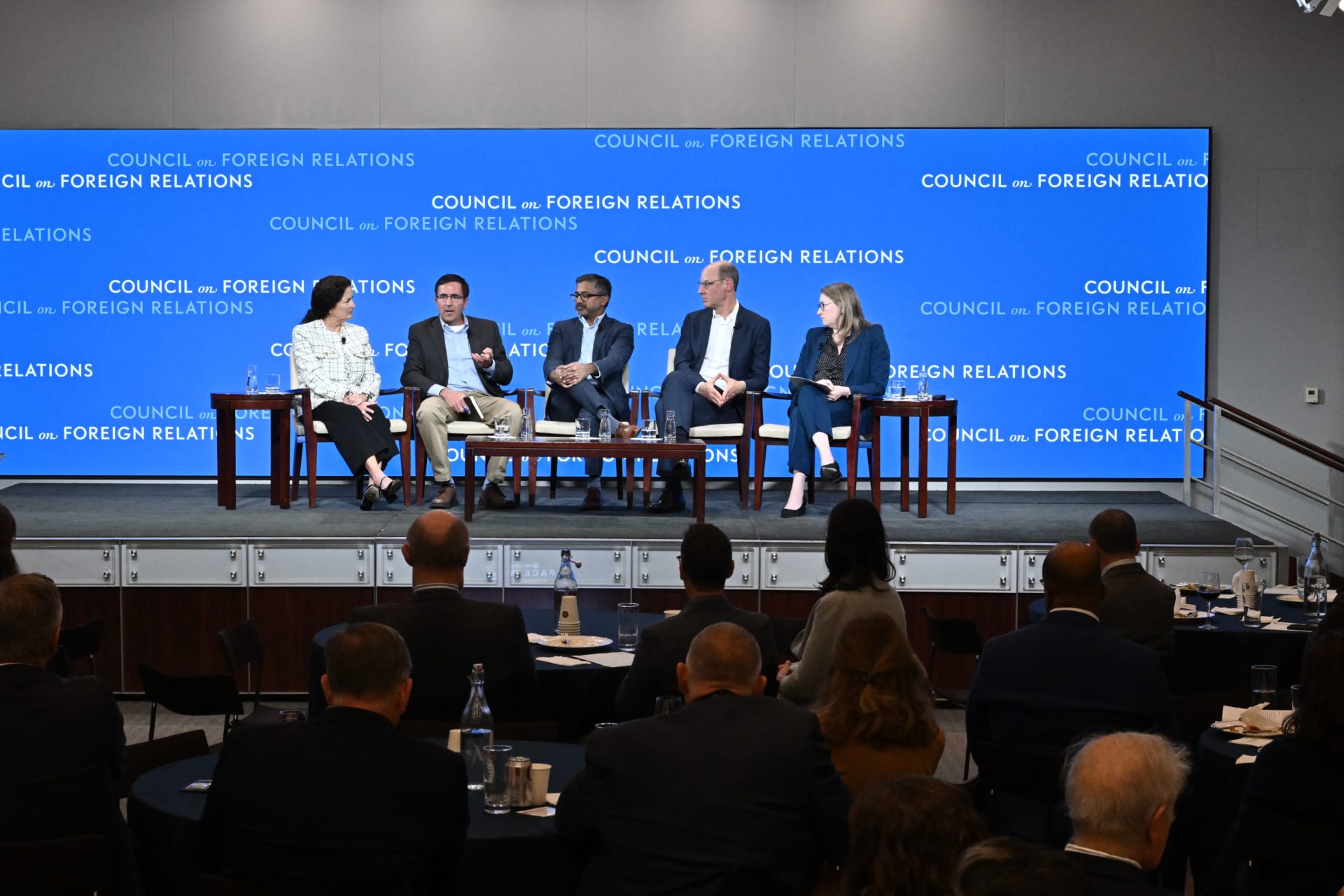
FISHMAN: All right. Well, thank you, everyone. And thank you for taking a break from focusing on the midterm elections to broaden our horizons and look at “China’s Challenge to the U.S. Dollar.” This is the second meeting in our series on the future of the dollar and the international financial system. Our first meeting earlier this year with Barry Eichengreen took a broad outlook on this issue, but today we are focusing specifically on China.
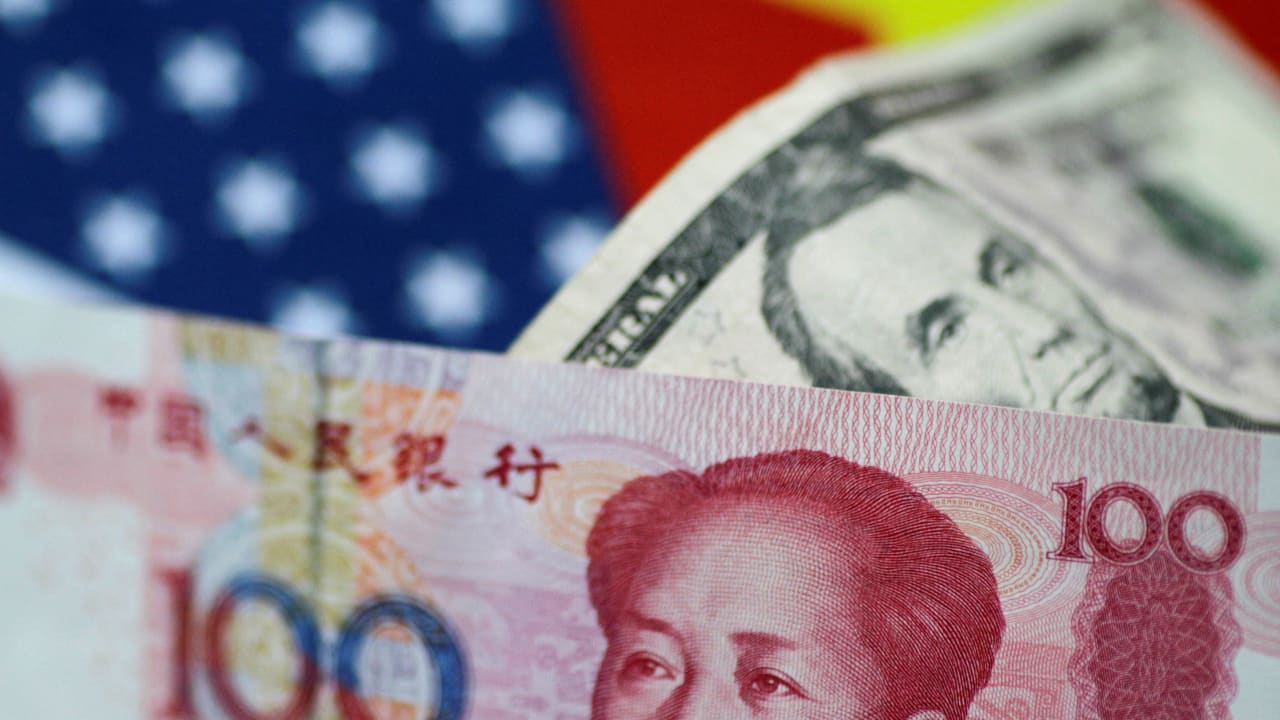
So the dollar’s role in the global economy is an essential pillar of American power. It allows the United States to fund our government, to finance transformative technologies like AI, and, of course, to impose very strong sanctions. And for those reasons perhaps it’s unsurprising that China is doing everything it possibly can to try to break that dominance, and to try to internationalize its currency, the RMB, in trade and finance.
Thankfully, we have a fantastic panel today to help us understand all of this. Truly, you know, three of the top people in the world on this issue.
We have Martin Chorzempa at the far end of the stage. Martin is the Dennis Weatherstone senior fellow at the Peterson Institute. He’s a leading expert on China’s financial system. And he’s the author of a fantastic book called The Cashless Revolution, which chronicles the transformation of money and finance in China. And I could not recommend that book enough.
Next to Martin is Robert Greene. Robert is a partner and chief operating officer at Patomak Global Partners. He’s also a nonresident scholar at the Carnegie Endowment. And, fascinating about Robert, was that he actually spent several years in Beijing as a fellow at Tsinghua University’s PBC School of Finance, so the premier think tank on finance in China, Robert worked there.
And then Jess Hoversen, who’s the chief economist at Column, which is a platform bank based in San Francisco, and a fellow at the Atlanta Council. Jess previously spent over a decade at the CIA, the State Department, and the Treasury Department, focusing on the intersection of economics and national security. And perhaps, because she was happy to leave the CIA and finally be able to speak publicly, she now writes what I consider probably the best newsletter on these topics, which is called Hegemoney. That’s with an E, like it’s a play on—hegemony with “money” at the end of it, so.
HOVERSEN: We love a pun. We love a pun.
FISHMAN: So, yeah. So highly, highly recommend taking a look at that. So for the next thirty minutes or so I’m going to moderate a conversation with our three panelists. And then I’m going to open it up to questions. So please, if you have questions, write them down, get them ready, because we are—we hope to make this an interactive conversation. And a reminder also that this is an on-the-record meeting.
So, Martin, I’d like to start with you. Earlier this year, Qiushi, which is the ideological journal of the Chinese Communist Party, published a speech by Xi Jinping in which Xi called for the RMB to, quote, “attain the status of a global reserve currency,” end quote. I want you to help us set the stage. And what do you actually think Xi’s vision is? And what is China actually trying to achieve with the RMB?
CHORZEMPA: Yeah. So this piece in Qiushi that you mention is really important because it was republishing something that Xi Jinping had said internally back in 2023. So it’s a sense of they really want to broadcast now beyond the inner sanctum of the party what these plans are. And reserve currency, I’m not aware of them mentioning reserve currency before this specific speech. So that’s actually quite an escalation in terms of their potential ambitions here. But overall, the way I see it is being a global reserve currency is not free. It comes with a lot of tradeoffs. And in China’s case, they have so far pretty consistently prioritized domestic stability and the stability of their currency over the kind of global, widespread international use of the renminbi that would allow them to really internationalize the currency.
What I think they want to do is not something as grandiose as supplanting the dollar and becoming the new hegemonic currency of the world, and wielding the same kind of sanction power that the U.S. has financially. It’s instead more of an insurance policy. This idea that China, across its economy, wants self-reliance. And one of the things they want to make sure is that, in the worst possible scenario—for example, some Taiwan contingency—that if the U.S. were to use major financial sanctions, China would still be able to maintain many of its normal trade relations with its partners. And in many cases, those can only use the dollar at the moment. So I think that it’s really just about getting enough and building some of these channels, even if they don’t make sense to use now. Thinking about it as insurance might be helpful. You pay some premium. You hope you never have to use the insurance. And if you buy too much insurance, you go bankrupt. But you want to get some level.
FISHMAN: Yeah. I think that’s really helpful, because oftentimes when we think about will China displace the dollar as the global reserve currency, that might be too high of a bar for us to set for what China is actually trying to achieve. I mean, on this concept of insurance, Jess, I want to bring you in. I mean, how much do you see China’s goals as really being to insulate itself from American financial sanctions?
HOVERSEN: I think that’s the sole goal, is in terms of how China wants optionality. And I actually think if you look about this from the perspective of the U.S. government, one of the things I think that has hurt the U.S. in terms of its outlook for other reserve currencies and, you know, the constant, will the dollar, will it not remain the hegemonic currency, is that for a long time the U.S. dollar looked at this as a bilateral competition. It was going to be the U.S. dollar versus another currency. And so when it saw the renminbi’s slow gains internationally, it almost wrote off the possibility of the fact that it could ever truly challenge the U.S. dollar. And I think if you look at what China has done over the last ten years, they have laid the pieces of essentially recreating the dollar system for the renminbi. So they’ve created payment systems. They’ve created the swap lines. They have recreated these pieces in a way that has, again, given them that insurance that Martin was talking about, versus trying to simply displace the dollar, writ large.
FISHMAN: Got it. So, Robert, I want to sort of take stock of where all of this stands. You know, how much progress has China actually made so far in terms of, you know, having this insurance policy that both Jess and Martin have talked about?
GREENE: Well, I would say that, you know, certainly progress has been made, relative to where the PRC was ten, twenty years ago, particularly with regards to payments channels. But at the same time, you know, the PRC remains heavily dependent on the dollar financial system. And so for all of the talk of a desire to increase the renminbi’s global use, the renminbi still remains a tightly controlled currency. And its offshore use is very much predicated on the ability to convert renminbi into dollars. And if you look at the, you know, data on the extent of renminbi foreign exchange transactions, the vast, vast majority—almost, I think, 97 percent or so—is, you know, dollar FX, and—dollar on the other side of the trade.
And on top of that, if you look at China’s financial system, writ large, you know, there’s actually been good research out of CFR on the extent to which China still maintains massive dollar reserves, even though they’ve taken steps to seemingly obfuscate the extent to which they maintain significant dollar holdings. So, you know, I think across a number of metrics—whether it be China’s exposure to the dollar with regards to its reserves, the reliance on, you know, its ability—the importance of dollar-renminbi convertibility to the renminbi’s offshore use, the nascency of China’s derivatives market, the fact that the Hong Kong stock market is effectively a dollar-pegged stock market—there’s a lot of—you know, I think that surely the RMB as a payments currency is increasing in use, but in a whole number of other dimensions the renminbi’s internationalization faces significant obstacles.
FISHMAN: Got it. So, Martin, I feel like one of the key puzzles that I often try to, you know, figure out here is that, you know, China is the world’s second-largest economy, right? It’s about 16 percent, I think, give or take, of GDP. It is by far the world’s biggest exporter. You know, almost 15 percent of all global exports. But as Robert indicates, it’s still quite underweight on a lot of these financial indicators. In your view, what are the biggest obstacles for China to actually achieve these goals that, you know, Xi Jinping has set out for them?
CHORZEMPA: There are a few. So, first, I want to just add a stat which I find really interesting and revealing, which is that China, in the SWIFT network at least, is at an intense competition with another titan of global finance for the fifth and sixth position in most-used currency. That titan of global finance is the Canadian dollar, by the way. So it’s consistently behind the U.S. dollar, the pound, the euro, and also the yen. And I find that really revealing, because they’re just so much larger than them as a global economy. The Chinese will often cope with this by saying, well, we’re not using the SWIFT network as much as before. We’re more self-reliant. We’ve expanded this Cross-Border Interbank Payment System, called CIPS. They have about 210 direct participants at the moment. And those are doing a little bit of decoupling from the global financial standards that that SWIFT uses. So pretty much any bank anywhere in the world will use SWIFT as the messaging system for payments, but China now has its kind of independent one.
But even though they’ve built this out, you can still see the volume is minuscule compared to the U.S. systems. What’s holding them back are a few things. Robert already mentioned the capital controls. One of the most important elements is if you invest in renminbi, you’re not sure you can get the money out, especially when you really need it, if there’s some moment of instability. That’s one of the biggest tradeoffs that they face, is if they open this up fully they have to accept a lot more volatility in their markets. And they’re not willing to do that. Another is that their system still uses a lot of financial repression. So it’s a kind of closed system. They want to make sure that people can’t get their money out. And the interest rates in China are currently very low. So it’s good to be a borrower in China if you have demand for credit, or if you’re an international, you know, company or a government that wants to borrow, but in terms of investing China’s markets are not doing very well. It’s looking like a less hospitable place to do foreign direct investment. So there’s less of this kind of inflow in the financial side, which drives a lot of those transactions.
FISHMAN: So I want to put another data point out there, because you mentioned the SWIFT data. So China, as we just—as I mentioned, biggest exporter in the world. And I think it’s, what, 30 percent, roughly, of China’s exports are settled in RMB. Is that right?
CHORZEMPA: Twenty-eight percent, yeah.
FISHMAN: Twenty-eight percent.
CHORZEMPA: As of the first half of last year.
FISHMAN: So more than—so 70 percent-plus of their exports are actually settled in other currencies. And we assume that most of that is in the dollar, right?
CHORZEMPA: Yeah. If you look at the data from the State Administration of Foreign Exchange, there was this chart which went super viral on Twitter recently, about last year, which was showing the share of China’s total cross-border settlement that was in the renminbi versus the dollar. And it showed this really stark decline from the dollar being essentially everything way down to 50 percent, and the renminbi went from very small, up to 50 percent, and then the chart cut off there. And you expected that the renminbi was going to go all the way up, and they were going to, you know, stop using the dollar.
I updated that chart recently. What you see is that renminbi completely stopped growing. It’s flatlined. And now both U.S. dollar and the renminbi are both kind of hovering around 50 percent. And if you look at some of the other data, U.S. dollar is something like 90 percent of non-renminbi settlement. And that has not gone down at all. So they’re not diversifying away from the dollar into the euro or another currency.
FISHMAN: Got it. So, Jess, I want to bring in a sort of different angle on this, because, you know, you’ve also written about China finding ways to, quote, sort of, “domesticate” the dollar. Sort of using dollars, while processing transactions through their own financial infrastructure. I think you’ve called this “red dollars.”
HOVERSEN: We call it red dollar.
FISHMAN: Yeah, which I think is another good one.
HOVERSEN: Thanks.
FISHMAN: Can you explain how this works? Like, how can China actually use the dollar without touching U.S. financial infrastructure?
HOVERSEN: So I was actually thinking about that while you were talking, Robert. I think that this also kind of fits into China’s broader strategy of optionality. So while they are laying the groundwork to be able to use the renminbi, A, if they want to, or, B, in the case of some sort of conflagration with the United States, they are also laying the groundwork to continue to use the U.S. dollar. What do I mean by that? It comes in various forms. We know that generally—we also—here, at Hegemoney, we do love a lot of fun phrases. You know, just keeps economics really interesting, keeps my mom reading, you know, that kind of stuff. So—
FISHMAN: We all have goals.
HOVERSEN: We all have goals. (Laughs.) You know. But we like to call it the “law of dollar gravity.” What do I mean by that? I mean that generally there is a propensity for dollars to go back to the U.S. financial system to clear, settle, and process. Along that path however, though, dollars become dark, they become invisible, i.e., dark matter. I will just continue to use physics analogies until one of them eventually sticks. But it’s this idea of, like, dollar obscura, dollar—the dark matter of dollars. What we’re worried about is, to what degree are those dark matter dollars in the Chinese financial system? And I look at it in a couple ways. The first is that China has CHATS, right? We have—yes, it is Hong Kong, but there’s about, you know, two trillion a month that settles in U.S. dollars in Hong Kong. That is outside of the U.S. financial system. Yes, a Western-linked, a Western-aligned bank is the settlement agent for that. So to a certain degree, we should have some influence on that.
The second is that there are a lot of book-to-book transfers that happen due to China’s quite large overseas financial footprint with their banking system. So they provide nested correspondence services, is one of them. But they also—I have seen CCB, ICBC, they publicize that they have these sort of book-to-book transfer systems. Obviously, as the United States we would not be able to see any of that, right? Now, I don’t know to what degree those systems still exist, but we do know that these Chinese banks settle and clear payments book-to-book. We will not be able to see that. Yes, that is a foundation of the euro-dollar system, but to what degree? Again, we have more—one could make the argument that we have more influence on a Western-aligned bank than Bank of China.
The last is that there is a domestic foreign clearing payment—foreign exchange payment system inside of China. It’s called CFXPS. It processed last year about five trillion overall dollars in payments. The Chinese do not break out what currency is—you know, they don’t break out that $5 trillion by currency, but given the rest of our conversation and how prominent the U.S. dollar was in all of these statistics, one could extrapolate that it’s also the prominent settlement currency in this system. We know that Chinese banks offshore can link to this foreign currency payment system and the United States has absolutely no insight into that. And so, $5 trillion a day is settling on that system. If there were to be some sort of issue, one could make the case that those banks could continue to process payments in dollars.
I’ll give one quick example. Bank of Kunlun, which was 311ed, I want to say, back in 2012—that means—and also had its—
FISHMAN: It was sanctioned in 2012.
HOVERSEN: It was sanctioned in 2012, excuse me. Had its correspondent banking services cut. They’re still attached to that CFXPS. Now, again, we can’t see if they’re processing euros or the titan of finance, the Canadian dollar—which I think they should make koozies and sell that, because I would buy that for sure. But we don’t know what actual foreign currencies they’re settling. But they have access to a foreign currency payment system that settles U.S. dollars. This is a bank that was sanctioned by the U.S. government. So if they’re doing it now, we just have to look back and think—we have to think, OK, in ten years from now how much foreign—how much dollar clearing will be available onshore? That’s my first question. What banks will be connected? And if we were to, you know, consider sanctioning a large Chinese bank, you know, at that point would they be so connected to the global financial system that it had serious reverberation? So these are all the things we need to think about. I’ll stop there, otherwise I’ll keep going, yeah.
FISHMAN: OK. And we’ll get into some sort of policy options for the U.S. later. But, Robert, I want to turn to you, because another quote, I think, that made the rounds earlier this year was a former PBOC governor in April, who’s called the Iran war, “a golden opportunity for the RMB to internationalize its role.” So Iran settles most of its oil trade in RMB. And there were reports earlier this year that the IRGC was actually collecting tolls at the Strait of Hormuz in RMB, as well as different digital currencies. So, how, in your view, has the Iran war, if at all, changed the outlook for the RMB as an international currency?
GREENE: Yeah. Look, I think within the Chinese system, there has, for years and years—and both the other panelists have alluded to this—there’s for years and years been this tension between, I would say, some of the more ideological parts of the Chinese Communist Party advocating for—you know, advocating for rapid abandonment of the global financial order, bemoaning the dollar’s global dominance, you know, extremely critical of the U.S.’ use of economic sanctions. That is certainly a line of thinking and a line of rhetoric that you hear quite a bit. There is also, kind of, a technocratic element that has been thinking of the appropriate pace and speed of renminbi internationalization, whatever that means.
And, you know, so you had earlier this year—or, at a recent meeting, I should say—a former—you had Pan Gongsheng, who, you know, was with the PBOC, talk about the need—talk about promoting renminbi internationalization, which is a shift from the past rhetoric of steady and prudent renminbi internationalization. And so I think, like with any crisis, you’re seeing certain voices and certain schools of thought within the Chinese system see an opportunity to advance their previously held ideological views, and their previously held policy views as to what should be happening. And I think that that’s what we’re seeing now.
I would say, though, you know, if you look across the Middle East and you look at the extent of renminbi financial channels, they aren’t particularly well developed. There are headlines of, you know, certain Middle Eastern countries establishing a renminbi clearing bank, or what have you. But, by and large, Iran seems to be—you know, based on reporting—seems to be the jurisdiction that has, by and large, accounted for the majority of renminbi oil sales. So they’re also—I mean, this is where the nascency of China’s derivatives markets are incredibly relevant, because if you look at Shanghai’s renminbi-denominated oil futures market, it is a fraction of a fraction of a fraction of dollar-denominated oil futures products.
So I think you’re going to certainly hear Chinese and Chinese Communist Party voices say that now is a moment for the renminbi to seize upon, you know, this disruption. But at the end of the day, the fundamentals of global finance will prevail. And, you know, the dollar’s, I think, preeminent role in the oil—at least in the energy markets, will remain steady, at least for now.
FISHMAN: Yeah. Well, by the way, the other country I think that was settling a lot of their oil trade in RMB, I believe, was Venezuela. I guess that changed earlier this year.
Martin, first of all, I want to ask you, do you agree with Robert? You’re kind of skeptical of this sort of petro-yuan that some people have talked about. And then maybe a sort of auxiliary to that, sure, maybe China is not going to displace the dollar in the global oil trade, but in certain critical minerals where China is by far the biggest producer, at least refined critical minerals, you already see a lot of contracts being in RMB. You know, lithium, for instance, is a good example. Do you see sort of clean energy technologies, or—you know, including rare earth elements, which is another one, which, I know, is RMB pricing, is that possibly a mechanism that China could use to internationalize the RMB?
CHORZEMPA: Yeah. I really agree with Robert. And he has a really good piece that he wrote recently about the impact of the Hormuz conflict. And one of the things that I’ve been following every month is the volume on China’s Cross-Border Interbank Payments System. And that system was stagnating for about a year and a half, all the way until the U.S. took action against Iran. And then there was a sudden massive spike in volume, which suggested that a lot of players somewhere had moved into the renminbi. Then it kind of came down a little bit. And now it’s risen again. So I think that they’ve been looking for a new impetus after the renminbi went up a lot in the aftermath of Russia’s invasion of Ukraine. And now they might have another geopolitical impetus to start boosting renminbi internationalization, that otherwise wasn’t really there. So I think that’s—it’s unfortunate, in the sense that we’ve given that impetus to China.
In terms of the settling critical minerals and things, I think what important here is that the volume of critical minerals, in terms of their economic value and the financial transactions that would be based on them, is minuscule in comparison to the strategic importance of those inputs. So you might lack, you know, a few cents worth of some trace amount of some critical mineral, or you might need one little permanent magnet that doesn’t cost very much, but then that’s in a, you know, $80 million machine that can’t be produced without it. So I’m actually pretty skeptical that they’ll be able to take their dominance of critical minerals and create enough volume that they need.
I mean, I see this a lot as a chicken-and-egg problem. If most of these transactions are driven—the global transactions we care about—are driven by market forces, where someone is going to decide whether they denominate a trade in renminbi or in dollars and which infrastructure they use, based on what’s cheaper. And so if it’s cheaper to go from their currency—let’s say it’s not involving the U.S. If a trade between China and Korea is cheaper to do because there’s a ton of liquidity and lots of hedging instruments available to go between the renminbi and the dollar, and then the same thing between the dollar and the Korean won, then you’re going to handle the transaction that way.
Whereas, if there’s a lot of volume on the renminbi-won together, then the spread on that might be lower, and you might go for that. And, again, hedging instruments might be needed. So kind of one thing I’d watch out for is, is China able to bootstrap enough volume and liquidity into those—into more pairs of currencies than they have for now. And they haven’t really prioritized that that much yet. Or it’s just a difficult challenge, because it’s really easy to just focus on one currency, and for everyone else to just focus on the dollar, and then you have a super liquid channel—very deep channel that’s very cheap to use. Whereas if you try to start splitting that and fragmenting the liquidity in the market across a bunch of different currency pairs, that’s going to be a lot less user friendly.
FISHMAN: Yeah. Something that hasn’t come up yet in our conversation is central bank digital currencies, right? China launched the digital RMB in 2020. And they also have now this cross-border central bank digital currency payment platform, called mBridge. We haven’t heard as much about these in recent months. Saudi Arabia, by the way, I think left mBridge a couple week—a couple months ago, which I found kind of—you know, raised my ears. I was curious what was going on there. Jess, do you have any views on the significance of mBridge, or China’s central bank digital currency? Do they play a role in this picture? And should we be paying attention to them?
HOVERSEN: What I think is interesting about the CBDC debate is that you have two parties on either extreme. And everyone else is sort of kind of hedging their bets. So you have China, who has gone all-in on CBDCs. They’ve essentially banned crypto and stable, unless—stablecoins, or renminbi-linked stablecoins, unless you get approval from the party. And then you have the United States, who has banned CBDCs until, I believe, 2030, through an executive order. Everyone else seems to be trying to figure out where they are going to fit. There are still many active projects. There are—and they’re happening at the retail level and the wholesale level.
I think when we think about payment dominance, we should be focusing on the wholesale level. MBridge was that first step. It was very surprising to me that for a long time the United States was not involved in any way in a cross-border—or, CBDC cross-border wholesale system. Eventually, we are—now we’re part of Project Agorá. We’re not calling it “CBDCs.” We’re calling it, I believe, “tokenized deposits,” which is just a fun new name for CBDCs at the wholesale level. But I love branding. So here for that, you know. But I think that with mBridge, it’s interesting because, at the end of the day, they’re still trying to figure out the one problem that Martin kind of alluded to, is that how do you create liquidity in between illiquid pairs? And that’s tough.
And now, one would make the argument that—you could make the argument that with CBDCs, you should be able to access more liquidity pools by using decentralized technology. That, however, is, I think, a challenge of the project. And we will have to see how that develops. But I wanted to make a quick point on what you were saying, Martin, on the idea of creating liquidity in pairs. The Shanghai clearing corp. actually just launched three new spot pairs. And so they are acting as a counterparty to—they recognize that—so, first off, you can’t clear RMB on—there’s no PvP settlement for RMB in CLS. However, on the Shanghai clearing corp., you can get—they are trying to reduce that counterparty risk by adding—I think they added the Singapore dollar, the Hong Kong dollar, and the THB.
And so what they see is that, yes, we need to reduce that spread. When I was an FX trader, we had this guy that called the desk. And I felt so bad for the exotics FX guy, because this person wanted to trade Iraqi dinar to Brazilian real. I was, like, well, I’m sorry, Bob. It’s five. I am going to leave, because that looks terrible. (Laughter.) And he could not find—obviously, there was no one that was going to make that market reasonably. That would be ridiculous. So what did he do? Of course, he had to go through the U.S. dollar. I do eventually believe that this person backed off from wanting to trade the Iraqi dinar because, wow, was that a hard currency to source.
But the point I’m making is that it is very difficult—when it’s so cheap to go through the U.S. dollar, you need—you needed a state—you need a state actor, essentially, to step in and create—and compress that spread. So it’s interesting to see. I kind of thought that CBDCs might be the mechanism by which we could do that. But now we have China’s—you know, the SDC coming in and saying, OK, well, we’re going to try to compress that, at least on the onshore market, so.
FISHMAN: So I want to zoom out now and sort of think about the implications for U.S. foreign policy and national security. So, Martin, in your—in your opening, you mentioned that a lot of this was about trying to build an insurance policy in the event that there’s a Taiwan conflict that puts the U.S. and China at odds with one another. Robert, do you see evidence that China is, like, preparing its financial system for a notional Taiwan conflict?
GREENE: Well, I think something—you know, this touches upon something Jess was talking about earlier, which is that there is a—this strand of—in addition to the recent Xi Jinping quote that we were talking about, and the recent speech that was put out in Qiushi, there’s also this emphasis on financial security. And so if you look at a lot of the recent party rhetoric, there is an emphasis on financial power and an emphasis on financial security. And those goals are somewhat at odds, because for China and the CCP to be able to project financial power, the renminbi’s global role would have to be more pronounced. The policy tradeoffs that one has to navigate in order to achieve that end state are difficult. And, hence, you know, the existence of a really robust capital control regime, that will be difficult to unwind. And, indeed, I think there’s a lot of internal policy resistance within the Chinese system to undoing that.
On the flip side, is this is—you know, so you have this financial power ambition and this goal of financial security, which on one hand gets to the payment rails dynamic that you were speaking of, but it’s also why the—why there is this desire for capital controls, because there is a fear that if the PRC was to embrace a more market-based financial system that the financial volatility that would enter in the system would be destabilizing to the party. So I think that that difficult balancing act ultimately is going to make it more difficult to obtain this goal of financial power. And with regards to the goal of financial security, surely that across many domains is something that the party seems to be emphasizing heavily. And, you know, I continue to think that will be the case across a number of domains.
I’ll just add, just building on the discussion just earlier, the proliferation of dollar stablecoins across Southeast Asia and emerging markets, I think that, as the PRC seeks to, you know, grow its footprint in finance in those jurisdictions, especially against the backdrop of derisking that has been brought about by policy trends, I think that the proliferation of dollar-based stablecoins is, indeed, a relevant policy factor in terms of the dollar’s global role. And it’ll be interesting to see—as the GENIUS Act is implemented and finalized—to see what—you know, see the role of dollar stablecoins in emerging markets, and how the PRC responds.
FISHMAN: Yeah. So there might be a tradeoff between the sort of CCP’s desire for political control and their desire for financial security, national security in the event of a U.S.-China sort of economic conflict. Martin, on the flip side of that, I mean, we’ve now talked about—for a while about the—you know, China’s efforts to build this insurance policy. Let’s say, God forbid, we had a Taiwan conflict break out in the next week, and the U.S. were to impose sweeping financial sanctions. Which is a big if, right, and we can debate whether that’s likely. To what extent do you actually think China is vulnerable? Like, would China struggle, for instance, to get paid for its exports if the U.S. were to take that step? Or would they quickly be able to scale up alternatives in much the way that Russia has?
CHORZEMPA: I think that that would be just a horrific bloodbath across—not just for China, but globally for the global financial system, because of how important Chinese financial institutions are. One of the most interesting things I read in the last few years was China’s reaction to what happened with Russia. And one of their biggest takeaways that I found fascinating, in these Chinese documents, was that they thought that Russia made a mistake in decoupling itself from the global financial system. That this Fortress Russia strategy meant that the U.S. and others could sanction it without too much blowback on themselves. And the response of these Chinese experts was, let’s actually get ourselves more entrenched in the global financial system, more integrated with SWIFT, so that the U.S. would—you know, it’s like you’re not going to throw a grenade at someone who’s sitting right next to you, because of that blowback.
So I think they would really struggle to build these. So you can imagine, let’s say the U.S. sanctioned CIPS. I mean, all of the major international banks that are part of that system would pull back. It would probably—China would eventually create kind of these Bank of Kunlun-style counterparts across many other countries, but they would need to interact with their country’s financial infrastructure. And if you look at Europe’s attempt to create a sanctions-isolated system to trade with Iran, and the threat of U.S. sanctions, completely failing to do so, I think that’s quite a warning sign to other countries in terms of their potential ability to take these local currency settlement systems or settlement banks and then have these alternative channels.
They would be probably back to barter, because literally with Russia today, a lot of Russia-China trade is a barter system where they have this kind of, you know, shit thing where they’re looking at how much Chinese cars went to Russia and how much is flowing the other way in terms of energy, and then they don’t—they kind of settle it on a net basis without actually moving any money. That’s probably what they’d have to do. And the Chinese response to the sanctions that we put on Russia is, I think, quite instructive. That all the largest Chinese banks pulled back from Russia business once secondary sanctions were on the table. And they required so much documentation to make sure that no export-controlled goods would be involved, that kind of thing, that it became really hard for them.
FISHMAN: That’s fascinating. So, basically, China is, like, banking on mutually assured destruction, as opposed to necessarily the Russia path, where they really did do a lot to diversify away from the dollar system.
So I’m going to open it up to questions in a minute, but before I just want to do one quick lightning round. Because, you know, I mentioned earlier that a couple months ago it was announced that Saudi Arabia had actually exited mBridge. This wasn’t, sort of, headline news, but it’s kind of fascinating because in some ways it was, like, one of the first examples I’d seen of, like, there being a direct reversal of kind of some of China’s efforts in this space. And I think there’s some rumors that maybe the U.S. government may have pressured the Saudi government to leave mBridge. So far, the U.S. government hasn’t really done very much to throw sand in the gears of these projects.
You mentioned CIPS has a bunch of international banks that are members of it. Big U.S. banks have Chinese subsidiaries that are direct participants in mBridge. You know, big European and British banks are direct participants in mBridge. There are other things, potentially, that U.S. policymakers could do to either sort of throw sand in the gears of China’s efforts, or potentially, you know, make the dollar more attractive. I want to ask each of you, if there was one piece of policy advice you would give to U.S. officials right now that might ward off some of the potential downsides of China succeeding, what would it be? I’m going to go sort of in order closest to me to Martin. So, Jess, you know, I feel comfortable putting you on the spot. You used to be at the agency, so I imagine you’ve been put on the spot a lot.
HOVERSEN: What a time. Yeah. (Laughter.) Slightly less high pressure though, so. (Laughter.)
OK, so I think a couple things. First is that one of the—when we conduct cross-border payments, the lifeblood of cross-border payments is still the correspondent network. And what is fascinating is that many countries—due to the fifteen-year trend of derisking by Western banks—many countries have to rely on nested relationships with third-party countries. One policy move that I would initially propose is that a country has—in order to provide—for a foreign bank to provide dollar correspondence services to a third-party country, that relationship has to be under heavy scrutiny of the U.S. bank. And it may be in that—because, essentially, if a U.S. bank is providing correspondence to Bank A, Bank A will provide services to Bank B. Right now, the know your customer rules stop from the U.S. bank to Bank B. That does make it easier, right? It puts the onus on Bank A to know its customers.
However, if a Chinese bank—for example, the Wall Street Journal has written about this, the New York Times has written about this—if they—there’s a bank called ZCCB. They have around eighty correspondent relationships in forty countries. They have about $65 billion in assets. The next closest bank is, like, bank—I think Bank of China has, maybe, like a fifth of that. ICBC, same, a fifth of that. These large G-SIBs are providing a fifth of that access. But this tiny Yiwu city bank is provide—you know, has seventy correspondent accounts? You’re telling me that that bank has the compliance—must have the compliance department the size of Citigroup? I mean that does not—this seems really disproportionate. So as a first pause, I would say the U.S. government could say we need to start monitoring if you’re going to provide third-party access to the U.S. dollar.
FISHMAN: Got it. And this deals with the problem, just to sort of level-set, some of these foreign Chinese banks actually providing dollar access by virtue of these nested correspondent relationships.
HOVERSEN: Correct. Correct, yeah.
FISHMAN: Robert, what’s your one grand piece of policy advice?
GREENE: Oh, well—
FISHMAN: And you worked at Treasury, right? So.
GREENE: I did. And look, I will—just because it’s related—there’s a number of suggestions that could be made. But since it’s related, I think the flip side of what Jess is saying is that, how can we help U.S. institutions enable better dollar access in jurisdictions where dollar access may be limited? I mentioned the stablecoin dynamic earlier. I think that’s quite relevant to that. And I would just also say, just an appreciation that within the PRC and within the Chinese Communist Party, the concept of financial power is, indeed, you know, part of this idea of comprehensive national power that dates itself back to Deng Xiaoping, and the way in which the Chinese Communist Party assesses its, you know, global strength. And so even though it remains very interconnected with the dollar financial system, we have to be sober about the ambitions that the CCP has with regards to the role that it wants to have in global finance. And we have to take steps to ensure, you know, America’s global dominance in finance. And so anything that advances that end is essential.
FISHMAN: Martin, final piece of advice before we open to questions.
CHORZEMPA: I’m glad that correspondent banking was covered because that’s what I would have done. But then I can pivot to tokenized deposits, that Jess mentioned and I think is really, really important. When I look at China’s central bank digital currency push, they have failed utterly to get people in China to use CBDC. And the mBridge project has handled—the last official numbers were from the end of last year—has handled 4,000 transactions. And, like, essentially, by the time you wake up in the morning, by the time that CHIPS in New York opens up and you’ve, like, been able to pour a coffee, it’s handled more transactions than the entire history of mBridge. So it’s just a very, very small amount of transactions. And, as we’ve seen, the geopolitics that push against it.
But when I look at stablecoins too, you know, the U.S. is kind of the opposite. No CBDC will do stablecoins. Stablecoins have had zero growth in total market cap over the last year, despite all of the improvements in the regulatory environment that GENIUS has had. And so I don’t necessarily think that either of those are going to work. Instead, I suspect U.S. and China will both—and along with the rest of the world—will converge on the tokenized deposit idea. Which is, we’re going to create a—take advantage of what blockchain makes possible in terms of automation and back office stuff, but still have people not have to have a separate account, like CBDC account. You have your money in your bank. You make interest on that. It’s on the bank balance sheet and can help fund lending. And then when you interact with an international infrastructure, then the question is, you know, do you use central bank money at that point? But I think that tokenized deposits, because it’s less disruptive to the banking system but still takes advantage of the technology, might end up being more of a palatable option globally.
FISHMAN: Got it. Great. All right. Well, at this time I’d like to open it up to questions. A reminder that we’re on the record. When I call on you, we’ll have a mic come to you. Please state your name and affiliation. Gentleman in the front.
Q: Asif Bhatti. I work at an AI company called Replit, formerly OpenAI.
Maybe the question that I have is, you mentioned the barter system between China and Russia as a function of, like, effectively underwritten by trust. And if you look at broadly financial systems internationally, it is an arbitration of trust of IOUs between banks and countries. And so my question there is, how is China eroding that trust in the Western banking system and bolstering their own, in the same way that we’re starting to see this, like, bartering system start to pop up? And one example of that is, like, with the ’08 crash, and crypto and stablecoins, that’s also an effective symptom of a lack of trust in central banking, and the adoption of that underwritten by technology.
HOVERSEN: I have a—I can—
FISHMAN: You can go for it, Jess.
HOVERSEN: So one of the things I think is really interesting is that when the United States sanctioned Deripaska, what they didn’t—
FISHMAN: Oleg Deripaska, Russian oligarch, April 2018.
HOVERSEN: Oh, sorry. Yeah, that’s great context. Sometimes when you’re in it, you assume everybody knows, and it’s not true. Imagine how fun we are at dinner parties, just rolling into that with that stuff. (Laughter.) So Oleg Deripaska was sanctioned 2018. And what the U.S. government didn’t think through was the impact on the LME. And how you can’t really choose what you get delivery of when you take delivery—physical delivery of nickel at the LME. That’s not, like, in their fill-out form, right, when you choose to—when you trade there.
What I thought was fascinating is how did China create trust, is that volumes were able to surge on the Shanghai Futures Exchange. And so one way to create trust is to have readily available alternatives, which is what we’ve seen. So we saw that in 2018, with the sanctioning of Deripaska. We saw that with the surge in CIPS volumes following the closure of the Strait of Hormuz. And so I think that that’s something we should—again, it goes back to our, kind of, theme of insurance, which one could call this an insurance conference. How fun for you! That’s how everybody wants to spend Tuesday afternoon. But I think that we could ultimately say they’ve created insurance, and they’ve created a backstop. So when the U.S. acts they have—they are ready and available. And I’ll pause there, see if someone wants to—
CHORZEMPA: I think that’s—
FISHMAN: All right. Cool. Next question. We have the gentleman in the back.
Q: Hi. Thanks. Howard Spector, Point72 Asset Management.
I just wanted to pick up on a comment from Martin. Previously we were talking about sanctions after the Russian invasion of Ukraine, and China’s approach. Does that effectively mean that their approach would help support the dollar-based system rather than undermine it? Or does it move more towards some sort of balkanized system? Said differently, the fact that they’re not pulling away from the dollar system just by default, is that—is that reinforcing the dollar system and, in a way, lean against some of the Chinese officials’ desire to internationalize the renminbi?
CHORZEMPA: Yeah, I see the Russia issue, because it was essentially every reserve currency issuing country imposing sanctions, that was really helpful in ensuring that there wasn’t this move away from dollars into other currencies. But overall, the response was really helpful to China in terms of internationalizing the renminbi away from the dollar. So since then China has more than doubled the number of direct participants in the CIPS network. And direct participants can send payment messages to each other within their own system without using SWIFT. So there’s this concern, you know, the fact that Russian banks were de-SWIFTed, I find actually was a really, really bad idea. Because we could put them on the sanctions list, and then SWIFT would have to mechanically, you know, remove them anyway. But instead, the idea was we’re not going to sanction them, but we’re just going to randomly disconnect them from this one messaging system. So we politicize the infrastructure rather than actually really hitting the banks where they should have gone.
And that, I think, has led to a lot of countries around the world thinking about, well, maybe China would get hit with the similar sanction. So it makes their banks want to sign up to be direct participants. And the share of renminbi in the SWIFT network went from about, like, 2.7 percent before the crisis, to a high of 4.7 percent a few years later. So there was a lot of—there were a lot of transactions that moved away from the dollar. And that begins to bootstrap that liquidity between those pairs. And India’s banks beginning to understand how to use the renminbi, and who the counterparties are, and how it’s priced, and all that. Like, it’s kind of forcing them to learn how to create alternatives. And that did not actually work out very well for us.
GREENE: I’d add a few points here. So what’s interesting about contrasting what the Russian central bank did pre-post the full-scale invasion and what the PRC central bank has done in the in recent years, it’s quite interesting. So the Russian financial system was able to diversify into renminbi, right? The Chinese financial system, query as to where it will diversify. And there is an active debate in Chinese financial circles, if you look at some of the literature that’s published, as to how the PRC system should go about reserves diversification. And this gets to this point of capital controls and currency convertibility, because the PRC has very limited, I would say, walkways through which it can traverse.
One would be to—you know, to change its monetary policy fundamentally, which carries of it a whole suite of risks. Two is to diversify away from the dollar, but perhaps diversify into euros, diversify into other currencies. And three is to, you know, not increase exposure to, what, you know, G-7 currencies, but pursue a path of, you know, continued financial, you know, tightening, and continued dollar dependencies. And so it’s—for the offshore renminbi, that is. So it’s a very, I would say, different dynamic that the PRC financial system faces, versus the Russian one. And the debate over the euro’s role, I think, is a particularly interesting one, as we—as we look at that issue.
FISHMAN: Yeah, just to comment on that too, because I think we actually—it’s really important to get this history straight. Because what happened with Russia—and I see Rory MacFarquhar in the back of the room, so you can attest to this—after 2014 they actually euroized their economy, right? They didn’t RMBize their economy. They first euroized. They diversified most of their reserves into euros. And then they actually started clearing most of their cross-border payments in euros. That came back to bite them when the EU also sanctioned Russia in 2022. So that could be an option for China too, right? It’s not just necessarily the RMB. If they were to bet that in this Taiwan contingency that maybe the U.S. would come down hard on them, but Europe wouldn’t, that Europe would stand on the sideline, maybe that does provide an interesting geopolitical hedge. So that’s another sort of thing just to add to this conversation.
We’ll go to the next question among our virtual participants.
OPERATOR: We’ll take the next question from Tara Hariharan.
Q: Thank you so much. My name is Tara Hariharan. I work for NWI, a hedge fund in New York.
The panelists have been very clear and lucid about flows and liquidity as limitations to renminbi internationalization. But I would just zoom out to an even more macro level, and point out that as long as China has a managed currency it would be very difficult for anybody to really be able to, you know, take stock in being able to improve the ability of the renminbi to be widely traded and accepted. And, case in point, today, for instance, they changed their FX reserves ratio because they didn’t want too much strengthening of the currency. So to the panelists my question is, do you think, given that some of Xi Jinping’s advisors have been suggesting that this might be an opportune moment to at least gradually strengthen the currency further and maybe loosen some of these controls, whether this is a window they will take advantage of? Especially because, you can argue, renminbi internationalization would also require a strong renminbi, rather than a weak renminbi. Or do you think that China will retain these rigid controls and managed currency situation, which, in my opinion, would obviate any ability for them to internationalize? Thank you.
CHORZEMPA: This level of a currency issue I think is really important because, fundamentally, opening this up would lead to more volatility in the currency. Right now, there’s appreciation pressure. But you could imagine if they took capital controls off. I was just in China recently. Had a discussion—quite a few discussions. The Chinese economy is very weak. Chinese financial markets have not been doing very well. You can imagine there is a huge pent-up demand to get money out of the country and to invest in better-performing financial markets elsewhere. And so when I talk to Chinese interlocutors, what I see is even in the moments where there seems like there’s appreciation pressure, now is the time to open the floodgates and allow the currency to float, because it’s not going to suddenly decline. The specter of 2015 kind of comes back, where they loosen things a bit and then there was a sudden dislocation downward in the value of the renminbi. And they got caught flat-footed and then kind of pulled back for a long time.
And actually, the amount of Chinese trade that was settled in renminbi, the Chinese share of the SWIFT network, declined for quite a few years after that moment. And I think they realized that if you open it up in a good time, and then a bad time comes, then now suddenly that appreciation pressure turns to depreciation pressure. Now, do you have the tools—without any experience handling a free-floating currency—do you have the tools to handle the potential volatility that leads to? And I don’t really see that happening. I think if you’re these kind of officials, you know that the party really, really hates downward volatility. They love when markets are going up. They don’t want the currency to appreciate too much, because then that hurts export competitiveness. But in terms of financial markets, they love it going up, but then if—when it goes down, they blame you, if you’re an official.
FISHMAN: Yeah. Gentleman in the center of the—
Q: Thanks. Mark Patrick with TIAA.
I wanted to pull on the China-Taiwan thread a little bit. You mentioned it a couple times. And also rare earths came up earlier. I wonder, in the context of the CFR doing the session in Washington that it did last week where, you know, Situation Room within the next couple years China announces an embargo, something like that, both the U.S. side and the Chinese side, what—you know, have the Chinese bought themselves resilience to the kind of tactics the United States could employ if it wanted to escalate on the economic side? What would the U.S. try to do, and how would China likely respond, and how much insurance has it bought in the kind of near term?
HOVERSEN: I guess I’ll answer. Everybody’s looking at me.
FISHMAN: I think it’s you, Jess.
HOVERSEN: I think it’s me. I think that we have learned a lot from the—let me start—let me take a step back. I think we’ve learned a lot from what we’ve done with Russia and Iran on isolation and how that can—well, especially when we look at what we did with Russia—Eddie, you’ve actually made this point in a podcast before—is that we didn’t go hard enough. And that’s why it’s 2026 and we are still embroiled in this conflict. Obviously, as a carbon exporter, they had something that the world needed. And in order to avoid, you know, disastrous inflation, that we were already experiencing at the time, we went light on Russia sanctions when it came to energy. So now, let’s say, had the situation been different—let’s say this had been 2008 and there was disinflation, and we had gone hard against Russia, we had locked down their energy markets—what sort of battle would we be fighting right now? I think the tables would have turned. I think it would have been a different outcome.
So as we look forward to the engagement—a potential engagement with China, we have to ask ourselves, there is—it’s a much finer tension, because Russia is not as obviously deeply integrated into the global financial markets. Yes, they are an essential part of the energy infrastructure, but not of financial markets. And so to what degree then can we—we’ve learned from Russia, we must go harder than what we did before, because the conflict could go forever. But we also have to recognize that China is—as Martin said earlier, they have—their large banks are G-SIBs. They are an essential part of the global financial system. And so I think that policymakers are going to have to be very creative and very delicate in terms of making that choice. How do we not crash the global financial system by going hard, which we need to do, but also cutting out certain parts of China’s essential infrastructure that will allow maybe a conflict to end sooner.
And I think that that goes back to what we were talking about with correspondent banking and whatnot. In that we have—policymakers again, for a long time, believed that a CIPS here, an SPFS here, these alternatives will mean nothing. But when you aggregate them, it gives our adversaries optionality. And so what we have to be thinking about is ten, fifteen years from now, and what else can they—where else can they build optionality, and how do we stop that? One way, to pull on what you said, Rob, is essentially we need an offensive dollar strategy. We have maintained economic heft. We’ve maintained credibility. We’ve maintained our deep capital markets. We’ve maintained them, but we have not taken active—like, proactive steps to make the U.S. dollar the most attractive currency in the world, at any cost.
And so in terms of thinking ten, fifteen years down the road towards a potential conflagration, what we should be doing is ensuring that the Global South does not want to use the renminbi. That they say, well, that swap line is actually, like, fairly useless, and I can’t convert it into dollars. It’s actually just for trade. You know, I’m going to be bartering. I guess, now. I mean, I think that the strategy now should be thinking, how can we go hard without completely disrupting the global economy? And how—and what is our offensive dollar strategy? How are we going to make sure that the Global South only turns to the U.S. in a conflict?
FISHMAN: Yeah. I feel like that’s a good topic for another conversation we have here, because something we haven’t had a chance to talk about is there has been a retreat of U.S. financial institutions in emerging markets, right? And in many instances, it has been Chinese banks that have filled the void. Much, honestly, like Huawei, you know, filled the void in telecom behind, you know, Nokia and Ericsson over time.
So we only have a couple minutes. I’m going to kind of take a couple questions, maybe. We’ll pool them. And then we’ll sort of—we’ll bring it home. So I see one there, I see Dan Tannenbaum and Rory MacFarquhar. So we’ll take those three, and then we’ll answer and finish it off. All three, yeah. So the three of you, yes. (Laughter.)
Q: Thanks, Dan. Thanks. Nicole Goldin, a nonresident senior fellow at geoeconomics, Atlantic Council.
And actually directly picking up on that last point, Jess. I mean, right now the U.S.—Africa—still roughly 70 percent of African external public debt is still held in dollars. But there are—the RMB is making moves. Kenya recently converted its Chinese—one of its Chinese loans on the railway, and is saving—to RMB—and is saving some $215 million a year. Zambia, which already takes mining royalties and taxes in RMB is reportedly considering a similar conversion. So I’m curious, as you’re kind of thinking about—you know, do you see this kind of debt management in the Global South, where there is—in particular in Africa—where there is this debt crisis, as a meaningful path to potentially have, you know, further internationalization, if you will, if not kind of direct competition? And kind of to the points that came up earlier, is it also potentially more about the kind of geostrategic competition and influence that can—that China can get from this, as opposed to almost more important than the actual economic or financial impact? Thanks.
FISHMAN: All right.
Q: Dan Tannenbaum, also with the Atlanta Council, and Oliver Wyman.
Double-clicking on the last question. A little bit more specifically, will the U.S. ever act? Having been involved in a number of investigations against Chinese banks historically, federal enforcement of Chinese sanctions violations is something like $17 million in aggregate. You rely on New York Times articles to, you know, designate, essentially, Chouzhou Bank, and allow banks to then act on it. But there really hasn’t been any enforcement mettle historically in a very bipartisan way. We keep talking like if they move on Taiwan that the U.S. will act, but will they?
FISHMAN: All right. Rory.
Q: Thank you. Rory MacFarquhar, former colleague of Eddies. And thank you for this great panel.
Picking up directly on the previous question, and basically coming at it from the opposite angle, if you were in the Situation Room the day of a Taiwan contingency of some kind, would you actually recommend that the U.S. put sweeping financial sanctions on Chinese banks, given that they do have this backup infrastructure, given that, you know, something like 120 countries have China as their predominant trading partner, and given that that itself, presumably, over time—even if you have chaos in the first instance in barter and, like, immediately after—that over time there would be workarounds built so that that trade could continue, and that that would itself dramatically change the role of the dollar in the world going forward?
FISHMAN: All right. Let’s go Jess, Robert, Martin. And it’s a challenge since we’re at time for each of you to answer in no more than thirty seconds. (Laughter.)
HOVERSEN: I feel like Martin really wants to go first. He’s, like, giving me that sign. (Laughter.) OK, no, I’ll go first. That didn’t work as well as I thought it was going to be.
OK. On the dollar has—there’s, like, three roles of a reserve currency—or, of a dominant currency: Reserve funding, vehicle currency. Vehicle currency is, by far, the most important. Funding currency, I view that the same way that I view Chicago sports. I like it when we’re winning. If we’re not winning, I do not care. And so funding currencies shift very similarly. Everyone’s funding in RMB right now because it’s 300 basis points cheaper than the U.S. Treasury. So I think that we should watch that, but we can’t benchmark the future of the global economy, again, the same way that I watch Chicago sports.
On the Situation Room, I think that I would it would be very tough to recommend sanctions on a G-SIB bank, especially given how connected they are to the global economy. I think the first thing I would do would be to attack derivative and commodity markets. I would look to attack every other piece of infrastructure that the—so the BIS has kind of five pieces of financial market infrastructure. I would try to attack all of those other pieces before I went—because that is the alternatives that we were talking about. If we’re create—if we start cutting away at those alternatives first, that shows we’re serious. It shows that we’re undercutting the infrastructure. And it shows that we will still—we’re going to hold off from trying—from potentially damaging the global economy. But we’re taking away those infrastructure alternatives. I think that was, like, forty-five seconds. I’m sorry.
FISHMAN: So, Robert, would you recommend sweeping sanctions?
GREENE: Well, I want to actually go to the question about Africa, because I think it’s really important, and because there’s been a lot of headlines recently about a huge increase in the amount of panda bonds and dim sum bonds. And I think it’s very easy for people to get grasped by those headlines. The reality is, I think from the—from the—so panda bonds are issued within mainland China, dim sum bonds are issued in Hong Kong. For panda bonds, there’s this real question mark as to what is the liquidity for those bonds going to be in the future. And it kind of speaks to the broader Chinese debt market, which is still to this day very—you know, there’s very limited foreign participation. So surely an issuer can raise funds in mainland China, but the ultimate future of that marketplace, query as to what it’s going to be.
And it’s really important because for the—going back to where we began—this desire for the PRC’s currency to potentially become a reserve asset, you need marketable debt securities. And you need liquid marketable debt securities. And what you’re touching on with your question gets to a fundamental limitation that can’t be solved by dim sum bonds, which is the offshore, you know, renminbi debt market. So I think we’re going to probably—you know, you nailed it—that the current rate environment is driving a lot of debt issuances. But the fundamental market structures I think remain. And that will be an impediment to the very kind of way we begun this conversation today.
FISHMAN: All right, Martin. I’m focusing you on the Situation Room, but take us home.
CHORZEMPA: You have—I was trying to squirm out of it, but you forced me in there. (Laughter.) I think if that scenario is happening, then China has already made the determination that we probably don’t have the resolve to hit that sanctions button, which is really a dangerous place to be. And in part, that might be due to our relatively weak response in regards to China on Iran, where we talked a big game and then didn’t actually back that up. So I’d be tempted to say, do something targeted at the beginning to show—put a shot across the bow, demonstrate some resolve. But if you show some weak, limited response to this big, big thing, I think that doesn’t necessarily solve the problem. I don’t think there are any good outcomes. And if you thought that the Deripaska stuff was a problem, then hitting a Chinese major financial institution—I mean, I’m not sure we’d be prepared for that fallout.
FISHMAN: All right. Well, thank you, Martin, Robert, and Jess. And thank you all for being here today. (Applause.)
(END)
This is an uncorrected transcript.