Early Career Professionals Series: Charting a Career in International Affairs—A Conversation With CFR Visiting Fellows
Event date
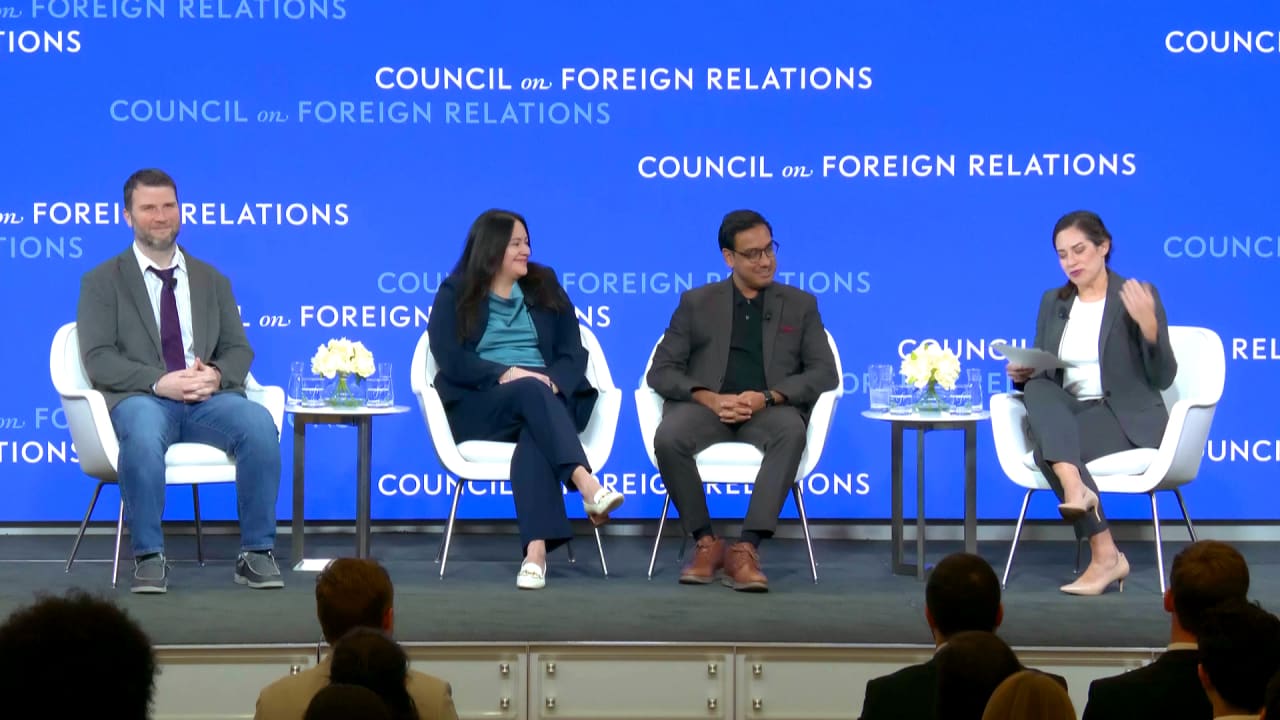
Speakers
- Ishaan TharoorCFR ExpertEdward R. Murrow Press Fellow, Council on Foreign Relations
- Andre SlonopasCFR ExpertTechnologist-in-Residence, Council on Foreign Relations
- 2025–26 International Affairs Fellow, Council on Foreign Relations
Presider
- Former Director, Coastal West Africa, National Security Council; 2020–21 International Affairs Fellow, Council on Foreign Relations; CFR Term Member
CFR visiting fellows discuss their career paths in foreign policy, the lessons they’ve learned along the way, and practical advice for those looking to build a career in international affairs.
The CFR Early Career Professionals Series provides an opportunity for those early in their careers to engage with CFR. The briefings feature remarks by experts on critical global issues and lessons learned in their careers. These events are intended for individuals who have completed their undergraduate studies and have not yet reached the age of thirty to be eligible to apply for CFR term membership.
DUNDERDALE: Good evening. We’re going to get started here. I want to welcome everyone tonight for the first Early Career Professionals Series session of the program year here in Washington, D.C.
Early career professionals are those who do not yet meet the age requirement to apply for term membership, but who have an interest in international affairs and engaging with the Council. We organize about one event per month in each city, in New York and Washington, and we also send out a newsletter that highlights Council meetings and publications.
My name is Sam Dunderdale, and I’m the director of Washington meetings and the Term Member Program here at the Council. I’m pleased to welcome all of you here in D.C. and also over a—over a hundred fifty who are joining via Zoom tonight. We have a fantastic lineup of speakers who will be joining us. We encourage all of you to participate. We’ll have about thirty minutes of conversation with the speakers, and then we will have thirty minutes of Q&A.
For those joining via Zoom, to ask a question during the Q&A period please click on the “raise hand” icon on Zoom. And for those of you attending in person, we encourage you to raise your hand, and when you’re called on state your name and affiliation before asking your question.
CFR is an independent, nonpartisan membership organization, think tank, and publisher. And on our website you will find links to past events, reports, podcasts, and analysis from our fellows. We aim to be a resource for you in all of your work, and provide information and timely analysis on U.S. foreign policy.
After tonight’s event, we will have a brief reception for those of you who are attending in person. So feel free to join us for that afterwards.
And I’m going to turn things over now to Molly Ariotti, who is our moderator for tonight, and a former international affairs fellow and current CFR term member. Thank you all so much. (Applause.)
ARIOTTI: Welcome to today’s Council on Foreign Relations Early Career Professionals Series. This meeting is entitled “Charting a Career in International Affairs—A Conversation with CFR Visiting Fellows.”
As a former fellow, I am pleased to be presiding over today’s discussion. I’m Molly Ariotti. So now’s my chance to ask all the questions I’ve been waiting for.
I want to start us off with some more broad questions, and in about a half-hour I will turn it over to you all for your Q&A. So start thinking of your questions early.
I want to start out by asking the panelists: What is one assumption that you had about international affairs or your chosen profession?
Oh, I didn’t even introduce you guys. Sorry. Whew, got too excited. (Laughter.) Backing up.
So with me this evening are Rita Fernandez, who is the 2025-2026 international affairs fellow. Andre Slonopas—sorry I’m going out of order—technologist-in-residence, so we can ask him all of our tech questions, all of our AI/SI, whatever you’ve got. Just kidding. Sorry, Andre.
SLONOPAS: No, no, let’s do it.
ARIOTTI: And Ishaan Tharoor, the Edward R. Murrow press fellow. So we should be able to get a lot of different and interesting insights from the three of them. And now I’ll go back to asking all of my questions.
So, starting off again with a more broad question: What’s an assumption you had about international affairs, your chosen profession, early in your career that your experiences have since challenged or changed? Turn it over to you first.
THAROOR: OK. Well, hi guys. Thanks. Thank you, Molly. It’s really, really great to be here. It’s really—I started my fellowship here at CFR alongside Andre at the beginning of September, and it’s an incredibly special institution. And I’ve already been sitting where you’re sitting multiple times for an incredible cast of speakers, so it’s really fun to be onstage. A little bit daunting, but it’s great.
Yeah, I’m Ishaan Tharoor. I’m the—every year CFR has a(n) Edward Murrow fellow from the press, kind of mid-career journalist, and I am in the unusual position of maintaining my day job—I’m a columnist at the New Yorker; I write a weekly column there called Global Notes—while also having the privilege of sitting here four days a week doing various things. And I don’t need to give you my whole bio, but I was at the Washington Post for twelve years and I wrote a column called WorldView. I don’t know if some of you ever read it. It was a newsletter.
To answer your question about, you know, things, what has changed—you know, what changed for you, you know, I’ve been in my line of work—sorry, out of curiosity, are any—are there any journalists or would-be journalists in the room? Cool. And who consumes journalism here? All right. That’s good. So I’m relevant. (Laughter.)
So, yeah, I mean, I’ve been a professional journalist for twenty years, and I began my career far from D.C. in Hong Kong at a very different kind of geopolitical moment. But you know, I think—I grew up in a family of foreign policy practitioners. My dad was at the U.N. for many decades. And I had this sense of the world of IR, the world of think tanks, and sort of the attached elites to foreign ministries/international organizations as being, you know, incredibly well-educated, very pedigreed. Everyone has to have a Ph.D. Everyone has to really know their beat. Everyone has to be intellectually curious. And, fine, maybe this is, like, my cynical journalist evolution over time, but that’s fundamentally not true as you navigate this city as well.
And it it’s really struck me—and this is—I mean, I really shouldn’t be leading with the cynicism here, but it’s really struck me as you sort of—especially as you spend extra time in Washington seeing the different iterations of administrations that come in, seeing who is slowly rising up or not rising up, how the—it really is—and Molly said this phrase backstage, which is true all the time—but you really choose your own adventure. And a big part of choosing your adventure to me seems to be, especially in this space, finding the right people, networking intelligently, maybe finding the right camp. And I don’t know what that means for all of you, and I don’t know what that means for even us on this stage. But I’ve been really struck by how easy it is for some people without much expertise, without much perhaps foreign policy pedigree, to break—get into these spaces, have impact, to be voices that are heard for better or worse.
And so that’s one observation. I’ll pass it on to Rita.
FERNANDEZ: Hi, everyone. So, Rita Fernandez. My, actually, fellowship ended yesterday. I was part of the 2025 to 2026 cohort. So this is the perfect way, I think, of bookending my experience, being here with all of you. And thanks to CFR for inviting us, for putting all of this together. So very excited to be here with you all today.
I think, you know, similarly, I had a lot of very preconceived notions about what a career in foreign affairs might look like, and I think my thinking of it has shifted over time. I actually grew up on the U.S.-Mexico border. My parents are Mexican immigrants. I grew up in, like, the southernmost part of California. If you were to look at a—at a map of the U.S. and, like, the southwest corner—like, the very, very bottom—that’s where I grew up.
And I initially had seen myself going into a career in public service, but didn’t really explore international affairs. And I think in part that was because I thought it was maybe a very exclusive sort of career field. It was one where it seemed like you really needed to pick a lane and hone your craft over time, where it was very difficult to sort of break through. And so I started, I think, gravitating a little bit more toward domestic policy issues, a little bit more towards, like, economics. But immigration policy in the U.S. domestically was something that interested me at a very early age.
And what I think has been kind of interesting for me is to see how I’ve been able to follow the immigration track to now make it an international migration career. And so I think that was maybe one of the—again, the misconceptions I had, that it had to be a very linear experience, right, that you—there is a path, and you kind of follow it. One of my very first sort of exposures to it was in college, when I was recommended—someone had recommended to me to take the Foreign Service exam, which I did not do in the end. But, like, those types of careers, just in my mind, again, seemed to be very structured, where you couldn’t really deviate very much from, like, a specific pathway. And I think my thinking on that has really changed over time.
SLONOPAS: Awesome. So maybe I’ll follow with Ishaan’s question: Anybody STEM degree here? OK. Perfect. Anybody going for, like, Ph.D. in in STEM? OK. Awesome. All right. I’m glad—I’m glad to see that.
So my first Ph.D. is aerospace engineering. My second one is materials science and engineering. And I’ll say this: Working in a lab, and that’s kind of where I grew up over the last twenty-five years or so, foreign affairs was, like, not a thing. As a matter of fact, I was—somebody told me about the Council on Foreign Relations, and I had a really good mentor, and he said, hey, look, they’re looking for a technologist, right? And I was like, OK, who’s looking for a technologist? They’re like, well, the Council on Foreign Relations. I was like, what in the world is that, right? So did I plan this? I did not.
But now having been here for about, like, forty-five days or so—so please keep in mind I’m learning about the foreign affairs and kind of how the world works—what I was exposed to in science, I’ll say this: We do have a significant what we call engineer-scientist exchange programs, ESEPs. So we do send our engineers and scientists over to Japan, to Israel, to some other countries all over Europe, and then we bring a lot of those back. I’ll share this story. We did have a gentleman from Japan, brilliant whenever he put his words on paper, but when you speak to him, you’re like, I don’t quite have a clue what you’re saying, right? But just brilliant when he—when he writes his thoughts down.
So—but what I’ve learned, actually, coming here, you know, I realized that there’s a lot of—and I’ve seen this, actually, when I was still working the lab. I’ve seen a lot of technology die—really brilliant, like, amazing things that could change the world, you know. And the issue is that unfortunately what ends up happening is you have a lot of scientists who are scientists, and that’s the end of it, right? And then it seems like you also have a lot of people in policy who are policy people. But that connection, unfortunately, is missing. There are certain things that I say even now, being in the office, that I think are in the—in the field of science, like in the lab, are pretty basic things, but as I talk to policy people they’re like, well, we didn’t know this, right? So that connection, I think, needs to be there.
And this is where I’ve changed a lot of my—of my worldviews over the years. You know, I used to think that you could really change the world from the lab, and that simply isn’t true. If you’re not social, if you’re not going out and engaging, you know, not just the local community but the world at large, you’re not going to be changing the world. There’s going to be a lot of really awesome technology that somebody somewhere is probably looking for, but unless you’re out there being extroverted/engaging you probably aren’t going to know about it, right?
So I say that to a lot of the scientists in the lab, but I would like to encourage you to do the same thing. You know, we’re actually coordinating a roundtable right now. We’re inviting some of the former NIST directors as well, who later became undersecretaries within the Department of Commerce, and I would like to encourage you to come to meetings like that. So they are very, very scientific people, but also they have been on the policy side as well, and it’s crucial. There’s a lot of really good stuff at NIST. If you have an opportunity to visit, please do. They have so many Nobel laureates working there. Just phenomenal work they do there. But unless that stuff makes it out of NIST into the bigger world, then—you know, then it’s ultimately going nowhere, right?
And so my worldview now is, OK, well, we got to get out of the lab, or maybe pick a person, right, that we’re going to sacrifice—(laughter)—from the lab into the big world, and then have that person go out and, you know, socialize a lot of technology. So that’s my—that’s my progression, I should say, in my worldviews. Thank you.
ARIOTTI: Thank you. This is all really interesting.
I am going to ask you about some pivots. So you all have their extensive bios, which I’m skipping over in the interest of time. Many of you have pivoted at various points in your careers, and sometimes that looks like going from a substantive area at a local level to an international level. Sometimes that means switching into a new area where maybe you don’t have the same expertise that you had—maybe getting a second Ph.D., which for those of you who haven’t done that, that’s crazy—(laughter)—would not recommend.
SLONOPAS: Highly encouraged. (Laughter.)
ARIOTTI: Have one. One’s good.
I’m curious about how you decide to make those leaps, and how some of the skills that you might have attained helped you in your moves from one of your professional lives to another. I think a lot of times, at least in my experience as a former professor talking to students or talking to people now that I’m in Washington, they’re like, well, how did you, like, plan from step A to step B? And they think that there was a plan. And as all of, I think, the panelists have noted, there’s not always a plan; sometimes it’s just staying open to opportunities. So I’m curious to hear from each of you how you approached those pivots.
FERNANDEZ: Maybe, yeah, I’m happy to start. Yeah. Sometimes I think a pivot or the opportunity for a pivot sort of is thrust upon you. You’re not necessarily, right, seeking it out.
I have had opportunities to pivot from state and local government into federal, and vice versa. I actually started out my career on the Hill, but moved over to work for the mayor of Los Angeles and the mayor of San Diego. And I am currently in sort of the midst of a pivot, as my fellowship is over and now I’m also back into the world of job seeking. So right now I’m also trying to figure out what my future looks like.
And so I think in the U.S. government context, like, going from federal to state to local, et cetera, I think what really helps is understanding, like, when the optimal time to do it. And again, sometimes it’s sort of not up to you. But I had decided to go back to California after I did my stint on the Hill. And when I was in the mayor’s office in Los Angeles, I started in communications. And then President Trump took office the first time in 2016, and I decided this might actually be the best time to go back into policy on immigration, and it was. It was the perfect time. Eric Garcetti was very vocal on the issue, so he was very engaged nationally. So it also was a very good career opportunity for me. So I think it’s sometimes, like, figuring out where the window is where you can make the most impact, where you can, you know, really be the most helpful.
And then for now my—I think the pivot that I’m undertaking now is a little bit different, in that my fellowship placement was at the U.N. migration agency—which is IOM, so the International Organization for Migration. And so I’ve now done migration at a, you know, government level in the U.S.—local, state, and federal—and now international sort of governance.
And so in my previous host institution at IOM, I kind of pivoted a little bit more into a different issue, which was combating human trafficking. And I actually wrote an analysis that was just published on Monday—I’m making a plug for that—if you want to read it, on the CFR website, that explores the intersection of AI and human trafficking, and how AI enables human trafficking, especially in Southeast Asia where you’re seeing a lot of scam centers that have popped up. So it’s very different, but it’s still somewhat related to migration.
So I have now, I think, used the time to explore an issue that was not really very, you know, immediate to me. It’s not something that I had really delved into very much. But I’m now kind of seeing it as maybe a different path forward for maybe research, maybe for something in the private sector.
And of course, like, AI is also on everyone’s minds, right? And the potential harms of AI are also in everyone’s mind. So I think, yeah, like, utilizing all of those opportunities as they come, but then also kind of taking challenge and kind of taking it as an opportunity, because being in the immigration space you might not think it’s, like, the best time for that issue—(laughs)—especially in the U.S., but sometimes there are ways to kind of give it a spin to something else.
SLONOPAS: Awesome. Then maybe we’ll go this way. So I think my most recent pivot is actually Council on Foreign Relations—(laughter)—you know, given my background, you know, because I—honestly, I have not worked in a field like this, on the policy side.
So what I would say with pivots is that, you know, it’s never too late to pivot. I will say that, right? You know, I’m forty-one. I’ll share that. I’m forty-one years old and I’m pivoting into something completely different, right, something completely new, and it’s a learning curve for me for sure.
But let me kind of walk you through my life, how it worked out and how these pivots took place. I was sixteen years old, about to graduate high school, early 2000s. Black Hawk Down came out, if anybody watched that movie? All right. Awesome. So I was about to graduate high school, and I was like, man, I don’t want to go college; what do I do? And then Black Hawk Down comes out and I’m like, that’s what I want to do. So I enlisted on my seventeenth birthday, right? I went the whole airborne ranger thing and everything, and I enjoyed it, and it was a really amazing time. But then my mind was just always very analytical, and I started doing the math and I was like, the odds just aren’t—stacked against you if you keep doing this over and over, and the deployments over and over again. And so I started just going to college, and I fell in love with that, right? So that was my first pivot.
Now, think about that, going from active duty into, like, college, right? And I went from, like, very type A, like—I don’t know, like, at the time when I was serving females weren’t allowed in our unit at all, right? And then all of a sudden I went to University of Virginia, where it was like, just—(laughs)—I mean, as polar opposite as you could think, right? So think about that pivot, right? And it was very intimidating at the time. And I see a lot of—a lot of people kind of struggle with that—with that transition, but you know, you kind of have to just take that step, you know. It’s not—it’s not all that awful. You know, you’ll learn a whole different world, and it will really open up your eyes. So that was my first pivot.
I went into academia. I ended up teaching at the University of Virginia for a while. I was selected for a Presidential Management Fellowship, and I shifted into the government. That’s probably my second pivot, as a PMF.
So, interesting story. I will share this. They share this when you get selected through a PMF program. They share this story. You could go anywhere in the government except for the White House, because a woman by the name of Monica Lewinsky was selected back in the 1990s, and she ruined it for all of us—(laughter)—for decades to come. So—but this was 2016, so I’m not sure the White House would have—you know, would have been—you know, anyway, there’s a lot of—a lot of fighting that I saw. (Laughter.)
So, but anyway, long story short, think about that pivot, then pivoting in the government, then back in academia, and then into policy, right? So—and I’ll share this, you know, that it was it was fairly challenging. And it was, like, I didn’t know what I was stepping into. And—but, you know, in my mind, I rationalized that I’m either going to love it or I’m going to hate it. And if I hate it, you know, I always have a fallback option, which is going to be right back in the lab where I get along, and everybody’s introverted, and it’s amazing, right? So I’m being—I’m being facetious there. So but the other—the other big thing—so that is your professional career, and definitely cherish that.
But the other thing that I will say is there’s—at some point of time, the family comes in. And the family is, like, an amazing experience, but it was a whole different experience from a professional world. And then it becomes a little bit of, like, just balancing things, right? So you have to make sure that, you know, you’re able to balance those two things. And I’ll say, my family has been extremely supportive, and my wife has been extremely supportive of everything. And sometimes I’m, like, I’m about to make the craziest decision of my life, what do you think about this? You know, and she’s, like, super supportive. I’m like, all right, well, if everything else fails at least I go back home and we talk through it, right?
So I will tell you this, like, don’t be afraid to pivot. You’re going to discover a whole new world. And if it doesn’t work out, not a big deal. Pivot back. You know, you have nine, ten, eleven, whatever, twelve months, pivot right back into whatever you were doing that was comfortable. But I will tell you, you got to enjoy the journey. If the journey ever becomes difficult for you, or like it’s not enjoyable, then it’s going to be a very long career, right? I mean, like just a very long and dreaded career.
Let me give you some numbers. I came from the Army, obviously. Army is 2 million people large, right? So, and I’m assuming foreign affairs also has millions of people engaged. So if you have a project you don’t like, there’s probably, like, a million other projects out there. So try something else, right? But, like, just enjoy the journey. I just finished off Steve Jobs’ book. And he says, you know, the only way to do a great job is to really enjoy what you’re doing. So don’t be afraid to go out, try things. You may like it. You may not. But you may actually love it, right? But you don’t want to miss out on those opportunities.
THAROOR: Yes. So I was a bit sheepish about answering this question because I’ve had a remarkably pivotless career. (Laughter.) Where I’ve been enrolled in legacy media writing about the world continuously for twenty years, and kind of clung onto it desperately not to lose that. So I think I’m a kind of object lesson in being too good of a company soldier and too scared of pivoting. But a pivot was thrust upon me this year in February, at the Washington Post, where hundreds of us were unceremoniously let go. And, you know, I had a role at the time that I thought, you know, I could—I’m forty-two—I could do this for the rest of my career. I thought I could be who I was.
And I think—and you all will find roles where, and it’s probably true in the foreign policy—it’s certainly true in the foreign policy space. It’s definitely true in journalism, that the longer you do it the more you feel existentially defined by your job. And I felt very much like I’m Ishaan Tharoor, columnist at the Washington Post. And that was very core sense of my sense of self. And to have that ripped away from you is pretty tough. But, you know, it also—I quite rapidly realized, especially at this particular stage in my career, how much I had not been exploring and thinking about. And now that I could do it.
And a pretty well-known journalist who you all probably know, who probably wouldn’t want me to identify, called me up a day after the news and said, you know, you’re going to be very tempted right now to take some time to lick your wounds, to really kind of recharge. You’ve been on this treadmill for years. But that’s the worst thing you can do right now. You got to strike when the iron is hot. Everyone wants to talk to you. Everyone wants to hear what you’re thinking. Everyone wants to know about what you’re thinking for yourself. They’re not going to necessarily want to be that curious two, three months from now. So strike when the iron’s hot.
So I listened. I took that advice. And that was really good advice. And I landed a gig I never thought I could have gotten, which is for me a dream gig, at the New Yorker, and also this fellowship. And so, yeah, I mean, I think—yeah, obviously in early stages of your career these are there different considerations. For me I knew I didn’t want to take any kind of risky breaks, try stuff on my own, Substack, all that. So I plunged back in. And it worked out. Yeah.
ARIOTTI: I’m debating if I’m going to ask one more question or two more questions, but I’m going to protect the Q&A for you all. So I hope that you have your questions ready. I’m going to ask you a, I think, fairly traditional question to kind of wrap up our time together, but I think it’s valuable. So I’m going to ask you, you know, kind of going back to the theme of the first question, what’s something you understand differently now? And how would that inform the advice you might have given yourself when you were twenty-five? So roll back a couple of the pivots or some of the years of doing what you’ve been doing. What’s something you might have told a younger iteration of yourself? In any order. You’re allowed to opt out, I guess, but I’ll ask you later. (Laughter.)
THAROOR: I mean, I can take a stab. I think for somebody who writes about international politics and politics in general, I kind of wish I told my earlier self about the ways in which the Overton window can change, the ways in which people who you would think are beyond the pale in a particular way, or sort of shouldn’t be in this particular conversation because they’re saying certain things, are going to be in that conversation, and kind of wrap your head around that sooner rather than later. I find, and this is across the political spectrum, I think sitting in, quote/unquote, “mainstream media” newsrooms, I think we’ve had some really complicated struggles in dealing with, you know, what our guardrails are in terms of what is—what seems like acceptable, fair discourse, and what doesn’t, what our parameters and terms are for how we define the discourse in particular ways, what we label as far-this or far-that. And I think I’m pretty proud of my sense of my compass on this stuff. I kind of wish it was a conversation that had been more alive in newsrooms around this country, but yeah.
FERNANDEZ: For me, I mean, I think looking back, I think I would have maybe told, like, a now a—you know, I’m I guess we’re all aging ourselves. So I’m thirty-eight. But I think I would have told a twenty-five-year-old Rita to just kind of chill, in the sense that—(laughter)—in the sense that I think there was a period very early in my career where I just was in a hurry. Like, I thought I had to do X, Y, Z, right? And I felt like I was on some sort of timeline. And, you know, all of that, I think, was good and it served me well, but I didn’t really leave myself too much room for flexibility, where, you know, a lot of times things didn’t work out the way that I wanted to. But in the end, it actually, you know, was the best thing for me. Like, maybe the job that I didn’t get, but that was actually fine because the job that I ended up landing was much a much better fit for me.
And then I would also say, you know, in that sort of, like, iteration of, like, that early stage of my career, I didn’t give myself a lot of time to pursue a lot of personal interests, a lot of just, like, that work-life balance that eludes everybody. Like, I never really gave that much of a shot. (Laughs.) Even now, I’m sad to say. So maybe this is something that I would have told myself, like, at a younger stage, is, like, the career is important, the job is important. It’s not everything, though. And it’s something that I’m now, kind of at my age, trying to, like, really work on. So I would say that to myself as a younger person, but would also say that to young folks.
THAROOR: Yeah, I mean, I would say, you know, drink less in your twenties—(laughter)—but the sense I get from your generation is that you guys don’t—you do drink less.
FERNANDEZ: It’s a millennial problem. (Laughter.)
THAROOR: Yeah.
SLONOPAS: Well, yeah, I’ll just second Rita here. I’ll say I would have told myself, yeah, definitely chill out a little bit, right? So I used to be a little more—or more, you know, short fused, fiery. You know, and I—you know, maybe it just the environment that I was living in at the time, but it was like, well, you know, if these people can get it done, whatever, we’ll get it done, and you know, let’s burn that bridge. Doesn’t matter. As a matter of fact, we had an expression. We would say, blow the bridge, we’re not coming back, right? So—and it was like, well, you know, sometimes you do have to come back. (Laughter.) So what I would tell you if you look across this room, everybody’s exceptional, phenomenal. I mean, you were selected to be here, right? I would—if I was in your shoes and I was a younger me, I would be networking extensively. You know, I would be meeting everybody, taking business cards, going out to lunch, coffee, whatever it is, because you just never know where that opportunity is going to be.
That person—as a matter of fact, I had a mentor years ago in the military. He gave us this lesson. He said—he was a very senior ranking officer, but he said I’m not burning a bridge with any of you. One of you is going to be a general one day, and I don’t know which one. So, you know, so—you know, but one of you is going to be an ambassador, or maybe a couple of you are going to be ambassadors, undersecretaries, secretaries, top lawyers in top law firms, you know, you name it, right? So—but you’re sitting right here. I would say, network. So that’d be that’d be one thing if I could go back and tell myself when I was younger, hey, don’t burn the bridges. You never know.
And the second thing I would tell myself is, find a mentor fast, but make sure it’s a mentor who’s on the way up, right? You don’t want to find a mentor who’s like, ah, it’s all good, whatever. (Laughter.) Whatever, you know? You want to find a mentor. And I’ve been extremely fortunate, you know, just having amazing mentors along the way. And, yeah, I would tell you that too, like, if you see, you know, managers, or maybe you see people on the way up, and you see how they operate, and they kind of align with your worldviews potentially, you know, just make sure you ask—take them out for coffee, right? Ask them for advice, develop that relationship.
To this day, I mean, I email people that have been mentoring me through the years. And it’s been phenomenal. Because otherwise, you’ll figure it out. I mean, I’m confident you’ll figure it out. But it’ll take you five extra years to figure it out, and there’s going to be a lot of pain along the way, right? So you can save yourself a lot of time and a lot of pain if you really have somebody who kind of paved the way for you. So that’s what I would tell myself. But the twenty-five-year-old would have been, like, you know what you’re talking about. Buzz off, whatever. Sorry, I’m not saying I was that bad at twenty-five.
ARIOTTI: Well, to summarize that, I’d say you don’t have to know what you want to be when you grow up. But even if you think you know what you want to be when you grow up, you are allowed to change your mind.
So with that, thank you to our panelists. We will turn it over to the question and answer. If you have a question, please raise your hand. And also, I am going to remind you that this meeting is on the record. I feel like if you’re in the front row and you’re going to raise your hand, I’m going to—unless you unraised it. OK. (Laughter.)
THAROOR: There’s a mic going, right? Yeah.
Q: Well, I’d like to thank all of you for this discussion. My question is to Ishaan, actually.
So you mentioned that when you had to leave the Washington Post, you felt like some part of your identity was actually lost. And I think that’s very important, because a lot of us inevitably and naturally identify at this—at times too much with our professional or academic identities. And I’m a Ph.D. candidate. I can see this very clearly among other Ph.D. students as well. So if you’re open to that, would you be able to, like, talk a little bit more about that period of your life, how you handled it, and how you managed to deal with that stress? And how did you make sure that it didn’t spill into other areas of your life? Thank you.
THAROOR: Oh, it’s a great question. I’ve not had to be this publicly self-reflective. (Laughter.) So, I mean, I would say it really helped having a kid. (Laughter.) So, like, you know, my daughter does not care what I do for work or, you know, what my name card says. And the sense of fulfillment and anchoring purpose that I got from that, that I always get from that but especially in a moment when I everything else—all the other certainties that I felt I had, you know, from like the big picture, like, this is my career, to, like, the really banal, like, oh this is my daily commute, this is what I do, this where I get my coffee all the time—the things that sort of make up your life, and that, you know, when you have a career kind of become the contour of your life. When you lose that, yeah, it’s a bit bewildering. But, yeah, I think for me it was having a very supportive family, very supportive wife who’s also a journalist, and my daughter who doesn’t care what I do.
And then I think I was—I did consciously know that I still want to be defined by my work. And I’m going to fight for that. And it lucked out for me. But, yes, you know, to answer your question, you do have some kind of dark nights of the soul, but at the end of the day you do realize that you’re so much more than the place you work at, the place that takes you—that, you know, gives you your W-2. And you’ll always be—you know, and then you eventually get another W-2 from a different place. (Laughter.) And so I’m trying to hold some perspective from that time, yeah, as well. Thank you for that question.
ARIOTTI: If I can use moderator privilege, as a former Ph.D. student myself, the thing I remind people is that your life in any career should be more than the sum of your CV or your resume. So don’t miss the friends’ weddings. Don’t not be there for your siblings or your friends, just because of what you’re doing in the moment. It might seem very important, but I promise you the amount my friends still drag me for missing their wedding, it’s not worth it. (Laughter.) Learn from my mistakes.
I saw another hand in the back.
Q: Thank you for taking our questions.
President Trump has recently demonstrated an interest in business deals with regimes that the U.S. and our allies have historically isolated, most infamously Russia but there are also talks with Myanmar now, with the junta. I’m curious if you think that there is any situation where this might lead to favorable outcomes from a humanitarian or strategic standpoint.
SLONOPAS: I’ll approach it from—you know, from my background in the military, and then technology perspective. And I apologize, you know, this is not going to be, like, a foreign relation type of, but just my observation. Interesting thing when you deploy to, like, Afghanistan and, you know, the Middle East. And it doesn’t matter what your beliefs are, like, it doesn’t matter like where you grew up, where your ethnicity is, like, which side of the conflict you’re on, or what you believe in—trust me, that conflict is a lot more complicated than the dichotomy that we’re being kind of shown here—everybody loves their iPhone, right? Like, it’s kind of unbelievable. Like, everybody loves their phone. And then AC? Let me tell you, like, AC is, like, it sells like it’s on fire. Like it’s kind of unbelievable. Everybody loves energy. Oh, PlayStation was like, oh my god, like, it doesn’t matter who you are. Like everybody loved. So do I see positive outcomes from collaboration in general in the field of technology? I would say, yeah.
We had this mission we had to plan out, and I’ll be kind of vague here, but it was out in eastern Africa. And it was al-Shabaab, if you remember that, in the Ogaden region. And one of the—one of the things we were thinking about was, like, if you were just to deploy technology out there, like, give people AC, energy, PlayStation, and, like, shower every day, like, I’m willing to bet, like, 70 percent of the extremism will go away, right? So I personally believe there is a lot of positive that could come out when you start working together, especially in fields of technology, and especially when you intertwine people in technology.
You know, if you have phones that operate through some sort of a common, you know, network, well, it’s, like, well, you cannot start a war because your network partially lives on our side, right? And vice versa. And now from there, it’s, like, well, now let’s negotiate. Like, what is a reasonable thing here? So, you know, from my perspective, that’s what I will say. I think there could be a lot of benefits. You know, collaborate at least in the technology. International Space Station. What a great example. There’s so much technology that came out from International Space. A lot of our signal receptions, you know, came out from that. But if you think about it, I mean, it was, like, the Soviet Union and, like, the United States. I mean, how different can you get, you know? But they worked together towards technology that benefited humans. So I would argue, yes, at least on the technology side. But, again, not my forte. I might be completely wrong. So, please. (Laughter.)
FERNANDEZ: So I was in Thailand in the summer for this research that I mentioned, analyzing the impact of—or, the use of AI in human trafficking. And the reason I chose the Southeast Asia region is because there are a number of cyber-scam compounds in Myanmar, Cambodia, Lao PDR. And the news about the sort of, like, the approach with the Myanmar government, like, that’s—it’s interesting because in that case, even though they’re really—you know, you can make arguments about, like, the downsides of legitimizing, you know, those authorities, there is a benefit to the U.S., right, in engaging, because a lot of those cyber-scam centers are set up in areas where even the de facto authorities don’t have control, right?
And at the same time, these scam centers not only traffic people that they keep in captivity at this—to carry out scams, but American nationals, but people over the world are scammed. In 2025 alone, Americans lost $18.2 billion to scams just in Southeast Asia. So, yeah, I mean, overall, I couldn’t really say, you know, yes or no either. But there might be some upsides where it could sort of be beneficial to the U.S., but also to other people that are sort of caught up in—like, in that specific dynamic.
THAROOR: Yeah, I mean, I think in our brave new multipolar world, one shouldn’t always clutch pearls about who we do business with and what we—where we extend ourselves to. But I think with the Trump administration it’s always a question of, you know, what’s actually motivating this and how are you actually going about it. And they often find the worst possible way to go about things that otherwise kind of make sense. I mean, I think anybody who’s following the Ukraine war and the dynamics there and the position of the Europeans and the position of the Ukrainians understand how this has completely undercut what’s happened there.
And then I think—I don’t know, with Myanmar—you were there recently. It’s a wretched status quo that no one’s really changing. And there are a lot of parts of the world where there are wretched status quo that no one’s changing. Afghanistan is another. Where maybe it does require the U.S. to kind of drop certain facades, and get on the ground, and engage in a more direct way. But I think it’s quite sad the way in which this coup-plotting general has been completely normalized across the region, and we don’t seem to be going back any time soon to the democratic structure, which was imperfect before, but that did exist.
ARIOTTI: I work on Africa, so this is all very familiar to me. (Laughs.)
We have a virtual question, so I’ll hand it over to Sydney.
OPERATOR: We will take the next question from Max Genin.
Q: Hello, panelists. Thank you. My name is Max. I’m joining you from Harvard.
I really appreciate all of your vulnerability and humility. You all spoke about multiple pivots and multiple interests. I find that employers nowadays increasingly ask professionals to be hyperspecialized. But how do you narrow a specialty if you have many interests? Have any of you had any challenges like this? I’m curious to hear your thoughts. Thank you.
FERNANDEZ: Maybe I’ll go first. Sometimes it feels like I am hyperspecialized, because, like, migration is a very specific niche. But, I mean, I find that the work that I do has a lot of very transferable skills into any number of things, including, like, strategic communications. I’ve done a lot of government affairs and have been able to sort of work on government affairs issues, like, not only related to immigration. So I think there’s, like, ways in which you can market yourself in a CV or a resume where you can sort of sell a skillset, as opposed to, like, a specific sort of collection of, like, knowledge on one particular policy area. And finding, again, those threads where there’s like maybe some intersectionality.
SLONOPAS: So I’ll say this, I’ve been pivoting a lot but I’m still, you know, very, very hyper focused in the in the field of semiconductors, right? So just the fact that I’ve been pivoting, you know, from—well, except for the military. Military was, like, just not related to a lot of stuff. (Laughter.) But, yeah, so but, you know, all of my work has been in the field of semiconductors. I mean, that’s kind of, like, where I grew up. So even now on the policy side, I’m a technologist, but all of my policy work is, again, semiconductors. So even though you’re still pivoting, but, like, you’re going to stay with that very specific thing that you’re going to be working on.
I was talking to somebody many years ago. And that person is like, well, when you retire, are you going to go do something else? And I’m like, no. Like, you have, like, literally thirty years’ worth of knowledge in whatever field that you dedicated your life to. That what you should—that’s essentially where you should be staying in, whether it’s consulting, teaching, whatever, it may be post-retirement. So just because you’re pivoting, you’re still going to be the subject matter expert in a very niche thing that you kind of commit your life to. But hopefully it’s a thing that you enjoy. You know, and that kind of goes back to the previous point. Thank you.
THAROOR: I’m not qualified to answer this question because I’ve specifically avoided specialization, even in a journalistic context. You know, I’ve never—I’ve decided not to be a foreign correspondent on a particular patch. I’ve been a roving kind of jack-of-all-trades, columnist, news analysis kind of guy. And it’s been a kind of unusual career, in that sense. But I would say, as somebody who has to interview a lot of people who are specialists, that the ones who rise up in their fields, and I say this as somebody who sees a whole range of them and talks the whole range of them, are ones who understand things outside their specialization and are able to help anyone, whether it’s professional peers, journalists, whatever, get what they’re doing in language and terms that are not hidebound by whatever their field is. So even as you are encouraged professionally to be really good on one thing, or to focus on one thing, or to nail this subject matter or this region or whatever it may be, always think about a bigger picture that people who are not your bosses or people who are not your competitive peers or whatever also want to see with you while you’re doing that work.
FERNANDEZ: Actually, can I just add one more point to that? So, for those of you who also want to go into public service, there’s, you know, I think something to be said about having bipartisan experience and experience working in offices that sort of go beyond your ideology. Because being, like, a global migration and U.S. immigration policy expert, I’ve worked for Democrats and Republicans. And that not only makes it look like you are versatile, like it shows that you are willing to put yourself in different environments where you may not necessarily agree, but even on a personal level it sort of allows you to, you know, explore the issue area from a different perspective, and it gives you a different—a different viewpoint. So I would say if you’re also trying to, you know, give yourself expertise in any particular given area, it’s also, I think, good to explore it from a number of different viewpoints so that you can also, you know, make yourself more well-rounded, in that sense.
ARIOTTI: I think that really adds a great point to something I was thinking as you all were talking, which is you can be an expert on process, and you can be an expert on substance, or you can do one or the other, right? So you might be somebody who understands policy processes really well. You might be somebody with deep substantive expertise in a particular area. Or you might have both. And so I think that’s one way to think about having a variety of different interests, and maybe not necessarily having to always just pick one.
Questions? All the way in the back. I’ll get you next time, I promise.
Q: Oh, sorry. Should I—
ARIOTTI: No, no, you’re good. Go ahead.
THAROOR: Could you guys tell us what you do as well, or what you—it would be nice to get a sense of that.
Q: Sure. My name is Felipe. Thanks for the panel. I work in a religious liberty law firm. We do public interest law.
I’m curious about what Andre mentioned in his last comment before the Q&A, about mentors. And just wanted to open that for the entire panel. How do you define—how do you identify mentors, and how do you cultivate those relationships? Thanks.
SLONOPAS: Sure, I can take another—OK. So sometimes mentors just kind of fall on your lap, you know? But sometimes you seek them out, right? So this is kind of how it worked out in my life. Sometimes I was assigned to a unit, you know, that I did not pick, but it just turned out that it was, you know, the person who was in charge was, like, absolutely amazing. And then and I know once we started working together that it was—like, and I did not ask to be mentored by this person, but that person I guess saw some potential in me, and then they took me under their wing, and they kind of mentored me. And that that person actually ended up becoming a general officer and later elected—you know, elected person, you know. So that’s kind of how it worked out for me on that side.
Now, on the other side, sometimes I just applied for these very challenging positions for very senior people who were, you know, reporting to Congress, like political appointee-level type of stuff. But I applied to them. And I’ll tell you this happened in my life one time, I applied to be the executive officer, right? And, you know, no job is beneath me. I was, like, I’ll be the XO. I’ll do your paperwork, or whatever. I’ll be your chauffeur. It doesn’t really matter. But, like, I want to talk to you, right? And this person, very senior person, came back and said, well, actually, no, you’re too good for that. But why don’t we do a quarterly one-on-one meeting, you know, in my office, shut door, you know, and then you just ask me whatever question you want to do.
And then the other thing is Presidential Management Fellowship. That’s actually the third thing just came out of my mind. Which unfortunately that program is dead now. I hope they revive it maybe in about a year or two, or a couple of years. But as a presidential management fellow they don’t tell you this stuff until you actually start working, they actually assign a senior executive servant to you who’s just assigned to mentor you through your career, you know? And that I still talk to my SES. He’s a three-star equivalent now, and just a phenomenal, phenomenal person, who’s also just been through life. You know. And there were challenges I had in my career, and, you know, this person was, like, well, just move on. (Laughter.) Which is the lesson I try to tell you as well. You know, like, if you’re struggling, just move on.
You know, so sometimes they fall on you. Sometimes you just have to be proactive and go seek them. And sometimes it’s part of some fellowship or development program. You know, but try to stick with those. Regardless of how I met my mentor, I stick with all of them. You know, I email them. You know, I stay engaged, so.
FERNANDEZ: I think the mentors that I’ve had throughout my career and that I still, you know, have—that are still mentors these years later are people that I actually worked with, either sort of just people that I worked with in an office that were maybe not my direct report, or that I was their direct report. But I also do have a couple mentors that were my supervisors in previous roles. And it was a combination of things, in that we, like, got along. But then I also just learned a lot from them. Not just about the job, but what it means to be a boss, right? Like, I got a lot of insights as to, like, what a good manager does, like, how a good manager respects, you know, the dignity of their team, right? And I always respected that. And I think, you know, over time I built the relationship.
Sometimes what’s also good in a mentor is not just someone who, you know, agrees with you, who can also kind of challenge your thinking about something. Because sometimes in your career you get myopic about a goal, right? But if a mentor can also kind of challenge your thinking and tell you to think of something in a different way, I kind of—you know, looking back sometimes I think, like, oh yeah, she was right about that, and here I was just sort of fixating on, like, doing this next, right? And so, yeah, I mean, I think for me the mentors have kind of come through work.
And I think maintaining those relationships, but also I think the personal connection is also very important. You said the—sort of, like, the living life, right? Like, that that was also a huge part of it was, like, us connecting about our lives, about our families, about our own personal goals and ambitions, right? It wasn’t always just shop talk. I think, like, building that, like, sort of that personal relationship with a mentor is very important too.
THAROOR: Yeah. I think that’s right. I think, you know, journalism is, of course, its own kind of crazy industry. And sort of, like, you’re permanently inside that that meme of the dog in a room of the house that’s on fire. (Laughter.) But I would say, just to answer quickly, you know, my sense of who my mentors have been over twenty years are kind of two different buckets. There’s the one bucket, as you said, the people who you work with, the kind of an editor or a senior leader or a senior reporter who’s sort of, quote/unquote, “in the trenches” with you, who has seen you evolve over time, gets you in a particular way, and feels invested in your growth and success as part of their own legacy. And those have been relationships—for twenty-plus years I now have people I still talk to, check in on, you know, talk shop with.
And then you also want the second bucket, of folks who are not in your place of employ, whatever that is, who are maybe peers, or more senior figures, or kind of in an adjacent track, but who get you, and who get what you’re doing, and are excited for what you’re doing and have feedback. So that can be, you know, a senior journalist or whatever in another institution. In my case, it’s been often, quite fascinatingly, people who used to be journalists but now entered, like, the foreign ministry of X country, or whatever, but who enjoyed reading me and maintaining touch. And those been very fruitful relationships for me, people who get the industry but are not necessarily in the work I do, but also invested in sort of having a conversation that evolves.
And you got to think about this as just this is not, you know, who can you introduce me to. This is somebody who’s going to be a frame of reference for how I see the world, how I engage my subject, my work on a daily or weekly or monthly basis, or whatever, and somebody who I can have an evolving conversation with about work, about life, about myself, about them. Yeah, those are the two buckets, I think.
ARIOTTI: Sophia, all the way next to you.
Q: Hello. My name is Livi. I work at the embassy of Lithuania. And thank you so much for being here and sharing your experiences.
What is the worst career advice you’ve ever gotten? (Laughter.) And knowing what you know now, what would you say instead? Thank you.
ARIOTTI: Oh man. For me, it would definitely be, like, be honest. (Laughter.)
SLONOPAS: Keep it real.
FERNANDEZ: Honest within reason.
ARIOTTI: Like, up to a point.
FERNANDEZ: Yeah, yeah.
ARIOTTI: When people are like, tell us what you really think, and I’m, like, what I really, really think?
SLONOPAS: It’s, like, keeping it real goes bad, right? (Laughter.) I would say I was doing a pivot, right? So it wasn’t as big as, like, going from lab into, like, policy or something. But I was doing a pivot in my career because I was really struggling on this one—it wasn’t even the project, it was just, you know, the climate. I didn’t like the climate that I was in at the time. And the people inside kind of saw the potential in me, I guess. And they’re like, no, no, no, stay, stay. It’s going to be different, right? Just stay. Just stick it out, grind through it. And then so I end up leaving regardless, right, but, like, six months later, after just, like, pulling my hair out, right?
So I think that was the worst advice. Like, if you see that there’s—like, you’re just not a right fit, you know, like the world is much bigger, you know, than kind of grinding through something that you really dislike, right? And I also saw that my output was mediocre, my ratings were mediocre, and it was just, like, it was, like, just a bad deal altogether, you know? But I just kept being talked into staying there. And I was like, oh my goodness. Like, anyway, long story short, I eventually left. So, like, don’t—just don’t. You know, just move on, you know? So, yeah.
FERNANDEZ: I think one of the worst pieces of advice was to never pursue graduate school. And I did not follow that advice. I’m glad I did not. I think some people have very, like, strong thoughts about whether you should go, whether you shouldn’t, like don’t get a Ph.D., don’t go to law school, or you definitely should go to law school, right? I mean, ultimately, it’s your choice. I don’t think there’s any right or wrong answer to any of it. And I had put it off for the longest time and then ended up doing, like, a midcareer program at Princeton, like, a few years ago. I graduated in 2024. It was, like, one of the best decisions of my life. And so I ultimately just tuned out people who were telling me this or that about graduate school, and ultimately just made the decision on my own.
THAROOR: I mean, I would say don’t go to journalism school. (Laughter.) But that’s a separate conversation. I think—and, again, and I don’t know how useful this is for people in the room. When I started—when I entered—kind of at the beginning of my career I was encouraged by a very senior journalist, you know, who I really admired and whose career I wanted to have, to go out and find a kind of steady, reportorial local news job at a tiny local paper and build myself from that. Because, of course, for that—in that journalist’s mind, that was how you build yourself up and have the career. You kind of go through the—you do—you kind of go through the motions. You go from a local desk, to another desk, to another bigger paper, to another bigger paper, and you make your—you make your way.
And I thought, you know, there’s nothing about me that wants to write—be a court reporter in some town in Connecticut, or whatever it is. I want to be thinking about elections and democracy and big, big things. And so I found a path where I could be actively interested and excited about what I’m working on. Even as a young person who had to pay my dues, I wanted to be interested in those things and not have to feel like, oh, this is the—I have to grind it out. And I’m happy that I went with my kind of instincts as opposed to that of a much more senior, celebrated person.
ARIOTTI: I think we have time for one more question.
THAROOR: There’s been a hand up here. And you can do a quick round.
ARIOTTI: Yeah. We’ll be speedy. Be quick.
Q: Hi. Thank you. I’ll be brief. My name is Emmanuel Ohiri. I’m a policy director at Black Professionals International Affairs.
And you all talked about, you know, striking when the iron is hot, knowing when to pivot, finding the opportune times, and being able to network intelligently. And for myself, I started out in the United Nations in 2024, and in the years that followed we’ve all seen what has happened in the international landscape. And as I’m continuing to navigate these shifts, I want to ask, how do we identify opportunities to pivot in those downturn times? And how do we gain the skills of analysis to know when it is opportune, or when the iron is hot, or when it’s cold? Thank you.
FERNANDEZ: I mean, it’s a very—sorry, I’ll take this one—it’s a very relevant question, especially today, right? And having just been in a U.N. agency and seeing a lot of people that were, like, laid off, that were afraid of losing their jobs, and kind of seeing what this, like, UN80 initiative will bring and what the future will bring. I mean, I think it’s just it’s so hard, right? Like, there’s no, like, right or wrong answer, or no formula, because sometimes—and I hate this term—but it is kind of, like, unprecedented, right, in that you just have to kind of roll with the punches.
So I would say, knowing what your skills are, like, what you want to do, what you definitely don’t want to do, and just kind of, like, forging opportunities for yourself. I can’t say enough about, like, networking and just, like, talking to people, right? So I think it’s really just a matter of, like, plugging along, and figuring out how you could be creative, right? And maybe finding a completely different sector, like a whole ‘nother different project, right, and, like, finding those opportunities for yourself. And it’s probably not the best answer, because I’m also trying to figure that out on my own at this time. (Laughs.) So it’s a tough one. But, yeah, at the end of the day it’s like, you know, being really diligent about your about your networking and just kind of, like, plugging along.
THAROOR: Should we take more questions?
ARIOTTI: Yeah, in the middle over there.
Q: Hi. I’m Laura Somoza. I currently work at Human Rights Watch.
I had a question about rejection. So, as someone who is also considering maybe a pivot, or going to grad school, I’m kind of in the zone right now of, like, failure to launch. Of, like, should I do this, or should I do that, or I’m too scared to do something. So my question to you guys is, in your pivots, how have you dealt with rejection or the potential of rejection? Thank you.
SLONOPAS: Oh, yeah. So what a story. So what you’re seeing here is a success story, right? What you don’t see is all the failure. And maybe I’m talking about myself, but it seems like I’m getting some nods. Let me share some of the rejections I had. My wife rejected me for four years before I finally convinced her to marry me, right? (Laughter.) So—but you can think about, like, how—you know, like just complete despair. But that’s on the family—that’s on the family side. But let me tell you about the professional.
There’s actually a great book. It’s called The Psychology of Money. And it’s not so much about money as it is about just the psychology of perseverance, right? And it’s a really interesting thing, because they bring a lot of examples from Wall Street and some other places. And people just fail. Like, it’s a very natural thing to fail. And, you know, when you read through that book, and the interesting thing about it, what separates, you know, the people who ultimately succeed and the ones who don’t, are the ones who don’t they typically quit somewhere in that process. So let me share some things from my life.
You know, when I went to Ranger School, you know, the failure rates were, like, I mean, through the roof. I mean, it’s unbelievable. But when people—you would see people come back two, three, four times. People spend—I mean, it’s like a concentration camp. This thing, like, you’re losing—at a peak of our starvation, I was losing, like, a pound a day. You know, it was like—it was unbelievable. Sleep deprivation was really bad. We’re all hallucinating. I had a gentleman behind me in the middle of a wood line, and he’s, like, I see a marshmallow doughboy next to me. And I’m, like, I think you’re hallucinating. He’s like, no, man. He’s, like, looking at me. I’m, like, don’t touch him. He’s icky and stuff, you know? (Laughter.) But people go through that for like—and you start talking to these people inside of that—inside of that experience, and they’ve been there for like 180 days or whatever. You know, they persevere.
I applied to five Ph.D. programs for my first Ph.D. Four rejected me. Think about that. UVA got me in, so, like, that was, like, my top choice, I guess. Johns Hopkins, which is my second doctorate degree, three times I applied, two rejections. I got in the third time. I applied to the Tillman Scholarship, three-time rejection. Never got accepted. So what you’re seeing here is success, but honestly, like, even looking at my life, I think it’s, like, 70 percent failure rate, like you know, maybe right around there, maybe 80 (percent). I don’t know. So I would tell you, like, just don’t quit. Persevere. You know, if you think that there are people who succeed on the first try, that just doesn’t happen. You know, so anyway, that’s my experience.
FERNANDEZ: Yeah. I mean, yeah, the failure is, like, inevitable along the way, right? And not to discourage anybody, but that’s just—it’s going to happen, right? It’s natural. But that’s OK. And, I mean, I always have to remind myself that a rejection is not personal, right? It’s just, like, it just maybe wasn’t the right time, maybe for any number of reasons it just didn’t work out.
I would say, especially in this job market and with a lot of pivots sort of happening simultaneously, there are some, like, tricks that I’ve learned just from, like, people that work in recruiting and in HR. So, like, if you see certain keywords in a job description, use them in the resume and cover letter, because apparently some companies now just feed things into AI. And if your resume and cover letter doesn’t have those words, no matter how applicable your experience is to the job description, like, it’ll go nowhere.
And then sometimes it’s also kind of, like, a matter of how you’re marketing yourself, right? Like you may read the job description or, like, think about a new pathway, and you think I’m perfect for it because I have all of this in my resume, but maybe the way that you’re presenting it in the application or on the resume isn’t immediately clear, right? Like there’s no immediate connection as to why all of a sudden you’re looking to go into a completely different type of company, right, or whatever it may be.
So I mean, I think also, like, building your brand in that sense is important, and like how you’re marketing yourself to employers. So, yeah, it’s a—it’s a tough, like, I think, just field right now to do the pivot and just to, like, have that rejection. But it also teaches you a lot about, like, how people in a completely different field think, right, and how they’re recruiting, how they’re, you know, looking for applicants. So it’s—you’ll get there, though.
THAROOR: I have nothing more than that to say. It’s not about you. And having been on both sides of this now, so doing a lot of selections for interns in the past and this kind of thing, there’s so many qualified applicants for jobs. You need a bit of luck. You need to market yourself cleverly. You need to probably have some connections. Make the introductions. Meet some people. Be curious. But don’t take it personally, because we are in a very complicated space. But no one wants to judge you the way you think you’re being judged.
ARIOTTI: Well, I’m honored to have been a part of a panel that can make failure a positive ending to our meeting. (Laughter.) And in the spirit of networking, I would like to thank you all for joining us for today’s session, with a huge thank you to Rita, Andre, and Ishaan. (Applause.) And if you’re attending in person, please join us for a reception just outside the room, where you can do all your networking. Thank you.
(END)
This is an uncorrected transcript.