Early Career Professionals Series: UN General Assembly—Key Issues to Watch

Event date
Speakers
- First Secretary, Cyber, Digital, and Tech, Permanent Mission of the United Kingdom to the United Nations
- Associate Program Management Officer and Former American Junior Professional Officer, UN Office for Disaster Risk Reduction
- Assistant Clinical Professor of Transnational Security, New York University; CFR Term Member
Presider
- Tony OwekeCFR ExpertResearch Fellow, Artificial Intelligence, Council on Foreign Relations; Former Digital Advisor, Permanent Mission of Kenya to the United Nations
As we approach the eightieth session of the UN General Assembly, panelists discuss the state of multilateralism and efforts to reform and modernize the United Nations amid financial strain, along with the key issues shaping this year’s General Assembly, including new climate pledges, progress on global development goals, and reform of the international economic system.
The CFR Early Career Professionals Series provides an opportunity for those early in their careers to engage with CFR. The briefings feature remarks by experts on critical global issues and lessons learned in their careers. These events are intended for individuals who have completed their undergraduate studies and have not yet reached the age of thirty to be eligible to apply for CFR term membership.
FULCO: Good evening, everyone. Good evening. If I could have your attention for a quick moment, please. Thank you all so much for being here tonight. This is our first event in our Early Career Professionals Briefing Series for our new program year. And we’re thrilled to kick things off tonight with you all here. We are also delighted to welcome over 450 newly nominated young professionals into the program. So welcome, everyone.
My name is Meaghan Fulco, and I’m associate vice president of meetings and the Term Member Program here at the Council on Foreign Relations. In addition to the hundred people we have here with us in New York, we also have about 300 joining us via Zoom tonight. As you all may know, the Council on Foreign Relations is an independent, nonpartisan membership organization, think tank, and publisher of Foreign Affairs. On our website you’ll find past events, reports, podcasts, and analysis from our fellows. It’s genuinely a great resource to bookmark, especially as the UNGA gets underway this month and the foreign policy news cycle gets into overdrive.
Tonight, in addition to the early career professionals, we also have a few CFR term members joining us tonight. And for those of you who are not familiar with the Stephen M. Kellen Term Member Program, it is a program for foreign policy leaders from an array of fields, including academia, government, business, journalism, and nonprofits. Each year a new group of members between the ages of thirty and thirty-six are elected to a five-year membership. Early career professionals are for those—series is for those who do not yet meet the age requirement to apply for term membership, but who have an interest in international affairs and engaging with the Council. We organize about one event in the series a month and also send out a newsletter with highlights of Council meetings and publications. So keep an eye out for that.
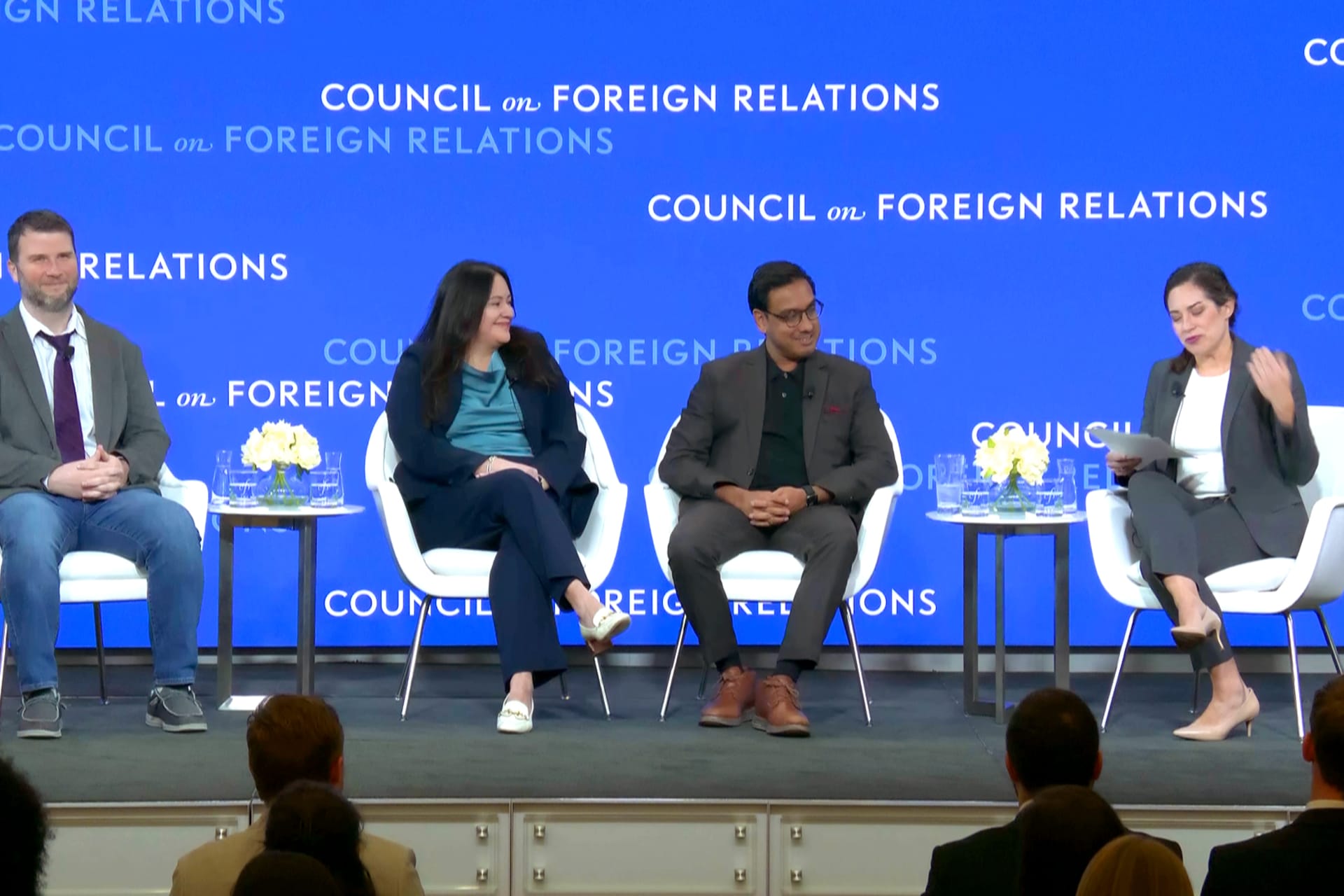
But tonight we have a fantastic lineup. To my left onstage we have Dr. Jumo Ayandele, an assistant clinical professor of transnational security at NYU, and a CFR term member; Inés Benomar, who’s associate program management officer and former American junior professional officer at the U.N. Office of Disaster Risk Reduction; and Luke Champion, first secretary for cyber, digital, and tech at the Permanent Mission of the United Kingdom to the United Nations. They bring together perspectives from academia, the U.N. system, and diplomacy that are genuinely hard to beat on this topic.
We’ll have about twenty-five or thirty minutes of conversation with the panelists on stage, and then some time for Q&A for all of you. For those of you in person, we’ll have mics around the room. So raise your hand when you’re called on, and stand and state your name and affiliation. And for those on Zoom, please click the “raise hand” icon on your Zoom window. And when you’re called on, accept the “unmute now” prompt and proceed with your name, affiliation, and question. And just note, for all of you, that the discussion is on the record.
So, with that, I’ll turn things over to our presider for the evening, someone who is especially well-suited to lead this conversation. Tony Oweke is a research fellow for artificial intelligence here at CFR and former digital advisor to the Permanent Mission of Kenya to the U.N. Tony, the floor is yours.
OWEKE: Yeah, perfect. So, first of all, welcome to the Council on Foreign Relations, and today’s iteration of the Early Career Professional Series. We’re very excited to be here. Today’s additional focus on the U.N. General Assembly, and will hopefully serve as, like, a curtain raiser for the big meeting that is coming in two weeks. As mentioned by my colleague, I’m a research fellow on artificial intelligence here at the Council on Foreign Relations. And I will be presiding over this meeting. Prior to this I was a diplomat for the Kenyan mission to the United Nations.
And I’ll just start by, like, framing our discussion. So the eighty-first session of the General Assembly was opened three hours ago, under the theme “Restoring Trust, Managing Transformation: A United Nations That Works for All.” And the annual high-level week will occur between the twenty-second of September and the twenty-eighth, and will cover, amongst other issues, global cooperation, climate action, rising sea levels, and health security. Now, the elephant in the room is that this will be the year, the U.N. General Assembly calendar year, in which the next secretary-general will be chosen. We have, so far, eight candidates. We’ve had two straw polls in the Security Council. But yet, no recommendation. And so no one in this room really knows who will take over on the first of January. But we do know, and we can depict to a certain extent based on our areas of expertise, what will be waiting for them when they assume the position.
So tonight, as opposed to focusing on who—which has been covered extensively elsewhere, including at the Council on Foreign Relations; we actually have a series on the next secretary-general—I would like us to focus on what. And today in the panel we have three people who work on very different pieces of the “what.” (Laughter.) You have their bios and they’ve also been introduced by my colleague, so I’ll skip that part and just go a little bit into the format. As mentioned, we will have thirty minutes of conversation, followed by a Q&A. And the conversation will be structured by three rounds. And each participant will be asked one question per round. And at 6:30, we’ll open up the floor to the Q&As. And we will endeavor as much as possible to have a balance between in-person participation and those who are joining us on Zoom today.
And before we dive into substance, and because this is a session on the Early Career Professional Series, I would really like to give each of the panelists here today forty-five seconds to talk about a decision that determined their career trajectory to this date. So we’ll start with you, Dr. Ayandele, followed by Inés, and then Luke. So, Dr. Ayandele, please.
AYANDELE: All right. Thank you very much. It’s a pleasure to be here. I would say, the driving ethos for why I do what I do is to center African agency when thinking about global affairs. And that’s because when we think about the continent, we think about it as something being done to, versus Africa actually producing knowledge for global order, for global debates, resilience when it comes to communities. So I started off following the money. I did my undergraduate in economics. And then I went into security for my Ph.D. And that’s what I’ve been doing for the last decade, trying to understand what African governments are doing when they are trying to address security, how they translate threats, who they decide to partner with, how communities are viewing security themselves, and how that is shaping global debates, especially within this geopolitical climate that we have today.
OWEKE: Inés, please.
BENOMAR: Thanks so much, Tony. And it’s a pleasure to be here. So I think for me the one turning point was my undergrad dissertation that I did in environmental migration. And I think then it really led me on this path of trying to understand the linkages and what drives environmental migration, and the losses and damages and other interconnected areas of work that make it so that communities have to, you know, migrate from where they’re from because of the impacts of climate change. And that led me on a path of doing a master’s in environmental policy and regulation, and then redefining this niche of work at the time on loss and damage, which has now become a really big thing in the climate sphere, and then on adaptation financing as a whole. And I think bit by bit it drove me to more work on disaster risk reduction, which is what led me to my position here at the U.N. right now. I originally started three years ago as a U.S.-funded JPO, and then transitioned to a more permanent position. And, yeah, that’s some of the work that I do on a day-to-day basis now at the U.N.
OWEKE: Thank you. Luke.
CHAMPION: Thank you very much, Tony. It’s really great to be up here with you as well, from our time negotiating together. And you are sorely missed down at the U.N. as well, but I’m glad CFR has you now.
A decision for me, odd to say a decision, perhaps. I don’t think this is particularly repeatable or necessarily a piece of advice. But I joined the cyber division of the FCDO about six years ago now. And a year after that the Ukraine war kicked off. And at the time I was doing programs around the world to build capacity of different nations to defend themselves. And when the Ukraine war broke out, I got a message from my boss at the time overnight saying, we’re going to need to put someone on this. Who do you think it should be? (Laughs.) And so I decided, right, well, I can’t say—I can’t say no to that. And it was a very pointed remark. If you’d met my boss you’d know that what he was really doing was volun-tolding me to go do that. But it was my absolute privilege. And through that process I learned so much about cyber defense, and managed to kind of build the credibility needed to come be first secretary here in New York and negotiate resolutions on cyber, digital, tech, and AI. All of which I’m still learning a lot in, but very, very pleased to be here. So that one decision, I think, very much changed my course.
OWEKE: Hmm. Thank you. Thank you. Very interesting. And I’m sure you’ll have a number of questions when we have the cocktail reception after the session. But for now, I would like us to commence with round one, which is really an opportunity for each of you in your area of expertise to highlight trends. Sort of setting the stage for the second round, where we will look at the challenges these trends will pose for the incoming secretary-general.
So, Dr. Ayandele, how terrorist groups raise money is changing fast, moving into cryptocurrency, online gaming platforms, and social media fundraising. The net effect of which is making it incredibly difficult to trace the source of said funding. Your research has covered this, to a certain extent, with armed groups in Nigeria. And we know that we have the Financial Action Task Force, which has recently indicated that two-thirds of governments that should be responding to terrorist financing have astonishing failures both in investigating and prosecuting. When that shift is that visible and enforcement is failing that badly—and by a shift, I mean the shift in how terrorists are sourcing their financing—what is actually stopping governments from closing the gap?
AYANDELE: Wow. OK. This is the million-dollar question. I’m going to try to answer it in two minutes. OK, I don’t think it is a capacity problem. I think it’s more of a speed problem. And you have pointed out that armed groups are able to move funds, whether that is through digital platforms, through banks, through cross-border transactions. So we have that on the one hand. And then we have the institutions that are supposed to be tracking them. It’s not a situation of they aren’t coordinating, but they aren’t necessarily being efficient. And I’m going to use a real-time example that we observed when I was doing a little bit of research over the summer.
So a few weeks ago we had seen on TikTok Live that some armed bandits, some people called them terrorists, had gone live and they were doing a giveaway. They do consider themselves influencers. And this giveaway was asking their viewerships to post their account numbers for them to give them money, right? And people were actually posting their account numbers. For me, I was flabbergasted. Your identity is online for everybody to see. But for these groups, it was a situation of them displaying power, for them showing and attracting followers and attracting attention.
Now, on the surface, you would think this is something that can be detected. We can see the bandits, the terrorists, right? We can see the accounts. And we can see that it’s happening live. But then, on the surface, when we think about the institutions, TikTok is the one hosting the livestream, right? The banks are the ones that hold the records. Maybe the Nigerian authorities are the ones that are able to trace who these bandits are. And if they were even going to prosecute, the data that they need is outside of the country. So all of these institutions need to coordinate. And that usually takes months or weeks, if we’re being fast. But this money is disappearing in real time. And we know this money is being gotten from kidnapping for ransom, or extortions, or the sale of weapons.
So I think we do have a speed problem. And that’s the issue. We aren’t proactive. We’re very reactive within this space. But it’s not all doom and gloom. I think that African countries are aware about the hybridity of what’s going on. But it’s a situation of, yes, they might know who the actors are, yes, they might know what the networks are, but when it comes to the platform that they need, they’re not in charge of it. When it comes to the speed at which actors are supposed to coordinate, they’re not in charge of it. And this is where international systems can come together, if we really want to close that gap.
OWEKE: Yeah. Thank you. Thank you very much. And now I’ll turn to Inés, which—I mean, your office, the United Nations Disaster Risk Reduction Office, reports that countries that have a comprehensive strategy for early warning systems experience up to six times lower mortality rates than those that don’t, when a crisis hits. But at the same time, the United Nations has established this goal for universal coverage of early warning systems by 2027. But as we speak, only 60 percent of countries actually have these strategies in place. And so, when the evidence of, like, the efficacy of these strategies is so clear, and yet there’s still an action gap by both governments and other regional actors, how can you explain this? Or, in your opinion, where does this originate from?
BENOMAR: Yeah. Thanks, Tony. I’m going to try to head deep—like, deep dive into the question a little bit. But, basically, the real obstacle with early warning systems and with implementation of early warning systems is not the one that’s the most obvious and that you’ll think about it right away. It’s not a lack of technology. It’s not a lack of satellites, right? The hardest part with early warnings, and it’s also the least fundable one, is what we call the last mile. So let me explain this a little bit.
I think with early warning systems, action actually is happening. And it’s happening really, really fast. For those of you who are not familiar with it, the secretary-general’s initiative on early warnings for all was first launched in 2022. And in 2022, we only had forty countries worldwide who were covered by an early warning system, or who were reporting having one. Now in 2025, we have about 115 countries covered in early warning system. So even though you say we have 60 percent of countries worldwide, there’s still a gap that we need to reach to meet, if you look at the decade wide, we have a 113 percent increase in countries having an early warning system. And that’s something really positive and that I want us to focus on as well.
And so where the real gap is with the last countries, and also with reaching—making sure that the mortality gap doesn’t heighten, is because an early warning system is not a product that you can buy from, like, a government agency, or, like, a technical agency, or an international organization that you just switch on and off when you need it, right? It’s like a chain that has four very distinct links. You need to know the risk. You need to forecast the hazard. You need to send a warning. And, once you send the warning out—this is the most important part and where there’s a bit of that gap on the last mile—is that communities and people getting the warning really need to know what to do, right?
So a warning won’t be worth that much if, one, you receive it too late, or if when you receive it on your phone you actually don’t have data for your phone to get the warning. Or if you get it, then you don’t know what to do, you don’t know where the evacuation roads are, you don’t know where the shelters are. And so I think this is where we need to bridge a little bit more of that work in making sure that at the U.N. and with governments we really work hand-in-hand and build partnerships to increase that last mile dissemination, right? And so to make sure that we do have that community preparedness so that even in countries where we have early warning systems, they reach everyone and they reach people who need them the most.
OWEKE: OK. So many follow-up questions for both of you so far, but we are very short on time so I will just move to Luke with the last question for this round. So, Luke, in July the United Nations’ new permanent cyber mechanism held its first substantive session. And this is the first universal platform wherein governments can work on cybersecurity. But it also took twenty years for this to be established. And up until this point, sort of the U.N.’s dedicated processes were disparate U.N. expert and working groups with fixed end dates. So now that we’ve moved to permanence, and despite the fact that it took us twenty years to get here, what has really changed? What should the audience and people who are not as informed about the U.N. machinery be aware of?
CHAMPION: Absolutely. We’re moving a little bit from the practical to the procedural here, but I’m going to say that permanence in the U.N., I think, is more than just a procedural detail. And I’ll explain that a little bit. I know I was thinking—when I was thinking about what I was going to talk about today, I was really concerned that when I turned up for my first day in the U.N. I think I hadn’t done enough model U.N. because I had no idea how the place worked, quite frankly. So I’m going to do my best to get this across in a clear enough manner as I can.
But, essentially, when we were rolling over we did four five-year open-ended working groups. And what that means is we met for five years to try and agree a final report that would update on the state of what all countries could agree, because it was a consensus mechanism, on what were the normative behaviors that should exist in ICT. So, what counted as use and what counted as misuse, essentially. And so when you’re running through those five-year cycles, the last year is largely obsessing about what is going to make it into that final report and what is your next five years going to look like.
So there’s an awful lot of agenda arguing that takes place as part of that. And it also means that as a state, if I want to resist it, if I’m if I’m fed up with how it’s working, if I don’t think it’s going anywhere, I can be obstinate for the full five years, and then cause it to fail with my vote at the end. Once we make this permanent, although it’s still a consensus mechanism—which means, yes, you can hold out for as long as you want—we’re still going to meet. Which means that the entire mechanism and all its other members, if you’re the last holdout, is going to be about convincing you to change your opinion. And so that’s a change, I think, in the state of play. You can’t just obstinately hold on to your beliefs.
I will say, though, I’m not going to pretend that it’s super-duper different, at the same time. I know you guys haven’t been in the open-ended working group. I know you haven’t been in the global mechanism. I’d be very surprised if you had. But had you been in both, you wouldn’t think they were particularly different, quite frankly. There’s a lot of similarities in the two, and that’s because there were lots of things that worked in the open-ended working group. But I wouldn’t say that familiarity is the same as kind of uneventful, as part of that.
And so the part I would leave with you today here is that sometimes when we do things at the U.N., procedurally even, we look at what happened and then we start assessing what happened, and we forget what otherwise might have happened. And I think those four terms over five years that got us to a permanent mechanism was not a given. And when that last decision to become permanent was agreed, had that not happened it leaves space for so many other things. And Russia actually had tabled a treaty on ICTs for a very long time. And it hadn’t really convinced anyone whilst the OEWG was there to talk about these issues.
But had it not been successful, and the global mechanism hadn’t become a thing afterwards and a permanent being, that treaty begins to become more attractive. And we might have been trying to force international law that many states weren’t comfortable with on others. And we would have ended up in this kind of very uncomfortable voting game and political game, moving forward agreement where it didn’t belong, then not ratifying things. And we’d be sat here talking about how the U.N. really failed to galvanize everyone. Instead, we’re keeping the discussion going and hopefully getting to a point where we can reach some success.
OWEKE: Hmm. And, on keeping the discussion going, it will feature in your second question in the second round, which I will turn to now. So on—again, we’d mentioned earlier that the secretary-general’s succession is a live process, right? And most of you, looking particularly at Inès and Luke, cannot comment on the candidates based on your affiliation, but we can focus on which issues will land securely on this SG’s desk. So I’ll turn to Luke.
You just mentioned quite specifically and outlined clearly the whole process by which we have established a cyber mechanism at the United Nations. Now, over the last couple of years the U.N., in addition to this cyber mechanism, established quite remarkable machinery on digital. We have a Global Dialogue on AI Governance. We have a scientific panel on AI. The relationship of both is supposed to be analogous to the IPCC and climate change and the UNFCCC. But, practically speaking, how are these entities supposed to contribute to how governments understand and govern the most transformative technology of our time? And what are we already seeing in the last three or four years that these entities have been established?
CHAMPION: Absolutely. OK, well, let’s jump into the understanding part first. I think that’s the easier part of the question to answer. Which I think, now that the Independent International Scientific Panel on AI has been formed—it’s a bit mouthy that one, isn’t it? It has two I’s in it, and scientific panel—but that’s now forty experts. I don’t know if anyone’s come across that before. It’s chosen from member states from across the world. We did actually vote on the full list of panelists that made it onto that scientific panel.
And I think that brings together a level of collective understanding. Its aim, at a very high level, is to look at the opportunities, the risks, and impacts of AI. And so now, whereas like the U.K. ourselves might have been referring to the AI safety report that we write, which is quite famous, we’re now all talking about the same risks. And, yes, theoretically that means that we’re moving from a conversation of practical risks and facts rather than policy differences. I think there’s some nuance to that take. But I do think that is going to grow our understanding. So all of you can go find that report online. It’s an interim report at the moment, but at the next global dialogue there’ll be a full one there.
I think—on governing, I don’t think the situation has changed anywhere as near as it has on growing that collective understanding. And there were many voices, including yours, I believe, when you were working with the Kenyan government, that wanted more hard rules coming out of the U.N. And I’m afraid that isn’t the decision or perspective, I’d say, of the U.K. and some of our other—some of our other friends. Which is that we think that national approaches need time to mature yet. So we don’t want to go and negotiate internationally at the U.N. whilst we’re still finding our own opinions.
And also, again, going back to the point I made with the permanent mechanism, it takes time to get 193 member states to agree to something and buy in. And forcing people to that negotiating table means that things aren’t later ratified and, again, we’re having this conversation about how we didn’t achieve some form of success in that agenda too early. But I think the global dialogue being formed—again, you’re asking what practically is going to happen—I’d really like to see that become place where regulators meet regulators, where countries that have formed working effective regulation can meet with other regulators at that level, who might go on to draft similar things.
And as we begin to do cycles of that, and we begin to create a bit of interoperability through that process, perhaps then we get to the level of agreement it takes to start having something come out of the U.N. and that we can sign together. And I do really hope that we get there in the long term one day, I believe, and start having some normative behaviors that eventually moves into the kind of governance that everyone can agree to. So that kind of—that kind of agreement is earned, though. It takes time. And I think it’s very dangerous when it’s negotiated too early.
OWEKE: Hmm. I see. Quick follow-up question. Do we have the time?
CHAMPION: Well, that’s a great—
OWEKE: The scientific panel that you and I spent hours designing—
CHAMPION: We did. We did. We did.
OWEKE: —(inaudible)—and has stated quite candidly that, you know, the technology is outpacing the pace of government. But also, the expertise within advanced economies that are producing AI systems is also lacking. So do we—do we have time to wait? Do we have time to rely on the United Nations?
CHAMPION: It’s a very good follow-up. And it puts me directly on the spot, so I love it. I think for the U.N., though, I’ll answer that, that I’d question—for the U.N., again, while I work in here—and I think you make a very strong point. If you were talking to a national regulator, I think that might be a different question. But for myself, working in the U.N., I’d sort of question whether the U.N. is really built for speed, with the 193 member states. (Laughs.) And I think we have to ask ourselves, is that what we really want from this institution? Or is it a place where eventually, when we get to that agreement, it carries the weight of every state’s name? And so I think we’re not going to optimize the U.N. any time soon for velocity. But I think, as you say, that that warning of do we have the time perhaps needs to go to national bodies, rather than international ones.
OWEKE: Mmm hmm. Thank you. And now I’ll move to Dr. Ayandele. I asked you in round one about the financing of armed groups and how this is evolving. And tracking that money runs through at least three separate systems—the United Nations’ own Office on Crime, the Security Council’s Counterterrorism Directorate, but also their Financial Action Task Force, which we mentioned earlier. So the new secretary-general, do they inherit one problem or three incredibly uncoordinated ones? And if so, what is the U.N.’s role in this area, if at all?
AYANDELE: In my own opinion, they are inheriting one problem. And it’s the ethos of this theme for UNGA-81, which is “rebuilding trust.” I say this because we have to be comfortable with this uncomfortable truth. All of these three agencies, whether it’s the Financial Action Task Force, UNODC, or UNCTED, they have been going to—and I’m going to use my specialization, Sub-Saharan Africa—they’ve been going to African countries for a long time, giving assessments, training, reports about how to show up their security and how to track a lot of these financial movements. And it hasn’t resulted into anything. You would even say some parts of Sub-Saharan Africa are now the epicenters of terrorism.
And for a lot of African governments right now, it’s a situation of who’s making the rules, who is going to decide what we should work on or coordinate on? I think that’s the conversation that is being had. And with the new secretary-general, they’re going to have to come into that space, especially given that national security is at the forefront of a lot of African governments and countries today. They have to come into that space. They have to rebuild that trust. And they have to work with African-led responses, whether that is with states, whether that is with African institutions, whether that is with communities. Because right now, you know, there is that lack of trust on what the U.N. is doing and how effective it is. So I think that’s the challenge that the new secretary-general is going to have to come in and address. And it’s a big one. I do not wish that on anybody. But, yes, good luck to the next secretary-general. (Laughs.) Yes.
OWEKE: And maybe just a quick follow-up question. Really, really conscious of the time. You talk about this coordination at the international level. And you’ve mentioned also sort of African solutions to African problems. Do you see this—what do you think the relationship will be between the regional economic bodies, ECOWAS, COMESA, et cetera. and the African Union when it comes to enhancing this coordination between the different actors who are looking at the problem of—
AYANDELE: They have to talk together. And they have to work together. And they are working together, I would say. There have been a lot of high-level meetings on how to coordinate. And this is where, you know, the example that I had given had come from. I would say this summer I actually worked with the AU and had some NYU interns. We were actually following the digital trail of a lot of these armed groups and terrorist groups. And we were briefing a lot of intelligence agencies on what’s going on. So there is coordination at the national as well as regional levels. And now it’s a situation of having the international system buy into how we are rethinking about security and how we are rethinking about these threats, and buying into African knowledge and actually solving a lot of these issues and problems.
OWEKE: Thank you very much. I’ll turn to you, Inès. So the secretary-general has explicitly acknowledged that we can expect at least a temporary overshoot of the 1.5 degrees Celsius threshold. And consequently, he’s mentioned that the U.N.’s priority will now be adaptation and resilience. At the same time though, the United Nations is increasingly facing very challenging decisions on how to allocate scarce resources, particularly in the context of UNDS reform, in the context of budget cuts that we’ve seen over the last three years. So to someone who is making the budget for the next secretary-general, what is the case for including disaster risk reduction, when every priority is competing with the same resources? And what will the next five years look like if not?
And I want to contextualize this question a little more, because there is a sort of political challenge that UNDRR faces in the sense that, like, prevention, which is your main area of focus, if successful, results in a disaster that’s not occurring. Which also means the efforts of your agency and the countries that undertake these strategies also do not get the platform as other issues. So how do you make that argument for consistent focus on disaster risk reduction? And what happens if that does not take place?
BENOMAR: Yeah. I mean, Tony, you’ve pinpointed to it directly in your question. I often laugh about it with my colleagues, that if disaster risk reduction fully worked I’d be completely out of a job right now, because essentially prevention is invisible, right? So if disaster risk reduction and prevention works, what you see is basically either a disaster that didn’t happen, or a death toll that was really low.
And that’s generally something that we think about often, because it’s something that’s hard to argue for in a budget when a government is thinking about their budget lines, when the U.N. is thinking about where to allocate resources. And then response, on the other hand, which is something that disaster risk reduction sometimes gets (mulled ?) into, is the complete opposite, right? It has a lot of visibility. And for the right reasons. Like, it’s important to know how many lives have been saved after an earthquake, or what happened when certain agencies have done work on the ground. And it’s something that’s visible, that you can count, that you can measure. But it’s also kind of what I want us to think about right now.
And so if I had to speak with, like, a pen holder, I think I would look at the numbers a little bit as well. Our global assessment report, which is the flagship report of UNDRR that we publish every year, last year had a specific focus on finance. And it found that for every $100 of ODA, only $2 went to prevention. Everything else happened afterwards. So, once a disaster hit. And also once costs are way higher, and when it does the least, right? The early warnings for all reports, and you mentioned earlier, it found that for every 100—or, for every $1 that you invest in early warning systems, you’ll have a tenfold return down the line on that. So it basically is the cheapest insurance policy that you can have. And it’ll give you the best return on your investment, right? And so that’s a bit the point that we’re trying to make with governments and with U.N. agencies as well, right?
And so I think prevention, you really have to look at it as a tool that you can use to stop or to really diminish a next crisis. Especially when we talk about climate adaptation, about disaster risk reduction, about geophysical hazards and natural hazards as a whole, right? Sure, you can cut it. You can cut the budget on prevention. But you’re not saving money. You’re basically handing yourself a bill further down the line, which will be way bigger. And when I say “further down the line,” I also don’t mean in the next ten years, right? You’re talking about the SG statements on overshooting. I’m talking about the next year, the next two years. And we’ve seen this happen over the last year.
I mean, the U.K. has recorded its highest summer on record in terms of temperatures. Heat waves across Europe have killed 16,000 people, most of it attributable to climate change just this summer. The floods in Nepal about a few weeks ago. Hurricane Melissa in Jamaica about a year ago was a category five hurricane. I think it was one of the only ones in the last few decades that was that high and that affected so many countries along the way, right? And so what I like to think about, and what we think about a lot at UNDRR as well, is a simple question, right? Do you want to fund resilience, and you want to fund resilient societies? Or you just want to basically fund disasters, and give yourself a much higher bill down the line?
OWEKE: So we do have—thank you very much for all of your responses. We do have one more round, but I note that we are quite over the time. So for now, I’d like to skip it and perhaps we’ll come back to the questions later before we close. I would like to now open the floor to any questions that we may have from the audience in person, and also online. But first, bit of housekeeping. As mentioned before, this meeting is being recorded. And when you are asking a question, ask a question, not a statement. And please introduce yourself, your affiliation. And we really welcome all of your responses. So at this point, I would open the floor. And I and I trust my colleagues at CFR to help me with those questions that may be posed online. So I would like to open up the floor in case there are any questions. And I see the gentleman in the back.
Q: Hi. Thank you so much for the question. I’m Daryl. I’m with UNDPO.
And I thought it was really interesting that you spoke about cryptocurrencies and addressing armed group financing, terrorist financing. And there’s sort of an opinion among U.N. watchers and people in the secretariat that DPO and DPP are being relegated—or, in general, the U.N.—being relegated towards providing technical services to, you know, issues of armed groups and terrorism. And so what I wanted to ask you is, should the U.N. be adopting a more strategic political role when it comes to addressing the issue of terrorism? Should it—can it, in this era of Security Council dynamics? And, you know, is, in general, the issue of terrorism treated as too much of a technical issue within the U.N., or should it be treated as more of a sociopolitical issue? Thanks.
OWEKE: It’s a very good question.
We’ll maybe take one or two more. I see the lady in the front, please.
Q: Hi there. I’m Cherie. I graduated from Harvard Business School this May and was nominated by a professor.
I’m struck by how much business is entangled with geopolitical issues—from TikTok being a platform where terrorist organizations can fundraise to, of course, AI governance. My question is, how do you enforce businesses and business decisions? Is it on the individual level? Is it on an institutional level? Thank you.
OWEKE: That’s a very, very, very good question.
We’ll take one more.
Q: Hello. I’m Peter with Brevan Howard. I was nominated by my manager, Jason Cummins. He’s a lifetime member.
I hate to ask the cliché question, but a frontier model did, at least partially, solve Navier-Stokes today. So I wonder, in the next, you know, ten years what you think will be the key factors in terms of AI regulation that will distinguish emerging market kind of success stories, particularly through three areas if you can, you know, give some context of financing. Will the IMF model still work or do we need to change it, especially for more vulnerable central banks? Safety and environmental protection, the balance between owning your compute and maybe the consequences that can come with it? And finally, I guess geopolitically. You know, do we embrace the open models, or do we participate in U.S.-China, you know, technological fight? Thank you.
OWEKE: Thank you. And maybe if you could just please keep the mic with him, because I was going to ask him if he can contextualize the development where an open AI model solved one of the most challenging mathematical problems that we face. Maybe you can explain it for the audience so that—
Q: Oh yeah. So the—yeah, yeah. The Navier-Stokes is a millennium, right, puzzle problem about a direct solution of—you know, within the area of fluid dynamics. And I think it was—it’s been an open standing problem for eighty years in pure mathematics. And no one thought anyone was near solving it. Even five years ago they made a major breakthrough that was maybe, like, 5-10 percent of the way, you know, the top mathematicians estimated. And then, you know, very nearly—kind of, I think, a month ago, a few scientists, one Anthropic employee—so there was a kind of also media fight there—started working on it and asking Codex—which is an interesting choice, you know, for an Anthropic employee to try to solve it. Well, it turns out OpenAI recently published a Lean-verified proof of it. And people are debating whether—what part of it was Codex and what part of it might have been some chatlog snooping. So that’s a question, I don’t think—or, maybe some of us can answer, but definitely not me. But, yeah, that’s the context for the question.
OWEKE: OK. Thank you very much.
So now we’ll turn to the questions. And, Dr. Ayandele, please, to address the first question.
AYANDELE: I will try to rapid fire this question. And I’ll answer your question as to whether the U.N. can adopt a political role, or whether it should treat terrorism as a sociopolitical issue, versus technical. I think it has to do both. In the sense that—and this, for me, is what a lot of policymakers get wrong, especially when we get in the field. We tend to see communities as either those that are victims or those that are informants, right, in helping with counterterrorism strategies. And we need to shift that thinking a little bit. This is why the technical and the sociopolitical role comes into play. Because communities themselves are making calculations—calculations about protection, calculations about legitimacy, and calculations about survival.
And that determines, even when the U.N. comes in, who they decide to cooperate with, how they decide to cooperate, who they decide to resist, right, and who they decide to get protection from or justice from. And this is where that technical aspect comes in, because if we get that sociopolitical aspect right, then the technical expertise or the technical capacity building that we’re providing helps to shore up and helps to build that trust at the ground level, and then also it makes the government look good when it comes to their national security strategy. So that’s to your question.
With businesses, how do we enforce at the institutional or at the individual level? That that’s a hard one. That’s something that we’re going to be grappling with, with this particular U.N. General Assembly. With, how do we hybridize this? Because, again, they are private entities. They aren’t part of the international community. They are supposed to help the global economy. But when it is going against national security strategies or even global stability, what should be done? And who has overall access—or, rather, overall coordination with this? That’s a big question mark. I know the EU has done some level of coordination between states when it comes to social media platforms. Maybe that can be replicated in other regions and areas. But that’s still a big question mark. So we’re still—we’re learning as we go. Which is the interesting part, but the sad part, about it.
OWEKE: Thank you very much, Dr. Ayandele.
For the last question, I’ll turn to Luke. And feel free to also ask for repetition.
CHAMPION: Yeah, no problem. Do you want to do the enforced business question as well?
OWEKE: I think she’s offered—
AYANDELE: No, no, you can also go.
CHAMPION: I was going to say, you can do that really—I was going to say—
AYANDELE: That’s just my—that’s just my perspective.
OWEKE: We are very short on time.
CHAMPION: We are short on time. OK, I’ll skip.
OWEKE: It’s unfortunate.
CHAMPION: So this was a very interesting question with multi parts. And I’m trying to work my way through it. And, frankly, the sense I got from hearing you speak was that at some point you should be up here to talk about what you know. Sounds very interesting. But there were multiple parts to your question. So can I just ask you to repeat perhaps one? I can try and do my best. But to give you a bit more context—I know it’s a lot for me to be up here and look like I have a lot of answers. I negotiate AI for the FCDO. So sometimes when things get very technical it goes a little too far for me. But at the same time, I do think your question on open models, if you want to pick up on that one, is really, really interesting. Is how do the market dynamics work, and are we really in a race, so to speak, when one product might cost $15, $20, $50, whilst the other one you might be able to pick up for free. And that raises a lot of very interesting governance questions. But, again, don’t know how they interact with the U.N. at times. But, please.
Q: Yeah. So I guess we’ll go on the open model angle. My question is more, what is the trade-off, you know, in trying to participate between—in a geopolitical battle, and perhaps, you know, getting a platform, you know, access to frontier stuff, and maybe, let’s say, more expedient research, which is quite important with how fast progress is accelerating? Or do you want to be an open player in the market? You know, deal with the open models and, to some extent, still be exposed to potential cybersecurity, et cetera, capabilities or threats that they provide? How should emerging markets think about this? And what factor, do you think, in policymaking or international negotiation, cooperation, et cetera, will determine potential success in the next five or ten years? I know it’s impossible, but maybe even in the next one or two years, you know, with how AI is going. Yeah.
CHAMPION: OK, still multipart, but I’m going to do—
Q: I guess—sorry. Yeah, whatever part you feel. I don’t know what part you would tackle best, but, yeah, pick your favorite.
CHAMPION: Yeah. So I think—I think the emerging market—thank you very much. And I think the emerging markets question is an interesting one. I read a report recently that some of the open models were very, very quickly harnessed and used for nefarious purposes within, like, a matter of hours and days, I believe. And that a lot of the models being used, as you might expect, are for cyberattacks and increasing the accelerating volume of those, are those models.
And so I think there’s an open question about what do you do when the countries producing those don’t regulate, and in your own country you’re also not providing particularly, like, a high level of regulation from the state as well? So how do you tell another state that you need to regulate these and don’t regulate your frontier model ones? And we got asked a question about enforcing the rules, which I think intersects with this partly. Which is, is it done on the individual level? These companies are also making choices. So the choice to have a potential voluntary framework in the U.S. on AI and what rules you should roughly follow, making sure models are checked before they’re released. There was the Mythos moment.
I think on the same end of the spectrum, I don’t think it’s in another country’s interest to have firms in their country releasing open models that then subsequently get used for harms and misuse on a regular basis. So I don’t have the exact answer to that. I’m not an expert in the area. But I’ve got a level of faith in this one area that there are enough incentives that are both diffuse and also particular that some of these issues will be tackled over time. And I think, you know, perhaps to use a theme from cryptocurrency in fact, like, knowing your customer, and who’s using it for what, and those red-teaming exercises and tracking what kind of inputs are going in are absolutely essential in open models as well. But, yeah, it’s a very interesting question. Let’s catch up after this, because you sound like a very interesting person.
OWEKE: Thank you. I see that we have one question online.
OPERATOR: We will take our next question from Felipe Jafet.
Q: Hello, can you hear me?
OWEKE: Yes.
Q: Thank you so much for the conversation. My question is about an underlying assumption that I’d love to hear your take on. There seems to be an idea or premise accepted there that the United Nations’ credibility to deal with these issues is the same as it was decades ago. And there seems to be, in my opinion, a substantive part of the population that questions whether the U.N. is the right organization for that and the right international organ to create that dialogue and that global cooperation that you’ve talked about. What steps is the U.N. pursuing to increase its credibility, especially towards the more isolationist part of the political spectrum?
OWEKE: That is a great question.
AYANDELE: I will let my U.N. colleagues take this one. (Laughter.)
CHAMPION: Yes. Nice one. Are we doing—
OWEKE: Very diplomatic of you. (Laughter.) Wait perhaps, just to give the panelists a bit of time to prepare their response. Are there any other questions that we can take online, or? This table over here.
Q: Hi. I’m Andrea Casique. I just recently graduated from Georgetown University in Washington, D.C.
My question is, there’s a lot of, I believe, targeting at the Global South by datacenters—AI datacenters, and the growing interest in opening these datacenters down in, I’m using South America as an example. It’s my area of expertise. I was wondering what mechanisms are being talked about or put in place in order to curve a targeting on the Global South. There is—obviously these companies are going in and talking about that they provide an economic growth for the population, but there’s studies out of Brazil and Chile saying that that is not, in fact, true, but the inverse is happening. So, yeah. That’s my question. Thank you so much.
OWEKE: OK. So I don’t see any more questions. So I will turn to the panelists, if anyone would like to take the first question.
BENOMAR: I’m happy to jump in on the U.N. question, with the caveat that often the U.N. is seen as, like, this one big organization that does one thing, right? The U.N. does so many things. It works on, like, food and agriculture, telecommunication agencies, health, women’s and reproductive rights, climate change, political peacebuilding missions. And so I’m going to look at this question from the disaster risk reduction perspective. And I think in our field we’ve seen real, real progress with the work that the U.N. does, and that we’re able to do in partnership with countries on DRR. There’s been enormous work on early warning systems, like I’ve mentioned before. In terms of mortality rates, because—with regards to natural hazards and disasters, we’ve seen over the past twenty years a 90 percent decrease in mortality rate after a disaster.
And that’s something that we were able to do because, through the U.N., we’re able to work hand in hand with governments to deliver resilient infrastructure in an earthquake-prone area, for example. We worked a few years ago with the government of Nepal, which is a very earthquake-prone area of the world. And in the Kathmandu Valley, as an example, we worked with 150 schools to work on the resilient infrastructure of the school and to basically retrofit all the buildings to ensure that they’re resilient to earthquakes. In 2015, when the earthquakes, I think it was a magnitude seven earthquake, hit Nepal, out of the 150 schools that we worked with Nepal with, not one fell after the earthquake, right?
And so I think, you know, the U.N., it has its weaknesses and it has its challenges, especially right now. But it remains one of the only organizations where you’re able to do this work at the international level, especially for UNDRR, and for the work that we do on disaster risk reduction. I think in terms of, you know, the second part of the question on international cooperation and, like, isolation of countries, maybe that one is better left to my other colleagues who work on these issues a little bit more. But, yeah, I think from my side, that’s about it.
OWEKE: Who would like to take the second part of the question?
CHAMPION: I can’t take the second part, actually, but I really want to answer the first. Is that all right? Can I build on what she’s already said? Which is just I find the credibility point just so interesting, because I joined the U.N. about a year and a half ago now. And the idea is really interesting. I meet so many interpretations as you—as you kind of pointed out, of what is the U.N. for? And I find that the majority of people view it as this kind of monolithic thing that is being criticized a lot for not achieving X, or Y, or Z. And I think it’s easy perhaps to forget because where we’re born in time—and I know this because I’ve kind of gone back and read foreign policy articles that pulled out the original people who reviewed the U.N.—that it wasn’t really meant to supersede the nation state, if that makes sense. It wasn’t given those powers. It could have been given those powers, but it wasn’t given those powers when it was formed.
And so people expect very large agreements and declarations that are enormously effective out of it. But none of the members turning up are negotiating for that at the moment. And it’s often those that go in with that negotiation that are the ones pointing toward it and saying that it isn’t achieving something, which doesn’t make, I think, a lot of a lot of sense, at times. So I’ll say I think we’ve probably lived through a very special time in multilateralism. And I think the SG’s great challenge here is, how do you reset the expectation and start delivering against that? And that requires a recalibration.
This isn’t something I think the previous SG could have predicted and then leaned into. On AI, how much should we expect out of the U.N. from a new technology as a place where—as I’ve kind of gone over in my talk—a place where you need 193 member states to agree to really get that good sense of motion and ratification of law. So I wouldn’t—I would be careful. I think the U.N. lost a credibility that perhaps it never really should have had, and was perhaps overpunching where it is. But I hope it returns to it one day, because I think it does great work when it does. (Laughter.)
BENOMAR: No, and, actually, if I can jump on what Luke was just saying, right? When people—it’s exactly what you were saying—when people think of the U.N., they think of this one, like, monolithic organization, right? But the U.N. is 193 member states. And one thing that I hear often, and that I really agree with, is that the U.N. and the SG is only as strong as its member states, right? So if you have a few who decide that they want to completely not show up to a negotiation, then that’s OK. But then you can’t blame the outcome, right? And so what the SG and what the U.N. can work with is only what member states are willing to work with, and what are willing to put on the table on, like, the many various topics that the U.N. works on.
AYANDELE: So it seems to me like the U.N. has a PR problem. (Laughter.)
OWEKE: Despite our best efforts. I think we have one more question, which will be our last considering the time. It’s online.
OPERATOR: We will take our last question from Sofia Ramirez.
Q: Hi. Good evening. Thank you so much for your time.
My question, I think, touches on one of the last comments made right now on the panel on having certain member states withdraw, decide the U.N. potentially isn’t the best mechanism in order to bring about the change that said member country wants to see. And, of course, you’re sitting in New York. I personally am not, but you are in New York, next to the headquarters in the United States. And I’m wondering now, like, a year and a half into the Trump administration, how you’ve seen the United States different—not only different positions, withdrawals from different U.N. bodies, U.N. organizations, change the work that you do? I think, from an outsider’s perspective that doesn’t have multilateral experience, maybe we might be outweighing, maybe not, the impact that, you know, the U.S.’ position on various issues and the withdrawal of various bodies has. Has it gone back to business as normal, if that was ever a thing? Just would love to get your perspective on how the United States’ changing stances on interactions with the U.N. impact your work. Thank you.
AYANDELE: I can go first. It’s forced me to definitely be more creative with my partnerships. So usually I have had some consultancies with the U.N. I have briefed the Security Council. But with everything that’s happened with the Trump administration, I’ve been a little bit more creative with who I have decided to partner with. And it’s been very interesting. So, for example, my summer research, which was following the digital trail, that was all private sector. I would never have thought about that if I wasn’t forced to think outside of the box. So, kudos to the Trump administration for forcing me to go outside of my comfort zone to look for money. (Laughter.) Yeah.
OWEKE: Does anybody else—would like to respond to—I know you guys are, to a certain extent, tied with what you can say, being a diplomat and working for the United Nations. So if you have anything to say, I can pass you the floor. If not, we can also close, because we are at time. And I would encourage all of you to attend the reception between 7:00 and 7:30, where you can ask some of these questions and perhaps receive more candid responses than you can right now. (Laughter.) So, yeah. With that I would like to close the meeting. Thank you, everyone, for joining today’s discussion. And thank you to our panelists. (Applause.)
(END)
This is an uncorrected transcript.