U.S. Strategy in an Era of Rising Conflict
Event date
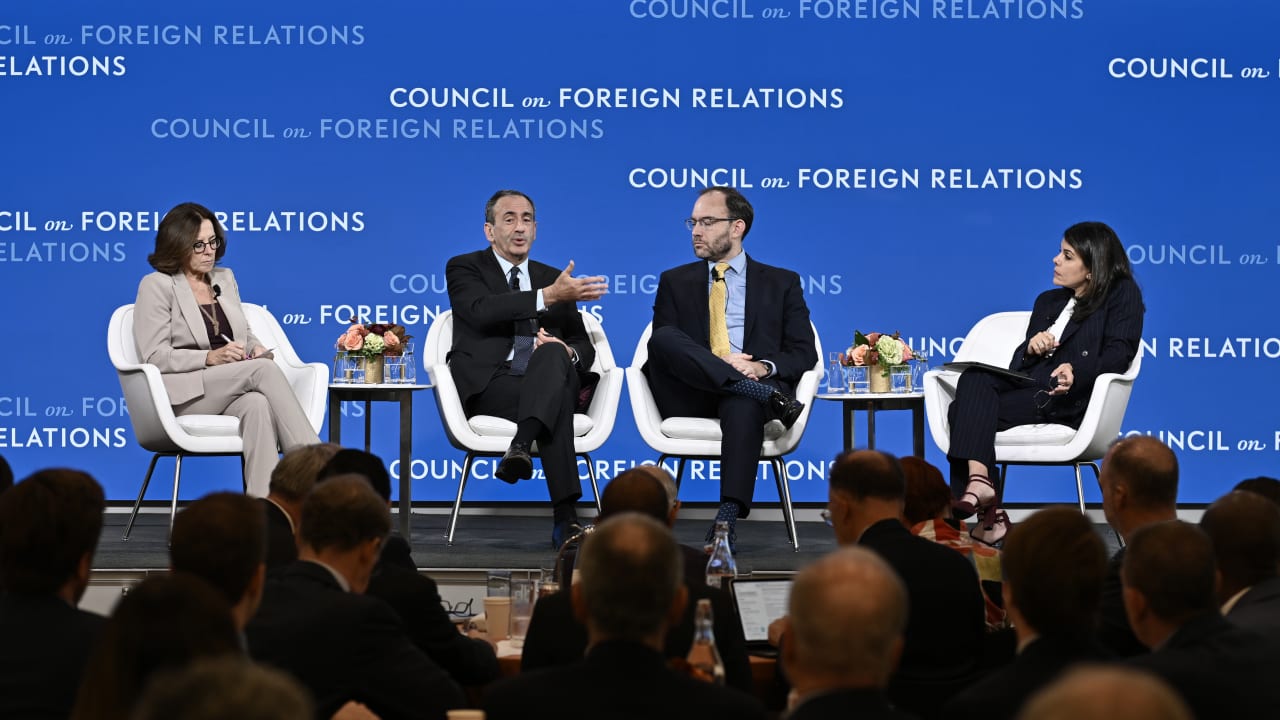
Speakers
- Senior Fellow, Hudson Institute; Former U.S. Deputy National Security Advisor for Strategy (2018); CFR Member
- Andy BakerManaging Director, American Global Strategies; Former Deputy National Security Advisor to the President and National Security Advisor to the Vice President (2025–26)
- Sydney Stein, Jr. Scholar, Strobe Talbott Center for Security, Strategy, and Technology, Brookings Institution; Former U.S. National Security Advisor to the Vice President (2022–25); CFR Member
Presider
- Staff Writer, The Atlantic
Introductory Remarks
- Paul B. StaresCFR ExpertGeneral John W. Vessey Senior Fellow for Conflict Prevention and Director of the Wachenheim Center for Peace and Security, Council on Foreign Relations
Former senior U.S. government officials discuss the implications of a more conflict-prone world and how the United States should manage this growing challenge.
The Wachenheim Center for Peace and Security advances rigorous research and practical policy recommendations to help the United States prevent, mitigate, and resolve armed conflict. Through analysis, strategic dialogue, and direct engagement with policymakers, the Wachenheim Center works to translate ideas into tangible outcomes for a more secure and peaceful world.
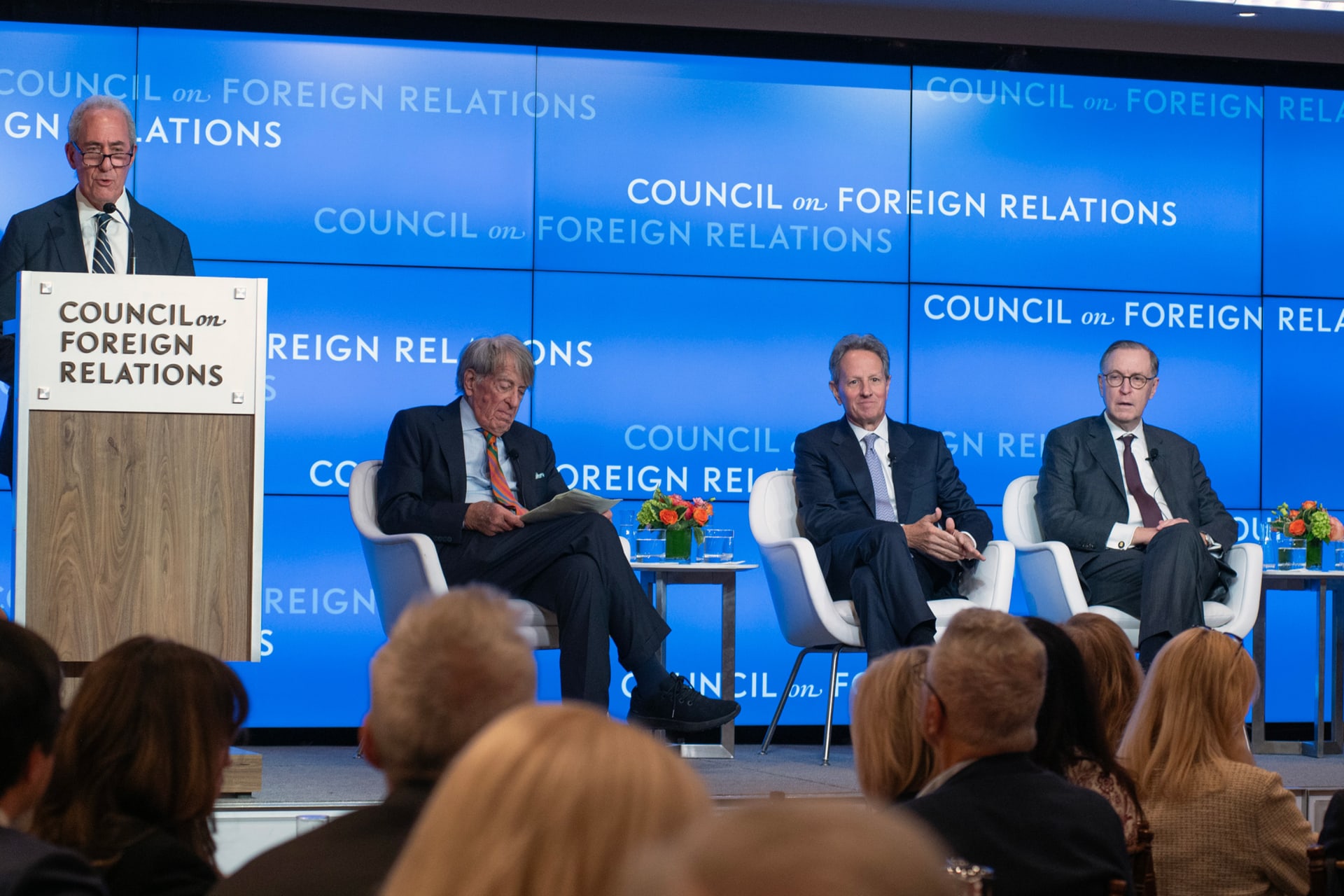
STARES: All right. Let us begin. Thank you, Sam. Everyone can take their seats. So good day, everyone, and welcome to the first of what we’re planning to be a series of general meetings organized by CFR’s newly established Wachenheim Center for Peace and Security.
Most of you know me, but I’m Paul Stares, senior fellow for conflict prevention here at the Council, and also the inaugural director of this new center, which was made possible with an extraordinarily generous gift by Sue and Edgar Wachenheim, who I hope are joining us today too. Their motives in making what is in fact the largest gift to the Council in its hundred-year history I don’t think are particularly hard to divine. In short, the threat to global peace and security today is without question greater than it has been in many decades.
Last year, researchers recorded sixty-five conflicts around the world, the most since the end of World War II. Part of this trend is also seeing the reemergence of interstate conflict; again, last year we saw eight such conflicts, which is the highest in fifty years. The international norm against the use of force, including against each other’s capital cities, is clearly eroding. I think there were nine or ten such cases last year in which a state attacked the capital of a—of another state, quite an extraordinary development that no one would have predicted maybe five, ten years ago.
Needless to say, the humanitarian consequences of this upsurge in armed conflict around the world has been horrific. Just in 2026 alone, over 200,000 people have been calculated to have died. The U.N. also calculates at the end of 2025 118 million people have been forcibly displaced by conflict.
This toll, however, I think would—everyone agree here would pale beside the consequences of a major-power war involving particularly the use of nuclear weapons and other weapons of mass destruction. Sadly, the risk of a nuclear conflagration is also rising.
So the imperative to manage and better still reduce the growing risk of armed conflict around the world cannot be overstated, and it is the driving imperative for this center that we’ve established.
While we are still a new center at the Council, we’re already pursuing a lot of activities, principally along three lines of effort.
The first is exploring ways to what we call preserve the great-power peace that has more or less stayed that way for the last eighty years. This involves efforts to anticipate the most dangerous flashpoints where a major-power conflict could erupt, as well as develop new crisis-management skills.
The second is to reimagine and revitalize how we approach the prevention and management of armed conflict. We clearly need to rethink and reorient the approaches that have dominated these efforts to this new era. We have studies underway exploring the role of how artificial intelligence could be used in positive ways for conflict management, as well as how we can reinvigorate various international organizations—the U.N., obviously, as well as regional bodies like the AU and the EU.
And, thirdly, we are exploring how we can directly support peace efforts in conflict-affected regions—notably in Ukraine, the Horn of Africa, and Myanmar, three of the most deadly conflicts in the world today.
In each of these areas we are trying to be innovative, and explore other ways to make a difference beyond simply producing more reports and more policy reports and briefs. We all are deluged with these. But—so we’re trying to actually make a difference on the ground.
If you want to know more about what we’re doing in this new Wachenheim Center, I encourage you to visit our webpage on CFR.org and I’d also be happy to talk with you—any of you after the meeting.
With that introduction, I will now hand over to Vivian and our terrific panel today to begin a conversation on what U.S. strategy should be to manage this new era of rising conflict. Again, thank you for being here today. (Applause.)
SALAMA: Hello, everyone. Thank you, Paul. Thank you to CFR. It’s always great to be here and to see so many familiar faces here in the room, and also know that many are out there joining us virtually as well. I am Vivian Salama. I am a staff writer with the Atlantic, and I’m really thrilled to be here.
Just a reminder before we get started: This is an on-the-record event and I am going to be taking questions for our panel about halfway through, so get your questions ready to go.
Our panel needs no introduction, but just in case to my right we have Andrew Collison Baker. He’s the managing director of American Global Strategies, and until very recently he was deputy national security advisor to the president and national security advisor to Vice President Vance.
Phil Gordon, Sydney Stein, Jr. scholar and Strobe Talbott Center for Security, Strategy, and Technology at the Brookings Institution. And his most recent administration post was for as national security advisor for Vice President Kamala Harris.
And Nadia Schadlow, senior fellow at the Hudson Institute. And her most recent administration post was as former deputy national security advisor for strategy for President Trump’s first term.
So thank you all so much for being here.
There’s so much we want to talk about today. The title of this panel is “U.S. Strategy in an Era of Rising Conflict,” and certainly no shortage of things to talk about there. One of the things that strikes me kind of going into this discussion is that we are seeing the largest outbreak of armed conflict essentially since World War II, and so I want each of you to sort of reflect on why that might be. Does it have to do with structural factors or shifts in the global order? Is it a great-power competition or fundamental changes in U.S. commitments? Andy, I want to start with you. You know, what—how do you describe this moment that we’re in right now?
BAKER: So, yeah, reflecting a little bit on are we in an increasingly multipolar moment, right, I would actually argue to the contrary; that, you know, multipolarity is something that folks have been talking about for the last twenty-five years, I think oftentimes as a placeholder for American decline, right? It’s an idea of how do we manage America’s inevitable decline in the world. The truth is we haven’t really seen a multipolar world order emerge. If anything, I would say the world today is more unipolar in many ways than it was twenty-five years ago.
And there’s a there’s a number of reasons for that, right? Number one, if you think about the world at the end of the Cold War, the United States and Europe had very, very capable forces, were broadly equivalent in terms of economic strength and potential. You know, Europe in many ways was a—was a much greater economic power than the United States at the end of the Cold War. And so if you think about Gulf War I, you think about the world of the 1990s, you know, the ability of the Europeans to project force around the world, to move forces around the world, to fight side-by-side with the United States—and you know, Gulf War I, I think, is a really important—you know, a really important example of this. You know, very solid.
Here we are in 2026. The United States is in fundamentally a different universe when it comes to its ability to move forces around the world to project power, but also in the way that it conceives of and conceptualizes power, right? The United States doesn’t just move things and people around the world; it moves data very effectively. It has extraordinary high technology that it brings to bear in fights and conflicts all over the world. So the United States generates options still.
Europe is really nowhere to be found in this mix. And if you think about many of the areas, you know, Europeans have been talking for the last, you know, really twenty years about this ring of fire that surrounds Europe—whether it’s North Africa, the Middle East, Eastern Europe, right? You know, why is that? Well, the reason is, you know, over the last twenty-five, thirty years the United States has been exhorting Europeans and European leaders to be better allies, to pick up the burden of actually being an ally of the United States, and that often hasn’t happened. And you know, there’s kind of this joke, you know, authors always want—authors tend to judge one another based on what they—what others have written; they want to be judged themselves based on what they are going to write. And Europeans have had this way of holding the place open with: Hey, we’re picking up our—you know, we’re pulling up our socks. We’re picking—we’re picking it up. We’re going to do better. And then they don’t, right? And that’s been the story of the last quarter-century. That’s really been the story of the last thirty years. Really, where that leaves the United States is in a position where it is picking up the bill for maintaining order, whether that’s in Eastern Europe, in Africa, in North Africa, in Central America, in Southeast Asia, in the Middle East.
You know, the other thing that’s really fascinating about this, we’ve heard time and time again that China is this rising power. What’s really fascinating—and this has actually been, to me, really remarkable over the last couple of years—is how often China has not responded, right? The most forceful thing about China oftentimes over the past couple of years has been the force of China’s disinterest in conflicts around the world. You know, China is interested in what it can get in the immediate, and this has often made China a less-than-stellar partner around the world whether you’re talking about sub-Saharan Africa, Southeast Asia, or elsewhere. China has been unwilling to develop a theory of order or a theory of governance around the world that actually enables it to lean into, you know, maintaining or creating some kind of alternative order.
So you actually have a really interesting situation now where, you know, the United States is more or less singlehandedly left holding the bag all over the world. China has a great deal of hard power, but is often unwilling to exert it. And Europe has the capacity to reinvent itself to develop a lot of new ways to, you know, have an impact in the world, but has also chosen not to develop that. That, I think, is a really, really interesting situation, and it’s one that creates a lot of clear strategic challenges not only for the United States but for countries around the world.
SALAMA: Phil, pick up on Andy’s comments. You just got back from Europe. You were saying—you also wrote an excellent piece on the conflicts in the Middle East for Foreign Affairs last week. You know, what are you hearing from allies around the world as far as America’s commitment? Is it a—is it America’s retrenchment, either now or just kind of broadly across the political spectrum, that is creating this environment that we’re in right now where there’s tensions all over the world, or is it—is it something else? Do they see the onus on them, as Andy was basically saying?
GORDON: Thanks, Vivian. I think they see a sort of perfect storm of threats rising at the same time that there are questions about whether they can count on the United States.
And I can start with Europe, where, as you said, I just returned from. And there you have—I mean, and this has been growing—you can go back to 2014-2015 Crimea, but then, obviously, the full-scale invasion of Ukraine in 2022, but even more recently—what is I think a still-underreported increase in whatever you want to call it— hybrid war, shadow attacks—in Europe and NATO countries as we speak. People are rightly focused on the biggest land war in Europe since World War II, and the tens of thousands or hundreds of thousands of casualties there, an invasion of a sovereign democratic country. It should get all of our attention, and there is increased anxiety, appropriately. But at the same time, you have Russia undertaking a range of other operations, including in NATO countries.
I was in Berlin. We don’t talk about it much here, but people understand that an explosive-laden drone was found in Leipzig that didn’t kill a bunch of people, but could have and was designed to do so. That would be an attack on a NATO country—on top of assassination plots and attempts, cyberattacks, other airspace incursion, drone attacks, attacks on shipping in the Black Sea as well, undersea cables being cut. My point is, Europeans are deeply anxious, and have every reason to be deeply anxious, because the Russian threat is real. Anybody who thought that invasions of sovereign democratic countries was a thing of the past, like, you know, the Ukraine invasion was just a reminder that it’s not necessarily a thing of the past. So that’s on that side of it.
And then, yes, to your point, there is increasing concern about the United States and the ability of Europeans to rely on the United States. That has been growing for some time. Article 5 in NATO still exists. That is the main mechanism for defending Europe. But there are questions about what it means in the eyes of the president of the United States, who has made it conditional, says it depends on whether Europeans pay their bills, now undertaking a force posture review that looks like it could be removing U.S. troops from Europe at the very time that this—the Russian threat is rising. So that, on top of diminishing U.S. support for Ukraine, which Europeans continue to see as core to their national security interests.
The timing of my trip was interesting because I think Europeans had broadly started to come around to think we were in an OK place. Ukraine had stabilized. Trump wasn’t leaning too hard on Zelensky, even had said some nice things recently. And then all of a sudden, in a week you get the agreement to buy diesel from Russia that the Europeans feel would fuel the war in Ukraine, and then these harsh comments on Zelensky, and then the still-mysterious cutoff of Starshield and potential intelligence. So that is to say that these two things, a rising threat and increasing questions about the United States, leads to an awful lot of anxiety, at least in Europe. We can talk about the other regions as part of the discussion.
BAKER: Although, if I can—if I can just come in really quickly, Phil, I think that’s a really excellent statement, but what’s left out of it is, what are the Europeans actually doing? You know, and I think if you want to—if you want to go to the heart of, you know, the U.S. problem with Europe, not just under this administration—this was an Obama thing, this was a Bush thing, right? This actually went all the way back to Clinton and Madeleine Albright as well. It’s been a—it’s been a point of continuity in U.S. foreign policy for over a quarter-century now. What is the actual European response to any of this, aside from handwringing, pearl-clutching, and anxiety?
GORDON: Well—
SALAMA: Well, I also want to ask—Nadia, one of the things that I want to—I want to ask is, you know, in the era that we’re living in right now where you hear politicians on both sides of the aisle insisting that we are not the global policeman that we used to be; you know, to Andy’s point, you know, the days of the Bush administration’s wars, or let’s say the Obama administration’s wars, are a thing of the past, and we have to prioritize domestic issues; but obviously, there are certain priorities that are essential, certain commitments that are essential. What are those commitments now?
SCHADLOW: Well, first, I’m going to go back and answer the first question—
SALAMA: Please do.
SCHADLOW: —because I think we’re sort of having two—we’re having two conversations.
SALAMA: OK.
SCHADLOW: One is a conversation about causes of conflict, right? That was the first question. Why are we seeing so many conflicts break out?
SALAMA: Right.
SCHADLOW: The second—the second part of this discussion has been why is the U.S.—why are the U.S. and our allies limited, essentially, in our agency to do something about those conflicts?
So, in causes of conflicts, I would—I would name—I would say three words: Iran, Russia, and China. Not everyone will agree, but ultimately, do you think the majority of the most—or, the most intractable, difficult conflicts are driven in some sense by these three powers? I would say, yes, I do. And if you agree with that, that leads to a certain set of policies. They don’t just happen, for the most part. So not everyone will agree, but I think that that’s a frame.
Second, you know, the U.S. and its allies have to a degree limited agency. I mean, we have—we have some, depending on the conflict, but we can’t do everything. It takes a long—it takes a—I mean, we can’t do everything. So, in that sense, I agree with—I agree with Andy in the sense that we need allies, we need partners, but we need to have a shared threat assessment and a shared set of the assumptions that are driving these conflicts.
I think the global frame has limited utility, at the risk of not offending Paul and my hosts. But I think it has seriously limited utility. Most of these conflicts, they occur at the regional and local level. I think the sets of institutions that we have had for the past thirty years—I mean, isn’t it ironic that we’re talking about the growth of conflicts over the past twenty-five, thirty years, and at the same time the set of institutions that have actually failed in many respects? And by their own measure, they’ve failed. If you go through the U.N. Development Goals and the goals that they’ve set out, whether it’s, you know, reducing poverty, reducing conflict, migration problems, they have—and climate—they have not fulfilled their own measures of where they want to be.
So I think this is an opportunity, and an opportunity for this center and all of the important work that you do, to rethink, what are the right sets of operational concepts, institutions, regional coalitions to do something different? And I do think that this administration, by opening the door by being so disruptive across so many areas, actually offers that opportunity—whether it’s aid, whether it’s development.
And in terms of priorities, I’m kind of a traditional regional balance of power person. You know, regions—I think the Middle East matters. Europe matters. Asia matters. Retaining balances of power in those regions matter. And thinking through the formulas for doing that, right? We’re in a renegotiation now of those formulas for doing that.
SALAMA: Right.
So, you know, taking what you’ve said—and Andy, you, I guess—correct me if I’m wrong—you were suggesting that what we’re seeing now is a reset from about fifteen years of policies between the Bush administration and the Obama administration where the United States is realigning itself with new priorities. And then Phil wanted to kind of jump in as well.
BAKER: You know, I think the United States has always had—American national interests have always sat at the core of U.S. priorities, right? I mean, I think we had a gloss of globalization. And maybe that’s the other thing that I think is kind of fascinating about the end of the Cold War, is for around, you know, again about a quarter-century, many Americans entertained this idea that that we weren’t Americans; we were kind of citizens of the world, right? And the truth is that was kind of a thin intellectual gloss. You actually get into, you know, where did the North Atlantic Treaty Organization come from? Where did any of these institutions come from?
This goes back to a point Nadia, I think, made very ably, which is, you know, what we’re seeing right now is the failure of a lot of these institutions. OK. But if you actually think about why did the United States create those institutions in the first place, why did we actually invest so much time and energy in them, it was to do certain jobs. It was to do certain things. It wasn’t because we were creating a new secular religion. It wasn’t because we were investing in a new theocracy. It’s because we wanted to accomplish certain objectives in the world.
One of the greatest things about President Trump has been his willingness to confront institutions that are failing and say: Well, let’s reinvent this. Let’s do something different. This thing is not fit for purpose. We’re going to fix it. And he’s been willing to actually do that. Now, that’s a long process. That’s a—this is generational work. And so, you know, I think that what the president has done is opened a door and he’s shown the American people a way. But I actually think there’s an enormous amount that still has to be done in terms of defining and, you know, building new institutional frameworks that will actually take up the work that the United States needs to accomplish in the next generation.
SALAMA: Got it.
SCHADLOW: There was a shared assessment that, you know, in 1945, if you go back through the foreign relations of the United States, those papers that I love—they’re great; go back to them and read them and see how diplomats wrote at the time—but there was a very strong shared assessment of the Soviet threat, right? That was the undercurrent for 1945, 1950s, the Cold War: A shared assessment. The U.S. was—believed very much in the threat of communism and the threat posed by the Soviet Union, and that was the glue linking together a lot of those institutions.
So today, as we see the fraying of the institutions, what’s the equivalent today? I don’t—like, that’s a big, big question. (Laughs.) But I think about—I think that that’s part of what we need to think about as we think about what drives the purpose for these new institutions, so.
SALAMA: Please, Phil, if you want to jump in.
GORDON: Yeah. Let me respond on two points, one to each of my colleagues.
I think Nadia made an important point on the—on the big-picture issue that I agree with, which is that—and I don’t want to fight the premise. There is—we are in an era of rising conflict, which is—(laughs)—the title of this. But I think it has less to do with systemic trends than to do with countries and specifics. So—and Paul cited a lot of figures that underscore why it’s a period of rising conflict: the number of interstate conflicts and rising casualties. What we mostly have is a major war in Ukraine, which has its own—which has caused, I think, more than half of the conflicts that we see overall in the world. We’ve got a major instability war in the Middle East with Gaza and Iran, which is another big piece of it, which has its own regional and national dynamics. We have the Sahel and Sudan, which is producing much of the rest of what we’re talking about here. And again, there are systemic factors. I do worry about the decline of deterrence. I worry about the erosion of rules and norms. I worry about the lack of capacity of the U.N. I worry about a lack—diminishing capacity in U.S. in terms of diplomacy, foreign assistance. But what we mostly have is stuff going on between people and countries that has gone on for a long time, and has regional and local factors more than global ones.
Second point, just to answer Andy’s question what are the Europeans doing, I mean, the shortest answer to that question is spending hundreds of billions of dollars additionally on defense, partly because of pushing from the Trump administration, and partly because of the threat and insecurity that I described. I would even put more emphasis on the latter. They’re doing it because they’re—they are worried about security because of the rising threat and an inability to rely on the United States. They’re also providing now virtually all of the support to Ukraine, in which I think we have a common interest in not letting Russia just gobble up a country, take territory, take away its sovereignty. And the Europeans are doing all of that.
You’re absolutely right that we’ve complained for years, pushed them to do more, would still like to see them do more. But I think—and they’re also trying to uphold these rules and norms that I worry we are walking away from. And just to—so, while agreeing with the point that this is something we need to see more of and have wanted to see for a long time, I worry on a policy level that, net/net, if the only way to get them to do more—which we’d like to see them to do—is to remove the U.S. commitment to Europe and the ability to reinforce that commitment, I don’t think any of us are better off. And that’s where I worry we’re headed. If we undermine the meaning of Article 5 and our ability to enforce it, we will have more conflict and instability. It would even make war more likely in Europe, and on balance I don’t think that benefits the United States.
SALAMA: Even with—you know, stepping back from the idea of conflict, even just the concept of maintaining alliances in their current forms. You know, I did a long read a couple of weeks ago where I talked about the state of alliances and whether or not they are changed kind of permanently even with future administrations, even a Democratic administration, where sort of there’s a realignment going on when it comes to these alliances. And you see across the world a trend where countries are looking for new partners, in particular right now with the rising rhetoric out of Washington that the U.S. is not going to maintain the same level of commitment in certain cases. The administration—when I talk to folks in the administration now, they say it’s ridiculous for countries to claim that they can decouple from the United States. It’s farcical. They cannot do that. But even the slightest step back—for example, with Canada going—turning toward Europe for closer relations; you see it in East Asia—it creates space for China to step in. And so I’m wondering, Andy, do you think that there’s any risk in the long term of this kind of rhetoric, where allies then look for other partners to fill the void, even if it’s just on minor issues? It eventually adds up, no?
BAKER: No. And frankly, I think it would be deeply foolish. You know, I think—I understand Prime Minister Carney’s posturing publicly for electoral purposes. There is no real realignment of Canadian interests. And I think the president is exactly correct when he says that we’re getting close to a trade deal and we’re going to—we’re going to figure this out. I mean that was—that was the inevitable conclusion of all of this posturing. You know when you set aside the posturing, right, number one.
Number two, like I said, China has been more of a—more of a rhetorical thing than a—than a real thing, right? I mean, one of the most interesting things about the last few years, like I said, is the Chinese don’t really seem to have a particularly coherent vision of the world or world order that they want to propound overseas. They have a very clear vision of what is China and a very clear vision of what is not China. Everything that falls into the not-China bucket, they actually tend to be a little bit, you know, hands-off about. And I think that’s actually come as a very rude shock and awakening to many of our partners and friends all around the world, whether in the Middle East, or sub-Saharan Africa., or wherever, where folks thought that, oh, if the United States is playing hardball with us, that’s OK, we’ll just go to the Chinese. Well, it turns out, you know, when the Chinese are willing to play ball, it’s always hardball, right? And so that also makes it very, very tough for, you know, folks to kind of exercise this picking and choosing.
And I actually think one of the chief challenges that countries are finding around the world every time they want—you know, when President Trump wants to renegotiate deals, they throw up their hands. They say, that’s fine; we’ll find new partners. And then about five minutes later they’re back at our door because they didn’t find those new partners. I think that’s actually, you know, one of the more interesting features of the last few years.
SALAMA: Mmm hmm.
Nadia, do you think it’s tough love, or is it—is it useful?
SCHADLOW: Well, I mean, I think I’d like to pose it more in thinking about the question of new alliances and approaches. Let’s take the formula that’s used often in deterrence, right? It’s will and capability, right? Will is the politics, the diplomacy, what you say, the sense of your willingness to act as a country. But the capability part is really important too. So I think when people look back on the reconfiguration and the alliances, like, who really has the capability? So maybe it’s a different way of saying what Andy’s saying, but it’s a—it’s, who really has those sets of capabilities?
Who are willing to make—like, if—what worries me about Europe is that the—I mean, they’re—Europe isn’t—has serious problems that are completely independent of the United States. It has social compacts that are blowing up right now—lack of innovation, lack of growth; you know, a resistance to kind of energy diversification over time—that over time, unless those problems are fixed, the capabilities that Europe will be able to bring to bear to sustain defense spending, to sustain its part of the—its part of the balance in the transatlantic alliance, I think will be, you know, seriously at risk.
So I think the question in looking at new operational models and alliances around the world is to look at the sets of capabilities, equal to the political part. But it’s easier to look at the political part because it’s just more fun, right? It’s fun to, like, oh, that that world leader insulted that world leader; that leader’s saying this, saying that. But look at the longer-term capabilities. And in that sense, the United States is in a much better position than most other countries in in the entire world, so that’s a good thing.
BAKER: Can I—oh, sorry—
GORDON: So there’s no question that allies don’t have great alternatives to the United States and they would rather be allied with the United States, and I think that gives us a lot of wiggle room. That’s why I’m not even too pessimistic about the future. I think it’s salvageable, because I read a different Foreign Affairs piece on the need for plan B, because I was traveling a lot and having this discussion. Like, they can’t count on the United States, what’s their plan B? And plan B is to try to make plan A work. (Laughter.) But at a certain point, they do have to look elsewhere. And I think, Andy, that, you know, Canada is a good example. I think there will be consequences more concrete than that, like compared to suggesting that they’ll just take whatever and keep coming back. At a certain point, they do have to make alternative arrangements. Which is why they did an electric vehicles deal with China and are pursuing other trade agreements with others.
That’s why the Europeans, not long after the Greenland escapade, finally did a trade deal with India that had been waiting for twenty years, and with Mercosur. That’s why they’re developing separate and more autonomous defense capabilities. They would rather ally and partner with the U.S. I mean, you know, both for Canada and the Europeans. I think they’re going in different directions when it comes to buying U.S. products and trade and tourism and studying in U.S. universities. So, and reluctantly. And Carney, I mean, epitomized this because, like, his speech about entering a new world was with regret. He was, like, he wanted to believe in the old world of being able to rely on the United States and our alliance system, but at a certain point they have to start being realistic. If they can’t count on the U.S., then they look elsewhere. So it does give us a lot of wiggle room, but it’s not infinite. And I think we’re already seeing, just in terms of, you know, favorable views of the United States and partnership with the United States, alienation of those allies, which I think, again, is not in our interest.
BAKER: Well, I think Carney is likely to have greater regret when Canadian industry has been devoured by Chinese overcapacity. And, look, a lot of the—a lot of the tension between the United States and Europe on trade policy has been precisely Europe’s failure to take corrective action to defend its markets against China. You know, Chinese practices in the trade environment have been extraordinarily predatory. And Europe has been the sole advocate for standing up and continuing on with WTO rules, at the—at enormous expense to their own domestic industry, and enormous expense to their own domestic workforce. And this is kind of what I mean when I talk about this thin veneer of intellectual globalism. You know, fortunately for the United States we have a system, we have a democracy that corrects really well, right? And so we didn’t—you know, our elites did not embrace that rhetoric to the peril of the long-term prospects of the United States. We had the very important correction, that was Donald Trump. Europeans have not had that. And you can see this tiny, you know, elite in Europe still clinging to this idea of globalization, going down with the ship with it, in fact. And it is deeply distressing.
You know, I think if I was going to really pinpoint the difference between a lot of European leaders and President Trump, President Trump is looking ahead. A lot of them are looking back. And so maybe I understand the sense of regret that somebody like Carney has when he’s looking backwards and he’s saying, well, the world isn’t like it was. OK, fine. But what is he actually doing about it? Making a bad deal with China in order to try to prove a point to the United States, that was a terrible policy. Now, fortunately, I think we’re going to get to a better place there. And this actually goes to a point Nadia was making as well, right? Which is, you know, every single economic revolution that we have had over the last twenty-five years—well, really, I mean, for all of our lifetimes, has been born in the United States of America. One of the biggest challenges that Europe faces is that over the last thirty-five years, Europe has said no thank you to the vast majority of those revolutions—whether it was the dot-com boom, Internet of Things, Web 2.0, the energy revolution.
You know, we’re at this point now where, with superintelligence, I really do fear if Europeans turn their back on that technology and refuse to embrace it—which, by the way, offers enormous comparative—you know, enormous advantages to Europe, especially where it enjoys comparative advantage in areas like advanced manufacturing and robotics, assuming they can actually defend those sectors against Chinese competition, then you could get a completely new Europe in the 21st century. You could get a reinvention of Europe. But I am really worried. Europeans are setting themselves up to do exactly what they always do when some new economic revolution comes from the United States of America. That is, to fold their arms, turn their back, and say, no thanks, not for us. And I think if you get—if that happens one more time, I really do think that a lot of these fundamental internal challenges that Europe faces may prove to be far too much.
SALAMA: The clock is running quickly. And I want to be able to bring the audience into the conversation. But I did want to ask you all one last question about sort of the limits of U.S. leverage. Particularly, we’ve seen examples with Israel over recent years. And I’m talking obviously with allies, but also with adversaries as well, whether or not there are limits. You know, with Israel, for example, it continued its campaign in Gaza, both under the Biden administration and the current Trump administration. And we’ve seen other incidents as well where it has frustrated both administrations. An example being with Russia or others. You know, sanctions did not deter it from going and waging war against Ukraine. You’ve seen Iran being able to continue its campaign—its military campaign, despite the fact that there are crippling sanctions on it. So what is the—what are the limitations, and what options does the United States have when either its adversaries or its allies, in the case of Israel, do not necessarily listen to what the United States is asking?
SCHADLOW: Well, there’ll always be a disparity when it’s existential to a country, right? So, Israel’s fight is an existential fight. So automatically, you know—(laughs)—it’s going to do, as it should, what it needs to do to survive as a state. Same with—I mean, for Ukraine too, it’s an existential issue. I think that a flaw of the current administration is not realizing that impact—you know, sort of the deep-seated, historical, cultural, religious roots of these conflicts. Like, these are deep-seated conflicts that do not lend themselves to easy deals. So there’s always going to be a disparity in leverage.
Second, a big factor in sort of our limitations is that the character of war is changing. The character of these conflicts is changing, as we are—literally, we’re seeing it change overnight, almost. The incredible speed with which we’ve seen things that we took for granted in war, like surprise, maneuver, mass, precision. All of that is just completely different, as we’ve seen in Ukraine but also—so we have—our leverage is limited also in terms of what we can—this is not a new argument, but it’s true—what we can produce, what we can sustain, what we can scale, but what we can sustain over time, right? We’re shifting our entire—we’re shifting a huge part of our defense establishment.
And this Pentagon is doing a good—a good job at it, driving the kinds of changes we need. But we’re not there yet, right? So our ability to deter, to address problems of how do you protect against swarms of drones. These are real problems. They’re not magic answers. It’s not like—you know, it’s not like we have those answers, even in the most secret areas of our government. Like, we’re working through these problem sets. So our leverage matters. Our ability to deter, to say to China, you know, we really are going to deter in the South China Sea, and we have these capabilities. We’re not there yet, right? We’ve seen plenty of think tanks do studies on the limitations there. So I think those are two—you know, two issues in terms of U.S. leverage.
SALAMA: So I want to ask you, especially with regard to Gaza—because obviously this was a major issue during the Biden administration especially, you know, with its campaign in Gaza and civilians being killed. The Biden administration really struggled to kind of rein it in.
GORDON: Yeah. One general point, and then I’m happy to talk about Gaza. On leverage, you know, we’ve all been fairly recently in and out of government. Leverage is one of those things, it always seems to me, on the outside seems so obvious and the inside seems so difficult. Like, you know, when you’re writing your op-ed about why these guys in office don’t just use their leverage, you know, just urge the leaders of Sudan to come together, or press this country to do that, when you’re trying to do it, it turns out it’s one of the thorniest things you face in government. That said, as I said, the U.S. is a really powerful country and does have leverage with its adversaries. Whether it’s China on trade or Russia in Ukraine or Iran in the Middle East, we do have leverage, and we need to use it. It also applies to allies, pressing the Europeans to do things, whether on economy and trade or defense spending.
On the specific Gaza thing, the United States had leverage over Israel. Nadia is right, when it’s an existential question it’s even harder to exercise that leverage. But I’ve said that we had, and should have, tried to use more leverage. I think throughout the Gaza conflict there were moments where you saw when the United States did—I’m talking about the Biden administration, we can get to Trump but I think Trump showed how you can use leverage in Israel too—moments where you saw the United States able to successfully exercise that leverage. There was a lot of discussion of President Biden’s call to Netanyahu after the World Central Kitchen attack on April 1, when he pressed really hard and got Israel to open up an additional crossing, let more aid in, let trucks go in. I think the U.S. was able to influence the Rafah operation by leaning on Israel and making clear what it wouldn’t countenance.
So even with an ally, it’s super hard, but there are moments you can. And then the Trump administration exercised leverage after the election, when it was still time to try to get a ceasefire, hostage deal, working together with the still-in-office Biden administration. I think Trump’s threat to Israel, and making clear that he wanted to see this get done. And there are other examples of Trump in the Middle East using leverage. So, yeah, even when it’s hard, it’s possible and important.
SCHADLOW: But leverage is a tactical—like, this is a bigger conversation. Leverage is often a tactical sort of moment. When the aims are very maximalist on the other side, like Russia’s maximalist aims vis-à-vis Ukraine, that leverage tends to be more tactical. That’s the art of diplomacy, right, yeah.
GORDON: That’s the art and science, is trying to figure out when it’s realistic and when it’s unrealistic. And, you know, we tried to exercise leverage in Iraq and ended up, you know, invading it, so.
SCHADLOW: Right.
SALAMA: We could probably do an entire panel just on the issue of leverage alone. I do want to give an opportunity for the audience. We’re going to take some questions here and also take some virtually. Got my friend, Ishaan.
Q: Thank you. Ishaan Tharoor, Murrow fellow here at the CFR and columnist at the New Yorker.
I’d love the panel to offer us, you know, what should the next U.S. president—how should they think about the—how should they articulate a vision for the global order? What should that look like? Should we expect any return to rhetoric around rules-based order around international law? We saw from Marco Rubio in Athens a turn to civilizationism which, while it may disturb liberals in the West, it has echoes in other parts of the world. Leaders in India, leaders in China see themselves as—also at the head of civilization states. Xi Jinping has his Global Civilizations Initiative. Should the U.S. sign onto that?
SALAMA: Who wants to take that question?
GORDON: I’m happy to start. You know, I think there is a growing consensus—to your point, Ishaan, about like going back to some rules-based order—there’s a growing consensus that that is dead and buried, and can never return. And in a lot of quarters also, that that’s a good thing because it didn’t serve us well, and it was unsustainable, so we should move onto something different. I actually am not persuaded by either of those points. While obviously acknowledging all of the flaws and challenges of the eighty years that followed World War II and the order that we refer to as the rules-based order, and, you know, consequences of globalization, inequality, there were all sorts of wars and domestic—it was also, like, compared to any other eighty-year period in world history, the most prosperous and stable and free of great-power war ever. So I think there is a risk of both prematurely concluding that there’s nothing we can salvage from that, and believing that there’s something better.
And you kind of hinted at this by evoking some of the alternatives. I don’t know what it would be. You know, to paraphrase, you know, Churchill’s quote about democracy, that rules-based order was the worst possible order, except for all of the others that have ever been tried. So I worry about just, like, dismissing it. That order benefited the United States enormously, and the rest of the world too. Not equally, but there are elements of it. And I think it requires U.S. leadership, alliance, a belief in rules and norms. Because I think the opposite of that, where we don’t have a strong United States leading the world, we don’t have allies that we can count on, we don’t have rules and norms, and it’s just, like, might makes right, big power spheres of influence, let’s just figure it out, I think that is a scary world to live in. So I think, whatever you phrased your question, the next president or presidents in the future, should be focused on those elements that have benefited the United States so much in the past.
SCHADLOW: I would just very quickly say, they should be our rules, unequivocally. And that does lead us to rejecting China’s civilizational order view of the world or others. Ultimately, it should be our rules. And that will make some people uncomfortable. It doesn’t make me uncomfortable, because I think the order that we referred to in the past are fundamentally the rules that the United States, you know, stood for. And there is a civilizational element to it. And it makes everyone uncomfortable.
BAKER: And it’s worth—I mean, it is always worth bearing in mind, when some commentator or another is saying that the United States needs to wave some magic wand or another to uphold some principle or another, you know, the name of that magic wand is tens of thousands of working-class American kids in uniform, right? And so the idea—you know, yeah, I take the point that the last eighty-five years have been very successful. But the last eighty-five years also lay on a foundation of tens of thousands of Americans who made the ultimate sacrifice for their nation, right? And so I’m tempted when we talk about the rules-based international order, a little bit like the Holy Roman Empire, it’s, like, you know, neither rules-based, nor international, nor an order.
In many ways, it was an expression of U.S. interest. It was an expression of U.S. principles. As we think about the future, you know, I think whatever the United States chooses to do—and I really think that this comes back to the United States at the end of the day. You know, to Marco’s point about civilizational rhetoric, you know, we have to make a decision for ourselves. What kind of country do we want to be? What do we want the world to reflect in us, right? And so, you know, you look at our national security strategy. People have often asked me, you know, well, why didn’t the president really focus on great powers? The president has never been focused on other powers. The president’s focus has always been on the United States of America. Who do we want to be as a nation? And ultimately, whatever we choose to do in the world, it should be a reflection of that choice.
SCHADLOW: It doesn’t mean imposing the rules, by the way. You know, it’s about creating alignments. But it’s not about imposition, to go to Andy’s point about force.
SALAMA: Great. Another question? Yeah, right there.
Q: Thanks so much. Liana Fix, senior fellow here at the Council.
Two quick points on Europe. There’s also a regret in European capitals about having believed too much in the America-is-back rhetoric, and a fear that perhaps the tone will change with a different administration in the future, but will the substance really change. So I’d be curious to hear views on that. And on the China point, I think the description of the China challenge for Europeans is completely right. The question mark there is that there’s not a lot of cooperation proposals coming from the United States. If that really, the China challenge, is an issue for allied scale, for allies to work together, I think the Europeans have come to the understanding what a problem China is for their industries, but they don’t see the offers from this administration to cooperate on that challenge.
BAKER: Well, I’m very happy to put—anybody who wants to be in touch with Ambassador Greer, I am more than happy to put them in touch with Ambassador Greer because, you know, Jamieson has been one of the most active—you know, he’s one of the most active, talented members of this administration. He’s been on the road nonstop since day one. And I know—I 100 percent know that Jamieson is on the phone regularly with the Europeans, offering them solutions. It is extraordinarily, extraordinarily hard to get them to take those solutions. But I’m always available if folks need to be put in touch.
GORDON: On the issue of would tone change or substance, I obviously understand the question. And what I say to European friends, because the question comes up a lot, is I don’t know. I think there are no guarantees. And on this plan B question, I think Europeans need to prepare for a world in which they can’t count on U.S. security guarantees. There was a lot of building resentment in the United States over the years and decades of the burdens, the extra burdens, the risk of war. So it’s possible. But it’s also possible, and I think more likely, that you see in America that—where not just tone but substance changes.
And if you look at, if we’re talking politically here, like ’29, if there’s a Democratic president, I think most Democrats who have spoken up in the last couple of years have been very critical, not just of the tone—certainly been critical of the administration’s tone on Europe, and Greenland, and some of the, you know, calling European leaders cowards and so on—but even on substance. The belief in Article 5, the cutting off of direct U.S. support for Ukraine. It goes beyond tone to, no, we should be committed to that.
And so I think there is still a chance. And if nothing else, when we look at opinion polls and other data, Americans are becoming, I think, more supportive of alliances and trade, for that matter, over the last two years. So I think there are no guarantees. But I think there’s a decent chance that you’d see an American not just with a different tone. And the argument about Europeans need to do more unquestioningly will be a part of it, but substantively determined to reestablish security guarantees and their credibility.
BAKER: But, you know, this idea that that Article 5 is a subject of belief I find deeply just aggravating, right? Because Article 5—it’s a treaty commitment to consult and to make a determination about what constitutes or what does not constitute a breach of the peace, and what allies are going to do in response. It’s a—yes, collective defense is inherent in it, but it’s not necessarily—
GORDON: A treaty commitment to consult is a pretty understated way of describing NATO’s Article 5.
BAKER: Article does not does not automatically commit—
GORDON: That is exactly why Europeans find this dangerous. When you go down the road of saying—
BAKER: Well, actually, that’s actually what it says. It doesn’t say we all go to World War III—
GORDON: Since 1940, it has been understood to be a U.S. commitment, if necessary, to use force to defend Europeans. And when we start saying it’s a commitment—a treaty commitment to consult, that that’s exactly what I’m worried about. You’re right. As a technical matter, you’re right. The United States is not obliged to go to war with Russia if Article 5 is violated, but—
BAKER: And as a treaty commitment, Europe is also committed to actually defend itself. As a treaty commitment, Europe is actually obliged to take the necessary steps to ensure its own defense. You know, when you actually start looking at the North Atlantic Treaty Organization, when you look at the Treaty of Washington, there’s an enormous number of steps between here and there. And actually thinking about this as an institution that actually has—you know, that’s bound by certain, you know, institutional fabric, that, I think, is critical. And so it’s not just about—
GORDON: This is—
SALAMA: But Europeans see that as a slap in the face. Sorry, Andy. But Europeans see that as a slap in the face too, because after September 11th they—
BAKER: But that’s because they’ve gotten away for fifty years of doing nothing.
SALAMA: But they sent their troops to Afghanistan alongside American troops, to die on the frontlines after September 11th, after we were attacked. They see that as a slap in the face, when this kind of rhetoric is used. So what is your response to that?
BAKER: I mean, my response is ultimately they actually need to be able to defend themselves. You know, yes, it’s great that they contributed troops to Afghanistan. It’s good that we had joint command in Afghanistan and so on. That’s all very useful. But that doesn’t necessarily satisfy the commitment within the treaty itself, right? Fundamentally, Europeans have a responsibility. European leaders have a responsibility to their own people. And to a point that Nadia made earlier today, you know, fundamentally the crisis that we see in Europe right now is because of a broken social contract between European leadership, what it is supposed to be doing, what it is elected to do, and European citizens who feel that that is not taking place.
And that conflict, crisis, has been brewing for some time now. That’s not an American crisis. That’s fundamentally internal to many of these European states. And so we—as NATO members, as allies of Europeans, we are often trying to manage the different pieces and parts of that crisis. But the fact is, we cannot ourselves change those internal—those internal dynamics. Only European leaders can step up and actually do that. So far, they have failed to do so. That’s an enormous, enormous challenge for the United States. And that ultimately—if you want to understand the geopolitics of the crisis that we’re in of the last quarter century, it stems from that. It stems from a failure of internal governance within European states.
GORDON: I just worry about what that sounds like to Putin, who I think it’s clear has been reluctant to take on NATO militarily, and shied away from a direct assault on NATO countries.
BAKER: Well, and the administration has been very clear about saying about saying this is—you know, warning Putin not to do—not to test NATO.
GORDON: As it should be. But if the message is—and, you know, what you started with, Andy, was, like, this is just, you know, putting—emphasizing that Article 5 is an idea. It is exactly an idea. And the idea has always been, the understanding has always been, that the president of the United States will respond if a NATO country is attacked. And to put out the message both to the allies and to the potential aggressor that, actually, you know, it’s a commitment to consult, and really the emphasis, on to avoid war, I just worry that that makes the war more likely. When people ask about NATO’s condition today, so NATO still exists. The North Atlantic Council exists. The integrated military command exists. And the troops are in Europe. And the treaty still exists. But nothing is more important than the idea of the president of the United States. And you can have all the rest, but if the idea is the president of the United States isn’t going to do anything, then the deterrent of Russia, I think, is dangerously undermined.
SALAMA: Nadia, can these concepts coexist? Is there a world in which they can coexist?
SCHADLOW: I think they can. But I think this panel is about more than—more than, you know, Europe and NATO.
SALAMA: Sure.
SCHADLOW: I think they can coexist. I think Andy’s making the point about capability and real capabilities. And in the end, an adversary testing us and not having the capabilities could end up—you know, and we don’t have the capabilities to respond, Europeans don’t have the capabilities to respond, could lead to disaster. And I see Phil’s point too, as a commitment to saying, you know, we are allies, we need to work together. I think with President Trump we’ve seen the rebalancing on the focus on for a long time. Europe hasn’t done its part, you need to do more to strengthen and reinforce our commitment to Europe. So I think we’re in between. So trying to—(laughs)—trying to keep the peace—conflict, peace, I think we’re somewhere in between.
SALAMA: Right. I see a hand all the way in the back. Let’s go there.
Q: Hi. Thanks. My name is Ben. I work at Reporters Without Borders.
I had a question, getting away, maybe, from Europe and, like, the larger geopolitical conflict. You know, the Trump administration cut USAID, that was arguably doing lots of really great work.
SALAMA: That was my next question. Thank you.
Q: OK. Peacebuilding around the world, right? And we’re talking about a $1.5 trillion defense budget, solving a lot of these problems militarily. We’re already sending, you know, our (peers ?) around the world to participate in conflict. So do you think it would be prudent to return to some of the peacebuilding efforts that were actually making a big difference? I actually used to work in some of these conflict zones and saw them doing a lot of good on the ground. Thanks.
SALAMA: Yeah, this concept of soft power, I’d love you all to address that. Phil, yeah, I think you were about to start. Please anyone jump in.
GORDON: Andy was. I’m happy to weigh in, but, sure, go ahead.
BAKER: Look, a couple things here. Number one, I think the reform of USAID was something that had been attempted, right, time and again over the—
Q: (Off mic.)
SCHADLOW: He’s saying it was cut.
GORDON: He’s getting to that. Go ahead.
SALAMA: I couldn’t even hear.
Q: It was cut, not reformed.
SCHADLOW: Yeah, he was saying “cut.”
BAKER: No, no, I’m saying the reform of USAID, right—stay with me; there’s an ellipsis there—the reform of USAID, right, was something that, you know, has been attempted under Bush, under Obama. I mean, numerous administrations tried to figure out how to bring USAID—you know, how to make it work in the twenty-first century for American foreign policy purposes. There was always frustration, you know, and I think, irrespective of administration over the course of the twenty-first century, with USAID’s propensity to kind of veer off into space and almost conduct its own foreign policy, right? This was—
SCHADLOW: It did conduct its own foreign policy. (Laughs.)
BAKER: As it—as it so often did, indeed.
So ultimately, getting rid of USAID did not mean, you know, the United States stopped engaging in foreign assistance. It just meant that the United States changed the way in which it was doing so. You know, I think there’s a number of really great organizations that have come into existence. You know, the Department of Humanitarian and Disaster Response at State has actually moved very quickly. You know, we just had this great earth—this horrible earthquake, rather, in Panama. The United States response to that has been very swift, right? Getting teams on the ground. The United States still sends, you know, disaster—oh, sorry—the DART teams, forgive me I can’t remember the name—the full acronym. The United States still sends DART teams around the world. We still have many of those mechanisms.
But there’s also been a reimagining of how some of this assistance works, right? You know, looking at South and Central America, for instance, through the lens of counterterrorism and counterterrorism authorities actually allows the United States to take advantage of many of the lessons learned over the last quarter century, working with substate actors, and the challenges that those can pose to sovereign states, and how do you actually build states, right? Not in terms of, you know, the kinds of engagement that USAID often prioritized, which frankly was often silly, but actually in terms of genuine U.S. objectives and interests. So I would actually contest the idea that, you know, that money has simply gone away, or that it’s all been cut. Is simply the way that it’s actually being expended is has changed.
SALAMA: But, Nadia, some of those programs have gone away. And the argument among critics is that offers an opportunity for our adversaries to step in and kind of—
SCHADLOW: Or, it offers an opportunity for us to do things more effectively, because this panel began with a sense that conflicts are growing, growing, growing over the past twenty-five years. So the world is, you know, afire. And Paul’s statistics that he had. So it leads me to think, well, what sets of institutions that we had in place maybe weren’t doing the best that they might have been doing, or maybe the operational concepts behind them weren’t the right—weren’t the right ones. I’m sorry, it’s very, very hard to make the connection between a particular USAID program and a strategic outcome, right? Or you can argue that at a tactical humanitarian level, yes, people are impacted and affected on a humanitarian side. But to systematically go through and point to larger sustainable strategic outcomes, I think we have a much—a much higher bar. And I think institutions like the Council, and programs, and think tanks can do that much more effectively. But it is hard.
Before this panel, I went online and started to look at the databases, just for fun. You know, like, what’s out there? And, you know, there are hundreds of databases out there on tactical kind of assessments of a particular program, without a sense of how, over time, a better strategic outcome has emerged. There’s a great—college William & Mary has their USAID center—data center. It’s excellent. It’s the closest thing to consolidating. But it doesn’t tie all these disparate efforts. So I do think there’s a question of what is the—what were the operational concepts behind USAID? There were so many tangential things going on, which is proven. How do you prioritize? How do you decide which countries you’re going to help over others, because you have to prioritize, and why?
And so I’m hoping that, you know, if I had the hand one of the questions before that we had talked about was, you know, what would you do? I would actually think through, what are the best—how might we revitalize U.S. thinking about development? Is it infrastructure forward, the way Belt Road Initiative is? That’s an infrastructure forward approach to development, where you’re—is it private sector driven? Is it private sector to create economic growth and drive economic growth in countries? Does it—you know, what do the compacts look like? We’ve had Millennial—you know, so, I mean, Phil, you’re skeptical, but would you recreate—I mean not to be the questioner—but would you really recreate USAID in its final form?
SALAMA: We have about thirty seconds left, but if you want to—if you want to answer.
GORDON: No. I think that’s a strawman, and not really the right question. I mean, you can say USAID wasn’t completely effective, and led some programs that were inefficient, and had its own foreign policy. But to go from there to immediately destroying the entire organization, massively cutting tens of billions of dollars in aid—you’re right, Nadia, that you can’t draw a straight line between that and certain strategic outcomes. But it’s not that hard to draw a straight line between that and people dying and humanitarian conditions getting worse. So I don’t know if it’s recreating USAID in exactly the old form. I don’t think it’s the question. I do think, to tie this up by going back to where we started, I said myself, and I agreed with Nadia, that most of these things have local causes, and U.S. foreign policy isn’t to blame for most of these conflicts. But we do have an interest. And I think it’s critically important to have effective and engaged diplomatic corps, an effective aid humanitarian programs preserving rules and norms, international institutions, partnerships, to try, as best we can, to deal with this extremely hard problem of rising conflict around the world.
SCHADLOW: But “effective” is the key word. And that’s where we could have a whole ‘nother panel on what constitutes—
GORDON: Right, but imperfect doesn’t mean—this was my point about, like, just throwing in the towel. Of course they’re imperfect and inefficient and problematic, but to go to the other extreme of saying therefore let’s just get rid of this whole mess, I think—
SCHADLOW: But we—yeah, we didn’t begin with a justification. We’re looking forward now, on how do we improve things going forward.
SALAMA: Well, this was a fantastic collection of points of view and a great discussion. I want to thank the panelists for joining us. Thank you all for your questions and for joining us. I think lunch will be served shortly. Thanks and have a great day. (Applause.)
(END)
This is an uncorrected transcript.