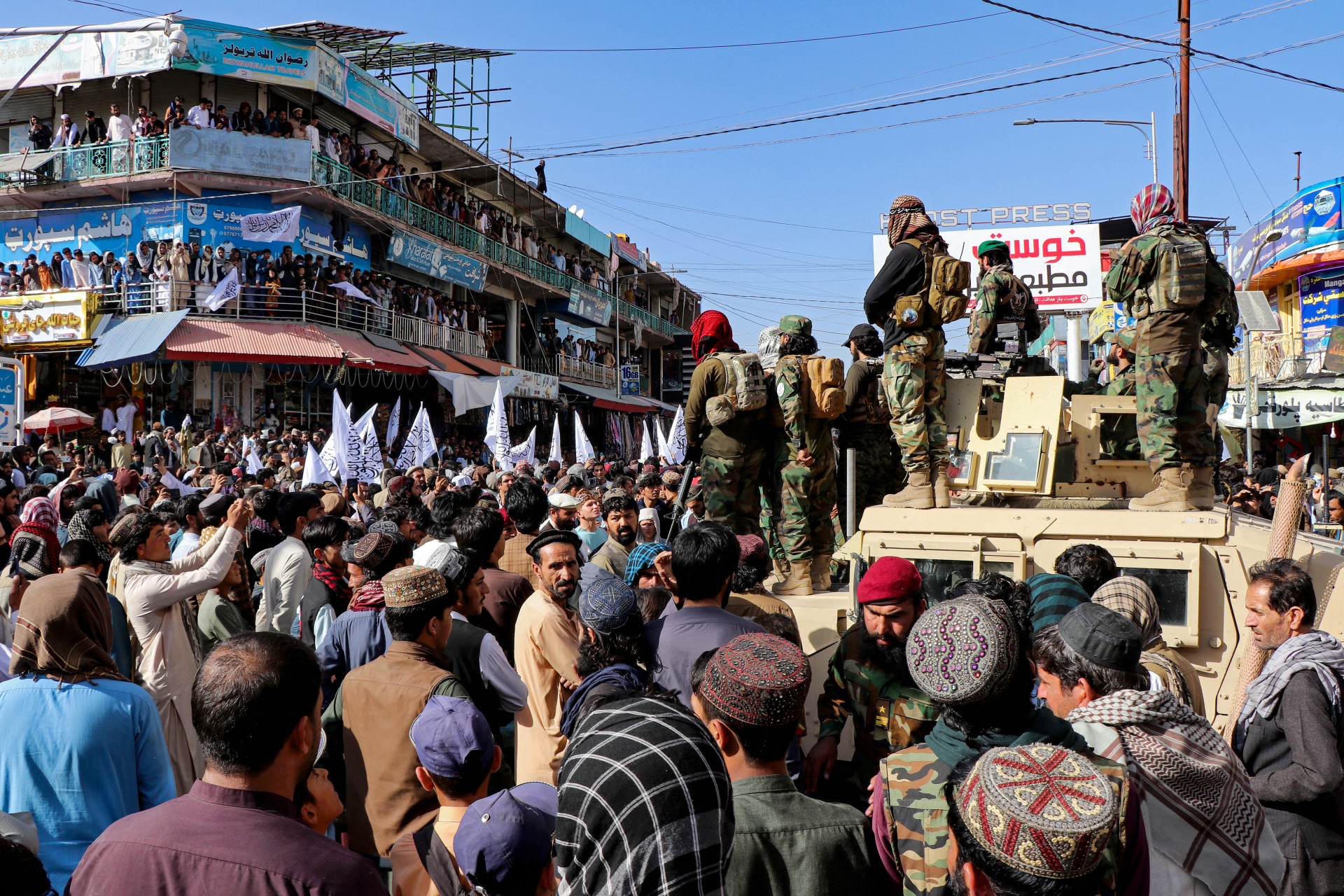
Taliban security personnel stand over a military vehicle as Afghan men gather in their support during a rally in Khost on October 13, 2025, amid heavy cross-border clashes between Afghanistan and Pakistan.AFP via Getty Images
TYPE
Interstate War
Terrorism
IMPACT ON U.S.
Low
STATUS
Unchanging
Related
Afghanistan
Pakistan
Updated October 7, 2026
RelatedAfghanistan•Pakistan
Updated October 7, 2026
Overview
Relations between Pakistan and Afghanistan are strained by cross-border militancy, with Islamabad attributing a surge in deadly attacks to Tehrik-e-Taliban Pakistan (TTP) fighters operating from Afghan territory, an accusation the Taliban government denies. Pakistan has responded with strikes on Taliban military facilities, declaring “open war” in the most direct military confrontation between the two governments to date.
Taliban security personnel stand over a military vehicle as Afghan men gather in their support during a rally in Khost on October 13, 2025, amid heavy cross-border clashes between Afghanistan and Pakistan.AFP via Getty Images
Pakistani Government Seizes Control of Opposition-Held Province
Pakistan declared a state of emergency and imposed governor’s rule in the opposition-controlled Khyber Pakhtunkhwa province bordering Afghanistan, citing the provincial government’s failure to ensure security (Guardian).
Pakistani authorities reportedly arrested the province’s chief minister, Sohail Afridi, who recently advocated for former Prime Minister Imran Khan’s release from prison; the opposition party condemned the Pakistani government’s takeover of the province as undemocratic (NYT).
Pakistan Conducts Airstrikes in Afghanistan, Killing at Least Ten Civilians
Pakistan conducted airstrikes on what it described as camps used by the Pakistani Taliban and the Balochistan Liberation Army in the Helmand and Kunar provinces of Afghanistan; Pakistan’s Ministry of Information said the strikes killed twenty-two fighters (BBC).
The UN Mission in Afghanistan reported that the Pakistani airstrikes killed at least ten civilians and injured nine others; most of those killed were children (AP).
Afghanistan Interdicts ISIS Fighters on Pakistani Border
The Afghan Ministry of Defense claimed it interdicted a group of ISIS fighters crossing into Nuristan Province from Pakistan with support from Pakistani intelligence services, killing twenty-eight and capturing thirty-two; Pakistan denied the claim (AP).
Border Clash in Balochistan Kills Thirteen Afghan Taliban Personnel
Pakistan claimed that a border clash with Afghan troops in Pakistan’s Balochistan Province killed thirteen Afghan Taliban personnel, although the Afghan Ministry of Defense denied this and said it destroyed a Pakistani post in the clash (AP).
Pakistan Strikes Ten Targets Inside Afghanistan, Killing Four
Pakistan launched ten airstrikes against ten sites across the Kandahar, Paktika, and Khost provinces of Afghanistan; Afghan authorities stated the Pakistani airstrikes killed four civilians (AP).
Pakistan claims its airstrikes targeted sites used to launch drones meant to attack Pakistan the day prior; Pakistan’s air defense shot down all the drones launched against it (Reuters).
History of Violent Extremism in Afghanistan
Following the Soviet Union’s invasion of Afghanistan in 1979, mujahideen fighters waged a guerrilla campaign against Soviet forces and the puppet leader they installed. The war cost the Soviet Union millions of lives and billions of dollars before Moscow withdrew [PDF] in 1989. After the Soviet withdrawal, Afghanistan descended into a violent power struggle between rival mujahideen factions that devastated Kabul and caused chaos around the country. The persistent instability ultimately paved the way for the rise of the Taliban, who initially gained support by promising to restore order through their own radical brand of justice.
The Taliban captured Kabul in 1996 and established the Islamic Emirate of Afghanistan, consolidating control over nearly 90 percent of the country by 2001. The regime governed as a highly centralized religious autocracy, prioritizing the enforcement of its interpretation of sharia-based law over the development of formal state institutions. In this environment, other radical Islamist groups such as al-Qaeda used Afghanistan as a base to recruit, train, and send extremists to other countries to conduct attacks.
When the Taliban refused to hand over terrorist leader Osama bin Laden in the wake of al-Qaeda’s 9/11 attacks, U.S. and allied forces invaded the country as part of the war on terrorism. Coalition forces quickly ousted the regime, and Taliban leadership relocated to southern Afghanistan and across the border to Pakistan. From there, they waged an insurgency against the Western-backed government in Kabul, Afghan national security forces, and international coalition troops.
Even as neighboring Pakistan publicly aligned with U.S. counterterrorism efforts, Islamabad played a critical role in sustaining the Taliban after its removal from power. Taliban leadership continued to direct insurgent operations from across the border, while elements within Pakistan’s Inter-Services Intelligence (ISI) maintained covert ties with the group—providing training, resources, and operational support that ensured its long-term resilience. That support extended to the Haqqani network, which ISI had cultivated as a proxy for decades; the network gradually embedded itself in Taliban leadership, conducting some of the deadliest attacks on U.S. forces.
When the U.S.-led coalition formally ended its combat mission in 2014, the Afghan National Defense and Security Forces (ANDSF) took over responsibility for Afghanistan’s security. However, the forces faced significant challenges in holding territory and defending population centers. The Taliban continued to attack rural districts and carry out suicide attacks in major cities, with the ANDSF suffering heavy casualties. The war largely remained a stalemate for nearly six years.
Meanwhile, a new terrorist group, the self-proclaimed Islamic State in Khorasan (ISIS-K), emerged in 2015 through defections from the TTP, al-Qaeda, and Taliban fighters. The group’s primary goal is to establish a sharia-governed caliphate across the historic Khorasan region—spanning Afghanistan, Iran, Pakistan, and Central Asia—while also inspiring attacks against Western targets and undermining democratic governance throughout Central and South Asia.
In February 2020, after more than a year of direct negotiations, the U.S. government and the Taliban signed the Doha Agreement [PDF], which set a timeline for the withdrawal of U.S. troops from Afghanistan. Under the agreement, the United States pledged to gradually draw down U.S. troops and complete a full withdrawal within fourteen months. In return, the Taliban pledged to prevent territory under its control from being used by terrorist groups and to enter negotiations with the Afghan government. However, no official ceasefire was established.
The Taliban’s Return to Power
In April 2021, U.S. President Joe Biden announced that U.S. military forces would leave Afghanistan by September 2021. The Taliban, which had continued to contest territory across the country despite ongoing peace talks with the Afghan government, ramped up attacks on ANDSF bases and began to rapidly seize more territory. In May, the U.S. military accelerated the pace of its troop withdrawal. By the end of July, the United States had completed nearly 95 percent of its withdrawal, leaving 650 troops to protect the U.S. embassy in Kabul.
The Taliban continued its offensive that summer, threatening government-controlled urban areas and seizing several border crossings. On August 6, the Taliban captured the capital of southern Nimruz Province, the first provincial capital to fall. Others followed in rapid succession. On August 15, more than two weeks before the official U.S. withdrawal deadline, Taliban fighters entered Kabul. Afghan President Ashraf Ghani fled the country, and the Afghan government collapsed.
Following the Taliban’s takeover, the Biden administration authorized the deployment of an additional five thousand troops to assist with the evacuation of U.S. and allied personnel, as well as thousands of Afghans who worked with the United States and were attempting to flee. On August 26, a suicide bombing outside the Kabul airport killed 13 U.S. service members and roughly 170 Afghans, making it the deadliest day for U.S. troops in Afghanistan since 2011. ISIS-K claimed responsibility for the attack. On August 31, the Pentagon announced the completion of the U.S. troop withdrawal.
Those remaining under Taliban rule have watched two decades of liberal and democratic gains reversed. Girls are barred from secondary schools, and women must travel with a male relative and cover their faces in public. Afghans also remain at a heightened risk of terrorist attacks, such as the August 2022 bombing of a mosque and the September 2022 bombing of the Russian Embassy, allegedly perpetrated by ISIS-K.
According to the United Nations, Afghanistan remains one of the world’s largest humanitarian crises. In 2025, nearly half of Afghanistan’s population—or 22.9 million people—required humanitarian assistance. Furthermore, 28.1 percent of the population was undernourished. Despite humanitarian exemptions, international aid flows have declined sharply, driven by both Western reluctance to engage the Taliban and broader donor fatigue. Continued sanctions and a frozen central bank caused the economy to contract by roughly a quarter in the two years after the Taliban returned to power, while climate-driven disasters have further devastated food supplies.
Cross-Border Militancy and Pakistan’s Security Crisis
Many of the cross-border ties that sustained the Taliban’s insurgency persisted upon its return to power, with consequences that increasingly ran counter to Pakistan’s interests. Although Pakistani leadership initially celebrated the Taliban’s 2021 victory, the country’s security environment has since deteriorated sharply, driven by the resurgence of the TTP, commonly known as the Pakistani Taliban. An ideological ally that once supplied the Afghan Taliban with recruits and shelter, the TTP seeks to overthrow the Pakistani government and replace it with an emirate under its own interpretation of sharia.
The Afghan Taliban’s takeover provided the TTP with safe havens and renewed momentum, enabling a dramatic expansion of cross-border operations. The violence made 2025 Pakistan’s deadliest year in over a decade, as combat-related deaths surged by 74 percent to more than 3,400 fatalities. Once the Afghan Taliban’s closest ally, Pakistan now finds itself in an openly adversarial relationship as TTP attacks continue to intensify. Further complicating regional security dynamics, Pakistan alleges that India covertly supports the TTP and Afghan Taliban as part of its long-standing bilateral conflict, though India and analysts reject that characterization.
While Kabul publicly denies sheltering the TTP, the Afghan Taliban has been reluctant to pressure the group, partly due to fears that coercing them could drive hard-line factions toward ISIS-K—a rival that threatens the Taliban’s grip on power. The Pakistani government pursued negotiations with the TTP, including multiple ceasefires facilitated by the Afghan Taliban, but talks repeatedly collapsed [PDF].
ISIS-K presents a separate but related challenge, having retained the capacity to conduct attacks in Afghanistan and Pakistan despite significant territorial setbacks. The Taliban nonetheless claims to be eliminating ISIS-K and accuses Pakistan of harboring the militant group. Beyond the region, ISIS-K has escalated its ambitions, killing hundreds in mass casualty attacks in Iran, Russia, and Turkey—including a March 2024 mass shooting in Moscow that killed at least 139. The group has also used its English-language magazine, Voice of Khorasan, to incite lone-wolf attacks against Western targets.
Terrorist threats from the TTP and ISIS-K are compounded by the presence of additional militant actors in the region. The Baloch insurgency, rooted in the region’s incorporation into Pakistan in 1948, has grown from a series of tribal revolts into an operationally sophisticated nationalist movement. Since the beginning of 2025, factions of the Balochistan Liberation Army (BLA) have carried out increasingly complex attacks, driven by deepening resentment over the Pakistani government’s exploitation of local natural resources. As with the TTP, Pakistan accuses the Taliban of harboring the BLA inside Afghanistan.
Conflict Between Afghanistan and Pakistan
Tensions over the Afghan Taliban’s support for the TTP turned to conflict in October 2025, when Pakistan launched air strikes on Afghanistan targeting what it called terrorist bases. The strikes triggered the deadliest clash between the two countries since the Taliban’s 2021 takeover. Qatar and Turkey brokered a temporary ceasefire, but Saudi-mediated follow-on talks collapsed by year’s end as cross-border violence resumed.
On February 6, 2026, a suicide bombing strucka mosque in Islamabad, followed by a TTP assault in Bajaur on February 17. Pakistani security services claimed they had “irrefutable evidence” that the attacks were connectedto Afghanistan. Then, Pakistan responded with air strikes targeting suspected militant camps in Afghanistan’s Nangarhar and Paktika Provinces, drawing retaliatory Afghan strikes along the Durand Line, the contested British colonial border that divides Pashtun tribal lands. Fighting rapidly spread to Kabul and Kandahar, and by February 27, Pakistan declared open war on Afghanistan.
On March 16, a Pakistani strike hit a drug rehabilitation hospital in Kabul in the deadliest single attack on civilians since the Taliban regained power. Although Pakistan claimed it had struck military installations, the United Nations Assistance Mission in Afghanistan confirmed at least 269 civilian deaths. Violence paused briefly during a three-day ceasefire on March 19 ahead of the Eid al-Fitr holiday. The peace was fleeting, as clashes resumed shortly after the ceasefire’s expiration. China has mediated talks between senior officials from Afghanistan and Pakistan in Urumqi, but discussions have failed to reach a formal agreement to end hostilities.
Key Actors
Afghan Taliban
An Islamist movement that was ousted by a U.S.-led intervention in 2001 and subsequently waged an insurgency against the Western-backed government; retook power in August 2021 and, since February 2026, has been engaged in a cross-border war with Pakistan, which accuses it of sheltering the Tehrik-e-Taliban Pakistan militant group
Pakistan
A longtime patron of the Afghan Taliban, historically providing sanctuary and support; now Afghanistan’s adversary in a cross-border conflict, driven in part by the Taliban’s refusal to suppress the Tehrik-i-Taliban Pakistan amid a surge in attacks since the Taliban’s 2021 takeover
Tehrik-e-Taliban Pakistan/Pakistani Taliban (TTP)
A militant group ideologically aligned with the Afghan Taliban that carries out attacks against Pakistani security forces with the aim of overthrowing the Pakistani state and establishing an Islamist government
Haqqani Network
A semiautonomous, historically Pakistan-linked faction now dominant in the Taliban government, led by Interior Minister Sirajuddin Haqqani; a U.S.-designated terrorist organization
Al-Qaeda
A transnational jihadist network that launched the September 11 terrorist attacks against the United States, prompting the U.S. invasion of Afghanistan to end the group’s safe harbor; although significantly diminished, it retains a presence in Afghanistan that undermines the Taliban government’s bid for international legitimacy
Islamic State in Khorasan (ISIS-K)
A regional branch of the self-proclaimed Islamic State that opposes the Taliban as insufficiently hard-line and ranks among the most violent groups in the region, with a record of external attacks
National Resistance Front
An anti-Taliban insurgent group led by Ahmad Massoud; the main organized political-military opposition to the Taliban inside Afghanistan, though of limited operational capacity
Balochistan Liberation Army (BLA)
An ethnonationalist insurgent group in Pakistan, with grievances tracing to the 1948 accession of the princely state of Kalat; seeking independence for Balochistan and control over local natural resources
India
A regional power and Pakistan’s principal rival, increasingly engaging the Taliban government; accused by Islamabad of backing separatist and militant groups inside Pakistan, though both Afghanistan and India deny it
China
Has attempted to mediate between Afghanistan and Pakistan, but March 2026 talks were inconclusive