America at 250: The Lend-Lease Act, With Lynne Olson
This episode unpacks the domestic political struggles leading up to the signing of the Lend-Lease Act of 1941.
Published
Host
 James M. LindsayCFR ExpertMary and David Boies Distinguished Senior Fellow in U.S. Foreign Policy
Guest
- Lynne OlsonAuthor, Those Angry Days: Roosevelt, Lindbergh, and America’s Fight Over World War II, 1939–1941
[Video: https://youtu.be/rX9fmN2LGPQ]
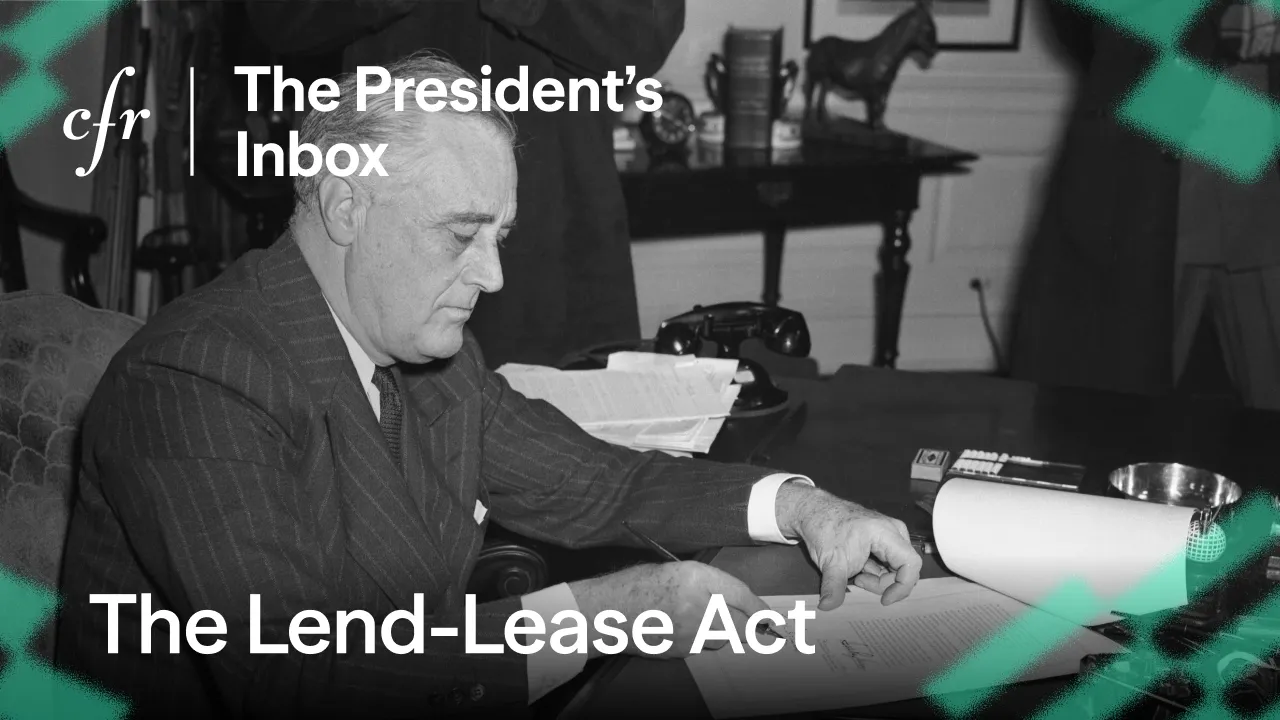
Lynne Olson, acclaimed historian and author of Those Angry Days: Roosevelt, Lindbergh, and America’s Fight Over World War II, 1939–1941, sits down with James M. Lindsay to discuss the history of the Lend-Lease Act of 1941 and the domestic political struggles that shaped the United States’ entry into the Second World War.
To mark the 250th anniversary of the U.S. declaration of independence, CFR is dedicating a year-long series of articles, videos, podcasts, events, and special projects that will reflect on two and a half centuries of U.S. foreign policy. Featuring bipartisan voices and expert contributors, the series explores the evolution of America’s role in the world and the strategic challenges that lie ahead.
Transcript
OLSON:
Lend-Lease is Roosevelt’s baby. It is one of the greatest foreign policy decisions ever made, and he made it. The isolationists knew this was their final battle. If they didn’t win this, it would mean that America was no longer neutral.
LINDSAY:
In December 1940, British Prime Minister Winston Churchill wrote to President Franklin Delano Roosevelt with chilling news. The war with Germany had drained the British Treasury. London would soon be unable to pay for the supplies and weapons it was buying from the United States. Knowing he had to act, President Roosevelt mustered political supported home for military supplies to friendly democracies in Europe. The resulting Lend-Lease Act became one of the most contentious and consequential decisions in U.S. history. Why was the Lend-Lease Act so controversial and how might the war have gone differently without it?
From the Council on Foreign Relations, welcome to The President’s Inbox. I’m Jim Lindsay. Joining me today is historian Lynne Olson, author of Those Angry Days: Roosevelt, Lindbergh, and America’s Fight Over World War II. Lynne, thank you very much for joining me.
OLSON:
Well, thank you very much for having me.
LINDSAY:
In recognition of the 250th anniversary of American independence, Lynne, we are devoting one episode of The President’s Inbox every month to a pivotal moment in the history of U.S. foreign policy. The enactment of the Lend-Lease Act on March 11th, 1941 certainly qualifies on that score. A recent survey I did with members of the society for historians of American foreign relations ranked the Lend-Lease Act as the fifth-best decision in U.S. foreign policy history. Yet I think you can only understand the battle over the Lend-Lease Act by knowing a little bit about the history of the decade leading up to World War I. So could you help us, Lynne, by sort of explaining to us the nature of the debate over America’s role in the world in the 1930s?
OLSON:
Sure. The debate over whether we should get involved in World War II really stems from the debate about America’s involvement in World War I. We got involved in World War I to make the world safe for democracy, or at least that’s what we were told by the president, that we had to intervene in the war to make the world safe for democracy. Well, we did. And then just a few years after World War I was over, Adolf Hitler and the other dictators in Europe entered the scene. And so Americans had had it really with foreign wars. This country was begun by people who were fleeing Europe and foreign wars. And so there was a very strong isolationist sentiment in the twenties and certainly in the early thirties and going up actually until the war began.
LINDSAY:
Lynne, that’s one of the really interesting things ‘cause I think you’re quite right. The United States did not go into World War I willingly. It entered the war in 1917, more than two and a half years after the war had actually begun in Europe. And it wasn’t very long after World War I ended that Americans had regrets essentially of having entered it. And one of the sort of arguments in the early 1930s was that the United States not only should have tried to have stayed out of World War I, it could have, except that Woodrow Wilson had allowed the United States to become entangled in the war. And I think that shaped a lot of the thinking in the early 1930s. Is that a fair assessment?
OLSON:
I think that is a fair assessment. And the belief was that basically Great Britain had kind of inveigled us into the war and so had supposedly arms merchants, munitions manufacturers. So yes, there was a lot of feeling that Wilson was the one responsible, but it was also the feeling that we were forced into the war by outside influencers, especially Britain. And the British did have an incredible propaganda campaign that contributed, I think, to our getting into the war. And so there was really a strong feeling that we’re not going to do this again.
LINDSAY:
I’m glad you raised the issue about munitions ‘cause that seemed to have been a big impetus behind the intensification of isolation and sentiment in the United States in the 1930s. There are a number of books and articles arguing the so called merchant of death thesis that the reason the United States was dragged into World War I was because companies were seeking to make money off of the war. Can you tell me a little bit about people like Gerald Nye, a Republican Senator from North Dakota who led the so called Nye Committee, which investigated arguments that munitions makers had inveigled us into war?
OLSON:
Gerald Nye was really made a name for himself by these hearings that he held and accusing munitions manufacturers of being responsible for the war. But they had a great deal of influence, this particular squad, this particular group of senators. During this time, up until the late thirties. The Roosevelt administration got involved in this whole debate. They were probably Roosevelt’s main foes at the time.
LINDSAY:
As you get into the 1930s, you see an intensification of isolationist sentiment in the United States. And I think it’s partly fueled by the fact the United States is going through the Great Depression. People are naturally sort of turning and this is a time in which one out of every four adult-aged male was unemployed, so there was significant economic trauma going on. But my sense is that FDR, when he came into office, was not looking to pursue internationalist foreign policy. And indeed, he was one of the people who suggested to Senator Nye that he open up his special investigation into munition makers. Tell me a little bit about where FDR was early in his presidency.
OLSON:
Well, FDR, not surprisingly when he was elected, focused all of his efforts on trying to save this country from economic collapse. I mean, that was his real campaign for many, many years. And so he put international affairs on the back burner, and in my opinion, did it too long. I mean, one can understand why he was so involved in the New Deal. Of course, he was, but he really did his best to stay out of any involvement in foreign affairs. Even as totalitarianism had started its marks in Europe, Hitler and Mussolini, Hitler came to power in the early 1930s, and Roosevelt really tried very hard to stay out of the whole question right from the beginning. So I mean, his focus was really on neutrality until when it was very clear that Hitler was not only threatening Central Europe, it was threatening Western Europe, and it was also threatening the rest of the world.
LINDSAY:
Lynne, I’m glad you raised the issue of neutrality, ‘cause that was obviously one of the big congressional battles in the second half of the 1930s over the question of how to have the most effective neutrality policy for the United States. The traditional American approach to neutrality, which was witnessed in World War I, is that the United States should have the right to trade in non-armaments with any country it wished to. But obviously, the time we get to the 1930s, you had many people, many Republicans, certainly many Democrats as well, who are arguing that that’s what got U.S. dragged into war. And they wanted to have essentially an embargo, particularly on the sale of munitions to belligerence. Tell me understand a little bit about that battle over neutrality.
OLSON:
Again, Roosevelt wanted very much to say to stay out of the whole catastrophe that was fast coming to Europe. He was going through a lot of things too back here. We should mention, he was reelected in 1936 in a great landslide, and then he got a little ahead of himself and started proposing policy that was earthshaking in a way. For example, he tried to pack the Supreme Court. He tried to add more members to the Supreme Court, feeling that he had backing of the American people behind him.
LINDSAY:
That blew up on him.
OLSON:
It blew up tremendously on him. Congress was up in arms about that, and he lost. He was sounding defeated, so-
LINDSAY:
Even though Democrats were an overwhelming majority in the Senate and in the house.
OLSON:
They were. They were, but this was a bridge too far for many, if not most, members of Congress. And so just as we came closer to war in Europe, Roosevelt was politically damaged at that point. And Roosevelt was above all a political animal. He was very, very careful about what he did. I mean, he really measured his actions to a great degree in terms of how it would affect him politically. And I think that was certainly true that he was at his weakest when things were really heating up in Europe. And so I think that’s one reason why he and his administration, or many in his administration, were supporting the whole idea of neutrality. Now, there were a number of people in his administration, and those numbers grew as the danger in Europe increased, who wanted the U.S. to at least pay attention to what was going on and to take some action. But Roosevelt, at least publicly, was saying, “No, we are going to remain neutral,” and really continued to feel that way until World War II began.
LINDSAY:
Yeah. I think one of the things that’s remarkable in looking back on the legislative debate, certainly over neutrality, was that many members of Congress actually feared allowing FDR to have discretion to act. Their fear was that he would plunge them into war. And this was a sentiment held not just by Republicans, but by a large number of Democrats. And a lot of that legislative to and fro was about making sure the president wouldn’t have a way to act contrary to the wishes of Congress. But FDR was always trying to find ways to get a little bit more room to be able to act. I think as the decade progressed, he became aware, as you alluded, that he was ending up in a position in which the very constraints that were being placed in him in a desire to keep the country out of war were actually going to make it very hard for him to do the sorts of things that could keep the country out of the war.
OLSON:
It was a very difficult place for him to be in. I mean, I think his sympathies obviously were with Britain and the other countries of Western Europe that were being threatened by Germany, but he was very, as I said, he was ultra careful not to get certainly himself involved and his administration entangled as the years went on. And we have to keep in mind too, that America itself, the country was an isolationist country. The American public opinion was very much against getting involved at that point.
LINDSAY:
Lynne, to what extent was the debate over America’s role in the world sort of tied to region or to ethnicity? ‘Cause I’ve often heard talk that the Midwest in particular was very much opposed to FDR into the notion of an internationalist foreign policy. Likewise, I’ve heard that German Americans and Irish Americans and Italian Americans who lived in large numbers in certain parts of the country were also really opposed to the war. To what extent did sort of regional biases or ethnic concentrations influence the politics in the 1930s?
OLSON:
Regional differences and ethnic differences played a huge role in how people thought about getting into the war, how people thought about the threat of Hitler and Mussolini and other totalitarians. I mean, one has to remember that the communications that were in this country, that dominated this country, we’re not like now. We didn’t have the internet, we didn’t have television. Basically, we had newspapers and radio, and radio was still in its infancy in terms of coverage, in terms of journalism. So it was radio, magazines and newspapers. And so the Midwest, yes. I mean, it was far more isolationist because most of those people did not know that much about what was going on in the rest of the world. They had really very few venues in which they could learn about it. In fact, many of them hadn’t traveled outside their state, so they really had no concept of what was going on in the rest of the world.
Whereas in the East Coast, particularly in the East Coast, that was kind of if there was a center of internationalism, it was the East Coast, particularly the Northeast. We’re talking about New York and businessmen in the Midwest, as opposed to businessmen on the East Coast. Businessmen in the Midwest were the leading figures in America First Movement, which was the made isolationist organization before the war. And businessmen on the East Coast were the leaders of pro interventionist groups. So where you came from in the country had a great bearing on how you felt about the world in general and about the role of this country in that world.
LINDSAY:
So Lynne, war finally comes to Europe on September 1st, 1939. Germany invades Poland within days, France and Great Britain declare war in Germany. That war doesn’t really come to Britain and France until the following spring, but the immediate American reaction is to remain neutral. Same response to the outbreak of war in Europe back in 1914. Help me understand where things stood in the United States in terms of public opinion, in terms of politics. We’re still before Pearl Harbor, but there’s growing concern about the course of the war because France follows very quickly. Britain is being subjected to the Blitz. So help me understand where things are going in the United States, and particularly someone like Colonel Lindbergh, who emerges as an important voice arguing to stay out.
OLSON:
So when the war began, as we’ve been talking about, the United States really was still a very isolationist country, and we didn’t want to get involved at all. But as it progressed, we’re going to see a fairly large shift in American public opinion. And that happened because of several events. First of all, as you mentioned, Germany invaded Poland, and then there was about eight months of what they called a phony war, where nothing much was going on. Poland was conquered, but the Germans didn’t go anywhere else. I mean, they were really focusing on Poland, et cetera. In the spring of 1940, that started, the German Blitzkrieg in Western Europe began, and that’s what really got the attention of America for the first time. Poland was a land that most Americans didn’t know anything about. We had a lot of Polish immigrants in this country, but it was a foreign land.
It was central. It was Eastern Europe, and it really didn’t mean that much to most Americans. But then when the Germans invaded the Netherlands and then several other countries, but particularly France, when Paris fell, that was a huge wake-up call for Americans because even though most Americans had never been in Paris, they knew about Paris. They had seen Paris in movies. There were famous French singers, French actors. So the fall of Paris, the fall of France really startled … I mean, startled is the wrong word. I mean, it stunned the United States. And then basically, we are left with one country standing up against Hitler, and that is England, and no one expected England to be able to survive. It was this tiny little island. Everybody else had fallen like 10 pins in front of the Nazi invasion, but England was there. And just as Hitler was launching his Blitzkrieg, however, Winston Churchill came to power in England.
And Winston Churchill, I won’t say single-handedly, but he certainly, without Winston Churchill, I doubt Britain would’ve lasted that long. But thanks to him and thanks to his leadership, Britain did stand up against Hitler. So in June 1940, here we are faced with this behemoth, this huge military force conquering all of Western Europe or most of Western Europe, with the exception of England. And so Roosevelt is faced with this. What should we do?
Everybody’s saying England won’t survive. England will have to give up. England will have to give in. And then the Blitz begins, the bombing, the night after night bombing of London and other major British cities, and they don’t give in and night after night. And that incredible stubbornness, the courage of Britain is captured by American reporters, particularly American broadcast journalists. And the most famous of those journalists was Edward R. Murrow from CBS. And his nightly broadcast about the courage of Londoners in standing up and not giving in, despite the fact that their homes were being destroyed, et cetera, really, really struck a chord in this country. And-
LINDSAY:
I take your point there, Lynne, and I do think it is remarkable that Britain was able to survive the battle of Britain. I think Churchill’s leadership, no doubt, played a pivotal role there, but this takes U.S. to late 1940, when all of a sudden in December, Churchill writes to Roosevelt and says, “I have a problem. You’ve been allowing me to buy supplies from the United States, but we’re running out of money. We can’t buy anything.” And FDR has to make a choice. And it’s interesting ‘cause he’s just come off a presidential campaign, which is unprecedented. He’s won his third term in office, but he also campaigned on a promise not to send American boys into a foreign war. Okay. We know that he decides he has to come to Churchill’s aid into the aid of Great Britain. Tell me a bit about how he got there. I know he talked about a garden hose in an arsenal of democracy.
OLSON:
Yes. At the end of 1948, Roosevelt has been reelected and Britain really thought once he was reelected, that in fact, he would be free from this political pressure and so that the U.S. would declare war against Hitler, but he didn’t. And so Churchill, as you said, wrote to him and said basically, “If the U.S. does not come to our aid, we’re going to go down.” Roosevelt still wasn’t ready to make that jump. I think he certainly had been thinking about it. Lend-Lease is Roosevelt’s baby. There’s no question. It is one of the greatest foreign policy decisions ever made, and he made it, but he had a lot of help in pushing him. And one of the people who was pushing him was the British ambassador to the United States, Lord Lothian, who was brilliant at creating public opinion in this country for England, the support of England.
Lord Lothian was pressing Churchill to be very, very, very candid to Roosevelt about why Britain needed the money. I mean, they were basically bankrupt. And at one point, Lord Lothian went before American journalists and said, “Hey, boys, we’re broke. We need your money.” And that really put pressure on Roosevelt. I mean, that statement by Lothian was on the front page of every newspaper in the country. And Roosevelt was coming to the conclusion that yes, he had to come to the aid of Britain. And that’s how he came up with the idea of Lend-Lease, a program that would supply countries that were fighting Hitler with enough war material so that they could do that and without Americans having to put boots on the ground. So in other words, it was, as Roosevelt explained it to the American people, it was a way to avoid Americans going to war.
And he used … Roosevelt was really good at explaining complex issues in ways that Americans could understand. And in this case, he compared Lend-Lease, the idea of a program of aid to, in this case, Britain, to a situation where your neighbor’s house is on fire and he doesn’t have a hose. He has no way of fighting this fire, but you do. And so you lend that hose to your neighbor so he can put out his fire. And so when that fire is extinguished, the neighbor will give back the hose. And so he said Lend-Lease would be like that. We would give this aid to Britain to kind of ensure that we don’t have to go to war. I mean, that we’ll be the arsenal of democracy. We will provide all the supplies, all the guns, all the ships, all the airplanes, but we ourselves will not be over there fighting.
LINDSAY:
As good as FDR was in giving a speech, Lynne, Congress didn’t sign on to Lend-Lease Act right away. Indeed, my sense is, it was a very contentious debate on Capitol Hill and the Nyes, the Borahs, the Wheelers of the world were bitterly opposed to it, arguing that it was going to plunge the United States in a war, not keep us out. Tell me a little bit about the battle over what was officially titled HR 1776, and that wasn’t an accident.
OLSON:
No, it was not. It was not an accident at all. Yeah, it was probably one, if not the most contentious debate around our getting into the war. It certainly was one of the top … It lasted for months. After Roosevelt proposed Lend-Lease, actually the American public opinion was very, very favorable to it overall. And polls showed that most Americans supported it, but not on Capitol Hill. As you point out, many, many, including Democrats, but mostly Republicans were very, very much against passing this bill. The isolationists knew this was their final battle. If they didn’t win this, then it was all over for them because it was basically, if Lend-Lease passed, it would mean that America was no longer neutral. I mean, there could be no pretense of neutrality. We would be in this war, maybe not fighting the war, but we would certainly be in the war.
And so they knew that if they had any hope, they had to defeat this bill. And so for weeks, there was this ferocious fight on Capitol Hill. Women who were against getting involved in the war would come in and demonstrate outside Senator’s offices and carry on. It was just a total theatrical performance for, as I said, for about two or three months. And there were two major figures who testified in hearings in Lend-Lease. One was Charles Lindbergh, who was really the guiding light of isolationism, and the other was Wendell Willkie, who was the Republican presidential nominee who had just been defeated by Roosevelt. Lindbergh was obviously very much against Lend-Lease. Willkie was very much for it. Even though he had been defeated by Roosevelt, he supported Roosevelt in his foreign policy, and he was absolutely adamant that we had to pass Lend-Lease. So as I said, this fight continued for several months.
Finally, a vote was taken and it passed two to one. It really was the kind of capstone of Roosevelt’s foreign policy up to that point. He deserves incredible amount of credit for it, but there were a lot of other people involved, including Wendell Willkie and a number of others who were responsible for it too.
LINDSAY:
Lynne, I think most historians would argue that Lend-Lease helped the United States and its allies win the war. Obviously, the United States entered the war in December of 1941 after the attack on Pearl Harbor. So Lend-Lease did not prevent the United States from getting the war, as FDR had argued. Nonetheless, the United States think allocated something on the order of $50 billion to various countries and people credited with helping, again, the allies win the war. Let me ask you what’s probably an unfair question to close out our conversation. What do you think would’ve happened if Lend-Lease had not passed?
OLSON:
I shudder to think what might have happened if that had happened. I mean, there were a number of things that year in those few months. We also had passage of the first piece time draft. So the draft and Lend-Lease, if we did not have them, I think Germany might very well have conquered England. We would’ve been faced with here with Hitler, we would not have been prepared at all. We would not have started mobilizing in terms of industry. We would not have had an army. God knows what would’ve happened. It would not have been good. It’s certainly true. The draft and Lend-Lease were really kind of the building blocks for our victory. But it was still early on. It was well before we got into the war. So we did have, even though these programs were very much in their infancy, and Lend-Lease really didn’t kick in until we got into the war, really.
But at least they were there. And we did have an army when we got into the war. And we did have a mobilization, a huge mobilization going on when we got into the war, which enabled us to win. And I’m not sure what would’ve happened if we hadn’t had both of those.
LINDSAY:
On that note, I’ll close up this episode of The President’s Inbox. My guest this week has been historian Lynne Olson, author of Those Angry Days: Roosevelt, Lindbergh, and America’s Fight Over World War II. Lynne, thank you very much for joining me.
OLSON:
Thank you.
LINDSAY:
Today’s episode was produced by Justin Schuster with Director of Video Jeremy Sherlick and Director of Podcasting Gabrielle Sierra. Our camera operator was Grace Raver. Our recording engineers were Antonio Antonelli and Bryan Mendives. Production assistance was provided by Oscar Berry and Kaleah Haddock.
Mentioned on the Episode:
Winston Churchill, “Letter to President Franklin Delano Roosevelt,” December 8, 1940
Council on Foreign Relations, The 10 Best and 10 Worst Decisions in U.S. Foreign Policy
Charles Lindbergh Testimony to the House Foreign Affairs Committee, January 23, 1941
Wendel Wilkie Testimony to the Senate Foreign Affairs Committee, February 10, 1941
Opinions expressed on The President’s Inbox are solely those of the host or our guests, not of CFR, which takes no institutional positions on matters of policy.
Associate Producer, Video and Audio
- Associate Producer, Video and Audio
Editorial Director and Producer
- Director, Podcasting
Director of Video
- Director of Video
More Episodes
 33:42Podcast
 36:05Podcast
 41:07Podcast
 39:26Podcast
 35:04Podcast
 31:46Podcast