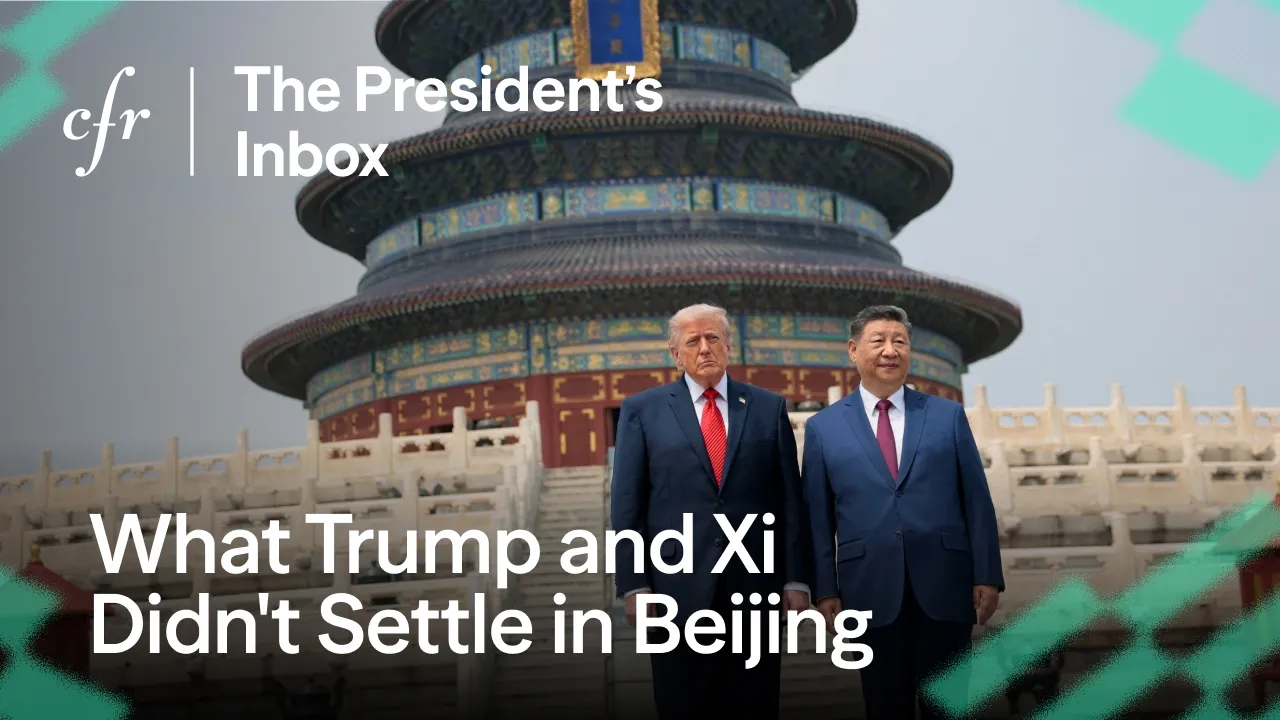
What Trump and Xi Didn’t Settle in Beijing, With Nicholas Burns
This episode unpacks the key discussion points from the U.S.-China summit, including Taiwan, the Iran war, AI regulation, and the future of U.S.-China relations.
Published
Host
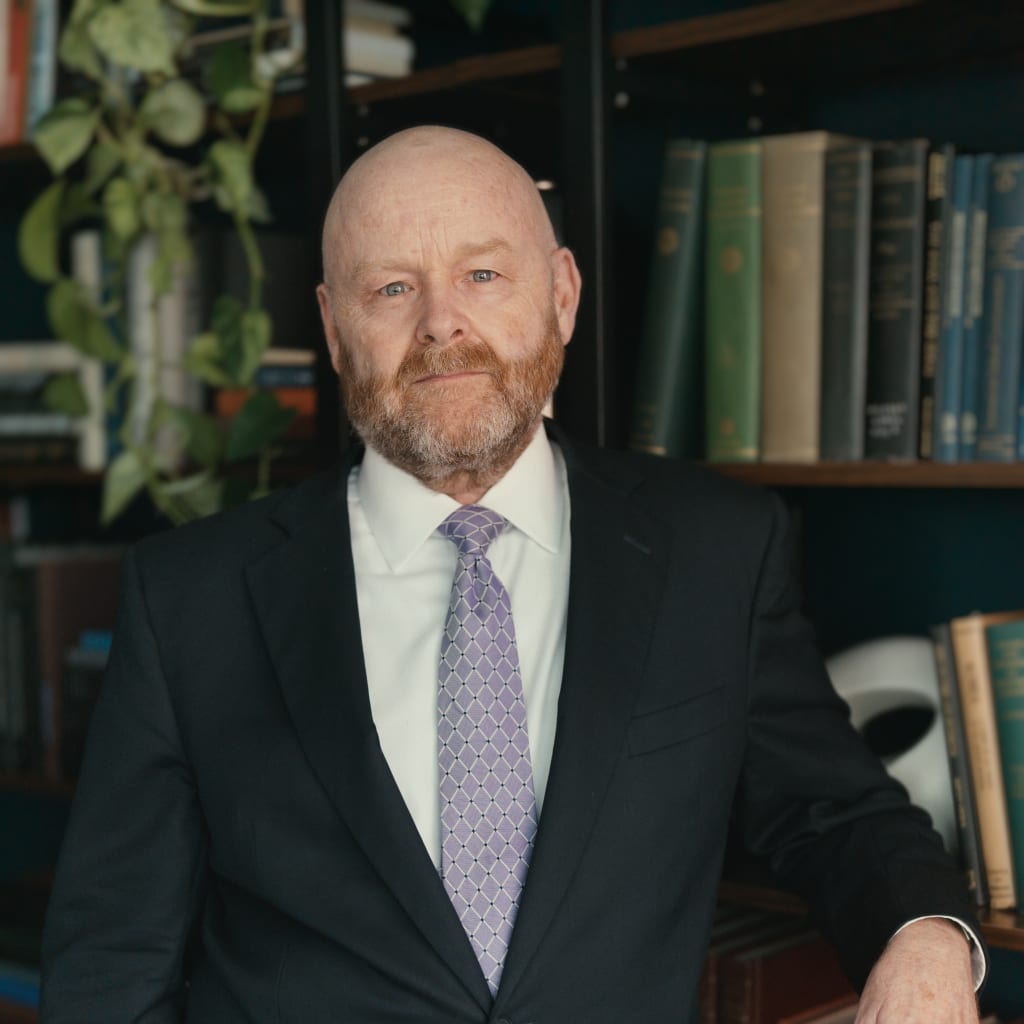 James M. LindsayCFR ExpertMary and David Boies Distinguished Senior Fellow in U.S. Foreign Policy
Guest
- Nicholas BurnsProfessor of the Practice of Diplomacy and International Politics, Harvard Kennedy School
[Video: https://youtu.be/VDeEhj6zqZw]
TRANSCRIPT
BURNS:
When the American president sits down with a Chinese leader, it’s all business. One thing I learned in China, Jim, flattery will get you nowhere. It’s all about the bottom line.
LINDSAY:
Last week, President Donald Trump wrapped up a two-day summit with Chinese leader Xi Jinping. It was the first visit by a U.S. president to China since Trump traveled to Beijing in November 2017. What did Trump and Xi discuss?
Did they reach any significant agreements? Did their discussions reset the direction of U.S.-Chinese relations or merely perpetuate the existing status quo? From the Council on Foreign Relations, welcome to the President’s Inbox.
I’m Jim Lindsay. Today, I am joined by Nicholas Burns, the Roy and Barbara Goodman Family Professor of the Practice of Diplomacy and International Relations at Harvard University’s Kennedy School of Government and a former U.S. ambassador to the People’s Republic of China. Nick, thank you very much for joining me.
BURNS:
Jim, thanks so much for letting me be on your show.
LINDSAY:
Let’s just jump right into it, Nick. I’d like to sort of do a 40,000-foot view of the summit. I mentioned that you were U.S. ambassador to China during the Biden administration. You’re also a career foreign service officer. You served in senior positions under both Democratic and Republican presidents, so you have staffed a lot of summit meetings over the years. You’ve attended a lot of summit meetings over the years.
Give me your reaction to what you saw transpire last week.
BURNS:
Jim, I think that President Trump’s visit to China, his discussions with Chairman Xi Jinping could turn out to be one of the more consequential of the recent summits with China over the last 10 years or so. I say that because there was almost a detente-like atmosphere, a visible, visceral cooling of tensions that have been so prominent in this relationship for the last seven or eight years, in the last few years of President Trump’s first term, and certainly throughout the time when I was ambassador for President Biden. And so, it looks like both countries want to dial down the temperature, find a way to have more effective channels between them, find more stability both in the economic relationship and on the many issues that separate us.
I think there were a number of accomplishments. I don’t agree with those people who say there were no accomplishments. I think there are also a number of areas that worried me greatly, and I’m happy to go into both of those if you’d like.
LINDSAY:
Fair enough, Nick, but before we dive into the particulars, just a couple of big picture things, just trying to put this summit in context with other summits. My understanding was there was not a final agreed-upon written communique at the end of the summit. Is that significant?
Is that something that happens at big summits or not necessarily so?
BURNS:
It was expected that there would not be an agreed-upon communique. In fact, throughout the Biden administration, President Biden had three in-person summits, and we never had a joint communique. Why?
Because they’re too difficult to work out between these two particular governments. The differences were so profound, and it was easier for both sides to put out individual statements not matching at all, sometimes describing issues in a different way, sometimes leaving one issue in one side and the other side highlighting it. So it didn’t surprise me at all.
I don’t think people should read too much into that.
LINDSAY:
So help me understand the release of dueling statements, because I read a number of the Chinese statements, at least as translated from Mandarin. I saw the White House statements, and as you hinted at, Nick, they often did not align. And even when they mentioned topics, they tend to emphasize different things.
So help me understand if you were to go back and read those statements, what you should make of them.
BURNS:
Well, I thought the American statement was much more specific in many ways. And of course, the Chinese statement emphasizes the issues that China cares most about, including most notably that big shot that Xi Jinping fired across the U.S. bow on Taiwan in the very first hours of the summit. I think on the positive side, I think it’s very important these two leaders met.
And both sides did reflect that in their statements. It was a warm meeting. Xi Jinping sits atop the Chinese firmament as the all powerful leader.
And so you have to meet with him if you want to have any kind of progress with China at all, or even deliver tough messages at the highest level. And so there’s no substitute for head of state communication and summitry. And I thought that was actually an accomplishment of this meeting, that it was so nine hours together.
They were positive about the relationship. On the American side, of course, the U.S. played up the fact that there’ll now be a resumption of agricultural sales. China’s the largest market for U.S. agriculture. One-fifth of all of our ag exports go to China on an annual basis. And purchases by China have been way down because of the major problems in the relationship. I thought that was positive, that according to Jamieson Greer, the U.S. trade rep, the Chinese now have committed to purchase at least $17 billion of U.S. agriculture products for the rest of this calendar year. $25 billion a year, he said, for the next three years. The Boeing announcement was not as big as people had expected. But since there hadn’t been a Boeing sale, and this is a big part of this relationship commercially, 200 planes sold by Boeing to China is a good first step.
And then third, I thought it was very important that they did not actually announce what everyone thought they might announce, a tariff truce and a supply chain truce. And again, Jamieson Greer indicated, well, because the U.S. tariff picture is changing because of the Supreme Court decision, the other challenges to President Trump’s authority, it may be necessary to rearrange some of the tariffs, recalibrate them this summer. That’s a big issue.
Neither side wants to go back to the trade and supply chain wars of 2025. And I would hope that they could get that done sometime in the next couple of months. And then finally, what was little noted, but possibly could turn out to be the most important part of this summit, Jim, was what President Trump said on Air Force One when he was returning to the United States.
And Scott Bessent, the Treasury Secretary, said in the first day that the two sides have agreed to sit down and talk about artificial intelligence, and specifically the security issues that right now are so worrisome after the Anthropic latest model, the Mythos model, indicates that cyber terrorists, bioterrorists, criminal organizations could really use this powerful model for terrible purposes to upset the international economic system, for instance. So it makes sense, just as we sat down, we the Americans, with the Soviets after the Cuban Missile Crisis, now’s the time for these two competitor nations on AI to sit down and talk about how our common interest, how do we provide guardrails?
How do we introduce mitigating measures to prevent the worst from happening?
LINDSAY:
Okay, Nick, let’s jump into the details, then, of the summit. I want to begin with a topic you haven’t mentioned, but seemed to be at the top of President Trump’s agenda when he arrived in Beijing, and that is Iran. And the President was hoping to get Chinese help in reopening the Strait of Hormuz, presumably also to get Tehran to agree to a deal.
I’ll note that the week before, the Iranian foreign minister had visited Beijing. Everybody understands that Beijing has at least some say with Tehran, or at least Tehran is willing to listen. What do you think actually happened on that front, in terms of the discussion between Xi and Trump?
BURNS:
Yeah, Jim, I thought that the two really worrisome problematic issues were Iran and Taiwan. Let’s take Iran, as you suggest. It was not a surprise to me that the Chinese were willing to say publicly in Beijing last week, we are not in favor of Iran becoming a nuclear weapons power.
That’s been the Iranian position for 20 years. In fact, I was the Iran nuclear negotiator for George W. Bush 20 years ago, when Iran, when China was very much in support of what we were trying to do to deny Iran a nuke.
Second, also not a surprise to hear the Chinese say, but it was good to hear them say that the Strait of Hormuz should be reopened without Iran or anybody else as a toll keeper. But that’s been their position really since the start of the war. And so I think it was positive for President Trump that Xi Jinping was willing to say this and willing to have his team affirm it publicly.
I’m somewhat skeptical, however, whether or not China is now going to use its considerable influence over the government in Iran to really push them very, very hard to agree to a ceasefire that the Iranians may not believe is in their interest. And I think this could actually get more complicated if President Trump, you know, in the last couple of days since coming home, has been threatening the Iranians with a resumption of the use of force, with bombing. If that happened, there’s really no question in my mind that the Chinese would not react positively.
They’d have to criticize it publicly. And I think they’d be unwilling to push the Iranian government to the limit in that instance. And I think the larger point here is, as you know, the Chinese live in an authoritarian world.
Their closest partners are Russia. President Putin’s visiting Beijing this week, right on the heels of President Trump’s visit. North Korea and Iran, they’re all working together to support the Russian war effort in Ukraine, for instance.
And so I do think, I think there’s a limit to what the Chinese are going to do to help us.
LINDSAY:
Nick, are you surprised at all that Xi Jinping hasn’t tried to insert China into the Middle East situation? Remember a few years ago, a lot was made of the fact that Beijing helped broker approach between Tehran and Riyadh. Obviously, a lot of Americans worry about China eclipsing the United States in world politics, becoming the dominant superpower, going around setting the rules of the game.
At least in terms of the current U.S. war or ceasefire with Iran, we’re not seeing the Chinese proactively trying to erect a peace. Is there a reason for that?
BURNS:
Well, it’s interesting you bring up, Jim, the fact that in 2023, three years ago, Foreign Minister Wang Yi presided over a ceremonial handshake, a coming together of the Iranian and Saudi foreign ministers in Beijing. And I remember talking to the Chinese foreign ministry in the aftermath, and they were pretty smug and feeling good about the fact, you know, we are now a new Middle East power. But to answer your question, I think one of reasons why China has not asserted itself is because the image that China really could do nothing to protect the Iranians on February 28th, even politically and afterwards, or protect Nicholas Maduro on January 3rd when the United States kidnapped him and brought him to the United States, I think it’s been a hit on China’s reputation, if you will, for reliability in the global South. So that’s reason number one. Reason number two, I think the Chinese have also felt if the United States can get caught in the quicksand of the Middle East again, why would we help them get out of the quicksand?
Because the Chinese have seen that we’ve had to transfer a carrier battle group from Japan to the Middle East, that very important air defense systems have been transferred from our bases in Korea and the Philippines and Japan to the Middle East theater. You know, the old adage, why interrupt, don’t interrupt your enemy while your enemy is making a big mistake. Napoleon’s advice.
That’s Napoleon. And the Chinese subscribe to it. So it hasn’t surprised me that they haven’t tried to be dealmaker.
And I think they probably recognize they’ve got enough influence behind the scenes with Pakistan, because of course, they are very close to Pakistan. And so I think the Chinese have been comfortable not to be in the forefront of this.
LINDSAY:
So we’ve talked about one T, Nick, that is Tehran. Let’s talk about the other T, Taiwan. Now, to me, what was interesting was what the Chinese said during the meeting, he alluded to it, that Xi Jinping brought this issue up very early on in the meeting.
He was quite clear in terms of how China viewed the issue. But obviously, there’s been a lot of reporting about the comments that President Trump made on his flight back from Beijing about what US policy will be going forward toward Taiwan. So how do you sort of see that issue?
BURNS:
What was interesting, Jim, to me, was that the Chinese actually leaked President Xi’s opening statement in the private meeting on the first day, which was that shot that he fired proverbial shot that he fired across our bow, that if you cross our red lines, this is to Donald Trump in the United States, if you cross our red lines, then there’s a possibility of a conflict. That’s a very strong statement. Xi Jinping always raises Taiwan.
This is one of the stronger statements I’ve heard him make in the last four or five years. And they leaked it mid-morning before they’d even left the meeting. They wanted that out there.
They wanted that to dominate the meeting. It’s been reassuring to hear Secretary of State Rubio and Ambassador David Perdue, and I have a lot of respect for Ambassador Perdue, by the way. He’s doing a really good job, I think, as ambassador in China.
They both said, look, there’s no change to our Taiwan policy. But how do you square that with what President Trump said on Air Force One on the way home? In that one conversation with journalists, he equivocated on whether or not the United States would stick to our One China policy and its Taiwan dimensions of the last 50 years.
The whole policy of recognizing One China, but strategic ambiguity about what we would do in the event of a Chinese attack, and particularly this issue of our legal requirement to provide defensive military technology to Taiwan. That’s in the Taiwan Relations Act. All that happened in the space of three or four minutes, and I was watching it live, and I thought, this is a possible, very dramatic, and I think very ill-advised U-turn.
This would give the Chinese what they’ve been trying to get for a half century, since President Nixon sat down with Mao and Zhou Enlai in February of 1972. And I was just thinking, I’m a former ambassador to NATO, and also while I was ambassador to China, I spent a lot of time working with Japan, our allies, Korea, the Philippines, Australia. What’s the signal here to the allies?
Is the commitment and word of the United States good anymore? Because if we do not proceed with the arms sales, if that’s going to be President Trump’s position, and we’ll have to see what he decides to do, and he hasn’t made a final decision, but it sure looked like he was leaning in that direction. I think that the allies are going to be significantly worried about the staying power and reliability of the United States.
Not to speak of the fact that there are 23, 24 million Taiwanese who live in a really strong democracy, who want to be left alone, who don’t want to be the latest acquisition by the People’s Republic of China. How are they going to feel about this? I think this could turn out, if he does, if President Trump does make this U-turn, refuse to provide the arms that the Taiwanese have asked for, and that we suggest that they buy from us to strengthen their defense, I think this could be the most significant mistake, along with the Iran war, of President Trump’s second term of office.
LINDSAY:
There’s a lot there, Nick, and I want to sort of just dig a little deeper. I want to begin first with your comments about the significance of what Xi said about Taiwan, and that they led with it and leaked it. What I’m trying to sort of parse through is the extent to which that Xi had this leaked, and I assume nothing gets leaked without his permission, to, in essence, throw a fastball high and inside to the Americans, versus being, in essence, throwing red meat to domestic hardliners in China, so he could sort of inoculate himself against concerns that he isn’t being tough enough on Taiwan.
Do you have any sort of sense of why it was leaked?
BURNS:
The Chinese always raise Taiwan. Every Chinese interlocutor, even when I used to go see the agriculture minister or the health minister, I would get the Taiwan lecture sometime in the first five minutes of the meeting, so I always expected it. I always had my response.
But President Xi, in all the meetings that I’ve been in with him over the last four years, always raised Taiwan in a very tough and nearly uncompromising manner. So I wasn’t surprised to see this. The Chinese in the past have leaked certain things in the middle of meetings, which by the way kind of violates diplomatic protocol.
You’re not supposed to one-up the people you’re meeting with before they’ve had a chance to issue their own statement or speak to the press after the meeting. But they did it because I believe they think that President Trump is susceptible to this kind of intimidation. That was a statement by Xi Jinping meant to intimidate the President of the United States and our country, and we should not be intimidated by the Chinese on Taiwan.
In fact, when I heard that, and I was monitoring this as you probably were hour by hour last week, I thought, we’ve got to respond to this in a way that makes it very clear we’re not going to be intimidated. And that’s going forward with the arms sales. That’s reassuring the Japanese and Filipinos, the two allies closest to Taiwan, that we’re going to stand with them here.
So I’m worried about President Trump’s equivocation, about his saying that the arms sales are now a bargaining chip. They’re actually, as you know, required by law, as I said before, they’re not a bargaining chip. And he’s now negotiating with Xi Jinping over whether we should extend arms to Taiwan.
No president has done that in the modern history of the U.S.-China relationship.
LINDSAY:
Nick, can you put that in context for me? Because again, we have what happened in 1979, Jimmy Carter exits the mutual defense treaty with Taiwan. Congress passes the Taiwan Relations Act, which is actually very short.
It’s only about three pages long. But what’s also significant is that in 1982, Ronald Reagan, then president, makes some decisions about how the United States is going to proceed in its dealings with Taiwan. And that agreement, which the United States essentially doesn’t clear what it decides to do with Beijing when it’s selling weapons to Taiwan, is something that my sense is President Trump questioned in the interview on the way back, in essence, arguing, why should I be bound by something that was designed, I guess, now 44 years ago?
How do you think through that issue?
BURNS:
Well, I mean, I noticed what President Trump said as well. I just don’t know whether or not he knows about the six assurances, knows what they are. I don’t want to be presumptuous in saying he doesn’t.
But, uh, you know, if this was an unsuccessful policy, if somehow what we’ve been doing with Taiwan was failing, then of course, every president has the right, uh, to change the policy. In this case, you can’t change the Taiwan Relations Act without referring to Congress, but you can certainly decide who you’re going to talk to. Because the six assurances were President Reagan’s private assurances.
They did not go through Congress. Um, but it’s been a successful policy. The status quo clearly preferable to a situation where the United States basically decides it’s going to take the side of China or lean towards the People’s Republic of China and away from Taiwan.
So President Trump has not made a convincing case as to why we should change 50 years of American policy where there hasn’t been a war, where we have kept China guessing appropriately as to what we would do in the event of a Chinese attack. Whether, you know, Taiwan arguably is more important to the United States now than it was 50 years ago, given the huge economic importance of TSMC in the modern global economy, the consequences of a Chinese takeover would be really severe for us. And by the importance of the Taiwan issue represents in the eyes of our allies, I always go back to the allies because they’re the decisive counterweight we have to China in the balance of power in the Indo-Pacific.
We are kind of evenly matched one-to-one, the US and China militarily, technologically, diplomatically. But if you add Japan and the Philippines and South Korea, India as a strategic partner, we’re much stronger than China. Boy, if you change this policy in Taiwan, particularly without consultation with the allies, I think there’s going to be a major, major negative repercussion with our allies.
And they’re going to have to decide whether or not we are reliable. And I would even go so far as to say an American U-turn on Taiwan where we essentially disavow our commitments. That’s what the president equivocated about on Air Force One.
I think it would affect the United States credibility globally with the NATO allies as well and friends around the world.
LINDSAY:
Nick, one of the things President Trump said was that he thought Taiwan could be a good bargaining chip. Did you get a sense of what he would try to get if he were to bargain over or bargain with Taiwan?
BURNS:
Boy, that was a loaded statement, but he wasn’t at all precise about what was being bargained about. Some people have speculated, well, if we agree essentially to lean towards China and don’t sell arms to Taiwan, will we get bigger agricultural purchases or more Boeing planes? That’s not a very good deal for the United States.
I mean, basically what’s happening on the agricultural service and Boeing, we’re just trying to get back to the status quo of 2018-19. That’s all that’s happening here. This is not new stuff.
But we’re talking about credibility of the United States and the world on a possible war and peace issue. There’s really nothing more important than that. And this is, Taiwan, the most important and most combustible issue in the US-China relationship.
So freelancing on Air Force One, it’s pretty presumptuous, I guess, of me to say that the President shouldn’t have a right to freelance. He does. It wasn’t responsible.
He wasn’t clear. He left more questions unanswered. And if he’s going in the direction of weakening our policy, in my view, that’s a major strategic mistake.
LINDSAY:
I have to ask you, Nick, about something else the President said. And let me quote you, he’s made statements like this before. But on the trip back, he said, Taiwan’s a very small island.
Think of it, it’s 59 miles away. I think for mainland China, we’re 9,500 miles away. That’s a little bit of a difficult problem.
Again, President Trump has made comments like this in the past. Does it matter for US-China relations? The President talks about what a challenge Taiwan or protecting Taiwan can be for the United States.
BURNS:
It matters greatly. Because the whole policy of strategic ambiguity that every President has followed since Jimmy Carter rests on convincing the Chinese that we’re solid about our commitments to other countries, that we are prepared if necessary. While we don’t say what we would do definitively either way, we’re not going to talk down the entity.
In this case, it’s not a country we recognize, Taiwan, but the entity that we are supporting militarily and providing defensive arms to. You don’t want to give Xi Jinping the impression that we’ve made our decision, that we’re not going to protect Taiwan. That would embolden him to think about maybe raising the prospects for a cross-strait invasion or some other kind of military offensive move to take down the Taiwan government.
Why would we want to do that? So I think that loose talk was very destructive about our credibility as a partner, if you will, with Taiwan.
LINDSAY:
Nick, I want to talk about a third T. You’ve already mentioned technology. Obviously, there’s the narrower issue of China’s access to US cutting-edge chips, those made by NVIDIA in particular, but also the broader issue of artificial intelligence and whether or not the United States and China can come to some meeting of the minds on how AI might be regulated so we can protect ourselves from the potential downside risks of artificial intelligence while still capturing the upside gains from this enormous new technology and capability. Where do you come out in terms of what you heard last week?
BURNS:
Well, it’s interesting, Jim. When I was preparing to be confirmed by the Senate summer of 2021, I knew the technology would be the issues you described among the most important issues. Boy, by the time I left four years later in January 2025, I thought technology had become the central issue between us because it’s going to decide which of our countries, both economically and militarily, will be more powerful in the 2030s, 40s, and 50s.
The competition, as you know, is just white-hot between the American tech firms and the Chinese tech firms. That’s issue number one. I think the Trump administration has been right to be very close to our tech firms, to give them the support they need.
It’s hard to say who’s in the lead on AI or quantum or biotech, but at least to do the best we can and to stay ahead of the Chinese. I also think, however, that the mythos model of Anthropic was a wake-up call. If you think about the opportunity, as we said at the top of this interview, that a cyber-terrorist organization, or even worse, a bioterrorist organization, or a criminal group, that the damage they could do to the globe, to 195 countries, to 8 billion people, to the global economy, is really horrible to think about.
I think it is absolutely necessary for President Trump and President Xi to appoint a group of people on both sides to begin to think through this. What are our responsibilities as the two leading tech powers in the world? Are there mitigating measures and guardrails that we can put in place, the beginnings of regulation, that would make this whole process safer and more predictable and more transparent?
The start of this came in President Biden’s very last meeting with Xi Jinping in Lima, Peru, 10 days after the 2024 election, when President Trump won. We were able to convince the Chinese, after almost a year of negotiations, that President Xi and President Biden would both say publicly at that summit, human beings should remain in control of nuclear weapons, not AI systems. We’ve already taken together the first step, if you will, in regulating, in thinking about working together.
This is what makes the US-China relationship so complex to manage. Here you have our strongest competitor on technology, and we’re going to compete with them for the next couple of years, into the next decade, and yet we’ve also got to be a partner with them on regulation. I was encouraged when Scott Bessent said that he thought there was an agreement, and President Trump also said on Air Force One, to begin these discussions.
Let’s see where they go. Let’s see how productive they are. We tried to get the Chinese and the Biden administration to talk to us expert to expert.
We sent a delegation of our best government experts on AI to Geneva in 2024. The Chinese sent a lot of diplomats with no expertise, so we didn’t get very far. I really hope that the Trump team can get further.
This I think is imperative for global security.
LINDSAY:
Nick, to close out our conversation, I’d really like it if you can sort of help me understand what we should be looking for in the months to come, to know whether or not this recent summit meeting in Beijing succeeded in putting US-Chinese relations on a different, more cooperative, less conflictual path. I know President Trump and Chinese leader Xi Jinping are going to have more meetings. Apparently, Xi may come to Washington in the fall, but are there sort of decision nodes, milestones, events out there that you say, pay attention to that, because it’s going to tell us something about where we’re going?
BURNS:
Jim, I’m smiling a little bit as you ask this question because what’s been on my mind the last couple of days as a veteran of many of these US-China summits, it’s all going to be about implementation and whether both sides meet their commitments. This will sound highly subjective to Chinese audience, but the Chinese government does not have a great record in meeting its commitments. That’s what I’m looking for.
Can they actually sustain some of the good feeling? Some of these accomplishments, the Boeing sales, the agricultural sales, the AI conversation, can they get to a tariff truce and supply chain truce? I’m looking for commitments.
Will this relationship, this summit even survive the next phase of the Iran war when the United States could possibly take military action again? I think I’m looking for two more things in addition to that. We pulled a lot of punches, our government, at that summit last week.
There was no criticism. Of China’s extraordinary cyber aggression against the American grid and the American economy. There was no criticism of what the Chinese are trying to do to intimidate and harass the Philippines and the South China Sea, Japan in the East China Sea.
There was very little talk of human rights, although it’s good that President Trump raised the case of Jimmy Lai.
LINDSAY:
Jimmy Lai being the tycoon in Hong Kong, correct? The person who symbolizes freedom of the press.
BURNS:
The Apple Daily newspaper that he ran for a number of years. He’s an older man and he’s been given a 20-year sentence. It’s almost a life sentence.
I think the United States has to be careful here. I’m glad that we have a more stable relationship. It’s good that the two presidents are meeting.
I’m all for that. You’ve got to raise the tough issues. There’s no apparent reason for us to believe that the president did that.
I also think, finally, Jim, we have to be careful about our tone. The president called Xi Jinping four or five times in that first day when the TV cameras were on. You’re a great man.
You’re a great leader. I admire you so much. We’re going to be fantastic friends.
I was sad to see him do that. He appeared almost as a supplicant, as weak. You didn’t see Xi Jinping return the favor.
I was going to say, it was not a mutual exchange of pleasantries. When the American president sits down with a Chinese leader, it’s all business. One thing I learned in China, Jim, flattery will get you nowhere.
It’s all about the bottom line with the Chinese. When the American president says to the world, Xi Jinping is a great leader, he’s great in terms of his power. Again, he’s the one who is competing with the United States militarily in the Indo-Pacific, who thinks that he can surpass us in power.
I mentioned the cyber aggressiveness. He’s the one gunning for us, who thinks that the East is rising and the West is falling. I thought that was really inappropriate and unfortunate that the president looked so weak when he said that.
You never want to look weak in front of the Chinese.
LINDSAY:
I take your point that that flattery is not going to get you much, if anything, in terms of diplomatic concessions.
BURNS:
This is not a sentimental leader, Xi Jinping. Maybe he feels close and he emotes a little bit about his relationship with another leader, Vladimir Putin, who, when this podcast appears, will be in Beijing following in the heels of President Trump. He’s not sympathetic about the United States.
I don’t believe Xi Jinping is a friend of the United States. In fact, he’s a competitor. I really think it’s important that we act in a strong way and keep things business, not personal.
LINDSAY:
On that note, I’ll close up this episode of The President’s Inbox. My guest has been Nicholas Burns, the Roy and Barbara Goodman Family Professor of the Practice of Diplomacy and International Relations at Harvard University’s Kennedy School of Government and a former U.S. Ambassador to the People’s Republic of China. Nick, it’s always a delight to chat with you, and thank you very much for coming on The President’s Inbox.
BURNS:
Thank you, Jim. It’s been a great pleasure. All best.
Thank you.
This transcript was generated using AI and may contain errors or inaccuracies.
We Discuss:
- Whether the Trump-Xi summit in Beijing represented a genuine diplomatic breakthrough or merely a cooling of tensions without resolving underlying conflicts.
- What the dueling U.S. and Chinese post-summit statements reveal about each country’s divergent priorities and negotiating strategies.
- How significant the summit’s economic deliverables—agricultural sales commitments, Boeing aircraft sales, and a potential tariff truce—actually are.
- How Xi Jinping’s early and deliberate warning about Taiwan set the tone for the summit, and what his decision to leak that statement mid-meeting signals about Chinese tactics.
- Whether President Trump’s equivocation about U.S. arms sales to Taiwan and the One China policy constitutes a major strategic mistake and what it means for American credibility with allies in the Indo-Pacific.
- What the presence of Putin in Beijing immediately after Trump’s visit reveals about Chinese strategic alignments.
- Why an emerging U.S.-China dialogue on artificial intelligence regulation could prove to be the most consequential and underappreciated outcome of the Beijing summit.
- What concrete benchmarks—from tariff agreements to arms sales to Chinese follow-through on commitments—will determine whether this summit actually put U.S.-China relations on a more stable footing.
Mentioned on the Episode:
“Joint Statement Following Discussions with Leaders of the People’s Republic of China (Shanghai Communiqué)” U.S. Department of State, Office of the Historian
“President Reagan’s Six Assurances to Taiwan” Congressional Research Service
“Taiwan Relations Act” Pub. L. 96–8, enacted April 10, 1979
“United States-China Joint Communiqué on United States Arms Sales to Taiwan” Ronald Reagan Presidential Library
“U.S.-PRC Joint Communiqué (1979)” U.S. Department of State, Office of the Historian
Opinions expressed on The President’s Inbox are solely those of the host or guests, not of CFR, which takes no institutional positions on matters of policy.
Associate Producer, Video and Audio
- Associate Producer, Video and Audio
Director of Video
- Director of Video
Editorial Director and Producer
- Director, Podcasting
More Episodes
 33:42Podcast
 36:05Podcast
 41:07Podcast
 39:26Podcast
 35:04Podcast
 31:46Podcast