America at 250: The Spanish-American War, With H.W. Brands
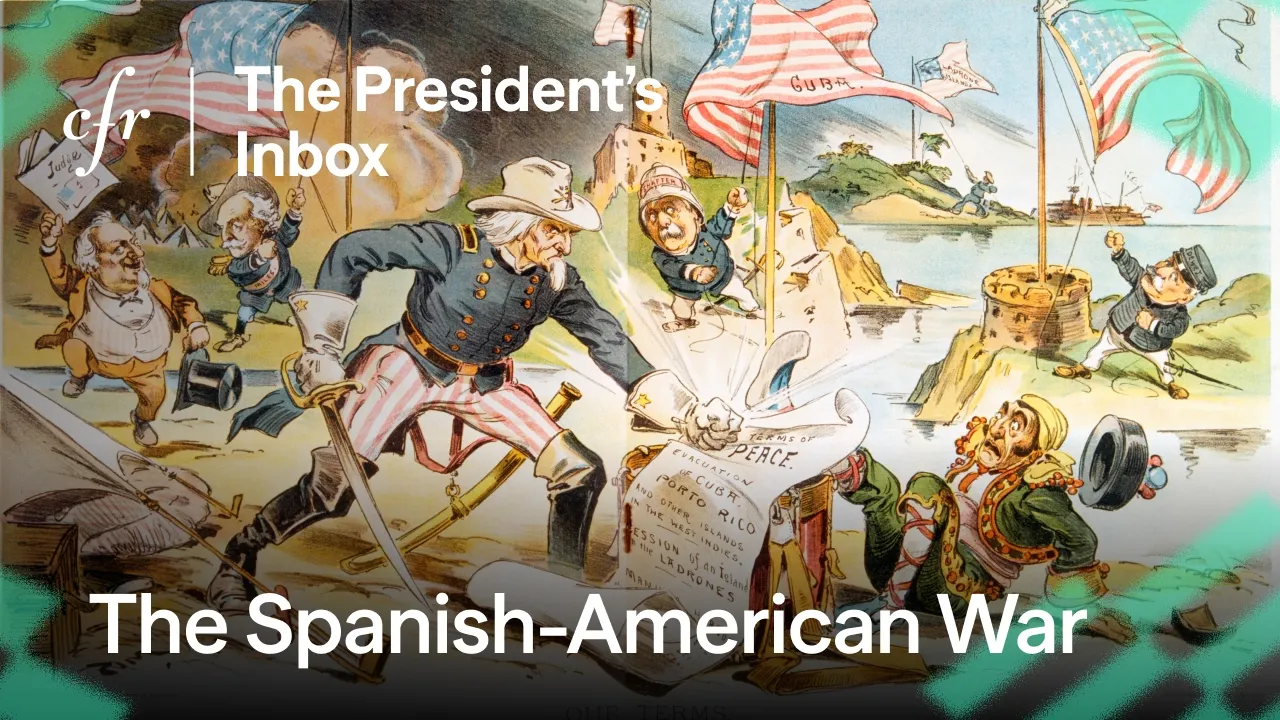
This episode unpacks the causes, key events, and consequences of the Spanish-American War, highlighting how it shaped U.S. foreign policy into the modern era.
Published
Host
 James M. LindsayCFR ExpertMary and David Boies Distinguished Senior Fellow in U.S. Foreign Policy
Guest
- H.W. Brands
[Video: https://youtu.be/yj8HELw9fNc]
TRANSCRIPT
BRANDS:
It’s almost a perfect recipe for lining up all sorts of different groups behind the idea that a war against Spain, maybe started by Cuba, would be in the interest of the United States.
LINDSAY:
Rebels fighting to overthrow a tyrannical government, horrific stories of human rights abuses, calls for the United States to intervene. Those sound like today’s headlines, but they were also in the headlines of newspapers across the United States 128 years ago as Spain sought to crush a rebellion in Cuba. On April 25th, 1898, the United States Congress responded to the calls for action and declared war on Spain.
The decision changed the fate of nations. What prompted the Spanish-American War? How did it change the course of U.S. foreign policy? In what lessons might it offer us today? From the Council on Foreign Relations, welcome to the President’s Inbox. I’m Jim Lindsay.
Today I am joined by Professor H.W. Brands, Jr., the Jack S. Blanton Senior Chair in History at the University of Texas at Austin, and a prolific author whose books have twice been finalists for the Pulitzer Prize. Bill, thank you very much for joining me.
Nice to be with you, Jim. Bill, in recognition of the 250th anniversary of American independence, we are devoting one episode of the President’s Inbox every month to a pivotal moment in the history of U.S. foreign policy. The Spanish-American War certainly qualifies on that score.
It marked the moment the United States emerged as a major world power, gaining possessions not just in the Caribbean, but also in Asia. Now, most people, Bill, know that the war was fought over Cuba, but perhaps you could start with you explaining exactly how things got to that point.
BRANDS:
The underlying influence that shaped American policy during this time was the coming of age of the American economy. The United States industrialized rapidly during and after the Civil War. So by the beginning of the 20th century, which is the late 1890s, the United States was probably the most powerful country in the world economically.
The United States, however, during the 1890s, was suffering from a great industrial depression. This was something new in American experience because when the United States was largely agricultural country, it didn’t have depressions. Nothing as systemic as there was a depression in the 1870s.
There was a deeper depression in the 1890s. And Americans looked at this and wondered what the world’s going on. The country was industrializing.
In aggregate, Americans were getting wealthier, but there were all sorts of ups and downs in the economy. So this is a backdrop. Americans are feeling concerned about things at home.
They’re also beginning to realize that it lies within the power of the United States to exert military force, to exert American power abroad. Until this time, from the founding of the United States in the 1770s until the 1890s, the United States had by and large minded its own hemispheric business. It basically paid attention to what was going on in the United States.
It dealt with the Civil War. It fought Britain in the War of 1812. But some Americans were beginning to think, we can do more than that.
We can project power abroad. And these folks began, I would say exactly looking for an opportunity to project American power, but they certainly were willing to take any opportunity that came. So in the middle of this, there’s a nationalist revolt in Cuba.
It wasn’t the first time that Cuban nationalists, Cubans who wanted independence from Spain, this was the last important Spanish colony in the Western Hemisphere, who wanted independence from Spain, they began to rise up and to assert their right to a country of their own. They expected and they received sympathy from the United States. The United States from its own anti-imperial beginnings had been inclined to support nationalist movements.
The United States was first arguably to achieve independence by this means. And so American sympathies went out to the Cuban nationalists. It dovetailed with the thinking of those who thought, okay, well, this is our chance.
This is America’s chance to project power abroad. War against Spain would demonstrate America’s ability, first of all, to manage affairs in America’s own backyard. And this was one of the early occasions when the Monroe Doctrine was trotted out as a way of justifying American control of the affairs of the Western Hemisphere.
But there were others who looked beyond the Western Hemisphere. Thought this was a time when European powers, the sort of the great powers of the time, were projecting their own power into Africa, into places that hadn’t previously been colonized. And some people in the United States, people like Theodore Roosevelt, Henry Cabot Lodge, a senator from Massachusetts, they thought that the United States ought to get involved in this or the U.S. was going to be left behind. So they’re a confluence of influences that incline a certain group of Americans to think, now is our chance to demonstrate to the world that the U.S. is a great power.
LINDSAY:
So Bill, help me understand that latter point, the notion of, I’ll call it nationalism, let’s say the Lodge-Roosevelt school of thought, that the United States was now a world power. It should act like one. There had been the scramble for Africa.
My sense was it had both an offensive element to it, we should assert our power, but also fear that the Europeans would be coming into our neighborhood to claim territory. There had been some tiffs with Britain over Venezuela, rising fears of Germany. Are these the people that history calls the jingos?
And where does that term even come from?
BRANDS:
Well, I don’t recall exactly where the term jingo comes from. It’s usually not meant as a compliment.
LINDSAY:
No, by no means is it a compliment. Yeah.
BRANDS:
And it refers to people who take nationalism to an aggressive extreme. And these are individuals who are looking, they basically go out in the world with a chip on their shoulder and are quick to be offended, to take offense, and then to take action. They are, you could call them hyper nationalists, or you’d call them militant nationalists, people who are looking for an excuse to exercise American power.
And for some, this is a result of their assessment of the nature of international affairs, that this political scientist would call this a realist view, and that the powerful countries do what they can and everybody else has to do what they must. There’s a personal element behind it in some cases. And Theodore Roosevelt, whom I mentioned, was one who impressed even his friends and allies, like Henry Cabot Lodge, with his aggressive attitude toward foreign policy.
And some of them said that Theodore wants a war. He doesn’t care who it’s against. He just wants a war.
And Roosevelt’s sister traced this in some degree to the fact that their father, who was Theodore Roosevelt’s hero, a man who could do no wrong, except in one critical area. He had not picked up a gun. He had not put on the uniform during the Civil War.
Now, he had very good reason for not doing it. In the first place, his wife was a Georgian, and she was deathly afraid that he would kill her brothers or her brothers would kill her, kill him. They were fighting for the Confederacy.
But he also had a very responsible job as a civilian officer, going around to the military camps, persuading soldiers to have their paychecks sent home to take care of families. So he did find work, but it wasn’t something to stir the blood of an impressionable young boy who spent the next 20 years hearing his friends talk about the heroic efforts of their fathers during the And what did your dad do, Theodore? And he had no answer.
So he had this suspicion. He needed to know that Roosevelt men were brave. So he was looking for an opportunity for himself to go to war personally.
He also, and this sort of gets back to the Jingo question, he developed this idea that wars could be good for the moral health of a nation. And so he was, during this time, he was assistant secretary of the Navy, and he gave a speech at the U.S. Naval War College, where he talked about the advantages of war over peace and how the greatest triumphs of peace pale next to the triumphs of war, because war called out the greatest selflessness in a nation. It called for courage, it called for willingness to put the nation above everything else.
And so Roosevelt was looking for an excuse to flex the muscles of the United States.
LINDSAY:
Bill, one of the other things that’s often mentioned when we talk about the Spanish-American War is the yellow press. There’s the famous story that William Randolph Hearst said to Frederick Remington, furnishing with photos, I’ll provide the war. That’s probably apocryphal, but I think it captures the spirit of the notion that the war was fed by newspaper coverage.
How accurate is that? How much does that really play a role?
BRANDS:
When you try to assess the importance of different influences on decision-making in a pluralist society like the United States, it’s hard to put your finger on how much weight to give anyone, but there’s no question about it that war sells newspapers. And newspapers were the prime media source of the day. And so for this war, there was a war in Cuba before the United States got involved.
It was the nationalist against the Cuban loyalists, the ones loyal to Spain and the Spanish troops themselves. And it made for great stories, great humanitarian tales. And when the American press, you mentioned William Randolph Hearst, Joseph Pulitzer was another, who they sent reporters down there and they wanted to report the news.
And news from a battlefront is almost always more dramatic than news that was happening in the local city council. And the competitiveness of the newspapers in those days was crucial to all of this. For the first time, newspapers had to sell lots and lots of copies because they were making most of their money on advertising.
And the more eyeballs that were watching, reading the newspapers, the more issues that were sold, the higher advertising rates they could charge. And this is very much the kind of media environment we’re in today. And so there was competition to get the best stories, to get the scoops, to exaggerate sometimes.
And as compelling as the story of the Cuban nationalists against the Spanish. And this was one where it was relatively easy for the papers to portray one side as the good guys and the other side as the bad guys. So the Spanish are the bad guys.
And again, this resonates with American thinking regarding European empires, with the Monroe Doctrine, with the idea of individual nationalist movements gaining independence. And when there actually were atrocities committed against Cuban civilians by Spanish authorities, it made for a great story. It would be even better if the United States got involved.
Now, there’s no indication that Pulitzer or Hearst had any direct line to American decision makers, but there’s no doubt that the excitement of the war was increased by the newspaper coverage. A kind of coverage that wouldn’t have happened 20 years earlier. The kind of coverage that is very familiar to people today.
LINDSAY:
And I should note that the Spanish forces were quite brutal in trying to suppress the rebellion. So it wasn’t that Hearst or Pulitzer or others like them were making up stories. One other aspect I want to just chat about quickly, Bill, and that is the economic component of it.
I mean, you’re a historian, you know, there’s a long history of historians arguing that the flag follows trade, that wars are caused by economic desires. The United States clearly took a lot of sugar in from Cuba. I think the revocation was the McKinley tariff in 1895 helped crash the Cuban economy and help precipitate the rebellion.
What was the role of economics and economic interest in the Spanish-American war?
BRANDS:
During the 1890s, the depression of the 1890s in America underscored a fundamental difference between a modern industrialized economy and the economy that went before. When the United States was predominantly an agricultural economy, overproduction was never a serious problem because, you know, you can only grow so much. And basically markets would clear themselves.
There were occasional gluts of this and that, but there wasn’t anything that caused widespread unemployment. In fact, unemployment itself is largely an artifact of a modern economy. When people work on their own farms, there’s always something to do.
But after the Civil War, first time obviously in the 1870s, then again in the 1890s, there’s a problem. Can America find sufficient markets to buy up all the stuff that it can produce? So, industrialization means building factories, filling out mines, do all this stuff, making the productive side of things much more efficient, so you can produce a lot more stuff.
But will there be customers? Will there be people to buy this? And the depression of the 1870s and again of the 1890s raised the specter that American consumers simply could not absorb, could not purchase everything that American producers could put out.
And so, for the first time, export markets seemed crucial to the continued prosperity of the United States. Now, again, this is not news to anybody who has observed the rise of China as a global economic power by producing stuff for export. And so, there was this thinking on the part of manufacturers, on the part of members of Congress who represented manufacturing districts, on the part of people who had other reasons for wanting to see an assertive American foreign policy and realized if they could get the manufacturers on board, that would add to the weight of their arguments.
So, there was an idea that there were markets overseas. Now, the mature markets in Europe, it was really hard to break into. Americans already did trade with Europe, but the European economies were, they were as efficient as the American economy.
But the big idea, the prize out there that everybody wanted to get into was the China market. Because the China market, as it was perceived in those days, were these hundreds of millions of people who were just looking for the produce of the American economy.
LINDSAY:
So, the enthusiasm to invest in China in the 1990s and early 2000s was not the first time we’ve seen that kind of enthusiasm in the United States.
BRANDS:
Exactly. And the China market, it was something you could just mention the China market in the 1890s and people say, yes, we got to get there. And we got to get there quickly because the Europeans are turning their attention, the Europeans and the Japanese are turning their attention to China.
And this was not an era that believed in free trade. So, if you planted a colony in or around China, you would make sure to keep out your competitors. So, the Japanese, the Germans, the British, the French, they were all kind of hovering around China, hoping to get a foothold in there so that they could export their own stuff.
And if they did, that would be to the detriment of the United States. So, there were people like Henry Cabot Lodge, people like Theodore Roosevelt, who said, we got to get access to the China market. And they looked around and say, how could we get access to the China market?
Now, it occurred to some of them once troubles developed in Cuba, a Spanish colony, that Spain had colonies near China, in particular the Philippines. Now, this required a geography lesson for most Americans who, you know, they didn’t pay any attention to the Philippines and they weren’t thinking about exports. But there were a few of them who were and thought, okay, if we do go to war against Spain, well, it’s not going to be a war just against Spain in Cuba.
It’s going to be a war against Spain wherever Spain might be. And Theodore Roosevelt again is one, he’s in his perch in the Navy Department. He’s thinking, okay, if there’s a war against Spain, we’re going to take it to the Spanish in the Philippines.
LINDSAY:
Because there was a Spanish fleet based in Manila. And one fare also was a strategic one, which is if you didn’t defeat them, they could sail to the West Coast.
BRANDS:
But if you go to war against Spain, you’re going to deal with the Spanish fleet. And the Spanish fleet, as you say, they had a big fleet in the Philippines, and they can sail across the ocean and prevent the United States from winning the campaign in Cuba.
LINDSAY:
Or perhaps potentially shell Los Angeles or San Francisco, I would imagine. Yeah.
BRANDS:
So all of this stuff kind of fits together. The war itself, the impetus to war, it increases. And one of the consistent through lines in this is this American humanitarian concern for what’s going on in Cuba.
And so this is, it’s almost a perfect recipe for lining up all sorts of different groups behind the idea of war. You can argue for war in Cuba on behalf simply of the well-being of the suffering Cuban people. So this is an entirely selfless act by the United States.
So the missionary types, they’re the ones who are, okay, we’re on board with this. And then there are others who think, well, the United States ought to be the dominant power in hemisphere. They call these the advocacy of the Monroe Doctrine.
And then they’re the neo-imperialists, ones like Theodore Roosevelt, who they don’t deny the fact that they want this big kind of policy. The United States ought to be more like Britain and France and Germany and those. And then they’re the China Market Business Association groups.
They say, okay, this is going to promote our exports. So bring them all on board. And they reach a point where they’re really entertaining the idea that a war against Spain, maybe started by Cuba, would be in the interest of the United States.
LINDSAY:
So let me ask you, Bill, about presidents. Now, in your writings, you often caution people not to exaggerate the importance of presidents. But I do want to talk at least a little bit about William McKinley.
He takes office on March 4th, 1897. He is a Civil War veteran. I think he was scarred by his experiences in the Civil War.
At one point, he lamented, I have seen the dead piled up. I do not want to see another war. Indeed, he used his inaugural address to warn against any sort of war of aggression, a war of territorial conquest against Cuba.
How did McKinley handle these pressures or growing pressures in the United States to do something about what people were seeing in Cuba?
BRANDS:
Well, for the first year and a bit more of his presidency, he was able to keep the voices in favor of war, keep them under control. But a joke, sort of an ironic joke or a dark joke developed between McKinley and his personal physician, Leonard Wood, who was a Navy doctor. And Leonard Wood was good friends with Theodore Roosevelt.
And Leonard Wood would come around to the White House to check on McKinley every so often. And McKinley was aware that Wood and especially Roosevelt were agitating in favor of stronger action against Spain. And McKinley would joke with Wood and say, well, Leonard, have you and Theodore declared war yet?
And Wood would say, no, we haven’t, Mr. President, but we think you ought to. And there’s a dynamic that develops here. And you see it again and again in American history.
And it’s probably true in history of other countries as well, that the activists, the voices in favor of decisive action, including military action, they often have an advantage over those people, a psychological advantage over those people, even if they’re president of the United States, who say, no, no, no, we shouldn’t do that. Because the decisive ones, the bold ones, they seem courageous. They think they were going to bet on the United States and the United States is going to do all these good things.
Again, because of the different motivations, moving people in this area, you can cast this war as, you can cast American action on behalf of the Cuban nationalists as altruistic. You can cast it as well as in the interest of the United States. And so in American foreign policy, certainly, if you can get these two separate threads, one as this is good for the world and it’s good for the United States, then it’s almost irresistible.
Now, McKinley did resist, but the newspapers were saying America ought to do more. And the likes of Roosevelt and Lodge were saying America ought to do more until McKinley finally felt obliged to do more. He made diplomatic statements to the Spanish to go easy on the nationalists and to the point where he sent an American battleship to Cuba to sort of monitor the situation.
Well, it was more than just monitoring the situation. This is an American battleship. And from the standpoint of the Spanish government of Cuba and the Cuban loyalists, and it’s important to note here that the Cuban people were not of one accord on this, that there were actually Cuban loyalists who thought that they’d be better off if Cuba remained a colony of Spain.
They saw this as American pressure, that the battleship, the Maine shows up off Havana. And then the battleship blows up and over 100 Americans are killed. Now, once Americans get killed in action, then politics kicks into high gear and people like Roosevelt and the groups that were in favor of war, they immediately pointed the finger of blame at the Spanish.
The Spanish blew up the American ship and they were directly responsible for the deaths of these Americans. Or if it wasn’t the Spanish, it was the Cuban loyalists who were just as bad as the Spanish. Now, in fact, it’s almost certainly the case that it was accident.
There was coal dust in one of the coal bunkers and these things blew up every so often and it did, but it put tremendous pressure on McKinley to take even firmer action because if he doesn’t, he’s seen as weak. And even someone who was so philosophically opposed to another war, well, okay, I got to do something here. Now, it’s worth a reminder to modern audiences that this was a time when Congress had to be involved in a decision for war.
A president could not take the United States to war. It was unthinkable at that point in American history. It was, exactly.
And so McKinley decided that, okay, the time has come to ask for a declaration of war. And so he goes to Congress and Congress votes in favor of war. It wasn’t unanimous.
There were those people who were skeptical of this. Wait a minute, those American imperialist types, they just want to seize foreign territory and the newspapers want to sell newspapers. So the war was divisive from the beginning, but the United States went to war.
And I should add here, during the debate over the war, the emphasis was entirely on affairs in Cuba and nobody who was in the middle of the debate was thinking about anything more than that. But some of the people like Theodore Roosevelt were, and indeed Roosevelt had already sent orders out to the American Pacific fleet in the event of war against Spain, sail directly to Manila and sink as many Spanish vessels as you can. So the debate as it was articulated, wasn’t the full story.
And the result was that when Congress said, okay, we’ll give you a declaration of war, the first thing Americans learn about the war is, when the war actually ended, taking place is, George Dewey has sunk the Spanish fleet in the Philippines. And Americans, they got to hustle to their analysis, where in the world is the Philippines? What’s that got to do with what’s going on in Cuba?
LINDSAY:
Well, this is one of the fascinating things, Bill, about the Spanish-American war, because in declaring war on Spain, the United States passed what was the Teller Amendment, which sort of forswore any interest in acquiring Cuba. This was in essence to say to the world, this is a humanitarian venture, we have no interest in acquiring Cuba. We’re morally clean on that score.
But the war ends, the United States has, quote, liberated Cuba, but it has also acquired Puerto Rico, and it’s acquired the Philippines. And that leads to a debate, which I would say is very interesting, you’ve written about this, about what to do with the Philippines, which as you said, before the war began, nobody knew where it was or why it mattered. As you well know, the decision was to annex the Philippines.
Why did that decision come about?
BRANDS:
So you mentioned the Teller Amendment. This is a case where the opponents of war, the skeptics of the arguments in favor of war, they couldn’t stop Congress from making a decision for war, but they decided to force the advocates of war to put their money where their mouth is, so to speak. And they said, you’ve been saying all along, this is not for American self-interest in Cuba, this is for the good of the Cuban people.
Okay, if you want money for the war, the Teller Amendment is an amendment to a war appropriations bill. If you want money for the war, you have to say, we are not going to annex Cuba as a result of this. Now the advocates of war, they couldn’t say no to this because it would undercut everything that they’d been saying, but it did not occur to the drafters of the Teller Amendment to include the Philippines and Puerto Rico in this.
If they had thought of it, they probably could have gotten the same self-denying pledge there too, but they didn’t. And as a result, the war ends, the United States is in thorough occupation of Cuba, but the United States cannot annex Cuba because of this law, except that it turns out that annexation wasn’t really that important. The United States occupied Cuba and had its way with Cuba for a long time anyway.
But the United States found itself in occupation of, well, not the Philippines. The Philippines is a sprawling archipelago of thousands of islands, but in occupation of the capital, Manila. And the United States has to decide what to do with the Philippines.
And McKinley, now this is one where the president had to go to Congress, consult Congress, ask Congress for a war. But after the war, he can direct his negotiators who are writing the peace treaty as to what to include in the peace treaty. Now, he will have to go to the Senate to get approval of the treaty, but at least he can make this decision.
What do we do with the Philippines? And this is the big question. And he thought about this, and I think he was quite sincere in this.
In figuring out, it was like, what are the alternatives? Now, to modern audiences, sort of thinking that independence is the default setting for nations around the world, and the United States had been in favor of this idea, well, let’s just grant the Philippines independence. And some people proposed that to McKinley.
But McKinley thought this is probably not a good idea, even from the standpoint of the Filipinos themselves. Because by ejecting Spain from the Philippines, the United States would have left Spain, sorry, would have left the Philippines undefended against other Europeans. So, as I mentioned earlier, there are the European imperialists who are hovering around China, and many of them are quite aware of the value of the Philippines and its harbors and its launching points for access to the China market.
And so, McKinley thought, if the United States should give the Philippines independence, well, that’s not going to last very long, because the Japanese will come in and seize the Philippines.
LINDSAY:
Well, that’s right. Because they just argued that Spain treated its colonies horrifically.
BRANDS:
Right, you can’t do that. So, independence. But Japan had just seized Taiwan a couple of years before, and the Japanese would be delighted to take the Philippines.
So, if the United States left the Philippines independent, basically unguarded, the Philippines didn’t have an army, it didn’t have a navy. So, somebody had to protect it. So, he couldn’t do that.
He certainly didn’t want to give it to any of the other European powers, colonial powers. So, he said, you know, the only thing for the United States to do is to take it over. Now, he cast it in a way that made him look sort of ignorant, or really parochial, when he said, he was mentioning this to a group of visiting Protestant ministers.
He said, the only thing we could do is take the Filipinos and lift them up and Christianize them. Well, they were all Christians. They were Catholics.
LINDSAY:
They were Catholic. I’m not sure some of those Protestant ministers accepted that inclusion.
BRANDS:
So, once the United States found itself in effective occupation of the Philippines, the decision to annex the Philippines might very well have been the least bad option, even from the standpoint of the Filipinos, because they probably would have fallen under the control of another imperial power. And as it turned out, American imperialism in the Philippines, as imperialism went in that era, was probably the best version on offer. But it did, this decision to write annexation of the Philippines into the peace treaty, prompted a big debate in the Senate.
LINDSAY:
And there was a bloody war in the Philippines. I know you’ve written a lot about Roosevelt. Is it your sense that he regretted the annexation?
Because it was a headache for him during his presidency.
BRANDS:
Yeah, exactly. So, Roosevelt was all in favor of annexing the Philippines. He was aware that there had been a national uprising in the Philippines against Spanish control.
It hadn’t gone as far as the national uprising in Cuba against the Spanish. But when the United States went in there, it found itself not being greeted as liberators by the Filipinos, but as the new imperialists. And so, the nationalists and the Filipinos started fighting against the United States.
And the war was bloody. It was in many ways a precursor to the Vietnam War of 60 years later, with the same kind of brutal tactics. And in fact, it was ironic and tragic that the United States found itself engaged in the same kind of anti-guerrilla warfare tactics that the Spanish had used in Cuba, that the United States had condemned so vigorously.
Theodore Roosevelt inherited the Filipino War when he inherited the presidency in 1901 upon the assassination of McKinley. And Roosevelt was willing to fight this to a successful conclusion where the Filipinos stopped fighting mostly, and they acknowledged American control. But he also realized that unless the United States garrisoned the Philippines, it was going to be a net disadvantage for the United States, because it meant that the United States now found itself in competition with Japan.
The Japanese were emerging as this up-and-coming power in East Asia. And the Japanese, as I mentioned, they gained control of Taiwan. They renamed it Formosa, which was known for the next 50 years.
And they didn’t like the idea of this new imperialist power, the United States coming in. And so Roosevelt, if it had been left up to him, if he had been Congress, he would have spent enough money to build up the defenses of the Philippines to make it impregnable against Japanese attack. But Congress wasn’t willing to do that, because Congress said, we spent money on this war.
We didn’t expect to become this military power that has to defend all these far-flung places. So by the time Roosevelt left the White House after the 1908 election, he was lamenting that the United States had taken the Philippines, not because it was wrong, but because the American people could not be persuaded to defend the Philippines. So the Philippines were not a source of strength to the United States.
They were a source of weakness and a source of competition with Japan. And he, and not Roosevelt alone, predicted, this is going to be trouble in the future. There’s going to be a clash between the United States and Japan, which indeed is what happened 30 years later.
LINDSAY:
Bill, in closing, one last question, which is sort of, as you look back on the Spanish-American War, which Secretary of State John Hay famously called the splendid little war, what do you see as its significance for the United States? And does the Spanish-American War hold any lessons for us today?
BRANDS:
I think there are two aspects of significance. One is the American War against Spain and the annexation of the Philippines signaled to the world that there’s this new kid on the block, the United States of America, that is beginning to basically grow into its own strength. And all of a sudden the British, for example, decide, you know, we better be nice to the Americans because if we go to war in Europe, it’d be nice to have the Americans on our side.
And it’s during this period that the British shift because they’ve been sort of a thorn in the side of the United States for a century since independence.
LINDSAY:
It’d be less than 20 years before they would need to rely on a turn to the United States.
BRANDS:
Exactly. And the United States basically rescues Britain in World War I and World War II. So it worked.
But so it announces to the world that the United States is a big player. And the second thing is it cures Americans of whatever idea they had that they wanted to be an imperial power. So the American reaction to becoming the colonial overlord of the Philippines so rubbed against the American grain that the chance of the United States taking any other colonies basically disappeared.
So in one respect, the Americans basically by violating a principle of American dealings with other countries, saying we’re not going to be an imperial power by violating that at once, it caused America to say, whoops, we’re not going to do that again. But it also announced the United States is this power that can have a decisive effect in world affairs.
LINDSAY:
On that note, I’ll close up the president’s inbox for this week. My guest has been H.W. Brands, Jr., the Jack S. Blanton Senior Chair in History at the University of Texas at Austin.
Bill, as always, a delight to chat.
BRANDS:
Great to talk to you, Jim. Take care.
Today’s episode was produced by Justin Schuster with Director of Video Jeremy Sherlick, Senior Video Producer Grace Raver, and Director of Podcasting Gabrielle Sierra.
Molly McAnany was our recording engineer. Production assistance was provided by Oscar Berry and Khaleah Haddock.
This transcript was generated using AI and may contain errors or inaccuracies.
To mark the 250th anniversary of the U.S. declaration of independence, CFR is dedicating a year-long series of articles, videos, podcasts, events, and special projects that will reflect on two and a half centuries of U.S. foreign policy. Featuring bipartisan voices and expert contributors, the series explores the evolution of America’s role in the world and the strategic challenges that lie ahead.
We Discuss:
- What drove the United States toward assertive foreign policy in the 1890s.
- Who the “jingoes” were and how American leaders pushed for American power abroad.
- Whether access to China drove American interest in Spain’s Pacific empire.
- Why the USS Maine explosion changed the political calculus for entering a war with Spain.
- What the Teller Amendment accomplished and what its drafters failed to anticipate.
- Whether the annexation of the Philippines was ultimately the least-bad option for the Filipino people.
- What the Spanish-American War’s legacy reveals about how the United States became—and chose to remain—a global power.
Mentioned on the Episode:
Monroe Doctrine, December 2, 1823
McKinley’s First Inaugural Address, March 4, 1897
Theodore Roosevelt, Naval War College Address, June 2, 1897
The Teller Amendment, April 19, 1898
Opinions expressed on The President’s Inbox are solely those of the host or guests, not of CFR, which takes no institutional positions on matters of policy.
Associate Producer, Video and Audio
- Associate Producer, Video and Audio
Editorial Director and Producer
- Director, Podcasting
Director of Video
- Director of Video
More Episodes
 33:42Podcast
 36:05Podcast
 41:07Podcast
 39:26Podcast
 35:04Podcast
 31:46Podcast