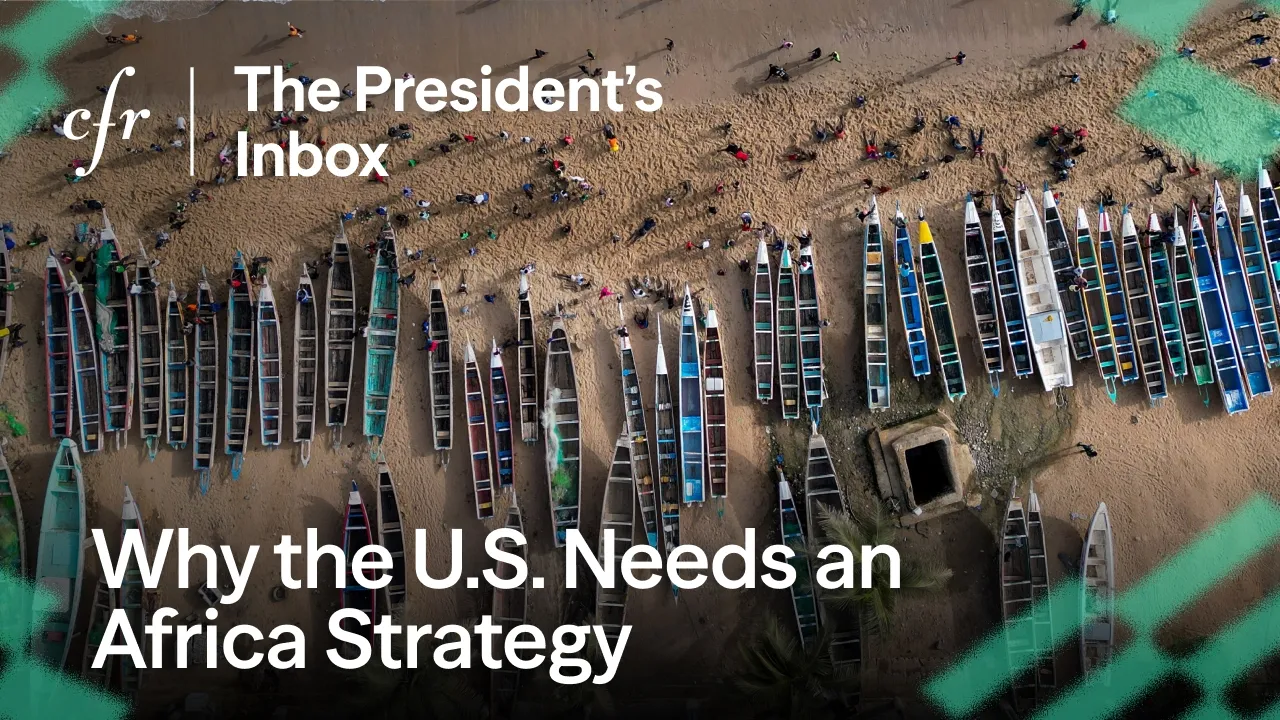
Why the U.S. Needs an Africa Strategy, With Michelle Gavin
This episode unpacks how Africa’s demographic surge, critical mineral wealth, and expanding security threats are reshaping its relevance to U.S. foreign policy in the twenty-first century.
Published
Host
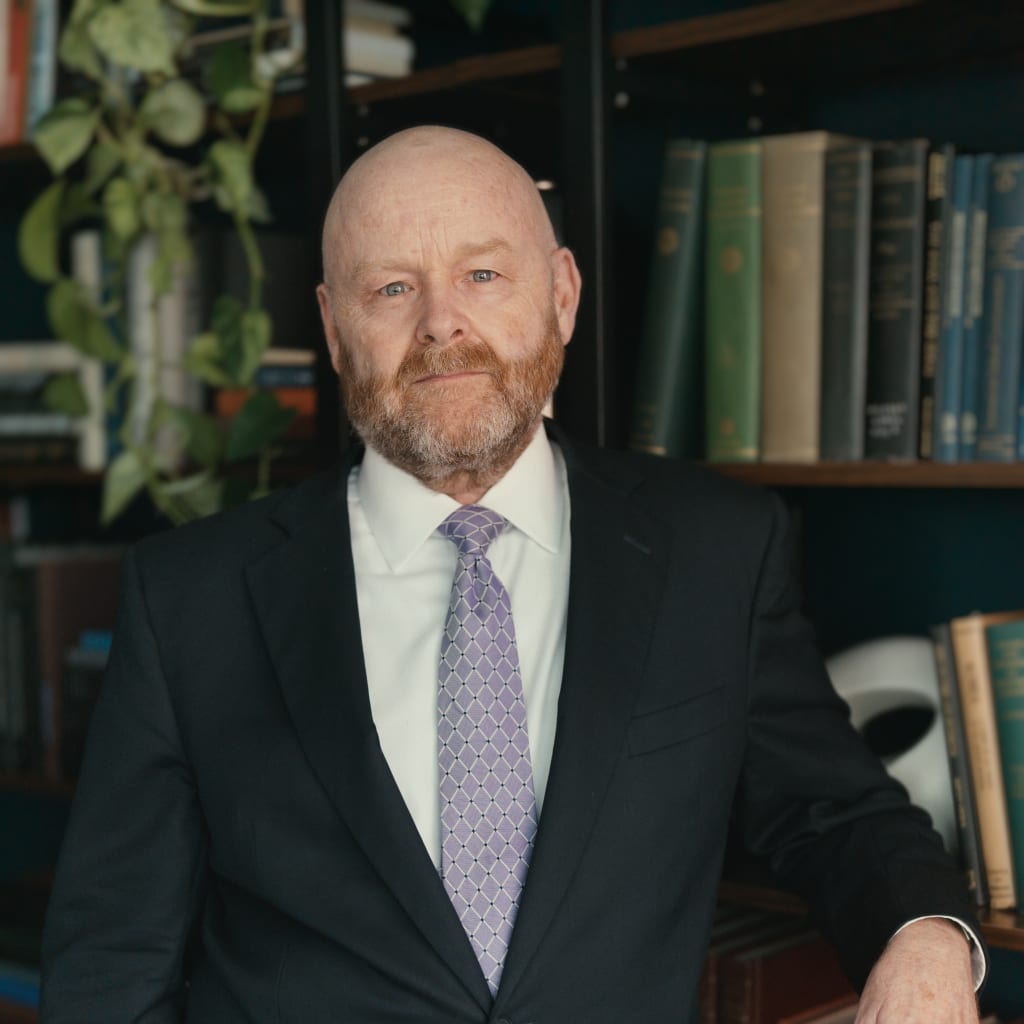 James M. LindsayCFR ExpertMary and David Boies Distinguished Senior Fellow in U.S. Foreign Policy
Guest
 Michelle GavinCFR ExpertRalph Bunche Senior Fellow for Africa Policy Studies
[Video: https://youtu.be/6vn1719Lh90]
TRANSCRIPT
GAVIN:
This mismatch between demographic might and economic returns will unquestionably be kind of at the center of where Africa belongs in some kind of restructured global order.
LINDSAY:
African states face major challenges in the 21st century. One thing, however, is certain, the continent’s influence on the global stage is growing.
FRANCE 24:
By 2050, Nigeria’s population is expected to become the third largest country in the world.
BLOOMBERG TELEVISION:
No continent is richer in natural resources than Africa.
BBC NEWS:
Johannesburg prepares to host the first G20 summit on the African continent.
LINDSAY:
The ability of the United States to succeed in an era of geopolitical competition will depend in part on Washington’s ability to deepen its engagement with African states, form lasting relationships with its leaders and people, and understand the continent’s priorities. What issues should U.S. policymakers focus on today? Where on the continent should they direct their efforts?
And what could the consequences be if the United States fails to make Africa and Africans a foreign policy priority? From the Council on Foreign Relations, welcome to the President’s Inbox. I’m Jim Lindsay.
Today, I am joined by Michelle Gavin, the Ralph Bunche Senior Fellow for Africa Policy Studies here at the Council. Michelle, thank you for coming back on the President’s Inbox.
GAVIN:
Thanks so much for having me.
LINDSAY:
Michelle, you are participating in a new Council on Foreign Relations initiative on the future of American strategy. It’s an effort to think through how the United States should adapt its foreign policies to a changing global order. In reading the essay you wrote for the initiative’s launch, I was struck by your conclusion that the United States needs to leave anachronistic and dismissive ideas about Africa behind.
So perhaps we can start our discussion right there. How is U.S. policy toward Africa failed to serve U.S. interests?
GAVIN:
Well, I think U.S. policy toward Africa has, you know, frequently treated an entire region, which is highly differentiated in a lot of ways, as sort of a zone for perhaps development projects, a sort of world apart where the only real issues are sort of the optionals. Perhaps we can help with development in this space. Maybe we could provide some diplomatic support on the peace and security side.
But if we have more essential things to do, we’ll immediately pivot away from that. And what we’ve failed to do is really think more strategically, what kind of African partners does the United States need to thrive and prosper and be safe going forward? And then back our way into what that means for policy today.
I will say, though, that that kind of longer term strategic outlook is very evident in other powers’ Africa strategies. Certainly that’s the case for China. It’s increasingly the case for Turkey, for the Saudis, for the United Arab Emirates.
And so I think the U.S. has a fair bit of catching up to do in really thinking concretely about the economic potential of the continent, about the geographies that, as we’ve all recently been reminded by the Strait of Hormuz, will be enduringly relevant, and about the security issues that are unlikely to stay confined to African soil.
LINDSAY:
So, Michelle, I want to pursue that point. Lay out for me what you see as sort of the major trends or developments across the continent that you think are particularly pertinent to the United States and to U.S. interests. What should we be keeping in mind when we look at the continent?
GAVIN:
Well, first of all, we should just be thinking about Africa’s shifting role relative to other powers around the world. So, you know, here demography comes into play. We have a continent that is growing rapidly while other regions tend to be aging.
It’s got about 45 percent of the world’s labor force now. That is only going to get bigger. But Africa accounts for about less than 3 percent of global GDP.
So this mismatch between a demographic might and economic returns is something that will unquestionably be kind of at the center of negotiations around where Africa belongs in some kind of restructured global order.
LINDSAY:
I’ll note in that score, Michelle, I just saw a statistic that within a decade, one in five people in the world will live somewhere in Africa. That’s a stunning number when you think of it.
GAVIN:
Absolutely. And then by 2050, it’ll be one quarter of the world’s population will be African. So Africa will be growing for some time.
And it’s just hard for me to imagine that the United States can continue to operate as a major power in the world with interests that span the globe and give such short shrift to such a massive part of the world’s population.
LINDSAY:
I would think the other part of the demographic changes we’re seeing in Africa is something you focused on in your recent book, The Age of Change. Africa is much younger than the other continents.
GAVIN:
Much younger. Yes, the age structures skew incredibly young. And that really puts a lot of pressure on African states because you have these very kind of flat based wide population pyramids.
That means that states have heavy demands for providing education, health care, because Africa is also the most rapidly urbanizing part of the world. That means the need for basic services in urban centers, transportation, access to water, access to power. So there are very heavy demands on African states right now and really insufficient fiscal resources to try to meet those demands.
So that sets up as the book describes this tension, this grievance space in African populations, a set of demand signals that is very, very hard for African states to adequately respond to.
LINDSAY:
So what other significant aspects of the continent are relevant to the United States?
GAVIN:
We cannot ignore some of the security issues on the African continent, both in the sense that there are radical extremist organizations that control large swathes of African territory, significant African mineral resources, and in fact have been growing in their scope and level of control, certainly throughout the Sahel. But these groups also operate in the Horn and in northern Mozambique. These are entities that are affiliated with Islamic State or Al-Qaeda that have, you know, expressed repeatedly and demonstrated desires to attack Americans and the homeland.
And so while we can’t view an entire continent through this lens of counterterrorism, it’s also, you know, we can’t neglect the fact that these are entities antagonistic to the United States, growing in strength and territory on the continent. So there’s that piece. But there’s also, you know, issues around maritime security.
So, you know, we’ve seen how important that is in the Strait of Hormuz, the Red Sea, and the Bab el-Mandeb. You know, when we think of these geographies, we rarely acknowledge that there are two sides to the Red Sea, and one side is African. And there are a set of kind of interconnecting tensions and rivalries in that part of the continent that could very much complicate the free flow of commerce through the Red Sea.
That has real impact on the global economy, certainly on America. But even now, as we see more shipping going around the Cape of Good Hope, taking that long path around the southern tip of Africa, that means that that Mozambique Channel is becoming much busier than it used to be. And so we’ve seen piracy in West Africa.
We’ve seen piracy off the coast of Somalia. I think we’re going to probably start to see more in that western Indian Ocean area as there’s more shipping. And so there are some of these maritime security issues that can’t be ignored.
Then there are also, you know, broader geopolitical competition issues. So as the order that I grew up with crumbles around us, and it’s something of a jump ball moment internationally for what the new regimes and norms might be, there are other powers very assiduously working to build African support for their preferred models. And that matters because if we, you know, if we engage in any kind of multilateralism going forward, you’ve got at least 54 African votes in any body that is looking at kind of states as shareholders.
And so there are conversations about the future of the international order happening that sometimes the U.S. is extremely absent from on the continent.
LINDSAY:
And what about critical minerals?
GAVIN:
So there is no question that Africa is the source of many of the minerals most important to a green transition, most important for some of the most competitive technologies today. I hesitate sometimes to put that front and center just because people far more technologically savvy than I frequently remind me that what is necessary today might not be as necessary tomorrow. But there is, for the foreseeable known technological future, Africa’s cobalt, lithium, and other critical mineral resources are extraordinarily important.
It creates some leverage for African states relative to international actors who want access to these minerals. But it’s also creating an interesting domestic political conversation in a lot of African countries about what happens to this mineral wealth. Why is there so little job creation associated with it?
Ultimately, who does it benefit?
LINDSAY:
I have to ask, Michelle, I frame this as a conversation about Africa, and I wonder if that might be misleading, talking about Africa as if it is a monolith. I mean, I think one point that’s important to make is Africa is a very, very big place. It is home to essentially five dozen countries.
You could take the United States, China, India, and most of Western Europe and fit it inside of Africa. So how should we think about Africa if we decide not to treat it as a monolith and try to break it down? Are there particular regions or countries that U.S. policymakers should be focused on?
GAVIN:
Geography can give us some clues. So we can think about that Horn of Africa zone where the stability of those countries is inextricable from stability in the Red Sea. We can think about the Sahelian zone that is now the home to these very large chunks of territory, sometimes spanning political borders that are controlled by radical extremist organizations.
So there’s a piece there. The critical minerals that you alluded to are particularly abundant in Central Africa, and you see this in the Trump administration’s focus on the Democratic Republic of the Congo, but you also have abundant lithium resources in Zimbabwe and significant resources in Zambia as well. So you can look at maps that way.
I would also just encourage thinking about African markets with a little bit of a different geographic lens as well. So when we think about these growing populations that are urbanizing, that does also create some very significant new consumer markets, and those markets sometimes stretch across political boundaries. Again, if you think about parts of West Africa, Togo, Benin, Cote d’Ivoire, there are geographies that are not bounded by political borders but that that do speak to specific segments of kind of consumer markets and media markets.
So to navigate the future, I think we probably need about 10 different maps of Africa, only one of which is kind of the political map that’s our standard.
LINDSAY:
So help me think through that, Michelle, because I’m left wondering if you’re going to give guidance to a policymaker, how do you give guidance in terms of what they should focus on? Because obviously, if everything is a priority, then nothing is really a priority. But as you’ve just laid out, the power map of Africa is actually complicated.
There are overlapping maps or different maps, different lenses through which you can view the continent, indeed, individual countries. So how do you unpack that? Do you focus primarily on security issues?
Is it a case where you should elevate economic issues? Because if you solve them, it’ll solve security issues. Is it a case of you really want to focus on humanitarian or infrastructure issues?
So tell me how you think about that intersection of competing priorities.
GAVIN:
I mean, I think like with any part of the world, you sort of have to start out looking for the overlap in the Venn diagram of what we know are our interests and the interests of these African societies. I do think if there’s one sort of dominant theme that comes through the incredible diversity of the African continent, it’s the need for job creation and the things that enable job creation. So that means access to power, a reliable rule of law so contracts can be enforced, the kinds of things that attract investment.
And that’s why there is no escaping the importance of governance on the continent, however much we might want to just pivot to commercial diplomacy. I think a more sophisticated, more energized, more ambitious commercial diplomacy initiative on the continent is long overdue. I think it’s quite welcome, but it can’t actually be divorced from these other kind of enabling factors or it’s unlikely to succeed.
LINDSAY:
Your point there raises for me, Michelle, an obvious thing that’s happening with the Trump administration, which it has shifted U.S. focus away from aid toward trade or commerce. And it’s often summarized as trade, not aid. Give me a sense of how that is playing out, to what extent that is the right way to frame this issue.
GAVIN:
We’re not actually seeing a massive uptick in U.S.-Africa trade. So I think there’s no one who’s worked on U.S.-Africa policy in the last three decades who would not agree that we need much more private sector engagement, much more robust commercial diplomacy, that there are lots of opportunities we’ve been leaving on the table, and that our African partners very much want us to be focused on mutually beneficial relationships. One of the things we’re seeing, though, is questions around beneficial for who.
So is this going to be an elite deal where a very small subset of political elites get rich and it really has very little impact on anyone else? Or are these transactions that the administration is so eager to execute, are they going to come with the kind of transparency that allows people to know what wealth has been generated with job creation, so there is some sense that this is actually contributing to answering those demand signals we talked about earlier? Those are actually really important questions, and they’re questions that regular Africans are asking about the U.S., but about other partners as well.
LINDSAY:
Help me think through that trade-off. You did a distinguished term as U.S. ambassador to Botswana, so you’ve had practical experience in reconciling the competing priorities of the U.S. government, the competing demands of African countries. I mean, it seems to me that in many cases you can see an argument for working with the government, which means providing those elites with what they’re asking for, because obviously to get you have to give.
At the same token, to the extent that those elites are not connected to the people, not delivering for the people, working with those elites may be a long-term bad thing to do, because it’s going to create opposition to U.S. policy in the future. So how do you make sense of those competing pressures?
GAVIN:
Yeah, I think with careful diplomacy and a commitment to, at a minimum, transparency, this should be a comparative advantage for the U.S., some clarity and transparency around the terms of the deals that the U.S. government is engaged in or backing or facilitating. And we’re not seeing that right now, but there is certainly potential for that going forward. And it does require, you’re quite right, a nuanced understanding of the dynamics in any given country or market.
And that means presence. But here we sit with some 35 African ambassadorial posts unfilled, and our capacity actually waning to have that kind of nuanced understanding so that we can proceed in ways that acknowledge the world as it is, the real world and the real power brokers, but also is cognizant of the fact that those power brokers won’t be there forever. And there are popular demands that simply cannot be ignored if you want kind of a stable, reliable return on investment.
LINDSAY:
So as you think about these issues, Michelle, how do you think about the role of soft power? For a while, it was sort of the thing to do. And the assumption was that if you built up soft power, if you made connections with publics, that would build up long-term goodwill toward the United States, which in some sense you could draw on in a crisis or at a pivotal moment.
I would say in the last several years, there’s been a lot of criticism about soft power, that it actually delivers very little, that people are happy to take American aid or American goods, but that doesn’t necessarily translate into helping the United States or even acting in the ways that the United States would prefer. We saw a lot of this conversation around the early days of the war in Ukraine. So to what extent should the United States be looking to build up this softer sort of power in Africa?
GAVIN:
I agree with you. I think that there is a fair bit of wishful thinking in the way we used to talk about soft power. But I also think given the nature of African demographics, the really profound social changes that are occurring, there are likely to be profound political changes as well.
And so when I think about soft power, I think what’s in the U.S. interest is to have a multiplicity of connections to any given society that is important to us. So it can’t just be the elite to elite relationships, but really an understanding of what the emerging private sector landscape looks like, what’s going on with civil society, what kind of partnerships exist between even cultural academic institutions. We’re seeing less of this now because of the administration’s concerns about immigration and then the cuts to USAID, which in addition to kind of the programmatic loss, we have fewer people on the ground in communities that aren’t necessarily the ones a high-level visitor from Washington would be in.
And that just means we know these places less. And I do think that that is a weakness that can be exploited by America’s rivals.
LINDSAY:
Well, let me give you a particular example, Michelle, we could sort of talk about, and that’s the U.S. response to Ebola. There’s an outbreak of Ebola in Central Africa. And I’ve heard from many people complaining that the United States response has not been as robust as it has been previously with similar sorts of outbreaks.
And I guess I have two questions. One, is that an accurate assessment of the U.S. response? And two, at the end of the day, how much does it matter for the United States and for U.S. relations with countries in Africa that the United States be seen as playing a prominent role in dealing with the response to Ebola?
GAVIN:
So first, yes, that is accurate. The U.S. is not playing the role we have played in other Ebola outbreaks. We don’t have the same connectivity to community health workers on the ground.
We don’t have the DART teams. We don’t even have the ability to communicate and collaborate with the WHO, which is responsible for the response. And it’s not just reflected in how people understand the U.S. and our image in the region. That is a security risk for us. We have very recent experience with pandemic disease. It’s, I think, just wildly self-defeating to have hindered our own response to something as alarming as an Ebola outbreak.
But, you know, more broadly, does it matter? I think you’re right that there isn’t going to be a big thank you note waiting for the U.S. when we’re in dire straits because we have provided food aid in places where there is famine or help with infectious disease. These are investments that make sense for us or make sense because of our idea about who we wish to be in the world.
And that is one reason I’m really glad the Council’s engaged in this Future of American Strategy Project because I think that’s a bit up for grabs. Who is it? What do we want America to stand for in the world?
And is there any principled element to that? Is there any element of kind of shared humanity that informs that? And that’s a discussion that we probably need to have.
I think that relates to this broader question of what do we understand our interests to be? What kind of world do we want our grandchildren to grow up in? And then you begin to work backward, right?
Well, what are the policies that could get us there? But without some consensus around that, I think it’s really hard to talk about soft power or about what we sort of expect the payoff to be for certain kinds of investments. Although in the case of Ebola, I believe it’s just very clearly in our self-interest to make sure that responses to infectious disease outbreaks are as efficient and effective as possible.
LINDSAY:
Michelle, I want to switch to the topic of hard power. It’s no secret that there are a number of conflicts taking place in Africa. You’ve already alluded to the success of Islamic militants across the Sahel.
I will also note there’s an ongoing horrific civil war in Sudan, which we have previously talked about on the president’s inbox. On the one hand, I think sort of a traditional American response is that the United States should either try to mediate or supply support to governments in question. I think there has been, particularly after Afghanistan and Iraq, a fair amount of belief in the United States that either we’re no good at this or we just get drawn in to conflicts that aren’t our own.
So as you look forward, how do you think of the role of the U.S. when it comes to conflicts like this? Because as you’ve alluded to, in the case of Islamic militants, they have expressed a desire to want to hit the United States.
GAVIN:
Yeah, and it’s interesting to see, you know, now this U.S.-Nigeria collaboration aimed at some of the radical extremists operating in Nigeria. The framing is around religious persecution, but it is, you know, kind of a startling turn of events to see the U.S. and Nigerian military operating side by side in Nigerian territory. So clearly there’s some interest in flexing some of those hard power muscles.
We also continue, of course, to operate in Somalia and, you know, targeted strikes, sort of forever playing whack-a-mole with terrorist organizations there. I think it’s frustrating to watch the U.S. learn and relearn the same lessons over and over, that it’s very difficult to root out extremism with a purely military strategy. There are push factors driving young people into some of these organizations, and some are forced to join, of course.
But, you know, while I would agree that the strategies we had been employing to try and counter violent extremism, to try and prevent extremism from growing and taking hold were obviously insufficient, I am concerned that, you know, simply jettisoning any part of an approach that’s not kind of purely about kinetic strikes is unlikely to succeed in the long run. One last thing, you know, I am interested in the way the Trump administration has been trying to rekindle cooperation with governments in the Sahel that have experienced military coups. So these are juntas that have no kind of constitutional legitimacy, but in the name of either security or pursuit of natural resources, we are at least moving past this idea that a U.S. refusal to talk to you is enough of a shaming factor that it’s going to change conditions on the ground. I do think that’s a realistic reckoning with the changed nature of our world and our role in it.
LINDSAY:
Michelle, I want to close with a simple question, maybe an unfair question, but I’d be really interested in hearing your thoughts on is there one or two things that you would really like to see the United States do differently in its relations either with Africa writ large or with particular key countries in Africa?
GAVIN:
Sure. I would like for us to think about whatever word you want to use, whether it’s development, whether it’s economic growth, whether it’s prosperity. I’d like for us to think about it in terms of job creation on the continent, because that is the number one imperative for this region.
And we have seen how destabilizing mass migration can be. We know how challenging this is and how easy it is to exploit grievance from all kinds of bad actors. So that would be point one.
I also do think that in places where we have fairly sophisticated commercial relationships like the U.S.-South Africa relationship, I would very much like us to pursue that relationship free of some of this domestic political signaling that is both divorced from reality in the nature of these claims about a genocide occurring and really, really harmful to the U.S. image across the continent.
LINDSAY:
On that note, I’ll close up the president’s inbox for this week. My guest has been Michelle Gavin, the Ralph Bunche Senior Fellow for Africa Policy Studies here at the Council. Michelle, thanks as always for chatting.
GAVIN:
Thanks so much for having me, Jim.
LINDSAY:
Today’s episode was produced by Justin Schuster with Director of Video Jeremy Sherlick, Senior Video Producer Grace Raver, and Director of Podcasting Gabrielle Sierra. Our recording engineer was Bryan Mendives. Additional assistance was provided by Oscar Berry.
This transcript was generated using AI and may contain errors or inaccuracies.
We Discuss:
- Why U.S. policy has historically treated engagement with Africa as an option rather than a strategic priority.
- How Africa’s demographic growth is reshaping its position in the global order.
- Why maritime chokepoints around Africa are increasingly critical to global commerce.
- How other powers, including China, Turkey, and the Gulf states, are outpacing the United States in building African partnerships.
- What Africa’s critical mineral resources mean for the green transition and for African domestic politics.
- How the United States can balance working with political elites while remaining relevant to broader African publics.
- What the diminished U.S. response to the current Ebola outbreak reveals about American policy choices.
- Why job creation should be the organizing principle for any coherent U.S. strategy toward the continent.
Mentioned on the Episode:
Michelle Gavin, “The New African Power Map,” cfr.org
Opinions expressed on The President’s Inbox are solely those of the host or guests, not of CFR, which takes no institutional positions on matters of policy.
Associate Producer, Video and Audio
- Associate Producer, Video and Audio
Head of Production
- Director of Video
Editorial Director and Producer
- Director, Podcasting
More Episodes
 33:42Podcast
 36:05Podcast
 41:07Podcast
 39:26Podcast
 35:04Podcast
 31:46Podcast