America at 250: The Marshall Plan, With Benn Steil
This episode unpacks how the Marshall Plan transformed postwar Western Europe and why security, allied cooperation, and forward thinking were the real keys to its enduring success.
Published
Host
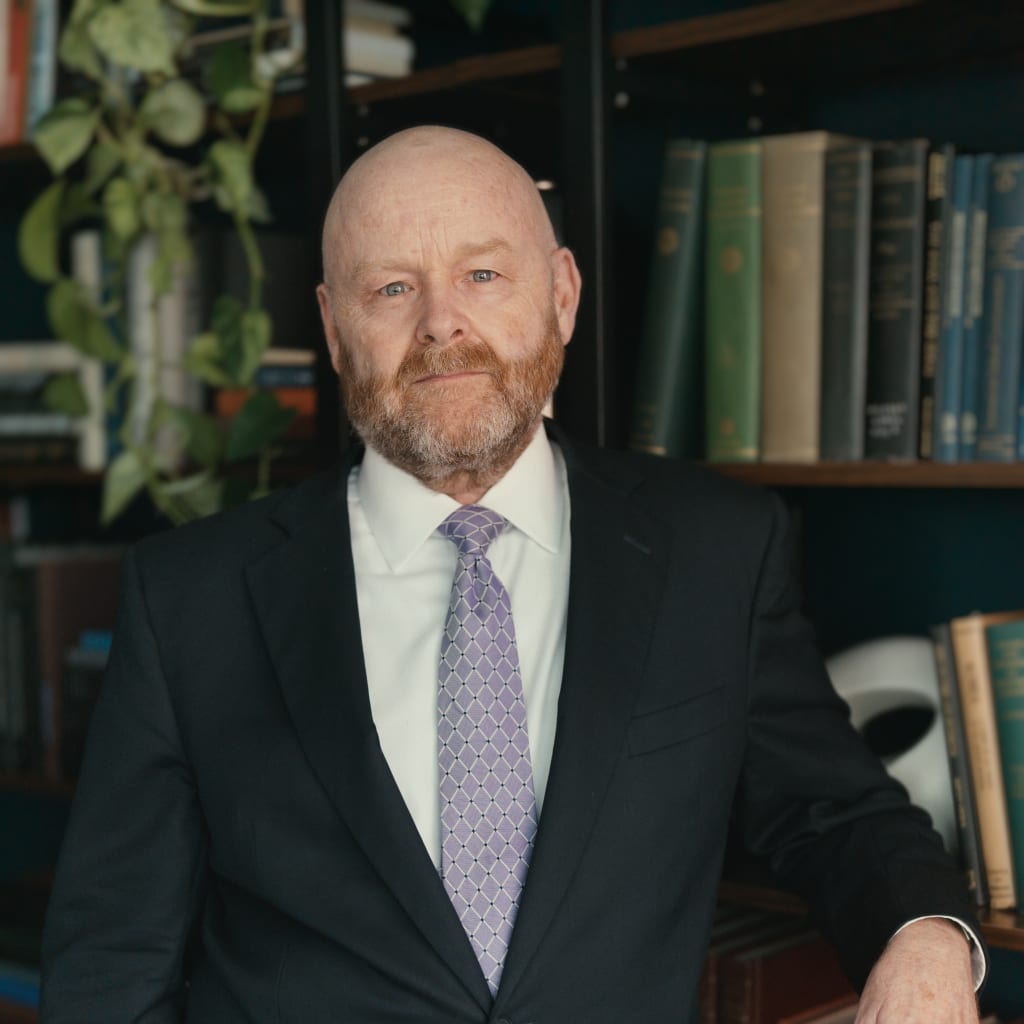 James M. LindsayCFR ExpertMary and David Boies Distinguished Senior Fellow in U.S. Foreign Policy
Guest
 Benn SteilCFR ExpertSenior Fellow and Director of International Economics
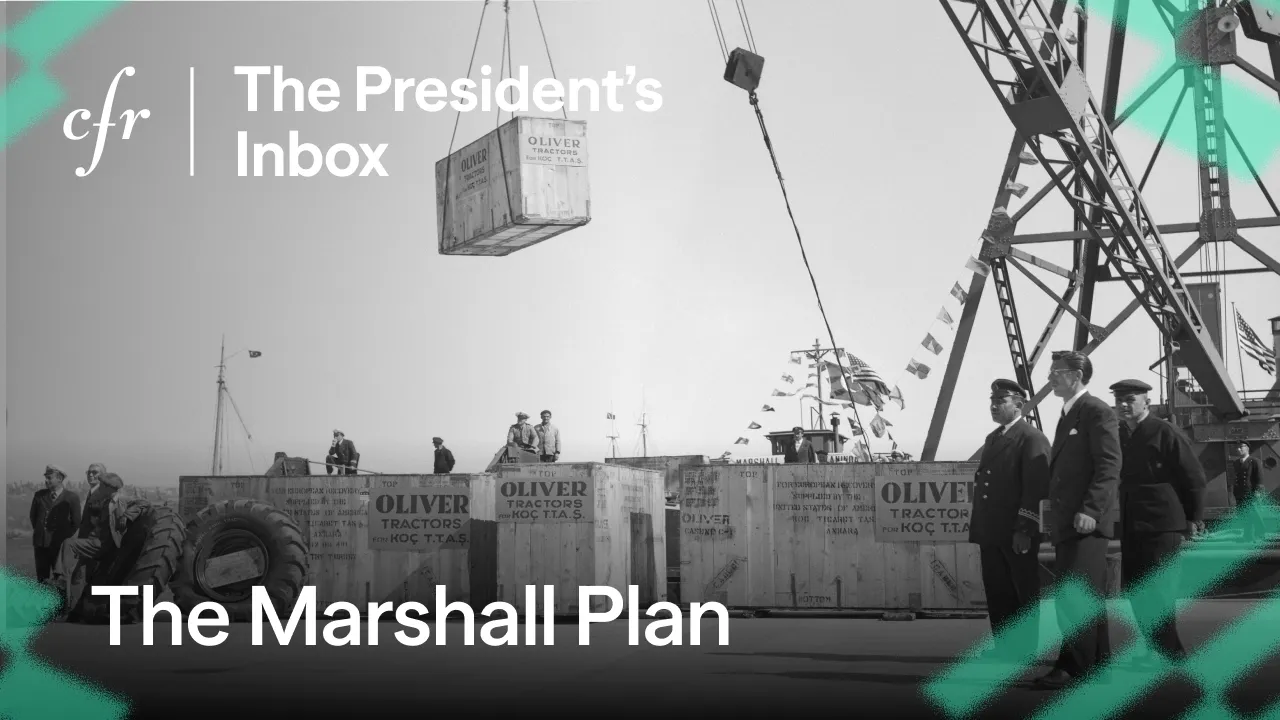
[Video: https://youtu.be/s-8bTRWnUOE]
TRANSCRIPT
STEIL:
George Marshall wanted to make absolutely clear that our job was to reinvigorate the productive capacity of Western Europe as quickly as possible and that this was a national security priority of the United States.
LINDSAY:
World War II left Europe in ruins. Hopes that life would quickly return to normal rapidly faded. A weakened, demoralized Europe looked ready to fall prey to communist propaganda and Soviet influence.
Worried that the United States had won the war but was losing the peace, President Harry Truman responded with the Marshall Plan. It changed the course of history. What did the Marshall Plan do?
Why were Americans willing to support it? And what lessons does it teach us about foreign policy today? From the Council on Foreign Relations, welcome to the President’s Inbox.
I’m Jim Lindsay. Joining me today is Benn Steil, Senior Fellow and Director of International Economics at the Council on Foreign Relations and author of the book, The Marshall Plan, Dawn of the Cold War. Benn, thank you for joining me.
STEIL:
Thanks for having me, Jim.
LINDSAY:
Now, Benn, in recognition of the 250th anniversary of American independence, I am devoting one episode of the President’s Inbox every month to a pivotal moment in the history of U.S. foreign policy, the Marshall Plan, which Secretary of State George C. Marshall publicly proposed in a commencement address at Harvard University on June 5th, 1947, certainly qualifies on that score. A recent survey I did with members of the Society for Historians of American Foreign Relations ranked the Marshall Plan as the best decision in the history of U.S. foreign policy. Now, my sense is that you can only understand the Marshall Plan by first understanding the dramatic shift in U.S. thinking in the two years since World War II ended. You have described that shift as going from Franklin Delano Roosevelt’s one-world vision to a two-world vision. Help me understand what you mean by that.
STEIL:
Yeah, this was indeed a radical shift, Jim. During the war, Franklin Roosevelt was working assiduously with his top cabinet staff to frame a post-war world in which the United States would be able to cooperate, in particular with the Soviet Union. But a number of institutions were going to be established that would create a rules-based order that was legitimately universal.
And this was supposed to be able to accommodate countries with very different political systems and economic systems. So the United Nations, the International Monetary Fund, the World Bank, these were all part of the FDR one-world vision. Within a few months of the end of the fighting in Europe in May of 1945, however, President Harry Truman, he had just become president in April when FDR died, was coming to the realization that things were going to be far more difficult with the Soviet Union than FDR had hoped.
And over the next two years, American foreign policy, that vision really changed quite dramatically. Instead of this one-world vision, Charles Bohlen of the State Department coined the term two worlds. And the new institutions that would be established, the Marshall Plan being the foundation of these new institutions would look to essentially divide the world between a liberal, democratic, capitalist West and a Soviet-dominated or influenced East.
Now, this division started in Europe, but of course it spread around the world very quickly.
LINDSAY:
So obviously, Benn, in those two years, a number of things happened. George Kennan, then assigned to the U.S. Embassy in Moscow, sent his so-called Long Telegram. That’s February of 1946, which essentially says that you’re not going to strike a deal with the Soviets.
Following month, I believe we have Winston Churchill gives his famed Iron Curtain speech at Westminster College in Fulton, Missouri. At the start of 1947, we have the British come and announce to Truman that they can’t support or continue to support pro-Western forces in the Eastern Mediterranean. That leads in March of 1947 to the Truman Doctrine, where Truman says the United States is now going to come to the aid of countries facing the risk of internal or external subjugation.
So give me a sense of what Truman was thinking about in March and how that leads to the Marshall Plan.
STEIL:
So February of 1947 is really a critical month in world history. The British Empire is imploding. Britain is losing control of India, of Palestine, of Burma, of Greece, and they’re rapidly going bankrupt.
And so in essence, in February of 1947, the British hand us the keys to the kingdom and say that it’s going to have to be our responsibility to maintain security in, for example, Greece and Turkey. Greece was in the midst of a brutal civil war. Yugoslavia in particular was backing the communist rebels in Greece.
So the State Department was forced to scramble very quickly and decide on the fly what the United States was going to do about this. Harry Truman met in early March with key members of the Senate, among which Senator Arthur Vandenberg, the chairman of the Senate Foreign Relations Committee, to talk about what the United States would have to do in this situation. And Vandenberg emphasized that if Truman wanted the cooperation of Congress, a Republican-controlled Congress, he was going to have to make absolutely clear what was at stake here for the United States.
It was a vital security risk to the United States to see the Mediterranean collapse, to see communists take over in Greece, to see the Soviets take over in Eastern Turkey, perhaps control the Turkish Straits. And so Truman made a very, very tough speech in March of 1947, laying down what would come to be known as the Truman Doctrine. The focus of the speech, the narrow focus, was on getting $400 million in military aid for Greece and Turkey.
But the wider message of the speech was that the United States was not going to tolerate Soviet interference in the internal politics of countries around the world, and the United States would help countries that were being affected by such policy, or might be affected by such policy, would help them defend themselves. At the very same time, the new Secretary of State, George Marshall, was in Moscow in March and April of 47 for six weeks of very difficult negotiations with the Soviets, in particular, with Foreign Commissar Vyacheslav Molotov, and at the end of his time there with Soviet leader Joseph Stalin. And the main item of focus was the future of Germany.
And Marshall came out of his meetings with Molotov and Stalin really shaken, quite convinced that the Soviets were determined to produce anarchy in Germany and to drag Western Europe broadly down into economic and political chaos. And when he came home, he made very clear in a radio address that the United States was not going to wait for Soviet cooperation, that the so-called Yalta-Potsdam framework for US-Soviet cooperation in the post-war world would have to be set aside. The United States would defend its vital world interest on its own, and it would go forward in the first instance by helping Western Europe recover economically from the devastation of war.
LINDSAY:
And I think it’s important to stress, Benn, that Europe was in dire straits. My understanding is the winter of 1946, 1947 was one of the harshest on record. Industrial production in Western Europe was at maybe 70% of pre-war levels.
Much of the infrastructure that would bring things from the farm to the market was destroyed, so it was really hard to get the economy running. So how did we get from Marshall’s trip, Truman’s announcement of the Truman Doctrine, to the Marshall Plan? Because you’re now talking less than three months.
STEIL:
Yeah. In late 1946, before we get to the winter, there had been a recovery of sorts in Europe, but it was set back dramatically by this brutal winter. And the United States becomes very, very concerned at this point, at the prospect of absolute economic collapse in Western Europe.
And let me explain why. In 1943, at the Tehran Allied War Leaders Conference, President Roosevelt pledged publicly that the United States would withdraw all its troops from Europe within two years of the end of the fighting. So fast forward to May of 1945, we have 3 million troops in Europe.
Truman moves aggressively to fulfill FDR’s vision, withdrawing troops from Europe. And the US military establishment becomes very concerned. They can see that the Soviets are not going to be cooperative partners.
They are cementing their power in Eastern and Central Europe, but how are they going to counter these Soviet moves without American troops? So you started to see the beginnings of an outline of how the United States might leverage its economic dominance at the time in order to allow Europe to recover its productive capacity at maximum speed and therefore to provide for its own security, so that the United States would not have to do this.
LINDSAY:
And to what extent were these decisions driven also by a desire in the part of the Truman administration to get the European economy up and running so that it could afford to buy American exports, whether machinery or agriculture?
STEIL:
It was definitely a part of the thinking that if the European economies collapsed, that the American economy, which was engaged in a very difficult transition from wartime to peacetime, might itself be dragged down and there would be a massive unemployment problem in the United States. So these two things were indeed very much connected. The whole idea of economic security really emerges to the forefront during this period.
And that’s certainly at the forefront of General Marshall’s mind when he makes his speech at Harvard in June of 47.
LINDSAY:
So my understanding is that when President Truman gives Secretary of State Marshall this directive to find a plan to help the European economies recover, it’s interesting, one, he didn’t turn to a special envoy or to a different cabinet secretary. And I should note that Marshall had been Army Chief of Staff during World War II. So he was a distinguished American with a lot of experience.
My understanding is that Marshall called in, I think it was George Kennan, his Director of Policy Planning, who was going to lead the team that would devise a plan. And I believe Kennan asked for his advice and Marshall replied, avoid trivia.
STEIL:
Avoid trivia. I have a George Marshall mug on my desk with the slogan engraved, avoid trivia. Exactly.
George Marshall wanted to make absolutely clear to George Kennan that this was to be a serious, hard-headed initiative. There was to be no fluff, no grandstanding, that our job was to reinvigorate the productive capacity of Western Europe as quickly as possible. And that this was a national security priority of the United States.
LINDSAY:
So when Marshall goes to Harvard to give this speech, how much of the plan was already developed? Because we’re talking a very short time and it’s a big challenge. And why the decision to speak at Harvard?
STEIL:
Yeah, the details were pretty bare bones at this point. Dean Acheson in a public speech in May had laid out some of the ideas behind what would become the Marshall Plan, but they did not include hard details. How much money would be spent?
How it would be spent? In the end, the Marshall Plan funds were used very differently in the different recipient countries. But part of that was quite deliberate on General Marshall’s part.
He was quite insistent at his Harvard speech that this was a plan for the Europeans themselves to work out, that they were not to come to the United States with say 15, 16, 17, 18 separate national shopping lists. They were to coordinate a policy such that they would maximize the efficiency of the combined European markets. So for example, we wouldn’t have 15, 16, 17 separate national steel industries in Europe.
We would produce steel, we would produce coal, et cetera, where it was most effective to do that. And we would restore trade and investment links among these countries in order to ensure that they could make maximum use of each other’s productive capacity. So General Marshall, why did he choose a Harvard commencement speech?
He didn’t want this to be a grand introduction to a scheme that would be formulated by the United States. He wanted the ideas to percolate. He wanted the Europeans to think seriously about it and come to the United States with their own ideas.
In the background, however, his undersecretary, Dean Acheson, was quite fearful that the Europeans wouldn’t quite get the message. George Marshall was not known as a great speechmaker. If you listen to his Harvard speech, which you can online, you’ll hear he really is not a great communicator.
So he pulled together a group of British newsmen right before General Marshall’s speech and made it clear to them that what the general was going to be saying was very important and that they should be sure, whatever time of night it was in Britain, to quote unquote, wake up Ernie, that is Ernest Bevin, the British foreign minister, and make sure he took the reins of this thing and got the process going in Europe.
LINDSAY:
So right from the start, the purpose of Marshall’s speech is to generate cooperation in Europe. That’s a fundamental idea. And he’s not just speaking to the assembled people in the yard, but he’s really speaking to Europe.
I have to ask you, Benn, given the significance of this proposal, why was it that Secretary of State Marshall was giving the speech and rolling it out and not President Harry Truman?
STEIL:
Well, this is a good question. I would say, first of all, that Harry Truman was a very effective delegator. He surrounded himself with good people.
He empowered good people. There were people like Dean Acheson and George Kennan who were holdovers from the previous administration, but they hadn’t really had much influence there. Truman was a very different sort of president.
He knew that George Marshall had great respect in Congress, including respect from the Republicans in Congress. So he wanted to put George Marshall out in front. After the speech, one of Truman’s top advisors, Clark Clifford, proposed to Truman that the plan that emerged from General Marshall’s speech should be called the Truman Plan, because he could sense that this was going to become a major U.S. diplomatic initiative. But Truman just laughed and said that anything bearing my name going before Congress will just quote-unquote twitch a few times, go belly up, and die. He said, however, that no member of Congress, even quote-unquote the worst Republican, could possibly oppose a plan named for the general. So Truman was not just modest, but politically very savvy about this.
He understood he was facing a Republican Congress that was not anxious to get involved in a new, enormous foreign aid scheme, and that he would need the general, and indeed Senator Arthur Vandenberg, in order to push this agenda forward and get it legislated.
LINDSAY:
Now, in making this proposal, Benn, the idea was the United States was willing to help Europe if Europe was willing to help itself. Soviet Union is part of Europe. Was the offer made to the Soviet Union and its then-emerging satellite countries?
STEIL:
So on the surface, the answer is yes. It was open to all European countries, including the Soviet Union. But the State Department, General Marshall in particular, were not naive.
They knew that if the Soviets participated that it would only be in a wrecking capacity. They would surely take whatever money they could get out of it, but there was no way that they were going to cooperate in the restoration of a democratic capitalist Europe. And so the plan was very carefully crafted behind the scenes to ensure that the Soviets would be rejecting American magnanimity and that it would not be the United States that would be dividing Europe.
So what happened after this speech? Stalin was somewhat taken aback by it. He didn’t know quite how to react.
Of course, American lend-lease aid during the Second World War was absolutely essential to Soviet survival. And he, as a Marxist ideologue, did actually believe that the United States was entering into the final phase of capitalist collapse and that the United States would need in its own interest to try to bail out its industry by allowing it to sell things to Europe. And so Stalin reasoned that he should cooperate and find out what this was all about.
If it was just more unconditional lend-lease aid, that was great. But his spies in Washington and London quickly disabused him of this notion, explained that the American vision was to stay engaged in Europe, perhaps permanently, and that in particular, the United States was determined to unify Germany as a democratic capitalist engine of a West European economy. And Stalin considered this an intolerable threat.
Stalin also became aware of the uncomfortable fact that his new satellite countries in Central and Eastern Europe were very interested in this plan, in particular, Czechoslovakia and Poland. And at that point, when they started speaking favorably about participating, Stalin decided he had to crack down on all the so-called coalition governments in Central and Eastern Europe and make sure that they were controlled by communist parties. So in the first instance, what the Americans did in concert with the French and the British was to get Soviet Foreign Minister Molotov to come to Paris in July of 47 to meet with the French and British foreign secretaries and to hammer out how they might cooperate in this new American aid scheme.
But behind the scenes, the agenda was very clear, to get Molotov angered and get him to storm out so that the Soviets would clearly be the wreckers of this great vision. And that’s exactly what happened. Stalin walked right into the trap.
LINDSAY:
So in a sense, Marshall rolled the dice, he gambled, and his gamble paid off. I assume that that made it easier for him to go to the Hill, which would have to agree to support what became the Marshall Plan. And I would note that the United States at that point, besides the Lend-Lease Act, which had come up in the midst of a war, had no tradition of providing foreign aid to other countries.
So how was Marshall able to get a Republican-controlled Congress, I think that’s worth repeating, to sign on to an initiative that was coming out of a Democratic administration that was headed up by a president that many Republicans did not like and were dead set on trying to beat in the 1948 election?
STEIL:
So two things I would emphasize. First, there was intimate cooperation between General Marshall and Senator Vandenberg. And if you listen to Marshall’s rhetoric in June of 47 and September of 47, it’s very, very different.
In June of 47, Marshall is emphasizing the suffering in Europe and how the United States has an obligation to help. By the time we get to the fall, however, Senator Vandenberg has made clear to him that this is not going to be sufficient to get Congress on board. And so Marshall becomes a hardline realist in Congress.
And when he gives congressional testimony, he really lays out his own sort of iron curtain border in Europe, making clear that the United States in its own self-interest, for its own national security interests.
LINDSAY:
America first, so to speak.
STEIL:
So to speak, but with allies. This is an important difference to what we’re seeing today. In its own interest, would have to secure the parts of Europe that we could defend.
Not all of Europe. General Marshall understood that it would be impossible to protect Czechoslovakia, for example, to protect Poland without millions of American troops. And we were not going to do that.
But it become, by the time we get to the fall of 47, the Marshall Plan, as it were, and General Marshall never used that particular term, was about preventing the spread of communism. So this was the first step. But developments in Europe were what really pushed Republicans into the pro-plan camp.
And in particular, in February of 1948, we have the communist coup in Czechoslovakia, which was instigated by Moscow. And suddenly, Republicans in Congress realized that unless the United States launches a major new foreign policy initiative quickly, that Stalin was going to continue to replay this sort of formula further and further west in Europe. Then in April of 48, we have the Italian elections coming up.
And so this accelerated the legislative timetable because both the Truman administration and Congress wanted to get this new plan legislated in time to influence the Italian elections such that the Christian Democrats would win and the Italian communists, who were very influential, would collapse. And that’s pretty much what happened.
LINDSAY:
Benn, in April 1948, Congress passes the Economic Cooperation Act of 1948, which is the formal name of the Marshall Plan. It’s in place for four years. The United States commits something on the order of $13 billion to European recovery, which is actually only a small percentage of the amount of investment that goes into Europe.
So does the Marshall Plan deserve all the praise it gets as being a pivotal moment in American foreign policy? Did it really make a difference? And if so, exactly how?
STEIL:
I think it does. It deserves its place in your polling, Jim, but not for the reasons that a lot of people believe. Many- Tell me about it.
For understandable reasons, believe that it was the money itself that rescued Western Europe and set it on the path of liberal democratic capitalism. That’s only partially correct. Beginning in the 1950s, economists started studying the Marshall Plan to figure out how it actually worked.
I mean, we did see a major recovery of the Western European economies over this period from 48 to 52, approximately a 60% increase in output. But when economists actually started studying what was going on, they couldn’t find any Keynesian mechanism by which this worked. Did it increase investment in Europe?
Yes. But this would only have accounted for about half a percentage point in growth, whereas we were seeing increases in growth in many recipient countries of four, five, six, seven percentage points. So it wasn’t that.
Was it more government spending that these countries wouldn’t have been able to afford otherwise? No. Government spending as a percentage of GDP actually fell in Europe over the Marshall years.
Was it that these countries were able to import more, import what they wouldn’t have been able to import without US dollars? Well, yes, to a certain degree, but today we would have a much simpler solution. If you need to sell goods abroad, for example, in order to raise money, you lower your exchange rate, you devalue your currency.
So this wouldn’t have required a Marshall plan. But a few things were going on here that these Keynesian focused studies would not pick up. George Kennan, not an economist himself, always emphasized that the primary benefit of the Marshall plan would be psychological, that it would convince the Europeans that we were not going home like we did after World War I, that we were going to be with them for the long run.
And that’s one of the reasons why this was a four-year plan. We didn’t just write them a check and wish them good luck. But very, very importantly, Jim, one year after the Marshall plan legislation went through, we had another major piece of legislation launching the North Atlantic Treaty Organization, NATO.
So what happened here, I would argue that NATO was absolutely essential to the success of the Marshall plan. You remember, I had explained earlier that the United States was determined not to be militarily involved in Europe anymore. However, the French and the British made clear to the State Department that they could not participate in an American economic integration initiative in Europe unless the Americans would guarantee their security.
The French said, quite logically, look, you’re withdrawing all your troops from Europe, in particular from Germany. What are we gonna do five years from now when the Germans cut off our coal supply? Well, when the Soviets take over Germany and cut off our coal supply, you’re gonna have to provide us with ironclad security guarantees if we’re going to be able to participate in such an initiative.
So NATO was not a US initiative. It was a Franco-British initiative. And I would argue that without that security component, the Marshall plan never would have succeeded.
There were other political factors what were enormously important. The one that I would single out first and foremost was the complete reversal of American occupation policy in Germany. At the end of the war, that policy was the so-called Morgenthau plan to de-industrialize Germany.
This was a complete and utter disaster. Germany was an industrial nation. It could not grow enough food for itself.
The rest of Europe was dependent on Germany’s industrial capacity for capital goods. This policy was only reversed by the Truman administration in 1947 as part of the Marshall plan. So there were a number of policies that went together with the Marshall plan that are not normally considered part of the Marshall plan that I think were integral to its success.
LINDSAY:
So taking all of that in mind, Benn, what should our takeaways be from the Marshall plan? What are the lessons that policymakers should keep in mind today as they think about similar plans to produce stability and enhance American national security interests?
STEIL:
Well, there are two things I would emphasize. One has to do with security. The second has to do with the importance of allies.
As you know, it’s been enormously popular among politicians around the world whenever they see a crisis on their TV screens or computer screens these days to say, we need a Marshall plan. We need a Marshall plan for Syria.
Ukraine, wherever there’s a problem, we need a Marshall plan. Well, the big lesson of the Marshall plan is security has to come first. Most people don’t realize that in Iran and Iraq, we spent over $50 billion more in current dollars on reconstruction alone than we spent on the entire Marshall plan for 16 countries.
And we achieved almost none of our geopolitical objectives. And that is first and foremost, because we were unable to provide these countries with the internal security that they needed. We were able to do that in Western Europe.
We would not have been able to do that if we had defined success in terms of bringing Poland and Czechoslovakia. And that’s why General Marshall was so hardheaded about the borders, the ultimate borders of this plan. But security is essential.
It has to come first before we’re going to get genuine economic rehabilitation. The second thing I would emphasize is that the Marshall planners on both sides of the political divide were taking a very long-term view of what this was about. And the observation I love to quote most is from a Republican Senator, Henry Cabot Lodge Jr., who in 1947 wrote to Arthur Vandenberg saying that the recovery of Western Europe was a 25 to 50 year problem. And that the investments that we make today and over the next three to four years will in the long run result in our having strong friends abroad. And how right he was. Four decades after the Marshall plan and NATO, the Berlin Wall falls.
And what do we see? That the alliances that the Soviets set up, like the Warsaw Pact, collapse overnight. And that the newly liberated countries of Eastern and Central Europe are clamoring to get into the major offshoots of the Marshall plan.
That is the European Union and even more importantly, NATO. So we succeeded, Jim, beyond I think our wildest expectations in producing this coalition of strong friends abroad who aligned their foreign policies with ours over literally generations. And we should be very careful about sacrificing that today, a very dangerous direction in which to move.
LINDSAY:
On that point, I will close up the President’s inbox for this week. My guest has been Benn Steil, Senior Fellow and Director of International Economics here at the Council on Foreign Relations. Benn, as always, it was a delight to chat.
STEIL:
Thanks for having me again, Jim.
LINDSAY:
Today’s episode was produced by Justin Schuster with Head of Production, Jeremy Sherlick, Senior Video Producer, Grace Raver, and Director of Podcasting, Gabrielle Sierra. Our recording engineer was Jorge Flores. Research assistance was provided by Oscar Berry.
This transcript was generated using AI and may contain errors.
To mark the 250th anniversary of the U.S. declaration of independence, CFR is dedicating a yearlong series of articles, videos, podcasts, events, and special projects that will reflect on two and a half centuries of U.S. foreign policy. Featuring bipartisan voices and expert contributors, the series explores the evolution of America’s role in the world and the strategic challenges that lie ahead.
We Discuss:
- How the British Empire’s rapid collapse in early 1947 forced the United States to assume responsibility for Western European security.
- What George Marshall’s six weeks of negotiations in Moscow revealed about Soviet intentions in Germany and Western Europe.
- How Marshall deliberately crafted the plan’s offer to include the Soviet Union while ensuring Soviet leader Joseph Stalin would reject it.
- How Congress, controlled by Republicans, was persuaded to support a massive foreign aid program from a Democratic administration.
- Whether the Marshall Plan’s $13 billion actually explains Western Europe’s economic recovery in the late 1940s.
- What role NATO played in making the Marshall Plan work, and why the French and British insisted on security guarantees before cooperating.
- Why security has to precede economic reconstruction—and what Afghanistan and Iraq reveal about ignoring that lesson.
- What Senator Henry Cabot Lodge Jr.’s 1947 prediction about sustained alliances tells us about the stakes of U.S. foreign policy today.
Mentioned on the Episode:
The 10 Best and Worst Decisions in U.S. Foreign Policy, Council on Foreign Relations
Benn Steil, The Marshall Plan: Dawn of the Cold War
George Kennan’s Long Telegram, February 22, 1946
“Sinews of Peace (‘Iron Curtain’ Speech).” at Westminster College, Fulton, Missouri, March 5, 1946.
Harry Truman, “The Truman Doctrine,” Address to Congress, March 12, 1947
George C. Marshall, Commencement Address at Harvard University June 5, 1947
Opinions expressed on The President’s Inbox are solely those of the host or guests, not of CFR, which takes no institutional positions on matters of policy.
Associate Producer, Video and Audio
- Associate Producer, Video and Audio
Head of Production
- Director of Video
Director of Podcasting
- Director, Podcasting
More Episodes
 33:42Podcast
 36:05Podcast
 41:07Podcast
 39:26Podcast
 35:04Podcast
 31:46Podcast