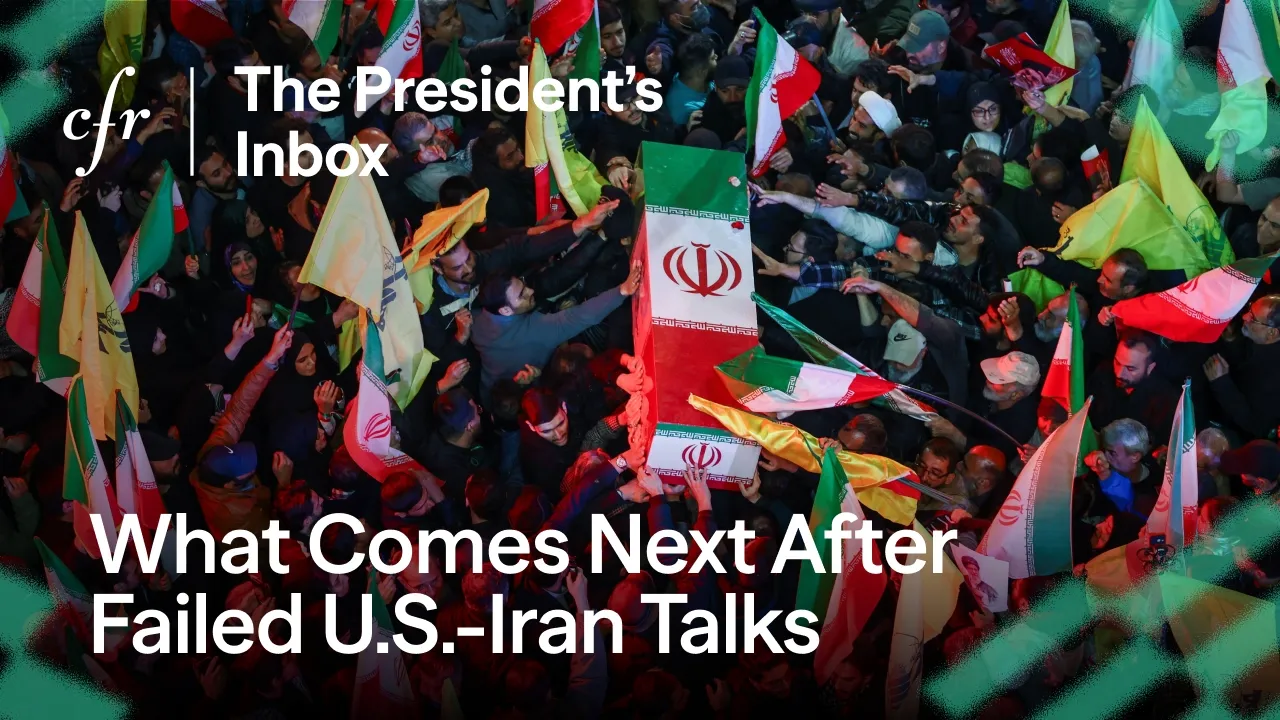
What Comes Next After Failed U.S.-Iran Talks, With Elliott Abrams
This episode unpacks the U.S.-Iran ceasefire talks in Islamabad and the prospect of a U.S. blockade of the Strait of Hormuz.
Published
Host
 James M. LindsayCFR ExpertMary and David Boies Distinguished Senior Fellow in U.S. Foreign Policy
Guest
 Elliott AbramsCFR ExpertSenior Fellow for Middle Eastern Studies
[Video: https://youtu.be/smih2hNEMjs?si=SPurHZEdPDC3NmcC]
TRANSCRIPT
ABRAMS:
There are disadvantages for both sides in going back to actual fighting, and it’s notable that the talks failed, but neither we nor the Iranian side went back to war. I think it shows you that both sides would like this war to be over.
LINDSAY:
U.S.-Iranian talks over the weekend in Pakistan failed to produce a deal to end Operation Epic Fury. President Donald Trump responded to the failed talks by imposing a U.S. naval blockade on ships transiting the Strait of Hormuz from Iran. Meanwhile, Israel continues to hit Hezbollah targets in Lebanon, which Iran insists are covered by the ceasefire.
Will the current ceasefire in the Gulf hold? Does a naval blockade give Washington leverage over Tehran? And what might renewed hostilities mean for the Gulf in the broader world?
From the Council on Foreign Relations, welcome to the President’s Inbox. I’m Jim Lindsay. Today I’m being joined by Elliot Abrams, Senior Fellow for Middle Eastern Studies here at the Council, and a special representative for Iran during the first Trump administration.
Elliot, thank you very much for joining me.
ABRAMS:
Thanks for inviting me.
LINDSAY:
Now, Elliot, the United States and Iran failed to strike a deal when they met in Pakistan on Saturday.
Do we know anything more about what transpired during those talks and the outcome?
ABRAMS:
There were leaks. Various newspapers claim to have spoken to people in the know. Of course, there were only three Americans in the room, so maybe they’re talking to their friends in the press.
What we know, or think we know, is that the tone was okay, warm, friendly. Ghalibaf, the head of the Iranian delegation and Vice President Vance, shook hands, and they talked about what’s going on in the Gulf and the reasons for the war. We know that they covered uranium enrichment and the nuclear program, a nuclear weapons program that Iran has, and Vance put forward the U.S. position, which is not only no bomb, but no enrichment of uranium. The Iranian side apparently simply rejected that. The U.S. also said no money for proxies like Hezbollah or Hamas, also rejected. No rebuilding missile program, also rejected.
The Iranian side said the ceasefire includes Lebanon, which the Americans rejected. There was something interesting here in that the Iranian position had been, we’re not going to talk until there is a ceasefire in Lebanon. We’re not even going to go to Islamabad.
Of course, they abandoned those positions.
LINDSAY:
Didn’t the United States abandon its own precondition, Elliot? Because my understanding was that President Trump had insisted that the Strait of Hormuz be fully reopened before the talks could begin, and that didn’t happen either. I think that’s right.
ABRAMS:
Of course, the talks had as a central question, what is going to happen to the Strait of Hormuz?
LINDSAY:
What does it tell you if both sides had preconditions, red lines they weren’t going to cross before they sat down, that in fact, they sat down and ignored their preconditions?
ABRAMS:
I think it shows you that both sides would like this war to be over. That is, there are disadvantages for both sides in going back to actual fighting, actual war. It’s notable that, okay, on Saturday, the talks failed.
Neither we nor the Iranian side went back to war. There are more Iranian attacks on Gulf Arabs or Israel, and no more US attacks on Iran. My assumption is that the desire to end the war still is strong in both capitals.
It may not work, and as soon as the next few days, the war may start again. The fact that the talks failed yet talks go on is a suggestion to me of the desire not to go back to war.
LINDSAY:
Now, Elliot, you’re very experienced in international diplomacy. You’ve been part of lots of negotiations. I have to ask you about two interesting facets of the talks that occurred in Islamabad over the weekend.
One is that it was a very senior delegation on both sides. In fact, it was the most senior-level meeting between the US and Iran since the founding of the Islamic Republic back in 1979. The other aspect of it, as you suggested in your remarks, is that this was not a heavily staffed meeting.
It was really the three principals who sat down in a room, I take it, with the Iranians and also with Pakistani officials. What do you make of that style of negotiation?
ABRAMS:
Well, first, it is worth noting, as you were just saying about the American side, it’s the Vice President of the United States. I can’t really remember a Vice President filling a role like this. If you think back, Kamala Harris, Mike Pence, Joe Biden, we go all the way back when Vice Presidents, they don’t usually do this.
You have a Secretary of State do it, or you have a special negotiator named, like say, George Mitchell was at one point for Northern Ireland or for the Middle East. To send the Vice President is, in that sense, a big deal for any administration and raises the stakes for him or her, and also for the administration as a whole. The style of is what I’d call Trumpy.
That is, the President, he doesn’t read 30-page memos. He doesn’t have endless or even brief NSC meetings, principals’ meetings, at which there is a hashing out of potential negotiating positions. What do we say if they say X?
What happens if Y? Usually, that’s the function of the NSC. Bring it all together, present it to the President, you have an NSC meeting, and it’s argued about, it’s discussed.
I don’t think any of that happens in this administration. For example, prior to the plane flight from Washington to Islamabad, how many hours did Witkoff and Kushner spend with the Vice President and others talking this through? My impression is the answer is none.
LINDSAY:
I have to ask you, Elliot, as I listened to the Vice President give his readout after the talks had concluded and not failed to produce a breakthrough, I was struck by one sentence in what he said. Let me just repeat it. He said that he and the rest of the delegation had made very clear what our red lines are, and they, meaning the Iranians, have not chosen to accept our terms.
That description sounds more like someone who went to the room expecting to accept the other side’s surrender and not prepared to make concessions on their own positions. Am I reading too much into what the Vice President said?
ABRAMS:
No, those are the terms. It’s kind of like Grant at Appomattox, right? Here are my terms.
Say yes or no. Of course, it is contrasted a bit in the Pakistani and to some degree American descriptions that the tone in the room was not bombastic and hostile. There were some nice American comments on background, never on the record, about Ghalibaf as the chief of the Iranian delegation as a negotiator.
In public, what the Vice President has said, as you put it, is, we’ve got conditions. Now, take them or else. Of course, the Iranians refused.
I don’t think that’s shocking because one question you always face in a negotiation is, what ability to make decisions on the spot does the opposing negotiator have, or does everything have to go back to the capital? I think in this case, everything really had to go back to the capital because the question of who’s running things in Tehran, how do you make decisions? There is no supreme leader.
In fact, there is someone with that name, but not with the powers.
LINDSAY:
I have to ask you, Elliot, do we have any sense of how quickly the Iranian leadership can make any decisions? You pointed to the fact that it’s unclear who’s actually running Iran. I would imagine that further complicating it is that whoever is running Iran, whether it’s a few people or a lot of people, they must have some pretty cumbersome ways of interacting right now for fear that their whereabouts will be tracked and will lead to their deaths, much as happened to other senior Iranian leaders.
Do you have a sense of how that all shakes out?
ABRAMS:
I don’t know the answer to that. I really wonder whether we, that is the United States government, know exactly how this is happening in Iran right now. There are so many people, dozens literally, at the top levels and the second level who’ve been killed.
I don’t think we have a very clear picture of not just the formal bureaucracy, who holds what job title, but who’s really important, who really can get decisions made. I would say though that in a certain sense, Ghalibaf took the easy path, which is to say no, no, no. It’s when you’re making compromises that it’s going to get to be hard.
When it’s 50% here and 30% there, that’s when there will be real debate in Tehran.
LINDSAY:
We don’t have any sense, whether on background or through leaks, as to whether the vice president indicated flexibility on any of the red lines the administration has put down. We do not. That’s right.
Okay. So we have this meeting. The atmospherics are good.
They come out, at least on background, are saying nice things about each other while underlining their persistent differences. The president’s response to it is to announce that the United States is going to impose a naval blockade on ships leaving from Iranian ports, transiting the Strait of Hormuz. Walk me through what the logic is of that.
Then I want to get into the practicalities of imposing a blockade, which I have to say under national law is an act of war. We already seem to be at war, because I recall John F. Kennedy famously called the blockade of Cuba during the Cuban Missile Crisis a quarantine, so he could avoid triggering international legal issues.
Help me understand the idea of the blockade.
ABRAMS:
Well, I think the idea is that as of a week ago, let’s say, Iran was controlling the Strait and was only allowing through it ships that it wanted to allow through, for example, once in a while a tanker carrying out Iranian oil. I think what President Trump was saying was, whoa, wait a minute. The last thing we’re going to allow is to have the Strait open only for Iran and for ships that are in some way related to Iran.
If nobody else gets through, you’re not getting through either. That’s the logic of it. I think there’s a slightly less obvious logic, which is this is going to hurt a lot of countries.
I think the president is thinking they’re going to try to gang up on Iran and say, hey, come on, countries like Pakistan, which is badly hit by the closure of the Strait of Hormuz, countries like China, which get a lot of oil from the Persian Gulf, they’re going to start leaning on Iran. This is the theory. Give it up.
We’ve got to open the Strait.
LINDSAY:
Okay. The logic is oil for all or oil for none. Yep.
The idea then is that this is going to impose economic pain on the Iranians and sort of force them to buckle. I guess short of that, the hope is that it will impose diplomatic pain on Tehran and cause it to buckle. How likely is that scenario to play out?
I ask it against the backdrop. My sense is that for all economic coercion campaigns, they take a while to really kick in. They don’t happen immediately.
That’s one of the frustrating things people have about maximum pressure campaigns. Countries can endure a lot before they collapse.
ABRAMS:
I think that’s true. I would say on the Iranian side, they do have another problem, which is they have a very restive and unhappy population. As the economy worsens, and it will, the population gets more and more unhappy and there’s a risk of uprisings.
I wouldn’t want to be sitting in their shoes. You’re right that the impact on the Iranian economy is not going to happen this week. It’s not going to happen in two weeks.
It’s going to take a while. Meanwhile, there are other countries that are going to be badly hurt. Again, one of them, actually, in some ways of measuring it, Pakistan, which is a poor country, is being hurt more than any other.
The hope would have to be that those who are getting hurt will get together, whether they’re Asians or Europeans, and either agree to try to force the strait open or much more likely lean on Iran to make some kind of deal that opens the strait. How likely is that? I think in the short run, let’s say next couple of weeks, it’s unlikely, which leads me to wonder whether President Trump will take an additional step.
That step, I think, would be taking an island in the Persian Gulf.
LINDSAY:
Before we get to that, I want to do a little bit more fleshing out of this blockade idea, Elliot, because I take the calculation that President Trump seems to be making that other countries are going to gang up on Tehran and put pressure on Tehran to do something. But why wouldn’t those same countries get together and put pressure on Washington? They may think that Washington’s more likely to bend than Tehran is.
Again, some of the countries are going to be hurt by the closure of the Persian Gulf, our American allies. I would also note that because oil is traded in a global market, oil prices are going to go up. They already have.
That is going to create domestic political pressure on the president to do something because people aren’t happy paying $4, $5, $6 a gallon for gasoline.
ABRAMS:
Well, that may happen. That is that other governments decide, let’s put pressure on the Americans. But prior to the imposition of this, whatever you want to call it, blockade, quarantine, very, very little oil was getting out of the Persian Gulf.
Very few ships were going in and out of the Strait of Hormuz. So, what is added by the American blockade is, I’d say, marginal. It just hits Iran.
If you want to solve the problem, you’ve got to get the Iranians to say, okay, fine, the Strait is open.
LINDSAY:
I will note that at the time we’re sitting down chatting, I’m not aware that any country has volunteered to join the blockade. And the British Prime Minister Keir Starmer told the BBC that Britain would not be participating in the blockade. Is it your sense that the United States Navy has enough ships in the Gulf of Oman to be able to effectively blockade the Strait?
Because in essence, the more ships that try to go through, the more resources it takes up, and you can find yourself sailing all over the place in pursuit.
ABRAMS:
In theory, that’s true, but I don’t think in reality it is, because again, go back to, say, Saturday when the talks were taking place in Islamabad, you know, one ship, two ships a day were trying to get through. That’s easy to locate and easy to stop. So, I’m not surprised that other countries are not volunteering.
What’s the upside? It’s an expensive effort. It’s probably unpopular with a lot of people back home.
And if the Americans want to do it, they can do it. I mean, we clearly, I’d say, have the power. And I just add one thing, which is the blockade by Iran is largely done via insurance companies.
That is to say, they make a threat, the insurance companies say, okay, we’re not covering that ship or the price of coverage is ludicrously high, and then you don’t sail.
LINDSAY:
So, as things stand right now, we have a ceasefire. It’s still in place. It’s supposed to last two weeks.
And I guess Tehran’s going to have to make some decisions. Washington’s going to have to make some decisions. Help me understand what it is you think the White House is hearing from two groups of countries.
One, the Arab Gulf countries, and secondly, Israel. Let’s do the Arab Gulf countries first. I have read lots of news stories over the last week that keep attributing to unnamed Arab leaders the words, finish the job.
Is that, in fact, what they’re saying? And what the heck does it mean?
ABRAMS:
Well, I think they’re quite torn. In the beginning, they didn’t want this war. And most of them, Oman and Qatar in particular, have been trying to maintain a good, friendly relationship with Iran.
The others, arms length, but not hostile. But once the war started, it seems that several of them were saying to the president, okay, we see now how dangerous this regime is. After all, Iran, during the war, shot much more ordnance at the United Arab Emirates than at Israel, if you count by number of missiles, number of drones.
And if you look at the level of damage, the greatest damage was done to Qatar, not to Israel. A huge amount of damage done to their largest liquid natural gas plant, which may not be in operation fully for several years. So I think several of them moved to the, if you can knock off the regime, let’s do it.
Now, the war then stopped. There is a ceasefire. And they’re going to have to reach a conclusion as to what is Trump thinking?
Do they interpret the ceasefire as meaning, okay, for domestic political reasons, he has decided the war has to end. If that’s true, then they’ll make their peace with that. And they’ll see that it is senseless to keep on urging him to do more.
I think the problem is judging what the president is thinking on any given day or week that is, you know, he went literally, I was gonna say overnight, it might’ve been the same night, from apocalypse, you know, destroying the civilization to ceasefire. And I think one of the things that they’ve got to figure out is if they’re riding along with Trump, where is he riding? How far is he going to go?
And I think for them, as for many Americans, that’s hard to figure out. The president is now saying, I want a ceasefire, but I’ll do a blockade. And if you try to break the blockade, all hell breaks loose.
So I think they’re in a difficult situation trying to protect themselves from a new outbreak of war and stay close to the president who’s got most of the military cards.
LINDSAY:
But Elliot, do the Arab Gulf countries really have much agency in all of this? I’m left wondering, what are their options? Can they really afford to allow distance to be generated between them in Washington?
Are they going to turn to China, to Russia, to India? What do they do?
ABRAMS:
They have agency in one way, which is they do have influence in Washington. And they have Qatar, for example, the Emirates, the Saudis, close relations with the president. And I think he will listen to their views.
I don’t mean he’ll necessarily follow them, but he will pay real attention to their views. But I’m with you on that. That is the notion that they can say the hell with the United States.
United States is unreliable. And then what? I think that the 12 day war last year and this war in 2026 have demonstrated that China and Russia are not global powers.
They actually cannot have much military influence or any in the Middle East.
LINDSAY:
So I said I want to talk about two groups of people. We just talked about the Arab Gulf states. Help me understand the nature of discussions right now between Washington and Jerusalem.
There was confusion at the start of the ceasefire as to whether it extended to the Israeli attacks in Lebanon. The White House came out and said, no, it didn’t. And the Iranians seemed to indicate that it had.
The Israelis, as best I can tell, have continued their attacks against what they say are Hezbollah targets in Lebanon. So help me understand that part of the equation.
ABRAMS:
The Israelis have been the US partner in this in a way that’s really quite extraordinary. I can’t think of a military partner we’ve had on this level since the British in World War II, where it’s not they’re going to send 100 guys to help us in Vietnam or 500 to help us in Afghanistan. It’s a real partnership.
Their goal is the end of the regime. That has occasionally been our goal, but it’s not the goal really of US action. We’re trying to change Iranian behavior, primarily with respect to nuclear weapons, but now also with respect to ballistic missiles.
In the shorter run, obviously, we’re trying to open the Strait of Hormuz, but I mean the longer run goals with regard to the regime. And thirdly, so nukes, missiles, and thirdly, stop supporting these proxies like Hezbollah and Hamas. The Israelis want to go further.
None of that’s going to work in their view, as long as the regime is there. They may stop for a week, they may stop for a couple of years, but they are who they are. That’s a gap between US and Israeli goals, though during the war, it really had no particular impact on working together on joint targeting.
In the aftermath of the war, it has an impact on a negotiation, however, because one could envision a more flexible IRGC led Iranian regime, in theory, that would say, okay, no nukes. Now they don’t mean it, they may be lying, but remember during the Iraq war, after we invaded Iraq in 2003, the Iranians, our intelligence believes, put aside their nuclear program for several years, maybe even five years. They could theoretically do that again.
They could make promises that would lead the US to lift sanctions. From the Israeli point of view, that’s awful because it keeps the regime in place and it enriches the regime if you lift all sanctions and unfreeze all money. So we could see a real gap developing between the US and Israeli positions.
It isn’t there now, it isn’t there now even on Lebanon, where despite the Iranian position, no talks unless there’s a ceasefire in Lebanon, there is no ceasefire and Lebanon and Israel are moving toward the first real bilateral negotiations they’ve had in decades.
LINDSAY:
So I have to ask Elliot, with this continued confrontation taking place, I understand the Israeli argument that the goal should be regime change, but the question really is whether regime change is achievable. I understand that the Iranian population has deep grievances against its rulers. However, those rulers have guns in a lot of them.
So if regime change is not a likely objective to be obtained, why make that the basis of policy?
ABRAMS:
Well, my answer to that would be that the problem of Iran can only be solved by regime change. That is, this Islamic Republic, now run really by the Revolutionary Guard, is an enemy of the United States saying, death to America, lots of American blood on its hands, it won’t change. It may delay things, but it won’t change.
So the long run solution is the fall of the regime. Now, what you say is true, they’re the guys that have the guns, but that was true in the Soviet Union, that was true in Tunisia, that was true, you know, we can go down the list, that was true with Mubarak, that was true Ceausescu in Romania. It’s always true, yet a lot of regimes fall.
So the question, I think, in terms of policymaking is, if that’s your ultimate goal, and you think, and I think this is the critical thing, it’s not going to be done by outsiders, it’s going to be done by the Iranian people at some point. Then what do you do in the interim, which could be six months, six years, 15 years, and there, you know, we get into the negotiation we’re having now, well, let’s put off the day they get nukes or rebuild their ballistic missile program. Let’s try to stop what they’re doing in the region in supporting terrorist proxies like Hezbollah.
And then over time, a year or five or 10, let’s see if the Iranian people can rise up and take hold of their own destiny.
LINDSAY:
So, Eliot, let me turn the question around on you. I understand that the IRGC has every incentive in the world to make false promises. They may agree to a deal that sounds really good for the next three, four, or five years, but that is also a time that allows them to regroup and maybe solidify their control over the people.
I understand authoritarian governments eventually fall. They fall in the long term, but the long term can be a very long time. So, how should U.S. decision makers think about striking a deal when one of the risks of the deal is that it’s simply going to give Iran time to become what we fear, a nuclear-armed power that can threaten the United States, its friends, partners, and allies?
ABRAMS:
Well, the goal would be to strike a deal that doesn’t allow them to move forward in their nuclear weapons program. That is, for example, under which they agree to significant IAEA inspections, make all sorts of promises about not developing nuclear weapons that, although they may be lies, allow for at least for the first years of heavy enforcement. It does mean probably trying to get that 440 kilograms of highly enriched uranium out of Iran so they can never go back to it.
I do think that their effort to re-legitimize the regime after the murders of maybe 30,000, 40,000 citizens in January, it’s going to be really tough because the new supreme leader is invisible. He has no prestige. He was chosen because he was the son of the previous one, a dynastic principle that they have always showed contempt for.
He’s not a real Ayatollah. I mean, I think this is a highly illegitimate regime in the eyes of the Iranian people. So, I seriously doubt they’re going to be able to reclaim any significant legitimacy.
LINDSAY:
Elliot, I want to close on what may be the biggest question of all. What do you expect to happen when we get to the end of the two-week period for a ceasefire? My sense is that Iran is not going to initiate hostilities.
It wants time to regroup and rebuild and rearm. What do you think the Trump administration is going to do?
ABRAMS:
I don’t think there’s ever going to be a peace deal in the sense of a 20-page piece of paper with 105 clauses. I think probably at the end of the two weeks, Pakistan announces that talks are ongoing and so both sides have agreed it’s worth keeping on trying and we just extend. Even this move by the president to blockade the Strait of Hormuz has not broken the ceasefire.
It’s very interesting. One might have assumed the Iranians would respond in a different way. So, I think the ceasefire is going to stick really for, let’s say, for April anyway.
Nobody wants to go back to war right now.
LINDSAY:
On that note, I’ll close up the president’s inbox. My guest has been Elliott Abrams, Senior Fellow for Middle Eastern Studies here at the Council on Foreign Relations. Elliott, as always, it was a pleasure to talk.
Thank you very much. It was my pleasure too. Today’s episode was produced by Justin Schuster with Director of Video Jeremy Sherlick, Senior Video Producer Grace Raver, and Director of Podcasting Gabrielle Sierra.
Our recording engineer was Elijah Gonzalez. Production assistance was provided by Oscar Berry and Khaleah Haddock.
This transcript was generated using AI and may contain errors or inaccuracies.
We Discuss:
- What transpired during the U.S.-Iran talks in Islamabad.
- Whether both sides abandoned their own preconditions before talks began.
- How unusually senior and small the negotiating delegations were.
- What the logic and mechanics of the U.S. naval blockade are.
- Why other countries have not joined the blockade and may resist it.
- What the Arab Gulf states are privately urging Washington to do.
- Whether Israel and the U.S. share the same goals regarding the Iranian regime.
Mentioned on the Episode:
Vice President JD Vance Delivers Remarks in Islamabad, Pakistan, April 11, 2026
Harry Sekulich and Kate Whannel, “Starmer Says UK Will Not Join Trump’s Blockade of Iran’s Ports,” BBC
Defense Technical Information Agency, “Iran: Nuclear Intentions and Capabilities,” October 1, 2007
Opinions expressed on The President’s Inbox are solely those of the host or guests, not of CFR, which takes no institutional positions on matters of policy.
Associate Producer, Video and Audio
- Associate Producer, Video and Audio
Editorial Director and Producer
- Director, Podcasting
Director of Video
- Director of Video
More Episodes
 33:42Podcast
 36:05Podcast
 41:07Podcast
 39:26Podcast
 35:04Podcast
 31:46Podcast