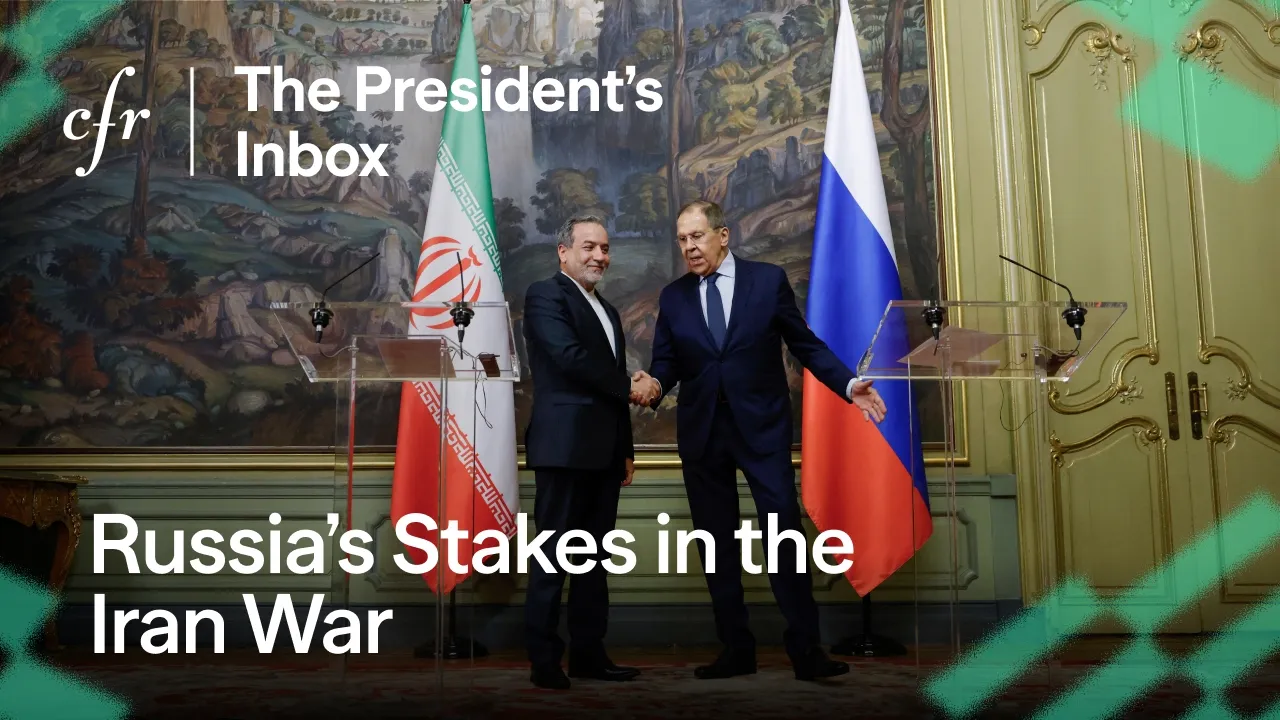
Russia’s Stakes in the Iran War, With Thomas Graham
This episode unpacks the opportunities and risks Moscow is facing amid the U.S. and Israeli war with Iran.
Published
Host
 James M. LindsayCFR ExpertMary and David Boies Distinguished Senior Fellow in U.S. Foreign Policy
Guest
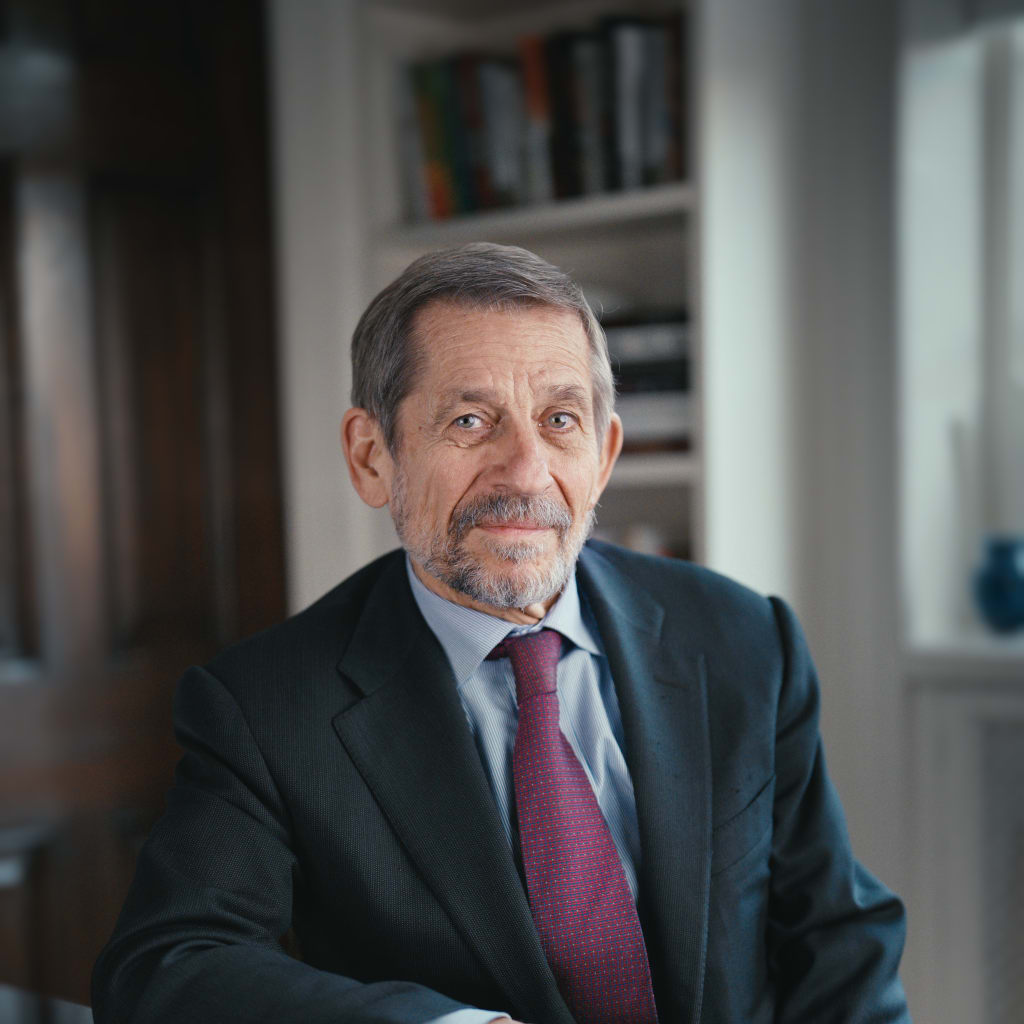 Thomas GrahamCFR ExpertHenry A. Kissinger Distinguished Fellow
[Video: https://youtu.be/h2GHMlyXa5k]
TRANSCRIPT
GRAHAM:
The view in Moscow as a consequence of the Iranian conflict is that this administration does not believe that Russia is a priority. They don’t have respect for Russian power, and they’re not interested in normalization of relations. And that is not the deep state, that rises to the very top.
VO:
Sources tell CBS News Russia is providing intelligence to Iran about U.S. positions in the Middle East.
VO (continued):
The U.S. has temporarily lifted its sanctions on oil produced in Russia.
LINDSAY:
As Iran fights for its survival, questions abound about the role that Russia is playing. Is Moscow helping Tehran to counter U.S. and Israeli airstrikes? Does Russia see the closure of the Strait of Hormuz as serving its interests?
And what does Operation Epic Fury mean for the war in Ukraine and the future of U.S.-Russian relations? From the Council on Foreign Relations, welcome to the President’s Inbox. I’m Jim Lindsay.
Joining me today is Thomas Graham, Distinguished Fellow here at the Council. Tom, thank you very much for joining me. Glad to be with you.
Tom, there has been a lot of talk in recent years about the rise of the so-called axis of autocracy as Russia cooperates with China, Iran, and North Korea. I want to focus our conversations on the Russia-Iran nexus, and I was hoping you could sort of start off by helping me understand the nature of the relationship between Moscow and Tehran. Are they allies?
Are they frenemies? Are they something else?
GRAHAM:
Yeah, frenemies is probably the best term at this point. Russia and Iran have had a complicated relationship for centuries. They’ve been rivals in the Caucasus, in the Caspian region.
That continued up until very, very recently with the deterioration in relations between both Russia and Iran. They drew closer after 2014, which is after Russia annexed Crimea, the break with the West. Both countries, perhaps among the most heavily sanctioned by the United States in the world, and they realized that they had a common interest in, in a sense, cutting the United States down, finding a way to circumvent U.S. sanctions. All that said, the relationship still has its friction points. I think it’s important to remember that when Russia signed a strategic, a comprehensive strategic partnership with Iran in January of last year, they did not include a defense clause the way they did when they signed a similar agreement with North Korea. So this is not a NATO-style arrangement between Tehran and Moscow.
It would have obliged Moscow to come to the aid of Iran in the current conflict. That is not an obligation on the part of Moscow at this point. So there’s still suspicions between the two capitals.
Again, historically grounded, they are rivals somewhat in the same neighborhood. They also compete for sales of oil and gas to China. So it’s not complete harmony by any stretch of the imagination.
LINDSAY:
Does it matter, Tom, that most of the Iranian leadership that Moscow dealt with are now dead?
GRAHAM:
Well, yes, I mean, that does have an impact. I wouldn’t say that all of them are dead. Remember, Moscow did have a close working relationship with Iran, technological, military, intelligence, and so forth.
So the contacts they have are not simply at the senior level. They go deeper into society. So I would presume that despite the fact that dozens of the people that they were most closely associated with have been eliminated, that they have some awareness of the leaders that are coming up.
You know, all that said, the president of Iran has met with Putin, the speaker of the parliament has met with Putin, the foreign minister has met with Putin, and all three individuals are still alive.
LINDSAY:
So, Tom, Iran over the course of the Ukraine war supplied Moscow with drones and drone technology. To what extent does Russia now have its own independent capacity versus depending upon the ability of the Iranians to produce drones for them?
GRAHAM:
Right. One of the first things Moscow did after it turned to Iran for the supply of drones, was to sign an agreement that would localize production in Tatarstan, in fact. So for the past couple of years, Moscow is producing the drones that it needs for the conflict in Ukraine.
Beyond that, it has taken the Shahed drones that the Iranians supplied, it engineered them, had modified them, improved them in some way. So they’re much more effective weapons than the originals that the Iranians have provided them. Now, reports are that they provided some of these enhanced drones back to Iran that Iran has been using in its conflict with Israel, the United States, and the Gulf States.
LINDSAY:
Is there anything beyond that that the Russians have done to aid Iran? I’ve heard reports about the sharing of satellite imagery, other intelligence information. What do we know on that score?
GRAHAM:
Yeah, there’s almost certainly been some sharing of intelligence. How much, difficult to ascertain how important it is, whether it’s operational or not, something that we don’t know. But it would be quite unexpected for Moscow to provide some of the intelligence that it had.
So we watch this very, very closely. Has it had an impact? Very difficult to say at this point.
LINDSAY:
What kind of information could the Russians share with the Iranians that you think would make an impact on the fighting?
GRAHAM:
Well, I mean, the question really is whether they are prepared to share with them, for instance, the imagery that they get in real time, whether they’re willing to share, again, in real time, the way they can geolocate certain American assets, ships, for example, aircraft and so forth. That would have a dramatic impact on Iran’s ability to target American assets, Israeli assets in real time. Again, we don’t know that.
But looking at the way this conflict has unfolded, I would think that they haven’t provided excessive amounts of that type of intelligence up to this point.
LINDSAY:
What do you make, Tom, of the conflicting reports coming out of the administration about the nature of cooperation between Russia and Iran? In the early days of the war, Special Presidential Envoy Steve Witkoff said that the Russians weren’t providing any help to the Iranians. President Trump supposedly said that he thought that the Russians might be giving Iran a little bit of help.
And then another point, we had news reports that the Kremlin, despite denying that it was helping Iran, said it was willing to stop helping Iran if the United States stopped helping Ukraine.
GRAHAM:
Well, I mean, this is a question of what the president and Steve Witkoff are prepared to believe from the conversations that they’ve had with their Russian counterparts. I’m quite confident the intelligence community has a somewhat different view as to the extent to which there has been a sharing of intelligence, much closer to this. Steve Witkoff reportedly had a conversation with Putin’s foreign policy advisor, Yuri Ushakov, and Ushakov said what you would expect them to say at the beginning of the conflict, that we’re not sharing intelligence.
But again, it was also quite expected that once this came out, once this became an issue somewhat in the United States, that the response from Moscow would be, well, you know, if you don’t want us to share intelligence with the Iranians, if you don’t want us to supply them with weapons, then it would be great if you wouldn’t stop or cease supplying intelligence to the Ukrainians and cease supplying them with weapons so we could have this trade-off.
I think obviously it’s a trade-off that the United States shouldn’t make at this point. The type of support that we’re providing to the Ukrainians I think is much greater and much more effective and much more important to Ukraine than whatever the Russians might be providing the Iranians at this point.
LINDSAY:
Is there anything, Tom, the United States could be doing besides stopping cooperation with Ukraine to nip Russian efforts to share information with Tehran?
GRAHAM:
Well, you know, that’s a difficult question. What you’re seeing with Russia-Iran at this point, to some extent, is a consequence of what I would argue is a great disappointment in Moscow with the quality of the relationship with the Trump administration. When Trump first came into office back in January 2025, there was a great anticipation in Moscow that he was going to be a president with whom Moscow could do business, that there would be rapid movement towards normalization of relations, that Moscow would get the type of help it needed to bring the Ukraine conflict to an ending largely on Moscow’s terms.
Here we are more than a year into Trump’s administration and Moscow hasn’t gotten any of that. Relations aren’t normalized. The United States continues to support Ukraine.
There hasn’t been any real pressure to bring this conflict to an end at this point. So Moscow is doing what it needs to advance its own interests with some less regard to the United States than it might have done otherwise. If the two countries were moving towards normalization, I think that the administration then would have a greater leverage over Moscow to say, you know, supporting Iran with weapons and with intelligence is not really going to benefit our constructive relations, so please stop.
And that would have had an impact, but that is not the state of the relationship between Washington and Moscow at this point.
LINDSAY:
Tom, help me understand the disconnect. I take your point just now that the Kremlin was expecting more progress in U.S.-Russian relations with the Trump administration coming into office. My sense, however, is you talk to most people in Washington, the view from Washington is the Trump administration has been too solicitous of Moscow, has done too much to avoid antagonizing Vladimir Putin, that the United States should in fact be tougher.
How is it that we have such yawning differences in understanding where we are?
GRAHAM:
Well, again, it’s different, I think, goals, different anticipation. Again, it’s a different political environment. I think you’re absolutely right.
If you’re looking at this from Washington, the critique of the Trump administration is they haven’t been tough on Russia at all, that they have been much tougher on Ukrainians, and that is unacceptable from the standpoint of American national interest. If you’re talking to people in Moscow, when I was in Moscow a couple of weeks ago, it’s just remarkable the different prism through which they look at this relationship, and that is because they had, I think, greater expectations when the administration came to office of how beneficial this would be to Russia. They don’t believe that the administration has been hard enough on Zelensky and the Ukrainians, President Zelensky and the Ukrainians.
If they were, this conflict would have ended several months ago in the Russian reading of the situation. So again, there’s a disjuncture between the way people in Washington look at the situation, the way people in Moscow look at the situation. When I try to look at this as an objective observer, I think it’s important to remember that the United States has continued to support the Ukrainians in substantial ways.
The intelligence has been extremely important. The provision of weapons, perhaps not at the levels that the Biden administration was prepared to provide, but nevertheless have been substantial through our NATO partners, and the Russians haven’t in fact made tremendous progress on the ground over the past couple of years. Indeed, the Russians have launched a spring offensive a couple of weeks ago, and they’ve made no progress on the ground.
In fact, there are reports that would indicate that the Ukrainians have taken back territory as opposed to the Russians seizing additional territory. So again, if I’m sitting in Moscow, things don’t look as good as I would have anticipated if the Trump administration had been working as closely with me as we had hoped they would back in the spring of last year.
LINDSAY:
Tom, let’s flip the script up until this point. We’ve been talking about how Russia might be helping Iran. I’d like to sort of focus on how the war on Iran might be helping Moscow, and I think topping the list of important developments is the increase in the price of oil.
As you’ve already alluded to, Russia is a major oil exporter. There’s been a lot of talk that the much higher price of oil on world markets is giving Russia a shot in the arm, an injection of cash that is going to matter. And I guess I have to ask you, how significant is this boost in oil prices for the Russian economy and for Russia’s ability to pursue its war against Ukraine?
GRAHAM:
Well, look, I mean, the first point to make is that so much depends on how long this lasts. We don’t know the answer to that question at this point. Certainly, it has a short-term boost.
Russia faced a significant budgetary problem in January and February of this year. The money flowing in from increased oil revenues is going to ease that problem to a certain extent. But there are a couple of things I think that are worth remembering at this point.
First, the length of the conflict. The longer this conflict goes on, the higher the oil prices are going to be, but it’s going to have significant negative consequences for the global economy, which could have the consequence of decreasing demand for oil and decreasing prices over time. That is not necessarily going to be good for Russia.
But the broader point I would make is despite the increase in oil prices, Russia still faces significant economic problems that have very little to do with the price of oil. The Russian economy grew beyond expectation in 2023 and 2024 because of the money Moscow poured into military production. It grew over 4 percent per annum in those two years.
Last year, it was somewhat less than 1 percent. The forecast for this year is 1 percent. Russia faces elevated inflation, 6-7 percent at this point.
It has high interest rates, 15 percent. The non-military sector of the economy probably hasn’t grown in two or three years, probably in recession at this point. So there are significant economic problems that Russia faces.
And an increase in oil prices, even if it lasts for an extended period, is not going to have a change in the trajectory of Russia’s overall economy.
LINDSAY:
Tom, one question about the spike in oil prices. I take your point that for the Russians, a long-term sustained increase in the price of oil could be bad by sending the global economy into recession, leading to a lower demand for oil and seeing a crash in oil prices. But do the Russians in the short term have an incentive to see the Strait of Hormuz remain closed?
GRAHAM:
Well, I mean, the short answer is they have an incentive to make it appear as if the United States military operation is not as successful as the president himself would indicate. So keeping the Strait closed for some period, demonstrating or helping the Iranians to the limited extent that they are to keep the Strait closed, will be beneficial for Russia. You know, one of the downsides of this conflict from Moscow’s standpoint is an image problem.
United States military is an effective military organization. And tactically, I think you could look at the military operation and said it’s been quite successful. Whether that dovetails with whatever the political strategy is, is another problem.
But if you’re looking at this from the standpoint, from Moscow’s standpoint, remember what happened at the beginning of the Ukraine conflict. They sent their military across the border. President Putin thought this was a 10 days, two week operation.
We’d be in Kyiv, regime change, and everybody on the Russian side is happy and the West is prepared to live with it. That didn’t happen. They’re now in a fifth year of a war of attrition.
The United States military operation has been quite dramatic in the way it has been conducted over the past five weeks. And Russia cannot be happy with a demonstration of military power along its southern reaches. It never has been.
It’s not today and won’t be in the future. So anything that Moscow can do, anything the Iranians can do that sort of take the aura off of that military operation is going to be welcomed in Moscow. Tom, what about the flip side of that question?
LINDSAY:
I’ve heard a lot of people talking about how Operation Epic Fury has actually helped Russia diplomatically. It has given Russia an opening to talk to the rest of the world about American hypocrisy, how the United States criticized Russia for invading Ukraine. Here is the United States attacking Iran.
Do you think that narrative really matters?
GRAHAM:
I don’t think it’s all that effective at this point. What the rest of the world would be looking for would be evidence of Russian power and diplomatic skill. And if you look at the conflict over the past five weeks, what is, I think, quite striking is how limited a role Moscow has played.
We’ve talked a little bit about weapons. We’ve talked a little bit about intelligence. I don’t think that has had a dramatic impact on the conflict at this point.
But if you look at the diplomacy, who’s turning to Moscow to find an exit from this conflict? It’s the Turks. It’s the Gulf states.
It’s the Pakistanis who are at the forefront of the diplomatic effort. Again, this is quite striking, given Moscow’s own rhetoric about how important it was, the way it had built constructive relations with all the major powers of the region, had a good working relationship with the Iranians, with the Turks, with the Gulf states, and so forth. And yet, its voice is not even heard when we’re talking about how we might fashion a diplomatic exit to this conflict.
And certainly, don’t you hear the people in Tehran saying, you know, it’d be great to get Moscow engaged in this to help us figure out a way out.
LINDSAY:
So on that issue, Tom, you don’t see a role that Russia might play in the diplomacy that leads to resolution of this crisis. I ask it against the backdrop of the fact that in 2015, Russia was a critical player in the Iran nuclear deal. It took several hundred pounds of low enriched Iranian uranium in order to make that deal go forward.
I know President Putin, at the beginning of Operation Epic Fury, offered to step in and take Iranian enriched uranium as part of a deal to end the fighting. But you don’t see that going anywhere?
GRAHAM:
You know, at this point, no. And I think President Trump has been quite emphatic that he doesn’t need the Russians at this point. I think it’s worth remembering that back in the 2000s, in the early 2010s, the period you’re talking about, there was a much better relationship between Washington and Moscow, a certain level of trust, because we had been working on the Iranian nuclear dossier for some time.
And while we didn’t see eye to eye, I think it’s quite clear that by working with Moscow, we did delay Iranian progress and its nuclear program. A lot of that goodwill has simply been devastated over the past four or five years because of Russian aggression against Ukraine. We have a breakdown in relations for all practical purposes.
There is no normal diplomatic contact between Moscow and Washington at this point. And the situation in the region has changed. So I think from Washington’s standpoint, there are other alternatives that could lead to a diplomatic resolution.
They don’t need to turn to Moscow at this point. The administration, I think, would also find it difficult to turn to Moscow at this point, absent some movement on Russia-Ukraine, which is a big issue as far as administration is concerned when it comes to Russia at this point. So the short answer is Moscow will keep offering, but I think it has, through its own actions, has eroded some of the goodwill is perhaps not the right term, but confidence that Washington might have, but that they would be an able partner in trying to devise a diplomatic resolution to the conflict at this point.
LINDSAY:
Tom, I understand that argument, but I’m trying to sort of reconcile it with the way the president has approached the Russia portfolio overall. And again, he has not, at least publicly, been overtly critical of President Putin, even though Russia has behaved in a number of ways, as you alluded to, that would normally have triggered sharp criticism coming out of the White House. My sense is President Trump really would like to reset U.S. relations with China, perhaps because he sees himself as potentially orchestrating a reverse Nixon-Kissinger, with reference to how Nixon and Kissinger made the opening to China. So I’m not really sure why it is, given the way the president has approached Russia, that he’d be so reluctant to work with Moscow to find a way to get out of the situation he’s currently in.
GRAHAM:
Again, if you look at this from Moscow, Trump’s treatment of Russia looks quite different. As I said, they wanted normalization of relations. Have we seen normalization of relations over the past year?
Absolutely not. The Russians wanted their diplomatic property, that was seized during the Obama administration, returned. Has the Trump administration returned it?
No. They were looking for increased pressure on Zelensky to end the conflict in Ukraine. Has that indeed happened?
Not really. Zelensky is still fighting, the Ukrainians are still fighting, and the Ukrainians have made it quite clear that they’re going to cede territory that Russia hasn’t seized militarily. The United States, the Trump administration, extracted Maduro from Venezuela.
Did they think about what the Russians’ interest might be in that? Absolutely not. They attacked Iran.
Did they consider what Russia’s interest might be in that? Absolutely not. They are moving into the former Soviet space.
Vice President Vance was in Armenian and Azerbaijan just a month ago, enhancing the American presence in the South Caucasus at Russia’s expense. So you go down the list. The view in Moscow, as a consequence of the Iranian conflict, is that this administration does not believe that Russia is a priority.
They don’t have respect for Russian power, and they’re not interested in normalization of relations. And that is not the deep state’s fault. That rises to the very top.
So the assessment of President Trump and how this relationship has developed has shifted significantly over the past month or so. The argument I would make, based on the conversations I had in Moscow, is crystallized into a new consensus about the Trump administration. As I’ve already said, that is, Russia is not a priority, this administration has no respect for Russian power, and it’s not interested in normalization of relations with Russia at this point.
LINDSAY:
Tom, I want to push this point, and I’m glad you raised the issue of Venezuela, because I’ve also heard talk that, in some sense, we’re misconstruing the approach of the administration, and that what it’s really trying to do is pursue a strategy of isolating and undercutting Russia by essentially peeling off countries that are in the Russian orbit or that support Russia. So we have the capture of Nicolas Maduro, the pressure on Cuba, Syria has already been lost to the Russians. We now have the war, obviously, in Iran.
You mentioned Vice President Vance’s trip. Are we actually really sort of missing a story in which the Trump administration is essentially collapsing support for Russia and its friends and partners?
GRAHAM:
You could paint that picture based on the events that you just talked about. The question is whether that is indeed a strategy on the part of the administration, whether someone has sat down and thought this through and said, you know, there are plenty of ways that we can isolate Russia. I tend to think that the administration has thought of things that it needs to do for its own interest.
It hasn’t taken Russia’s interest into account when it’s done it, but I don’t think that it’s deliberately or consciously put together a policy that’s intended to undermine Russia, to isolate it, to demonstrate that Russia doesn’t have the power that the Kremlin likes to believe it does. If the administration, in fact, were doing that, that would be a pressure point that you could use with Moscow to get the resolution of the Russia-Ukraine conflict. In fact, if I were on the outside or if I were in the administration, this is one of the things I would be talking about at this point.
This is a point of leverage that you have. And if you really want to bring the Russia-Ukraine conflict to an end quickly on terms that are satisfactory from the standpoint of our interests that would be acceptable to the Ukrainian and European, here’s a point of leverage you can use. I see no evidence that the administration has thought of this as a point of leverage.
So, the short answer is, yes, you could pick up the data points and say there’s a strategy here. I think if you talk to the administration or listen to what the administration is saying, you don’t see the elements of a thought through strategy.
LINDSAY:
Tom, speaking of leverage, on the flip side of the argument or question I just raised is the fact that the administration gave a waiver to the sale of Russian oil. It’s a temporary waiver. I think it’s supposed to expire next week.
We’ll see if the administration renews that. What do you think the administration’s thinking was in extending this waiver? Was it simply just a desire to hold down gas prices or did it somehow fit into how the administration thinks about Russia?
GRAHAM:
I think it was primarily an effort to hold down oil prices. That is a factor inside the United States for domestic political reasons at this point. It may have also been throwing a bone to the Russians because I think the administration understands that this is not going to have a dramatic impact on Russia’s ability to prosecute the war in Ukraine, for example.
You could say something similar about allowing the Russian tanker to sail through the blockade to Cuba to provide oil. That is some form of humanitarian relief. There’s no reason to push back against that.
It’s not going to have a dramatic impact on the trajectory. Maybe it’s an effort to send some sort of soft signal to Moscow that, yes, we understand that we’re eroding your interest in various places around the world, but it’s not total. We’ll allow you to do a couple of things that you can present as positive, but really, from our standpoint, aren’t going to have a dramatic impact on the trajectory of developments that are important for our national interest.
LINDSAY:
Tom, in closing, I want to come back to the issue of Ukraine and just get your sense of whether or not you think that Operation Epic Fury could end up in any way sort of tilting the outcome of the war there. I ask that both because of the cash injection that the Russians got, which you’ve already spoken to, but there’s been a lot of speculation that weapon stocks that would have gone to Ukraine are going to end up going to be used in Operation Epic Fury.
GRAHAM:
Well, I would answer that question in two ways. First, I think the Iran war has already had an impact on Russia-Ukraine. There were negotiations under way between the Russians and Ukrainians that were quite intense in January and February, and we’re making some progress.
Not to say that there weren’t still significant differences between the Russians and the Ukrainians, but the critical element here was the American acting as a mediator, pushing the negotiations forward. Those negotiations have stopped dead in the water because of the conflict in Iran, and no idea when those may be resumed in the future and under what circumstances. So that has been a net negative.
If the United States had remained engaged, it is possible to imagine that this conflict would have ended in the ceasefire sometime in the next several months. That certainly is not going to happen at this point. As far as the weapons are concerned, yes, you need to worry about that, but perhaps not to the extent that many people think.
The most critical for the Ukrainians is going to be the interceptors, and those are obviously being expended at a very rapid rate in Iran at this point. But much of the other equipment that we might have provided is less necessary at this point than it was before. The Ukrainians produce all the drones that they use at this point, and they’re using them with much greater effect at this point.
Deep strikes inside Russia. Indeed, one of the things the Ukrainians have done over the past two or three weeks is destroyed Russia’s petroleum export facilities, which has decreased the amount of benefit that Russia might receive from oil prices. The Russians tried to demoralize, to break Ukrainian society this past winter by their aerial assaults.
That didn’t happen. So yes, it can have an impact. The Ukrainians, if they had their druthers, would prefer to have the weapons rather than not have them.
But I would hesitate to draw far-reaching conclusions from that as to the ability of the Ukrainians to continue to defend themselves. So already indicated, Russia started its spring offensive. They’ve made no progress at this point.
They continued their aerial assault. Have they broken the Ukrainians’ will? Absolutely not.
So, you know, the Ukrainians are taking care of themselves. Along with the Europeans, they are increasingly providing the weapons they need for themselves to push back against the Russians. This conflict is still a war of attrition.
Nobody, no military expert I talked to, sees a strategic breakthrough that is radically going to improve the battlefield situation for the Russians going forward. So what we have is what we’re going to see, plus or minus a little.
LINDSAY:
On that note, I’ll close up the President’s Inbox for this week. My guest has been Tom Graham, Distinguished Fellow here at the Council on Foreign Relations. Tom, as always, a delight to chat.
GRAHAM:
Thank you.
LINDSAY:
Today’s episode was produced by Justin Schuster with Director of Video Jeremy Sherlick, Senior Video Producer Grace Raver, and Director of Podcasting Gabrielle Sierra. Production assistance was provided by Oscar Berry and Kaleah Haddock.
This transcript was generated using AI and may contain errors or inaccuracies.
We Discuss:
- Whether Russia and Iran are true allies, or simply friends of convenience.
- How decades of rivalry and recent convergence shaped the current Moscow-Tehran relationship.
- Why Russia’s strategic partnership with Iran excludes a mutual defense obligation.
- What role Russian intelligence sharing may be playing on the Middle East battlefield.
- How rising oil prices help Russia in the short term but carry serious long-term economic risks.
- Whether keeping the Strait of Hormuz closed serves Moscow’s interest.
- How Operation Epic Fury has stalled peace negotiations in the Russia-Ukraine war, and complicated weapons supply to Kyiv.
Mentioned on the Episode:
Joint Comprehensive Plan of Action, July 14, 2015
Russia-Iran Comprehensive Strategic Partnership Treaty, January 17, 2025
Opinions expressed on The President’s Inbox are solely those of the host or guests, not of CFR, which takes no institutional positions on matters of policy.
Associate Producer, Video and Audio
- Associate Producer, Video and Audio
Editorial Director and Producer
- Director, Podcasting
Director of Video
- Director of Video
More Episodes
 33:42Podcast
 36:05Podcast
 41:07Podcast
 39:26Podcast
 35:04Podcast
 31:46Podcast