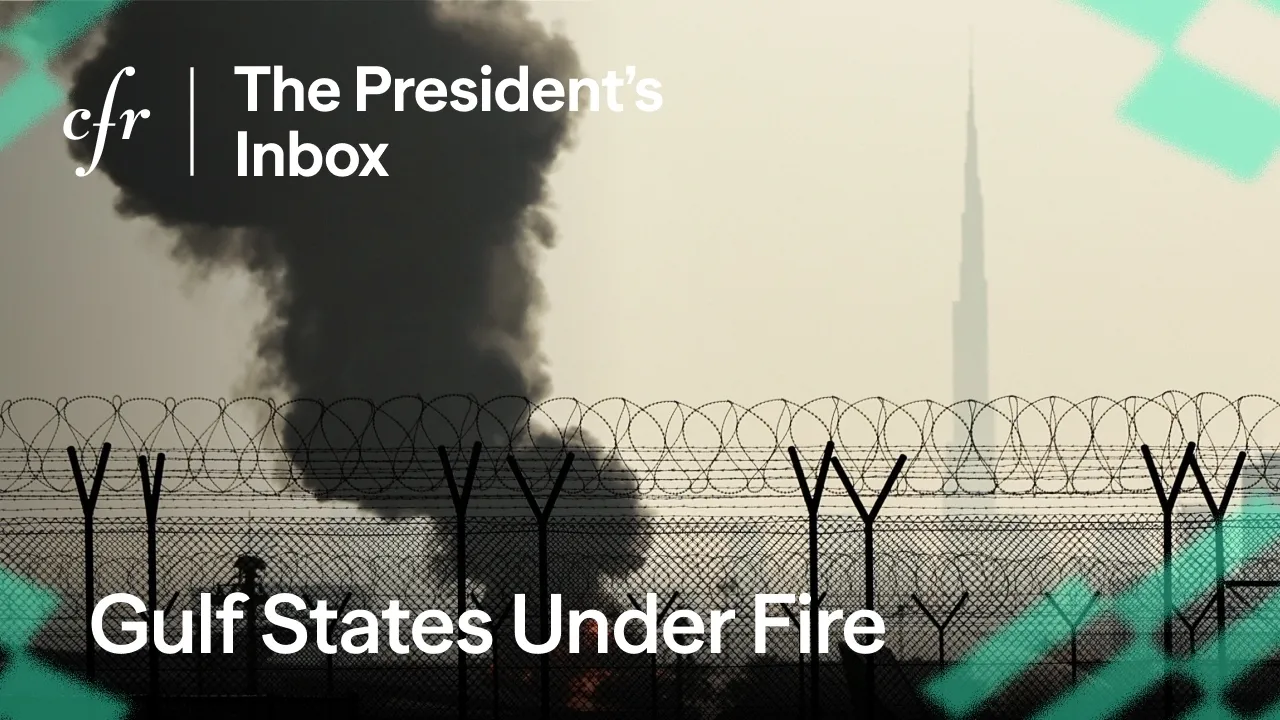
Gulf States Under Fire, With Mina Al-Oraibi
This episode unpacks how the war with Iran will affect the future of the Gulf countries’ security and economic prosperity.
Published
Host
 James M. LindsayCFR ExpertMary and David Boies Distinguished Senior Fellow in U.S. Foreign Policy
Guest
- Mina Al-OraibiEditor-in-Chief, The National
[Video: https://youtu.be/ZBiAdUe_gM0]
TRANSCRIPT
AL-ORAIBI:
All the officials I’ve spoken to from the UAE have been clear that their messages in public were the same as those in private, which was, do not go to war.
VO:
Countries around the Gulf are reporting a new round of Iranian missile and drone attacks.
VO (continued):
Across the region as missile defenses spring into action. Schools are shut until further notice.
VO (continued):
Here in Dubai, I mean, this is a global commerce hub. It is an area where tourists come.
LINDSAY:
Saudi Arabia, the United Arab Emirates, Qatar, Bahrain, and Kuwait now face the threat that their economies will be strangled and their civilian and commercial infrastructure ruined. Did the Gulf states want the United States to attack Iran? How are they reacting now that they have come under fire?
And what does the Iran war mean for the future of the Gulf security and economic prosperity? From the Council on Foreign Relations, welcome to the President’s Inbox. I’m Jim Lindsay.
Today, I’m joined by Mina Al-Oraibi, Editor-in-Chief of The National, an English-language newspaper based in Abu Dhabi covering regional affairs. Mina, thank you very much for joining me.
AL-ORAIBI:
Thank you for having me, Jim.
LINDSAY:
Mina, I’d like to begin by asking you, what’s the mood in Abu Dhabi right now?
AL-ORAIBI:
So we have now entered the fifth week of this war. There is both a sense of resilience, a sense of strength in Abu Dhabi. Thankfully, the vast majority of missiles and drones that have been launched from Iran onto the UAE and the wider Gulf since the 28th of February have been intercepted.
So there is a sense that this was the ultimate test and they’re able to meet this test. But there’s also concern. There’s anxiety about where this goes, what the intentions are, not only from Iran, but of course, the US and Israel as this war continues.
And there’s also a mood of thinking about where the world wants to go. I mean, the Strait of Hormuz, of course, has global ramifications, global concerns. You’ve had world leaders from Malaysia and Indonesia through to Canada and the US, through to Russia, India, all reaching out to the UAE.
Over 125 heads of government and states have called the leadership of this country, not only to, of course, sound their rejection of attacks on UAE, but also to confer with the UAE of where we go next.
LINDSAY:
So, Mina, let’s go back to the beginning. I’m trying to understand how this war came about. And I’ve heard conflicting reports as to the directions, guidance, suggestions that the UAE, Saudi Arabia, Qatar gave the Trump administration.
Is this a case in which the UAE was urging the United States to use force against Iran?
AL-ORAIBI:
All the officials I’ve spoken to from the UAE have been clear that their messages in public were the same as those in private, which was, do not go to war. Let us find a way to ensure that Iran is not a threat to the region. But diplomatically, the UAE put in a lot of effort with the Iranians themselves to take the negotiations seriously.
Of course, Oman, next door neighbors, were leading on the mediation. But the UAE put in a lot of effort too to convince the Iranians to take these talks seriously. They had their senior diplomat, one of their most senior diplomats, Lana Nusseibeh, visit Tehran ahead of the war.
They had Iranian officials also speaking to Emirati officials here. And they were very clear that there is the threat of war. There is the possibility of war.
But they certainly wanted to avoid it. That’s everything that I’ve heard, the officials I’ve spoken to. And that’s what our reporting has indicated.
LINDSAY:
Were people in the Emirates surprised that Iran responded to the US and Israeli attacks by targeting the UAE, Saudi Arabia, Kuwait, all of the countries in the region?
AL-ORAIBI:
They weren’t surprised because the Iranians had never really hidden the fact that they would threaten this region, but they’re surprised about the numbers. So if you look at the number of drones and missiles targeted at the Gulf compared to Israel, it’s almost three quarters more in comparison as a totality. And the UAE has taken more than half of the attacks in terms of missiles and drones.
So I think they were surprised at the percentage, let’s say. And I think they were also surprised about the fact that they had been very clear that American bases in the UAE and the Gulf were not used to target Iran, and that they had put in efforts of diplomacy. So I think they were surprised at the reaction of the Iranians immediately, targeting the Gulf and at this rate.
But they were not surprised that Iran would target the Gulf, because this is a threat, especially when it comes to missiles and drones, that the Gulf was warning about from the time that the Obama administration was negotiating with the Iranians, the JCPOA, in 2015, 2014, 2015. So, you know, a decade ago, they were warning that, hold on, you can’t just talk about the nuclear, because actually the military threat of Iran for the region is stronger when it comes to military and drone attacks.
LINDSAY:
Well, Mina, I was on the web page for your newspaper, The National, and I refer people to it who want to get a sense of how things are being seen from the region. And what I noted is that they had a running tally of some 2,400 drone and missile attacks targeted against the UAE specifically. Can you give me a sense of what those drones and missiles are targeting?
Is it all against US military installations, UAE military installations, or are they hitting a broader array of targets?
AL-ORAIBI:
They are certainly hitting a broader array of targets. We’ve had Emirates Global Aluminium, which is one of the most important companies in the world for aluminum production. They have targeted energy installations in other ways, hugely important in the UAE.
They’ve targeted Dubai Airport, which, frankly, is a hub for the world. You have global connectivity coming through the UAE, and it’s not just, of course, the UAE. You rightly said the wider Gulf.
Energy installations in Qatar, in Saudi Arabia, Bahrain, and Kuwait have been targeted. Kuwait this week had a strike on a desalination plant and an electricity or energy grid also targeted. These are not military targets.
These are civilian targets. Here in the UAE, in the first days of the war, there were drone attacks on hotels. The Fairmont Hotel on the Palm was one of those hotels.
LINDSAY:
A very lovely hotel, I will say. You can go to the view and have a commanding view of the Gulf and the high rises in Dubai.
AL-ORAIBI:
You’re right. It does have a great view. It’s back to being operational, which is quite impressive.
Within a couple of days, it was back to being operational. The point is that the attacks seem to be much more about causing terror, trying to frighten people as much as is possible, and to really disrupt life. Now, of course, the Iranians will push back and say that they are targeting military installations and so forth, but the reality is you’ve seen it.
The Emiratis have been quite transparent in saying where has been targeted, and everything from industrial complexes through to airports and hotels have been targeted. Now, again, there are also interceptions, so some of the debris that falls falls in different areas, but you can see that what would be targeted if the missiles and drones were allowed to land would not be military installations, as I said in the case of, for example, when there was the attack on the Fairmont Hotel.
LINDSAY:
So, Mina, how is the United Arab Emirates, Saudi Arabia, Qatar, other Gulf Arab countries responding to these attacks? I take it that, as you mentioned, the UAE is using defensive means to shoot down as many missiles and drones as it can. Are we seeing any contributions offensively to go after Iranian ballistic missile sites or military installations, or is this purely defensive from the vantage point of the Gulf countries so far?
AL-ORAIBI:
So far, purely defensive. There had been false reporting that the UAE took part. I have to say it was very irresponsible reporting that came out from Israeli media claiming that an Israeli source said that the UAE took part in an attack on Iran, and it was immediately refuted by the Emiratis.
And actually, that media outlet could not stand up its reporting. There was no sourcing, and it was refuted very quickly. And the Gulf has been really clear that any measures they take is defensive.
Now, they are, however, on the offense when it comes to diplomacy. So they worked really hard to get a UN Security Council resolution that would condemn the Iranian attacks on the Gulf. It was important that Russia and China did not veto the resolution, despite the fact that the Russians wanted to insert language into the draft that spoke about the attack on Iran.
But actually, you saw Gulf diplomacy succeeding in convincing the Russians not to sully the water and to actually be very clear that the actual attacks on the Gulf, that these Gulf countries are not part of the offense on Iran, were to be condemned. And so that happened. They’re also making it very clear that they are noting every single attack that is happening here in the Gulf.
And my understanding is that this is in preparation for the day after the war to demand that Iran takes responsibility financially for the damage it’s creating. You know, when Iraq invaded Kuwait in 1990, there were war operations that Iraq had to pay for over three decades after that, almost four decades after that. Even after Saddam Hussein’s regime fell in 2003, Iraq continued to pay almost 18 years later war reparations for those that demand compensation.
Of course, it didn’t cover all the damage, but it covered a significant amount. And I think you’re seeing that together. Legal cases are being put together.
Diplomatic efforts are there. So really on the offensive in those modes. But in terms of actual military use, it remains defensive.
LINDSAY:
I mean, one of the things that’s clearly happening in the course of this war is that the United States, but especially Israel, have been going after the Iranian leadership. That raises the real question of who right now is running Iran. Do you have a sense of who that might be?
AL-ORAIBI:
That is a really important question. And the answer is unclear, not only to us reporters, even to diplomats and officials. We speak to officials and say, well, your usual channels of communication, OK, the foreign minister is still there.
And I think there was almost a decision made that the foreign minister and the president would be the interlocutors, even though we know, of course, that the foreign minister and the president are quite weak when it compares to the IRGC, the Revolutionary Guard Corps, or the actual religious authority of the so-called supreme leader, Mujtaba Khamenei, the son of the previous supreme leader that is meant to be the ultimate leader of Iran. So the interlocutors when it comes to the foreign minister and the president are there.
But actually, the decision-making is now much more in the hands of the Revolutionary Guard at the moment. And they’ve taken on some very important roles, be it for the head of security, the head of the intelligence ministry. And so they seem to be calling the shots.
One of the things that became apparent immediately after the war and the top-level leadership being taken out is that there is a plan that if the command-and-control direct communications are interrupted, for local commanders to start almost acting on their own. And so you’ve had instances where the Iranian foreign minister or the Iranian president have wanted to appear to distance themselves from some of the attacks. But the reality is it’s still the Iranian state that’s responsible for the attacks that are happening.
And that seems to be led from the IRGC.
LINDSAY:
Samin, I have to ask you, there’s a lot of talk here in Washington about bringing about regime change in Iran. Are we seeing any signs of regime change? Any evidence that Iranians are rising up to throw out the IRGC or the other elements of the old regime?
AL-ORAIBI:
The protests at the beginning of this year in Iran were incredible. I mean, city after city rose up. They had people in the bazaars, in the local markets, students at universities heroically calling for their own liberation.
And they were met with brute force. The lowest estimate is about 35,000 people died. People estimate it to be much higher than that.
However, once the war started, we had gotten to a point that, again, so many activists had either been killed or imprisoned. And then once the war started, it became much harder to know what’s happening inside of Iran. There have been now over four weeks of almost complete internet blockage.
So the usual sources of information where, for example, my colleagues, our reporters, were in touch with activists and so forth, it’s been impossible to reach them. And also on the ground, it’s really hard for people to organize to go out and protest because one, either their leadership has been killed or imprisoned previously, or now in a state of war. I mean, the attacks on Iran, the strikes on Iran are absolutely extensive.
So it’s really hard for people to organize and go out and protest on the streets or try to overthrow a regime in the middle of the chaos of war.
LINDSAY:
So right now, we’ve just completed four weeks of fighting. President Trump, when he announced major combat operations at the start, anticipated or suggested that the fighting would last for four weeks or so. The Strait of Hormuz has been closed.
Now there’s talk in Washington of the United States sending combat troops on the ground in the Gulf. Talk about seizing Karg Island or perhaps the shoreline near the Strait of Hormuz to try to open up the strait. What is your sense of what that might mean if the United States were to introduce ground combat troops?
AL-ORAIBI:
Ground combat troops, of course, complicates the situation for American military, but also for the Iranians. The Iranian propaganda machine is on full force saying that, actually, we want American troops to come because it will make it easier for us to inflict greater pain on the American Well, they had a lot of experience with that during the Iraq war by supplying Iraqi militants with improvised explosive devices and the like. Absolutely, you’re right.
For a couple of decades, the pain that the Iranians were able to inflict on not only, of course, American soldiers, but even Iraqi government troops that were trying to work closely with the Americans. There were ample examples of that. So that’s on the one hand.
However, there is a sense that in order to ensure that the Strait of Hormuz does not stay hostage to Iranian decisions, to Iranian control, that there has to be some sort of military move to reclaim the opening of the Strait of Hormuz. That is no easy feat, nor is it straightforward. But there is a sense that if this doesn’t happen, if Iran is allowed to determine what happens in the Strait of Hormuz, this will have global ramifications, not only because of the energy market, but also if one country can decide to close an international waterway and get away with it, then we’re looking at very troubling times globally.
And what this means for the international organization of global trade that relies on the free movement of trade through international waterways. And so I think it will be an important way to show that you can reclaim an international waterway, but it will be very complicated. It will mean that the Iranians are able to target American troops more directly.
And I think they’re banking on the political appetite in Washington for something like that. Because again, for the Iranians, what are they going to lose? The country was already incredibly weak.
Sanctions were imposed. They’re trying to show, the Iranian regime is trying to show some sort of political win. But the reality is their leadership has been killed.
Their country’s infrastructure is destroyed. They’re unable to continue this on the long term. But they’re hoping that they can withstand it longer than the political ramifications for Washington, especially if it means more soldiers are killed in the line of duty.
LINDSAY:
I mean, is it fair to say then for Iran, winning simply means not losing?
AL-ORAIBI:
Sadly, yes. And also for the Iranian regime, winning in their mind is just surviving. But that’s not winning for the Iranian people, right?
So, you know, it’s quite interesting because you do get a narrative where people say, oh, the Iranians are winning this. I mean, what does winning mean? Your country is destroyed.
Your economy is destroyed. Your neighbors no longer. I mean, look, the Gulf and Iran had, you know, difficult relations, but there were diplomatic ties.
There was work actually improving ties. The last five years, there was a lot of effort put into that. They’ve literally blown that up.
And so, you know, I would find it very hard to say that the Iranians are winning. But in their psyche, if the actual survival of the regime is enough to win, then in their mind they are winning because the regime survived.
LINDSAY:
Mina, you mentioned a moment ago that the Iranians hit a desalination plant in Kuwait. President Trump has gone on to social to threaten going after desalination plants in Iran. Can you give me a sense of the significance of that kind of threat, particularly if the United States were to act on it?
Or if the Iranians were to continue their attacks on desalination plants in the Gulf?
AL-ORAIBI:
It is concerning. There’s critical infrastructure like that, and desalination is absolutely one of them. The Iranians, as you said, had already done that.
Previously, there was an attack on a small desalination plant also in Iran. And this is the sort of infrastructure that really shouldn’t be targeted, both according to international law, but also because of the ramifications it has for civilian populations, regardless of who they are. I mean, we have to draw the line there.
So it is quite critical. Different countries in the Gulf, including Kuwait, for example, have already said that despite the attack on this plant, Kuwait hasn’t had any interruption to its ability to have running water or anything like that. They’ve made plans and preparations for the possibility of attacks like this to happen for them to be able to manage any sort of short-term disruption.
I think there’s a lot of planning that’s gone into this, and there’s a lot of defensive efforts being put on that. But one, it’s a worrying development. And two, some of the threats, it starts with rhetoric, but then it’s a way to test what kind of response it would get.
And it seems both sides, be it the Iranian side or the American-Israeli side, seems to be using both rhetoric and then turning it reality on the ground to try to test the will of the other side.
LINDSAY:
Mina, besides threatening a variety of Iranian assets, President Trump has also said that there are ongoing negotiations, something that the Iranian leadership has denied. Do you have a sense of whether there actually are negotiations? And if so, who’s conducting them or how they’re being conducted?
AL-ORAIBI:
So, the main actors at the moment are the Pakistanis. That is the mediation effort that seems to have the most traction. They are confirmed in terms of not only passing messages, but trying to find common ground.
The Pakistani prime minister has spoken to not only the American side and the Iranian side, but also the Gulf side. The Turks and the Egyptians also have tried to use their relationships and they’ve put out calls. But I think they will be less significant than the Pakistani effort.
Of course, Oman was the main mediator between Iran and the U.S., but they’ve been attacked numerous times. Most recently, last week, Salalah being attacked. So they’re currently not conducting any sort of mediation.
But the Pakistani effort seems to be the most tangible and the one that is most serious. The Turks and Egyptians, however, are playing a role. But how any of this actually plays out will depend on the sides, especially the Iranians and Americans’ seriousness and commitment to try to de-escalate.
LINDSAY:
Mina, there’s been a lot of reporting here in the United States that while the Gulf countries did not want this war to begin now that it is unfolding, they want the United States to finish the job. Do we have any sense of what that means and what it is that Abu Dhabi or Riyadh want out of this war?
AL-ORAIBI:
What’s clear is they don’t want to just have a ceasefire where things stop at the moment that we’re at now. Because the moment we’re at now is that Iran is still able to fire drones and missiles to Saudi Arabia, to the UAE, to Kuwait, to Bahrain, to Qatar, to Oman and beyond. Jordan has been attacked several times.
So they don’t just want things to stop as they are now. They want to make sure that Iran is unable to take the Strait of Hormuz hostage. So they want to make sure that waterways are cleared and they want to make sure that the missile and drone programs and, of course, the nuclear program are controlled in Iran, contained, not allowed to pose a threat.
What that looks like in negotiations is unclear. But I think there has been unfair reporting, to be honest, that claims that the UAE or Saudi Arabia want the war to continue, almost like they’re egging the US and Iran not to stop the war. That’s not the message.
We understand, again, in our reporting, when we’ve spoken to officials, both here and in Saudi Arabia, there is a sense of we can’t just have a ceasefire and stop where we are now. And you can’t go back four or five weeks ago. Too much has changed in the region.
Too many red lines have been crossed. So it’s more about saying, OK, what does the security apparatus infrastructure look like in the region? You can’t just be having, OK, well, let’s build up more missile defense programs to be able to handle further Iranian strikes in the future.
How do you ensure that a political solution also includes some sort of security guarantees, but also make sure that the missile program in Iran is decommissioned? And there are UN sanctions on Iran specific to the missile program. It’s not just the nuclear program, even though that’s what gets the most attention.
The missile program is as problematic. And of course, now we have the drone situation, which really has amplified asymmetrical warfare because drones, of course, are cheap. They can be a nuisance.
But to be frank, the damage they cause is only when they’re able to get to fuel tanks or sources of energy that can allow them to cause greater damage. Otherwise, the drones are not that effective. They can be quite a nuisance unless they’re, again, laden with enough weaponry.
And I’m not a military expert, but it really depends on how far they travel and how much they’re carrying with them or what they actually attack. But that is something that needs to be dealt with. So the lines that I hear from officials from Saudi Arabia and the UAE is that this needs to also now be put on the table of any sort of mediation or long-term political solution.
It’s not just about the nuclear situation.
LINDSAY:
I mean, one of the biggest customers for oil coming out of the Persian Gulf is obviously China. China also has been a big investor in Saudi Arabia, in the United Arab Emirates. Do you see any role for the Chinese in reaching a negotiated settlement?
Any sense that the Chinese are seeking to carve out a role for themselves?
AL-ORAIBI:
It’s really interesting to watch the Chinese reaction so far. You know, in 2023, it was in Beijing that Saudi Arabia and Iran signed an agreement to restart political talks and diplomatic ties. And I think the Chinese at the time were quite proud of crowning these efforts.
Now, these efforts didn’t start with the Chinese. Actually, funnily enough, it was Iraq that played a role. The Omanis also played a role.
And it was crowned in Beijing. But since then, they have taken a step back. And I think part of it is also letting the United States kind of play out its own political ambitions and then at what point they will want to step in, if they will want to step in is unclear.
So far, as I said, they abstained from vetoing a resolution, but they didn’t vote for it, but condemned the Iranian attacks. On the Gulf, there have been talks with different Gulf countries, certainly with the UAE, there was an envoy that actually traveled to Beijing and updated there. They do have long-term interests with the Gulf.
But at the moment, they have been the most prominent actor to not want to get too involved at this stage. They may wait to see what happens with the Pakistani efforts at mediation and then see if they will want to get involved. Of course, many people were waiting to see what happens ahead on during the meeting of President Trump and President Xi of China.
That has been delayed now twice. So it seems to have the U.S.-China relationship seems to have a bearing on what the American decision-making will be in this war. But the Chinese have been very tight-lipped, as they usually are, on what their position is regarding the U.S. and this war.
LINDSAY:
Mina, are we seeing any role being played by the Russians? I’ve heard news reports that they’re supplying the Iranians with intelligence to target U.S. assets in the region. At the same time, the United Arab Emirates and Saudi Arabia have a lot of experience dealing with Moscow, given the fact that they’re all major oil producers.
Any sense that the Russians may try to carve out a role in negotiations?
AL-ORAIBI:
The Russians have been very vocal in their support to Iran. You’ve had the Russian foreign minister come out and condemn the American and Israeli attack on Iran, but not much in terms of condemning the Iranian attacks on the Gulf. He’s been quite tight-lipped on that.
I think the Russians have shown how close they are. An interesting development has been that the Ukrainians are lending their support to Iran. And dealing with the Iranian Shahad drones, because, of course, Russia has been using Iranian drones in their war efforts against Ukraine.
So that’s been a really interesting realignment that you’re watching. Especially the fact that the Ukrainian President Zelensky has been very vocal about saying, we want to be close to the Gulf. We want to support the Gulf.
And trying to create a bit of a division between the Russians and Gulf Arab states. At the moment, I would say Russia feels much stronger. I’ve seen the reporting that you’ve referred to about Russia giving intelligence.
We haven’t been able to stand that up in terms of accurate reporting. But certainly, they have very strong ties. They have defense agreements between the Iranians and Russians.
Both sides clearly also use each other’s weaponry and defense capabilities. So there are those ties. But to what extent Russia’s involvement when it comes to intelligence and everything, I genuinely couldn’t give you a straight answer because we haven’t been able to stand it up independently.
LINDSAY:
I mean, I want to ask you a question that may be a bit unfair. But I’d like you to sort of look to the future in terms of what you think the consequences of this war are going to be for Gulf security and prosperity. Having had the pleasure to go to Abu Dhabi, Dubai, Doha, Riyadh, you see just a massive transformation in these societies.
Obviously, Dubai, as you mentioned, is sort of a travel point for the world. That is now at great risk with this war because when people were thinking about building high rises and hotels and big data centers, big aluminum smelting plants, they were not anticipating having to fend against drone and missile attacks. Where do you think this goes, certainly for the prosperity of the Gulf?
AL-ORAIBI:
That’s the very reason that the Gulf has made clear that any end to this war has to take into account that they can’t continue to live with the sort of threat that we’ve seen play out for the past four to five weeks. So long-term prosperity, long-term security requires making sure that Iran cannot continue to pose this threat. But also the fundamentals stay strong.
So I agree with you that it’s on everybody’s mind, you know, where does the Gulf emerge out of this? I can speak to the UAE because I live here because we report very closely on the day-to-day here. Fundamentals remain really strong.
You know, it’s been over four weeks of a regional war, but people are able to work, basic services, all services actually are absolutely functional, foodstuffs, everything is still coming in and out. Yes, schools are working remotely because it was seen as being safer. When you look to the future, this is the test, right?
This is the stress test. How can they survive at a moment of this stress test? And they’re able not only to thrive, but actually people are functioning.
I just had guests here visiting from London ahead of us having this call. People are flying in, people are flying out. There are, of course, business considerations to be had.
I think whether it’s capital, the richness of the countries in terms of different communities, different nationalities here, many people have chosen to stay. Some people have left, absolutely, but many people have chosen to stay. And also, you know, the legal infrastructure, be it, you know, having international companies here, people’s, you know, family laws here are very good and conducive to having people from all walks of life living here and different religious backgrounds and so forth.
All those fundamentals remain. So the question is, how long does the war go on for? What sort of damage is created?
Will it be the financial bill? Of course, that will have a bearing. But I think the long term remains quite optimistic when it comes, especially, I want to talk about the UAE specifically, and then we can talk about, I think the UAE remains quite optimistic because of those fundamentals.
Capital, energy, geographic positioning, you know, companies like Emirates Airlines, Etihad Airlines, they’ve been around for a long time. The financial markets here, the art scene here, this is decades old. This is not something that was up and coming for three, four years.
So then you can stunt its growth quite easily. I think those are deep-rooted fundamentals. So most people remain quite optimistic about where this goes.
I think for the wider Gulf, different Gulf countries will have, you know, different stages of either their economic diversification. I mean, again, UAE economy is quite diversified, not as reliant on energy as perhaps some of the other countries. So you, and then you look at Saudi Arabia, for example, you know, Saudi Arabia was having its own dynamic even before the war of like readjustment, thinking about where they want to prioritize the many, many projects that were announced.
And I think, again, that Saudi Arabia in terms of size, in terms of Aramco’s ability to, you know, continue to be a major player, like ADNOC here is a major player. I think in general, people are not concerned about the long term. It’s much more looking at the short to midterm and how these economies will be transformed by the war, what lessons will be learned.
And also, you know, how do they emerge from this very serious test that they’ve all been put under? I think the different economies of the Gulf, by and large, would be okay. But, you know, there will be a financial bill and also, you know, for certain communities, an awakening of what it means to have a neighbor like Iran if it’s not resolved politically, which is why the insistence of countries, particularly like Saudi Arabia, Qatar and the UAE, is that any resolution has to take into account that Iran cannot continue to pose a threat.
LINDSAY:
I mean, what do you think this means for the Abraham Accords?
AL-ORAIBI:
You know, I mean, Bahrain and the UAE, of course, have continued with the Abraham Accords ever since their signing in 2020. Qatar has had and has Oman relations with Israel at different points in different sorts of relations and visits. So I think that doesn’t change.
What does it mean for Saudi Arabia and the possibility of, you know, ties being established with Israel? I think the fundamentals don’t change. The Saudis have made very, very clear that they connect this with Palestine, what happens to the emergence of a Palestinian state.
That doesn’t go away. I mean, I think the dynamics in Lebanon are very worried. An Israeli incursion that becomes an invasion in Lebanon is problematic for the entire Arab world, those that have ties with Israel and those that don’t have ties with Israel.
So I think it will also depend on what the dynamic inside of Israel is like, what they do in Lebanon. So we’ll see some of that play out. I think in the thick of it and with the very fast moving events now, it’s hard to take the long view of what it means.
But I think those that already have ties with Israel will continue to have ties with Israel. And those like Saudi Arabia or Kuwait at the moment, I think, are really focusing on the immediate and how do you not only end the war when it comes to the Gulf and Iran’s attacks in the Gulf, but also what are, you know, Israel’s ambitions like in Lebanon. And let’s not forget about Iraq.
Iraq is a hugely important player in the region. Lebanon and Iraq at the moment are facing their own internal pressures because of the war and Lebanon and Iraq have groups within the country that are not really under state control that are supporting Iran. And that is a dynamic that is very harmful to the state as a state sovereignty of both Lebanon and Iraq.
But then the sovereignty of Lebanon and Iraq is also being challenged by airstrikes coming in from Israel. And then, of course, with Lebanon, it’s that land incursion. So it’s a whole confluence of events that are much broader than Abraham Accords.
But the Accords in themselves, I think, will continue as they have done through the last four to five years of really up and down kind of moments in the region. But whether they will be expanded, I think, is not an immediate consideration, even though, of course, we’ve heard from President Trump very vocally telling Saudi Arabia that they see a real need for those ties to be established. Senator Lindsey Graham, who has been very vocal about the Iran war, also has said that he would like to see that happen.
But the Saudis for now have been quite clear in saying that their priority is much more what happens to a two-state solution, but also how this war ends.
LINDSAY:
On that note, I’ll close up the President’s inbox for this week. My guest has been Mina AL-ORAIBI:, Editor-in-Chief of The National. Mina, thank you very much for such an informative conversation.
AL-ORAIBI:
Thanks, Jim. Thank you for having me on.
LINDSAY:
Today’s episode was produced by Justin Schuster with director of video Jeremy Sherlick, senior video producer Grace Raver, and director of podcasting Gabrielle Sierra. Production assistance was provided by Oscar Berry and Kaleah Haddock.
This transcript was generated using AI and may contain errors or inaccuracies.
We Discuss:
- Whether Gulf states supported or opposed the war with Iran and their role in the intensive diplomatic efforts to avoid conflict before it began.
- How Iran’s retaliation expanded the war into the Gulf, targeting civilian infrastructure, energy hubs, and global transit points.
- The scale of drone and missile attacks across the region, and what they reveal about modern asymmetric warfare.
- Who is actually in charge in Iran, and how the IRGC is shaping decision-making and escalation.
- Why regime change in Iran remains unlikely, despite internal unrest and external pressure.
- Why Gulf leaders don’t want a simple ceasefire, but rather a long-term security reset that addresses Iran’s missile and drone programs.
- How the war is stress-testing Gulf economies and their long-term bets on stability, globalization, and diversification.
Mentioned on the Episode:
Joint Comprehensive Plan of Action, July 14, 2015
Vibhu Mishra, “Security Council Adopts Gulf-Backed Resolution Condemning Iran Attacks; Russia Bid Fails,” United Nations News
Opinions expressed on The President’s Inbox are solely those of the host or guests, not of CFR, which takes no institutional positions on matters of policy.
Associate Producer, Video and Audio
- Associate Producer, Video and Audio
Director of Video
- Director of Video
Editorial Director and Producer
- Director, Podcasting
More Episodes
 33:42Podcast
 36:05Podcast
 41:07Podcast
 39:26Podcast
 35:04Podcast
 31:46Podcast