Data Centers In Space? + Planet Labs CEO Talks ‘Large Earth Models’
AI and satellite imagery are quickly converging to create “planetary intelligence,” a new generation of systems capable of capturing and analyzing images of Earth in real time. This episode explores how the AI infrastructure race could move into orbit, with space-based data centers, falling launch costs, and “large Earth models” potentially transforming the global economy, geopolitics, and the future of artificial intelligence itself.

Published
Host
 Sebastian MallabyCFR ExpertPaul A. Volcker Senior Fellow for International Economics
Guest
- Will MarshallCEO and Co-Founder, Planet Labs
[Video: https://youtu.be/xXEcrIfhPJo]
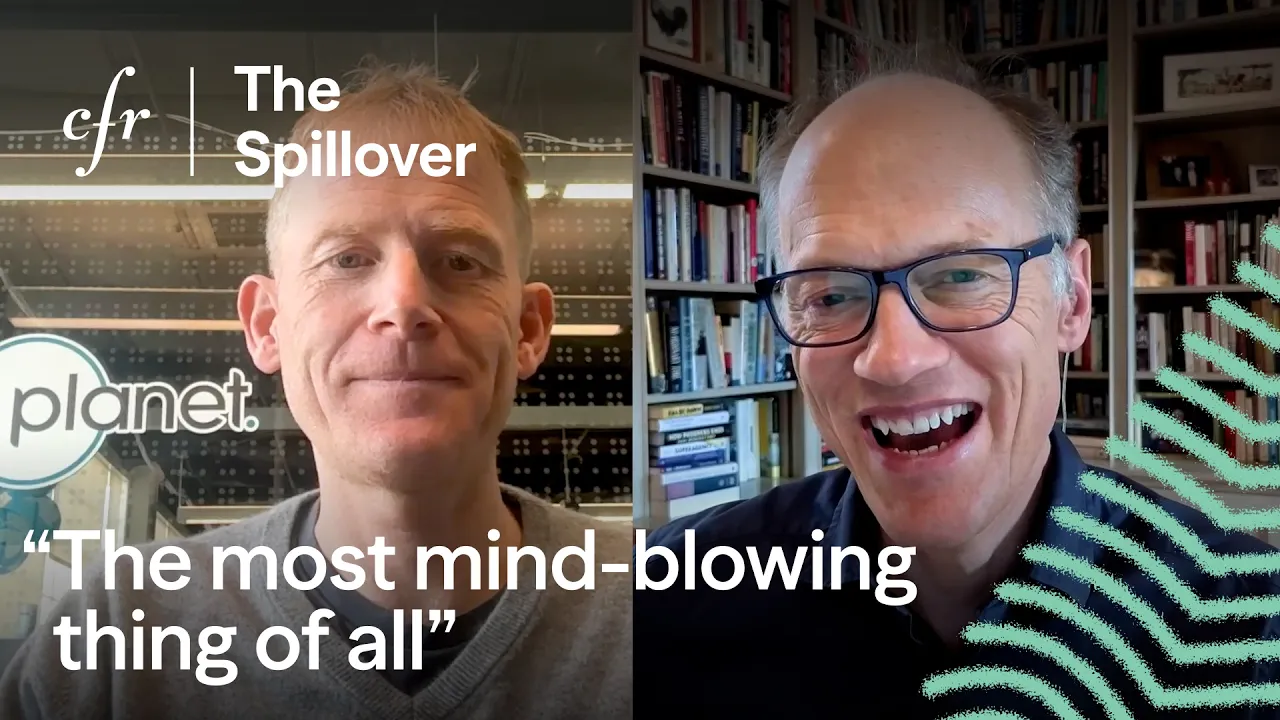
Transcript
MALLABY:
In his 1956 science fiction masterpiece, The Last Question, Isaac Asimov tells the story of a supercomputer called Multivac. As humanity’s need for data processing expands, Multivac also expands, eventually outgrowing planet Earth. The computer moves into space and draws energy from the sun.
Today, with hundreds of billions of dollars being spent on supercomputers for AI, tech leaders from Elon Musk to Jensen Huang, from Jeff Bezos to Sundar Pichai of Google, are suddenly posing their own version of Asimov’s Last Question. As the need for AI processing expands, perhaps our supercomputers will outgrow planet Earth, and maybe, instead of locating all those data centers on the ground, space will prove to be a better place for them. I’m Sebastian Mallaby.
Welcome to The Spillover. This week, my Spillover co-host, Rebecca Patterson, is in Japan attending meetings of the Trilateral Commission, so I’m going to be talking instead with Will Marshall. Will is a former NASA scientist and the co-founder of Planet Labs, a San Francisco startup that launched in 2010 and is now a public company, quoted on the New York Stock Exchange and employing over 1,000 people.
The business of Planet is to put satellites into space, then use these satellites to collect images of the Earth, and then figure out ways of making those images useful to everyone, from governments seeking to collect intelligence, to environmentalists monitoring deforestation, to journalists reporting on disasters, to hedge funds monitoring global shipping. I’ve known Will for some years, but the reason to have him on The Spillover right now is that the satellite business, or if you prefer, the GDP of space, is on the verge of a transformation. AI is definitely going to transform the value of satellite data.
That much is happening already. But maybe, if you are willing to squint into the future, AI is also going to mean Multivac-style supercomputers in space, with potential spillovers ranging from a dangerous profusion of space junk to the risk of extra-planetary conflict. And as I think we’re about to find out, Will has an exhilarating way of thinking about these questions.
The way he frames it, and you’ll soon see what he means, we are entering the age of planetary intelligence. Will Marshall, thank you for doing this, and great to have you on the show. Glad to be here.
I want to start a bit, Will, by asking you to talk about your early journey. You were British, you still are British, originally British. You did a PhD in physics at Oxford University.
Then you joined NASA as a scientist there. And so what was it like working at NASA, and what prompted you to leave?
MARSHALL:
Well, it was really fantastic. I mean, honestly, it was obviously a childhood dream for me as a space geek, wanting to go work at NASA, do space exploration, do science. I spent my time there working on lunar missions.
We sent a couple of probes to the moon. We found water on the moon, and it’s very exciting now with the Artemis program going back there recently. I was so inspired by those missions.
Obviously, the presence of water is really helpful for putting self-sustainable bases off Earth. But the more we looked out, and my co-founder was doing this mission that was looking for planets outside our solar system on exosolar planets, and he found thousands of these planets, but none of them are as beautiful and incredible as this one. And so really, we started Planet with a modus operandi of using space to help life on Earth, going out to help protect this planet.
And what we recognized was a gap of… See, NASA had been doing incredible things, and we learned so much monitoring the Earth, really to take a scientific baseline of how things were changing with Landsat, with weather satellites, with various other things. Incredible understanding of Earth sciences, of geology, of glaciology, of climate science, obviously, and land changes over time.
But it wasn’t fast enough to change human decision-making. So it was like awareness, but not inside the decision-making loop, inside the OODA loop of human action. We recognized a gap of if we could take an image of the whole Earth every day, then we could be inside human decision-making loops and help instead of get to the end of the year and notice there’s a big hole in the Amazon, stop deforestation in the act, or same with illegal fishing, or protecting coral reefs, or even helping to prevent war.
The idea is to underpin the fact that humans are making changes on this planet really fast with data that enables us to make smarter decision-making all across the globe. And so we left NASA mainly because NASA’s forte is science and exploration, but this was more like human action and operational impact. It was more a business and an impact opportunity than a scientific or exploration one.
And so we thought we could do it faster, more furiously outside of NASA. So we raised some capital here in Silicon Valley. We were at the NASA Center here in Silicon Valley, which helped to give birth to Silicon Valley, by the way.
And so our founding team, we left NASA, got financing here, and started Planet right here in the Bay Area.
MALLABY:
I think it’s just worth double-clicking on something you just said there, which is that the motivation for putting satellites up in space the way you see it is to protect the planet, to cherish the special uniqueness of this planet, since your co-founder had inspected the other ones and found they didn’t support life, were less exciting. And it’s just a rather different one to the Elon Musk, hey, if we can be a multi-planetary species and something goes wrong with this planet, no problem, we can go live on Mars or something.
MARSHALL:
Yeah, well, quite. Look, I mean, all power to them, going to Mars or the Moon. This one is the best one, space birth.
And let me just also put in, you know, there’s not a place on Mars that’s better than the worst place on the Earth. I mean, the Earth is just so much fantastically better planet and more suitable for life. And obviously, maybe long term, we’ll send lots of people and other life forms off Earth.
But in the meantime, almost all of our challenges are here. Almost all the people are going to be here for the foreseeable future. And all the life that we know in the cosmos is here for the foreseeable future.
And there’s a cosmic significance to taking care of this planet. And it’s going to space is not irrelevant from that challenge. You might think going off Earth is like abandonment of responsibilities to take care of the Earth.
But it is only through satellites that we have really understood our own planet. It’s like you need to go to another country before you understand your own country and have some perspective on it. You need to go to other planets before you understand your own planet.
I mean, it wasn’t until we sent probes and looked at the runaway greenhouse effect on Venus that we went, holy shit, we don’t want that. And we started thinking about what that could mean here. It’s only with Earth imaging satellites and weather satellites that we’ve underpinned our climate models.
It was only with satellites that we found the hole in the ozone layer. It’s only with satellites and the Apollo missions that we even discovered the Earth. And that’s the more philosophical and sort of consciousness raising piece of it, which may be, again, less tangible.
But when humans went to the Moon, they didn’t find the Moon, they discovered the Earth. Because they look back at Earth, look back at Earth and realize its fragility. They realize, obviously, we knew we’re on a planet, but we didn’t really sense it viscerally.
And they sensed it viscerally. And they brought that back. And actually, the blue marble shot is one of the most widely shared pictures ever, I think, the most widely, one of the Apollo astronauts shots.
And the green movement sort of started mainly after that, because people were like, what, you know, and so it wasn’t obviously we knew that before. But viscerally, we became more aware of our planetary neighborhood and, and consciously aware of it as we went out. So, you know, anyway, that’s all to say that space is absolutely critical.
Most of the data that underpins our climate models comes from space, most of the data that underpins our weather model. So it’s relevant down here on Earth. It’s not an abstract runaway escapism.
It is absolutely relevant to taking care of terra firma.
MALLABY:
So you co-founded Planet in 2010. And just paint the picture, what was happening in the space industry at that time, which sort of made it a right moment for Planet?
MARSHALL:
I mean, we realized that something that was, I think, you know, there was a trend of trying to reduce the cost of satellites. The most pioneering example was actually in England, satellites. They had taken the billion dollar satellite model and taken a couple of zeros off that.
But we have worked further at NASA, we had looked at phones and other consumer electronics and said, well, wait a second, this, if you look at the list of things a satellite has, and the list of things a smartphone has, they’re pretty aligned, right? You have radios, computers, accelerometers, rate gyros, GPS, you have a computer, all the sensor systems, that’s very aligned with what a satellite has. The only thing it doesn’t have is solar panels to keep it powered.
You have to plug it into the wall. Obviously, that doesn’t make sense in space and a couple of other things. But basically, 90% of what you have in a satellite is in a phone.
And we were like, scratching our heads going, well, this costs $500. Our normal NASA satellites cost $500 million. So what are the extra six zeros doing for us?
And sorry, satellites had attack on that and made some progress. But we think we could go a couple of orders of magnitude further. And we did.
And so it was all about what I would call leveraging Moore’s law and applying it to space. So taking the fact that billions have been spent on the miniaturization of electronics, of sensors, of computers. And unlike in Apollo, where actually Apollo helped to invent the microprocessor because they had to have a computer that would fit in the Apollo capsule, which wasn’t very good at the time.
But they had to invent that. And that led to a lot of the birth of modern computing. But still, subsequent to that, they’ve taken a very conservative attitude of what compute systems were put in space.
Basically, don’t put a computer in space unless we’ve already tested in space. Well, that best led to a chicken and an egg. And we only kept the very old stuff in space such that to give you an example, the last probe on Mars has a 33 megahertz processor.
You can’t even find one of those. You know, literally, NASA JPL has to keep a whole line of things open just to build those chips that no one else wants. And a two megapixel camera.
And again, much better ones in here. So we were saying, let’s reverse this. NASA was inventing everything as it went, computing, solar panels, everything because it had to.
We were saying, let’s leverage the fact that there’s billions of dollars already being spent on the miniaturization of computing and other infrastructure for consumer electronics and take that to space. That is strapped space to Moore’s law.
MALLABY:
Half of the insights here is that is the militarization of consumer electronics. And then the other half, I guess, is SpaceX bringing down the cost of launch so you could actually get the satellites up there?
MARSHALL:
No, that’s a misconception. At least for us, it was nothing to do with how we started. It was exciting.
SpaceX was started a couple of years, several years before us, but but they hadn’t really come to fruition. So launch costs when we started were dominated by international launch costs, Soyuz, Indian PSLV, others that were already about twenty thousand dollars a kilogram, which SpaceX didn’t come to until about five years ago. And then they actually dropped it below the international rates.
What SpaceX initially did the first few years is just bring U.S. launch costs from an obscenely high, about 20x the international rate to being about comparable with the international rates. So to start with, we just weren’t using SpaceX because they were more expensive. But later on and in recent times, they had brought the launch costs down below what was the international rates and they brought them down about 5x compared with that, which is a big deal, by the way.
But it is not nearly as big deal as the thousand x increase in cost performance of every kilogram that you could put in the fairing. So what’s mainly led to the space boom is not the rockets. It’s the miniaturization of electronics.
MALLABY:
I see. I see. I see.
Okay. So you found the company, you launched satellites into space, you start collecting gigabytes of images of Earth. So what was your early hypothesis of how these images would be used and how did the hypothesis differ from what actually turned out?
MARSHALL:
Yeah, great question. Firstly, a quick course correction. It’s about 30 terabytes a day, not gigabytes.
So it’s about 4,047 megapixel images. To applications, I mean, actually the applications are roughly how I expected it. I hoped the world would be dealing more with sustainability so we could get to that in a second and leveraging our data.
The world hasn’t turned out to be quite ready for that as yet, although we’re burying our heads in the sand a little bit. What has turned out, though, in most applications and including in that one, and I can give you a bunch of examples, is that this drives, you know, the whole thesis underneath planet was transparency, drives accountability, drives better decision making, right? And that’s the case for stopping deforestation.
That’s the case for war and security situations around the planet. That’s the case for insurance, agriculture, what have you. So we thought of a wide range of applications across commercial, civil government, defense and intelligence, and various others, media, NGOs, human rights, think tanks, so on.
And all have essentially come to fruition at different speeds and different value in terms of business, but all are coming to fruition. And, you know, we’ll get to this, but AI is, of course, accelerating that. And that’s very exciting, too.
But it’s not far off what we predicted. We never had to pivot, so to speak.
MALLABY:
So but to make this concrete, I think there was a moment on Valentine’s Day in 2022 when a pontoon bridge appeared on the border between Belarus and Ukraine. And by spotting that, you actually had an effect on how the world processed what happened next. Can you tell that story?
MARSHALL:
Yeah, absolutely. This was just before the Russian invasion of Ukraine. And literally the day before Putin said, no, no, no, I’m just kidding.
And we were like, yeah, but we found this bridge, literally collecting Belarus to Ukraine that was built that day that that was essentially clearly a bridge to send troops over to invade. And yeah, it was one of many things that were amounting to calling bluff on Mr. Putin. Look, the general point is that we were not just showing the buildup of troops in the obvious places, which you saw in the press.
And a lot of that, if not most of that imagery came from Planet. But we also saw things much earlier. Looking back now, we could see that months earlier, the Russians were doing very different operations.
And the hope is that in future, we could give countries not just a few days or weeks warning, but many months warning of those sorts of things. Our data is used heavily in Ukraine to defend it. And it’s, I think, proved to be extremely valuable.
At our investor day recently, we had the former defense minister speak. And it was really compelling examples of how our data can help reduce casualties there, help secure their country.
MALLABY:
What about for human rights lawyers trying to prosecute war crimes, stuff like that?
MARSHALL:
Absolutely. And food security, the World Food Programme used our data to show, I mean, a lot of people didn’t know this before the war. But I think 40% of the world’s poorest countries got their grain from Ukraine.
It was like a breadbasket of Europe that was being sent by the World Food Programme to all these countries, Lebanon and many other countries that were benefiting and getting most of their food supply from Ukraine. And then it was suddenly cut off. So they were trying to get that out, not just to feed Ukraine, but to feed all those poor countries.
So as is typically the case, war creates challenges downstream, security challenges, not just physical security, but food security, water security, other security challenges downstream. And our whole point, again, is to help those actors make smarter decisions, to get earlier warning, to make smarter decisions. And that’s in the security realm.
And we could obviously go into concrete cases in other realms, in agriculture, insurance, as you wish.
MALLABY:
Right. We’ll get there in a second. But I want to just sort of dwell on one thing here, which is that reducing the fog of war reduces the scope for miscalculation.
That’s good for security. Understanding how much the food shortages might be coming out of Ukraine once the war has started allows other countries to understand the scale of adaptation they need to go through to meet that challenge. So there’s lots of upsides here, but there can be moments, right, when more information is not a good thing.
And I think you encountered that with Iran, where you basically had to stop putting out images of what was going on in the war recently.
MARSHALL:
Yeah, well, just to be clear, in every case where we’ve had conflict, we’ve addressed what would be the right balance between critical things like security of operations, we obviously don’t want to put people or civilians in harm’s way, and transparency and accountability for the longer term, right. And different needs have different timescales, right. So we have typically put a delay in place.
And this was no exception in the war in Iran. And so yeah, we did that. And what’s important to note is that almost all of our critical clients in the region continue to get access straight away.
It’s just that that data can’t be published out in the public domain, because that could then be used by terrorist organizations or proxies or what have you to do what could be bad things. And so that’s the reason. It’s a tension always.
But this was no exception.
MALLABY:
Yeah. Okay, so when you got started, I read somewhere that there were about 950 active satellites in total. By 2022, I picked that date to check because it’s before so we can’t describe the growth to AI.
You know, that number had jumped to almost 7,000. Well, maybe there was AI. Of course, there was AI before ChatGPT.
So maybe you’ll tell me that that growth from 950 to 7,000 was AI related. Anyway, you fast forward another four years to today, and there are over 15,000. So it’s basically more than doubled in the last four years.
So you tell me what’s been driving this growth? What’s the main reason?
MARSHALL:
Well, again, I think it’s a combination of miniaturization of electronics that has enabled us to do more with less in a fairing going up. And then this is where SpaceX really comes in the proliferation of a rapid and scalable transportation to space at reasonable or cheaper prices. And SpaceX, of course, have used that they dominate that that number of 15,000.
They’ve launched over 10,000 satellites themselves. So the majority of those were in the top four or five constellations of satellites. Ourselves with the largest earth imaging one, most of the others, in fact, all of the others are communication fleets.
So they are launching Starlink at SpaceX, but there’s also OneWeb. And we’re the largest imaging satellite fleet with a couple of hundred satellites ourselves. But yeah, the proliferation there is dominated by the fact that this is that threshold of launch costs and satellite costs.
You’ve unlocked different opportunities. So I liken this to the mainframe to desktop transition, a computer transition. So we only had computers the size of buildings.
And again, Apollo helped to push microprocessors. Microprocessors unlocked a totally new set of use cases when you could have a computer that was the size of a desktop or maybe a room first and then a desktop and then a laptop, right? And now a phone.
And that led to unleashing loads of applications. The same is true in space. As you lower that cost, all these other applications, and we’ll talk about computing space, you already hinted at it in the intro, that one’s being unlocked right this second.
And that’s why that’s going to be a big thing. But basically, as you bring those satellite costs down and launch costs down, these things unlock.
MALLABY:
Okay, great. So let’s get to the heart of the matter now. So the number of satellites is already growing fast, but it’s about to grow a heck of a lot faster because of AI.
And that’s because first of all, AI basically is going to transform the usefulness of your data, of Planet Labs images. I’ll just sketch out my understanding and then I’ll invite you to refine it. But I think there’s kind of like two reasons, as far as I understand it, why AI is going to be so important to what you can do with the images.
The first is simply that AI is excellent at reading pictures. So it has been since 2012, the breakthrough with ImageNet. Now we are 14 years beyond that.
It’s really, really good at it. It’s good at reading medical scans. And by the same token, it’s good at reading satellite images of the ground.
And so it used to be that you could generate all these images, but your customers would have to spend a lot of their own time looking at these images, scrutinizing them, trying to extract useful data. And now that’s automated. So that’s the first thing.
Second thing is, it’s not merely that the AI can look at the picture and spot the detail in it. It’s also that it can learn across all of the images that you’ve collected over the past decade. And just as a large language model can ingest all of the internet, all the text on the internet, essentially inhale Wikipedia and be able to converse intelligently on everything under the sun.
So too, if you train a model on all of the images that you’ve collected, terabytes, not gigabytes, then the planetary intelligence, that’s your phrase, will blow us away. We keep on talking about how AI has already advanced a lot. It’s changed the world already, but you ain’t seen nothing yet.
This is almost the most dramatic example I can think of, of how we haven’t seen anything yet, because training a model on all of the images will turn it into a very different and in fact, possibly more useful kind of machine intelligence. Discuss.
MARSHALL:
Yeah, absolutely. No, I think you hit the nail on the head. I think the merger of LLMs and earth imaging can enable a new kind of AI that has planetary understanding, that has at the local level and global level, that has an integrated understanding of all the challenges around the planet from security to sustainability and everything in between.
And yeah, you noted already the trends. I mean, computer vision, the stuff of ImageNet and onwards had figured out how to do image recognition, but you actually had to train a lot of data to get to a model that could detect trees or detect cars or other vehicles or what have you. And it would take loads of training time, typically many months to train one model that could detect one kind of thing.
And often only one region, it would work and then other regions would work. And so we were doing that. And we’ve done that for years.
And that’s what underpins the work we did with deforestation tracking, for example, in the Brazilian Amazon, where we scan 8 million square kilometers of Brazilian Amazon every day. Computer vision looks for new road starts and that finds illegal deforestation. Then the Brazilian police go out and stop those things about 10 times per day.
Great. And scaled operations. But basically, the difference now is that you didn’t have to be the federal police of Brazil with 100,000 people and a whole geospatial team.
LLMs now mean that you can chat with the data and get a semantic answer without any expertise whatsoever and even code up whole applications using code or whatever in the background to spin up and build a whole application on top of it. Fluidly, just like LLMs, chatGPT, Gemini and the like have enabled us to chat with that text of the Internet, all the data, all the world’s knowledge, everything under the sun, as you said. Actually, it’s not everything under the sun.
It’s everything on the text of the Internet. Right. And now we are giving it more like everything under the sun.
Actually, I wouldn’t claim that because it hasn’t got all the other planets yet. But basically, it’s everything on the Earth, which is much bigger than everything on the text of the Internet. And actually, a separate and related trend is that all the AI companies, the companies all around here, we sit in the middle of what I call the AI triangle in between Gemini team, the Google team, Anthropic and OpenAI.
We’re literally in the middle here. And we feel it because AI has been on this course of building physical world models. Dario, Demis, many of the others have been talking recently about building real world models because they want to answer questions, not just about the text of the Internet.
The text of the Internet, if you are a farmer and you want to know theory about crops, you can find it today. If you actually want to know about your field and how it’s doing today and how it compares to the one next door and what you should do in this circumstance, it doesn’t know shit. It doesn’t know about your field.
Our data knows about your field. So the combo enables that farmer to actually have prescriptive answers about what would be useful to do in his field or that journalist that’s tracking that flood. You can go on LLMs and know about the theory of floods, but it doesn’t know, Jack, about this flood happening today in this village and what impact is happening, where should emergency responders go, and so on.
And so they’re all building towards real world models. But for real world models, you need real world data. Obviously, AI is only as good as the training data set.
And so we are moving and I would argue space has the preeminent example of real world data sets to train these physical models, or as I like to put it, planetary intelligence is the sort of outcome. Instead of talking about large language models, I like to talk about large earth models. And instead of AI, I like to talk about planetary intelligence.
And that, I think, is this thing is going, the combination of LLMs and earth data.
MALLABY:
Right. So I’m quoting you back to yourself here, but I read something where you said, Google indexed the internet to make it searchable. Planet is indexing the earth to make it searchable.
AI is the key that will finally make it accessible and answerable to everyone who needs it. It’s a pretty mind blowing idea.
MARSHALL:
I agree with myself. Actually, I said that first quote, I think it was seven, eight years ago now at a TED talk, and AI just wasn’t ready. So we could index things in theory, but the semantic interface was really not there.
And the boon in the last year or two, really only in the last year have the LLMs become multimodal in the way that they leverage all that computer vision stuff and could understand imagery, not just text. And that has really unlocked the value of our data.
MALLABY:
Yeah, there you go. You say it on TED way, way too early, and now the time is ripe. So here you’re on the spillover, just saying.
Okay. I mean, just to maybe to make this distinction between just looking at a photograph and understanding it versus thinking about the photograph. I suppose in category one, you might have, you know, you’re looking at shipping and you want to see whether there’s been illegal fishing and you can spot the fishing boats.
Category two would be you’re looking at a field and you can actually analyze the condition of the soil from the picture because the system has learned across millions and millions of pictures of different fields, what healthy soil looks like. And then maybe also knows what the intervention is when you have unhealthy soil and the weather conditions are such and such and such and such. Right.
Is that, am I on the right track there?
MARSHALL:
Yeah, I think you’re on the right track. And in particular, looking at the history of your field, what’s normal, what’s abnormal, is this good compared with the recently and then learning, as you say, from all the other examples, here’s a similar field, but they did this and that intervention helped them in the similar circumstance. So perhaps you should do that, whereas these other interventions didn’t work.
So it can learn again from all the global examples as well as know about you, what you’re doing locally to give you locally specific advice. I think it’s incredibly powerful in that sense. We can’t actually tell much about the soil specifics.
We could tell the soil moisture. We can tell certain things about the surface of the soil, but we can tell things like above ground biomass, which is essentially crop yield. And we can tell crop type using our multi-sensor data, our near infrared band, chlorophyll sticks out like sore thumbs.
So we can do certain things. We can’t tell everything. It’s not a replacement for a soil sample, for example, but we can do a lot and we can do it for the whole world and every three by three meter box of every field on the earth every day.
MALLABY:
Well, this idea of planetary intelligence and moving from large language models to large earth models is sort of, you know, would be mind-blowing enough to fill a podcast, but but actually we’re just warming up for the most mind-blowing thing of all, I think, or at least equally mind-blowing. And that’s this sort of squinting in the future, this idea of data centers in space. So tell me outside of Asimov and science fiction, who first came up with the idea of putting a data center in space?
MARSHALL:
No, I mean, I think it was back to the sci-fi writers. I actually don’t know an earlier thing than the 50s, but I haven’t looked at it and researched it. In recent times, we’ve been thinking about it a fair bit.
In the space community, there’s been papers on it for decades now and how one might do it. And Google and Planet, we did this first study on this. I dug it up recently, just historical records about eight years ago, looking at what it might mean to put data centers in space, what are all the costs on the ground.
So it sounds sci-fi on the face of it, right? But, you know, it really does sound like an Asimov story, not a reality.
MALLABY:
I think that was an understatement, just a sci-fi on the face of it. I think it categorically sounds sci-fi, but yes. But you’re telling me it’s plausible.
MARSHALL:
No, it’s not just plausible. It is going to happen. I’m pretty confident.
And the reason is that it’s just simply a launch cost question. What we realized in this study eight or nine years ago with Google was that when launch costs, when we added up all the costs of data centers on the ground, the buildings, the cooling, the electricity, the compute facilities themselves, of course, so on and so forth, all the stuff for space, the launch costs, the satellite costs, the compute costs, and so on. There was a tipping point when launch costs come down to about two to $300 a kilogram.
In principle, it was going to get cheaper to put it in space than on the ground.
MALLABY:
And where are we now? What’s the cost now?
MARSHALL:
About $1,000 a kilogram is the cost of a Falcon 9, reusable Falcon 9. So we’re about, you know, three or five X off.
MALLABY:
And if you go back, just give us a sense of the progress in this. I mean, if you go back five years.
MARSHALL:
Yeah. So it was about 10 X off at that point.
MALLABY:
I see. So we’ve halved the gap.
MARSHALL:
In order of magnitude times, we’re getting quite close and Starship promises to get us close to that zone, if not better.
MALLABY:
When do we expect Starship?
MARSHALL:
I mean, the sort of cadence necessary for this, I’m guessing four, five years, something like that. Three, five years might be a good bounding condition. So basically, the time to invest in studying that technology is now because, of course, you can’t just turn those things on.
You have to think about all the other challenges of putting data centers in space. But let me just give you an intuitive reason why I think that will help explain why it really makes sense. Data centers are primarily an energy problem.
And you would naturally build on the ground terrestrial data centers with power from solar panels, because they’re the cheapest way to do it from a pure dollars per watt standpoint. But then you get into missing power and no one wants a data center that’s on during the day and off during the night. They want a data center that’s working 24 seven.
So then you have to have batteries or then you have to have nuclear power or geothermal or whatever else. And then it gets much more complicated. Also, we just can’t build energy quick enough.
Also, it’s driving electricity costs up. It’s driving water usage affecting communities, which gets another general battle, even if aside from just potentially becoming cheaper, by the way, it’s going to become more sustainable because it’s not going to be in conflict with all these challenges on the earth, which gets to the border points. Our space geeks have been thinking about for decades back to Asimov and potentially before, which is you kind of want to put energy intensive infrastructure off earth and keep earth zoned, light, industrial and rural because of the magnificent back to my first comments, magnificent, beautiful ecosystem of life that exists on this planet that is more or less either unique or very rare in our cosmos. Like, let’s keep that and put this energy intensive stuff. And that most obvious energy intensive thing to put in orbit by far is compute because power, if you put space based solar power and space keeps to be talking about that for a long while, but then you have to bring the power back.
And actually, that’s very difficult. It’s not so hard, but it’s kind of difficult. Various other infrastructure also has its sort challenges, but for data centers, you literally only have to beam up the bits and beam back the results.
Hey, we know how to do beam bits. That’s we know we’ve been doing that for a long time. So it was simply a question of when it’s cheaper.
And back to my point about energy, whilst the solar panel on the ground, you have intermittent power, a solar panel in space, you can put it in a sun-synchronous dawn, dusk orbit. We were already sketching this out a decade ago, you can have 24 seven power. So you don’t need you get five times more power per solar panel, which makes it even cheaper than it is on the ground.
And you get you know, you don’t have to have batteries or another power source to keep it powered. So actually, and you don’t have to have buildings, you don’t have to have land, you don’t have to have ongoing electricity costs, you are in orbit, permanent power. And you don’t have to Yeah, you just have to build all that infrastructure of buildings.
So you have this very light solar panel with a radiator and loads of chips. And then you’re beaming up your questions, you’re beaming back your results. And it’s just that is obviously going to make sense.
Now we can argue whether it’s next year, or in 10 years, but it’s definitely happening in that sort of timeframe.
MALLABY:
Well, that was a terrifically enthusiastic riff in favor of an idea, which I think I wouldn’t have believed until, until we chatted about a month ago, actually.
MARSHALL:
I can’t believe Elon didn’t believe it either, because he wasn’t saying anything about this until a couple of quarters ago. And then soon as we said we were doing it with Google, he said, Oh, that’s the most important thing since last breath.
MALLABY:
So just just sort of, I mean, you follow this more closely now, but what, what’s been the I have a vague impression that multiple tech leaders have been talking about it suddenly in the last three, four months. Am I right? Or is that an illusion?
MARSHALL:
No, I think that’s right. But some of us have been thinking about it a lot longer.
MALLABY:
What about the argument that rather than deal with the shortcomings of existing terrestrial data centers, by building them in space, you deal with them by doing a smarter design on the ground, I mean, you could repurpose the heat that you generating to heat people’s homes, or is all that stuff being done anyway, and it doesn’t solve the problem?
MARSHALL:
Well, exactly. A lot of that optimization has already been worked on. And again, our projections taking all that into account is that it’s just cheaper still put them in orbit.
MALLABY:
Submarine centers, that’s another idea.
MARSHALL:
Yeah, absolutely. And these things should all be explored, I think. But it is clear this point that it’s one of the best ways to solve the general set of challenges of building and scaling the amount of compute that we want.
MALLABY:
And I think you said a minute ago, four or five years would be the timeline.
MARSHALL:
So the cost threshold on launch, I’m guessing. Yeah, correct. And so I think the prediction that most of it, most of compute dollars will be spent in space within 10 years is about right.
MALLABY:
So the European Space Agency’s Ascend study published a couple of years ago, was talking about 2050. And then it was just a gigawatt. Why are they so much more pessimistic?
MARSHALL:
I don’t know what assumptions they have made about launch costs and when they come down to what point. But I haven’t looked at that study in detail. I’ve seen it, but not read it in detail, where I would differ from it.
MALLABY:
Okay, so assuming this works out, we get this build out of data centers in space, starting in about five years and working up.
MARSHALL:
Well, we’re sending a demo out this year.
MALLABY:
Okay, okay.
MARSHALL:
But it’s scale, I think your point stands.
MALLABY:
Okay. So but how big of a deal is this going to be for the GDP of space? Like if you compare the value of the hardware, which is already flying around in low earth orbit now to what it will be?
MARSHALL:
Yeah, roughly speaking, the maths suggest that it will be probably 10x or more the present entire space economy, as it stands today. So space today is primarily communications, earth observation, launch, there’s other things, weather, so on. And GPS, if you add up all of that economically, I think the estimates are a few hundred billion per year.
And I think it will jump at least 10x that over the next 10 years, because just for computing space.
MALLABY:
Okay, so let’s talk about what this might mean and sort of more broadly. I guess first question is, you know, I think of space as being vast, but I understand also that it can be crowded. How worried should I be about space junk collisions between different satellites, etc?
MARSHALL:
Much less worried about that such collisions on the earth. So and to give you a sense, and I just want to put it in perspective, even in the kind of orbits we’re talking about in low earth orbit, there’s perhaps 1000 times the volume on simple terms given reasonable spacing than there is on the earth surface 1000x in nearby low earth orbit, meaning there’s vastly more. Now, I’m not saying that space traffic management is a problem.
When I was at NASA, I did several years of research in space debris, the challenge of space debris, the Kessler syndrome, what that could mean, how we avoid it, which is basically primarily keeping our satellites really low. So the earth’s atmosphere does a self cleaning job. And the satellites reenter quickly, if they’re not being used, and so on.
It’s a real challenge. But in principle, there’s so much more room, we just need to have a little bit of rules of the road of traffic management, more than we have today, which is essentially a bit of the wild west. So if your satellites and hope they don’t miss it and think it’s not quite like that, actually, we really do forecast, but it’s not planned in as much as a way as it could be to make more optimal use.
But on sheer physics terms, you’ve got, you know, roughly 1000x the terrestrial landmass of the earth to play with. So we, I mean, just a rough, you know, mass in nearby space. So it’s just a hugely, hugely greater volume to deal with.
You’ve basically got a third dimension, right? You’ve got the roughly the same surface area of the earth, but times another axis.
MALLABY:
Okay. Now, if space GDP jumps enormously, as you were saying, is this good for the United States? Because they dominate the satellite fleet at the moment, and they would capture most of that upside?
MARSHALL:
I don’t know. I mean, right now, it certainly looks that way. But it’s early days, you know, I think there’s actually a couple of Chinese companies doing space data centers and have been for longer than any American one.
So in this particular game, they’ve been ahead so far. But the US has significant advantages of, you know, has most of the companies that have done scaled satellite operations, much lower launch costs. So I think the US has the US companies have the upper hand as a starting point.
But we’ll see. I mean, you know, it’s going to be competitive for sure.
MALLABY:
And so also, this is a field famously dominated by mega tycoons, Elon Musk, mostly, but Jeff Bezos, late entry. So if these characters put up a large share of the satellites, talk to me about the question of whether we should worry about concentration of power, this private power.
MARSHALL:
Well, that’s sort of about my pay grade. I mean, I don’t know if you tell me you’re better qualified for that. But I would certainly worry about it.
I think it’s a reasonable thing to worry about. Again, planets focused on our mission of bringing that greater transparency and accountability, which we hope to reduce war, increase sustainability, the planet help grow the earth economy. And I think that that’s where we’re trying to fit in.
We hope to be that positive influence on the world in that way. And, but, you know, so your question is a little bit, it would be speculation for me.
MALLABY:
Okay. What about military risks? You know, we’ve got to have all these data centers up in space, they’re going to be absolutely vital for how we operate on the ground.
The temptation for somebody to shoot a missile and take out your data center must be there. What’s to stop or control? Or how do we think about that?
MARSHALL:
Yeah, I think these are reasonable questions. Again, I mean, I think, historically, the US, for example, has made the statement that if you take out our satellites, that is the equivalent of declaring nuclear war. So they have said, don’t do that else it’s it pulls into the biggest thing that you can do.
And other countries have said something similar. So basically, I think that’s how it will pan out. But obviously, if things are commercial versus US government satellites, and so on, maybe, again, you tell me, but I think that there’s certainly there’s vulnerabilities.
And there’s certainly ways of trying to protect that through proliferation of the satellites. That’s certainly been our approach by putting up hundreds of satellites, they’re much more resilient to any one attack. So that deters people from trying to attack them.
But that doesn’t mean there’s no dangers along the lines that you were saying. Yeah.
MALLABY:
All right, next thing. You’ve suggested that a large earth model might be more aligned with human objectives, particularly the preservation of the planet. If you teach the machine intelligence, what the planet is about how it works, what it, you know, it acquires a deep planetary intelligence, it’s going to probably care about that thing more.
And relative to other methods of aligning AI, constitutional frameworks, reward modeling into interpretability, all that stuff, maybe teaching the models to see and appreciate and understand the functioning of the physical world will make it more solicitous of the physical world. And I know you care a lot about both the safety of the planet from that sort of environmental perspective, and also separately about AI safety. But I’m wondering, if, first of all, I guess, talk to me about that first idea.
How far can we push this expectation that teaching models about the earth will make it more benign?
MARSHALL:
Well, not very far. I don’t think we know. But that is, it’s, there is an intent there that as we as humans, at least, gain knowledge, we care about things.
So as I learn more about birds, because my partner, she’s into birding, the more I know about their names and the different species and the different songs and all the different beautiful features of birds, the more I value them. I don’t just notice, oh, there’s some birds over there. Oh, it’s these birds, these different varieties, and I care about it, right?
There’s an intrinsic greater care for birds as a result of learning more about birds. The hope is, and it is a hope that as the AI models learn about these large earth models, learn about the deltas and the coral reef systems and the deforestation and the beautiful ecosystems around the planet, yes, they might value them more. Is, do I want to rely on that hope to align AI?
No. Is that the best method of aligning AI? I don’t know.
I don’t, I haven’t heard of a good method of aligning AI. I think interpretability is important. I think that we don’t really have a path to ensure that as we break out artificial superintelligence, that it will have human interests and care about the rest of life as well, which we often forget about at the same time, and therefore that we can have a peaceful future with AI, humans, and the rest of life.
But our potential contribution, mine as it may be, and philosophically, let’s say loose as it is, is trying to bring in data because yes, I think there is a correlation, but it’s, is that a strong argument? No. Is it a foolproof?
No, but that that is still a contribution.
MALLABY:
Well, let me ask you one last impossible question, which is, I suppose the flip side of that. I mean, is it possible that a planetary intelligence learns about the planet, how it functions, and then actually has malign intent and instead of protecting the planet does the opposite?
MARSHALL:
Well, I don’t know how learning about it makes it more likely to do that.
MALLABY:
Well, it would understand the tricks more. It would understand a way of poisoning the soil or understand a way.
MARSHALL:
I mean, look, the problem is if it has bad intent, we’re kind of screwed. So the trick is how to ensure that it doesn’t have bad intent. But I mean, Alan Turing said in 1954, essentially superintelligence that is going to come at some point, um, is not going to be something that we can control.
It’s going to be extremely hard for humans to control. That is going to be the end of human sovereignty on planet earth. And I say those words, uh, you know, um, with some caution because they’re very, you know, grand instead, but I literally think this is the most important thing humans have done giving birth to superintelligence that humans have ever done by far potentially a life moment as big as the Cambrian explosion or is the evolution from single cellular to multicellular life forms as, as in terms of how significant this is for the future of life. That’s, that’s the terms I think about.
And so how we steward its birth, I think is a tremendous responsibility, but I do think somehow this responsibility to take care of the rest of life and to get, and this birth of AI are going to be somewhat related again. Um, I hope, I firstly think that we can’t get to superintelligence without it having his own eyes, just like, uh, a baby can’t become, it can’t learn without interacting with the real world. You know, it needs eyes and actuators and ears and sensor systems to interact with the real world, to be, to learn and ultimately to become conscious, self-aware and conscious.
Um, I don’t think AI models just trained on the text of the internet are going to get to that next phase. I think they’re going to need to have their own sense and systems and interact with the real world. Now we will get there with all sorts of things, cars, what have you, satellites.
Um, but I think larger models are a bit of an active embodiment of a brain that’s sort of sitting out there and amazing model of knowledge to something that is starting to have eyes and ears and sensor systems to interact with the physical world and, or at least to understand it and see it. And I think that that’s an important part of that step. But also, as I was saying, I think in understanding that it will then come to value that life more.
Uh, again, I can’t, I can’t be sure about any of that. Um, I don’t think we as a species have a good plan right now, but I think planetary intelligence could be part of, uh, how we do this in a, in a smart way.
MALLABY:
Yeah. Um, that’s an uplifting thought to wrap on. And I mean, whatever the risk, one can certainly see the upside that we move from, you know, the human species moves from responding clumsily to crises that we can’t foresee, um, to finally stewarding a world that, you know, we finally understand because the systems have been trained on all these images from planets.
So I definitely see the upside.
MARSHALL:
I think about it as well. That’s right. We’re billions of astronauts on spaceship earth.
And per my analogy earlier, you know, there’s thousands and thousands of planets, but none as, as incredible in terms of the ecosystems and potential for life. And yeah, we can take smarter care, both in the security sense, sustainability sense and everything else. Um, if we have real time information and real time intelligence about what’s going on.
So yes, uplifting us from if you’re like de facto stewards of the planet, but doing it clumsily to doing it surgically, smartly, and long-term thinking both at the local and the global level with large earth models.
MALLABY:
Well, if anyone doubted that AI is going to get even more exciting in the next five to 10 years, I think you’ve laid their doubts to rest. Um, before we wrap up, we try to end the show with a mention of something we found kind of like amusing or surprising or whatever in the past week. Um, I have a sort of addendum to a story I told last week about a robotic arm that I encountered in San Francisco airport that was serving cappuccinos.
Have you seen this thing? I have. My observation about that was that there was zero people lining up for it or interested in it.
They were all going to the human barista. And so maybe, um, disruption of, uh, human workers by machines might be a little bit more gentle than we thought if, if nobody cares about the robotic arm, but, um, I’ve kind of got a country story this time, um, which is a statistic from the National Student Clearinghouse that I read in The Economist. Um, and the statistic is that across the U S undergraduate enrollment in computer science, uh, fell by 11% in 2025 and in computer programming, i.e coding skills, rather than theory that dropped 26%. Um, and this tracks were the greater challenges that students in AI related fields seem to be having when they graduate and then to the job market. Um, so, uh, uh, one quarter drop in the number of computer programming students feels like a pretty big change. Indeed.
Do you have anything?
MARSHALL:
Uh, well, actually, um, I got an insight recently from a professor, um, a professor friend of mine who shared some of the collaboration they’ve been doing recently with Claude, um, uh, to build new physics models that sounds like they’re on some pretty incredible, uh, beginnings of breakthroughs that, um, I can’t say more than that, but like essentially, um, I think, you know, we we’ve talked a long time about how AI can assist in science, put a lot of the dots together.
I mean, the sheer thing of all the data that we already have and all the models that we had and all the problems we have with them, it can integrate all of that in a way that no human can. I mean, simply the, the amount, uh, uh, of, of data and knowledge. Um, and so with a little bit of coaching, coaching, you can imagine how it can maybe integrate that together to find new solution paths.
And I think we’re on the verge of that. And there was some tantalizing evidence. Um, I heard to that effect, uh, and this last week was just pretty cool.
MALLABY:
Wow. Well, we’ll all watch that space. Will Marshall, thank you for joining me on Spillover.
It’s been so great speaking to you. Likewise. Want to stay up to date on the latest episode of the Spillover sign up to receive an email alert when episodes drop at cfr.org slash newsletters, or click the link in our show notes. If you have an idea, you just want to chat with us, email podcasts at cfr.org. Be sure to include the Spillover in the subject line. This episode was produced by Molly McAnany, Gabrielle Sierra, and Jeremy Sherlick.
Our video editor is Claire Seaton. Our sound designer and audio engineer is Markus Zakaria. Research for this episode was provided by Liza Jacob.
You can subscribe on the show, uh, to on Apple podcasts, Spotify, YouTube, or wherever you listen to podcasts.
This transcript was generated using AI and may contain errors or inaccuracies.
We discuss:
- How AI could transform the space economy more profoundly than the invention of the internet, and potentially move the world’s supercomputers off Earth entirely.
- Why Planet Labs founder Will Marshall believes satellites and AI are converging into what he calls “planetary intelligence.”
- Why the real driver of the space boom wasn’t just rocket technology, but the smartphone revolution and the miniaturization of electronics.
- How commercial satellite imagery exposed Russia’s invasion buildup before the war in Ukraine, including the discovery of a pontoon bridge on the Belarus border.
- Why AI is making satellite data dramatically more valuable by allowing models to analyze satellite images in real time rather than having to send individual images back to Earth.
- Whether orbital compute infrastructure could expand the space economy by a factor of ten, and reshape the balance of geopolitical and corporate power.
- The idea of “large Earth models”—AI systems trained not on the text of the internet, but on continuous visual data from the physical world.
- Why tech leaders increasingly believe AI data centers could move into orbit, powered by uninterrupted solar energy in space.
- How falling launch costs from companies like SpaceX could make space-based computing economically viable within the next decade.
Mentioned on the Episode:
“Planet Successfully Runs AI in Space,” Planet
“Thales Alenia Space Reveals Results of ASCEND Feasibility Study On Space Data Centers,” Thales Alenia Space
“Is AI Putting Graduates Out of Work Already?,” The Economist
The Spillover is a production of the Council on Foreign Relations. The opinions expressed on the show are solely those of the hosts and guests, not of the Council, which takes no institutional positions on matters of policy.
Producer
- Producer, Podcasts
Supervising Producer
- Director, Podcasting
Supervising Producer
- Director of Video
Audio Producer
- Audio Producer & Sound Designer
Researcher
- Research Associate, Finance, Business, and Technology
More Episodes
 48:01Podcast
 47:25Podcast
 50:17Podcast
 47:25Podcast
 52:31Podcast
 48:40Podcast