Are We Ready? | America’s Next Battlefield, With Thomas Shugart
This episode unpacks whether the U.S. military is adapting fast enough to deter a great power war.
Published
Host
 James M. LindsayCFR ExpertMary and David Boies Distinguished Senior Fellow in U.S. Foreign Policy
Guest
- Thomas Shugart
[Video: https://youtu.be/Ai50lRs-5bQ?si=snj37V6eDkTXH93s]
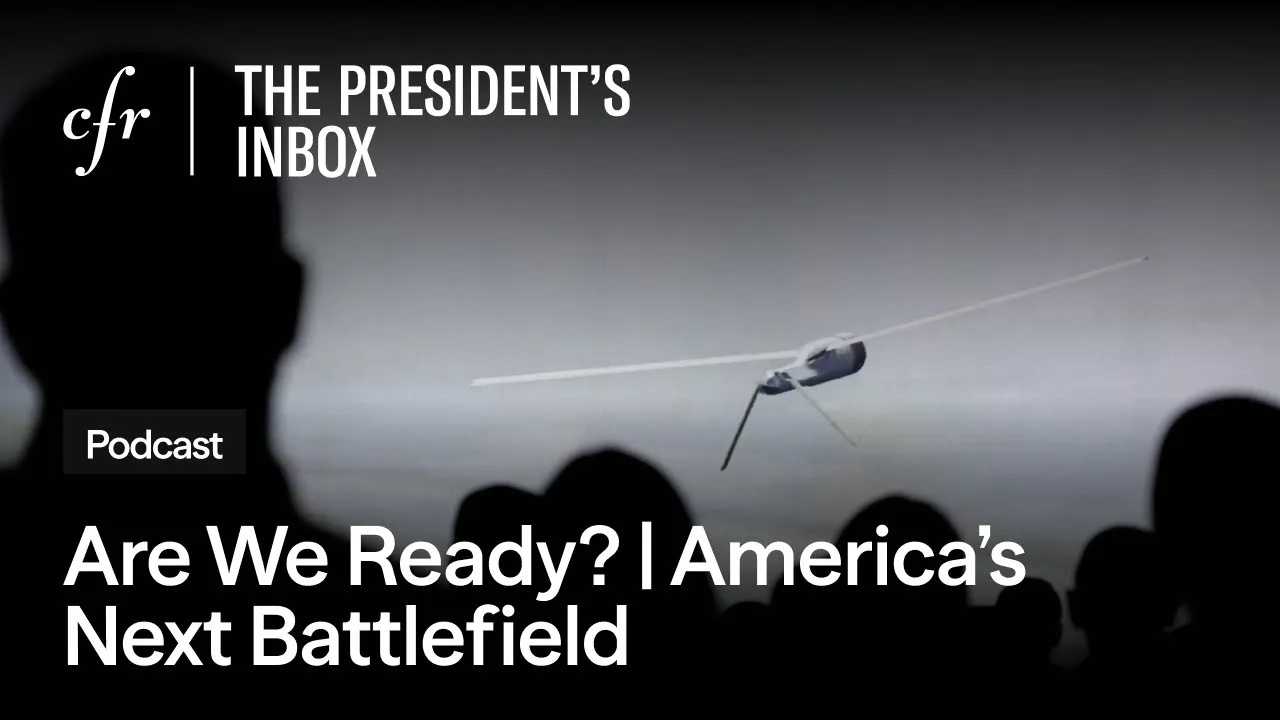
Thomas Shugart, founder of Archer Strategic Consulting and adjunct senior fellow at the Center for a New American Security, sits down with James M. Lindsay to discuss how the tools and tactics of warfare have changed in the past decade and whether the U.S. military is adapting fast enough to deter a great power war.
This is the second episode in a special series from The President’s Inbox, bringing you conversations with Washington insiders to assess whether the United States is ready for a new, more dangerous world.
TRANSCRIPT
LINDSAY:
The world has turned dangerous. Is the United States prepared to meet the new challenges it might face? In this special series from The President’s Inbox, we’re bringing you conversations with Washington insiders to assess whether the United States is ready for a new, more dangerous world.
In the three decades after the collapse of the Soviet Union, the United States focused on deterring rogue states and defeating terrorist groups. The U.S. military used its vast technological superiority to oust first the Taliban, and then Saddam Hussein from power and to hunt down al-Qaeda and ISIS.
Todd YOUNG:
We’re in the middle of a great power competition with an authoritarian regime in Beijing that seeks global primacy. And the truth is Beijing’s well on its way to accomplishing these goals.
LINDSAY:
Today, however, the United States faces the renewed prospect of major power war. America’s once daunting technological edge will be far smaller, if it exists at all, against pure competitors, and the scale and intensity of operations possibly far greater. Meanwhile, artificial intelligence, along with advances in drone, sensor, and missile technology are remaking the face of warfare.
PBS News Weekend:
And does that mean that the United States is really in catch-up mode?
I think the United States is in catch-up mode, certainly depending on who you’re comparing the United States to.
LINDSAY:
The U.S. military is now rethinking its force structure, its doctrines, and its deployments. Is it moving fast enough and making the right decisions? The answers to these questions will determine whether the United States will be able to deter, or if necessary, win, a great power struggle that may span the globe.
From the Council on Foreign relations, welcome to The President’s Inbox. I’m Jim Lindsay. Today I’m joined by Thomas Shugart, Founder of Archer Strategic Consulting, and Adjunct Senior Fellow at the Center for New American Security. Thank you very much for joining me, Tom.
SHUGART:
Thank you, Jim. Great to be here. Thanks.
LINDSAY:
Okay, I want to start with a bit of your bio. And you served for 25 years in the United States Navy.
SHUGART:
That’s right.
LINDSAY:
You were a submarine warfare officer. From 2013 to 2016, you were the commanding officer of the USS Olympia, which I believe was a fast attack submarine.
SHUGART:
It was, yeah.
LINDSAY:
And then you did a stint on the staff of the Joint Staff, where you were a principal advisor on nuclear planning, and you also did a stint in the Office of Net Assessment, which until recently was the Pentagon’s think tank, charged with looking down the road, peering into the future to figure out how the U.S. military should adapt. And that’s where I’d like to begin our conversation. If you were to do a net assessment right now, of the U.S. military facing the current and future likely battlefield, what would it be?
SHUGART:
I think what I’d have to emphasize at this point, in terms of our pacing threat from China and in terms of the most crucial, most stressing, most dangerous scenario, which is probably a war over Taiwan, I think the overall sense that I have now is really just a sense of uncertainty. And this is something I’ve talked about in testimony and whatnot, that if you asked me 10 or 15 years ago, “How would a conflict like that go?” the answer would’ve been pretty straightforward that China would not succeed. They wouldn’t bother trying, that clearly it was something they could not achieve. They didn’t have the sealift, they didn’t have the precision strike. We had overwhelming advantages. I think at that point I’d no longer had that certainty. I wouldn’t say that I’m certain that China would succeed today or, say in 2027, but I think there’s a good chance they could. And a lot of that, of course depends on how does the war unfold? Does the United States intervene or not? When does it intervene? Does China strike by surprise? Is that successful? So at this point, I think there’s just a lot of uncertainty.
Now, uncertainty at this point is probably good enough for the moment, because I think that as long as China President Xi Jinping is thinking of making a choice of waging an optional war, as long as they’re uncertain as the outcome, I think they’ll probably keep kicking that can down the road. The thing I worry about is that if someday the Chinese Communist Party (CCP) and the People’s Liberation Army (PLA) does the math and figures out that, “Yeah, this’ll work,” that could be the day they go for it. And I think on our current trend lines, for now, the way things have been going in terms of the relative change in military capabilities, that net assessment you talked about, if things keep going the way they are, there may come a day where in the future, 10, 15 years from now, by that key 2049 goal that Xi Jinping has declared of national reunification… Well, national rejuvenation, part of which is reunification with Taiwan-
LINDSAY:
So Taiwan would say they’re talking about unification, not reunification.
SHUGART:
Right, since Taiwan has never been part of the People’s Republic of China. Let’s not forget that.
LINDSAY:
Right.
SHUGART:
I think that by that timeframe, barring some changes in the trajectory, they could decide that the day has come that they’re confident that it’ll succeed.
LINDSAY:
I want to drill down on one particular aspect there, which is, from the vantage point of the United States, the idea is that you want to structure your forces such that the Chinese decide it would be futile to launch an invasion. You’re not looking forward to having a war. Correct? This is about trying to maintain deterrence.
SHUGART:
Right. This is having them continue to decide that it’s not going to succeed. Now, one thing I think it’s worth folks understanding on the Taiwan issue, is that people will sometimes talk about deterring China by threatening cost and position on the Taiwan issue, that we’ll blockade them, they’ll lose too many soldiers, whatever. It’ll be too costly of an invasion. I think it’s a very risky way to try to deter China through the idea of punishment and cost and position, because Taiwan is a core issue to the CCP. They, on their own have made it very much, and by choice, a part of the whole national rejuvenation thing. And so they have to make it happen one way or another.
If you hang a price tag on Taiwan… If they’re confident that the invasion will work, that the troops will get ashore, that they’ll do what they need to do, that they will subjugate the government, I think if they know there’s a price tag, but it will succeed, they may decide to pull the trigger on it. This is why it’s key to deter them. This is this deterrence by denial. They have to be uncertain that it’s going to succeed. You can’t rely on, “Oh, we’re just going to make it costly for them. We’ll put huge tariffs up,” for example, or “We’ll sanction them,” if you hang that price tag, Xi Jinping may decide to pay it.
LINDSAY:
Okay. And again, that’s an important point, that the fact that we may not be willing to pay that price, doesn’t mean that the Chinese government may not be willing to pay a very high price. As you think about Taiwan, and the challenge of maintaining robust deterrence would be for the United States, does the nature of the scenario matter? Does it matter whether it is an outright invasion? And I’m not sure how likely the Chinese could have a surprise invasion of Taiwan. I would assume they would have to do so many things that a lot of alarm bells would be going off, not just in the Pentagon, but all around the world. But they also have the option of, in essence, taking a boa constrictor strategy of slowly squeezing Taiwan and basically putting the onus on the United States to move to kinetic action. How does the nature of the scenario play into your thinking?
SHUGART:
I do agree that if Xi Jinping thinks, or the CCP thinks that they can take Taiwan without an invasion, I think they would take that option for sure. But what I think is worth considering is that any lesser strategy where, “We’re just going to blockade them or we’re going to just launch a missile bombardment campaign…” This was proposed in a recent article on Wargame on this question, that maybe their best strategy is to bombard and then offer surrender terms. The problem with those as final options for China, is that that relies on Taiwan surrendering without being forced to surrender. All they have to do is not give up in any of those scenarios. And if you look at the history books, there’s a long history of countries that get bombed pretty heavily and don’t surrender. London during The Blitz-
LINDSAY:
Ukraine today.
SHUGART:
Ukraine today. There’s plenty of options where bombardment doesn’t work. Japan, cities had been firebombed and it was subjected to a submarine blockade and mine blockade, near starvation levels, and it took two atomic bombs to force them to surrender ultimately in the invasion of Manchuria. I think, again, if Xi Jinping wants certainty, that’s not a certain strategy that is guaranteed to result in success. Now, that being said, they might try that first. And certainly, if you look at the China’s doctrine and how they would do a landing campaign, step one of a landing campaign is going to be isolating the island via something that looks like a blockade. So you’re likely to see a quarantine or blockade either way.
I also think that any lesser option like a blockade or bombardment, is far more likely to succeed if it is backed up by the credible threat of invasion. That it’s a very different thing for Taiwan’s leaders to face if they realize that if they don’t surrender now, the Army’s going to come anyways and they’re going to wind up against the wall. So I think that’s worth considering. On the surprise angle, I agree that it’s likely that it’s unlikely that China could actually launch the invasion itself by surprise. But this is, again, where if you turn to Chinese doctrine and see how they would plan to do a landing campaign, there’s a lot of preparatory stuff that happens first. Seizing air and naval superiority, seizing information superiority, firepower strikes, those are things that can be conducted potentially with a significant element of surprise.
And the thing we have to think about that is that, this is not just me making this up, they talk about it in their doctrine all the time. In particular, when they reference fighting the powerful enemy, which we all know who they’re talking about there, they emphasize in particular in that case, striking by surprise. They practice preemptive strikes against fake targets in the desert. I found them years ago. They’re building a force with a number of missiles that’s appropriate to do something like that. There are enormous first-mover advantages when you have a force like China’s that is focused on the use of long range missiles, where striking by surprise is very much your favor.
So, I agree that it’s something that we have a hard time imagining happening, but I think we have to remember that they talk about it, they practice doing it, and if you ask me what kind of force would I build to do something like that, it’s what they built, basically, at this point.
LINDSAY:
Okay. So if I understand you correctly, you’re skeptical of what I might call the Malacca option, the notion that what you would do to deter the Chinese is to focus on an ability to deny the Chinese to import goods, particularly oil. Malacca, referring to the Indonesia narrow strait there, where presumably it would be easier from a military point of view, naval point of view to disrupt supply. Correct? You don’t think that sort strategy is going to work in terms of deterring the Chinese?
SHUGART:
No, I don’t think it would work, period, and I certainly don’t think it’d be useful to deter them if they thought they were going to succeed in an invasion. And I say this because, first of all, they’re well aware of the Malacca dilemma. They’ve talked about it for more than 20 years now. They’re doing the kinds of things you would do to make that not an effective option to really strangle their economy. They’ve increased the amount of energy they can move over land. We have to remember now, and some people may not appreciate this, that China is now by every measure but one, the world’s premier maritime power. They are the world’s largest shipbuilders by far. They have the world’s largest merchant fleet, both by ownership and by flagging now. Maybe not by flagging, but certainly by ownership at this point. They have the world’s largest fishing fleets. They have the world’s largest coast guard in maritime law enforcement, and they have the world’s largest navy by hull count.
It is only in sheer naval tonnage that the United States is still in the first and China’s out-built us by 50% on a tonnage basis too over the last decade. So it’s a matter of time. Why do I say this? Why does this all matter? How does it relate to the Malacca dilemma? Well, if you’re a nation that is dependent upon sea lines of communication, which China is, it’s natural that you would take the action necessary to protect those sea lines of communication. Well, here they are building aircraft carriers now, building huge numbers of escort ships. I heard we’re about to cancel our frigate program. They have two types of frigates they’ve been building for years now. So those are the kinds of things you would do to prevent that.
Let’s remember too, that the Strait of Malacca is literally under the umbrella of the PLA rocket force. If you have destroyers that are trying to enforce a blockade, they will be within range of DF-26 and DF-27 missiles that we literally see practicing against destroyer-shaped targets in the desert. So this is not something we can just do and not expect them to do something about it to prevent that. Then there’s finally just the sheer number of ships. China has more than 6,000 merchant ships at this point. So the idea that we could strangle their economy by stopping all those ships… And of course, any attempt to do so would require complete cooperation by all of the neighbors in the area, like Singapore or like Indonesia, which have very powerful incentives not to help, potentially.
LINDSAY:
And it presumably would come after the fact. I mean, you wouldn’t start sinking Chinese merchant vessels or any ships bound for China until an invasion began. But at that point, the invasion could be over, which may lessen the desire or the political support for going after ships at sea.
SHUGART:
Exactly. And add to that, the internationalization of shipping. The example I like to give is the Ever Given, the ship that people may recall ran aground in the Suez Canal a few years ago. That ship was, see if I can remember, Japanese-built, Japanese-owned, chartered by a Taiwanese company with an Indian crew, carrying goods from China. Do you sink that ship? Are you going to sink that ship in the middle of the Indian Ocean?
LINDSAY:
That’s an opportunity to alienate a lot of other capitals.
SHUGART:
It’s a lot harder than it sounds. That is a ship engaged in trade with China, but are you going to sink that ship? Are you going to cause the environmental results that’s going to happen from that? I would let it stop me if World War III was on on the line. But I think the problem is much, much harder than many people appreciate. And I think there’s a lot of people out there that think, “Oh, we’ll just cut off their oil. We don’t have to worry about that.” That’s a very dangerous way to think that you’re going to stop China from launching a war like that.
LINDSAY:
What is required to actually maintain the kind of deterrence, to maintain that uncertainty for Chinese planners going forward? What kind of force structure changes would you have to make? What kind of changes would you have to make in weapons acquisition? And I note that been talk about something called the Hellscape Plan that Admiral Paparo of INDOPACOM has talked about. Help me understand those issues.
SHUGART:
I think the current efforts like Hellscape, like using a lot more drones, I think they’re the right idea. I’m concerned they’re not happening at the right scale.
LINDSAY:
What is Hellscape? Maybe I should ask you what that is.
SHUGART:
Yeah, so Hellscape is this idea that Admiral Paparo, I believe was the first one to talk about it, the idea that we will deter China by invading because we’ll turn the Taiwan Strait into a, quote, “Hellscape,” that they’ll be unable to operate effectively and drive across the Strait. And the means of achieving this will be, to a significant degree, very large numbers of relatively low-cost attribable unmanned systems. And then produced, in large part, through what’s known as the Replicator program, which is a program that started under the Biden administration, and as far as I know is still continuing, to push that way. To push acquisition towards quickly-acquired, relatively low-cost attribable systems that can be fielded in large numbers.
Great. I think that’s sounds like the right kind of thing we need to do. As I’ve said in testimony before, we have to be able to stop the enormous numbers of ships that would be involved in an invasion. Because we have to remember this is not going to be dozens of amphibious assault ships, it’s going to be hundreds, if not thousands, of ships. You’ll have a core of gray-painted PLA Navy amphibious assault ships. You’ll also have huge numbers of civilian vessels that are built to dual purpose civil military standards. The companies that own them, these ferry companies are organized auxiliaries of the Chinese maritime militia. They are part of the Chinese military part-time.
LINDSAY:
So these are dual use and have a clear military purpose.
SHUGART:
Absolutely. They’re regularly practiced in exercises. I just was looking at imagery this week of them sending assault vehicles straight to the beach from these ferries. So this is not something they just use to carry stuff.
LINDSAY:
But normally when you’re delivering your latest shipment of BYD electric vehicles, you’re not driving up to the beach and unloading them that way.
SHUGART:
No. These ships are specifically modified to be able to support those operations. China also in the last year, people may have seen, they developed this pretty incredible set of telescoping barges with pilings that basically set up a temporary pier. Although, unlike the Gaza Pier, which took weeks to build and fell apart basically in heavy weather, which may have been beyond its design characteristics, these things can be set up and taken apart in hours. I’ve seen them. I’ve seen an image where they’re set up, being used to unload stuff, and then four hours later in the next image, they’re gone. So, much more mobile, much more employable. This is the kind of tools that they’re using to leverage that enormous state-owned, party-controlled shipping industry to support it. And people have to remember, COSCO is not a normal company. They’re not like our shipping companies.
LINDSAY:
This is not Costco, the company where-
SHUGART:
Right, this is not Costco…
LINDSAY:
… you can get a hot dog for $1.50.
SHUGART:
This is COSCO, China Overseas Shipping Company. It’s a state-owned enterprise. If you go look at the organization chart on their website, they’re all dual-hatted as chairman and party secretary, vice chairman, deputy secretary. These are arms of the CCP, designated a PLA military company by the Department of Defense, etc. All of them will be in the fight. There will be fishing boats, probably thousands of them that’ll have radar reflectors on them to make them look like bigger targets than they are to be used as decoys. This will be a whole of society efforts.
So what do you need for that? Well, you need weapon systems that can pick out the important ships from the not important ships. You need mines that can distinguish the right kinds of ships to detonate, or maybe that allow several ships to go overhead before they detonate. These kinds of systems exist, but I don’t think they exist in the quantities they need to exist, and I don’t think they’re in place in the way they need to. Because we have to remember, if China strikes by surprise, any weapon system you have that’s in a known location or in a known warehouse, if it’s within range, they’re probably not going to survive day one if the PLA thinks they’re going to matter.
If you have mines that you plan to lay to stop a Chinese invasion, you better be laying them now. Because if there’s a crisis brewing and it looks like Xi has made the decision to invade, I’m pretty confident China’s not going to sit there and watch you lay a minefield that’s going to stop them. So if it’s not being put in place now either clandestinely or suddenly to put the PLA on the back foot, because I don’t think they’re very flexible as an organization, you’re not going to get a chance to put those in place.
Likewise, in terms of the island itself, again, it’s going to be isolated. So when people look at the Ukraine model, for example, and say, “Oh, well, look how the Ukrainians have held out. They’ve got all these drones they’re producing,” Taiwan’s going to be isolated. All that drone production that’s happening in Ukraine has to be done with raw materials and components that come across the land borders that Ukraine shares with NATO allies. This may not be the case for Taiwan. And we have to remember Ukraine consumes millions of drones a year, so when you’re talking 2 million drones a year in production and consumption… Taiwan recently bought 10,000 drones. I’ve heard the U.S. Army may buy 10,000 drones. Sounds like a big number. That’s about 11 hours of Ukrainian drone consumption.
LINDSAY:
How does cybersecurity figure into all of this? I mean, modern warfare is different, let’s say even from World War II, in the sense that we are so interconnected electronically and there’s the ability of countries to, in essence, step into an opposing country’s economy and infrastructure. A lot of concern about the Chinese having laid malware across the United States economy, perhaps even in the U.S. military. How do you factor that into doing your net assessments of your ability to deter other great powers?
SHUGART:
Net assessments of cyber capabilities, in particular, are devilishly hard to do.
LINDSAY:
Oh, I imagine they are.
SHUGART:
Much of it’s super classified. It’s hard to know in the open source world how good we are, how good they are. They seem do a fair bit of damage. I’m sure we’re very good at it too. I suspect there are, again, first-mover advantages for cyber and that you may put in place exploits that you’ve got all set up and it takes years to set up, and things that you’re ready to pull the trigger on. Now, that being said, I’m sure there are also counter exploits that somebody may keep in reserve. But I suspect that if you’re the one deciding on the timing of the war, you may have an advantage overall in terms of that kind of thing.
But again, I don’t claim to be a cyber expert. I know they’re working hard on it. I expect to see dramatic effects. I think that to some degree, that sort of thing may be one reason why they’re expanding their nuclear arsenal. In the absence of a robust ability to strike back, the United States made it pretty clear a few years ago that it would consider nuclear options for even non-nuclear strategic effects. And one of the examples people would give was, okay, if you’re a country and you execute some cyber attack that puts United States back into the Dark Ages, United States may reserve the option to respond in a nuclear manner. So you could use nuclear weapons to deter-
LINDSAY:
And you’re hoping that will deter them from doing it?
SHUGART:
Right. Having a nuclear option on the table as the United States may have been able to deter strategic cyber effects that can be really devastating. Well, if China has a robust, large, survivable nuclear option, now you don’t really have that anymore as a free option to exercise. So with that backing of a much more robust nuclear arsenal, they may feel more free to conduct more robust cyber operations against us that are more painful.
LINDSAY:
And I would imagine if China succeeds in its efforts to decouple itself from the U.S. technology sphere, that the Chinese may gain confidence that they’re less vulnerable to cybersecurity. Whether that’s true or not, it may govern how they think about the use of force, Taiwan or anywhere else.
SHUGART:
Sure. If they’re building their own ships, it’ll be harder for us, I would think, to be able to execute some of that sort of thing.
LINDSAY:
Yeah, and I guess that goes back to the fundamental issue of deterrence is what people believe, not what may actually be factually true. As you think about this challenge of meeting Chinese power, Tom, what do you think it means in terms of weapons acquisition? I keep hearing we’re going to buy more drones. Do we need more submarines? Do we need a smaller Army? Do we need a bigger Marine Corps? How does this shake out as you think about force structure?
SHUGART:
Well, I certainly think we need more submarines, and as a submariner, it’s easy to say that, but I lived in a time in the past where the submarine force was really searching for relevance in the early days of the global war on terror. And that’s clearly not the case anymore. I think that’ll continue to grow in importance as we see the intersection of three things, I would say. So, really widespread, persistent, hard to stop low Earth orbit satellites in huge numbers, combined with AIML-driven pattern recognition, combined with long range precision strike weapons like the Chinese are really good at building, apparently. Those things coming together can make it very difficult for anything that can’t hide, to survive on their side of the planet.
So, more of that. We are building them as fast as we can. There’s an adjunct capability there in unmanned systems, unmanned undersea systems, that also could hide underwater. Although, sometimes I think people get a little too excited about what those things could do. Like hunting submarines, for example, I think is really hard to do.
LINDSAY:
Just a question on that point, Tom.
SHUGART:
Sure.
LINDSAY:
How much do you worry about talk of the ability of the Chinese using AI and advances in sensor technology to turn the oceans transparent and take away the ability of submarines to hide?
SHUGART:
I think it will make some things more difficult, but it is not going to turn the oceans transparent. And people should understand, that’s been a term that’s been used since the 1970s. When the Trident missile system was first, and the Trident submarine classes were being budgeted for in the 1970s, opponents of them literally said, “Oh, there’s these new technologies coming. It’s going to turn the ocean transparent.” And here we are 50 years later and it hasn’t happened yet. But now, the thing that people see, new technologies like quantum magnetic detection, again, AIML, they may miss the fact that there’s a lot of other-
LINDSAY:
What’s AIML.
SHUGART:
AIML is artificial intelligence, machine learning pattern recognition. One of the things that artificial intelligence is really good at is recognizing patterns, like for example, looking for submarines or other things that look like this thing you want to find. The problem is there’s lots of other stuff in the ocean. Okay, let’s say you have a magnetic detector that’s quantum and it can detect metal objects at longer ranges than you previously could. Okay, great. Along with the submarine you’re looking for, there’s also going to be wrecks. You’re going to detect more things. So the question is not can you detect more metal things, but can you tell which ones are the submarine and which ones aren’t?
LINDSAY:
And the ocean’s a very big place.
SHUGART:
It’s a very big place. There’s lots of noise. There’s lots of ships driving around. There’s lots of natural environmental noise. There’s lots of metal out there, whether it’s wrecks or ore or whatever.
LINDSAY:
Well, I imagine you could also put more metal out there. You could have drones that are basically decoys to confuse any system.
SHUGART:
You can use decoys. In particular, acoustic decoys, lower cost drones that are designed to put out the kind of frequencies the other guy might expect to find. Then there’s also just being able to find what the other side looks like. It’s one thing to go look for a needle in the haystack. If you don’t know what the needle looks like because you haven’t recorded it or whatever, that can make it a lot harder. There’s a lot of things that still make that a challenging problem.
Now, to be sure, it will be harder. And so the kind of thing that will cause for submariners, it’ll make it harder to do your job. Maybe you can’t come to the surface as often as you could, or you can’t stay there as long. Maybe you have to operate deeper to stay away from some of these sensors and the signatures that you might give off. But it doesn’t mean you’re not going to be able to operate. As opposed to a surface ship that may not be able to come within thousands of miles because it’s very easy to find. Relatively very easy to find. Now, could this change if you’re in a long protracted conflict and satellite constellations are taken down? Sure. Then maybe things could be more permissive. This is to say nothing of air bases that are fixed that has Admiral-
LINDSAY:
Well, let me ask you about that because you wrote an interesting piece for War on the Rocks, talking about the fact that the United States has air bases. We know where they are, the Chinese know where they are. So in the earliest stages of the war, China could choose to take them out and that we haven’t really done anything to harden those bases to build shelters for aircraft. We saw the vulnerability of the Russians against a surprise Ukrainian strike suggesting that it’s at least occurred to other capitals or other militaries, that you may want to take out somebody’s air power if you can.
SHUGART:
Yes, that War on the Rocks article was based on a report that I wrote with Tim Walton for the Hudson Institute. It’s called Concrete Sky. You can go read it. Anyone can go read it.
LINDSAY:
We’ll put it in the show notes for people so they can find it.
SHUGART:
I mean, I’m a simple man. Those islands are big. Wow, they have lots of missiles. So I counted hardened aircraft shelters, and literally didn’t know what we were going to find. What we found was that while United States has done almost no hardening in terms of building hardened shelters in the Western Pacific, China has built hundreds and hundreds, basically double the number of hardened aircraft shelters. They now have more shelters than they have combat aircraft. Not all hardened, but they have more shelters, which now you can’t see the airplanes.
LINDSAY:
You may be hitting an empty target.
SHUGART:
Hitting an empty target, whatever. So it’s just much harder. We built two in Japan in the last decade, while they built hundreds within 1,000 miles of the Taiwan Strait, hardened shelters. There’s a huge asymmetry there. Now, it doesn’t mean that hardened shelters are the end-all, be-all, and there could be other ways you can increase air base resilience, but I think it certainly matter that the Russians are building them, the Israelis have built them. That’s part of why Iran strikes against Israel were so ineffective is their air bases are hardened, is one reason. So everybody else seems to get this but us. I don’t really understand it. The Air Force has people they pay to do studies for them, say things like passive defenses are the most cost-effective. The Air Force has chosen to go the route of dispersal instead. I worry that that will be ineffective, because if the Chinese have enough sensors and enough missiles, those bases you disperse to, they’re even smaller and even less hardened than our main operating bases.
I worry about that being effective. The Air Force doesn’t appear to be making any effort that I can tell. I’ve asked this question before and sometimes Air Force leadership says things like, “We want to do hardening, but there’s not enough money.” Well, if you look at the ‘26 budget, as far as I can tell there’s nothing in the budget. And also, on the unfunded priority list, which is a list the service gets to create without bypassing the Office of Secretary of Defense, the service itself for the Air Force did not put it on the unfunded priority list. This is a list of things we could get if we had more money. So it just doesn’t appear to be a emphasis.
The part about the bombers and the Ukraine strike, that’s one that I have really been beating the drum on recently. I think what’s interesting, because it’s not just the Ukraine Operation Spiderweb, it’s also what Israel did to the Iranians, and that they also launched drones from inside Iran that were pre-positioned. And the interesting part about both of these raids was that the drone wasn’t really the warhead. The drone was a detonator, in both cases that set off larger quantities of explosives, so fuel tanks on the Russian bombers, solid rocket motors on Iranian missile launchers. It was essentially the precision detonator that detonated larger-
LINDSAY:
It’s almost like a judo move.
SHUGART:
Kind of, yeah.
LINDSAY:
You’re taking advantage of the adversary’s energy to create destruction.
SHUGART:
I think anybody that was really paying attention to that, that knows the defense realm very well, there shouldn’t have been much gloating over that Ukrainian attack because we are deeply vulnerable to exactly the same kind of thing.
LINDSAY:
Well, the reason I was struck by that report is, I think when we talk about military readiness going forward, we tend to focus on the latest technologies and new weapons systems. But that success in warfare often depends upon doing a lot of old things, small things, doing them right, and doing them well, whether we’re talking about protecting logistics, supply lines, or making sure that we don’t lose big chunks of our very expensive military apparatus in the early hours of a war.
SHUGART:
Exactly. I tried to put it pretty simply in some articles I’ve written about this on my Substack and on Twitter that-
LINDSAY:
We should do a plug for your Substack.
SHUGART:
There it is. There it was. I have a Substack. It’s free. Anybody can subscribe to it.
LINDSAY:
Title is?
SHUGART:
Well, it’s just The Shugart Update.
LINDSAY:
Okay.
SHUGART:
That article I called Concrete Dome, that I think we need to start an emergency hardening program. When I look at 2027 coming down the road and Xi Jinping telling the military to be ready, if they are successful in striking our bases in Asia and the surface ships can’t really get close and the carriers can’t really get close, well, what’s left? Bombers, right? We just saw somebody execute a strike against bombers deep inside a country using drones from short range, using something that looked kind of like a container. China has thousands of containers coming into our ports every day. Our society is very open. Our bomber bases are essentially completely unhardened on a day-to-day basis.
There was a military construction hearing a few months ago, and the Air Force three-star general who’s in charge of military construction was asked directly, this is weeks after Operation Spiderweb, “General, we could be vulnerable to the same kind of thing. What are you doing about it?” And what I saw was a lot of, it looked like hand waving to me, like, “Oh, it’s a multifaceted problem, multifaceted approach. The FBI. Working with the FBI, the FAA, electromagnetic this or that.” Great. Those are all things that are worth doing, but I worry that with enough drones, maybe they’re fiber optic that you can’t jam them, like the Russians have been using. And oh, by the way, you can see on my Substack, the Chinese are using them now too, in their video that they put out a few weeks ago. I worry that we could be overwhelmed and the same thing could happen to us, particularly when, again, China is obsessed with striking by surprise, especially against the powerful enemy.
They’re the world’s largest drone producer. Their doctrine talks about striking the enemy deep in home areas. It talks about destroying the enemy on the ground so you don’t have to fight them in the air. It’s just everything that would align to encourage them to do something just like that. And for us to rely on not half measures, but just a smorgasbord of, “Maybe this’ll work or maybe that’ll work,” I really worry about that. I think we should start an emergency hardening program to start pouring concrete. I don’t care if we have to use Chinese steel to do it. We need to start hardening our infrastructure. And it’s not just bombers. I think we need to worry about our ships in port. Because again, I worry about in particular, as I said in the article, assets that have three characteristics. And usually when I make a list, I forget one. But things that are few in number-
LINDSAY:
You’re not alone.
SHUGART:
Things that are few in number, bombers, submarines, surface ships. Things that matter for the China fight, submarines, bombers. And things that if you strike certain parts of them, you can have a catastrophic detonation, if you strike the fuel tanks, if you strike a missile magazine. So I’m not talking about everything. I’m not talking about hardening the entire U.S. military. Tanks, no. There would be thousands of them. They probably won’t matter for a China fight. They’re hard to kill anyways. So not everything, but certain key facilities. And I think we need to turn that on. What are we going to do the day after the next Pearl Harbor and we look around at each other and go, “Well, we could have seen this coming”?
LINDSAY:
Well, I think in many respects we’ve seen a lot of the vulnerabilities discussed, which takes me to, I guess my closing question, Tom. Which is, is the United States capable of reconfiguring its military forces given the weaknesses of the defense industrial base? And since you’re a submariner, I will point you the example of electric boat, which builds by all accounts the world’s premier submarines, but it can’t build them fast enough, partly because of supply chain problems, partly because they can’t find the skilled workers they need to be able to produce the new Columbia-Class, the new Virginia-Class submarines.
SHUGART:
If we’re talking about 2027, for example, I think it’s probably too late to make changes to the defense industrial base that will significantly change the amount of material and munitions that are on hand in two years. I don’t think we can change that. But what we could do is change our productive capacity enough that in two years, that may change the calculus of China’s leaders and whether they decide to embark on a war. The reason why I say this is because, again, if you look at Chinese doctrine, one of the things they talk about for planning a landing campaign, for example, is that if you are fighting a war against the powerful enemy, your planners need to plan for a protracted campaign.
So there’s a very specific consideration in Chinese doctrine for fighting the United States, that you have to look at the adversary’s ability to wage a protracted campaign. So even if you don’t have a lot more material in hand in two years, if your industrial base is in better shape in two years, that may change their calculus in terms of whether to start a fight against us because our industrial base may be in better shape. That is something that might be doable that could change your calculus.
LINDSAY:
On that note, I’ll close up this episode of The President’s Inbox. My guest has been Tom Shugart, Founder of Archer Strategic Consulting and an adjunct senior fellow at the Center for a New American Security. Tom, thank you very much for joining me.
SHUGART:
Thank you, Jim. It’s great to be here.
LINDSAY:
Today’s episode was produced by Justin Schuster, Molly McAnany, Markus Zakaria, and Director of Video, Jeremy Sherlick. Production assistance was provided by Oscar Berry, Jorge Flores, and Kaleah Haddock.
Mentioned on the Episode:
Thomas Shugart, “Blue Planet, Red Planet: A New World of Contested Maritime Power,” The Shugart Update
Thomas Shugart, “Concrete Dome: It’s Past Time for an Emergency Anti-Drone Hardening Program,” The Shugart Update
Thomas Shugart, “Forging Ahead: The PLA Shows Us What It Wants Us to See,” The Shugart Update
Thomas Shugart, “Has China Been Practicing Preemptive Missile Strikes Against U.S. Bases?” War on the Rocks
Thomas Shugart, “Mind the Gap, Part 2: The Cross-Strait Potential of China’s Civilian Shipping Has Grown,” War on the Rocks
Thomas Shugart, “There Are No Magic Beans: Easy Options to Deter China Militarily Do Not Exist,” War on the Rocks
Thomas Shugart, “The United States Can’t Afford to Not Harden Its Air Bases,” War on the Rocks
Thomas Shugart, “Trends, Timelines, and Uncertainty: An Assessment of the Military Balance in the Indo-Pacific,” Center for a New American Security
Timothy A. Walton and Thomas Shugart, “Concrete Sky: Air Base Hardening in the Western Pacific,” Hudson Institute
We Are China, “Forging Ahead - Episode 1: Orders Are Sacred 第一集《军令如山》,” Youtube.com
Opinions expressed on The President’s Inbox are solely those of the host or our guests, not of CFR, which takes no institutional positions on matters of policy.
Associate Podcast Producer
- Associate Producer, Video and Audio
Editorial Director and Producer
- Director, Podcasting
Director of Video
- Director of Video
More Episodes
 33:42Podcast
 36:05Podcast
 41:07Podcast
 39:26Podcast
 35:04Podcast
 31:46Podcast