Are We Ready? | China’s Campaign to Reshape the Global Order, With Hal Brands and Michael Kuiken
This episode unpacks how China is working to reshape the global balance of power.
Published
Host
 James M. LindsayCFR ExpertMary and David Boies Distinguished Senior Fellow in U.S. Foreign Policy
Guests
- Hal BrandsHenry A. Kissinger Distinguished Professor of Global Affairs at the Johns Hopkins University School of Advanced International Studies (SAIS)
- Michael KuikenDistinguished Visiting Fellow at Stanford University's Hoover Institution
[Video: https://youtu.be/mp0ig0AZ3e8?si=fuXGyLZPs66oefdn]
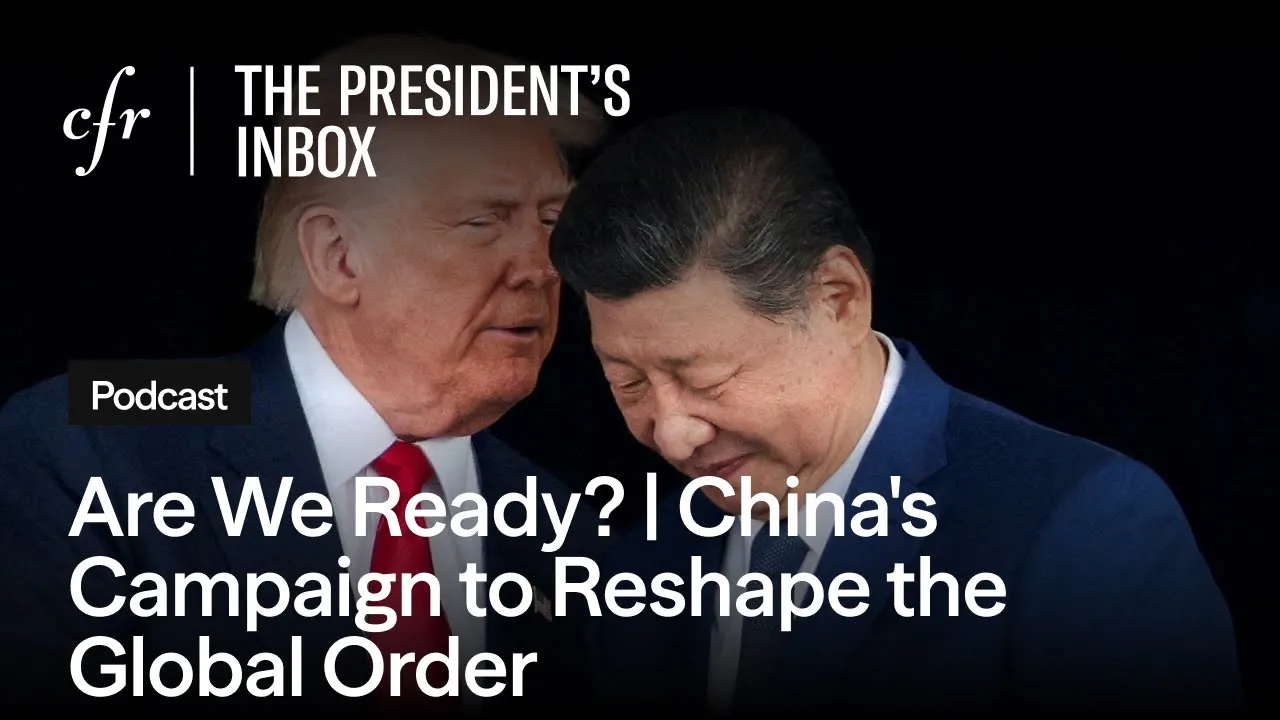
Hal Brands, Henry A. Kissinger Distinguished Professor of Global Affairs at the School of Advanced International Studies at Johns Hopkins University, and Mike Kuiken, Distinguished Visiting Fellow at Stanford University’s Hoover Institution, sit down with James M. Lindsay to discuss the U.S.-China Economic and Security Review Commission’s latest annual report to Congress and how China is working to reshape the global balance of power.
This is the sixth episode in a special series from The President’s Inbox, bringing you conversations with Washington insiders to assess whether the United States is ready for a new, more dangerous world.
TRANSCRIPT
LINDSAY:
The world has turned dangerous. Is the United States prepared to meet the new challenges it might face? In this special series from The President’s Inbox, we’re bringing you conversations with Washington insiders to assess whether the United States is ready for a new, more dangerous world.
Is America’s time as the world’s leading power coming to an end? The past three decades have seen China’s remarkable rise. Beijing is not just challenging the United States economically. It is rapidly building up its military and flexing its diplomatic muscles around the world. China’s goal looks to be remaking the international system so that it’s friendly to Chinese interests and the needs of the Chinese Communist Party. That means surpassing the United States as an economic and technological power, undercutting U.S. global leadership and values, and separating the United States from its friends, partners, and allies. In doing so, China is assembling its own coalition of countries eager to end U.S. primacy. How should the United States adapt to the emergence of its first true peer competitor since it emerged from World War II as the world’s leading power? What would ceding global leadership to China mean for American prosperity in values? Can Washington craft a long-term strategy capable of blunting the challenge that China presents and do so while avoiding great power war?
From the Council on Foreign Relations, welcome to The President’s Inbox. I’m Jim Lindsay. Today I’m joined by Hal Brands and Michael Kuiken, two members of the U.S.-China Economic and Security Review Commission. Hal is the Henry A. Kissinger Distinguished Professor of Global Affairs at the School of Advanced International Studies at Johns Hopkins University. Mike is a Distinguished visiting fellow at Stanford University’s Hoover Institution and a longtime national security advisor to Senator Chuck Schumer. Hal and Mike, thank you for joining me.
KUIKEN:
Thanks for having us.
BRANDS:
Thanks for having us.
LINDSAY:
Mike, I want to begin with you, and I’d like to do a little bit of housekeeping. As I mentioned, you and Hal are both members of the United States-China Economic and Security Review Commission. The commission released a major report last week, but I suspect that most people listening to our conversation don’t know anything about the commission. So maybe you give us a bit of history and background.
KUIKEN:
I mean, you hurt my feelings here, Jim, but I’ll definitely give you some background. The commission was created twenty-five years ago. We’re actually celebrating our twenty fifth year next year, I should say, and the commission was created by Congress. It’s a legislative branch commission, and the origin story is a fun one. It’s right around the time that Congress and the President are working on PNTR and WTO accession. And if you-
LINDSAY:
PNTR being permanent normal trading relations for China.
KUIKEN:
You nailed it. Sorry. Acronym soup. Bad way to start. And Congress basically came to the conclusion that there were two entities it did not trust. One, the Chinese Communist Party, and two, the executive branch, which is a common story on both nowadays, but that’s the origin story of it. Every year, we do a series of hearings, release an annual report, companies with recommendations. We usually do a series of meetings with folks on the hill throughout the year as well as folks in the executive branch and that’s sort of how we conduct our business and our origin story.
LINDSAY:
So, how many commissioners are there, and who picks them?
KUIKEN:
There are twelve commissioners. It is bipartisan, I don’t think I said that word yet, but it is six and six, and each of the four leaders get three appointees.
LINDSAY:
So by leaders, you mean House and Senate majority-
KUIKEN:
Congressional leaders, speaker, minority leader, majority leader, minority leader in the Senate.
LINDSAY:
Okay. So you have a new report that came out, Hal, it’s a quite comprehensive report. I think it runs 733 pages. We’re not going to get to talk about everything that’s in the report, but maybe you can sort of walk us through some of the top-line findings from the report, particularly with respect to national security and global affairs.
BRANDS:
I think there are a handful of things that are worth mentioning in this regard. And Jim, to my mind, you alluded to one of the most important of them in your opening spiel, which is the fact that while the United States confronts a serious generational challenge from China itself, China is increasingly at the heart of this larger network of autocratic powers that are each trying in their own way to rewire the world. And China has emerged as what we call the decisive enabler of this coalition because it provides forms of support that allow Russia, North Korea, Iran, to do things that they wouldn’t otherwise be able to do. And Russia is the best example of this. Russia would have lost the Ukraine War, wouldn’t have been able to sustain it for quite a long time, had China not provided crucial economic support in the form of strategic trade and dual-use components that have really helped rebuild and sustain the Russian defense industrial base.
And that’s just one example of an area in which this coalition is working together in ways that make individual challenges worse, but then they come together in ways that make the global situation worse for the United States and its allies. Another key area of focus that I’ll mention here has to do with Taiwan. And all of us have been watching with concern in recent years as to tarize the military balance around Taiwan becomes more concerning and China increases its pressure on Taiwan through military exercises and other gray zone activities.
And so one of the areas of emphasis for the commission is pointing out that A, we are reaching a point where we can no longer treat a potential Taiwan crisis or conflict as some distant eventuality that we’ll sort of get to once we’re done dealing with more pressing challenges. This is something that could be upon us in a handful of years, if not considerably less than that. And B, we need to be very careful that we are supporting Taiwan in the ways that it needs to defend itself while also being brutally realistic in our own assessments of precisely what the military balance in or around the strait is and what would be required to prevail if a crisis or a conflict did erupt.
LINDSAY:
Mike, I want to pick up where Hal just left off and ask you to tell me where the commission came down on the issue of China’s military modernization.
KUIKEN:
I mean, the story of the last few years with the China Commission report is China’s military is on the march. On the march in terms of growing capacity and growing capability. And we told that story in the, I think it was the second chapter, Security and Review. And so that story is getting worse, it’s getting more urgent. And I think we all know the reason, according to public reports, President Xi has said that the Chinese military should be ready to invade Taiwan by 2027. And my sense is, and I think Hal would probably agree, is they’re on course.
LINDSAY:
So let me ask you a question that has come up recently a lot, and it has been occasioned by the fact that Xi Jinping has cashiered a number of senior military officials. I was recently at a conference in which this was a major topic of conversation, and the conclusion that the panelists drew from it, Mike, was this meant that China was less likely to invade Taiwan or to exert substantial military pressure on that island because Xi Jinping obviously didn’t have or doesn’t have confidence in his military leadership. Would you read things the same way?
KUIKEN:
I mean, the simple answer, anytime we’re doing criminology type stuff, the answer is we have no idea. And so people are making their best guesses. I think that it probably means that there might be some slowing down, but I think one of the reasons he’s firing folks is to make sure that the march continues, and that’s how I sort of evaluate it. I think people are important, but you can replace people in the Chinese military, and that’s obviously what he’s doing.
BRANDS:
Can I add something on this? Because if you look at Chinese history, there’s actually a pretty good track record of the PLA using force in a massive way relatively shortly after major military purges. The intervention, the Korean War comes about a year after you get the end of the Chinese Civil War, which leads to a huge purge of what had been the nationalist military. Of course, you get the Sino-Soviet border war in 1969, which comes amid the Cultural Revolution, which brought its own series of purges and so on and so forth. And so it may be true that you wouldn’t fire a bunch of your top generals if you were thinking about using force tomorrow, but Chinese history and the history of the PRC in particular would suggest we shouldn’t draw too much comfort from that.
LINDSAY:
Yeah, I suppose another inference you could draw, since we’re really in the realm of speculating about what’s in Chinese leader Xi’s mind, is that by swapping out all generals and putting in his people, he may actually have more confidence in what the PLA can do.
BRANDS:
I think that’s exactly right. I think that he wants a PLA that is fit for purpose, and part of that is having a high command that will be absolutely responsive to his orders.
LINDSAY:
Yeah. And I think on that score, it’s always important to keep in mind it isn’t really relevant whether the new generals are better or worse than the old generals. It’s what the leader of the Chinese Communist Party thinks his generals can do. Mike, can I ask you to talk a little bit about what the commission found in terms of China’s nuclear modernization? Because again, one of the remarkable changes in China over the last decade has been this buildup of nuclear forces. For essentially half a century, China was different than the United States, different than the Soviet Union and then Russia in not seeking to build a very large nuclear force. It only had about maybe two dozen liquid-fueled missiles that seem to be more symbolic than anything else.
KUIKEN:
We did not spend a lot of time this year talking about nuclear modernization, but it’s something the commission has looked at historically. And I actually think the way you sort of talked about it is right on point, which is we are seeing China do everything it can to build its deterrent capability with respect to Taiwan, whether that’s parking on American electronic or electric infrastructure, or water infrastructure, or telecommunications infrastructure, or building out its nuclear modernization capabilities. So I don’t want to repeat myself, Jim, but going back to my opening comments, China is on the march, whether it’s in terms of military capabilities and military capacity, and also in the technology space.
LINDSAY:
Hal, let’s talk about one of the top lines that you referred to this development in which China is working closely, particularly with Russia, with North Korea, with Iran, I’ll call it the axis of autocracies. And sometimes we had a visual of this back in, I think it was in September, when the Chinese are celebrating the end of World War II, and we see Xi Jinping come on a red carpet. He’s flanked by the leader of North Korea, he’s flanked by the leader of Russia, the president of Iran is just behind him. And I guess there was this symbolism of trying to say, “Hey, we have friends too.” Sort of walk me through how you and the commission thinks about this so-called Axis, if that’s even the right term to use for this alignment.
BRANDS:
I think Americans have a hard time making sense of this set of relationships because they don’t look like the alliance relationships that the United States has for the most part. And so when Americans think about alliances, they think about NATO, they think about these deeply institutionalized arrangements that have been around for decades, and they come with firm mutual defense commitments, and the president makes a ritual of going to Brussels or wherever the first leader-level meeting is and affirming America’s Article Five commitments. And that’s what an alliance feels like to Americans. Historically, that is not the model that most alliances take. Most alliances are looser, they are less institutionalized, they’re more transactional. And by historical standards, the set of relationships that have developed between China, Russia, Iran, and North Korea would qualify as alliances in the eyes of most historical figures. Some of them do have mutual defense commitments.
And the big new development here has been the Russia and North Korea alliance that saw North Korea deploy troops in support of Putin’s war in Ukraine. There’s also a China-North Korea alliance that has waxed and waned over time. But if you just look at the areas where they are cooperating most closely, they’re having a major impact on the strategic equilibrium. They’re making it easier for rogue regimes to flout international sanctions regimes. Just look at the way that Russia has reoriented its oil shipments primarily to China as a result of the Ukraine war. It is resulting in the construction of new trade routes and infrastructure corridors.
If you look at what Russia and China are doing together in the Arctic, for instance, that’s a good example of that, and it is intensifying the military modernization programs that each of these powers has underway. For a long time, China benefited significantly from buying finished Russian military kit. There’s less of that now because the Russians and the Chinese are producing things together, and Russia is increasingly willing to sell off some of the crown jewels of its military technology in exchange for the support that it has gotten in Ukraine. And so what’s happening is as this goes on, the Russia-China relationship is hastening China’s military modernization, and it’s worsening the military challenge that the United States and its friends face in the Western Pacific.
KUIKEN:
Jim if you-
LINDSAY:
Mike, I just want to pick up on that theme, if I may with you, Mike, which is one of the counterarguments I hear a lot, is essentially people in the beltway in Washington, D.C., are exaggerating the extent of cooperation among these four countries. One point often is made is that most of it is just bilateral. It’s not really among, it’s between, I guess you’d put it that way, but also that when important events have come up, like the twelve-day war this summer between Israel and Iran, this axis or whatever you wish to call it, really didn’t come together. The Russians didn’t aid the Iranians; the Chinese didn’t aid the Iranians. How do you think the commission should respond to that kind of argument?
KUIKEN:
Sometimes aid is in the form of silence, and sometimes aid is in the form of something more robust, as we’re sort of looking at Iran and the silence of China and Russia there. What Hal said is I think really important, and let me put a little meat on the bones. Let’s just think about the drones that are being used on the Russian side of the conflict right now. There are basically four vital pieces of a drone. Okay? There’s a camera, there’s a bunch of chips, there’s a motor, and then there’s the software piece of it. The Chinese have basically provided all of those critical enablers to Russia, and that’s why we’re seeing all of these drones coming out of Russia. That is vital military assistance, and so that is one of the things we’re seeing. The other things that the Chinese are undoubtedly gaining from that is learning from the intelligence of the sort of tactics and techniques, and procedures that are being used by Ukraine.
So drones coming in, intelligence coming out, and as we look towards Taiwan, that’s going to be a very important part of the conversation. And then the other thing I would say, just to pile on a little bit more in terms of this access is the commission actually had a hearing Jim called the Axis of Autocracy. So we’ve endorsed your terminology. The second thing I would say is that we put out a paper on the sort of sanctions and export control evasion networks that have essentially been created as part of this conflict in Ukraine. And it goes from everything from dual-use parts that Hal already talked about to intermediary goods to energy. And so the energy purchases that are happening and flowing, whether they’re from Iran or from Russia into China, are extraordinary, and that is a key enabler as well. Money and energy are important lifebloods for any military.
LINDSAY:
Hal, I want to draw you out on another objection I hear to talk of an Axis, which is that this essentially is a momentary temporary alignment of convenience, and it’s going to fall down. These are odd bedfellows. The Chinese Communist Party is atheist. Vladimir Putin sees himself as the defender of Orthodox Christianity. Iran is an Islamic theocratic republic, and I’m not even sure how you would describe North Korea family dynasty. They have competing interests, particularly Iran, China, and Russia, in Central Asia. So why should we think that this is something that’s going to last beyond the next year or so?
BRANDS:
There’s definitely something to this critique, and I would add your point, Jim, by saying that it’s actually impossible for all of these regimes to achieve their aims simultaneously. And so a world in which China does manage to become the dominant superpower across a vast swath of Eurasia is a world in which it probably looks more menacing to Russia actually than it does to the United States. But I think there are two points that are worth keeping in mind. First, most alliances of revisionist powers, most alliances of countries that want to shake up the status quo, are inherently transactional because revisionist powers tend to pursue programs that are ultimately at odds with one another.
Just to give you one example, Nazi Germany and Imperial Japan never could have coexisted over the long term, but they worked together, and they did some real damage in terms of destabilizing Eurasia at both ends during the late 1930s and early 1940s. And that leads me to the second point, which is that even if these relationships can’t last forever, they can do a lot of damage between the here and now. And so imagine a world in which Russia and China eventually fall out after Putin and Xi pass from the scene because there does appear to be a degree to which they genuinely like each other, or that’s at least the impression that they try to give the world. We’re still talking about-
LINDSAY:
A friendship with no limits.
BRANDS:
That’s right. We’re still talking about five, ten, fifteen years from now, in which that happens. And you can do a lot of global destabilization between now and then. If you look at what these relationships have already achieved in Ukraine and in other areas, I think it cautions us against assuming that these are all going to come apart pretty soon, and we should just ignore the damage they do in the meantime. And then the last point I’ll make here is that yes, there are points of friction in these relationship, but the trend of the last three and a half years in particular has been toward tighter relationships, mainly as a result of the war in Ukraine.
LINDSAY:
I take your point, Hal, that this Axis may fall apart in the long run, but a lot can happen between now and then. I guess also the fact that these countries may not agree on what they are for doesn’t mean that they don’t agree on what they’re against, which in this case is U.S. primacy or U.S. dominance of the international system. Mike, I want to go to you and really ask a question about why Americans should be worried about the challenge that China is posing to the international order. I suspect for most Americans, the international order is something really abstract. They’re more worried about, I don’t know, the price of bacon or the price of gas, prospects for their kids going to school. The fact that China is not promoting democracy and maybe promoting autocracy somewhere far away doesn’t necessarily concern them. Why should the public be seized with this issue?
KUIKEN:
I mean, it’s sort of an eighty-year legacy that we’ve benefited from, essentially the rules of the road, the infrastructure that everything has been built on is American infrastructure, European infrastructure. And as you sort of look forward over the next eighty years, what do you want it to be built on? My preference is for it to be built on American infrastructure, European infrastructure, where we have shared values and shared interests. As we look at, let me just take one of the examples from the hearing we had a hearing on China Shock 2.0, which is this idea of industrial overcapacity, right? We already saw American factories get hollowed out sort of post-WTO accession and PNTR, which is obviously the origin story of the commission, and we’re seeing essentially that happen again. So why are these issues important? I mean, American jobs are important. American sort of innovation is important.
And listen, the innovation machine of america is part of the endless frontier that was built by Vannevar Bush eighty years ago. And keeping that going is important. Making sure the innovation machine keeps going and making sure that we continue to unlock various technologies as general purpose technologies has allowed us to work on the standards, the measurements, and all of the things that allow you to code in that sort of ecosystem and work with your partners and allies who have shared values to make sure that you’re allowing your people to benefit from that.
LINDSAY:
Hal, do you want to add anything to that question?
BRANDS:
Yeah, I like Mike’s answer. I’d add two points. So one is that if you just think about the situation in East Asia and the Western Pacific and United States, the national security community, the circles that Mike and I run in, we spend a lot of time worrying about Taiwan and the South China Sea and Japan and so on and so forth. And I take the point that that can seem relatively abstract from the viewpoint of an ordinary American, but remember, if China becomes the dominant power in the Western Pacific, that doesn’t just have strategic implications, it has economic implications as well, because you would expect that China would try to lock the United States out economically of a Chinese sphere of influence. China might exert greater control over waterways like the Taiwan Strait and the South China Sea, through which an enormous amount of global trade and container traffic in particular passes.
And that will ultimately have economic ramifications for the United States. That will affect the price of bacon, so to speak, in the United States. The second thing is that as China has grown more powerful, it has also grown less restrained and more inclined to try to reach into democratic societies and change the way that they do business domestically. And the point I would refer you to, if you go back about five years, when Australia suggested there should be an international inquiry over how COVID got started, China hit Australia with a bunch of sanctions and a bunch of demands. And among the demands were basically demands that anti-China newspapers and think tanks be stifled. This was essentially China trying to export its free speech restrictions into democratic societies. We are only going to see more of that as China grows more powerful, and so ultimately this is a competition. This is a contest that is about the sanctity and security of American democracy itself.
LINDSAY:
So Mike, we spent a lot of time so far talking about the nature of the challenge that China presents to the United States, and I realize the report goes into great depth on the economic aspect or economic side of the challenge, different regional challenges, and I confer people to the report itself, but I want to shift to talking about what the United States should do in response. To what extent does the commission have recommendations on how U.S. policy should be sustained or changed?
KUIKEN:
Thanks for the question, Jim. Hal and I actually worked on a bunch of recommendations together, so I’ll just mention a few, and I’m sure he wants to pile on with a few more. The number one recommendation this year, and it is touched on a little bit earlier in the conversation, is economic statecraft. We’re going to be in a different conflict than we’re used to. During the Cold War, the Soviet Union was isolated from the global economy for the most part. With China, we’re not dealing with a country that’s isolated from the global economy. It’s really an integral part of the global economy, and we haven’t really modernized the institutions in our government to think about the sort of conflict in the economic space in a different way. We’ve done a lot of one-off solutions, a lot of prohibitions, some funding things, and the number one recommendation is we need to look at this in a different way.
And so the recommendation is taking some of these key elements in the executive branch, the Bureau of Industry and Security, it’s sort of an unknown entity of the entire government for a long time, until probably the last five years, the sanctions community and a few other places at the Department of Defense and the Department of State. And we need to unify these things into one entity. We don’t have unity of command right now in that ecosystem. And the other thing, not that we don’t have, the thing that we do have right now is essentially a series of feudal states that are just basically in constant bickering mode. And the commission sort of watched this over the last few years. You’ll see the paper that we did on sanctions evasion and export control evasion, and we said, “Folks, we got to stop this. We need to unify these entities and look at this in a holistic way.”
And then the other piece of that that I just want to highlight, after 9/11, we did a major reform of the sanctions community, really to sort of empower it to work faster and to sort of get after the various threats that we were seeing in the non-state actor space. A key element of that was integrating a small element of the treasury department into the intelligence community. Most folks that are your listeners probably are going to appreciate this, but I’ll just say it for first-time listeners. When you’re inside of the intelligence community, you get to drive collection requirements. That means I need this information, and I can sort of drive the intelligence community to go get it. You know who’s not part of that right now?
The Bureau of Industry and Security and they have incredible requirements in terms of semi-conductors, quantum, biotech, and a variety of other sort of key sectors in this competition that we’re in. And getting them inside of the intelligence community was another sort of key part of this recommendation. That was our number one recommendation this year. I’ve talked for too long, Jim. I’ll see if Hal wants to do anything or if you have another question.
LINDSAY:
If I can just get a clarification on that, Mike, I’d appreciate it. Which is, as you’re thinking about creating this sort of comprehensive economic statecraft unit, would it be a standalone agency, or would you give it to an existing department?
KUIKEN:
You know this as well as I do, Jim, this area of export controls and sanctions are tightly guarded by some congressional committees. So we’re sort of very deferential to Congress on that part. But I think what we wanted to do is feed into the system a new and different idea. Everyone always takes these little tweak ideas, and we wanted to say, “Folks, take a step back. We’re too close to the painting. Let’s look at this in a new and different way.”
LINDSAY:
Okay, Hal, I’m going to give you an opportunity to tell us a little bit about what you think the United States should be doing.
BRANDS:
Let me just briefly mention three recommendations that all have to do with the security of the region that we’ve been talking about to some extent, which is the Western Pacific. One is sort of colloquially known as the Taiwan show your work recommendation, which is basically about stress testing the estimates the U.S. government has of how a Taiwan contingency would go, so that we’re not whistling past the graveyard when it comes to a shifting balance of power in the Western Pacific. A second recommendation has to do with Southeast Asia and particularly the Philippines. The Philippines is going to be a crucial ally in any contest in the Western Pacific. It’s a treaty ally. It has some of the most important real estate along the South China Sea and just across Luzon Strait from Taiwan. And so there’s a recommendation that has to do with various tools to strengthen the U.S.-Philippines relationships.
So it’s fit for purpose in the years ahead. And then if you’re trying to get to the Western Pacific, you got to go through the Central Pacific. And one of the most concerning developments of recent years has been a pretty concerted Chinese campaign to try to establish greater influence in some of the central Pacific Islands and to undermine the U.S. presence there. And so we have a recommendation that’s essentially a cluster of ideas about how the United States can square up to that challenge, and it ensure that it has access to the region where it’s ultimately trying to get.
LINDSAY:
Hal, can I go back to your point about Taiwan? Just before we sat down and had this conversation, I was looking at new polling results done by the Chicago Council on Global Affairs. They went out and asked Americans about Taiwan, and I guess there were two takeaways from the results, maybe three. One is that Americans are more worried about Taiwan than they were in the past. Number two, substantial number of Americans aren’t convinced the United States should go to war to protect Taiwan. And based on public statements, one of those peoples would seem to be the president of the United States, who was on a number of occasions, suggested that it is, in essence, not sensible to pursue a war that is in China’s backyard. And the third thing is that the extent people are interested in supporting Taiwan, they’re talking about economic sanctions, cutting off trade, things like that, something which will probably not have much of an impact. If, as people argue, a Chinese effort to take Taiwan would it unfold very quickly. So how do you respond to those kind of arguments?
BRANDS:
Let me agree with one of the premises and then argue with the conclusions. And so the point I agree with is that a U.S.-China war over Taiwan would be a cataclysm. This would be the most shockingly violent thing that anyone has seen since World War II. It would have devastating consequences for the global economy because it would tear up key supply chains and trade routes in the Western Pacific. It could very well spread up and down East Asia and perhaps even into other theaters. It’s not an exaggeration when people talk about this as the World War III scenario. And so the United States should absolutely want to avoid a scenario in which the American President has to decide whether or not to use force to defend Taiwan. In my view, the best way of doing that is by helping Taiwan make itself look really, really hard to attack and conquer if you are the PLA and if you are the CCP.
And so we’re going to have to work very hard to create and sustain a meaningful military deterrent to aggression because that’s the best way of convincing Xi Jinping that this isn’t worth it. And on the point about economic sanctions, you can think about economic sanctions as part of a way that you exert punishment against China for doing something bad in and around the Taiwan Strait. The problem is that even the most powerful economic sanctions are not going to work quickly enough to prevent China from grabbing Taiwan if it makes up its mind to do so. And so you can think of sanctions as a yes and but not really an or when you’re talking about the role of military deterrence in the strait. And so I hope that we, Taiwan, and our allies in the region will all work very, very hard and with a great degree of urgency to try to make a Taiwan attack look unappetizing from Xi Jinping’s perspective because that’s the best way of avoiding that agonizing choice that might otherwise be forced on a U.S. President.
LINDSAY:
Mike, I’d like to, if I may just ask you about a point that Hal may, which you think is quite correct, which is that the objective of U.S. policy should be to deter aggressive action by China. There’s not a real desire to want to actually get into a war, but that raises the question of how does one deter without being provocative? Do you have any thoughts on that?
KUIKEN:
I mean, escalation management is something that every political leader deals with every day, whether it’s on an economic issue or on a military issue. And it’s a bit of a dance, right? You’re never going to do it perfectly. Maybe you do it perfectly every once in a while, but it’s always something where you’re doing a bit of a countermeasure sort of a thing. I think in this space, listen, there’s military deterrence and then there’s economic deterrence. Hal sort of talked very articulately about the military piece of that. There’s also an economic piece of this, too, which is how do we use the economic levers that we have through export controls and sanctions to make sure that we’re slowing the Chinese military advance? And so that’s another piece to think about as we think about how do we not go to war over Taiwan?
LINDSAY:
And I would imagine on the economic front that if the Chinese succeed in their goal of ending their dependence upon Western countries, particularly the United States, if they can in fact decouple or de-risk, that would give them more freedom of maneuver.
KUIKEN:
Certainly sounds like autonomy to me.
LINDSAY:
So Hal, I’m going to give you the final word on this question. How does one deter without provoking?
BRANDS:
The United States has been trying to do this and trying to strike this balance for a long time, and the U.S. policy toward the cross-strait relationship between Taiwan and China has long been referred to as one of dual deterrence in the sense that the United States is trying to deter China from using force or coercion to reset the status quo. And it’s also trying to discourage Taiwan from doing things that might destabilize the situation, a Declaration of Independence being the classic example. I think that basic balancing act still makes sense. I think the United States, there’s no mystery about where America’s sympathies lie in the contest between China and Taiwan, but even as we are trying to dissuade China from taking aggressive action, we want to ensure that China is not given a pretext to do so through a dangerously destabilizing action or rhetoric coming out of Taiwan. Now, the way the United States strikes that balance necessarily evolves over time.
Jim, you remember this, there was a time about twenty years ago where the United States actually thought that the government of Taiwan was more likely to destabilize the relationship by making move towards independence than China was by making moves toward forced unification. I think we’re well beyond that point right now, and so the balance that the U.S. strikes is much more and appropriately so focused on deterring China rather than restraining Taiwan. But those two pieces, the deterrence and the reassurance, are still going to be critical in navigating a really tricky three-way dynamic in the years ahead.
LINDSAY:
I’m glad that you raised the issue of the three-way dynamic, Hal, because I think it is important to keep in mind that Taiwan has agency itself, and that can work in multiple different ways. But I think at this point, I have to close up this episode of The President’s Inbox. My guests have been Hal Brands and Michael Kuiken, both of whom served as commissioners on the congressionally mandated U.S.-China Economic and Security Review Commission. Hal and Mike, thank you very much for joining me.
BRANDS:
Thanks, Jim.
KUIKEN:
Thanks, Jim.
LINDSAY:
Today’s episode was produced by Justin Schuster, Molly McAnany, Markus Zakaria, Director of Video, Jeremy Sherlick, and Director of Podcasting, Gabrielle Sierra. Production assistance was provided by Oscar Berry, Elijah Gonzalez, and Kaleah Haddock.
Mentioned on the Episode:
U.S.-China Economic and Security Review Commission, “2025 Annual Report to Congress”
Opinions expressed on The President’s Inbox are solely those of the host or our guests, not of CFR, which takes no institutional positions on matters of policy.
Associate Podcast Producer
- Associate Producer, Video and Audio
Editorial Director and Producer
- Director, Podcasting
Director of Video
- Director of Video
More Episodes
 33:42Podcast
 36:05Podcast
 41:07Podcast
 39:26Podcast
 35:04Podcast
 31:46Podcast