Why Allies Aren’t Following on Iran, With Kristi Govella and Constanze Stelzenmüller
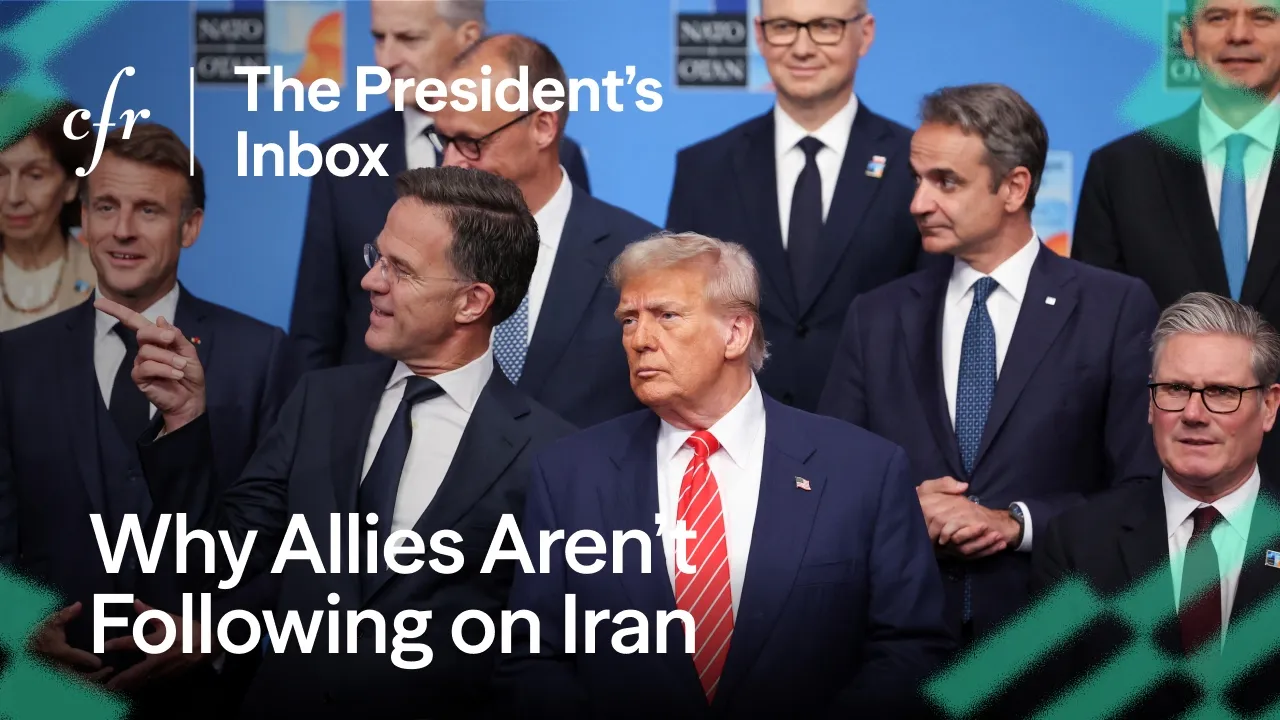
This episode unpacks how Europe and Japan are reacting to Operation Epic Fury.
Published
Host
 James M. LindsayCFR ExpertMary and David Boies Distinguished Senior Fellow in U.S. Foreign Policy
Guests
- Kristi GovellaSenior Adviser and Japan Chair, Center for Strategic and International Studies
- Constanze StelzenmüllerDirector, Center on the United States and Europe, the Brookings Institution
[Video: https://youtu.be/JSB3yosKQ2Q]
Transcript
GOVELLA:
There is no plan B for the U.S.-Japan alliance when it comes to really guarding against the security threats that Japan is most concerned about.
STELZENMULLER:
This conflict finds no quick and easy end, but if it expands, if it endures, there is going to come a point, I think, when American interests will be harmed by the closure of the strait as well.
CLIPS:
In this hour with the major developments in the Middle East as the U.S. and Israeli war against Iran now entering its fourth week.
LINDSAY:
The Strait of Hormuz, through which one-fifth of the world’s oil passes, remains closed, threatening the global economy. President Donald Trump has called on U.S. allies to help reopen the strait. They have largely declined, not wanting to join a war they did not start.
How do U.S. allies view the Iran war? Can they ignore Trump’s calls to join the fighting? And what long-term effects will Operation Epic Fury have on U.S. relations with its allies? From the Council on Foreign Relations, welcome to the President’s Inbox. I’m Jim Lindsay. Today I’m joined by Kristi Govella, Senior Advisor and Japan Chair at the Center for Strategic and International Studies, and Constanze Stelzenmüller, Director of the Center on the United States and Europe and the Fritz Stern Chair in Germany and Transatlantic Relations at the Brookings Institution.
Kristi and Constanze, thank you very much for joining me. Thanks for the invitation.
STELZENMULLER:
Great to be here.
LINDSAY:
I want to begin with a disclaimer. This is obviously a very fluid situation. Lots of things could happen between now and when the podcast goes live.
But I’d like to begin with you, Constanze, and I’d like you to sort of give me a sense of how Europeans have reacted to Operation Epic Fury, and particularly how Germany’s reacted.
STELZENMULLER:
It’s been really a remarkable show of unity so far. Most European leaders have said, variations over this is not our war, and we are not going to contribute to U.S. efforts. The backdrop of that is, of course, the past year, the wavering support of Ukraine by the U.S. administration, the predatory grab for Greenland, and the general contempt expressed for Europeans, such as in JD Vance’s speech in Munich a year ago, and Marco Rubio’s second speech, which was slightly more polite but no less disturbing in content a few weeks ago at the last Munich security conference. That said, despite the fact that Europeans don’t want to be active participants in this war on the side of the U.S. and Israel, the truth is that they are in a bind, and they have been quietly allowing the U.S. to use their bases, and that’s, I think, eight countries now that are letting the U.S. use their bases for this military intervention, the only exception being Spain, and there is a conversation ongoing on how this war affects European economic, political security interests, and the short version of that is extremely strongly, and how Europe ought to respond to that, but we are, I think, nowhere near a decision on that latter point.
LINDSAY:
Constanze, how is this feeding into domestic politics in Europe? I would say over the last decade, there’s really been something of a hollowing out of centrist parties in Europe. We’ve seen the rise of parties on the left, but particularly parties on the right, nationalist parties, many of whom seem to be very sympathetic to Donald Trump and the MAGA movement, but don’t seem particularly enamored with the war in Iran.
Do we have any sense of how that might be playing out, at least in the short term?
STELZENMULLER:
Jim, we could have a separate entire podcast about this because it’s complicated, but here’s the bottom line. This has been something of an election week for Europe, with regional elections in Germany two weeks ago and this weekend, the Danes have a national election tomorrow, there was an election in Slovenia this weekend, and we had local elections in Bavaria and in France, and frankly the picture here is mixed. The hard right has continued its progress into national politics on many levels, but not quite as much as they would like, and part of the problem here is that although they had really, really counted on support from the Trump administration and the MAGA right, they’re very unhappy with this war, and in fact the leaders of the extreme right in Germany, the Alternative for Germany party, have been publicly distancing themselves from this war. Nonetheless, Chancellor Merz has no doubt chosen his words and his rejection of this war, saying it’s not our war, we don’t want any part of this, because of his concern that his centrist coalition between his conservatives and the Social Democrats might be further diminished in these regional elections.
LINDSAY:
But has Germany been one of the countries that has allowed the United States to use its military facilities and bases?
STELZENMULLER:
Absolutely, and those facilities are huge, and I just want to say they house US personnel, they house equipment warehouses, they house weaponry, US fighter jets start from them, they house an enormous hospital in Ramstein, they house intelligence facilities, and of course US-European command in Stuttgart, and I would also remind listeners that they do so mostly at Germany’s cost. The US pays only a fraction of the cost of all this.
LINDSAY:
Well, as you know, President Trump would probably argue that Germany should pay all of the costs of support basing, but we’ll get to that in another conversation.
STELZENMULLER:
That plus punitive damages for being Germany.
LINDSAY:
Well, put that aside. Kristi, I want to jump in and bring you into the conversation. You studied Japan.
I’d like to get your sense of how Japan has reacted to Operation Epic Fury, and particularly given that the Japanese Prime Minister, Madam Takaichi, was in Washington just last week to meet with the President. I don’t know whether that was good fortune or misfortune on her part.
GOVELLA:
I think a lot of people were asking themselves that question last week. I think when we look at Japan’s reaction, which in many ways is similar to other Asian allies, we see a fundamental pragmatism. So first we see Japan condemning the Iranian government for its proliferation of nuclear weapons, condemning its attacks, but being rather silent on the actions of the US, for example, expressing support and that they would like to do things.
But also in the case of Japan, there are some pretty concrete limitations to what Japan can do because of its constitutional constraints. So Japan, of course, after World War II, constrained itself to not maintain war potential. It has a very sophisticated self-defense forces, but they can only be deployed in very specific situations where the survival of Japan is threatened.
And even then they can only use the minimum force necessary.
LINDSAY:
And it’s fair to say, Kristi, that the United States urged Japan to have a constitution that limited its military capacity or ambitions, correct?
GOVELLA:
Exactly. And actually people from the occupation forces wrote the Constitution of Japan. They drafted that text.
So that relationship goes back quite a long way. So when we see Japan’s reaction, we see the condemnation of Iran, we see the relative silence or lack of criticism in contrast to Europe of the US. And we see a kind of a hedging saying that at this time they don’t think this is a survival threatening situation, but they’ll think about it.
There are no plans to deploy ships right now, but they’ll discuss it. And so we see this kind of desire to please and accommodate US requests, but also this very real flagging of the constraints and this desire to kind of not get in the middle of it.
LINDSAY:
So Kristi, explain to me how the Prime Minister was able to navigate between sort of dueling rocks here as she came in. Because I was in Tokyo the week before the visit, and everyone was concerned that the visit was going to go poorly. To judge by the headlines in major newspapers, it went reasonably well.
The President was very kind and flattering in what he had to say about the Prime Minister and about Japan. So what is it Japan agreed to do? And how was it that the Prime Minister managed to avoid not suffering the fate of other Allied leaders who’ve become sort of front and center in the President’s crosshairs?
GOVELLA:
Well, I mean, I think that for Japan, the timing of the summit was initially meant to really catch President Trump before he went to China to meet with Xi in April, which of course now that trip has been postponed. So they had this whole vision of announcing some investment deals, coming to some agreements about economic security and defense, and then, you know, bending Trump’s ear about China. So I think what happened in the end was that they were able to actually keep a lot of the original agenda, and Trump decided that it was a good idea to frame the U.S.-Japan summit as a good news story about how Japan was stepping up, and how they were doing all of these things, and not to press them too strongly. I think that Prime Minister Takaichi, you know, took again a very pragmatic approach of flattering President Trump and, you know, telling him that he is the only person who can bring peace to this situation, you know, on one hand. Also emphasizing that there are things that Japan can’t do, but not getting too technical into the very complicated legal details of why that is, but trying to keep it at a high strategic level. So I think that in some ways, you know, the Japanese approach has been, you know, very pragmatic.
They try not to get into the details of values where there are obvious tensions. I mean, if you look at the Japanese response to the Russian invasion of Ukraine, they have consistently emphasized that, you know, attempts or actions to change the status quo unilaterally, by force, should not be allowed. And, you know, if we look at what the U.S. is doing, that seems to be very much in the vein of the attacks on Iran. But they are not emphasizing that. Instead, they’re emphasizing what they can do. And I think that’s part of why the summit went well.
LINDSAY:
One thing I have to ask you about, Kristi, because it got a lot of attention, at least on social media, was President Trump’s reference to surprise and how Japan knows a lot about surprise. And was that as big a diplomatic faux pas as social media would have it? Or is this something that the Japanese Prime Minister people just took in stride?
GOVELLA:
I mean, I think it would have been considered a very big faux pas and a very shocking statement in many other contexts. To reference Pearl Harbor very casually in that kind of context is not something that we would have seen in a previous U.S.-Japan summit. That’s quite certain.
I think in some ways, you know, given that the general volatility and uncertainty that President Trump has brought to much of international politics, the expectations are now quite different. So I think in some ways, you know, people, you know, let it go without the kind of heavy criticism. But it did attract quite a lot of attention on social media, certainly among government circles.
But yeah, I think that we’re just in a very different atmosphere of what is or what is not appropriate or tolerable in diplomatic settings these days.
LINDSAY:
Constanze, I want to talk about what the next steps are going to be for Europe, particularly on the issue of Persian Gulf security, given that the President has said he expects countries that benefit from oil leaving the Persian Gulf to actually provide the security. I will note that while the Prime Minister of Japan was in Washington, Japan, Germany, France, a number of other countries released a statement which condemned Iranian behavior and then said, we look forward to working with others for repair, to do something to provide security in the Persian Gulf. But there were no commitments of ships or personnel.
So where do you think we’re headed here?
STELZENMULLER:
Well, I’m not sure that there is actually a publicly available answer on that. But let me just perhaps expand a little bit before I give a, you know, a guesstimate on that, on just what this means for the Europeans. Ninety percent of European oil and gas is imported, right?
And much of it passes through the Strait of Hormuz. A closure of the Strait leads to exploding gas and oil prices in Europe and already has. That has political consequences.
The same is true for products made with these fossil fuels. It’s especially true of fertilizer. Then there is the larger issue of the PERL, the Prioritized Ukraine Requirements List.
I always have to look that up, the acronym, by which last fall the Trump administration and Europeans agreed that we would be buying American-made weapons, particularly interceptors, to give to Ukraine. The dwindling stockpiles of American weapons in the fourth week of these strikes mean, as American experts have said, that the PERL pipeline is practically going to dry up. That puts the Ukrainians potentially into a very difficult position at a moment when the blockage of the Strait and the lifting of American sanctions on Russia relieves the Russian budget and allows them to reinforce their efforts vis-a-vis Ukraine.
That is already one extremely disturbing and damaging aspect of this war. And then there is the larger potential aspect of increased refugee flows from the Middle East, possibly from Northern Africa, of terrorism, tensions between Muslim diasporas and Muslim and Jewish citizens in Europe, and of course the relationship with Israel itself, a nation with which a number of European countries, not least my own Germany, have a very special relationship for all the obvious historical reasons.
So on all of those counts, this is a significant worsening of the geostrategic landscape the Europeans are facing. And yes, the options are pretty slim, because let’s not forget that while the Russians are attacking Ukraine, they’re also perpetrating acts of hybrid warfare, sabotage especially, in Europe practically every day. So the Europeans right now are still being cagey.
They’re saying one thing we could do is expand the mandate, the remit and the scope of the European Maritime Protection Mission Aspides, which was created to protect shipping in the Gulf of Aden against Houthi attacks. That said, protecting shipping in the Strait of Hormuz against Iranian missiles is a challenge of a completely different order of magnitude. Aspides right now consists of three frigates from varying European countries and two more on call.
We’re looking at something that is an nth degree of that, and I’m really not sure whether that is feasible, given the naval power that we have. Something that we do have, though, is minesweepers. And given that the Iranians are mining the Strait, it’s conceivable at least, right, that we would deploy those minesweepers that are currently not engaged elsewhere to help demine the Strait.
But that does, again, require that the U.S. and Iran come to some sort of agreement together with Israel. And we already know that the U.S. and Israel have relatively obviously diverging strategic interests here. So the Europeans are saying, we are willing to do things once the war ends.
But the question of when and how the war ends, I think, changes every day. And that’s just based on the President’s pronouncements. And we’re not even looking at what the Israelis might be thinking or doing, or what the objective situation is, or in fact, what the Iranians might be wanting.
LINDSAY:
So just to make sure I understand you clearly, you don’t see any realistic chance that Germany or France or Britain is going to send naval assets into the Strait of Hormuz while the conflict is still ongoing.
STELZENMULLER:
I think that the political bandwidth from European publics for European governments to do that is pretty narrow, given how this administration has treated European leaders. Right. That said, I think the three of us on this call probably assume that this conflict finds no quick and easy end.
In fact, we can probably, all three of us, imagine some very, very unpleasant vertical or horizontal escalations. But if it expands, if it endures, I think there is going to come a point when European leaders would have to engage with the Iranians and strike deals, hopefully together with the Americans. But there is going to come a point, I think, when American interests will be harmed by the closure of the Strait as well.
Let’s not forget that. Let’s also not forget that while the President keeps saying that America does not need to import foreign oil, it actually does. Because the oil that it exports is not the same as all that it imports.
So, yes, American interests are also deeply affected by this closure. And I think we are going to have to have quiet conversations about how to work with the Iranian regime. But I think we can all imagine that the regime that ends up ruling the country could be much worse than the regime that these strikes tried to destroy.
LINDSAY:
Kristi, I want to ask you the same question for Japan. Obviously, we’ve talked about the limits on what Japan can do under its constitution, though the Japanese self-defense forces have sort of broadened the range of what they can do over the years, even in the absence of constitutional revisions. But Japan also depends upon, I think it’s something like 90 percent of its imported oil coming from the Gulf.
Can Tokyo afford to just wait it out and hope for better days?
GOVELLA:
So, to be clear, this crisis is a major factor for Japan. So, about 94 percent of Japan’s crude oil supply comes from the Middle East, and 93 percent of that travels through the Strait of Hormuz. So, this is already having very big expected impacts and real impacts on Japanese energy, on the economy.
And when we look at the broader issues, we’re really seeing that the Japanese government takes this very seriously. As you mentioned, Japan has made a series of very significant reforms on defense over the last decade or so that enable it to engage in limited collective self-defense. And so, the self-defense forces can do more now, with the caveat, as I said before, that the survival of Japan has to be threatened.
So, for participation in this crisis, for example, we would have to argue that the energy impacts from the Strait of Hormuz threaten the survival of Japan, and that would be the justification that they need to act. Now, short of that, there are things that Japan could do, which would not require navigating the legal processes for actually activating collective self-defense. And I Japan would likely be looking to do those things.
So, it might be difficult to send escort ships, particularly in an active conflict zone. I think that’s not really an option for Japan. But they may be able to do other kinds of logistical support to help with refueling in other places, to help with production of missiles or other things.
So, there would be things that they can do within the scope of their new revised defense capacities that they would look to do. But again, for the kinds of things that President Trump was asking for this week, to send ships to escort right now in the Strait of Hormuz, that’s beyond what Japan can do legally. And as Constanze was saying, actually in Japan, the numbers in the public support is quite low for this war.
We see between 75 to 82 percent of the Japanese public is not in favor of this and deeply concerned about the impacts on the economy. So, I think there are many legal, political, social hurdles to Japan’s participation in a more active way, while the conflict is still active.
STELZENMULLER:
Can I add a point? There is one difference, I think, between the European and the Japanese situation here, which is that because of the American interest in U.S. bases and in opening the Strait, and in fact, you know, finding some kind of off-ramp for what is a conflict that might escalate terribly. One of the things one might think about, and I would be very surprised if people weren’t thinking about it actively, is trying to strike a deal with President Trump, which is to say, we will help you if you maintain support for Ukraine, if you continue to give us weapons to give to Ukraine, if you continue to supply U.S. intelligence for use by Ukraine, then we are willing to engage with you on this question. The problem that I could see, however, right, is, if you will, a cognitive one. I think in the perception of at least some members of the administration, not least the president himself, the Europeans have, to use a phrase that the president likes to use, no cards.
We are, I think in his mind and in the mind of some other members of the administration, in a state of total dependency and ought to do the president’s bidding. I don’t think that that comports with the actual facts of the relationship, but that would still mean that the Europeans would have to together muster the courage to say so.
LINDSAY:
Right. Well, let me draw you out in that, Constanze, because I think it’s safe to say that President Trump has made hedging hot, or at least talk of hedging. And you’ve probably been to many of the same conversations I’ve been to, where people talk about how America’s friends, partners and allies are looking to hedge against an unpredictable or unreliable security guarantor and partner.
And the sense I get from people who support President Trump’s policies is that they’re deeply skeptical that America’s friends, partners and allies really want to hedge or can in fact hedge. How do you assess that argument?
STELZENMULLER:
I think it is incontrovertible that Europe is still in key ways profoundly dependent on America’s power. The first element there is the American extended nuclear deterrent. And the second one I’ve already named strategic enablers and including intelligence.
But I would say if you look at the larger picture, there is a huge amount of hedging going on. Let me start with the fact that the Germans lifted their constitutional debt break to engage in an armaments program of historic size. Similar things, again dependent on fiscal bandwidth, are happening across Europe.
The European Union is concluding trade agreements with Latin America, India, Australia and Canada. Things that only a couple of years ago were sort of stuck in backwaters because of minor regulatory disagreements. All of that suddenly has been mobilized.
There is always some sticking point in the final round. But what has happened in Europe’s trade relationships over the past year is nothing short of revolutionary. That kind of bandwagoning together of Western allies without the US for now is economic diplomacy, but it will have political consequences.
Especially because there will come a point when the president’s instrument of foreign policy, which is the threat of geoeconomic coercion, will be limited by this kind of banding together of what used to be America’s allies. And that’s just an example. We could look at other things.
We could look, for example, at the fact that the Icelanders are considering restarting European Union membership negotiations. We could look at the fact that both the UK and Switzerland have renegotiated their relationship with the European Union and moved it closer. And there are many more.
I mean, all of these are sort of little elements, but together they provide a mosaic of a greatly changed European landscape. Are there countervailing aspects of political disunity? Of course there are.
But still, it’s a completely different picture than only a year ago.
LINDSAY:
Okay, so you’re bringing to mind the proverb that a little by little, a little becomes a lot. Yeah. Seems to me.
Kristi, I want to ask you the same question because in the conversations I have, what I often hear is that Japan has nowhere else to go. Japan is really dependent upon the United States as a security guarantor because Japan at the end of the day is fundamentally worried about Chinese hostility and there’s nowhere else to go. Better an unpredictable security guarantor than none whatsoever.
How do you assess that argument?
GOVELLA:
I would agree that what I hear a lot from colleagues in Tokyo, you often hear that there is no plan B for the U.S.-Japan alliance and that, you know, there is no substitute for the kind of relationship that the U.S. and Japan have when it comes to really guarding against the security threats that Japan is most concerned about, namely China, also North Korea, increasingly Russia. So you have seen over the last decade, particularly since the first Trump administration, but even before Japan expanded security relationships, it now has reciprocal access agreements with Australia, the Philippines, and the UK. It’s doing a lot on trade and other kinds of cooperation in the Indo-Pacific, also with Europe.
It became very invested in the so-called latticework under the Biden administration, the mini-laterals, the trilaterals, the quadrilaterals, etc. But, you know, fundamentally, I would say that Japan still thinks of this as a sort of U.S.-plus arrangement where this isn’t really hedging in the sense of going and getting closer to China. Actually, we see that Japan and China have very, very strong tensions at the moment.
They’re in the worst relationship in the past since about the early 2010s. But, you know, they are very interested in, of course, building cooperation with other Indo-Pacific countries, with the Europeans, and they certainly have a lot of things to discuss. But, you know, when it comes to the security relationship, really there’s no substitute for the U.S. And also Japan is very important to the U.S. for its own security interests. And I think that’s why you don’t see the U.S. criticizing Japan to the same extent. There’s really no talk of withdrawing significant troops or other things from Japan. So I think that is recognized.
And on the economic side, there’s also really no substitute for the U.S. market. And we have seen Japan come to the negotiating table and try to make a deal with the Trump administration over the last year. And they’re actually moving forward with implementing their own trade deal.
They just announced the second batch of investment projects last week at the Trump-Takaichi summit. So I think for Japan, they’re signaling quite strongly that they’d prefer to maintain a really strong relationship with the U.S. And of course, they would love to work with everyone else, but they don’t see these things as being mutually exclusive.
LINDSAY:
I want to close with a sort of long-term question. It’s something I hear from my friends who do public opinion. And they say that what is most notable to them looking at public attitudes, particularly in Europe, maybe a lesser extent in Japan, is that younger Europeans are much less enamored with the United States.
Is the United States at risk? Constanze, was losing Europe in the longer term because younger Europeans don’t view the United States the way their parents or grandparents did?
STELZENMULLER:
It saddens me to say this, but I think that’s true. And I say this as someone who spent part of her childhood in this country, who went to graduate school here, and now has been living here for more than a decade. But if you look at the number of the tourism numbers, the numbers of high school, and remember the famous AFN, American Friends Network, that sent European high school students to America, those numbers are apparently going down.
The numbers of university students are going down. There is an academic brain drain to Europe. In fact, there is open recruitment from European academic institutions, some of whom, by the way, have in the past funded American research with huge sums of money.
So based on those numbers alone, it looks as though there is a loss of soft power. Yes. I do think that European publics are mature enough to distinguish between an administration and the country itself.
And I think a lot of Europeans, based on my own personal subjective experience, are watching what’s happening here incredibly closely and reading American media, consuming that with obsessive interest. And so they can see that this country isn’t completely thinking and acting and living in unison. The other thing that has, I think, been a huge damper on interest in travel has been the reports of what happens at the borders, of tourists getting arrested, put into an ICE detention facility and not being let out for weeks and even months.
That kind of thing is unhelpful. I think those of us who are professional analysts in this field probably spend a fair amount of time in Europe explaining that this country and its politics are more complicated and more variegated than public opinion might think. But the risk of an estrangement, I think, is very real.
LINDSAY:
Kristi, I want to ask you the same thing about Japan. Is there a risk that younger Japanese will just see the United States fundamentally different than their elders did?
GOVELLA:
So I think when you look at the public polling in Japan, it’s certainly true that things like trust in the U.S. are way down. You see a lot of concern, as I already mentioned, about the Iran conflict. I think that you see this across generations.
It’s not necessarily more pronounced amongst young versus old. And in general, I think that people are deeply concerned about many of the things that were just mentioned about the immigration policies, about concerns about visiting the U.S. and these kinds of things. But we don’t see really a rise of anti-American sentiment in Japan.
I think that also there are some countervailing trends that push the Japanese public closer to the U.S. in some ways. For example, particularly since the Russian invasion of Ukraine, we’ve seen a much greater awareness of security issues in Japan and a much deeper concern about, for example, Taiwan contingencies, a much more strong realization of the importance of the U.S.-Japan alliance. So I think these kind of countervailing things mean that in some ways, the trust and the kind of feel-good elements of U.S.-Japan relations maybe are suffering at the moment, but then the sense that they need the U.S. is also heightened by other factors. So I think that it’s a little bit too complicated to point towards a trend. But things are developing all the time with new U.S. policies, with new events in the world. And so I think it will be interesting to see how they unfold in the months and years to come.
STELZENMULLER:
So there’s really one important difference between the Japan and the European case, right, which is the Trump administration’s obsession with Western Civ, right? In other words, the obsession with a supposedly sovereignist, Christian, white, nationalist alternative future for Europe that would be a better future and would align Europe with the MAGA right. I think that’s the operative difference between our two cases.
LINDSAY:
We haven’t seen the Secretary of State or the Vice President go to Japan and give a similar kind of speech. Exactly.
GOVELLA:
I mean, I would just say that in recent elections, there has been a notable increase in the rise of populist parties in Japan, some of which are explicitly modeling themselves on the Make America Great style and some of the policies, particularly with regard to immigration. So particularly a small party called Sanseito has really made headlines. They really use social media.
You do see some parallels. But I do think I agree that it’s a very different conversation than in Europe. Really, the political alignments between progressive and conservative, they don’t align the same way.
And so Prime Minister Takaichi, actually one of the various things that drove her to power was to kind of take the wind out of the sails of these more conservative populist parties. And so she essentially is moving the LDP more towards the conservative to try to recapture them, and seems to have done so at least by the landslide election in February, at least for the moment.
LINDSAY:
Well, she had a historic victory.
GOVELLA:
Right. Exactly. The biggest victory in 70 years.
But I think that the point being that there are some of these things, but it doesn’t map onto the same ideological spectrum as Europe, but it is getting more fluid in Japan. I always caution people that populism is not necessarily taking root and will expand in Japan in the same way.
STELZENMULLER:
Germany’s Chancellor Merz tried something similar just before the elections, allowing the AfD, the German hard right, to vote with him on a measure. And that probably cost him several percentage points in the election last February.
LINDSAY:
Well, it is always good to keep in mind that all countries have their domestic politics. And while things may rhyme, they don’t necessarily repeat. On that note, I want to close up the President’s inbox for this week.
My guests have been Kristi Govellas, Senior Advisor and Japan Chair at the Center for Strategic and International Studies, and Constanze Stelzenmüller, Director of the Center on the United States and Europe and Fritz Stern Chair in Germany and Transatlantic Relations at the Brookings Institution. Kristi and Constanze, thank you very much for joining me.
STELZENMULLER:
Thank you. Such a pleasure to be on with you. Thank you for the invitation.
LINDSAY:
Today’s episode was produced by Justin Schuster with Director of Video Jeremy Sherlick, Senior Video Producer Grace Raver, and Director of Podcasting Gabrielle Sierra. George Flores was our recording engineer. Production assistance was provided by Oscar Berry and Kaleah Haddock.
This transcript was generated using AI and may contain errors or inaccuracies.
We discuss:
- The long-term erosion of U.S. soft power, especially among younger generations in Europe and shifting public sentiment in Japan.
- Why U.S. allies are refusing to join the Iran war, and what that signals about weakening alliance cohesion and growing strategic independence.
- How the closure of the Strait of Hormuz, through which roughly 20% of global oil flows, is already reshaping the global economy and raising the stakes for every U.S. partner.
- Europe’s balancing act, publicly rejecting the war while quietly enabling U.S. operations through military bases.
- Japan’s pragmatic hedging, supporting the U.S. diplomatically while using constitutional limits to avoid direct military involvement.
- The cascading global risks of the conflict, from energy shocks and inflation to refugee flows and rising geopolitical instability.
Mentioned on the Episode:
“Vice President JD Vance Delivers Remarks at the Munich Security Conference,” The White House
“Secretary of State Marco Rubio Delivers Remarks to the Munich Security Conference,” U.S. Embassy in Switzerland and Liechtenstein
“G7 Statement on Support to Partners in the Middle East,” Ministry of Foreign Affairs of Japan
Opinions expressed on The President’s Inbox are solely those of the host or guests, not of CFR, which takes no institutional positions on matters of policy.
Associate Producer, Video and Audio
- Associate Producer, Video and Audio
Director of Video
- Director of Video
Editorial Director and Producer
- Director, Podcasting
More Episodes
 33:42Podcast
 36:05Podcast
 41:07Podcast
 39:26Podcast
 35:04Podcast
 31:46Podcast