How Demand for GLP-1s Overwhelmed the Global Drug System
On this episode of Why It Matters, Gabrielle Sierra and CFR Senior Fellow Prashant Yadav trace how the GLP-1 trend led to shortages, a booming gray market, and steep price gaps driven by patent laws that vary across borders.
Published
Host
 Director, Podcasting
Guest
 Prashant YadavCFR ExpertSenior Fellow for Global Health
[Video: https://youtu.be/u7pjI1NwFlc]
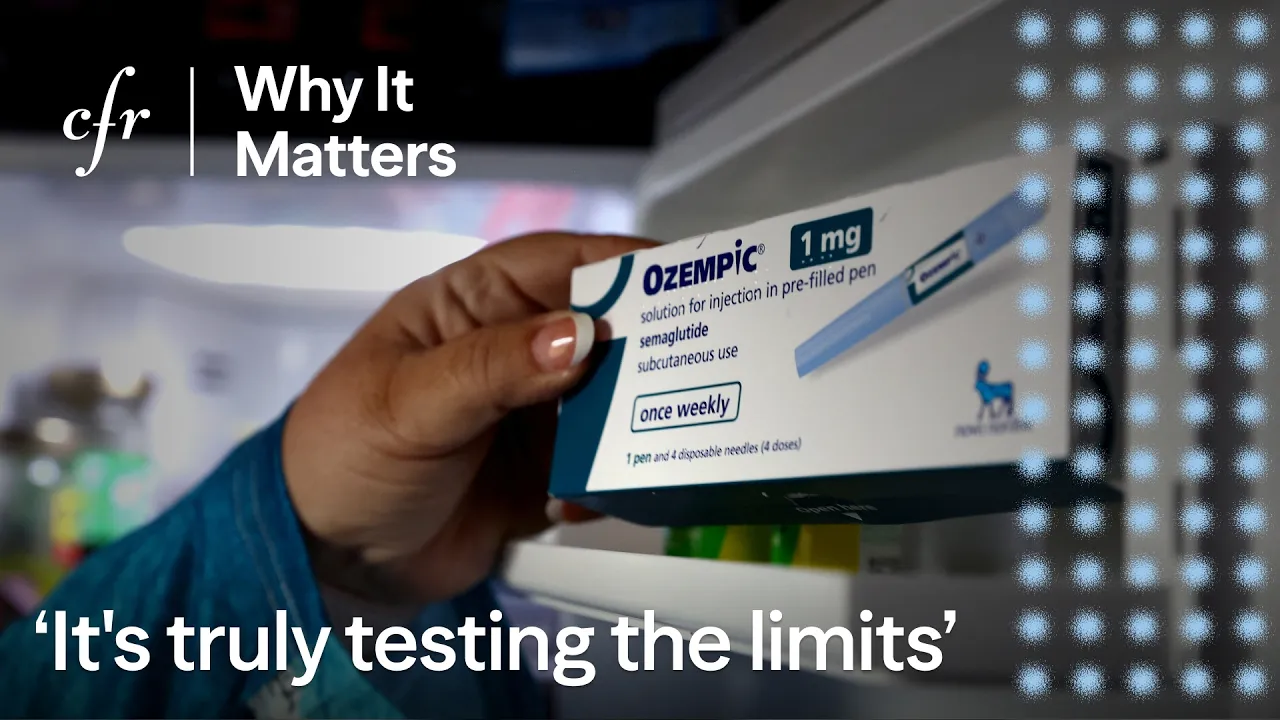
GLP-1 drugs such as Ozempic have become some of the world’s most-wanted medicines, but soaring demand has also turned them into a stress test for the global drug system.
Transcript
Cast your mind back to 2023 and the cultural phenomenon that rocked the world.
The Hollywood Reporter: The box office is gearing up for a barbenheimer showdown.
Hi Barbie! Hi Barbie!
No, no, not that.
BBC News: ChatGPT, maybe you’ve heard of it. If not, get ready.
No, not that either...I’m thinking more about...
Nikki Glaser: “And welcome to the 82nd Golden Globes, Ozempic’s biggest night!”
Chelsea Handler: “The whole town is on Ozempic.”
“Everybody’s walking around skinny, maybe too skinny.”
Society is deep in our GLP-1 era. It may feel like a Hollywood fad or the latest internet trend, but the numbers are real - this is a market that as of last year made roughly $79 billion in global sales, and the U.S. makes up more than 75 percent of the GLP-1 market value.
But GLP-1s turned out to be a stress test for the entire global drug system - surfacing price disparities, supply shortages, quality control failures, and a patchwork of patent laws that mean access to the same medicine looks completely different depending on which side of a border you’re on.
I’m Gabrielle Sierra, and this is Why It Matters. Today we’re looking at what happened when one of the world’s most wanted drugs met a system that was unable to handle the demand - episode one of a series in which we take a look at the fragility of the global health system, and the vulnerable position the U.S. finds itself in today.
Gabrielle SIERRA: So to start off with a big question, how the heck did we get here?
YADAV: So when the first GLP-1 was launched, I think the initial reaction that people had was there will be limited uptake.
YADAV: I’m Prashant Yadav. I’m a senior fellow at the Council on Foreign Relations. I work in global health and pharmaceuticals.
Prashant also sat on the advisory board for Novo Nordisk - a pioneer company in the GLP-1 market and a primary manufacturer of Ozempic.
YADAV: When it first was developed it was largely a product for patients with diabetes and clinical obesity, and most people thought there would be a relatively small to modest market for this because you’re talking about having people to self-inject an injectable medicine and most people said “Oh it’s been extremely hard to have uptake for anything that’s injectable and it will be unlikely that other people will take it up.” The product had a much higher uptake than what was anticipated. People started walking to physicians’ offices asking for it themselves versus physicians having to prescribe to people. The manufacturers in question did not build that much capacity, which meant there were shortages.
CBS 17: “A drug shortage is impacting people living with diabetes, and some pharmacies say they just can’t get it in stock.”
Hartford Healthcare: “There’s been a real supply chain issue with Ozmepic and the company has been unable to meet demand.”
NBC: “For the last two months now I’ve been trying to get the Monjouro prescription and all the pharmacies have been out of it.”
The impact GLP-1s have had on people’s health can’t be overstated. Yes, it has cosmetic appeal. But people are emptying the shelves because they’re seeing real results, not just with weight loss but in preventing conditions like heart disease and diabetes before they’re even diagnosed. Some doctors have even said that they consider GLP-1s to be the first ever longevity drug.
So it’s not a surprise that semaglutide, the molecule found in Ozempic and Wegovy, and tirzepatide, the key ingredient in Mounjaro, hit the FDA’s drug shortage list in 2022. Still by 2024, semaglutide was the second-best-selling prescription medicine in the world - so how is that possible if there was a shortage?
YADAV: Because of shortages, compounding pharmacies got into the business in order to fill the gap in supply because of manufacturers not having sufficient capacity.
There’s a provision in U.S. law that says when the FDA officially declares a drug to be in shortage, certain American compounders can legally make their own versions of it. So when GLP-1s hit shortage status, compounders were given a legal opening.
YADAV: Now, compounding pharmacies typically do this for a short period of time, but this became a multi-billion dollar business to compound and sell. And alongside came these telemedicine platforms where instead of having to visit a doctor’s office, you could essentially have a virtual consult. So that became a huge business.
Even bigger companies you might have seen advertising on TV or, if you’re like me, in the New York subway were using compound pharmacies to supply demand. That includes Ro...
Serena Williams: Yes, I’m on Ro.
-and Hims & Hers.
YADAV: They are respectable companies. They have safeguards in place and they usually try to get the the best quality even when they are doing compounding.
But where there’s an open market, there’s room for...
YADAV: -these completely fuzzy domain of pharmacies and compounders where you have no confidence of whether it has the right active ingredient and in some cases it has the right active ingredient but it came from a source and we have a couple of examples now where the FDA has sent out letters to a manufacturing company in China which is technically approved but then it in turn sourced the active ingredient going into a GLP-1 product from another active ingredient manufacturer which was not approved.
Most times where it is getting synthesized is not in a lab in the U.S. It’s getting synthesized in a lab in China, in India, somewhere else in the world, Europe also in some cases and then it’s being brought in and then someone is filling them into a syringe or in a vial and using them. So the supply chain originates in foreign countries outside the true jurisdiction of federal agencies that can control supply chains. For example, for routine medicines that come into the U.S. these are plants which are non-FDA approved. They are not technically selling a product to the U.S. They are coming through a chain of intermediaries for personal use and the personal use in these cases is declared as research purposes. So if we can prove the intent that it is going to be used for self-use and not for research purposes then it’s illegal. But it falls in these gray zones where enforcement becomes hard.
So basically the compound market got so big so fast that regulators couldn’t keep up and it became kind of impossible for a user to really know where the ingredients in their GLP-1 were coming from. But that didn’t stop people from trying to get their hands on them through any channel possible.
YADAV: What is interesting is that these compounders would go on Reddit channels, and they would go and post TikTok videos, they would go on Instagram...
“The medication we provide is compounded medication, and I’ve talked about this on previous segments. It’s on the website.”
“I just found the holy grail of compounded semaglutide, you guys. If you are on a higher dose, listen now, because I just found the cheapest price…”
YADAV: And they would say “If interested, DM me,” and then through direct messages they say sure I can send it to you or I can get this delivered directly to your doorstep or some other common point that you select.
SIERRA: It’s beginning to sound a little bit like ‘The Substance’ you know call a number and get an off-market cosmetic drug sent to you and you go pick it up somewhere.
YADAV: Yup.
SIERRA: That sounds super shady.
YADAV: It is super shady.
Americans’ use of GLP-1 injectables for weight loss has nearly quadrupled since 2024. And this January, Novo Nordisk’s CEO said that as many as 1.5 million patients in the U.S. may be using compounded versions of GLP-1 drugs.
SIERRA: Okay, so we have the compounders in the game and then we have these sketchy random social media sellers, and they’re all jumping in to fill the gap left by the original manufacturers. What happened then?
YADAV: Over time, the manufacturers caught up. They realized they were losing revenue. They had created a great health product, but someone else was making money off it, so they expanded their capacity, and they came back and said there’s no more shortage because we have sufficient capacity now, at which stage the U.S. Food and Drug Administration went and said, “You cannot be compounding this product because there is ample supply from the original manufacturer.” So they took away the compounding agreement.
This meant that Ro and Hims and Hers, which had been using compounding pharmacies legally and saving money while doing it, had to stop. All of a sudden, the compounding market that was legal in 2023, and made up 30 percent of the U.S. GLP-1 market, was suddenly illegal in 2025.
YADAV: So that’s been the dynamic over the last five years or so of this market, which has been a very interesting thing to watch. Typically, a five-year period is not that dynamic for many medicines, but this is a category which has gone through lots of upheavals in a short period of time.
Ro ended up partnering with Novo Nordisk in 2025 to distribute FDA-approved Wegovy, and after an on-again-off-again year, Hims & Hers struck its own deal in early 2026 to carry branded Ozempic alongside Wegovy. But there was a catch: moving from compounded GLP-1s to the FDA-approved drugs meant higher prices for many patients. Which brings us to where we are today - the GLP-1 price gap.
While most adults who have taken GLP-1 drugs say their insurance covered at least a part of the cost of these drugs, about a quarter of users with health insurance say they paid the full cost of the drugs themselves. And unlike other places in the world, Americans can’t just opt to buy a cheaper, approved generic, because there isn’t one. And that comes down to patents.
YADAV: So a patent for any medicine, but in particular in this case for GLP-1s, consists of a range of things, right? It’s the patent on the core molecule. It’s a patent on the indications that the molecule is approved for. And in this particular case, there are also patents on some special additives, which are added to make the product orally usable. Now, the exact timeline for when the patent expires in a country depends upon a range of things, but the first patents that expired were in India, Canada, Brazil, and that had to do with the timing of filing. In the case of Canada, it was a lapse in paying a fee. But in most other countries, it was about the timing of filing and the maximum duration that that country’s patent law gives. So the patents have expired in India for semaglutide. In China, the core patent has expired. In Brazil, the patent expired. In Canada, the patent has expired. And over time, I think Turkey, Mexico, many other countries will go through that same process. The U.S. patent expires in 2031.
But then there are other patents, which are for the pen or the cartridge in which the injection comes. Patents on the process of manufacturing and the indications for which it has been approved, right? So indications implying for weight loss, for cardiovascular disease, for sleep apnea, each of those have different kinds of patents, right? So which ones were filed and accepted by which country on these indication patents or these process patents, it’s a very diverse landscape. And then an added complexity is that now the GLP-1s have come out as orals, in particular semaglutides, which is a pill instead of a self-injection. And the oral is patented everywhere in the world till 2036 at the least, because one of the additives that goes into making it oral is patented. So even if the core compound is not, the additive is. So that will have a patent till 2036.
SIERRA: Okay so what does this mean for pricing in the U.S. then compared to somewhere like India where the patent has expired?
YADAV: Yes. So if people want to use it largely for weight loss, I think it’s a tricky affordability barrier. At this point those who do not have a diagnosis for any of these conditions, such as cardiovascular disease, diabetes, combination of cardiovascular disease, diabetes, and kidney disease, they are the ones who are having to pay the $199 or the $350 price. The estimates for cost of production in India after it went generic range somewhere between $15 to $35 so a very small fraction of the price we have in the U.S. So there is at least a 10 to 20 times difference in the price, which is not abnormal to semaglutide, that’s usually the case when a generic product enters the market. But given the scale of use of semaglutide or GLP-1 as a class, this is a big affordability question.
This March, Novo Nordisk’s core patent on semaglutide expired in India, opening the door for Indian manufacturers to sell their own versions of the drug. And they didn’t exactly trickle in. More than 40 Indian drugmakers have now jumped into the market, with more than 50 generic brands to enter the market competing for patients.
SIERRA: Why can’t I just like get it from India?
YADAV: Because the patent protection regime in the U.S. would not allow bringing a product that would not be respecting U.S. intellectual property if you were to import a product from India. But you can bring it into Canada.
SIERRA: Okay, well unless people are going to relocate to Canada, then that probably won’t work for most Americans. So, the U.S. patent expires in 2031, right? Do we then just wait this out? Why does it matter that these patents are expiring in these other countries?
YADAV: Two things, in my opinion. First, is the companies who will start manufacturing and selling in India or exporting from India to other countries, or when eventually the Chinese companies come in, they will sell to the China market, and they will export from China to other countries where the patent has expired. That will give them more economies of scale, which means they will establish themselves with larger volume and become bigger players in this business. Which will then hurt the competitive advantage for U.S. companies in this business over time, because somebody else has established capacity, has gotten their costs down to a level that no one else can compete. So it will, in a way, amplify our dependency problem on a drug class, which is an important drug class at the moment. Second is, it will create continued pressures on the companies selling in the U.S. market to reduce their prices, because there will be people in Congress who will keep asking, “Look, somebody in India is getting this for $14. Why does my state, Medicare, Medicaid, have to pay our negotiated price of $200?”
SIERRA: So once our patent expires in 2031, are we going to have the same issues with quality control that we saw in the GLP-1 shortage or that we’re already seeing when say an Indian supplier is selling their generics to Canada?
YADAV: Yeah, so a big risk is quality, and this will get much more pronounced and become more vivid in the case of GLP-1s, but it exists for all types of generic medicines. We’ve had many instances where the quality of generic medicines coming from outside the U.S. into the U.S. sometimes does not meet the same standards. And there is an ongoing debate as to whether that is a systematic problem or it’s an ad hoc one-off problem. The reality is that for the Food and Drug Administration staff to go and inspect a manufacturing site that’s located in India or China is not that straightforward.
So they’re not inspected as often, which means there are chances that they may have product quality that’s not meeting the same standards as a factory in, let’s say, New Jersey. Now this becomes important and it’s already been shown to be a problem for semaglutide, which is the two or three companies that were the first to launch a generic semaglutide in India, one of them had a quality problem. They themselves withdrew their batches. So the good thing is that they themselves realized they had a quality problem and instead of continuing to supply the market, they decided to recall and pause their production. So it’s a risky proposition that we don’t have full control over the quality of manufacturing of a product that is going to be so widely used by people in the country and used by people who are generally healthy.
SIERRA: Are there countries or factories around the world that are transitioning to making GLP-1s because they can sell it for more than let’s say insulin, another product that’s used by diabetics?
YADAV: Yeah that’s an important question. So what has happened is that the manufacturers were getting ready to make insulin right because there was a need for insulin supply in the world. You know the four or five companies that are the largest suppliers of insulin couldn’t keep up in supplying at the prices that are what people can afford in Africa and parts of Asia so these generic companies were gearing up to make that. The good ones amongst these generic companies, the ones that are bigger, more respectable FDA approved higher quality standards, quickly realized that why make insulin when you can leapfrog and jump straight to making GLP-1s and peptides. So many of them jumped straight on and started making GLP-1s. These companies have very quickly geared up to sell to the U.S. market which is the biggest market for GLP-1s and peptides. In doing so they’re ignoring the insulin needs for many other countries in the world, and many other countries in the world are still reliant on insulin that is produced not in their own country but you know somewhere else India or Europe. So that’s an impact which is indirect which is not about GLP-1s but it’s indirectly impacting insulin access.
Novo Nordisk, which is not only responsible for Ozempic but has long been one of the world’s largest insulin suppliers, is winding down human insulin pen production and has let emerging market contracts lapse. When the company declined to renew South Africa’s contract in 2024, the public system ran out of insulin pens, and no one else bid on the contract.
This spurred criticism from some global health organizations such as France-based NGO Doctors Without Borders, which accused the company of leaving patients in poorer, developing countries to use outdated glass vials and syringes.
But a Novo Nordisk spokesperson has said the company was phasing out human insulin pens because of “capacity constraints,” and that it had preserved “a significant supply” for vulnerable patients, including children, the elderly, and people with visual impairments or arthritis. Still, as of 2026, South Africa is actively dealing with severe medicine shortages, with insulin being one of the most critically affected categories.
At the same time, India’s biggest drugmakers are chasing both markets at once, scaling insulin and GLP-1s. All this to say, the question isn’t whether the world will still need insulin. It will. The question is, who will keep making it when the industry’s biggest profits are somewhere else?
SIERRA: The story around GLP-1s seems to have taken on a life of its own. There’s memes, there’s new lingo, there’s even food branded ‘GLP-1 friendly.’ I’ve seen those around lately. It feels like these drugs are in the zeitgeist.
YADAV: I mean, semaglutide is a sociocultural story, right? The fact that the use of a medicine and the percentage of the U.S. population that was using it, the moment it hit around 10 percent, that’s when share prices of food companies started dropping. The share prices of sugar beverage companies started dropping because people said this is going to impact how much food, what kind of food will people consume, right? So it’s a sociocultural phenomenon because people went and said, “This is a good drug for me. I want to take it,” even if their physician wasn’t telling them that. At the other level, it’s also testing the limits of how the market mechanism works for healthcare. It’s truly testing the limits of that, right? Because it’s saying all actors care about their profits. The compounder cares about its profit. The manufacturer cares about its profit. The insurer cares about not having to pay too much. And where in this fight between the three of them does the market land and what is the role of the regulator, both the price regulator, but also the quality regulator, which is FDA.
Aside from the FDA, some regulators across the world are also getting involved. In October 2024, the Australian government banned compound GLP-1 replicas after finding that at least 20,000 Australians were injecting products that had never been tested for safety or efficacy. South Africa has also moved towards banning the compounding of weight-loss injectables, as the government grapples with the safety risks of copycat drugs.
SIERRA: We’ve talked a lot about the global demand for these drugs. But what does this tell us about the pharmaceutical supply chain more broadly? How global is this really and how dependent is the U.S. on other countries for the drugs we take every day?
YADAV: The U.S. has become extremely dependent on China for a number of critical medicines. These are common drugs like heparin, which we need as an anticoagulant for any hospital procedure or surgery. And up to 85 percent of the ingredients that go into heparin are coming from China or are manufactured in China. Same thing with amoxicillin, our sort of staple antibiotic without which children getting an ear infection or a strep or something would not have medicine to account for it. So what I worry is that what has already happened in many of our medicines, that trend and that pattern continues to happen in newer medicines. Now it’s happening in monoclonal antibodies for cancer. We are seeing this happen in GLP-1s and peptides. So we may land ourselves in a place where something which is truly like a wonder drug, like GLP-1s to some degree, and we have a very high degree of dependency of manufacturing and getting it only from sources abroad and in places which are not considered allied nations, we have a real risk. And that’s a risk we’ve got to counter through our tools of foreign policy and trade.
And the ripple effects don’t stop at your wallet or your medicine cabinet. As Prashant points out, this is a national security issue as well. Because as the market for these drugs explodes, one country is becoming increasingly important to how the world makes, supplies, and accesses pharmaceuticals: China.
Rush DOSHI: Part of why China is able to do this was because the government gave their chemical industry huge amounts of support, and our chemical industry couldn’t compete.
Olivia KOSLOFF: It is a strategy China has pursued in other industries and it is now a point of geopolitical leverage that they have over the U.S.
More on that, next time on Why It Matters.
Want to keep up with Why It Matters? Sign up to receive an email alert when new episodes are available at cfr.org/newsletters or click the link in our show notes. If you ever have any questions or suggestions or just want to chat with us, email at [email protected] or you can hit us up on X at @CFR_org.
This episode was produced by Molly McAnany, and me, Gabrielle Sierra. Our audio producer and sound designer is Markus Zakaria. Our intern this semester is Abigail Breyfogle. Our theme music is composed by Ceiri Torjussen.
You can subscribe to the show on Apple Podcasts, Spotify, YouTube or wherever you get your audio. For Why It Matters, this is Gabrielle Sierra signing off. See you soon!
Read More:
“6 Facts About Obesity and Weight Loss Drugs In the U.S.,” Pew Research Center
“The Expanding Benefits of GLP-1 Medicines,” Cell Reports Medicine
“Obesity Drugs Are Scaling Fast,” Morgan Stanley
“FDA’s Concerns with Unapproved GLP-1 Drugs Used for Weight Loss,” U.S. Food and Drug Administration (FDA)
Want to keep up with Why It Matters? Sign up to receive an email alert when new episodes drop.
This work represents the views solely of the host(s) and guest(s). The Council on Foreign Relations is an independent, nonpartisan membership organization, think tank, and publisher, and takes no institutional positions on matters of policy.
Producer
- Producer, Podcasts
Sound Designer
- Audio Producer & Sound Designer
Intern
- Abigail Breyfogle
More Episodes
 29:35Podcast
 38:36Podcast
 31:35Podcast
 37:32Podcast
 32:26Podcast
 32:47Podcast