Are the Kurds in Iran Capable of Challenging the Islamic Regime?
Leaders of Iran’s sizable Kurd population are reported to be mobilizing in the aftermath of joint U.S.-Israeli strikes on the regime, but their ability to mount a successful armed resistance remains highly doubtful.

Henri Barkey is adjunct senior fellow for Middle East Studies at the Council on Foreign Relations.
The United States has reportedly begun reaching out to leaders of Iran’s Kurdish minority population to potentially support an uprising against the besieged Iranian regime. The contacts, including a widely reported call between U.S. President Donald Trump and Iraqi Kurdish leaders last weekend, appeared to signal U.S. support for training Iranian Kurdish groups based in Iraq to take up arms against the regime—though this has not been confirmed.
But Iran’s Kurds, who represent a sizable minority in the country’s northwest, have much less experience participating in armed actions than Kurdish groups based in Iraq and Syria, and it is unclear how much support they might receive from these other groups. To assess the potential role that Iran’s Kurds could play in the country, CFR spoke with Middle East expert Henri Barkey, who has long tracked the status of the Kurds in the region.
What is the significance of Iran’s ethnic Kurds?
Iranian Kurds are estimated to number between ten and fifteen million and are primarily located in four provinces along the northwest of the country, adjacent to ethnic Kurdish regions in Iraq and Turkey. They have had comparatively much less international political exposure—and contacts—than the Kurdish populations in Iraq, Syria, and Turkey.
In Iran, Kurds have started to become more active. Mahsa Amini, the young woman who died in detention at the hands of religious authorities, was Kurdish, and her death in 2022 set off massive nationwide protests under the slogan “Women, Life, Freedom.” The regime has always been wary of potential Kurdish mobilization and has maintained a very heavy security presence. During the nationwide protests that erupted at the end of 2025 and continued in January, the brutal crackdown by security forces also took place in Kurdish regions, where they are said to have killed and imprisoned large numbers of Kurds. (Not surprisingly, the targeted killing of Iranian Supreme Leader Ayatollah Ali Khamenei by U.S. and Israeli forces on February 28 was boisterously celebrated in the Kurdish cities.)
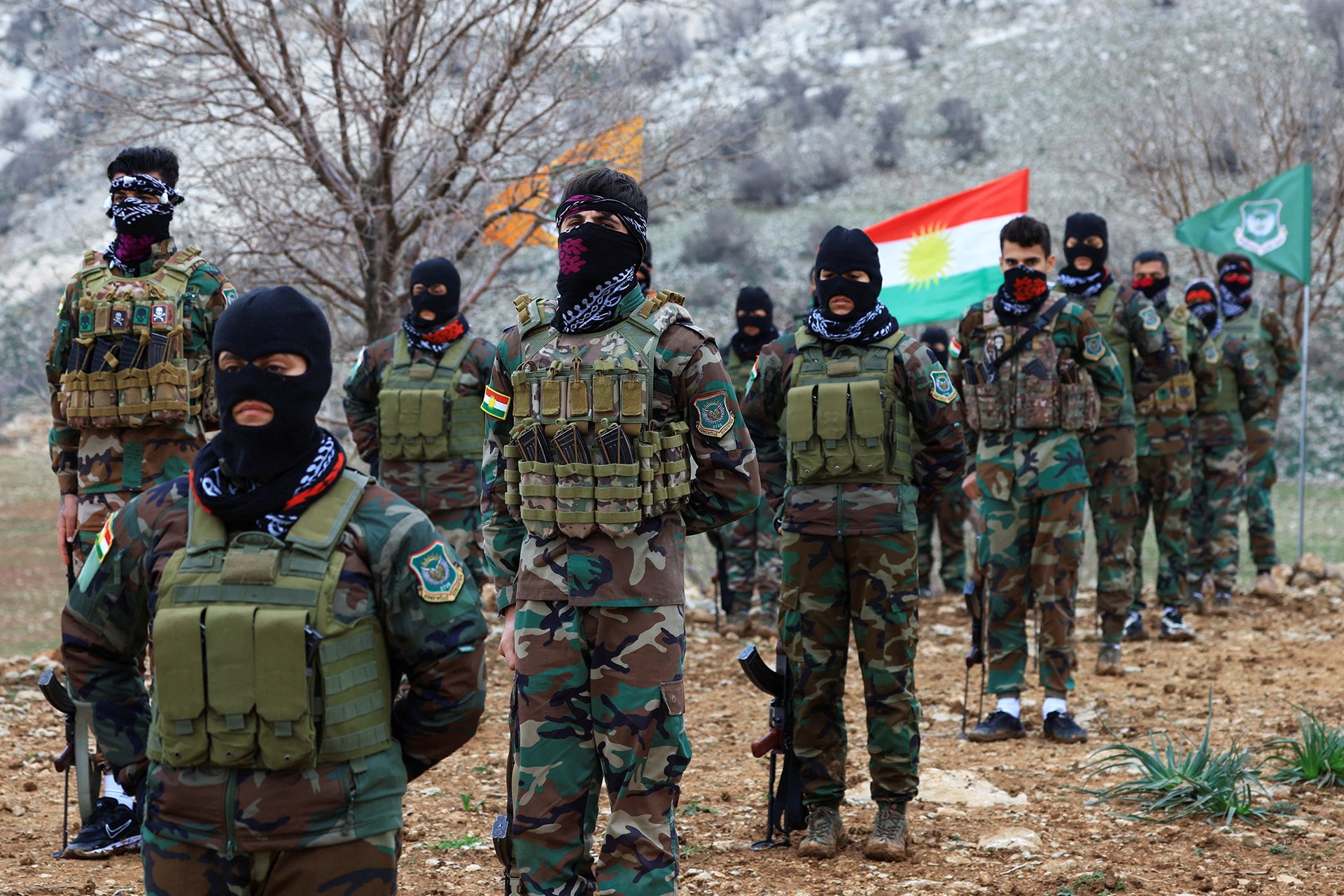
On February 22, five Kurdish groups with political headquarters in northern Iraq agreed to form a united front calling for the removal of the Islamic regime and self-determination for the Kurds, though what that means remains unclear. Two of these groups, known by the acronyms KDPI and PJAK, have their own military contingents. The creation of a united front is reminiscent of Iraqi Kurdish efforts at the height of U.S. moves against the Saddam Hussein regime in the 1990s following the Gulf War that ousted Iraqi forces from Kuwait.
Paradoxically, the Kurdistan Regional Government (KRG), a federal unit encompassing four provinces in northern Iraq, immediately warned the new Iranian Kurdish alliance not to engage in military activities from its territory. The warning, issued before the onset of the current hostilities, reflected authorities’ concern about potential retaliatory moves by the Iranian regime. Iran has shelled KRG territory in the past, and reportedly did so again this week, citing the presence of Iranian Kurdish groups. Also, Iraq’s federal government is dominated by a Shi’a majority that is positively disposed toward Tehran.
Yet following the joint U.S.-Israeli strikes in Tehran, news reports this week said Trump had phone conversations with the leaders of the main Kurdish factions in Iraq—Masoud Barzani and Bafel Talabani—who are known to have influence with Kurdish groups regionwide, including in Iran. Multiple reports, citing unnamed sources, said U.S. experts had started to train Iranian Kurds in combat and supply them with weaponry. U.S. and Israeli air forces have systematically bombed the regime’s security infrastructure, including police stations, installations of the Islamic Revolutionary Guard Corps, and local paramilitary (Basij) bases in an effort to clear the way for Kurdish forces. Some reports suggest that thousands of Kurdish fighters (which seems like an unrealistic figure) have gathered to begin training in northern Iraq. But the amount of time needed to train Kurdish rebels to be effective against regime forces makes it unlikely they can act in the near future. On the other hand, they may have been designed with a longer-term engagement in mind.
What does the future look like for Iranian Kurds?
Everything hinges on the outcome of the current war. If the regime stays in power, it is likely to first crack down on those it sees as the biggest threat, especially if they have foreign ties. If a formal deal were to end the conflict, Tehran would demand that all outside support for the Kurds (and other minorities) stop. Iranian Kurds have been through this before. In 1946, the ten-month Mahabad Republic was set up with help from Soviet forces occupying Azerbaijani territory and what is now Iranian Kurdistan. The Mahabad Republic quickly fell when Western officials managed to persuade the Soviets to pull out.
The Kurds may still continue to resist the central government, and significant fighting may ensue. It is not uncommon for Kurds from other countries to come volunteer their support to their Iranian brethren. Much would depend on Washington’s willingness to continue standing by them and to persuade the Iranian regime not to seek revenge.
Looming over Kurds in the region is a precedent set by Trump in 2025. That is when he dropped support for the Syrian Kurds, who had been fighting the Islamic State of Iraq and Syria (ISIS) in alliance with the U.S. military since 2016. Soon after the overthrow of the Bashar al-Assad regime by Syria’s new leader, Ahmed al-Sharaa, Trump insisted that the Kurds agree to Sharaa’s conditions. Initially, with Trump’s full support, Sharaa sought to impose a draconian system on them that would undo the whole security system overseen by the Kurds in northeast Syria, including prisons containing ISIS fighters. Sharaa eventually agreed to a compromise solution that allows Syria’s Kurds to maintain some degree of autonomy in a smaller band of territory than before.
How will Kurds and other minorities coexist in a postwar Iran?
Kurds and other minorities could fare better in the event of the autocratic regime’s collapse. Competition among the many groups demanding improved circumstances is likely to be stiff. Persians constitute between 50 and 60 percent of Iran’s population of ninety million. Azeris, Kurds, Lurs, Arabs, and Baluchis account for almost another 40 percent of the population. Trying to even partially accommodate these groups’ demands is likely to prove an impossible challenge. And though the regime may be unpopular, change induced from abroad, especially at the barrel of a gun, may not be to everyone’s liking.
Some, like the Kurds in this case, may be the exception, but all one has to do is look at the sectarian struggles in neighboring Iraq in the aftermath of the 2003 U.S. invasion to imagine how everything can go awry. Outsiders, however well-intentioned they may be, often misjudge regional reactions. In the case of Kurds, their spread across four countries almost always engenders defensive responses by central governments whenever their political status changes.
Given its sensitivity to its own domestic Kurdish issue, Turkey will attempt to influence the outcome in Iran. In Syria, the government of Recep Tayyip Erdoğan pushed hard to limit Syrian Kurdish gains by leveraging its influence over Syria’s Sharaa—and Trump. Paradoxically, the Iranian regime’s harshness notwithstanding, Iranian Kurds enjoy rights that their Turkish counterparts have yet to win, such as access to the use of the Kurdish language in the education system. One of the five Kurdish groups in the united front, PJAK, or the Free Life Party of Kurdistan, is closely affiliated with Turkey’s Kurdistan Workers’ Party, which the government has designated a terrorist organization. PJAK was added to the U.S. terrorist list in 2009 in an effort to please Turkey.
Another outcome could be a surviving but weakened hybrid Iranian regime that seeks to strike deals with ethnic minorities and other groups to survive. Kurds will not be the only ones knocking on the door; Baluchis and the Arabs in Khuzestan province in southern Iran, for instance, have also been pushing for reforms.
The proliferation of demands may provide the Kurds (and other groups) with a measure of autonomy, which may prove important in the medium term as all parties work to fashion a new political arrangement that is free from the repression the Islamic regime is known for.
This work represents the views and opinions solely of the author. The Council on Foreign Relations is an independent, nonpartisan membership organization, think tank, and publisher, and takes no institutional positions on matters of policy.