Andy Burnham: What to Expect From the UK’s New Prime Minister
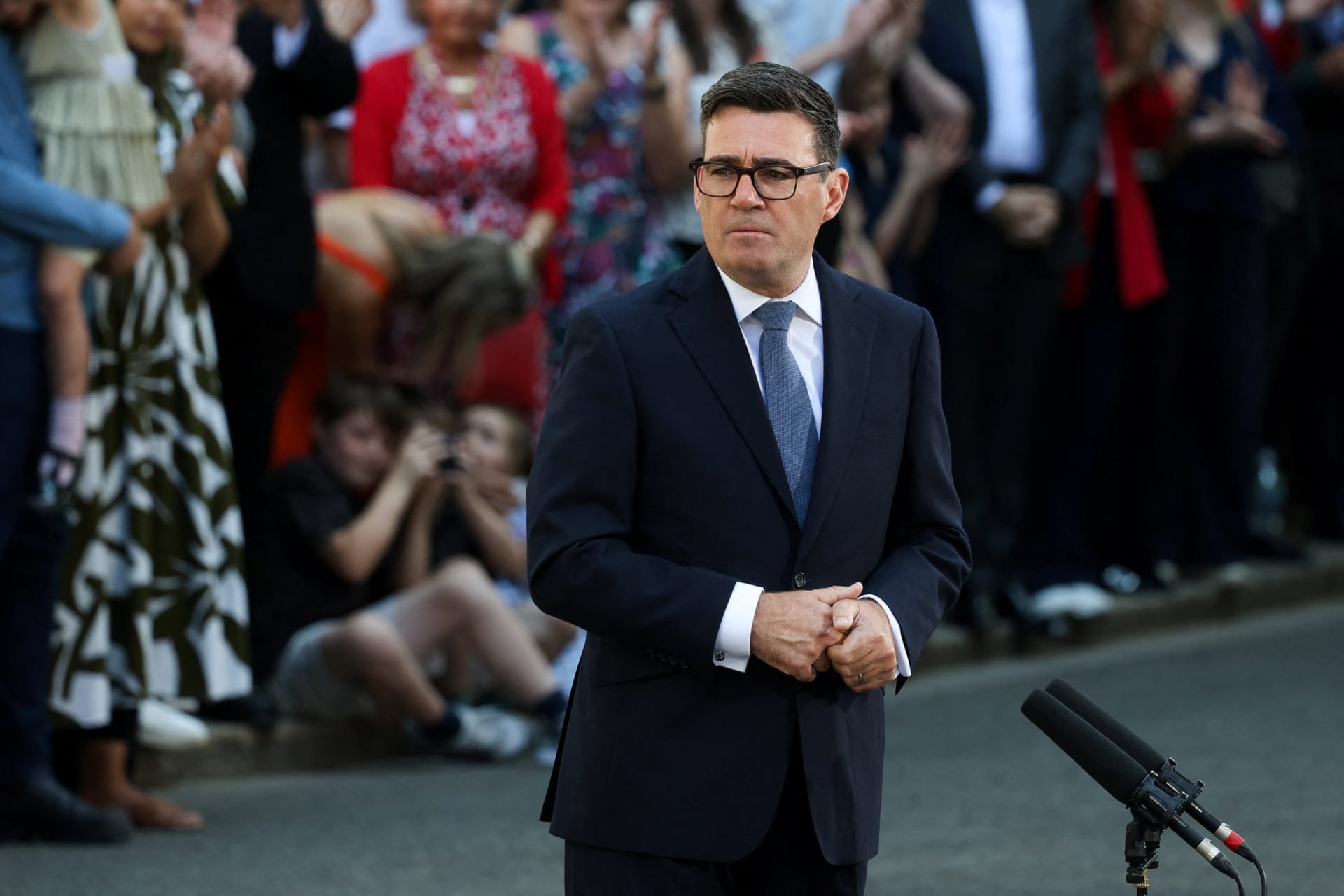
As Britain’s seventh prime minister in a decade, Andy Burnham enters Downing Street with a “Manchesterism” agenda of devolution and reindustrialization—and a cooler disposition toward Washington than his predecessor.
By experts and staff
- Published
 Matthias MatthijsCFR ExpertSenior Fellow for Europe
- Benjamin HarrisResearch Associate, Europe and U.S. Foreign Policy
Matthias Matthijs is an expert on European political economy, the politics of economic ideas, transatlantic relations, and EU integration. He holds the Dean Acheson Chair at Johns Hopkins University’s School of Advanced International Studies. Benjamin Harris is a CFR research associate for Europe and U.S. foreign policy.
It might have required an act of God to keep Andy Burnham from becoming the United Kingdom’s next prime minister, the seventh in a decade. His accession on Monday, following Keir Starmer’s short stint of two years as prime minister, marks a shift in Labour’s center of gravity, from top-down Westminster technocracy toward a politics of place, investment, and national renewal. For Washington and Brussels alike, the question is whether Burnham represents continuity with a new (Northern) accent or something more consequential.
The uncertainty arises because Burnham is a rare figure in British politics: a genuine political veteran who refashioned himself as an insurgent. Born in 1970 in Aintree, a suburb of Liverpool, he was first elected as a member of parliament (MP) for Leigh in 2001. He served under Tony Blair and Gordon Brown as Chief Secretary to the Treasury, Culture Secretary, and, from 2009, Health Secretary. His signature achievement from that era—launching the Hillsborough Independent Panel into the 1989 stadium disaster—established his reputation as a politician who takes on institutional cover-ups on behalf of ordinary people, a theme he has cultivated ever since.
He ran twice for the Labour leadership, finishing fourth in 2010, when Ed Miliband won, and second in 2015, when he lost to Jeremy Corbyn. What transformed his national standing was leaving London and Westminster. As mayor of Greater Manchester from 2017, Burnham won three consecutive elections by widening margins, earning him the sobriquet “King of the North.” He built a policy record on buses, housing, and homelessness that made him Labour’s most popular politician in the polls. He belongs to the party’s so-called “soft left:” to Starmer’s left on economics and public services, but no Corbynite.
In an early sign of his agenda as prime minister, Burnham promised in his first speech outside 10 Downing Street to “build a new economy where we put life’s essentials back under stronger public control.”
The rocky path to Burnham’s coronation
So how did Burnham move from being mayor of Manchester to becoming Prime Minister of the United Kingdom? The short answer is: through the side door and at speed. Starmer’s premiership unraveled over eighteen months of policy U-turns and questions about his judgement, capped by painful local election defeats in May 2026 and the controversial appointment of Peter Mandelson as the UK’s ambassador to Washington.
The party establishment initially tried to keep Burnham out. Back in January, Labour’s National Executive Committee (NEC) blocked him from standing in the Manchester by-election of Gorton and Denton by an 8-to-1 vote, with Starmer himself voting against. The maneuver backfired spectacularly when the Greens won the seat in late February.
The endgame came quickly. On May 14, Josh Simons, the young MP for Makerfield, resigned his seat to give Burnham a route back to Parliament. Burnham would go on to win the June 18 by-election with a majority of over nine thousand votes and close to 55 percent of the overall vote. Four days later, Starmer announced his resignation, on the same day Burnham was sworn in as an MP. Potential rivals folded in sequence. Wes Streeting, the former Health Secretary, quickly endorsed him, and Armed Forces Minister Al Carns, his last plausible challenger, ruled himself out. On the first day of nominations, 322 out of 403 Labour MPs backed Burnham—making it all but impossible for a challenger to gather the 81 signatures required. Burnham then became the UK’s next Prime Minister after meeting King Charles III on Monday.
It is, in short, a coronation in the tradition of Gordon Brown in 2007 and Theresa May in 2016, with neither a happy precedent. An Ashcroft poll found only 27 percent of Britons believe Burnham should become premier without a contest. His mandate rests on 403 Labour MPs, not the country. The UK government doesn’t have to hold a general election until August 2029, but Reform UK has led national polls for over a year—and the pressure for Burnham to seek his own mandate could build.
“Manchesterism” comes to London
Burnham himself likes to describe his economic and domestic philosophy as “Manchesterism.” It is based on the conviction that the United Kingdom’s core problem is a hyper-centralized state that has starved its regions of economic investment and political power.
Burnham has pledged to reverse nearly two decades of low growth since the 2008 financial crisis by harnessing public and private capital for transport, housing, and infrastructure. This, in essence, is his mayoral playbook scaled nationally. His signature gesture is a “No. 10 North” in Manchester to coordinate devolution, alongside an ambitious social housing program, taking back control of public utilities, nationalizing steel, and expanded social care.
Crucially, he has moved to reassure markets rattled by memories of former PM Liz Truss’ so-called mini-budget in September 2022, which had scared bond investors by cutting taxes without a plan to pay for them. He has committed to the government’s existing borrowing limits, pledged fiscal discipline, and promised to reduce the welfare bill. Much of the substance is continuity with the Starmer-Reeves agenda—industrial strategy, self-sufficiency in sectors essential to national security, directing procurement toward domestic production—but wrapped in a more compelling political story. Burnham’s talk of “sovereign capabilities” in shipbuilding, energy, AI, and quantum would not sound out of place in Paris or Brussels.
For Europe, a new dynamic but not a UK reset
Here lies the central paradox. Burnham is personally the most pro-European prime minister since Blair but will likely talk about Europe less than Starmer did. He said back in 2025 that he hoped Britain would rejoin the EU in his lifetime. But during the Makerfield by-election, fought in a strongly “Leave” constituency, he stressed he was not advocating rejoining now.
His first order of business is unfinished. The second UK-EU summit, originally scheduled for July 22 in Brussels, was postponed after Starmer’s resignation, leaving a package of agreements—a veterinary deal easing agri-food border checks, a linkage of the two emissions-trading systems, and a youth mobility scheme—signed in principle but not sealed quite yet. The postponement itself caused friction. London suspected Brussels of deliberately waiting for the more pro-European Burnham before concluding the reset. Rescheduling the summit and banking those deals will be an early test for Burnham.
Beyond that, Europe and the UK can probably expect a subtle reframing. Burnham’s stated priorities are European cooperation on illegal migration, economic security, and societal resilience. Notably, this does not include further economic agreements, and Labour’s red lines against the customs union, single market, and free movement of people will remain intact.
But the deeper logic points toward convergence. Burnham’s UK “sovereign capabilities” agenda mirrors the EU’s own strategic autonomy debate, and a less U.S.-centric approach to AI and critical technology will push London toward friendshoring with European partners on critical minerals, cloud, and payments infrastructure. While Burnham may sound less pro-European than Starmer, his government may end up more pro-European in substance.
Transatlantic relations and the UK’s role in the world
There will likely be continuity on fundamentals, but things will be cooler in tone. In a Times of London op-ed setting out his worldview, Burnham reaffirmed Labour’s commitment to NATO and the UK’s independent nuclear deterrent. He also pledged continued military, diplomatic, and financial support for Ukraine. But the mood music toward Washington is changing.
The UK’s next prime minister described the U.S. relationship merely as “critical”—rather than the standard “special”—and is reportedly not prioritizing an early trip to Washington. This is in stark contrast with Starmer’s assiduous courtship of President Donald Trump. Figures in Labour circles expect a less deferential approach, and Burnham has staked out more distance from the United States on the Middle East, saying the previous government was too slow to call for a Gaza ceasefire and floating sanctions and a ban on trade with illegal Israeli settlements.
Burnham’s approach to British power runs through the domestic economy, where he hopes to restore UK “hard power” via reindustrialization and higher defense spending. Whether a prime minister whose instincts, career, and mandate are all resolutely domestic can sustain Britain’s outsized international role—while managing Trump, Brussels, and Reform UK simultaneously—is the question that will define his premiership.
This work represents the views and opinions solely of the authors. The Council on Foreign Relations is an independent, nonpartisan membership organization, think tank, and publisher, and takes no institutional positions on matters of policy.