The Senate Rejects the Treaty of Versailles
The defeat of President Woodrow Wilson’s plan for a League of Nations highlighted the power of the Senate and the dangers of refusing to compromise.
By experts and staff
- Published
 James M. LindsayCFR ExpertMary and David Boies Distinguished Senior Fellow in U.S. Foreign Policy
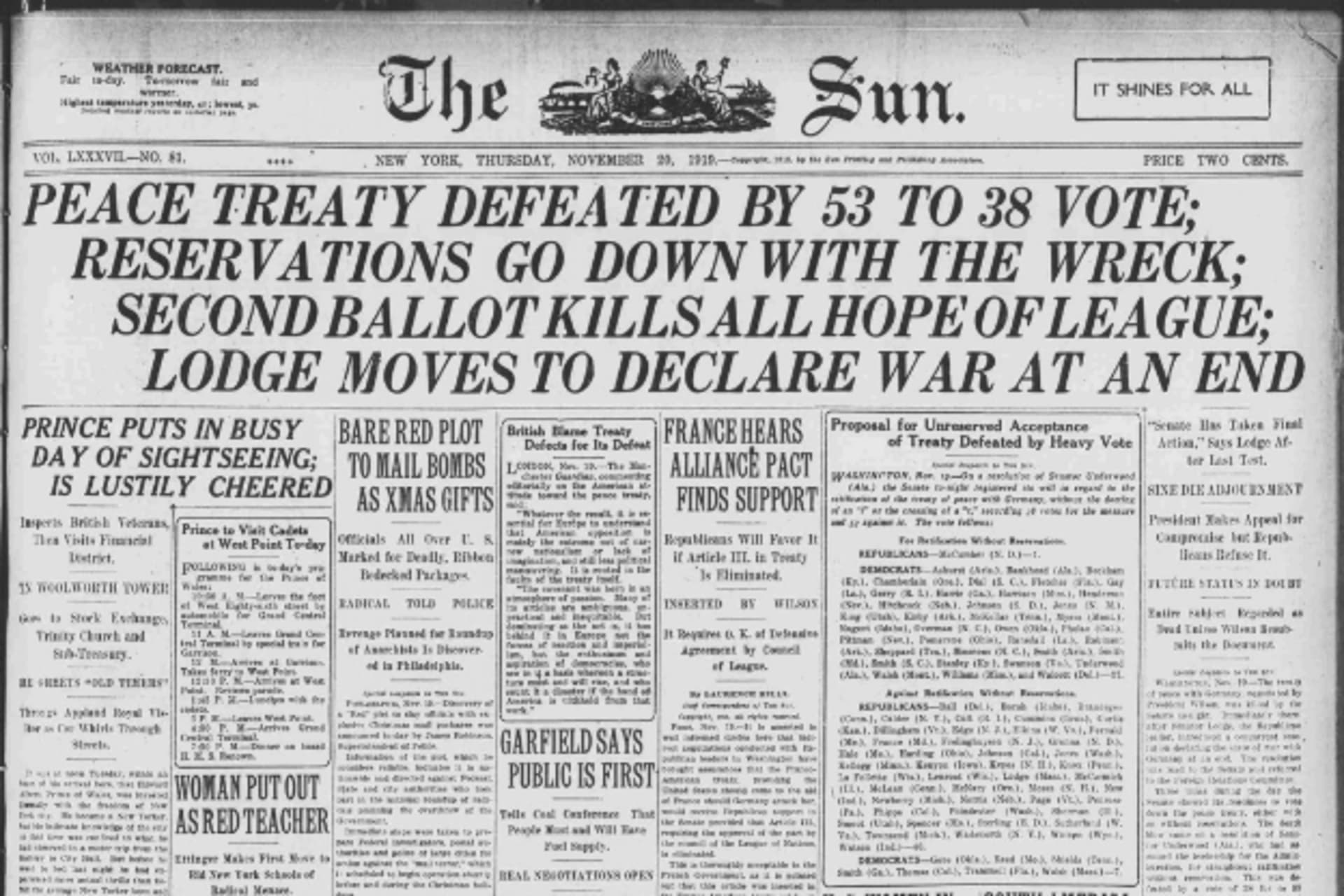
Today marks the anniversary of the Senate’s 1919 rejection of the Treaty of Versailles. I am flagging the vote not because it was one of the pivotal moments in the history American foreign policy, though it was, or because it indirectly helped lead to the creation of the Council on Foreign Relations, though it did. I flag the treaty’s defeat because we continue to hear its echoes today in the question of whether and how the United States should engage in the world.
A recent survey I conducted on behalf of the Council on Foreign Relations with members of the Society for Historians of American Foreign Relations ranked the Senate’s rejection of the Treaty of Versailles as the fifth worst foreign policy decision in U.S. history.
[Video: https://www.youtube.com/shorts/FFr94TN6qjw]
“Neutral in Fact as Well as in Name”
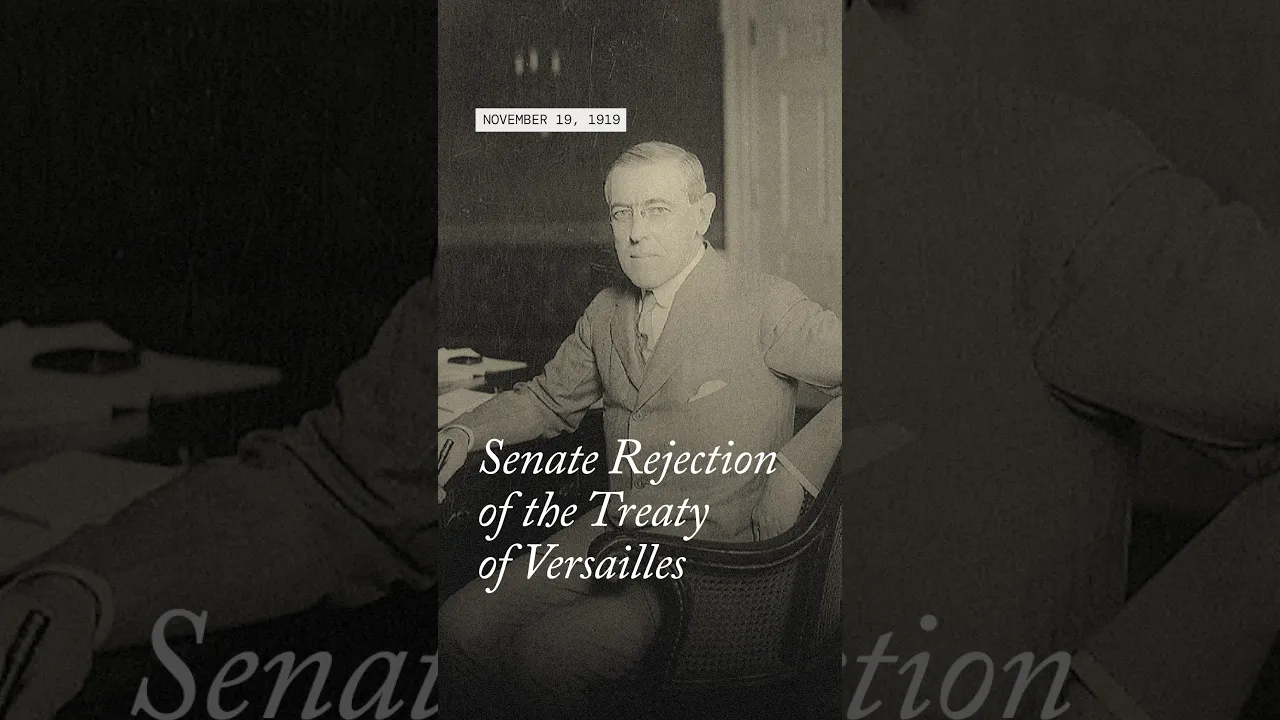
When Europe went to war in August 1914, President Woodrow Wilson declared U.S. neutrality and argued that “the United States must be neutral in fact as well as in name.” The decision to stay out of Europe’s war was unremarkable. For more than a century, the United States had sought to stand apart from the old world, operating in accordance with the so-called Great Rule of Conduct that President George Washington laid out in his Farewell Address:
The great rule of conduct for us in regard to foreign nations is in extending our commercial relations, to have with them as little political connection as possible. So far as we have already formed engagements, let them be fulfilled with perfect good faith. Here let us stop.
Europe has a set of primary interests which to us have none; or a very remote relation. Hence she must be engaged in frequent controversies, the causes of which are essentially foreign to our concerns. Hence, therefore, it must be unwise in us to implicate ourselves by artificial ties in the ordinary vicissitudes of her politics or the ordinary combinations and collisions of her friendships or enmities.
Wilson’s decision to pursue a policy of neutrality was so unremarkable that the New York Times published the news of the White House neutrality proclamation on page seven. Americans saw themselves as witnesses to the war, not participants.
“A League for Peace”
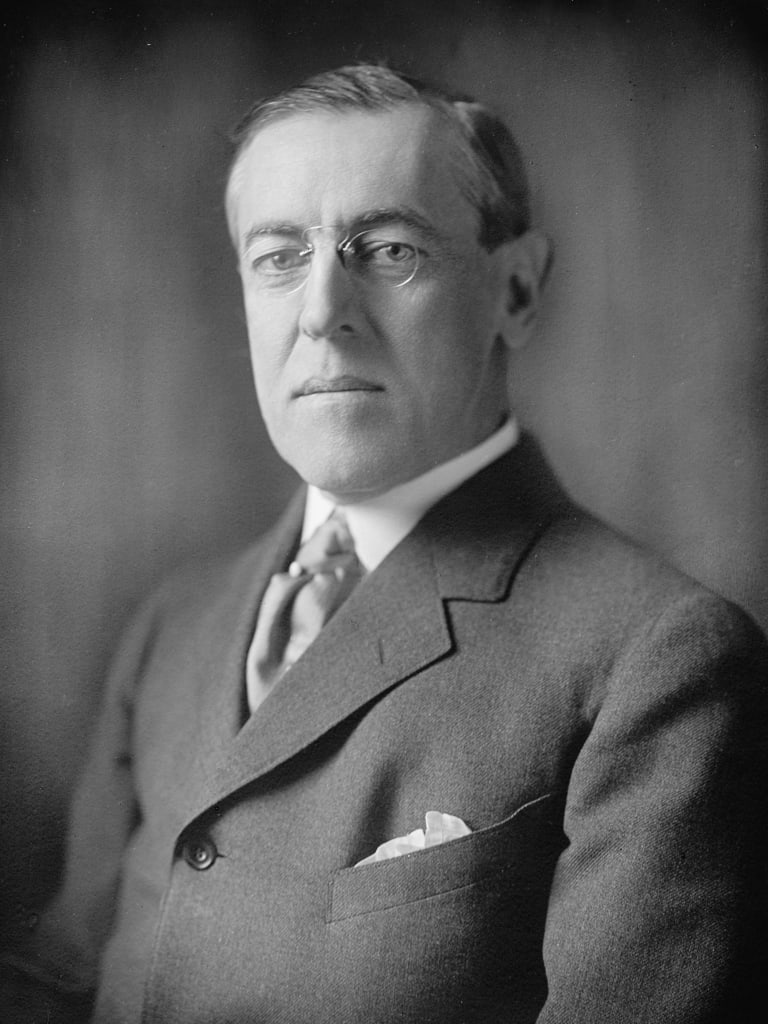
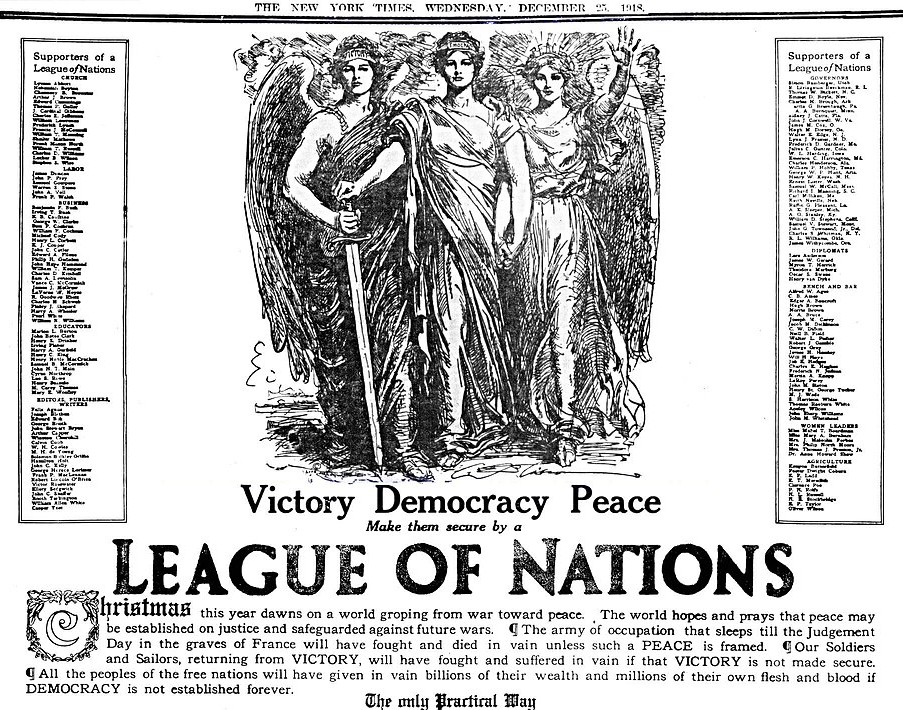
The fact that Wilson chose neutrality did not mean that he favored doing nothing. As the war that most people expected would be over “by Christmas” turned into a prolonged and devastating conflict, he hoped to mediate an end to the fighting. In January 1917, he addressed the Senate in person, the first president to do so since the days of Washington, to call for “peace without victory” and the creation of “a League for Peace.”
The idea of creating a multinational organization to prevent war was not original to Wilson. The call for such a league had been gaining popularity in the United States for years. In 1910, a year after stepping down as president, Theodore Roosevelt used his speech accepting the Nobel Peace Prize for negotiating the end to the Russo-Japanese War five years earlier to urge the world’s great powers to “form a League of Peace, not only to keep the peace among themselves, but to prevent, by force if necessary, its being broken by others.” In 1915, American proponents of Roosevelt’s idea formed the League to Enforce Peace to advocate for the creation of a multilateral organization to prevent war. Former President William Howard Taft was its head.
“I Want to Do Right”
Wilson’s efforts to keep the United States out of Europe’s Great War ultimately proved futile. Germany’s rape of Belgium, the sinking of the civilian cruise liner the Lusitania, Germany’s offer to help Mexico retake territory it had lost to the United States, and Germany’s resumption of unrestricted submarine warfare on U.S. merchant shipping slowly moved U.S. public opinion toward favoring war with Germany. Even then, Wilson remained reluctant to intervene. At a cabinet meeting on March 20, 1917, one of his closest advisors said that the American public wanted war. Wilson responded: “I do not care for popular demand. I want to do right, whether popular or not.”
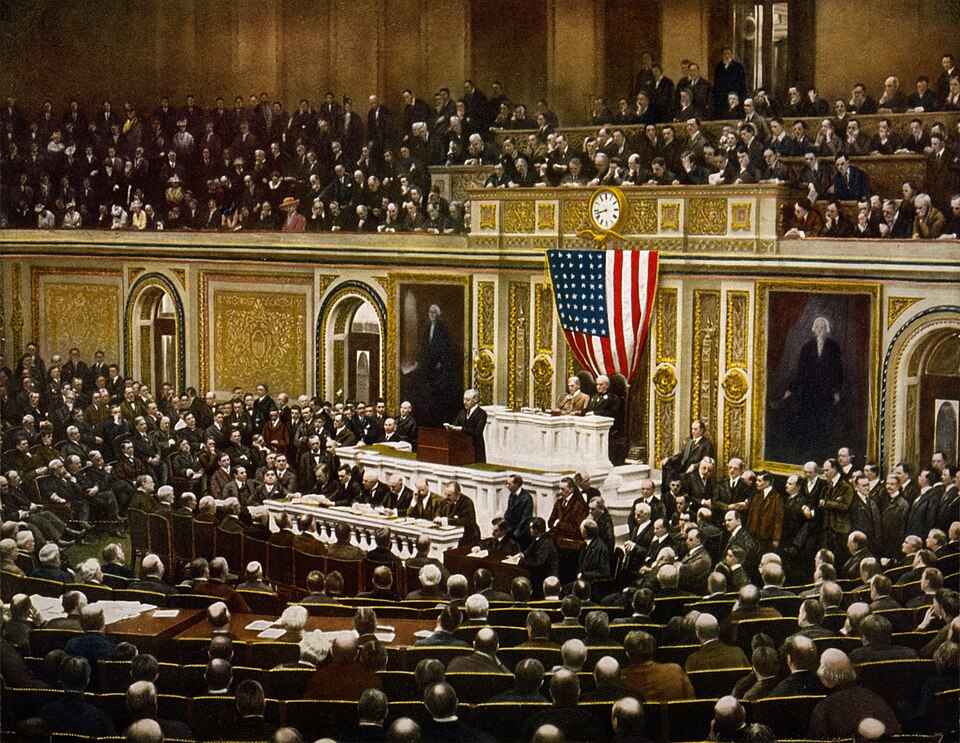
The next day, however, Wilson reversed course and called for a special session of Congress. At 8:30 PM on April 2, he stood before a joint session of Congress and urged senators and representatives to:
declare the recent course of the Imperial German Government to be in fact nothing less than war against the government and people of the United States; that it formally accept the status of belligerent which has thus been thrust upon it, and that it take immediate steps not only to put the country in a more thorough state of defense but also to exert all its power and employ all its resources to bring the Government of the German Empire to terms and end the war.
Two days later, the Senate voted 82 to 6 for war. The House of Representatives followed suit on April 6 by a vote of 373 to 50.
The Fourteen Points
With the United States at war, the question became, what was the country fighting for? Wilson did not want the United States to become just another major power fighting for land, or resources, or power. As he argued in his speech advising Congress to declare war, he thought it should be fought for a more ambitious and righteous cause, namely, making “the world itself at last free” and “safe for democracy.”
In January 1918, Wilson sketched out what that meant with his Fourteen Points speech. It offered many proposals familiar to Americans at the time: freedom of navigation on the high seas, more opportunities for trade, an end to colonies, and self-determination for all nations. Point fourteen, though, was Wilson’s passion. It called for a “general association of nations” to guarantee “political independence and territorial integrity to great and small states alike”: the League of Nations.
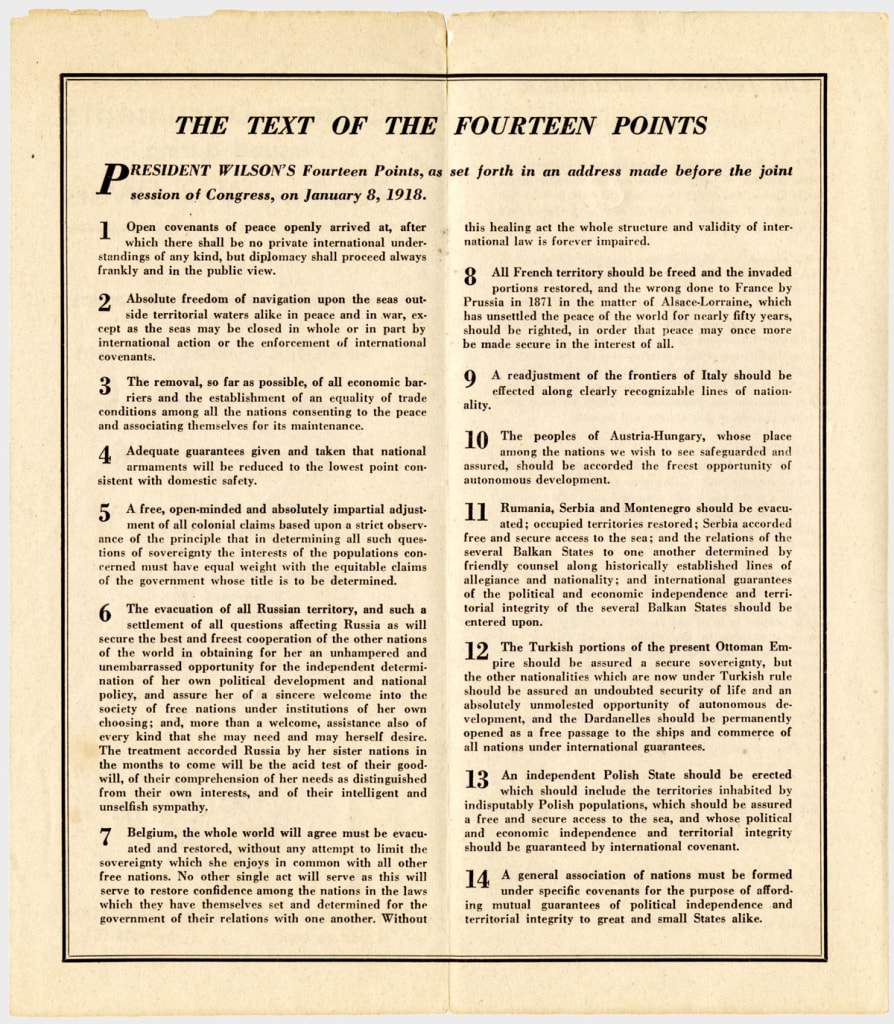
Wilson’s chance to turn his grand vision into a reality came ten months later. The armistice ending World War I took effect on November 11, 1918. Wilson’s advisors urged him to send someone to Paris, the site of the peace conference, to make the case for a league. They noted that no sitting president had left North America and that the conference could last months. They also feared that difficult negotiations might damage his reputation both at home and abroad. But Wilson was certain that only his personal involvement could persuade the victorious Allied leaders to embrace the creation of a league. So he set sail for Paris.
The Paris Peace Conference
Massive crowds greeted Wilson when he arrived in France in December 1918 and in his subsequent visits to Belgium, Italy, and the United Kingdom. The crowds were grateful that the U.S. entry into the war had tilted the balance against Germany. Just as important, having experienced four brutal years of war, they were thrilled by the idealism and hope embedded in Wilson’s Fourteen Points and his call for a League of Nations.
Wilson’s British, French, and Italian counterparts shared their citizens’ gratitude for what the U.S. Army accomplished on the battlefield. They did not, however, share their enthusiasm for his plans for a peace settlement. They had agreed to negotiate based on the Fourteen Points only because Wilson had threatened to strike a separate peace with Germany if they refused. But they disdained his idealist ambitions, and especially his call for a League of Nations, as unworkable and a threat to their plans for a post-war peace.
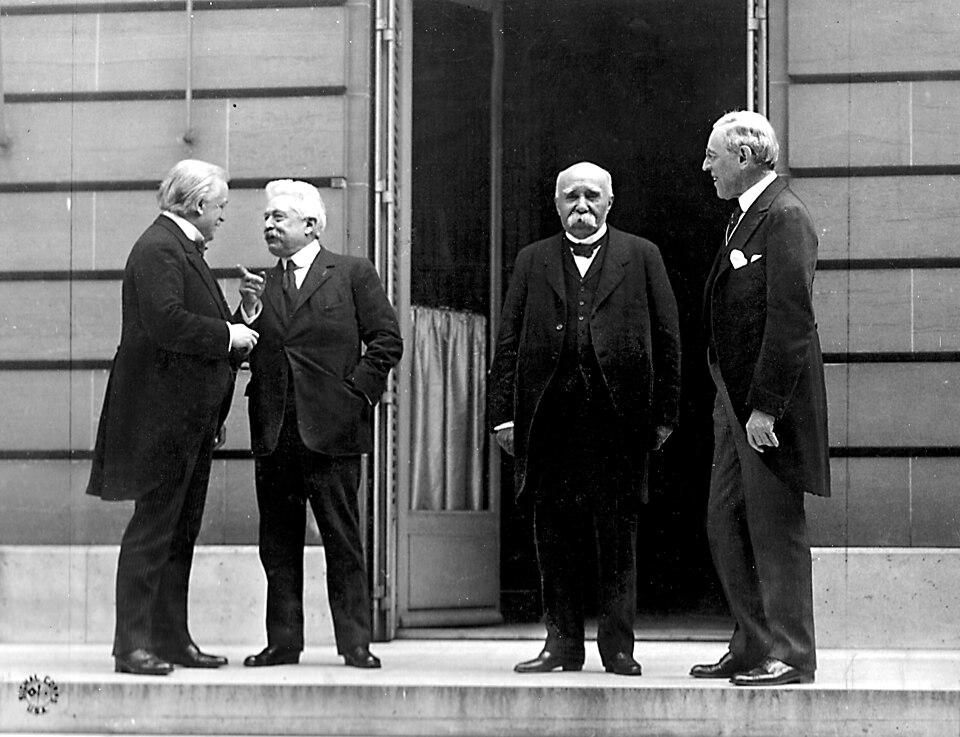
The peace negotiations were difficult. Wilson compromised on many of the Fourteen Points, but he doggedly pushed for the league. When the Treaty of Versailles was signed on June 28, 1919, its first twenty-six articles formed “the Covenant of the League of Nations.” The core provision was Article 10: “The Members of the League undertake to respect and preserve as against external aggression the territorial integrity and existing political independence of all Members of the League.”
“A Brick Into a Beehive”
Although Wilson was feted as a hero during the six months he was in Europe, he was a politically weakened president at home. When the United States entered the war in April 1917, Wilson’s fellow Democrats controlled the House and Senate as well as the White House. Once the war began, Democrats and Republicans observed an uneasy domestic political truce; neither party sought overtly to win political credit from the war effort.
Things changed, however, as the war wound down. Faced with looming midterm elections and egged on by Democratic Party leaders worried about maintaining their congressional majority, Wilson “hurled a brick into a beehive,” as one historian put it. Eleven days before Election Day in November 1918, he issued a statement urging voters to send more Democrats to Congress. Doing otherwise, he suggested, would weaken his hand in peace negotiations.
I am asking your support not for my own sake or for the sake of a political party, but for the sake of the nation itself, in order that its inward unity of purpose may be evident to all the world. In ordinary times I would not feel at liberty to make such an appeal to you. In ordinary times divided counsels can be endured without permanent hurt to the country. But these are not ordinary times. If in these critical days it is your wish to sustain me with undivided minds, I beg that you will say so in a way which it will not be possible to misunderstand either here at home or among our associates on the other side of the sea. I submit my difficulties and my hopes to you.
The move backfired. Rather than heeding Wilson’s call to unify behind his leadership, voters returned control of the House to Republicans for the first time in eight years. An even more consequential loss came in the Senate, which reverted to Republican control for the time in six years. The loss of the Senate came by the narrowest of margins. Had nine hundred voters in New Mexico switched parties, Democrats would have retained control.
Republicans resented what they saw as Wilson’s effort to make political gain out of the war, even though twenty years earlier then-Vice President Theodore Roosevelt had called upon Americans to strengthen the hand of President William McKinley as he negotiated the end of the Spanish-American War by voting Republican. So as Wilson sailed for Europe, Republican senators were looking for ways to put their imprint on the eventual peace treaty.
“Wandering With Alice in Wonderland”
The Republican Senate victory made Henry Cabot Lodge of Massachusetts the majority leader. He had a long history with Wilson. More than four decades earlier, when Lodge was the editor of The International Review, he had published Wilson’s first academic article. But as Wilson rose in political promise, Lodge came to loath the former academic, saying he “never expected to hate anyone in politics with the hatred I feel towards Wilson,” who he thought was, with the exception of James Buchanan, “the most dangerous man that ever sat in the White House.”
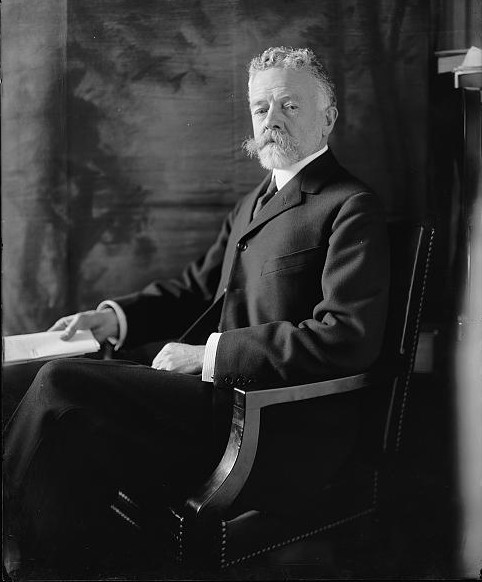
Lodge exercised his prerogative as majority leader to make himself chair of the Senate Foreign Relations Committee. Whether Lodge always intended to kill the treaty that emerged from the Paris Peace Conference remains a matter of debate. He was close to Roosevelt and had supported the former president’s call for a League of Peace. But he also faced pressure from fellow Republicans to derail the Treaty of Versailles and with it the League of Nations. A dozen Republican senators were so-called irreconcilables or bitter-enders—they opposed the league in any form because it would entangle the United States in European affairs. Wilson had not helped his cause when he returned to the United States in February 1919 and briefed senators on the status of the Paris negotiations. His remarks left many of them unsettled. One Republican senator complained: “I feel as if I had been wandering with Alice in Wonderland and had tea with the Mad Hatter.”
Lodge feared that divisions over the Treaty of Versailles could produce a repeat of the election of 1912. Then, Republicans had splintered between Roosevelt and Taft, allowing Wilson to win the White House. Lodge’s fellow Republicans played on this fear, leading him to lament that his colleagues were speaking to him in language that “no man my age should be obliged to hear.”
Fourteen Reservations
Lodge knew that the American public initially favored the Treaty of Versailles, so he did not attack it directly. He instead sought, as one historian put it, to “prolong the preliminaries and to delay the Senate’s advice and consent to the treaty until American opinion came to his side.” He began by taking two weeks to read the treaty out loud, sometimes to an empty committee chamber. He then called for public hearings, an unprecedented action at the time for a treaty, which lasted six weeks. Then he generated a list of Fourteen Reservations designed to “improve” the treaty. Among other things, the reservations stated that the league would have no say over U.S. domestic law and that Congress would retain its power to declare war.
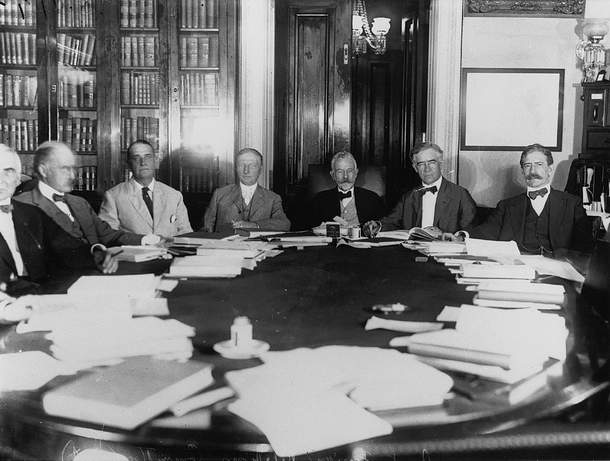
Lodge’s reservations infuriated Wilson, who believed that they gutted his handiwork. He refused to compromise even after Britain and France indicated they would accept Lodge’s changes to the treaty. Wilson instead took his case to the nation. Over three weeks in September 1919, he traveled more than eight thousand miles and gave forty speeches to rally support for the league. After speaking in Pueblo, Colorado, on September 25, severe headaches and nausea forced him to return to Washington. A week later he suffered a massive stroke, the effects of which he kept hidden from members of Congress and the American public.
“What Form the Internationalism Is to Take”
The intellectual dispute at the heart of the Treaty of Versailles was as important as the partisanship that animated it. The treaty debate is often, and incorrectly, described as pitting isolationists against internationalists. Isolationist voices were certainly vocal. Republican Senator William Borah of Idaho, the leader of the irreconcilable faction, denounced the League of Nations as a “treacherous and treasonable scheme” that should be “buried in hell.” If those words were not sufficient to make his point, he thundered that even “if the Savior of men would revisit the earth and declare for a League of Nations, I would be opposed to it.”
But the irreconcilables were a minority. Most senators recognized that “internationalism has come,” as Senator Minority Leader Gilbert Hitchcock of Nebraska put it, “and we must choose what form the internationalism is to take.” For Wilson, that internationalism meant international law and collective security. That approach troubled anti-League internationalists, who included most Republicans and some Democrats. They were happy to see the United States flex its muscles beyond its borders. But they believed that the United States should do so while preserving a free hand to act and not by tying its fate to the interests and decisions of others. Lodge put the point bluntly when he asked his colleagues: “Are you willing to put your soldiers and your sailors at the disposition of other nations?”
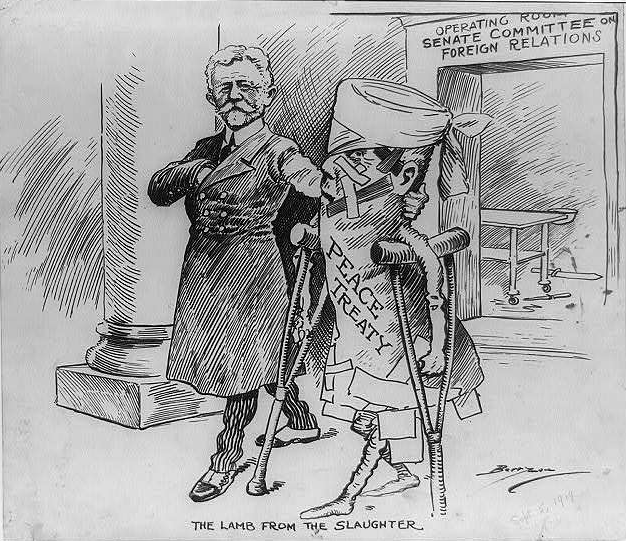
Despite pleas from his advisors and from Democratic senators, Wilson refused to discuss a compromise that Lodge and other anti-League internationalist senators could support. Even as the Senate vote approached, Wilson stuck to the defiant tone he had adopted upon signing the treaty when he was asked how he would respond if senators sought to revise it: “I shall consent to nothing: the Senate must take its medicine.” For Wilson, the League of Nations fulfilled a higher plan. As he told senators when he formally presented the treaty to them in July: “The stage is set, the destiny disclosed. It has come about by no plan of our conceiving, but by the hand of God who led us into the way.”
Medicine Rejected
The Senate took up the resolution of ratification for the Treaty of Versailles on November 19, 1919. Senators voted first on the treaty with Lodge’s reservations attached. That motion failed, 39 to 55, with both Wilson’s supporters and irreconcilable senators voting no. Senators then rejected the treaty without reservations by virtually the same margin, this time with those favoring the reservations joining the irreconcilables in opposition. The breakdown of the two votes showed that the treaty likely would have been approved had Wilson had been willing to compromise with his critics.
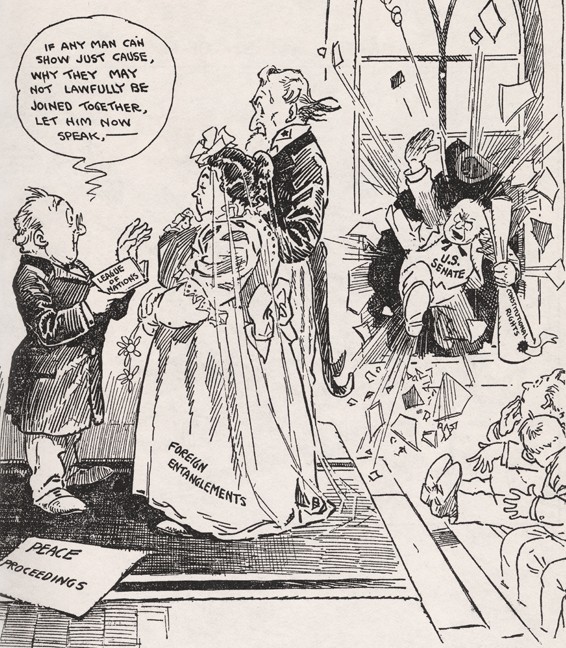
Four months later, the Senate considered the treaty with reservations once again. Although Wilson demanded that his supporters vote no, some broke ranks. The vote was 49 to 35 in favor, seven votes shy of the two-thirds needed for Senate passage.
Confronted with yet another defeat, Wilson vowed to make the 1920 election a “solemn referendum” on the league. But the moment had passed. Republican presidential candidate Warren G. Harding won in a landslide on a pledge to “return to normalcy,” and U.S. participation in the League of Nations was dead. In 1921, the Senate approved a treaty with Germany that accepted the Treaty of Versailles, minus the Covenant of the League of Nations. Wilson was left to mourn his failure to persuade the Senate to embrace the League of Nations: “It’s dead … Every morning I put flowers on its grave.”
The Legacy of the Senate Vote
Despite the Senate’s rejection of the Treaty of Versailles, the League of Nations came into existence on January 10, 1920. The league may have always been destined to fail because of its organizational flaws and because the harsh peace struck in Paris sowed the seeds for a future war. But the lack of U.S. participation and cooperation effectively guaranteed that the organization’s ultimate failure to preserve world peace.
Standing apart from the league made it easier for the United States to turn inward over the next two decades and to view growing world crises as someone else’s problem. After Pearl Harbor, many Americans concluded that Wilson had been right after all—standing apart from the world had made the United State less rather than more secure. That tragic lesson, learned at a grievously high price, would drive U.S. foreign policy for the next eight decades.
Oscar Berry and Jack Patton assisted in the preparation of this article.
The United States celebrates its 250th anniversary in 2026. To mark that milestone, I am resurfacing essays I have written over the years about major events in U.S. foreign policy. A version of this essay was published on November 19, 2010.
This work represents the views solely of the author(s). The Council on Foreign Relations is an independent, nonpartisan membership organization, think tank, and publisher, and takes no institutional positions on matters of policy.