As Washington Embraces Morocco, Regional Rivals Wake Up
U.S. backing of Rabat’s Western Sahara ambitions hinders peace prospects and worsens tensions in the region.
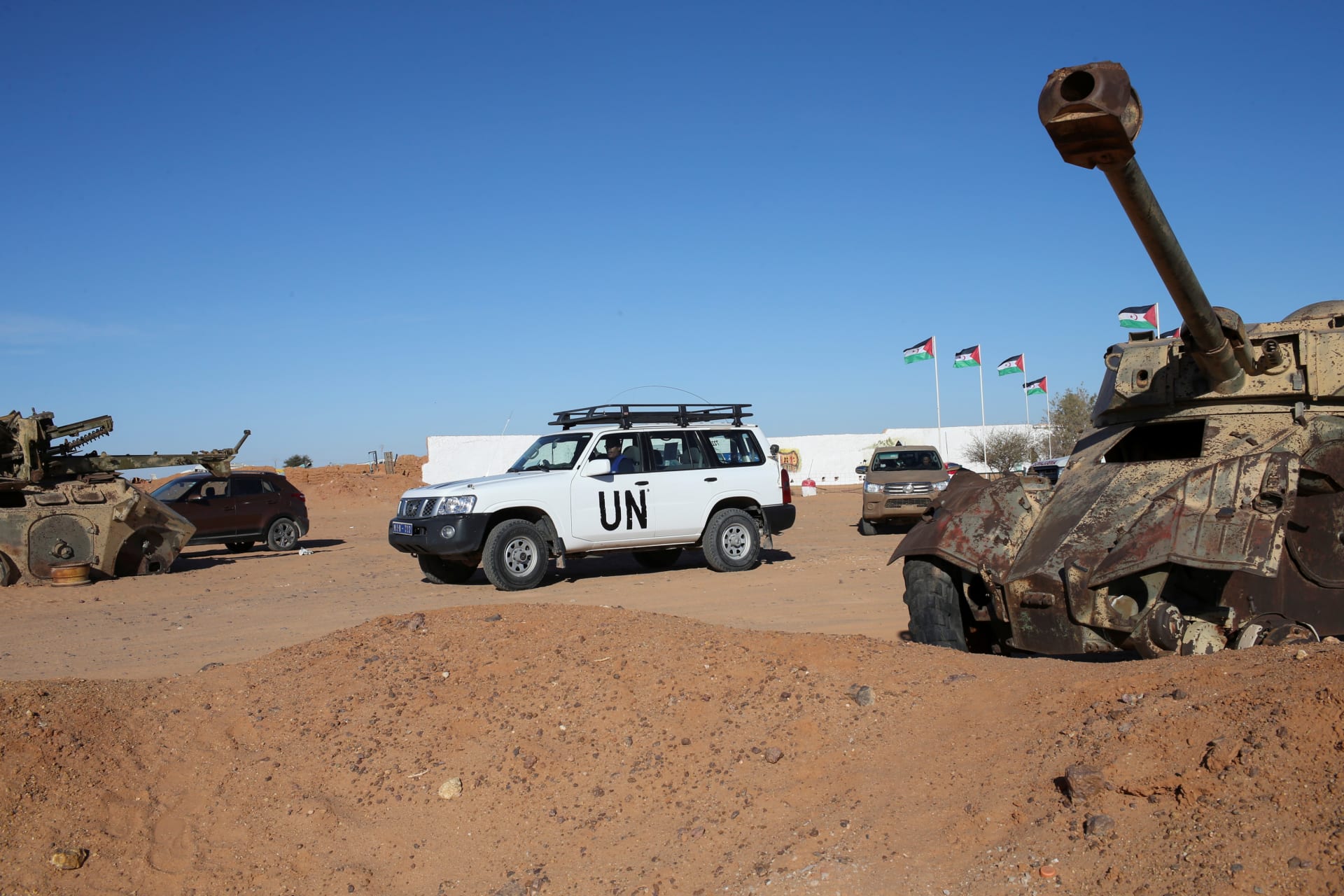
Last Friday, the United Nations Mission for the Referendum in Western Sahara (MINURSO) was left without a mandate, as the United States and Russia voted against each other’s proposals. Western Sahara, a territory on the northwest coast of Africa, has long been a contested space, with an independence movement calling for statehood even as Morocco claims the territory. Following years of armed struggle and a peace agreement, MINURSO was established to supervise a vote to determine whether the land would become part of Morocco or be an independent state. But disputes about the terms of the proposed referendum left the area in limbo for years. Recently, a Moroccan proposal that would give the Western Sahara limited autonomy under Moroccan sovereignty has won powerful supporters, including the United States. But the costs of siding with Rabat may include heightened tensions throughout the region.
The second Trump administration characterizes the UN as a bloated organization badly in need of cuts, and this is the lens through which it has explained its opposition to MINURSO. U.S. Ambassador to the UN Mike Waltz described the mission as costing too much money and lasting too long. In pursuit of a diplomatic victory, the United States arranged peace talks last January and February among Algeria, Mauritania, Morocco, and the Popular Front for the Liberation of Saguia el-Hamra and Río de Oro (Polisario). These efforts were framed as an exercise in pragmatism and morality, with U.S. officials stressing that the UN mission only prolongs uncertainty and that the people involved deserve a resolution. They point to a UN Security Council resolution (2797) that passed in 2025 (with U.S. endorsement) and supports Morocco’s preferred plan, providing a veneer of consensus to this path forward.
But that consensus has proved illusory, and it may be impossible to reconcile the leading role the United States has played in backing Morocco’s position with Washington’s desire to broker peace.
In 2020, as a part of the Abraham Accords negotiations that led to normalization of relations between Morocco and Israel, the United States reversed its own longstanding policy to back full Moroccan sovereignty over the territory. Prior to that, the United States treated the territory’s status as undetermined, acknowledged Morocco’s plan as a possible option but not the only option, and emphasized the role of the UN and MINURSO in bringing about a mutually agreed upon resolution. Since the 2020 shift, several European countries have changed their policies to be more aligned with Morocco. However, there is a difference in the degree of support offered, best divined by whether the country uses a definite or indefinite article to refer to Morocco’s plan. The United States and France describe Morocco’s plan as “the” or “the only” solution while Germany, Spain, and the United Kingdom have tended to use “a” solution. Neither is a win for the Polisario, but the latter leaves open the door for Sahrawi independence, while the former does not.
In July, the U.S. Trade and Development Agency announced funding for an ammonia plant in the disputed territory, referring to the area, as Morocco does, as the “southern provinces.” The U.S. Embassy in Rabat hosted an event to celebrate preparations for a consulate in Dakhla, held outreach appointments in Laayoune, and publicized visits by embassy staff to the Mauritanian border and Dakhla’s Atlantic Port. The administration has sought to undermine the Polisario, shopping for alternative groups that claim to represent the Sahrawi people but might be less demanding in negotiations. Prominent congressional Republicans have called for designating the Polisario as a foreign terrorist organization, characterizing it as associated with Iran or Hezbollah, with Senator Ted Cruz referring to the group as the “Houthis of West Africa.”
This U.S. embrace of Morocco appears to have caused some anxiety in Algeria, jolting officials into action to avoid losing regional influence. Algiers sent fighter jets to Niger to support the military government against a mutiny, and, for the first time since 1973, approved a foreign military action to deploy troops to Niger. Algeria normalized relations with Mali, exchanging ambassadors and welcoming Prime Minister Abdoulaye Maïga for a working visit. Lastly, Algeria cut diplomatic ties with the United Arab Emirates (UAE), citing “provocative and hostile” behavior in the region. Algeria’s renewed external action has been attributed to its understanding of the crises in Sudan, Libya, and the Sahel as increasingly interconnected.
The United States did not start the rivalry between Morocco and Algeria and is unlikely to ever demonstrate the level of support for the Polisario that Algeria would prefer. But by increasing its involvement with Morocco on the Western Sahara, it exacerbates existing tensions. It further stokes them by trumpeting the “unlimited opportunities” for collaboration among Morocco and Israel, fueling Algiers’ fear of a UAE-Israel-Morocco bloc that stretches across the continent and necessitates counterbalancing.
Ultimately, neither U.S., nor Moroccan, nor Sahrawi interests are served by the increasingly zero-sum nature of security and economic arrangements in the most fragile parts of the African continent. With the MINURSO presence already winding down and uncertainty heightened, the region will brace for renewed violence. In the abstract, U.S. interest in bringing about an end to the frozen conflict status of Western Sahara would be a welcome development. But by simply choosing a side, Washington may have worsened the outlook for regional peace.
This work represents the views solely of the author(s). The Council on Foreign Relations is an independent, nonpartisan membership organization, think tank, and publisher, and takes no institutional positions on matters of policy.