Horse Wrestling and Hegemony: Why Central Asia’s Nomad Games Matter This Year
CFR President Michael Froman analyzes the geopolitics playing out in the background of the World Nomad Games in Kyrgyzstan.
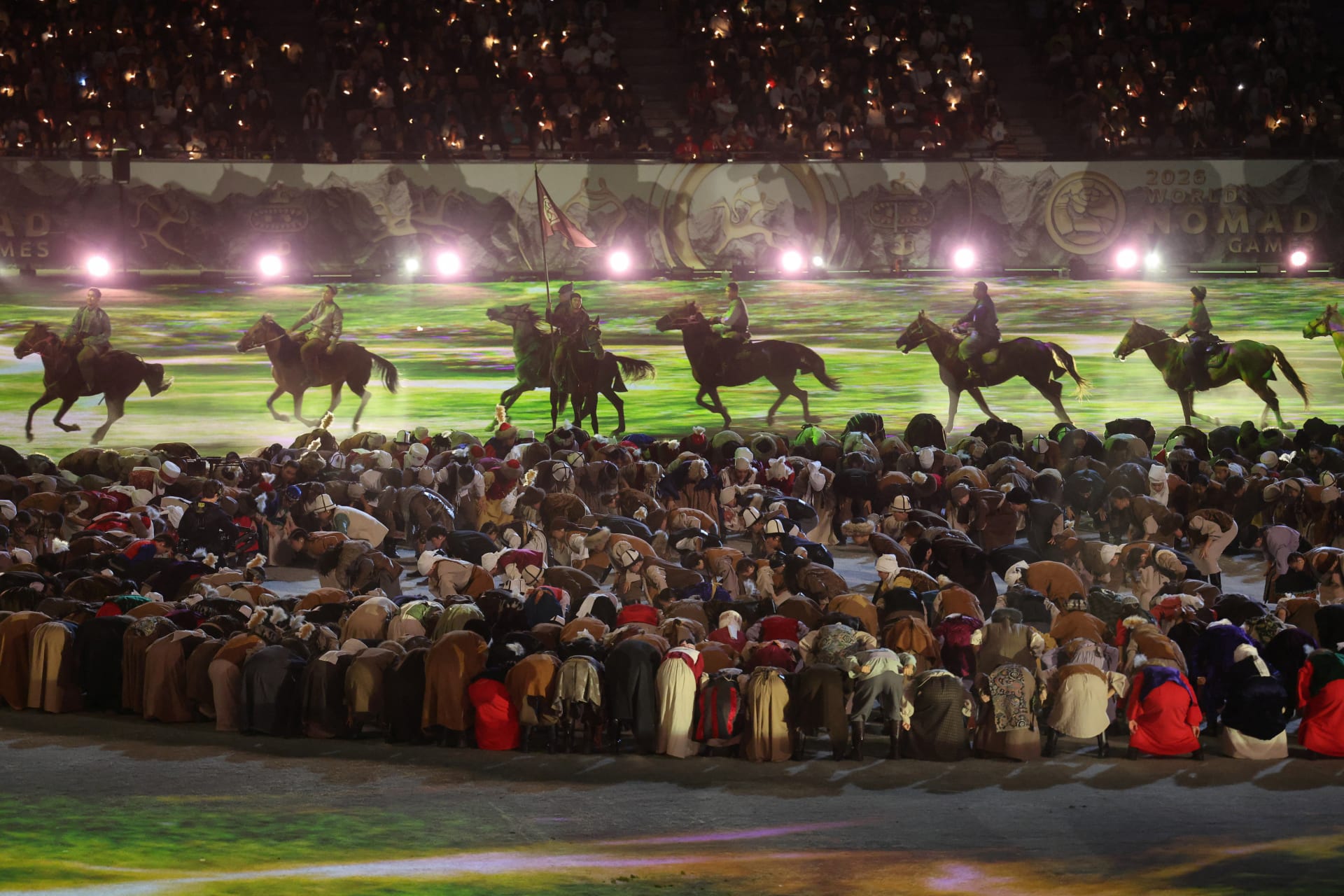

August is supposed to be the month when the world slows down. Not this year. And so The World This Week is back from vacation a week early.
In just the last few weeks, the United States has paused and resumed its military operations against Iran; U.S.-Canada tensions spiked after trade talks collapsed; U.S. government debt tipped over the $40 trillion mark, sending bond yields to their highest level since 2008; and we all learned a lot more about AI agents jumping out of sandboxes and going rogue. That’s a lot to get caught up on.
Notwithstanding all of those important developments, I wanted to focus instead on an event that has not hit the homepages of most media outlets. It’s about the power of sport, but it’s not the World Cup. It’s about Americans and Russians meeting on the field of competition, but it’s not the G20 Finance Ministerial (although the in-person appearance of the Russian minister there for the first time since the invasion of Ukraine was also a noteworthy development this month).
It’s the World Nomad Games in Kyrgyzstan.
With synchronized horsemanship, projected mountain ranges, and throngs of athletes from around the globe, the World Nomad Games kicked off with impressive fanfare in the Kyrgyz capital, Bishkek, earlier this week. The games are considered the Olympics of Central Asia, featuring competitions rooted in the region’s cultural and athletic history. There are half a dozen kinds of wrestling events, multiple versions of falconry, archery (both on horseback and not), and, interestingly, several traditional board games.
My personal favorite is Kök-börü, a game that combines elements of polo and rugby, as men on horseback battle each other to deliver the carcass of a goat into the opposing team’s goal. Goat polo is the GOAT, as far as I am concerned. (Sorry, just too tempting to pass up.)
You would be forgiven for thinking that the unfamiliarity of these games would mean that they are only played amongst Central Asian states. But you would be wrong. More than one hundred countries will be participating this week, including the United States and the United Kingdom. The British team of mostly university students is participating in a literal tug-of-war contest. The American team is bringing the mountain west’s love for horses to two competitions: horse wrestling, which is just about exactly what it sounds like, and Kök-börü. (Take a look at this video highlighting the considerable goat polo expertise of the U.S. team.)
But for readers of The World This Week, there was something else on display at the opening ceremony worth paying attention to: in attendance was Russian President Vladimir Putin, Indian Prime Minister Narendra Modi, and Iranian President Masoud Pezeshkian, alongside the heads of state of the other members of the Shanghai Cooperation Organization (SCO), which held its annual summit this week in Bishkek as well. Chinese leader Xi Jinping was expected to attend the opening ceremony but pulled out to focus on the response to disastrous flooding and landslides in Tibet.
Playing out in the background of the sports and the somewhat psychedelic opening ceremony is a complex geopolitical struggle, with Central Asia at its core. For years, the SCO has been touted as a regional counterweight to major Western blocs. Although the impact of the organization has been exaggerated, it has shown staying power in bolstering regional ties. The convergence of the SCO summit and Nomad Games in Bishkek presents an opportunity to shed some light on an important corner of the world.
First, this region is playing a delicate role in navigating the economic fallout from the war in Iran. With U.S. sanctions crippling the Iranian economy and a naval blockade of the Strait of Hormuz significantly reducing its oil exports, Iran’s economy is finding some limited help in the form of trade with its Central Asian neighbors. While Pezeshkian’s presence in Bishkek for the SCO summit primarily underscores Iran’s client relationship with China, it also highlights Iran’s need to deepen its economic ties with the broader region. Tehran’s pivot to Central Asia is part of a long-term strategy that predates—but is being accelerated by—the war. However, as any U.S. official will tell you, pivoting to Asia and away from quagmires in the Middle East is a lot easier said than done.
At the same time, however, those Central Asian powers could look to exploit Iran’s instability and shore up a stronger position for themselves in the global energy market. Kazakhstan produces nearly as much oil as Kuwait and is already a significant supplier to the EU, while Turkmenistan holds the world’s fourth-largest natural gas reserves and sells almost all of that to China. As everyone seeks to de-risk away from the instability of the Strait of Hormuz, those resource-rich producers become increasingly attractive sources of energy for the rest of the world.
Central Asia has also played a critical role in keeping the Russian economy afloat since the invasion of Ukraine. Kazakhstan and Kyrgyzstan are members, alongside Russia, of the Eurasian Economic Union, enabling the transfer of Western electronics, microchips, and machine tools without customs scrutiny, evading Western sanctions on critical dual-use goods. Trade data from the European Union shows that in the first ten months of 2025, imports of many of those high-priority items from Europe into Kyrgyzstan ran 800 percent above pre-invasion levels, while Kyrgyz exports of those same items to Russia were 1,200 percent higher, helping to sustain both the war effort and the economy that undergirds it.
For both Iran and Russia, Central Asia has become a kind of lifejacket: it won’t rescue them from the current crisis, but it will sustain them amid stormy geopolitical times.
If Central Asia serves as a lifejacket, China is the lifeboat that provides a more durable craft in troubled waters. This role was undeniably on display at the SCO summit, where Xi and Putin held a public bilateral meeting that reaffirmed their no-limits partnership. That alliance has become both existentially necessary for Putin and transformative for Xi, who has turned a partnership of peers into a clientelist relationship.
China is playing a similarly significant role for Iran. Days before the SCO meeting, China stressed it will not have the terms of its engagement with Iran, its de facto client state, dictated by the United States. “Economic D-Day” implicitly threatened China with secondary sanctions, but it was quick to denounce and dismiss the threat. China is the one country that could potentially deliver Iran to the negotiating table, but Xi has shown no interest to date in leveraging his role as Iran’s most important benefactor to do so.
This tournament and the politics around it speak to our current moment, but also to a longer contest. The eccentricities of the games, and of the geopolitics surrounding them, strike me as the product of two forces stuck in a tug of war of their own: fragmentation and globalization.
On one hand, both the sports and the politics are profoundly local: while Chinese, Iranian, Russian, and Uzbek athletes face off in a game of horseback archery or traditional Kazakh falconry, their leaders are forming a tight-knit regional alliance network, designed to insulate them and their neighbors from unwanted Western influence. Stability and security no longer come from diffused integration with the global economy, but from concentrated networks of allies and partners—coalitions of the willing. It is no coincidence that this sixth round of the World Nomad Games was grander than ever before: regionalism, grounded in a shared geography and culture, is becoming a defining feature in global politics.
And yet, I can’t help but find something both amusing and uplifting in the fact that dozens of Americans, Brits, and others far removed from Central Asia got on a plane to proudly represent their country in everything from ancient board games to horse wrestling. That they chose to do so tells the story of the openness of the last three decades. It is a reminder that the globalization of goods and services also enabled a globalization of culture and customs. As we beat a retreat from uber-globalization, we ought to remember that the kind of cultural understanding that globalization enabled was a rare and good thing – except for the goats.
Let me know what you think about the World Nomad Games and what this column should cover next by replying to [email protected].
This work represents the views solely of the author(s). The Council on Foreign Relations is an independent, nonpartisan membership organization, think tank, and publisher, and takes no institutional positions on matters of policy.