In These Midterms, Foreign Policy Mattered
CFR President Michael Froman analyzes the results of the midterm elections.
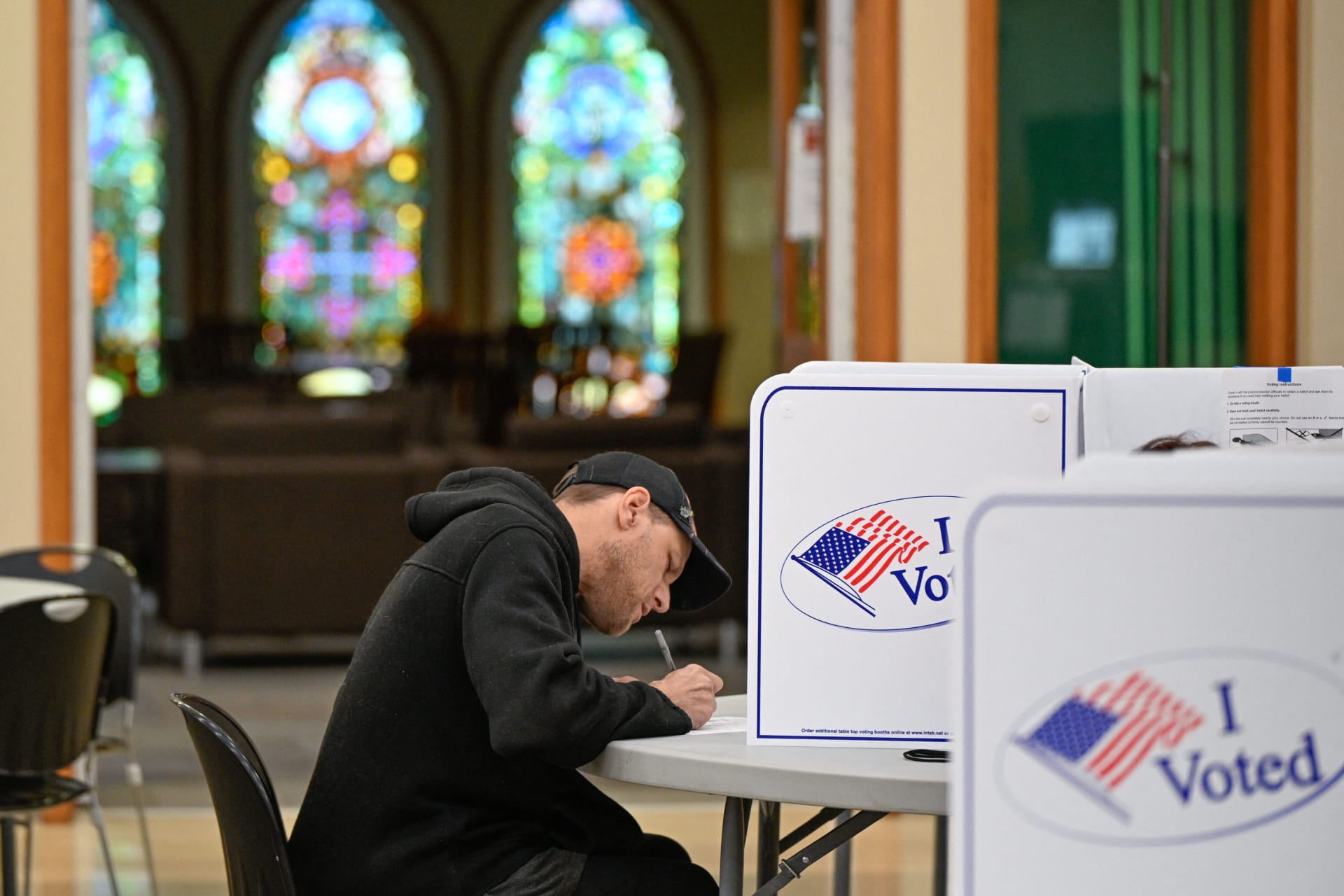

It has often been said that foreign policy issues will not win you an election, but they sure can lose you one. More often than not, foreign policy is irrelevant to election outcomes, particularly midterms. Not this week.
Here at CFR, we are often pressed to explain “why it matters.” Why should foreign policy matter to the American public, particularly when they have more immediate issues to worry about, including making ends meet? This week’s results demonstrate what happens when foreign policy meets the kitchen table. Affordability was front and center in voters’ minds, and they linked that to the Iran war and tariffs.
While the extent of Tuesday’s rebuke of Republicans might have been surprising, the drivers behind it were not. For the last several months, CFR fellows have been traveling the country conducting opinion polls and speaking to voters to gauge Americans’ views about the issues that are most important to them, the key foreign policy questions, and what role they want to see the United States play in the world. The findings were clear and overwhelming. The poll, taken over the summer with Morning Consult, for example, found that 75 percent of Americans were concerned about affording food and groceries, and 41 percent of people surveyed saw tariffs as raising prices.
Similarly, voters in Arizona and Wisconsin were feeling the pain of high prices for energy and other goods, did not see the logic behind the Iran war, and thought the indiscriminate application of tariffs was irrational. As CFR’s Rebecca Lissner concluded, “Americans in Wisconsin and Arizona shared many concerns, anchored foremost in anxieties about affordability and the ways Washington’s foreign policy choices seem to be raising costs.” This is consistent with one of the key lessons from the 2024 election: American voters are highly price sensitive.
War and gas prices
In a conversation with CFR’s Jim Lindsay held just before the elections, Jessica Huseman, the editorial director at Votebeat, which provides nonpartisan local reporting on elections and voting, concluded that Americans worry about foreign policy primarily in terms of its consequences at home. Huseman argued that voters do not think about foreign policy the way that experts do. When experts “talk about the Iran war, [voters] hear gas prices. When we talk about tariffs, they hear or see rising grocery prices or the fact that … they can’t sell their products as farmers,” she said.
[Video: https://www.youtube.com/shorts/csI_slprjBY]
Vice President JD Vance seemed to agree, at least in part. In his election postmortem on X analyzing his party’s defeat, he wrote that “The reason we lost is the war. The president himself said so last night. If you’d like to argue it was worth it, that losing the Senate for the next 6 years was worth it, then do so. Argue it was a worthwhile cost to pay. Agree or disagree, that’s at least honest. But everyone knows why we lost. And any honest conversation about where we go from here must start there.” The vice president is right that we need to have an honest conversation about tradeoffs. No foreign policy or trade policy is free. It all involves costs and benefits, tradeoffs and sacrifices. It is a sign of the health of our democratic process that we are at least having that conversation.
Where do we go from here? Well, the president has already achieved much of what he hoped to achieve with regard to legislation and, beyond that, he has relied largely on the exercise of executive power, not Congress. He is even more likely to do so going forward, now that control of Congress has shifted to the Democrats. With the political constraints of the midterm races behind him, he might well double down on the trajectory he’s been on, from tariffs to Iran to, perhaps, Cuba.
What Congress can—or can’t—do
There are a lot of people around the world speculating about how Congress is going to rein in the president, but in reality there is little Congress is likely to be able to do. If Congress were to legislate on tariffs or Iran, it would likely face a presidential veto, unless it can package its actions with a must-pass bill such as the National Defense Authorization Act (NDAA), a debt limit increase, or an appropriations bill.
On Iran, there could well be more oversight of the Pentagon’s conduct of the war, but it is hard to see Congress taking steps that could be seen as undermining the president’s military posture or negotiating leverage. On tariffs, there is talk about constraining authority Congress has previously delegated to the executive, but there is less consensus about whether, when, and how tariffs should actually be applied.
Ukraine will be an interesting test case. There continues to be bipartisan support, perhaps as large as a veto-proof majority, for aiding Ukraine and sanctioning Russia. President Donald Trump has ignored that perspective when he waived sanctions on Russia, but Congress does still control the purse strings and could potentially appropriate support for Ukraine, even if the administration does not request it. Still, the executive has lots of ways to delay or avoid spending money if it so chooses, and it’s hard to imagine a situation in which Congress forces the transfer of arms to Ukraine if the president is dead set against it.
Talking trade and tradeoffs
Perhaps this will be the beginning of a real conversation about the tradeoffs inherent in trade policy. The global trading system has always provided room for tariffs to be imposed—to counteract unfair trade practices and to protect national security, for example. The administration has stretched those authorities beyond recognition. This would be a good occasion to build upon the administration’s willingness, seen at the recent Trump-Xi summit, to distinguish between strategic and nonstrategic trade, and to reduce tariffs on the latter so that Americans aren’t paying more for basic goods, such as sneakers, T-shirts, and cabinets, for no compelling reason. In polls and focus groups, we found that Americans saw value in distinguishing between allies and partners, on one hand, and competitors (read: China), on the other. Shouldn’t we be able to rely on Canada to supply us strategically important goods, such as aluminum?
That said, tariffs are easier to put on than they are to take off. Constituents who benefit from tariffs tend to mobilize to keep them in place. And, in the context of the federal government’s fiscal challenges, it might prove difficult to wean ourselves off a source of revenue, paid by consumers and by manufacturers that rely on imported inputs, which brings in about $200 billion a year.
The base case, then, is one of continuity. Despite the bipartisan opposition to elements of the administration’s tariff regime and its application, the White House remains committed, arguing it is a key factor in the reindustrialization of the U.S. economy. This is an issue that is deeply personal to the president, who bucked decades of Republican conventional wisdom by making tariffs a central component of his economic strategy. Still, this president has shown a remarkable willingness to change tack amid shifting political winds. Last November, for instance, days after Democrats swept races in Virginia, New Jersey, and New York City on a message of affordability, he quietly exempted more than two hundred food products, including beef, coffee, and bananas, from his tariffs. And last month, he tried to relieve pressure on Republican candidates in Maine and Michigan by reducing tariffs on certain products coming from Canada.
Recalibrating his tariff policy to focus more narrowly on strategic goods—and sparing allies and partners from the indiscriminate imposition of tariffs—could allow him to maintain his signature economic policy without dismissing affordability as a hoax. Working across the aisle with a Democratic Congress to define the parameters of durable trade policy could offer the president a way to cement one part of his legacy—by addressing affordability concerns while modeling a more judicious, strategic use of tariffs.
The data center dilemma
While all eyes are rightfully on the change in power in Washington, DC, we should not forget that Democrats took control of key statehouses across the country, from Texas to Ohio. These new governors have a mandate to lead on a broad set of issues, but one stands out in particular: data center buildouts. In these key races, Democrats ran on a platform of slowing the expansion of data centers, proposing moratoriums and other less extreme restrictions. And beyond the statehouses, a number of local referenda restricting data center construction passed as well. But whether the United States continues to lead on artificial intelligence (AI), at least in the quest for superintelligence, is thought to be tied to the continuation of the investment boom in data center infrastructure.
This election showed that there is little political appetite for a pro-AI argument and that the AI companies have a long way to go to make their case to voters. Whether Washington steps in, and how, is now an open question.
Of polls and prediction markets
As for the health of American democracy, data suggests that nearly 123 million votes were cast, representing just shy of half the eligible population, besting the 2022 turnout, but falling short of the 50 percent mark in 2018. In a win for data enthusiasts, the polls and prediction markets were fairly on the mark this week, with a couple notable exceptions, such as the Senate race in South Carolina where Darline Graham was the odds-on favorite to win and instead lost.
The key takeaway is the reminder that prediction markets are probability machines—not oracles, as CFR’s Sam Lazarus noted in a recent CFR report. To state the obvious, even if a particular outcome has 60 percent odds, that means it is likely to come out the other way four out of ten times.
What are the odds we see a fundamental change in the foreign landscape in the coming months? Kalshi says that the odds that traffic through the Strait of Hormuz will return to normal before January 1, 2029 are 69 percent—exactly what Darline Graham’s odds of winning the Senate race in South Carolina were at 5:00 p.m. on November 3, Election Day. In other words, your guess is as good as mine.
Let me know what you think about what the midterm results mean for foreign policy and what this column should cover next by replying to [email protected].
This work represents the views solely of the author(s). The Council on Foreign Relations is an independent, nonpartisan membership organization, think tank, and publisher, and takes no institutional positions on matters of policy.