The Iran War Is Highlighting—and Expanding—Authoritarian Collaboration
Autocratic regimes like China and Russia have increasingly supported Iran and other repressive partners in an effort to keep authoritarians in power and build a global network of autocracies.
By experts and staff
- Published
 Joshua KurlantzickCFR ExpertSenior Fellow for Southeast Asia and South Asia
Joshua Kurlantzick is senior fellow for Southeast Asia and South Asia at the Council on Foreign Relations. He is writing a book on global authoritarian collaboration.
The Iran war appears no closer to ending, despite a ceasefire and ongoing negotiations, and Tehran seems emboldened by these developments. Part of Iran’s calculus may be that it can take advantage of the leverage it has over the global economy—demonstrated by its ability to close the Strait of Hormuz—and effectively outlast the White House’s economic pain threshold. (Iran had opened the strait during this ceasefire, and then it quickly closed it again.)
But Iran has also benefited significantly from autocratic partners’ help. China and Russia, among others, have continued to provide critical support to Iran during the war, sometimes using existing hard-to-track trade and shipping methods that these countries have perfected. Since the war started, China has provided Iran with satellite navigation, radar systems, and electronic warfare technologies, and appears ready to supply shoulder-fired missiles that would upgrade Iran’s anti-air defenses. It also has continued to buy Iran’s oil, providing it with critical cash through a network of tankers designed to avoid sanctions. Iran itself, without help from China, has utilized these types of false-registered tankers to back other autocrats, such as by supplying Iranian fuel to the junta in Myanmar.
Meanwhile, Russia has sent Iran sophisticated drones, which have been adapted as Russia learned lessons from the war in Ukraine. Moscow has also helped Iranian forces with drone targeting, cyberwarfare, and signals and electronic intelligence, according to U.S. and European officials.
These drones have proven hard for U.S. forces to combat, despite the Pentagon’s massive military advantage over Iranian forces. Indeed, the drones have done significant damage to U.S. bases near Iran, killed U.S. service members, and forced the United States and its partners to deploy many of their interceptors—so much so that Washington had to start diverting interceptors from allies in Asia.
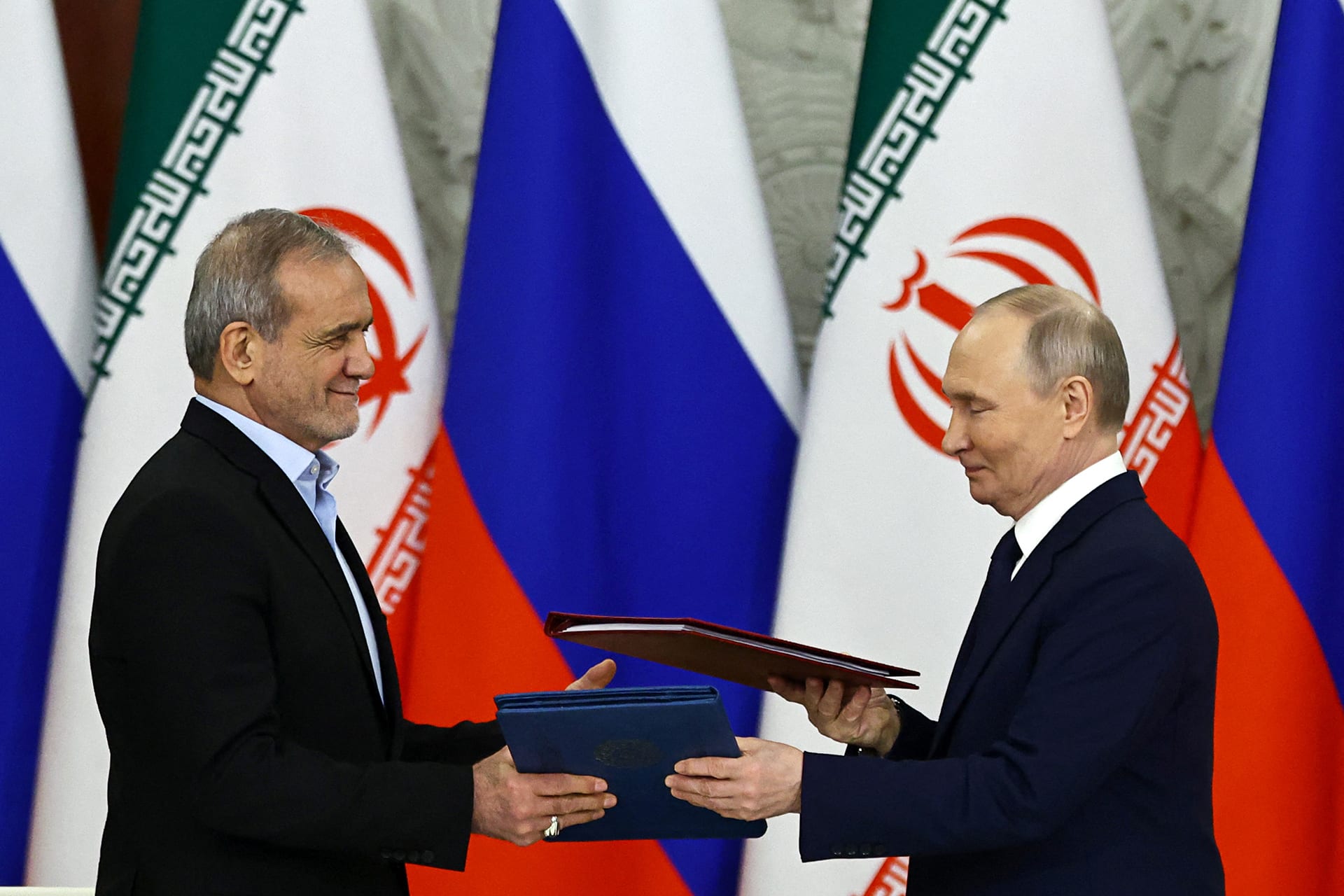
China and Russia’s support for Iran is part of a growing trend of authoritarian cooperation—a type of collaboration that has become increasingly powerful and regular. Over the past decade, a wide range of authoritarian giants, mid-size states, and smaller autocracies have increasingly worked together and even formalized their collaboration. For instance, Myanmar and Russia signed a four-year defense and security agreement in February that makes them almost allies. Similarly, China and Russia announced a “no limits” partnership in 2022, and then followed it up in 2025 with a bilateral investment agreement. In 2025, Russia also signed a defense cooperation deal with Burkina Faso, Mali, and Niger, three military-run autocracies in West Africa that have become increasingly close to Moscow. These are but a few examples of this trend. Autocratic states of all sizes are formalizing diplomatic, economic, and military cooperation deals with each other.
Not every autocracy is closely enmeshed in this network, but most are. There do remain authoritarian or semi-authoritarian states today—Egypt, Jordan, Morocco, Vietnam, to name a few—that, while repressive, have little cooperation with the global network of autocrats. This is often because they have economic and strategic ties with leading democracies, such as Egypt’s reliance on U.S. assistance, or have long histories of conflict with China or Russia.
But they are the outliers. Overall, the autocrats building this network are gaining the strength needed to make this collaboration work. After all, autocracies are not just more populous than democracies today—nearly three-quarters [PDF] of the world now lives in authoritarian states—they are getting richer and more sophisticated, both diplomatically and in how they present themselves to the world.
Autocratic countries were responsible for nearly 50 percent of global gross domestic product (GDP) in 2022, double their share of global GDP in the 1990s. While this greater wealth has helped them build more repressive environments at home, it also has helped them upgrade and expand their diplomatic corps, state media, and ability to wield influence online—often to bolster each other’s global disinformation efforts and other goals. Indeed, Russian, Chinese, and other authoritarian state media have worked to amplify (often false) Iranian state media claims and online disinformation during the war.
This group of regimes has defied democratic leaders and policymakers’ long-standing, post-Cold War belief that autocratic regimes could not build lasting, powerful international cooperation and achieve goals together. The longtime wisdom is that autocrats are too insular and brittle to build the ties needed to shape the world over the long term.
Even before the Iran war, evidence was building that authoritarian collaboration was no longer just ad hoc. As I previously noted, the landmark Authoritarian Collaboration Index released in 2026 by Action for Democracy, a global democracy research organization, demonstrated the seriousness of the threat. The group used a combination of sophisticated large language models, natural language processing, and political science typology to create the most exhaustive chronicle of recent interactions between autocrats around the world. The index, which contains autocratic interactions from January 2024 onward, contains some 72,000 incidents of autocratic collaboration.
These authoritarian collaborators appear to share multiple broad goals. They want to keep other authoritarians in power, degrade democracy in many parts of the world, challenge democracy as the best system of governance, and ultimately create autocratic regional and global alternatives to the post-World War II order, including the use of the dollar as the international reserve currency.
The Iran war has highlighted this trend and could make it worse. The war shows how autocrats can survive via the help of other authoritarian regimes. The war also could facilitate dedollarization.
Facing sanctions after the start of the Ukraine war, Russia has already collaborated with China and other states to create financial transfer systems that often use the Chinese yuan instead of the U.S. dollar in order to avoid the SWIFT transfer system, a financial messaging system overseen by Group of Ten countries’ central banks that facilitates cross-border financial flows. Meanwhile, as former International Monetary Fund chief economist Kenneth Rogoff has noted, China has already been moving to denominate more of its trade in the yuan and pushing many large developing economies to do so too, with some success.
During the war, Iran has helped increase the use of the yuan internationally. With its control of the Strait of Hormuz (at least before the ceasefire briefly reopened it), Tehran declared it would only permit consumers paying in Chinese yuan to transit the strait. The longer these consumers, mostly in Asia, use the yuan, the more they get used to it as a currency of global exchange. Indeed, even close U.S. allies and partners in Asia, starved for energy, are increasingly working with Iran and Russia to buy oil from them, thereby moving closer to U.S. adversaries and further boosting the use of the yuan.
In solidarity with previous U.S. aims, these U.S. partners in Asia had mostly stopped buying Russian oil after the onset of the Ukraine war. Now they are welcoming petroleum from Tehran and Moscow—and are increasingly praising Iranian and Russian leaders. On a trip to Moscow last week, Indonesian President Prabowo Subianto declared that Russian leader Vladimir Putin had played “a very positive role in dealing with this uncertain geopolitical situation.”
The Iran war could also potentially rupture collaboration between democracies in a Suez Crisis-type fashion, permanently denting the United States’ image as a hegemon. This could be a blow that further convinces traditional U.S. allies and partners that a post-U.S. world order is here. Research shows that the trust between democracies that is central to international institutions is already beginning to collapse—as democracy falters in many countries and U.S. leaders increasingly dismiss many traditional partners. The latest index on global democracy produced by respected research organization Varieties of Democracy Institute (V-Dem) finds that [PDF] while half of the world’s population lived in democracies in 2005, only 26 percent do today.
To be sure, the autocratic network is not winning all the time. It could not save former Syrian leader Bashar al-Assad’s regime or prevent former Hungarian Prime Minister Viktor Orbán’s recent loss in Hungary, for instance.
But the broader trend suggests authoritarian collaboration is growing stronger and more globalized. As the war continues, Iran’s autocratic partners, and Iran itself, seem emboldened. Clearly, the war has done little to stop the authoritarian ascendance.
This work represents the views and opinions solely of the author. The Council on Foreign Relations is an independent, nonpartisan membership organization, think tank, and publisher, and takes no institutional positions on matters of policy.