The Limits of Trump and Xi’s Photo-Op Summit
The leaders of the world’s two most powerful countries did not resolve any of the major issues facing the U.S.-China relationship. But that does not mean the meeting was a complete failure.

David Sacks is a fellow for Asia studies whose work focuses on U.S.-China relations, U.S.-Taiwan relations, Chinese foreign policy, and cross-Strait relations.
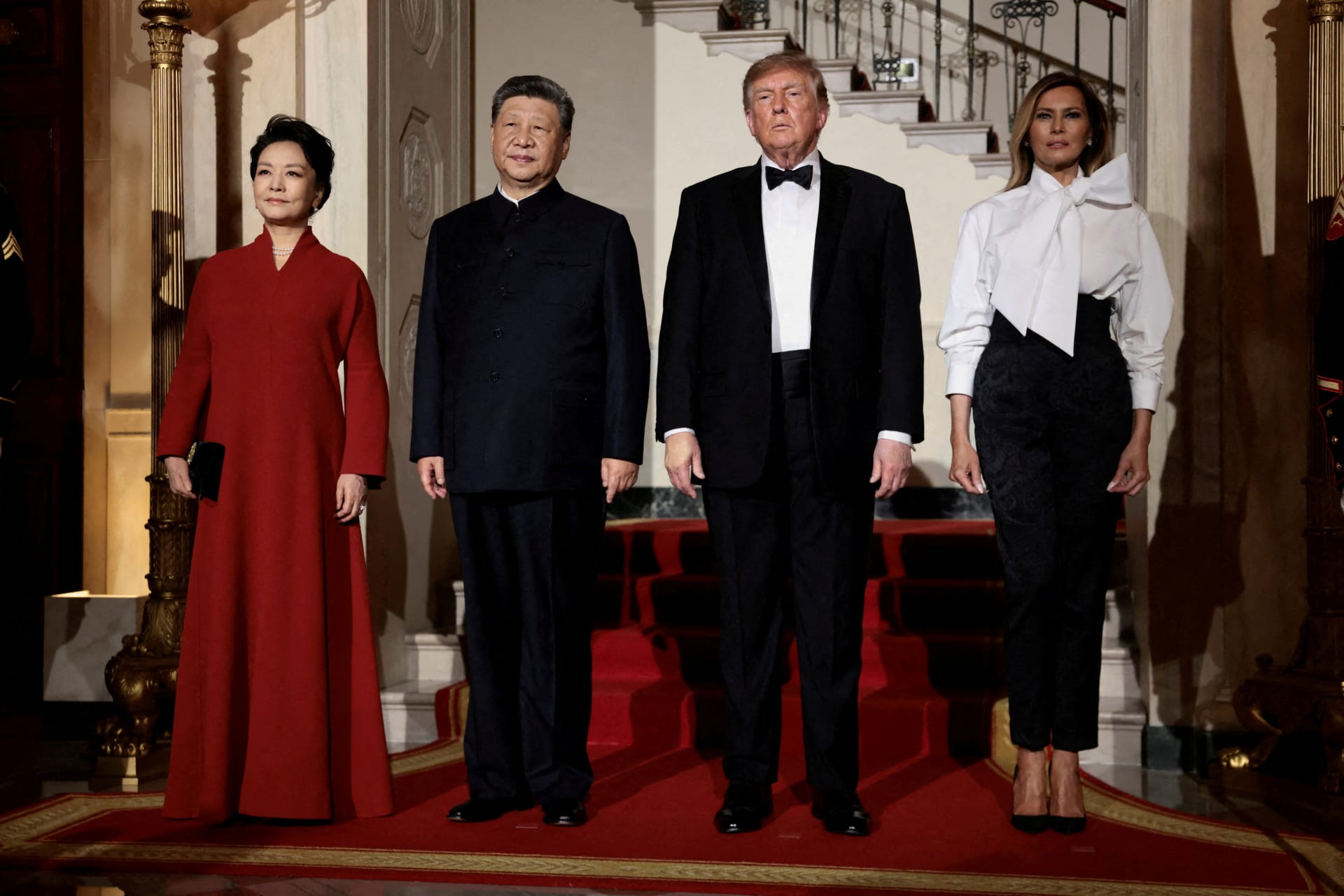
It is by now a cliché to note that meetings between U.S. President Donald Trump and Chinese leader Xi Jinping are high on symbolism and low on substance. Xi’s visit to Washington this week, though, may have set a new high-water mark for symbolism and a new low for substance. Trump and Xi did not reach a consensus on any of the major geopolitical issues in which they find themselves on opposing sides, make headway in regulating the development of artificial intelligence (AI), or place the bilateral economic relationship on a more sustainable trajectory. Indeed, the only clear winner to emerge from the discussions was Zoo Atlanta, which is set to receive two giant pandas.
The tone for Xi’s visit was set at Joint Base Andrews, where Trump eagerly awaited his guest’s arrival. Members of the U.S. military literally smoothed the red carpet for Xi, who received the distinction of becoming the first foreign head of state to be greeted at Andrews by a U.S. president (aside from papal arrivals) in over six decades. Notably, Xi did not extend the same courtesy when Trump visited Beijing in May. Trump’s decision to bestow such an honor reflects his belief that a strong personal bond with Xi can effectively paper over the major structural issues between the United States and China. China, for its part, will use these optics to make the case that it is now an equal of the United States and should be treated accordingly. According to China’s readout, the visit resulted in eight modest deliverables. The Trump administration’s fact sheet did not directly repeat these eight deliverables.
In the economic realm, according to the Trump administration, the two sides identified $30 billion of nonsensitive goods in each direction that could enjoy reduced tariffs. China also agreed to import at least ten million metric tons of coal from the United States in both 2027 and 2028. The two countries also established a U.S.-China Board of Investment. The Chinese readout, however, did not mention the coal purchases or the Board of Investment.
Trump and Xi also agreed to extend by two months, to January 10, 2027, the one-year economic truce that took effect in November 2025. Under the terms of that agreement, the United States reduced tariffs on Chinese goods and China pledged to restore U.S. access to rare earths, purchase twenty-five million metric tons of U.S. soybeans a year, along with other agricultural products, and crack down on the export of precursors used to manufacture fentanyl. Despite this agreement, Chinese exports of rare earths to the United States remain below their historical levels, and the Trump administration noted “U.S. concerns regarding supply chain shortages related to rare earths and other critical minerals.” A major question moving forward is whether Chinese exports of rare earths bounce back in the coming months or remain depressed.
The summit did not yield any breakthroughs on AI, which has emerged as perhaps the most talked-about and consequential facet of U.S.-China relations. Those who fear that humans could soon lose control of advanced AI models have been urging the United States and China, as the world’s two leading AI powers, to agree to slow the pace of development and establish safeguards. Others have urged the Trump administration to pressure China to curb distillation, an AI training technique for copying a rival model’s outputs. Beijing, for its part, wants Washington to ease export controls on the most sophisticated semiconductors, which are needed to develop and train advanced AI models. In the end, the two sides agreed to establish a U.S.-China AI dialogue, with the next meeting scheduled to take place in November, and to create a bilateral communication channel for AI incidents. Trump seemed more focused on getting China to agree to rebrand AI as “super intelligence.” According to the U.S. fact sheet, Trump and Xi “agreed to use the term ‘super intelligence,’” although China has not adopted this new naming convention.
Geopolitical differences seem to have been left on the back burner. Trump and Xi agreed that Iran should not develop a nuclear weapon and that tolls cannot be levied on international waterways. According to U.S. Ambassador to China David Perdue, Trump reiterated to Xi that any Chinese assistance to Iran would be “totally unacceptable” and Xi “assured him that changes had been made.” The two sides did not announce anything notable pertaining to Russia’s war against Ukraine or North Korea’s nuclear weapons program.
Buying time
Xi, unsurprisingly, raised Taiwan during his meetings with Trump. Xi’s statement noted, “It is hoped that the U.S. side will adhere to the correct position of opposing ‘Taiwan independence,’ and handle the Taiwan question with caution, so as to lay a solid foundation for China-U.S. strategic cooperation and the development of bilateral relations.” Calling on Trump to “persist” (坚持) in opposing Taiwan independence—a more accurate rendering than the official English translation’s softer “adhere to”—indicates that from Beijing’s perspective Trump has already altered U.S. policy and the task is for him to maintain this course. Xi also cast U.S. policy toward Taiwan as a prerequisite for laying “a solid foundation” for the bilateral relationship.
Despite this messaging in the days leading up to the summit and during the summit itself, Taiwan was not featured in either side’s end-of-summit readouts. Trump did not yield to China’s pressure to explicitly oppose Taiwan independence, while administration officials stated that U.S. policy toward Taiwan remains unchanged.
While Taipei will likely find this reassuring, it will be more concerned about the fate of the pending $14 billion U.S. arms sale. Beijing aims to delay this sale indefinitely, which would deepen doubts in Taiwan about U.S. reliability and delay the arrival of important weapons. Perdue noted in an interview after the summit that Trump and Xi “talk about that every time they get together” and that Trump even asked Xi if he would like to buy U.S. weapons in the future. With Xi and Trump agreeing to meet again at the Asia-Pacific Economic Cooperation (APEC) leaders’ meeting in Shenzhen in November and at the Group of Twenty (G20) summit in Miami in December, China is likely confident that it can delay any U.S. arms sale to Taiwan into 2027.
Trump and Xi did not achieve meaningful progress on any of the major issues in the bilateral relationship. But that is not to say that the summit was a complete failure. Both leaders oversee top-heavy systems, making discussions between the two of them even more important. For now, they seem content with attending summits that do not resolve the points of friction and kicking many cans down the road. Both are playing for time: for Trump, to wean the United States off Chinese rare earths, and for Xi, to overcome dependence on U.S. high-tech products.
Given the array of sensitive geopolitical issues, from Iran to North Korea, Taiwan, and Ukraine, communicating bottom lines and clearing up potential misunderstandings are critical. To the extent that regular meetings allow Trump and Xi to clearly convey their positions and get a better sense of the other side’s perspective, they should be encouraged. Whether Trump actually uses such meetings to do so, however, remains an open question.
This work represents the views solely of the author(s). The Council on Foreign Relations is an independent, nonpartisan membership organization, think tank, and publisher, and takes no institutional positions on matters of policy.