Europe’s China Auto Deal
Europe’s auto deal with China is a good start. But containing China’s export boom will require a much broader response.


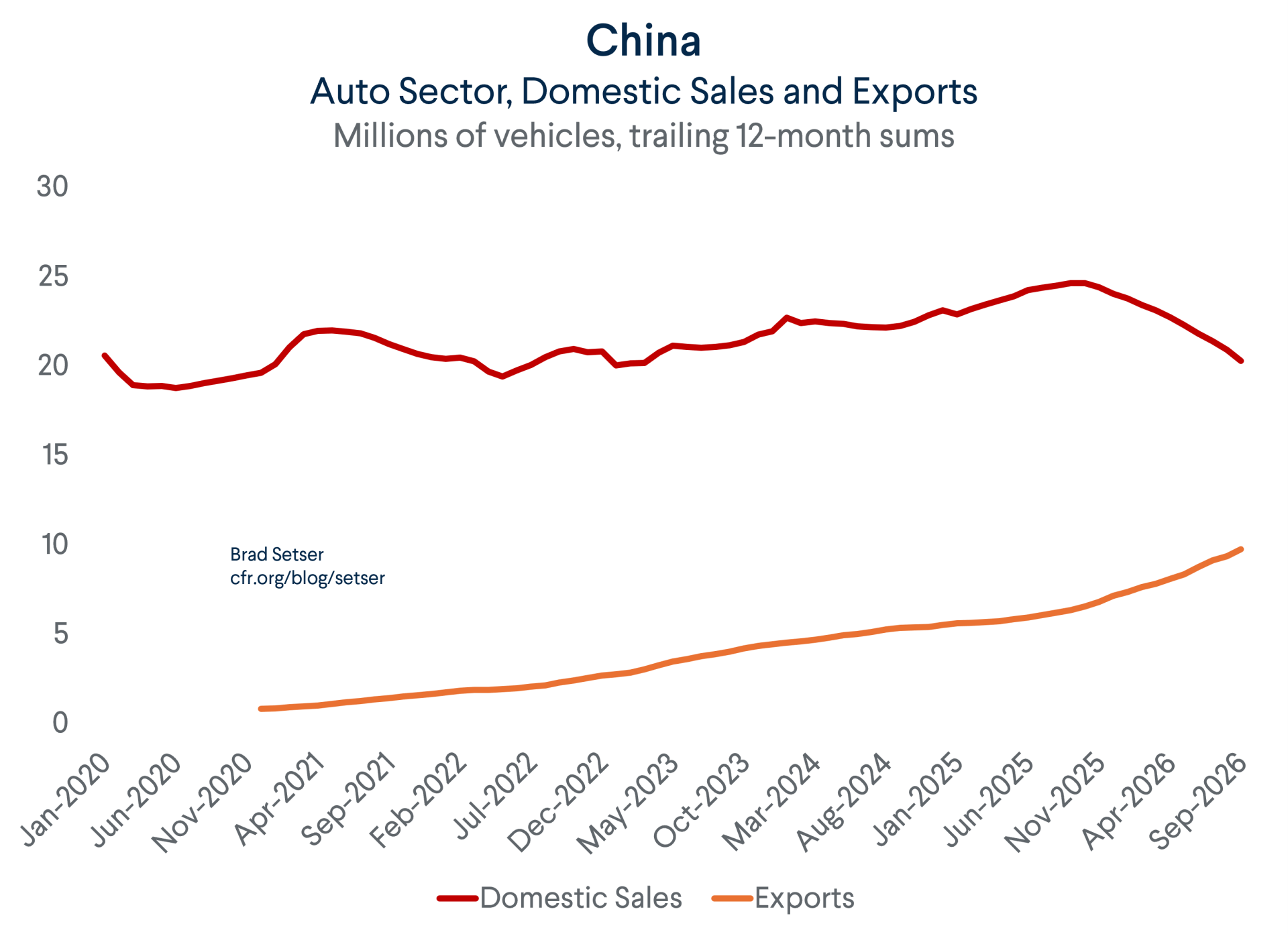
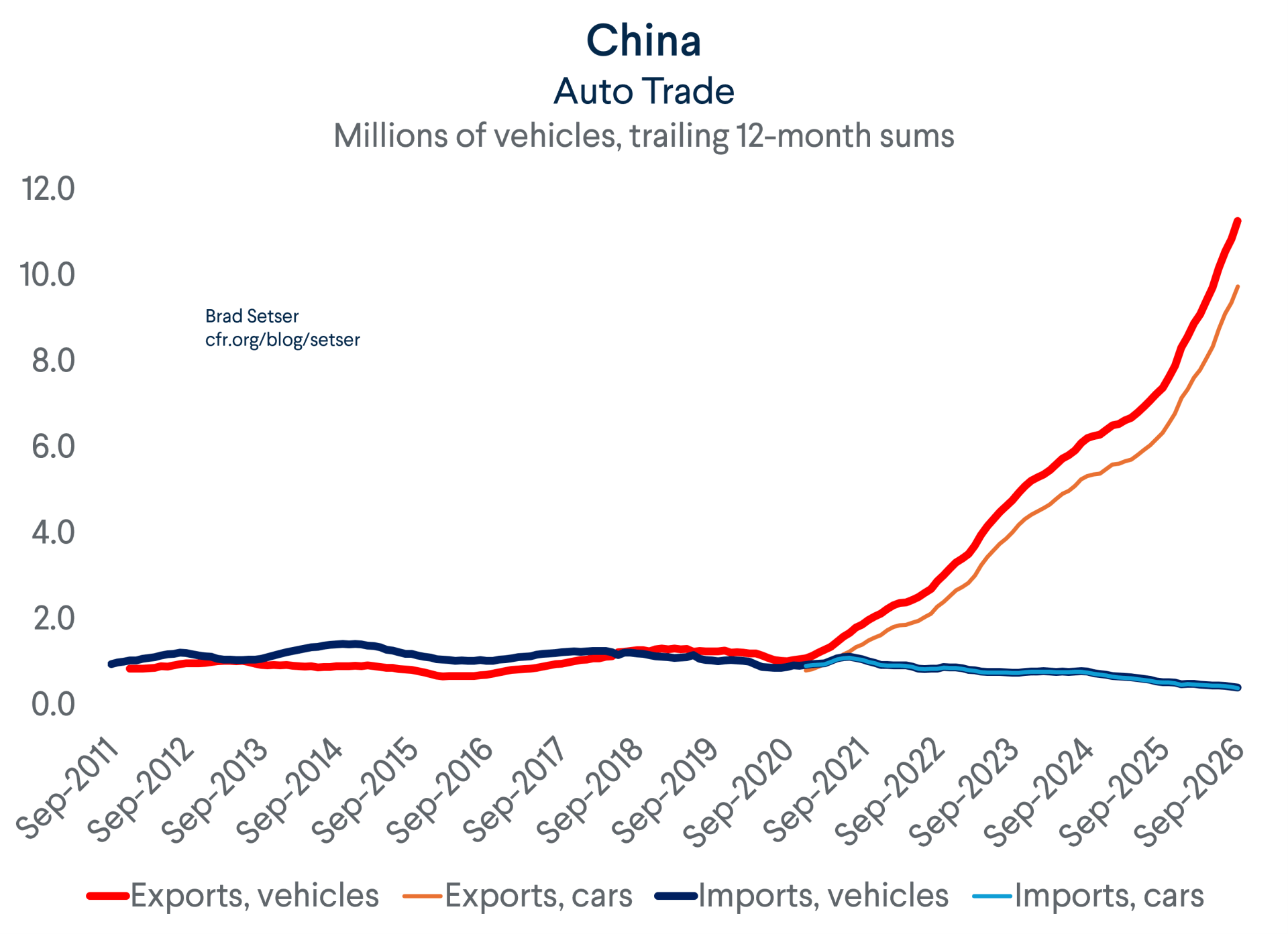
The year-over-year increase in Chinese automobile exports to all markets is currently about 3.5 million cars.
Over ten years, that is 35 million cars. The global market excluding China is only around 60 million cars. Japan raised its auto exports by about 3.5 million cars in the 1970s—but that was over a decade, not one year. And right now the U.S. and Indian markets (around 20 million cars) are effectively closed to Chinese production. The 2026 jump in exports is an incredible.
China’s domestic market, though, is down 20 percent this year—that works out to a decline of about 5 million cars. The Wall Street Journal estimates that domestic sales will fall to around 19 million cars this year, less than a third of the production capacity of China’s auto industry.
So even though China’s exports are increasing at an unprecedented pace, China’s domestic auto sector isn’t really booming; production is essentially flat, and intense domestic competition is destroying the profitability of firms that don’t export.*
Europe’s new auto deal with China should be understood in this context.
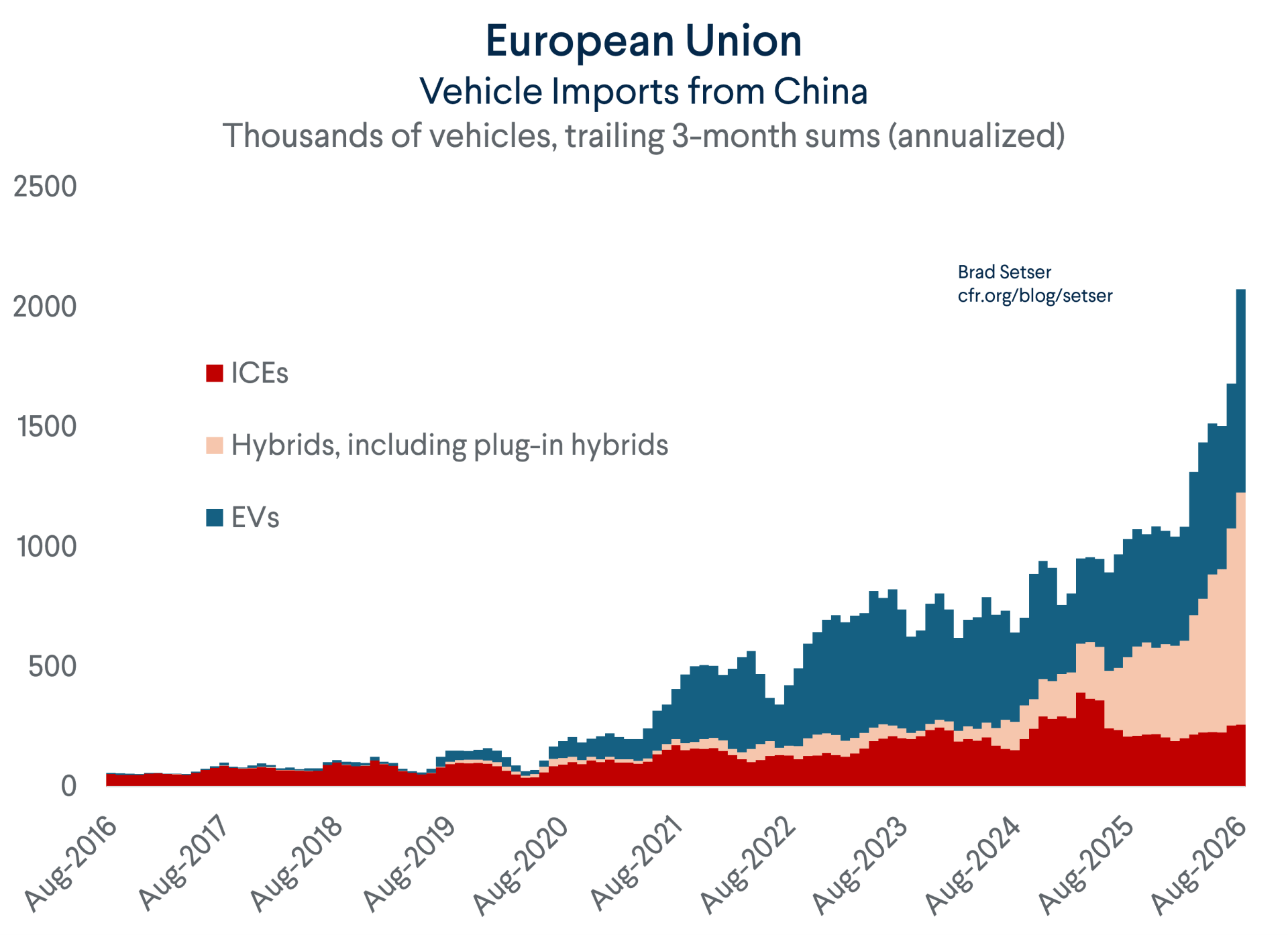
The deal limits China’s exports of hybrids (including plug-in hybrids) to Europe to around 350,000 cars. That is above the 300,000 hybrids that China exported to Europe in 2025, but well below the (gulp) 800,000 annualized pace for hybrids in the last three months of (European) data. Total imports, annualized, were running at an incredible 2 million a year pace thanks to strong battery electric imports in September.
China appears to have concluded that it prefers a guaranteed market for a limited number of cars (and more or less guaranteed profits) to the risk of a prohibitive tariff that would cut off all its exports.
And Europe preferred a negotiated deal to the risk of retaliation and a slowdown in licensing rare earth and magnet exports.
The Commission also thinks of this as a bit of a model—more on that later.
I certainly understand the logic of the deal. Something needed to be done. China’s export of hybrids to Europe were up an insane 200 percent year-over-year in the last 3 months of data, which led to a 75 percent increase for all cars. One more year of 75 percent growth would bring China’s exports to around 3 million cars; in two years, close to 6 million, and in three years, 10 million—or most of the market.
But Europe still is a long way from a coherent trade and industrial policy with respect to autos, let alone a coherent economic policy towards overall trade with China.
After this deal, as I understand it:
- Hybrid imports are capped at 350,000, down from a projected 800,000 in 2026—and then rising to 370,000 and 390,000 in subsequent years.
- Battery electric vehicles face a tariff from 25 percent (Telsa, 10 percent base + 15 percent) to 45 percent (10 percent base plus 35 percent). BYD’s total tariff is at 27 percent, which isn’t prohibitive. Even with these tariffs, battery electric imports will total around 600,000 this year, up from 500,000 last year.
- Diesel and gasoline (ICE) cars face a tariff of 10 percent. Europe is importing around 200,000 of these a year (including a significant number from Chinese-owned MG).
There are no special tariffs on imported parts or imported batteries, which matters for the growing number of Chinese factories in Europe. So long as tariffs are low and the renminbi is undervalued, Chinese firms still have an incentive to maximize the Chinese content of their “transplant” factories (ask Thailand).
There is currently no unified European policy on inward investment that requires joint ventures or technology transfer either, only a lot of wishful thinking.**
Sum it up, and it is a market where Chinese exports are constrained by a hodge-podge of different trade defense tools, and there is no standard policy for ensuring that Chinese assembly operations use European parts rather than import Chinese kits. The existing operations, which are just starting to scale up, don’t draw on a European supply chain. They likely preserve a few assembly jobs at the expense of the broader automotive ecosystem.
A coherent European (or national) industrial policy for the automotive and battery sectors is thus still a work in progress.
The safeguard on hybrids and the resulting tariff rate quota only stops the bleeding.
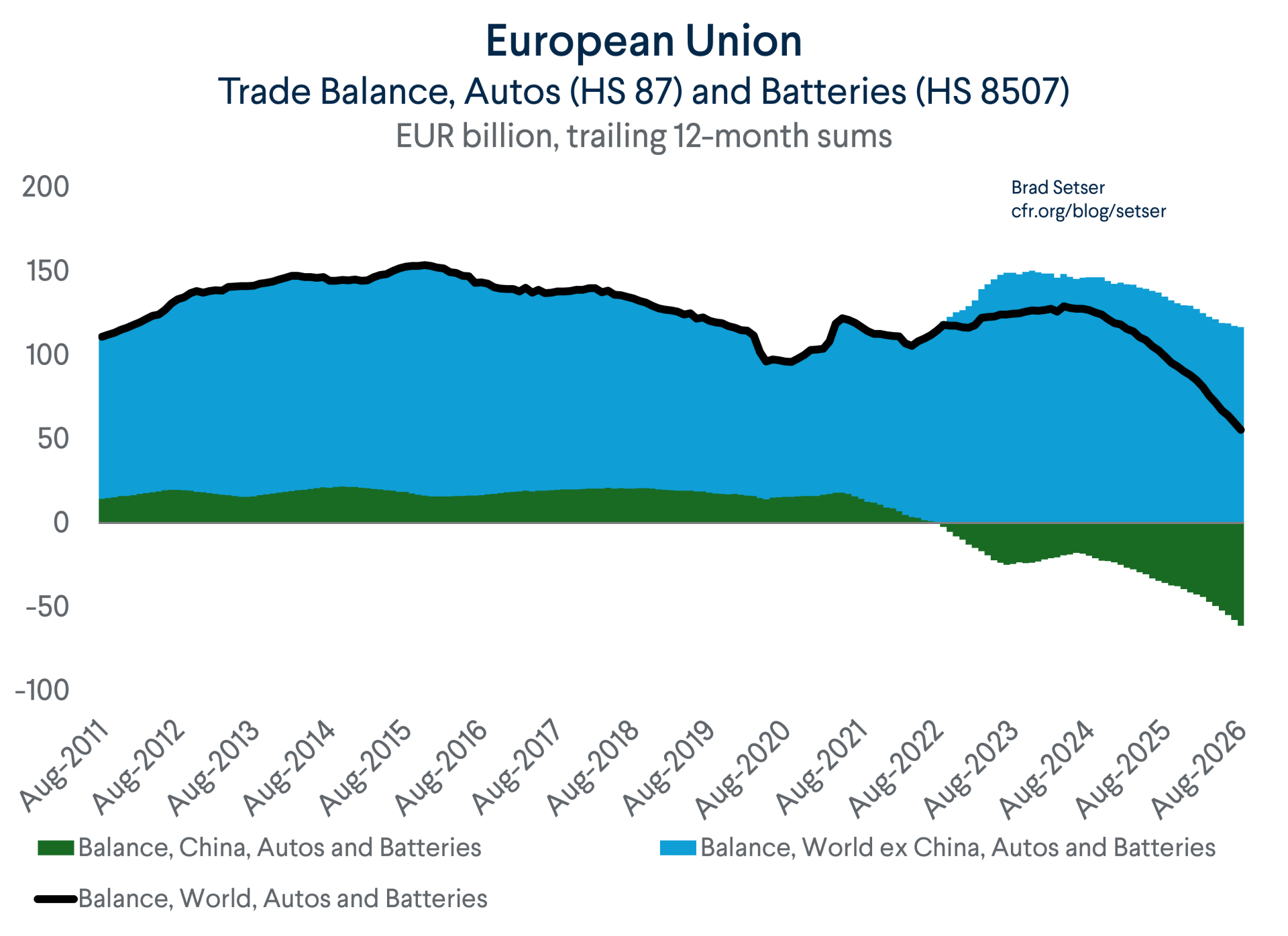
And make no mistake, Europe’s position in the global automotive sector is slipping. Europe still runs an overall surplus in auto trade, but that surplus is falling fast if trade in batteries is added to automotive trade (there isn’t a split between batteries used for energy storage and batteries used by cars in the EU data right now, at least not that I have found).
Europe’s broader trade policy to China is similarly a work in progress.
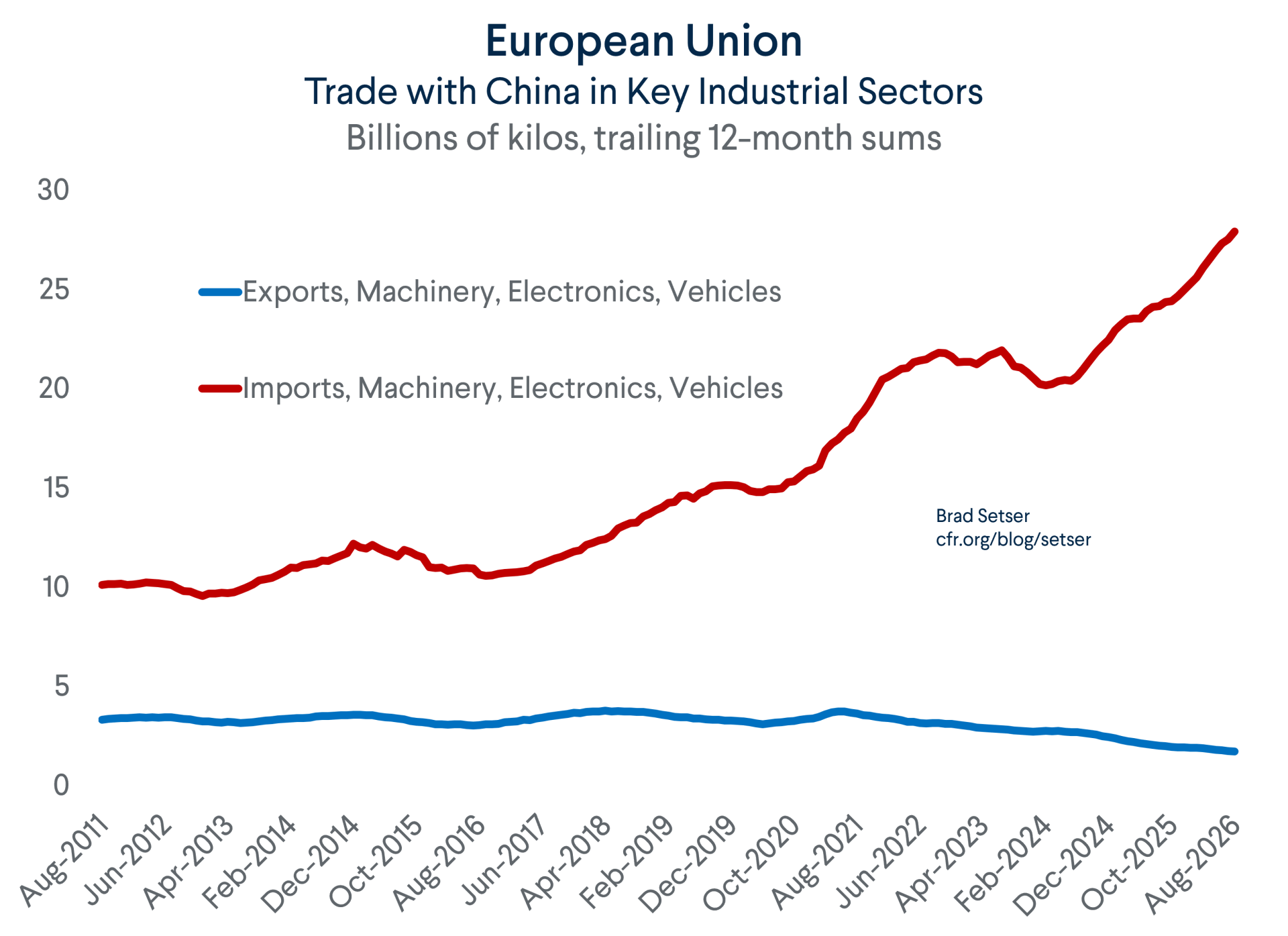
The surge in imports of hybrid cars was particularly pronounced, but it is by no means the only such surge. The balance in industrial machinery has eroded significantly. Consider the following chart, which shows imports and exports of machinery, electronics and vehicles (HS 84, 85, and 87) by weight.
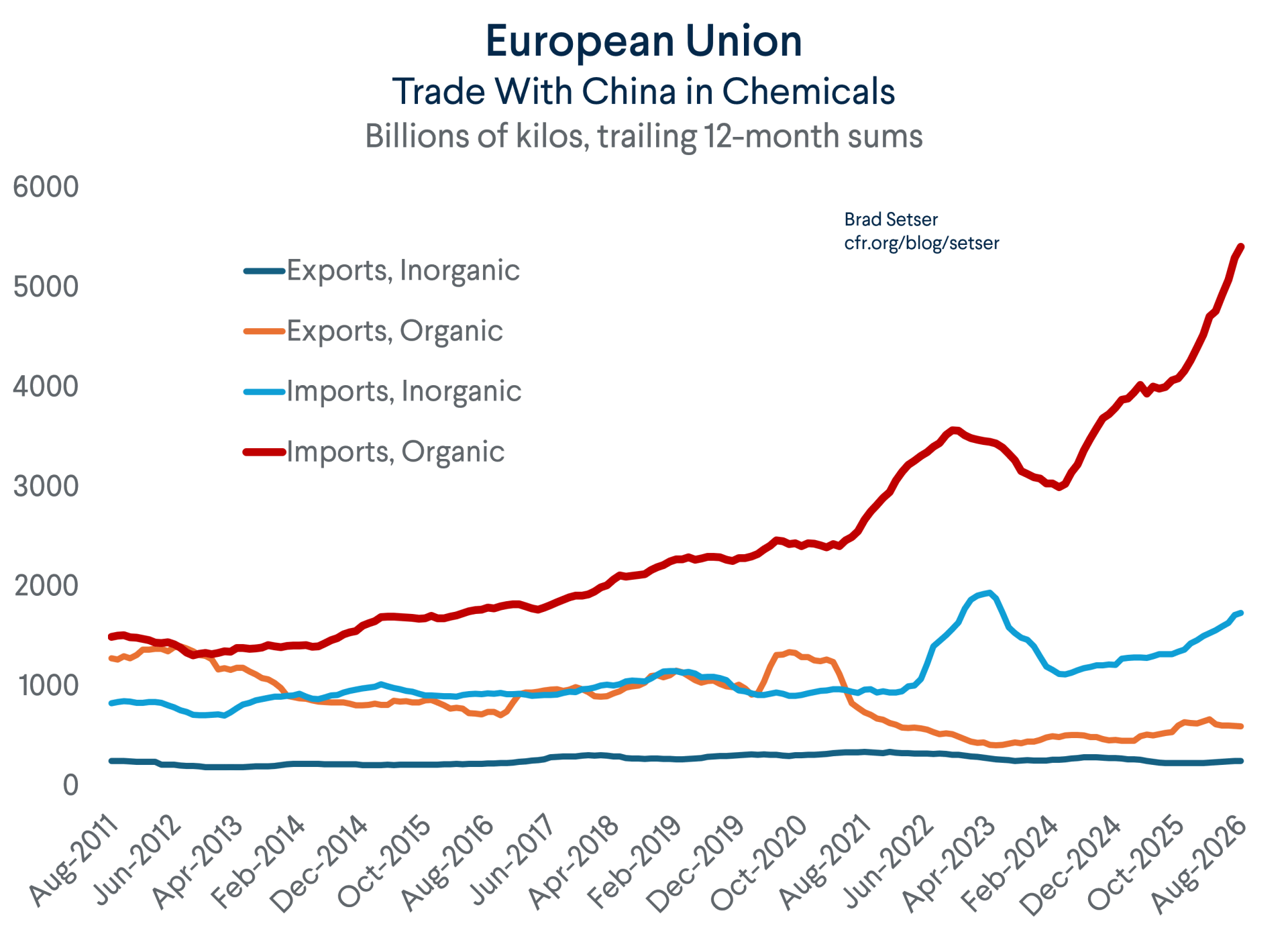
The balance in chemicals, measured by weight to abstract from price changes, shows the same trend.
Europe doesn’t have an across-the-board tool for applying tariffs against China like the U.S. section 301 statute.
But that isn’t necessarily an immediate constraint, as there are plenty of solid safeguard cases thanks to the current surge in European imports from China.
But if each safeguard needs to include a negotiated tariff-rate quota that gives China enough guaranteed market access (and Chinese firms enough guaranteed profits) to ensure trade peace, Europe needs to get moving with negotiation in other sectors.
Chemicals and machinery are more diverse sectors than cars and thus aren’t as amenable to the same high-level Šefčovič-Wang negotiations the led to the most recent deal.
This critique isn’t meant as criticism. Europe needed to act on cars. Look at a chart of automotive trade in kilos.
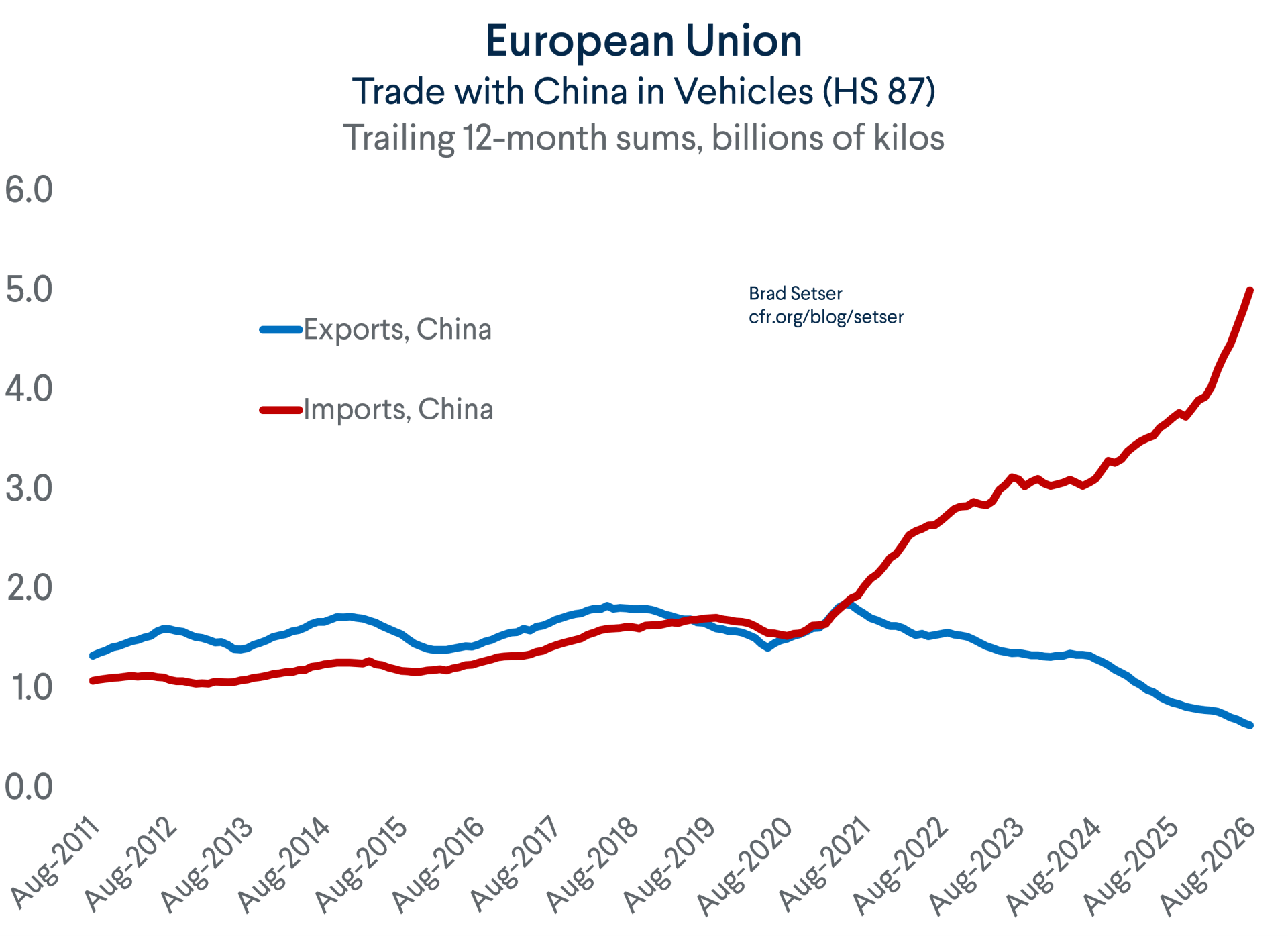
It’s just that it also needs to act in other sectors: auto parts, batteries (though that is complicated), chemicals, and some categories of industrial machinery. The scale of China’s export boom and the fact that in most sectors there are no limits to China’s ability to scale up is a real problem.***
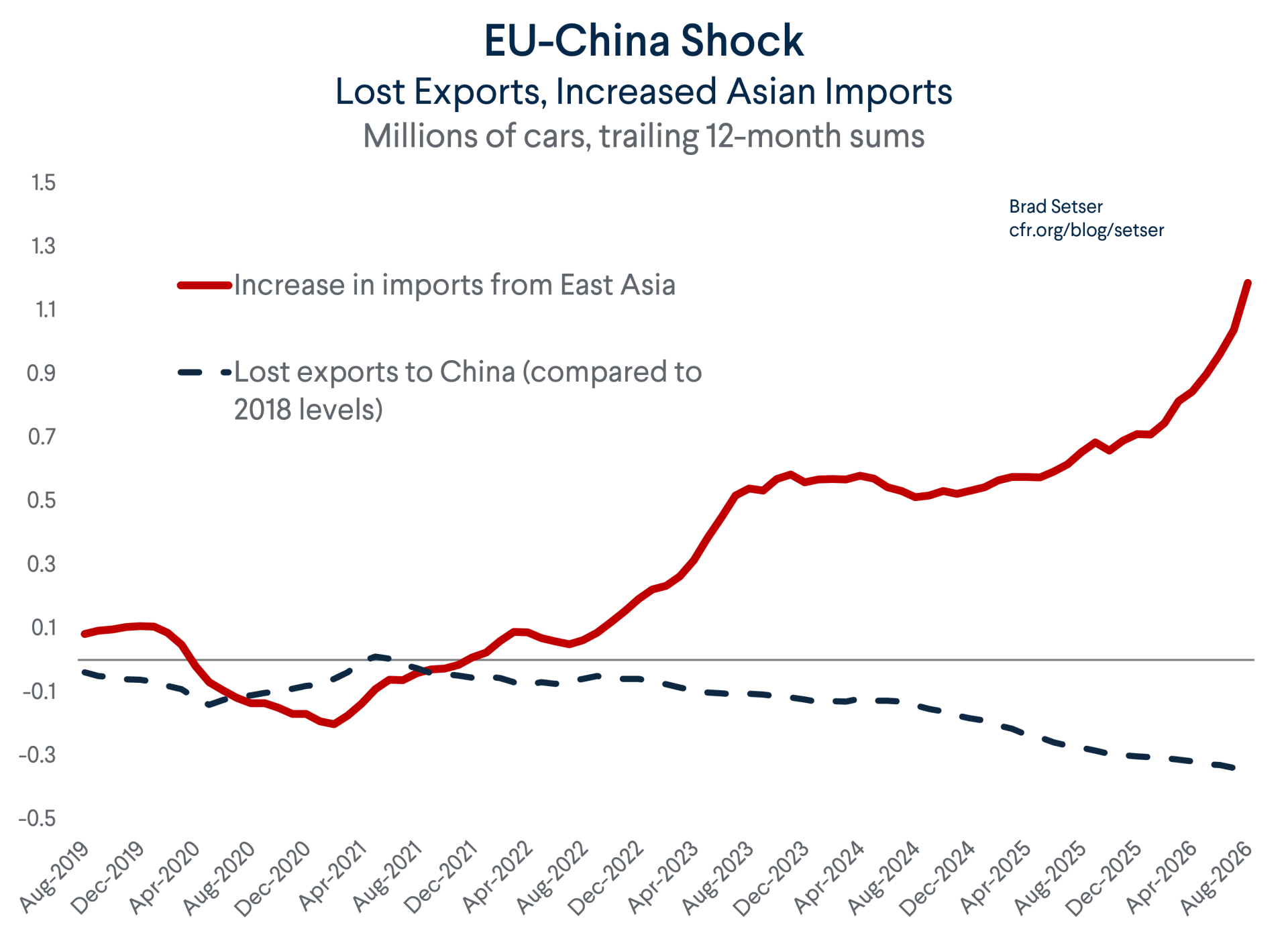
And Europe cannot wait for China to conclude that it would rather grow on the basis of internal, rather than external, demand.
I disagree with the IMF’s former top brass on this. A China that grows on the back of a 1.5 pp net export contribution for another couple of years will deindustrialize much of the world. China’s trading partners cannot step aside and do nothing until China figures out how to escape deflation using its own demand. Xi appears more than happy to continue with his current policy mix and gamble that the world will continue to absorb China’s ever growing export surplus.
Pascal Lamy, Nicolas Köhler-Suzuki, and Victor Luiz do Prado of the Jacques Delors Institute recognize the need for a more systemic response—as do Jean-Pierre Landau and Sébastien Jean, who have done an excellent job explaining how China’s micro- and macro-industrial policies fit together into a coherent, self-reinforcing whole.
The proposals in the Lamy et al. paper overlap heavily with the Commission’s current approach to China.
The authors envision a two-pronged approach: first, negotiating with China to seek agreement on tariff-rate quotas that effectively limit the EU’s imports from China; and second, developing a broad yet targeted tariff-based instrument to address structural imbalances should negotiations fail. The latter would give Europe a credible threat should China refuse to agree to the proposed safeguards.
My own view: don’t let the perfect be the enemy of the good.
The EU has shied away from developing its own 301 tool out of concern about preserving a “rules-based system.” I still think a European 301 would allow a more fulsome response, but understand that European isn’t as willing as the United States to use tools that at least appear to be outside those authorized by the WTO. In reality the EU no longer really wants to trade with China on the same (MFN) terms applied to other WTO members. That mirrors the current view of the United States. But the EU is willing to go through more procedural hoops to get to a similar result.****
But I also recognize that, absent policy adjustment in China—notably a stronger currency that allows for fair market competition—the scope of safeguards and managed trade will progressively expand.
* One sign: Stellantis is resuming Jeep production in China, but primarily for export rather than the domestic market.
** There is a lot of (in my view) somewhat confused analysis of Chinese investment that works off the analogy provided by either foreign investment in China’s auto sector or Japanese investment in the U.S. and Europe in the 1980s. These are relevant examples of course, but asserting that Chinese investment will result in a similar outcome when the underlying economics differ is a big logical jump. Japanese firms had incentives to localize their parts production in the United States from the then-strong yen as well as from the risk of protection. Foreign firms operating in China had to do JVs until recently and had incentives to localize from China’s significant tariff on auto parts and China’s lower cost structure (in part because of a weak RMB). Tesla’s Shanghai incentives and tax deal included strong localization incentives, and there were additional incentives from Tesla’s desire to qualify for the lists the governed access to China’s consumer EV subsidies. That is why something like 90 percent of Tesla parts, including its batteries, are now made in China. Chinese investors in Europe have no similar incentives to localize right now, yet many assume that the results will be the same. That, to me, is naïve. Since the underlying economics differ (Europe’s cost basis is much higher than existing production in China) getting Chinese firms to do more than final assembly in Europe will take stronger policy tools than were required to get foreign firms to localize parts production in China. Europe’s Industrial Accelerator Act would be a step in the right direction, but more is likely needed. Thailand provides a useful cautionary example.
*** China can make over 60 million cars, according to recent reporting from the Wall Street Journal. The domestic market this year will be under 20 million cars (down from something like 24 million cars last year). Even with exports of 10 million, there is ~30 million cars worth of unused auto production capacity (roughly double European demand). And China is still investing at a pace that is consistent with adding close to 5 million of EV production capacity a year. Chinese firms, who don’t make any money on domestic sales, are strongly incentivized to export. The world has never encountered such elastic supply.
**** The more different the legal basis for the European and U.S. response—and the more policy differences (TRQs vs. a flat tariff, for example) the harder it would be to ever develop a harmonized policy approach. But with President Trump, a harmonized policy isn’t even a U.S. goal.
This work represents the views solely of the author(s). The Council on Foreign Relations is an independent, nonpartisan membership organization, think tank, and publisher, and takes no institutional positions on matters of policy.