Trading Places: The U.S. and Europe on China and Russia
CFR President Michael Froman analyzes Europe’s changing posture toward China and Russia, and how that mirrors what the U.S. approach used to be.

For years, the United States pressed Europe to join it in taking a harder position on defending itself against Russia and protecting itself against China. Europe resisted, insisting it could navigate a middle ground between the United States on one hand and Russia and China on the other.
How times have changed. Now, Europe is lecturing the United States on the threat Russia poses, while Washington is less committed to Ukraine’s defense and confronting Russian aggression. More interesting is that Europe appears to be taking steps to achieve escalation dominance in a potential trade war with China precisely at a time when the United States is emphasizing détente, strategic stability, and a decent peace with China.
From pushing European countries to increase their NATO defense spending—as U.S. presidents as far back as Dwight D. Eisenhower have done—to implementing sanctions and export controls against China, the United States has led from the front for years. In the meantime, Europe, and particularly Germany, pursued a strategy that left it overdependent on Russia for energy, China for markets, and the United States for security. Europe sought to prioritize economic ties and stability with these countries while leaving concerns about security and competition to the United States.
This week might mark the moment when the United States and Europe ultimately swapped positions. Since Russia’s full-scale invasion of Ukraine in 2022, after which point European security became a critically acute issue, the Europeans have increased their defense spending and switched to alternative sources of energy. At the same time, European leaders have beaten a path to the Oval Office to try to warn President Donald Trump of the dangers of accommodating Russian President Vladimir Putin. In turn, the Trump administration withdrew five thousand troops from Germany this spring, reduced overall U.S. force deployments to Europe to prewar levels, and cut direct military aid to Ukraine by 99 percent.
And, while the Trump administration raised tariffs on China to as high as 145 percent in the first half of 2025, Beijing’s subsequent threat to impose restrictions on exports of critical minerals, magnets, and related processing know-how resulted in the the United States seeking to de-escalate and stabilize relations with China. This included delaying an arms sale to Taiwan, approving China’s access to advanced (but not the most advanced) semiconductor chips, reducing tariffs on select non-strategic goods, and choreographing a state visit for Chinese President Xi Jinping—which was long on respect and short on addressing conflicting interests.
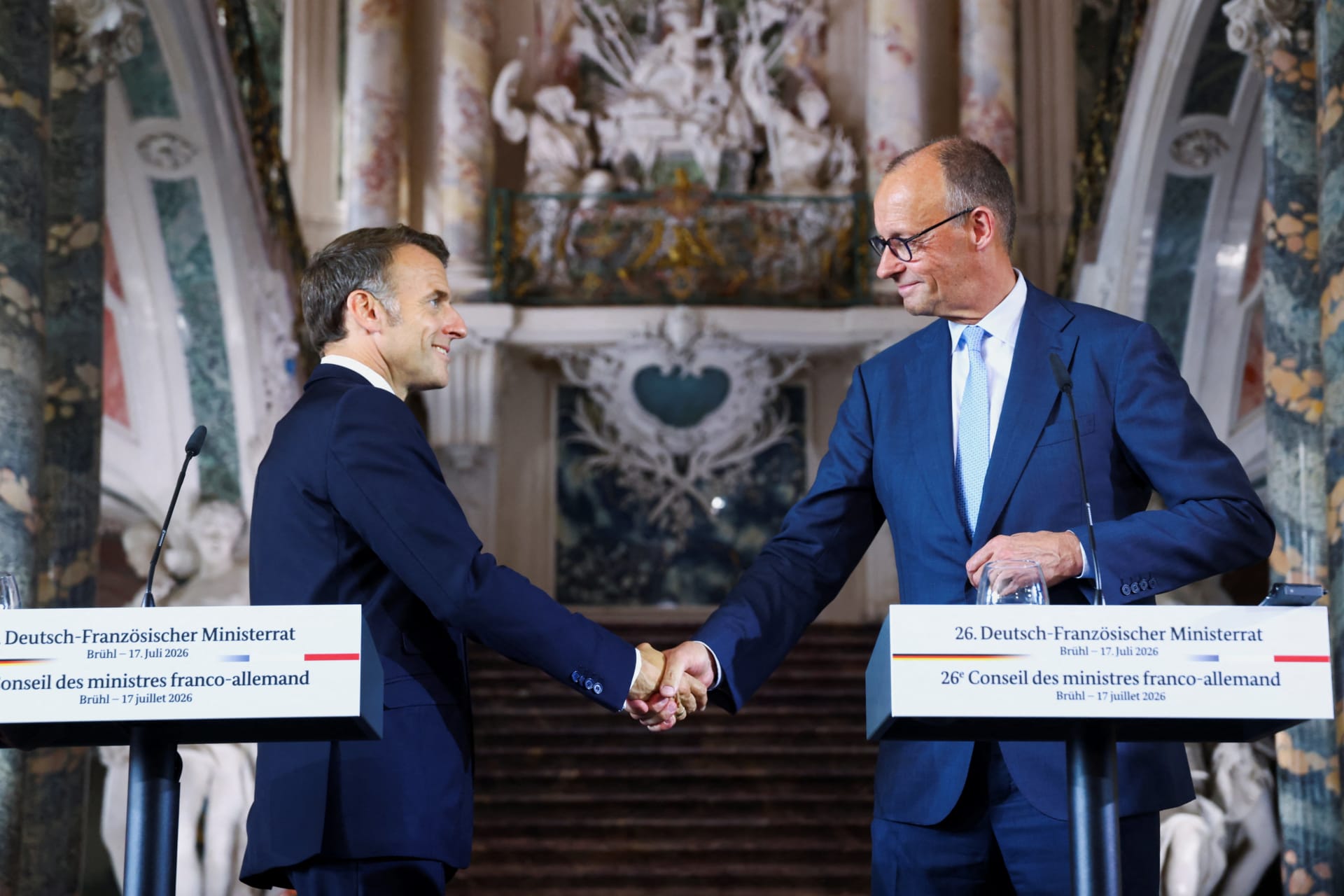
This week, the Europeans showed that they may be taking a different tact. In a letter sent Monday to European Commission President Ursula von der Leyen, German Chancellor Friedrich Merz and French President Emmanuel Macron proposed that the European Union (EU) adopt a last-resort trade tool that would empower the European Commission to immediately cut off access to the EU’s single market in the face of China’s economic coercion, particularly on rare earth minerals. In the words of a senior German official, this new tool would operate as a “second-strike weapon” if China decides to exploit its chokepoints over rare earth minerals again, as it did last year. Rather than pull its punches, Europe seems to be warming up for a fight.
The proposal is, at this stage, just a proposal, but the language used by the two European leaders underscores a sea-change in Europe’s perspective. “The open and rules-based trade system is massively affected by weaponization of trade, systemic market-distorting practices, and global macroeconomic imbalances,” they write. They argue that the new trade instrument is needed to “give us the ability to counter cases where third countries deliberately seek to undermine the restoration of a level playing field and fair market conditions by political or economic means, leading to severe and systematic distortions of our internal market.” While they do not name any particular country—and while the United States could conceivably be a target—this tool was clearly designed with China in mind.
Macron and Merz’s letter amounts to a meaningful recognition by the drivers of European policy that China has the capacity and the will to wreak havoc on their economies through a combination of overcapacity, currency manipulation, and export controls. To Macron’s credit, the French have been beating this drum for some time now: for one, he was a strong backer of the EU’s tariffs on Chinese electric vehicles (EVs).
The reason that this announcement is noteworthy is that Germany has for years been a major impediment to Europe taking a more aggressive stance toward China on economic issues. Berlin has belatedly come to the conclusion that it has been the victim and target of Beijing’s concerted industrial policy, which is hollowing out Germany’s industrial base, eliminating manufacturing jobs, and undermining its economic independence, just as the country weans itself off Russian energy. To take just a few illustrative data points: Germany is losing ten thousand manufacturing jobs per month due to Chinese imports, and German auto giant Volkswagen plans to cut fifty thousand jobs and close four plants after Chinese EV makers flooded the market with better and cheaper cars. More broadly, Germany’s industrial sector eliminated more than 341,000 jobs in the past seven years, including the loss of one in seven auto jobs.
There are a few other takeaways from this announcement.
In August, I warned in an essay for Foreign Affairs that China’s export-dependent growth model is corroding the industrial base of its customers around the world, leading to protectionist politics and a reduction in global demand for Chinese goods that cannot be made up in the domestic Chinese market. That mismatch of oversupply and weak demand is kindling for an economic reckoning in China with potential implications for the broader global economy.
The instrument described by Macron and Merz is precisely the kind of economic weapon that, if deployed, would deprive China of the foreign consumers it needs to maintain its excess capacity-based, export-led growth strategy. In the best-case scenario, this proposal is Europe’s way of deterring China’s economic coercion and arming itself for negotiations, while remaining cognizant of the fact that one rarely negotiates a desirable outcome from a position of weakness. A trade deal that avoids a trade war is the ideal outcome, and a stronger Europe makes that more likely, not less.
When Germany cut itself off from Russian gas after the invasion of Ukraine, that was justified on obvious and explicit national security grounds: Germany would not fund the Russian war machine that it was spending billions of dollars to prevent from overrunning Ukraine. The pivot on China has national security ramifications but is driven by a more nuanced set of motivations. As reporting from the Financial Times confirms, Merz became convinced of the need to take on this stronger approach after seeing the profound pain inflicted on swaths of Germany’s industry. The hollowing out of Germany’s industrial base has, as in the United States and across Western Europe, fueled a rise in right-wing populist politics which has a distinct historical valence in Germany. The question for Merz, and the rest of Europe, is whether shifting positions like this is too little, too late.
Finally, it was difficult in the past to get Europe to cooperate with the United States in taking a firmer position vis-à-vis China. U.S. pleas were met with resistance and recalcitrance. Europe was reluctant to be dragged into what it viewed to be the United States’ obsession with competing with China and thought it could pursue a “third way.” This week’s announcement indicates that there is a new and growing appetite among our European allies for a more aggressive policy toward China, but it might be coming precisely at a time when the Trump administration, or least the president himself, appears to be reluctant to be confrontational. The risk is that the United States and Europe are again not entirely in sync.
The United States’ network of allies is one of its greatest geopolitical advantages. Everything from tariffs to export controls to investment screenings are likely to be more effective when like-minded countries join together. The Trump administration and future U.S. administrations will face a series of issues involving China—from Taiwan to artificial intelligence to critical minerals—where having these allies at our side, rather than on the sidelines, could prove invaluable. We shouldn’t get ahead of ourselves, but this proposal from Macron and Merz is a good sign that Europe is moving in the right direction. The question is, will the United States be there when they arrive?
Let me know what you think about Europe’s position on China and what this column should cover next by replying to [email protected].
This work represents the views solely of the author(s). The Council on Foreign Relations is an independent, nonpartisan membership organization, think tank, and publisher, and takes no institutional positions on matters of policy.