The Trump Administration’s Shift on Myanmar Is a Disastrous Decision
Washington’s sudden decision to open talks with Myanmar’s government grants further legitimacy to an authoritarian regime and is unlikely to deliver access to rare earths.
By experts and staff
- Published
 Joshua KurlantzickCFR ExpertSenior Fellow for Southeast Asia and South Asia
Last night, news broke that the U.S. government, which for years had shunned Myanmar’s brutal military regime, now appears to be shifting course and engaging with it. During a recent visit to Myanmar’s capital of Naypyidaw, ostensibly to help secure the release of a U.S. citizen (which he did), Michael Vance, the assistant secretary of state for intelligence and research, launched direct talks with Myanmar’s top generals.
Reuters further reported that Vance has played a major role in connecting with the Myanmar generals; several sources have told me that, prior to the visit, U.S. officials had been secretly meeting with officials from Myanmar in Japan.
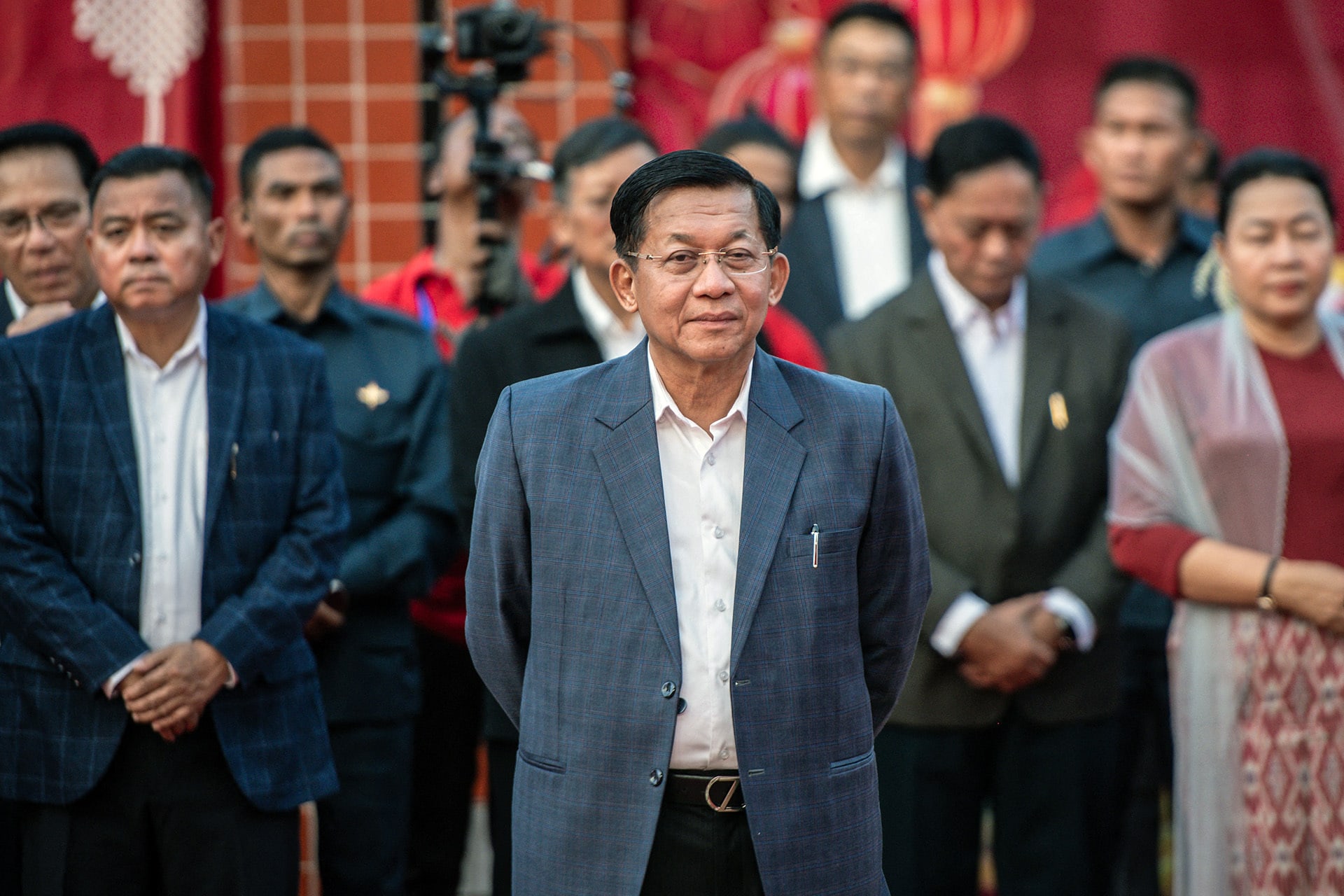
Myanmar’s president, Min Aung Hlaing, led the February 2021 coup that overthrew the country’s elected government and ultimately led to a civil war—the worst conflict in Asia—that has resulted in one hundred thousand deaths and a de facto failed state. Min Aung Hlaing remains under U.S. sanctions for his crimes against humanity, and it is possible that these changes to policy indicate the United States could reconsider those sanctions.
Nevertheless, Min Aung Hlaing cannot simply wash his hands of all the blood he has shed. He was involved in the 2016–17 massacres of Rohingya that the U.S. government called a genocide, and he has overseen a wartime policy of mass killings of civilians, often by striking civilian targets from the air.
The United States had already slashed aid to Myanmar, with predictably disastrous effects on its people. Hunger has skyrocketed, the public health system has collapsed, the regime has bombed hospitals and clinics, unemployment is rampant, and, as I noted in a recent article for Think Global Health, there has been a resurgence of dangerous diseases. These include cholera, polio, and, most alarmingly, drug-resistant malaria, which has spread across borders into neighboring states.
The regime also seems to be stepping up its brutality. As I noted earlier this week, “in July and August, the military conducted so many air strikes on civilians in Rakhine and Chin States that they averaged four civilian casualties by air per day.” On September 29, the regime bombed a market, killing dozens of civilians.
As the Myanmar government gains greater legitimacy, not only from the United States but from regional democracies such as Thailand and Malaysia, it will see little reason to slow its rising abuses. Indeed, Malaysia, a democracy led by Prime Minister Anwar Ibrahim, who himself suffered years in jail [PDF] and abuses at the hands of an authoritarian regime, welcomed a visit by Min Aung Hlaing on Thursday. The visit, his first to the country since the coup, followed a trip to Thailand in August.
U.S. connections to the junta are bad news for the people of Myanmar, and they make little strategic sense for the United States itself. Vance and other U.S. officials have apparently discussed with their Myanmar counterparts the possibility of access to Myanmar’s sizable deposits of rare earths. Washington is unsurprisingly looking anywhere it can for rare earths, because China controls the majority of them, and they are critical to new technologies including defense stockpiles depleted by the Iran war.
It is hard to imagine a scenario in which Washington actually gets its hands on Myanmar’s rare earths. They are located close to the Chinese border, in Kachin and Shan/Wa States, a war zone where Beijing wields dominant influence. China has pressured ethnic militias in these areas to essentially lay down their arms, giving Beijing even more control of their rare-earth exports. These exports are important sources for Beijing; the Stimson Center estimates that Myanmar has some six hundred rare-earth mines.
Even if U.S. companies could somehow get near these valuable minerals—there are rare earths in one area controlled by an ethnic militia still fighting the regime—they would have to deal with a devilishly complex environment involving an ongoing civil war and a wide range of other armed groups. They would have to navigate a country that has now become a global center of organized crime, protect their in-country employees from attacks by antiregime forces, and enmesh themselves in Myanmar’s complicated political future.
Deciding to work with the regime grants it legitimacy and dilutes the global battle against authoritarianism at a time when autocrats are collaborating and winning all over the world. A good example is the Iran war, where advanced Chinese satellite imagery reportedly helped Iran kill U.S. service members at a base in Jordan.
In fact, after antiregime forces made major gains in the earlier period of Myanmar’s civil war, it was Naypyidaw’s key autocratic partners—Belarus, China, Iran, Russia—that provided the struggling military with technology, intelligence, money, and other essential items that turned the tide in the war and also allowed the regime to indiscriminately bomb civilians.
Before that, throughout late 2023 and into 2024, the antiregime fighters had battered the junta’s forces, driving them back, taking territory, winning battle after battle, and shocking both the army and the outside world. The regime was suffering massive defections, and all over the country, an alliance of various antijunta groups was creeping closer to the junta’s main strongholds. The junta was allowing men as old as sixty-five to be conscripted, as well as disabled men. It could not fill military academy classes. Antiregime fighters had gotten close to the fortress capital, Naypyidaw. But as Naypyidaw’s powerful allies provided it with planes, drones, fuel, and other aid, the military took back the offensive, and now the rebel alliance is badly weakened.
Engaging with the regime now will simply show powerful autocrats that their collaboration works, and democracies accede. And it will cause more misery for the citizens of one of the most benighted places in the world.
This work represents the views solely of the author(s). The Council on Foreign Relations is an independent, nonpartisan membership organization, think tank, and publisher, and takes no institutional positions on matters of policy.