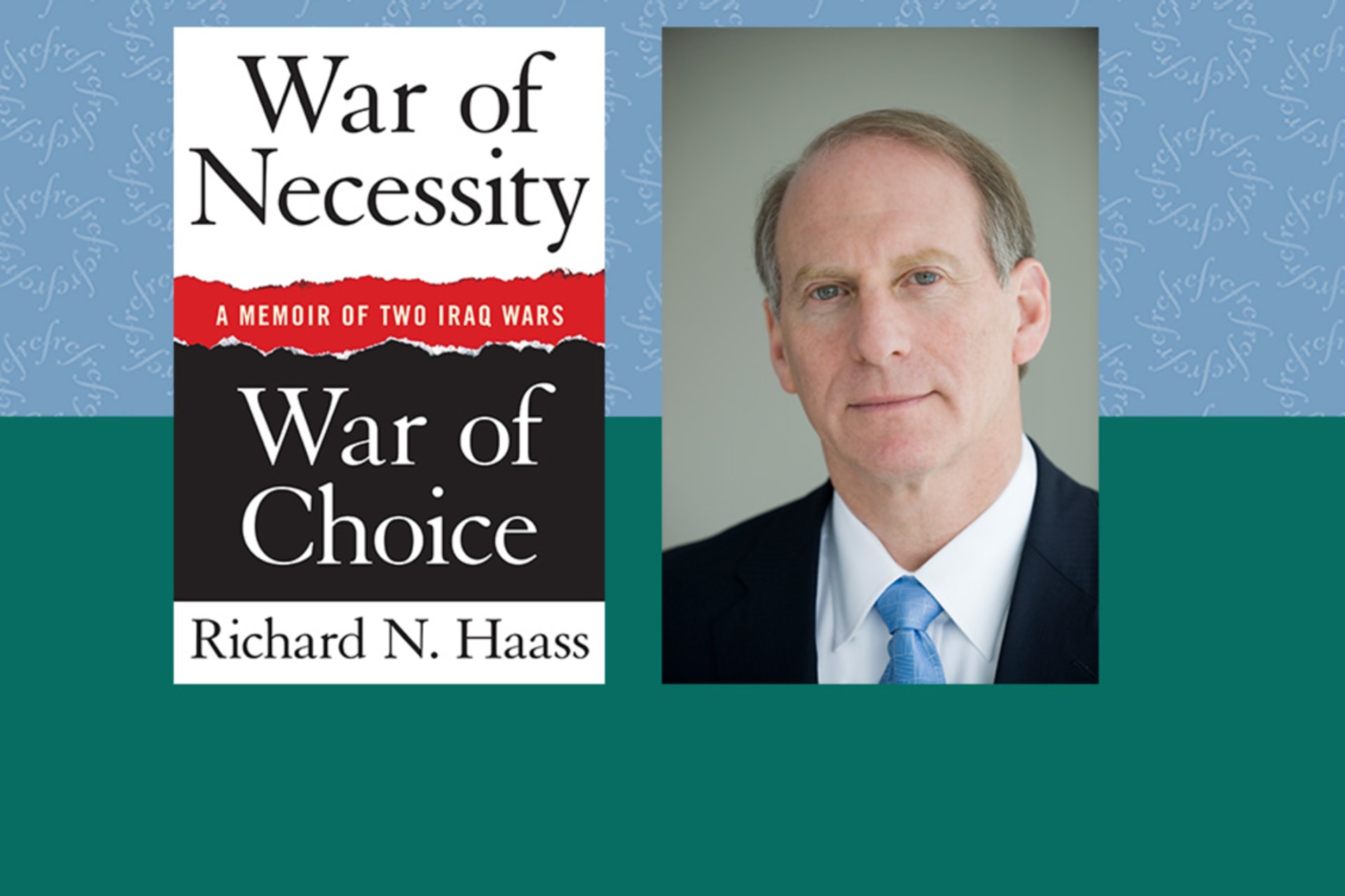
War of Necessity, War of Choice
In this book, CFR President Richard N. Haass contrasts the decisions that shaped the conduct of two wars between the United States and Iraq, and writes an authoritative, personal account of how U.S. foreign policy is made. Teaching notes by the author.
By experts and staff
- Published
Discussion Questions
Courses on U.S. Foreign Policy
- Was the George H.W. Bush administration right to go to war in 1990–91 to drive Saddam Hussein’s forces out of Kuwait? Do you believe that this was a war of necessity for the United States?
- Was the George W. Bush administration right to invade Iraq in 2003? Do you believe that this was a war of choice for the United States?
- What should be the role of democracy promotion and attempts to change the nature of societies in U.S. foreign policy? Are such objectives ever a worthy basis for going to war?
- Are wars of choice ever warranted? If so, under what circumstances?
- What were the costs and benefits of the first Iraq war? What were and are the costs and benefits of the second? In general, how should an assessment of probable costs and benefits affect consideration of whether to undertake a war of choice?
- What are the lessons of the two Iraq wars for what the United States seeks to accomplish in the world? How can these lessons be applied to current or future situations in which the United States is using or might consider using force (e.g., Afghanistan, Pakistan, Iran, North Korea, or Darfur)?
- How do the two Iraq wars represent competing schools of thought in American foreign policy? How do the outcomes of the wars challenge or support the tenets of these schools? What should be the principal purpose of American foreign policy?
- What are other examples of wars of necessity and wars of choice that the United States or other countries have fought? How are they similar and how do they differ from the two Iraq wars?
Courses on Public Policy
- What should government officials do when they disagree with policies being put in place? What factors should influence their thinking on how to handle their disagreement (e.g., the importance of the issue, strength of the individual’s objections, opportunities for their arguments to receive a fair hearing)?
- Under what circumstances should government officials resign? How should they evaluate the trade-off between, on one hand, staying in government and trying to influence a policy they disagree with and, on the other, making a statement by resigning but losing their direct influence?
- Based on his argument in the book, should Richard Haass have resigned when the 2003 Iraq war was launched? Should Colin Powell have done so?
- What actions other than resignation are appropriate for officials to make their disagreements known? Is leaking information or undermining a policy ever justified?
- Compare the decision-making approaches of the two Presidents Bush. How do they differ in their levels of formality, inclusiveness, and other characteristics? What are the merits and drawbacks of each approach?
Courses on Ethics and International Affairs
- Was the first Iraq war a “just war?” Was the second?
- Can wars of choice ever be just?
- Can any war be just if it lacks broad support among the American public? In Congress? In international public opinion?
- Is just war thinking an adequate framework for deciding whether to undertake a war today? What are the benefits and limits of this thinking?
- What should be the criteria for determining whether a conflict is a war of necessity? What should be the criteria for deciding whether to begin a war of choice?
- Under what circumstances is it advisable or justifiable to talk to objectionable regimes, such as that of Saddam Hussein? Under what circumstances should contact with such regimes be cut off?
- Did the United States respond appropriately to Saddam’s crackdowns on the Kurdish and Shia uprisings in the aftermath of the Gulf War?
Courses on Middle East History
- Do you agree with the George H.W. Bush administration’s attempts to maintain a relationship with Saddam Hussein’s Iraq in the 1980s? What, if anything, could the United States have done to head off the threat that Saddam came to pose to the region and to U.S. interests?
- Was the George H.W. Bush administration right to limit U.S. goals to evicting Saddam’s forces from Kuwait and to refrain from “going to Baghdad” to oust Saddam’s regime? Was it right to stay aloof from the Kurdish and Shia intifadas?
- Was the second Iraq war the wrong choice? Was it the right choice poorly implemented?
- What were the consequences of the first Iraq war for the region? What were and are the consequences of the second?
- What would have been the consequences had the United States not used force to liberate Kuwait in 1990–91 or to oust Saddam in 2003?
Further Projects
Mock National Security Council Meeting
Assign students to play the role of senior administration officials such as the president, vice president, secretaries of state and defense, national security adviser, chairman of the Joint Chiefs of Staff, and others. Conduct a mock National Security Council (NSC) meeting in order to:
- Reenact the deliberations surrounding the Gulf War, with a focus on important decision points such as:
- Simulate a debate over whether to undertake the second Iraq war
- Examine a scenario in which the United States might consider using force (e.g., state failure in Pakistan, nuclear advance in Iran, instability or immediate threat on the Korean Peninsula, genocide and humanitarian catastrophe in Darfur).
In each case, participants should present their analysis of the situation consistent with the role they have been assigned, lay out policy options, and argue for their preferred course. In a reenactment of deliberations over the Gulf War or a simulation of a debate over the 2003 Iraq War, the goal should be to see whether students arrive at the same decisions made by the relevant Bush administration. In a hypothetical scenario, the goal should be to apply lessons from the two Iraq wars in considering both what policy to adopt and how to ensure the effective operation of the national security policymaking process.
Memorandum to the President
Invite students to assume the role of presidential advisers. Then assign them to write a memorandum to the president on a scenario in which the United States is considering or might consider using military force. These could be real-life possibilities, such as Iran, Pakistan, North Korea, or Darfur, or imaginary cases laid out by the instructor. Memoranda should analyze the situation and the U.S. interests at stake, outline a series of viable policy options (both involving force and not), and argue for a particular course of action. They should explicitly take account of lessons from the two Iraq wars and other conflicts in considering possible U.S. military intervention.
Analytical paper
Assign students to write papers analyzing the arguments surrounding one of the central questions laid out in the book. Examples include:
- Whether the first Iraq war was one of necessity
- Whether the second Iraq war was one of choice, and whether it was the right choice
- What government officials should do when they disagree with an important policy decision and when resignation is appropriate
- What circumstances make a war necessary
- Under what circumstances wars of choice can be justified
- What lessons the two Iraq wars offer for potential U.S. military intervention, both in specific cases and in general
- Whether popular support (domestic, international, or both) is necessary for a war to be justifiable
- What role democracy promotion should play in U.S. foreign policy and in decisions to go to war
Papers should consider arguments on different sides of the issue, weigh lessons from the experiences discussed in the book, and make a case for the student’s preferred view.
Supplementary Materials
- Atkinson, Rick, Crusade: The Untold Story of the Persian Gulf War (Boston: Houghton Mifflin, 1993).
- Bush, George, and Brent Scowcroft, A World Transformed (New York: Knopf, 1998).
- Gordon, Michael R. and Bernard E. Trainor, The Generals’ War: The Inside Story of the Conflict in the Gulf (Boston: Little, Brown and Co., 1995).
- Gordon, Michael R. and Bernard E. Trainor, Cobra II: The Inside Story of the Invasion and Occupation of Iraq (New York: Pantheon, 2006).
- Haass, Richard N.,The Bureaucratic Entrepreneur: How To Be Effective in Any Unruly Organization (Washington: Brookings Press, 1999).
- Haass, Richard N., Intervention: The Use of American Military Force in the Post-Cold War World (Washington: Brookings Press, 1999).
- Neustadt, Richard E. and Ernest R. May, Thinking in Time: The Uses of History for Decision Makers (New York: Free Press, 1986).
- Packer, George, The Assassins’ Gate: America in Iraq (New York: Farrar, Straus & Giroux, 2005).
- Ricks, Thomas E., Fiasco: The American Military Adventure in Iraq (New York: Penguin, 2006).
- Walzer, Michael, Just and Unjust Wars: A Moral Argument with Historical Illustrations (New York: Basic Books, 2006).