Trump’s Putin Overtures Deserve Criticism. But Outrage Won’t End the Ukraine War.
As Trump’s envoy meets Putin in St. Petersburg, critics accuse the White House of abandoning Ukraine. CFR’s Thomas Graham argues that this criticism may be warranted, but dialogue and diplomacy remain the only route to a settlement that preserves Ukraine’s sovereignty and alignment with the West.
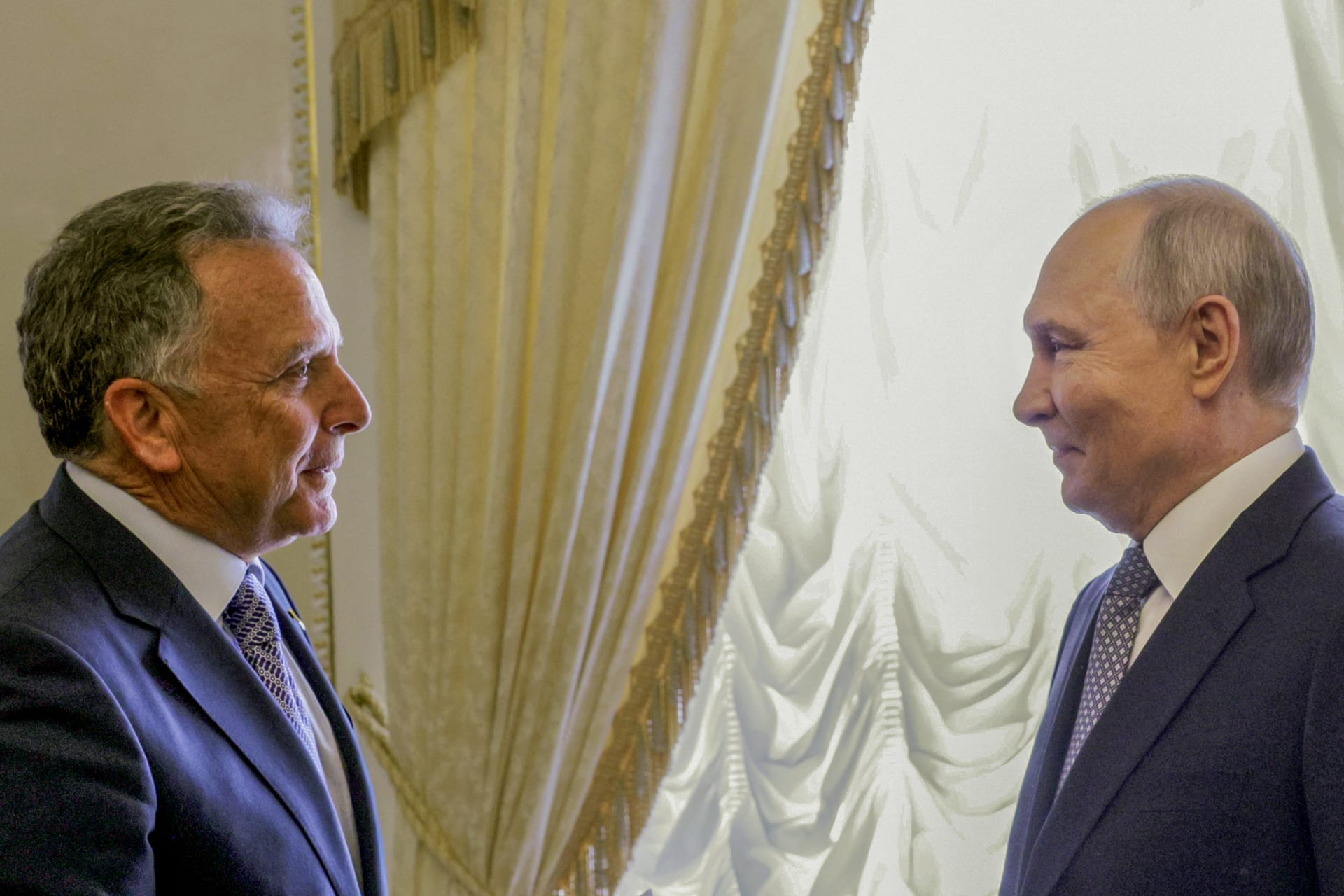
President Donald Trump’s envoy Steve Witkoff landed in St. Petersburg on Wednesday morning to meet with Russian President Vladimir Putin for the ninth time, days after the White House eased sanctions on Russian diesel. The Kremlin opened the gathering with a goodwill gesture: the release of Stephen Hubbard, a retired American teacher who was taken into Russian custody from his home in occupied Ukraine. One day earlier, Witkoff met Ukrainian President Volodymyr Zelenskyy in Oslo, where Ukrainian and European leaders sought to ease a widening dispute with the United States over military aid, intelligence sharing, and access to Starshield—the military version of SpaceX’s Starlink satellite network.
Trump’s deepening rift with Zelenskyy and recent accommodation of Putin have unleashed a torrent of criticism not only in Ukraine, but also in Europe and the United States. He has been accused of betraying a fledgling democracy and victim of Russian aggression in favor of a ruthless autocrat, who is, moreover, seeking to undermine the United States across the globe.
While the outrage may be justifiable, it has done little to clarify the hard choices the West and its Ukrainian partner confront. As before, rhetoric substitutes for a hard-nosed assessment not so much of what is at stake as of what can be achieved in the short term and what long-term goals should guide current policy. Three matters need to be soberly addressed: What near-term settlement of the Russia-Ukraine war is both desirable and achievable? What type of near-term relations with Russia are beneficial to Western interests? And how should relations with Russia be structured in the long term?
Ukraine and its Western backers continue to insist on a just peace, without defining it in practical terms. But everyone knows that the settlement will not be just in the strictest terms. The victim will not be made whole again and the aggressor will not be sternly punished. Russia will retain control of most of the Ukrainian land it has seized. Even Ukrainian leaders concede that they will not be able to liberate all the land within their internationally recognized 1991 borders through military means. At best, Ukraine can withhold legal recognition of Russian control.
Similarly, Putin is not going to be hauled off to The Hague to be held accountable for his war crimes. To the contrary, peace will have to be made with him. At best, he can be made to pay a stiff price for his aggression by ensuring that Russia ends the war in a worse strategic position.
In part, that would entail preserving Ukraine’s sovereignty and independence on as broad a swath of its 1991 territory as possible with its ambitions to join Europe undimmed. The slow but steady integration of Ukraine into European security structures, even if well short of NATO membership, would be a step in the right direction. That should be the goal of Ukraine and its
backers today. Not a just peace, to be sure, but an achievable peace that holds open the promise of a better future for Ukraine.
Reaching such a peace requires continued strong Western backing for Ukraine, especially through the provision of the weapons and intelligence it needs to thwart, if not reverse, Russian advances on the battlefield and to protect itself from Russia’s fierce aerial bombardment. Sanctions do have a role to play, but the experience of the past four and a half years demonstrates that they are much less consequential than promised and probably have long since reached the point of diminishing returns.
With pressure only able to go so far, dialogue and diplomacy are critical to reaching a settlement. But engagement is also a step toward the normalization of relations with Russia. Ukrainian and European leaders have categorically rejected this, railing against the United States’ talk of normalization because, in their view, it would reward an unrepentant Russia. That argument misses the point, however, in large part because it conceives of normalization as a return to a broadly cooperative relationship, like the one that existed in the first post-Cold War decades and definitively ended with Russia’s illegal annexation of Crimea in 2014.
This is far too positive and generous an interpretation of normalization. The West enjoyed fairly normal relations with the Soviet Union during most of the Cold War, despite the implacable rivalry. Reliable channels of communication and eventually habits of consultation helped avert crises or at least prevented them from spiraling into unwanted, and likely devastating, military confrontations. Such normalization is needed today for the same reasons. It may include some major commercial deals or other cooperative endeavors, as Cold War relations did, but they would not conceal the fundamental rivalry.
In the initial post-conflict years, Europe and Ukraine will almost certainly organize their security against Russia. They will need a credible deterrent force to stabilize the long frontier stretching from the Barents Sea to the Black Sea across Ukrainian territory. In time, however, the desire to reduce the costs of stabilization will likely lead to arms control agreements with Russia. Societal interaction across the frontier will also assuredly grow. Russia and Europe, including Ukraine, remain natural commercial partners, as they have been historically. Europe does need access to Russian energy resources, if not to the excess of earlier years, to diversify its suppliers and lower prices. And Russia, despite the talk of a turn to the East, remains strategically focused on Europe, as the war against Ukraine perversely demonstrates. Like it or not, Europe, along with Ukraine, and Russia share a continent.
Those who seek justice and moral clarity will be disappointed by the dénouement of the Russia-Ukraine war and the likely evolution of relations with Russia. But wars in which neither side achieves a decisive victory end in messy compromises, and countries that share a continent must eventually find a way to coexist.
Whatever comes of Witkoff’s talks in St. Petersburg and Oslo, they should be measured against what is achievable. Victory as commonly understood may be out of reach, but an imperfect peace that holds out the promise of a better future can be achieved. That is a goal for Ukraine and the West worthy of the sacrifices already made and those still to come.
This work represents the views solely of the author(s). The Council on Foreign Relations is an independent, nonpartisan membership organization, think tank, and publisher, and takes no institutional positions on matters of policy.