Why U.S. Borrowing Costs Keep Climbing Despite Treasury’s Efforts
Four CFR experts explain why Treasury’s market interventions haven’t lowered bond yields, how the sell-off is spreading abroad, and how AI spending and higher oil prices are affecting the bond market.
By experts and staff
- Published
 Benn SteilCFR ExpertSenior Fellow and Director of International Economics
 Rebecca PattersonCFR ExpertSenior Fellow
 Sebastian MallabyCFR ExpertPaul A. Volcker Senior Fellow for International Economics
 Brad W. SetserCFR ExpertWhitney Shepardson Senior Fellow
A sell-off in the U.S. bond market has pushed long-term U.S. borrowing to levels that haven’t been seen in nearly twenty years. The Trump administration has responded with two unusual interventions: an expanded buyback program for long-term debt and a U.S.-Japan coordinated effort to prop up the yen without selling U.S. Treasuries. Yields haven’t come down, however, and because U.S. yields anchor bond markets worldwide, this is being felt outside the United States.
The Council on Foreign Relations (CFR) turned to four of its experts to break down the continued bond market sell-off. They examine why Treasury’s market interventions haven’t worked, how rising U.S. yields are affecting other countries, what role artificial intelligence (AI) is playing in higher borrowing costs and how that could affect the AI sector, and what effect higher oil prices have had since the start of the Iran war.
Treasury Market Ploys Won’t Lower U.S. Borrowing Costs
Benn Steil is senior fellow and director of international economics at the Council on Foreign Relations in New York. He is the author of the Geo-Graphics blog.
The interest rate on 30-year U.S. Treasury bonds recently climbed to a nineteen-year high of 5.36 percent. The rise clearly alarmed the Trump administration, prompting Treasury Secretary Scott Bessent to undertake two highly unusual market interventions to keep long-term rates down.
On July 31, the U.S. Treasury coordinated with the Japanese Ministry of Finance (MoF) to aid the latter in pushing up the yen against the dollar—without selling Treasuries. The Federal Reserve Bank of New York, acting on Treasury’s behalf, bought yen with euros from the Exchange Stabilization Fund. Treasury apparently also encouraged the MoF to use the Fed’s Foreign and International Monetary Authorities (FIMA) repo facility, through which Japan could borrow dollars against Treasury securities held at the New York Fed. The aim was to enable Japan to acquire dollars with which to buy up yen without resorting to Treasury sales, which would put further upward pressure on U.S. long rates.
The coordinated intervention did boost the yen—from ¥164 to the dollar to ¥155. A month later, however, Japan disclosed that it had spent roughly $99 billion on intervention between July 30 and August 25, while the reported value of its foreign-securities reserves fell by a comparable $88 billion. Although the reserve figures do not identify which securities Japan sold—and partly reflect valuation changes—they strongly suggest that it financed much of the intervention by liquidating Treasuries rather than using the FIMA facility. Bessent’s use of foreign financial coordination to prevent bond sales, therefore, appears to have been unsuccessful.
On August 19, Treasury pivoted to direct market intervention, announcing that it would at least double its buybacks of long-term securities for the stated purpose of “liquidity support.” The announcement initially pushed yields down, but they quickly climbed back up. On September 10, Treasury actually bought up $5.2 billion of long-term Treasury securities (financed by short-term debt sales). This purchase represented a trivial 0.016 percent of the marketable Treasury market, however, and was therefore apparently meant merely to shock markets into believing that more would come if long rates did not fall. It too failed: rates did not fall.

What can we conclude from these two failed interventions? The U.S. Treasury market is now so vast that only fundamental changes in the supply of, and demand for, U.S. debt can durably lower interest rates. Ad hoc government gimmickry merely burns credibility. Changes that would make a meaningful difference include a falling fiscal deficit, lower inflation, lower AI infrastructure borrowing, and less aggressive U.S. financial sanctions—which encourage de-dollarization. None of these, however, appears to be on the horizon.
The U.S. Bond Market Intervention Has Affected Markets Around the Globe
Rebecca Patterson is a senior fellow at CFR, a globally recognized investor, and a macroeconomic researcher. She is the host of The Spillover, a weekly CFR podcast that examines the ripple effects of global events across policy, geopolitics, economics, finance, and technology.
The U.S. Treasury Department’s recent efforts to calm bond markets, and ideally bring U.S. Treasury yields lower, have not yet worked for one simple reason: Fundamentals are overpowering.
Against a backdrop of resilient growth, uncomfortably high inflation rates, tightening monetary policy, and questions over bond demand versus growing supply, yields have marched higher despite the Treasury’s actions, which include significantly larger buybacks of longer-dated Treasury bonds through early November.
Given that U.S. interest rates act as the anchor for global fixed-income markets, it should come as no surprise that rising U.S. yields have been felt globally. That said, the degree of recent contagion from the United States has varied considerably, depending on how integrated economies are with the United States and other timely market drivers.
Consider Mexico, with its economy deeply entwined with the United States. It has seen its government bonds closely track U.S. peers in the last month or so. However, in a country like Brazil, where investors are fixated on a heated election and its implications for economic policy, U.S. Treasury trends have been a secondary influence on Brazilian debt markets, if that.
Europe, meanwhile, has seen its government bond yields generally rising alongside U.S. peers. However, this is likely more than just U.S. contagion. Higher yields in countries like France and the United Kingdom also reflect domestic challenges. Large and growing budget deficits are raising concerns over demand meeting rising bond supply. At the same time, politicians who try to encourage even a modicum of fiscal austerity face an uphill battle to win over voters who are increasingly looking for government help to address affordability concerns.
The bottom line is that the U.S. Treasury market dominates and sets the tone for global bond markets directionally, but the degree of contagion will vary widely. The United States can use intervention to slow the pace of these moves, but without changes in underlying fundamentals, such as growth or fiscal policy, the direction of yields still appears biased higher.
How AI Spending Is Affecting Bond Yields
Sebastian Mallaby is the Paul A. Volcker senior fellow for international economics at CFR. His latest book, The Infinity Machine: Demis Hassabis, DeepMind, and the Quest for Superintelligence, is a New York Times best seller.
A decade ago, in that time between the global financial crisis and the COVID-19 pandemic, economists diagnosed a condition known as “secular stagnation.” Businesses and consumers were spending and borrowing cautiously, so savings were plentiful and the price to access those savings—the interest rate—was low. Part of the reason for low borrowing lay in the dominant technology of the time. Software was eating the world, as the venture capitalist Marc Andreessen said. And software companies such as Uber or Airbnb could be built with very little capital.
Today, in the AI era, this dynamic has reversed itself. The capital-light growth of the 2010s has been displaced by AI, which requires enormous capital spending on advanced semiconductors, the data centers that warehouse them, and energy infrastructure. Goldman Sachs puts this year’s U.S. AI-related capital expenditure at $581 billion, with the global figure standing at $1 trillion. In the United States, that $581 billion represents 1.8 percent of GDP, with Goldman predicting that the share will rise to 2.8 percent of GDP by 2028.
Studies of government finances suggest that borrowing an additional 1 percent of GDP pushes up long-term borrowing costs by 20–30 basis points (hundredths of a percentage point). So the current rate of AI spending probably pushes up the 10-year bond yield by a bit more than that. This is a material effect, but smaller than that of the federal budget deficit, which is running at around 6 percent of GDP.
While AI affects the bond market, high bond yields could affect AI by imposing stress on tech firms. When it becomes more expensive to borrow, it becomes harder to finance data centers or new sources of energy. For those who suspect the market is in an AI bubble, higher long-term interest rates will make it more likely that the bubble will pop. History suggests, however, that the relationship between high interest rates and tech distress is uncertain. In 1994, the U.S. bond market experienced a meltdown, and a famous hedge fund blew up. But 1994 was also the year in which internet stocks began a six-year bull run.
Higher Oil Prices Are Adding to the Bond Market Sell-Off
Brad W. Setser is the Whitney Shepardson senior fellow at CFR. He is the author of the Follow the Money blog.
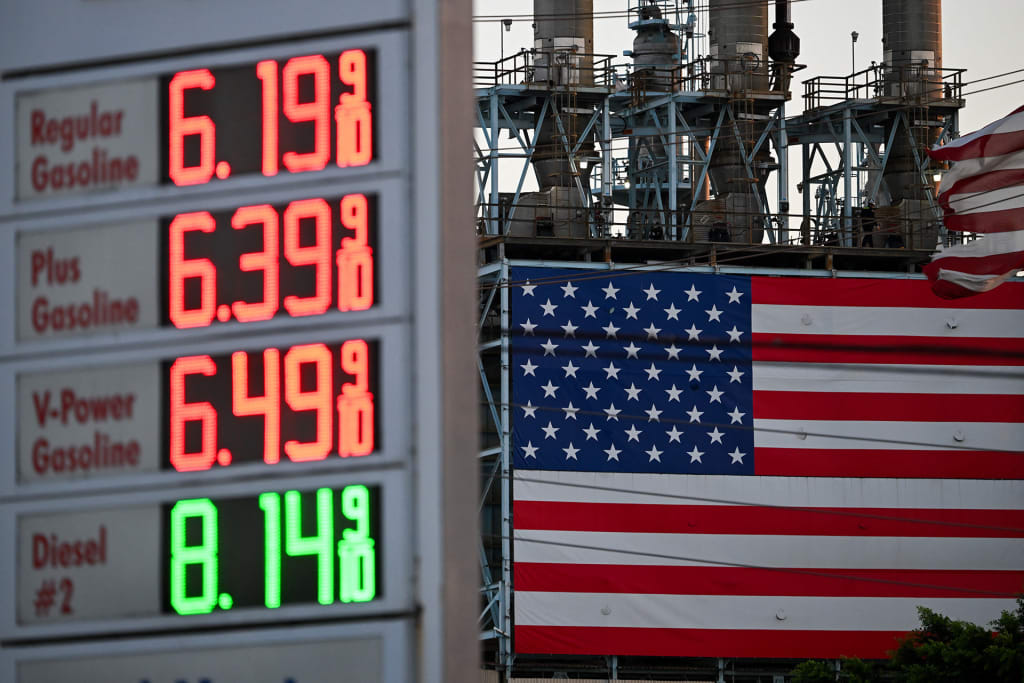
The recent rise in interest rates—notably the interest rate on 10-year government bonds—has played out in many countries at once. That at least suggests that a common global shock could be contributing to this rise in rates. And the most obvious global shock has been the rise in the price of oil and an even more pronounced rise in the price of diesel fuel. Oil prices spiked immediately after the start of the Iran war this spring, but they fell back to around $70 a barrel in early July. The benchmark for global oil (Brent) has subsequently marched up to more than $110 a barrel, often—though not always—moving in lockstep with interest rates.
The theoretical effect of an oil shock on interest rates is ambiguous. Higher prices of oil immediately push up the price of a key good and, as a result, measured inflation. But higher oil prices reduce the ability of households to buy other goods and services, which can lead to lower prices for other goods. When overall demand is weak—as it was after the global financial crisis—and there aren’t expectations of future inflation, central banks can look through temporary oil price shocks. And so too can government bond markets.
Right now, though, a number of central banks are worried that they have missed their inflation targets persistently over the last six years. This has made them reluctant to assume that the surge in oil prices is temporary. The surge in diesel prices, which increases the price of all goods transported by ship or road, only added to these concerns. The European Central Bank, the Bank of Japan, and the U.S. Federal Reserve have all hiked interest rates over the summer. And in the United States there are growing concerns that AI investments and a strong stock market have muted the normal drag on the broad economy from higher oil.
The persistence of both the oil shock and relatively solid activity has put pressure on the Federal Reserve to continue hiking rates and contributed to the current correlation between high oil prices and a rise in bond yields. So, it shouldn’t surprise anyone that the rise in oil prices is part of the sell-off conversation.
This work represents the views solely of the author(s). The Council on Foreign Relations is an independent, nonpartisan membership organization, think tank, and publisher, and takes no institutional positions on matters of policy.