A Conversation With President John Dramani Mahama of Ghana
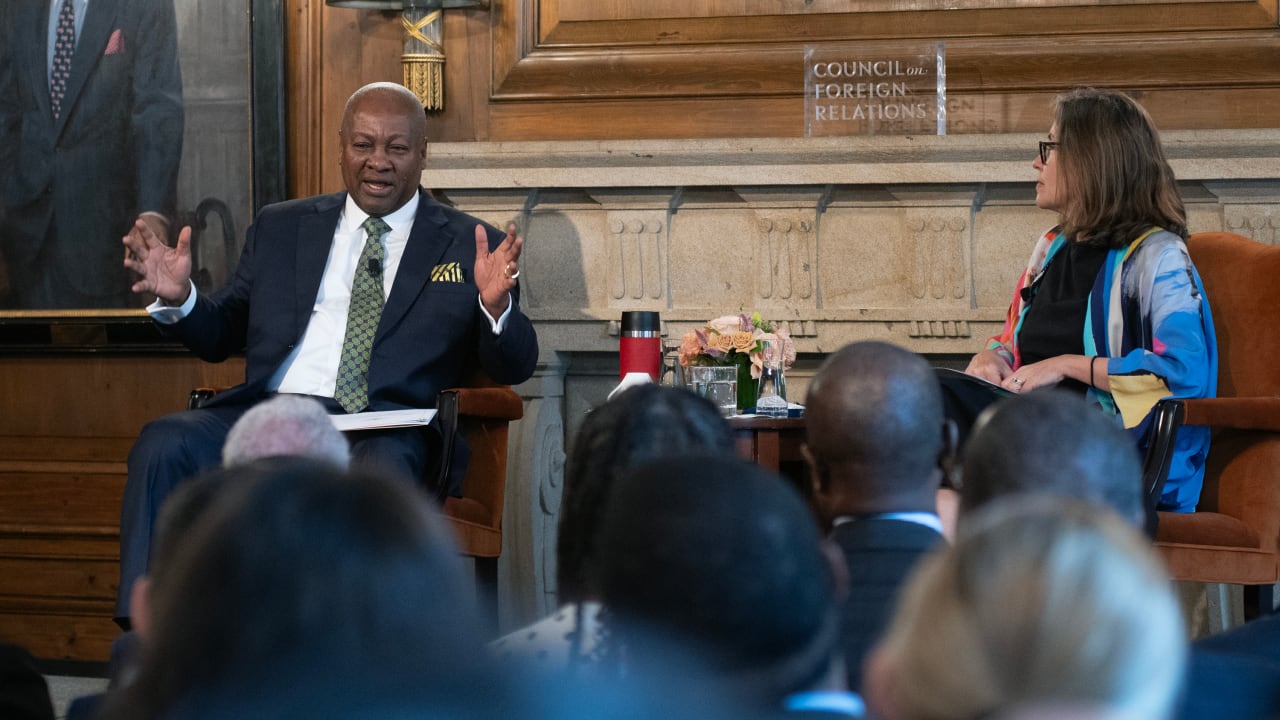
Event date
Speaker
- President, Republic of Ghana
Presider
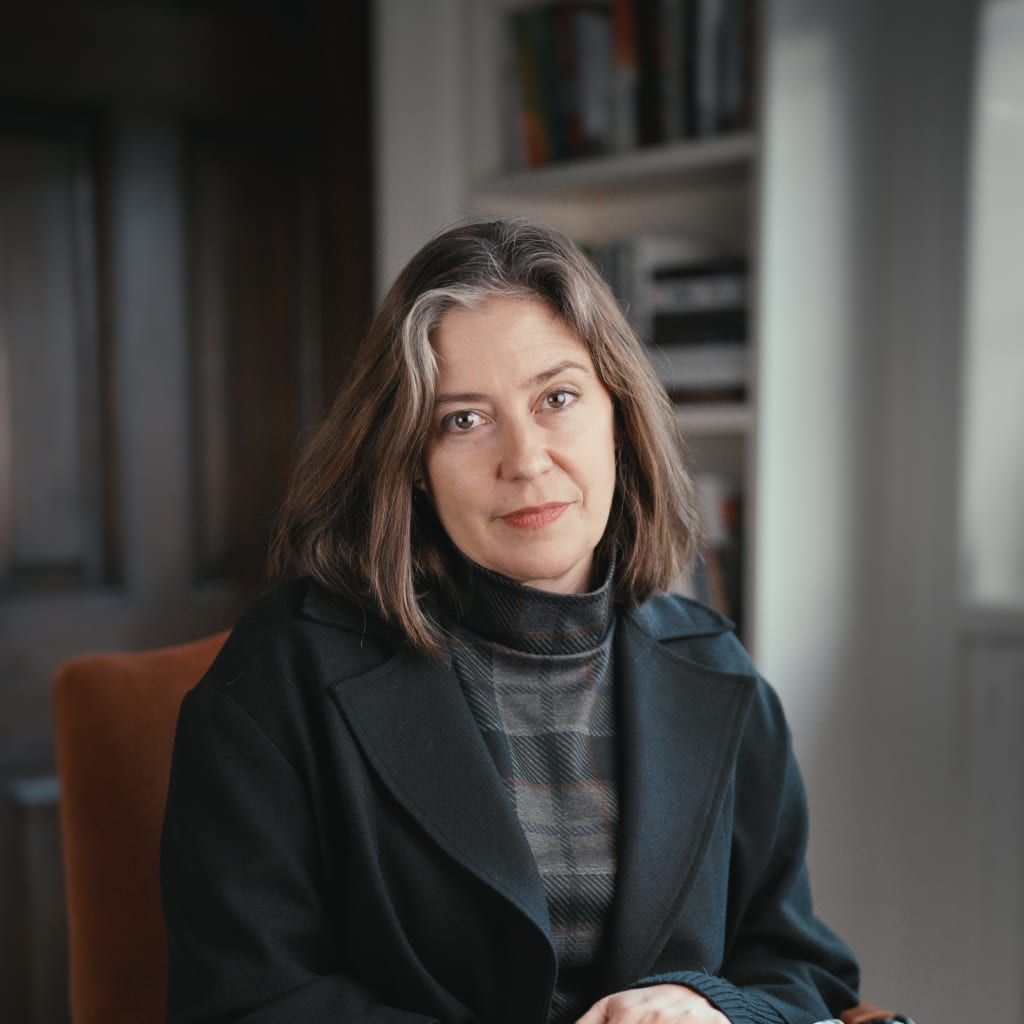 Michelle GavinCFR ExpertRalph Bunche Senior Fellow for Africa Policy Studies and Director of the Council of Councils, Council on Foreign Relations; Former U.S. Ambassador to the Republic of Botswana
From Africa Program.
President John Dramani Mahama discusses Ghana’s development priorities, the country’s role as a regional leader in West Africa, and the future of U.S.-Ghana relations.
GAVIN: And it is my honor to be in conversation with the president of the Republic of Ghana, John Dramani Mahama. (Applause.)
Now, you have his full bio in your materials. It is incredibly impressive, but our time is short, so I’m not going to read it to you. But I do want to note at the outset that just as Ghana has always played an outsized role, had an outsized influence on the course of African history and global perceptions of Africa, President Mahama is a figure with a highly influential profile among champions of democracy, his own career embodying faith in democratic systems as he has won elections. He has lost elections and accepted the result with grace and then gone on to win again. He’s a leader among those working to rethink the global development paradigms with his commitment to the Accra Reset, which I hope we’ll be able to talk about, and his is one of the most powerful voices in the global discourse around preparatory justice.
So, President Mahama, thank you so much for being with us today.
MAHAMA: Thank you. Thank you. Thanks for having me. (Applause.)
GAVIN: And I just wanted to start with the neighborhood.
So Ghana, of course, is a stable, peaceful democracy, but conflict and authoritarian military rule are right at your doorstep along the northern border with Burkina Faso where radical extremists control large swathes of territory.
There’s a tremendous security crisis and humanitarian crisis resulting. Multiple coups have left that country in the hands of leadership that claims democracy is a Western imposition.
So can you tell us a bit how Ghana is thinking about violent extremism that’s spread across the Sahel and threatens coastal West Africa, and how does that relate to the governance issues that have divided West Africa with ECOWAS and the alliance of Sahelian states?
MAHAMA: I think that those are more the symptoms than the actual cause, the underlying causes and other external factors. Indeed, the destabilization of the Sahel started as a result of the actions of America and France when Gadhafi was taken out. That destabilized Libya, and it was the destabilization of Libya that led to a flow of arms into the Sahel, and Libya became the gateway for terrorists into the Sahel.
So that’s the beginning of the whole problem. In Mali, there was an insurgency by indigenous Malians who were Tuaregs, but Malians, and then they complained about marginalization and wanted an autonomous region for themselves called Azawad, they called it.
And so that low-level insurgency started. But that has grown and has been fueled by the arms that came into the Sahel, and the terrorists who were displaced in Syria found a safe haven coming through Libya into the Sahel.
And so let’s start from there. Then after that, we can talk about coup d’etats and other things. Coup d’etats are the after consequences of everything that happened.
Now, the military felt that the civilian government was not pursuing the fight against the terrorist—(inaudible)—as well as it should. They were losing too many men. The military was demoralized and all that and so that triggered the coup.
And so we shouldn’t mix all these up together. Now we are faced with a situation where a coup occurs, the ECOWAS protocol says if there’s an unconstitutional overthrow of government, sanctions should apply. And so then that leads on to the schism between ECOWAS and the AES states and has created the current construct that we have.
So yes, we recognize that it’s destabilized the Sahelian part of ECOWAS. Of course, the AES have withdrawn from ECOWAS and formed their own federation.
But let me tell you that there’s still dialogue. When I came to office, I decided that, look, we must create a rapprochement with our brothers because we have the same people. Our ethnic groups spread across borders and, indeed, our people don’t recognize those borders. They walk across the borders anytime they want.
And so we must create a bridge where at least we are talking. And I believe that from last year to this year, the relations are much better. ECOWAS is talking to the AES states. We have stronger relations with them. Our borders are open. They are taking their imports through our country. They are sending their exports through our ports and all that.
So I think that the relation is still good and it has room for improvement. But all in all, I do think that it is not a fight they can fight alone. They need global support. They need regional support, and ECOWAS is willing to work with them and help them in the fight against terrorism, and I think that the world should not give up on those three Sahelian states.
GAVIN: Mmm hmm. And how is it that Ghana has maintained its security in the face of these threats? Because some of your coastal West African neighbors have experienced attacks from these groups.
MAHAMA: I don’t kid myself that Ghana is not vulnerable to attack, and maybe it’s a question of when, not if. And so if there’s an almighty God somewhere who has protected us thus far, we cannot continue to rely on divine providence. We need to take action to make sure that we protect ourselves.
And so, unfortunately, money that I should spend on education and health, I’m having to ramp up and spend on defense just in the possibility that we do come under attack.
But we’re increasing surveillance, and also we’re exchanging intelligence with our neighbors. And so our intelligence agencies and Burkina Faso are working together. We’re tracking the movement of terrorists and all that. If we have information, we pass it on to them. If they have information, they pass it on to us.
But I do think that we are seeing some light at the end of the tunnel. There’s a little more rapprochement taking place with the U.S. I know the U.S. has reached out to Mali, Niger, and Burkina Faso. I know Algeria, too. There’s a thawing of relations between Algeria and Mali, which is important in the fight against terrorism.
And so those are little first steps that we need to build out.
GAVIN: Hmm. So it’s kind of the perfect segue as you lay out some of the complexities in international relationships that affect your security to think about the broader continent. So Ghana will assume the chairmanship of the African Union in 2027.
Can you tell us a bit about your vision for that chairmanship?
MAHAMA: Indeed, we want to make that chairmanship impactful, and let me say that a lot of the younger generation has become a bit dispirited and, you know, discontent with the effectiveness of the African Union, and so we need to move it up a notch and let people realize that the union has a good purpose.
In the early days, it was focused on the liberation of the African continent. Now that all the countries in Africa are independent and liberated, it must focus on the things that matter to our present. And so I think that one of the things we’ll do is to continue the integration projects. The African Union has done some good things. There are many good protocols on democracy and good governance.
Recently, the African Continental Free Trade Area Protocol—I mean, those are all positive steps that we must work to get us, fifty-four countries of Africa, to advance.
The protocol has passed. Several countries have assented to it. But now we must work to put in the framework and the logistics for exchanging goods amongst ourselves and so, that means that we must put in the roads. We must put in the railways. If I order two containers of tea from Kenya, that tea shouldn’t come to U.K. before it’s shipped back to me in Ghana. We must have the opportunity to have that container shipped directly to me in Ghana.
And so even though we have the African Continental Free Trade Area, the existing trade networks that were set up by the colonial administration do not favor exchanges amongst ourselves. Indeed, you are better able and easier to fly to Europe than to fly to another African country. That must change.
And so the AU is important insofar as it continues to promote regional integration. So that will be one of the priorities that we work on, regional integration. And then also, peace and security.
Like you said, in our own backyard we have these violent extremists operating. Not only there, in Central Africa and other places, and the DRC conflict and all that.
I think that we should put in some more work to try and silence the guns. And then also we have what we call the Accra Reset.
GAVIN: Yes.
MAHAMA: Yeah, Accra Reset is—it started as a trigger, as a result of—actually, let me say, the withdrawal of USAID triggered Accra Reset because all of a sudden, we had passed our budgets and all that, and then you get a signal that says—let me use Ghana as an example—$174 million withdrawn. It’s not available.
And that went into education, it went into health, mainly. Health budgets for USAID annually was about $74 million. But it went into very critical things. It went into medical research, it went into supporting laboratories, testing laboratories for HIV and AIDS.
Actually, the whole PEPFAR program was administered by USAID and so provision of antiretroviral drugs and all that. Suddenly, we found—let’s take health sector alone—$74 million hole in our budget.
And so we had to make provision to cover that gap, and so that’s when President Obasanjo, Mark Dybul, and all the others came to me and said, look, we need to think about Africa’s health sovereignty again. Africa must learn to break this dependency syndrome.
And so that set a whole ball rolling and led to the whole issue of the Accra Reset. And so what we want to do is to achieve what we call health sovereignty.
GAVIN: Yes.
MAHAMA: Yeah. Produce more of the medicines and vaccines in Africa. After what happened in COVID, we were the last in the queue to get vaccines. Everybody else took care of themselves, because the big vaccine producers are all in the West.
And so we want to change that. They say that it’s not if another pandemic will come but when. Africa doesn’t want to be last in the queue again to receive vaccines if something like that happens.
And so we want to improve our capacity to be able to produce our own medicines, our own vaccines, and also spend more money on health outcomes because health is an important factor in African development. So—
GAVIN: That’s an ambitious agenda.
Just to follow up for a moment on the Accra Reset, how does this concept of health sovereignty relate, or does it not, to Ghana’s decision to decline to sign a bilateral health agreement with the current U.S. administration?
MAHAMA: Yeah. We received the health compact from the U.S. to replace USAID funding, and Ghana is a sovereign nation and we have our processes. We’re a democratic country. And so when the compact was received, the health ministry studied it and did what we call a Cabinet information paper.
And so the compact was brought to Cabinet, and we flagged several things in the compact. One, it says that we shall give the United States our pathogen profile. It means that diseases that are endemic in Ghana, what are diseases endemic in Ghana, what is the pathogen profile of a country. I’m sure there are medical experts who understand that better than me.
And it also says we should give our medical records. I mean, who takes another country’s medical records? And so that was strange.
And then it says we would have to put up a certain amount of money as part of the program into health care, and then it also says that any medications or any medical products that shall be brought into our country our food and drugs administration has absolutely no right to inspect.
I mean, it was humiliating. Yeah.
And so it was the compact that was thrown out in record time in our Cabinet. (Laughter.)
I’ve never seen anything thrown out as fast as that and so, of course, we rejected it. And we asked the health minister to inform the U.S. ambassador that we didn’t need it. We’ll manage ourselves, you know, and for a pittance, a hundred and something million dollars.
And so, we said, no, we didn’t want it and we’re doing fine. Yeah. (Applause.)
GAVIN: That certainly does sound like the antithesis of the agency and ownership that you’ve been talking about.
So could we talk a bit about your reparatory justice agenda?
One piece that I found particularly interesting is you’ve stressed the importance of cultural property and emphasized that cultural heritage is not separate. It’s not a distinct thing from the employment and economic concerns that animate so many African populations. But rather, it’s an engine of development.
And I was hoping you could share a bit more about how you see that connection.
MAHAMA: These are symbols and artifacts that have been a part of our tradition, and yesterday when I spoke at the U.N., I said that belonging is at the heart of everything. And so my values, my traditions, and all are part of who I am.
And so if as a result of a certain period of domination things that are valuable to us, sacred to us, are taken away and put in glass cases in other places where they make millions of dollars from people coming to look at those artifacts that do not belong to where they are but they, rather, belong to us, then it’s a part of the process of economic empowerment and development that those items are returned.
We can have those museums. If people want to come and see the Mponponsuo sword, which was one of the valuable symbols of the Ashanti kingdom, why don’t they come to Kumase and see it?
And so restitution is a part of the whole dialogue of reparatory justice because the Benin bronzes and all that are a symbol of the creativity of the people who made them and they have no business sitting in repositories in private collections outside.
And so it is linked to the progress and development of our countries to have those artifacts back, to build them as part of our tourism infrastructure. Indeed, it’s spurring a new movement to set up museums in Africa that can preserve those artifacts.
Indeed, the AU and EU are discussing together to set up an African museum that can have the facilities to preserve and display these artifacts and I think that, of course, that’s the way to go.
GAVIN: Mmm hmm.
And as we take this tour around the many issues on your plate, I wanted to ask about Ghana’s experience with the G-20 common framework.
So Ghana defaulted on its debt. It moved through the framework in really record time, certainly relative to the attenuated Zambian experience, and I know that this, you know, started under your predecessor.
But could you just talk to us a little bit about what that experience revealed about the way the international financial system works, and did it lead you to any clear recommendations for how this kind of debt restructuring should be handled, going forward?
MAHAMA: I don’t want to be the poster boy and model for how good that framework works, even though we’re being held up. Look at Ghana’s example. Look at Ghana’s example.
I do think that there are some things we can do to further reform it. But let’s go to the beginning. Actually, debt treatment is the end, not the beginning.
You know where it starts? Africa borrows eight times more expensive than the rest of the world. That’s where it starts. That’s where the debt trap starts.
And let’s just give an example, climate justice. We contributed just—we contributed just 4 percent to greenhouse gases. The earth is warming. We’re facing all kinds of climate events, and when we have a humanitarian crisis, we have to borrow at eight times the rest of the world to be able to resolve the issues of the climate fallout.
That is where it starts. That’s where the debt trap starts. And then when we’re trapped in debt, then now we come and we have to go through debt treatments and all that.
But aside from that, I mean, just look at it like this. There’s estimated $90 billion of illicit financial flows from Africa because big corporations from the West are misinvoicing, doing transfer pricing.
I’ll give you an example. You take Nigerian oil and sell it cheaper to—that’s just an example—to your other company in Europe, and then you make the profits on the commodity.
Let’s not use oil. Let’s use an African commodity. And then you make the profits on the commodity here in Europe, but you don’t pay the tax in Africa.
Then, again, you have interest and debt servicing. Took again another $80 billion out of Africa. If you add risk premium, that’s another $40 billion. So that’s 120 billion (dollars) plus 90 billion (dollars). More than $240 billion out of Africa every year.
And yet, ODA—total ODA into Africa is 70 billion (dollars) in 2023. In 2025, that crashed to 30 billion (dollars). So 30 billion (dollars) comes in and 200 and something billion (dollars) leaves Africa.
Those are the causes of the debt and so we must look at those causes. And so when we talk about a world that is rigged against Africa, that’s what we’re talking about. When we talk about a new global order, a reform of the financial architecture of this world, that is what we’re talking about.
Debt treatment is actually palliative. And so yes, Ghana has come true but at a cost. I’m having to pay billions of dollars to retire debt. That’s money I could have put in education. That’s money I could have put in health care. That’s money I could have put in infrastructure.
So even though we’ve gone through the debt treatment and the framework, it is at a cost. We’re having to pay quite a lot in debt repayments. And so we think that the whole global architecture must be looked at again in terms of the financial architecture and made fairer for Africa.
Africa must be able to borrow cheaper. We must have a bigger share on the IMF. We are 4.5. We are advocating for ten. And so those are the kinds of demands. Our demands are simple. We want a permanent seat on the U.N.
We want a bigger say in the international multilateral institutions. We want to be able to borrow at better rates. We want these risk premiums. It’s like when you come to Africa, there are some savages going to eat you up and so our credit risk premium is high.
You know, those are the things we want changed, not only the framework. (Applause.)
GAVIN: Well, I think this is a great moment to turn to our attendees for their questions.
But first, some reminders. This session is on the record. So this is not your moment to be indiscreet. Please wait for the microphone. State your name and affiliation. And please, may I ask that we aim for a reasonably concise question and only one question? Not a speech, not a series.
We’re so lucky to have some of President Mahama’s time and so let’s try and maximize the amount of time we spend listening to him.
So can we start right here?
Q: Good morning, President Mahama. My name is Edward Hightower and I live between the Motor City in Detroit, Michigan, and Accra in East Lagon.
I’m the founder of a company called Accra EV. We are working to develop the market and localize the value chain for electric cars, pickups, and SUVs in Ghana. When I say value chain, I mean component manufacturing, vehicle engineering, software engineering, all related to electric vehicles. I spent a career in the auto industry working around the world between Ford, BMW, and GM. I’m also the author of a book on how to develop the auto industry in six of the fifty-four African countries, including Ghana, and I presented that book both here at the Council and at the African Union. I have one question and a gift. The question is what are your thoughts on industrialization now as part of your agenda, given the—especially in the auto sector, especially given the global transition from gasoline and diesel to electric vehicles, and China’s move as a global powerhouse in electric vehicles? And the gift is, if I may, I’d like to give you a copy of my book at the end of the session, which I’ve autographed to you. Thank you.
MAHAMA: OK.
GAVIN: Why don’t we take two at a time? So, yes, right here, and then I promise we’ll go to this side of the room.
Q: Mr. President, good morning. Tigan Shem (ph), Côte d’Ivoire. Just first to say that I’m really proud to stand here in front of you and listen to what you’ve said. It’s an inspiration for all of us.
Just one question and a suggestion. When you’re president of the AU—we’re very excited about that—I believe that African countries need to become shareholders downstream of the sectors where we have significant raw materials. To take an example, Côte d’Ivoire and Ghana should be major shareholders of Nestle. When the price of cocoa goes down, the profits of Nestle go up. So it’s a very significant opportunity, and if you look at what the Gulf countries have done in the oil, they are at the gas station in ownership. And there are a number of critical sectors where Africa has a critical mass to unite, whether it’s on cobalt or others, invest in BHP Billiton, invest in Glencore, invest in those companies. And that will be a reliable source of income, which you can then use to invest in health and education. So that’s really something I would like to propose to you and suggest that you promote when you become the head of the AU. Thank you.
MAHAMA: Thank you. (Applause.)
OK. I think we have two. We’ve just come out with an EV policy to regulate the manufacture and importation of EV vehicles into Ghana.
First, you have to provide charging stations. You must have a policy to roll out charging stations. And because Ghana is a developing country, our network is not as robust as you find in other places, and so you must regulate even where EV charging stations are put so that you don’t overload a substation and brown out the area.
So all those are things that we’ve had to capture in the EV regulations. We also have the automotive policy that is encouraging assembling of automobiles in general including EVs. And I must say, like you said, the Chinese as usual have taken the lead. At least there are two automotive assembly plants in Ghana that are producing both internal combustion engine vehicles but also EV vehicles.
And you’ll be surprised at the rate of expansion of EV vehicles in our country. I bought my first one in 2024 and since then—I was an exclusive owner of an EV vehicle. Since then, I mean, it’s democratized. It’s a democratized commodity. And so it’s something we are encouraging, we’re working on, we’re putting in the policies to encourage and incentivize people to come produce.
But it’s linked to the question he gave, that we must bring part of the value added into Africa. And so if you listened to my speech yesterday, I talked about it. I said Africa must process its minerals. We must add value to what we produce.
And in Ghana we’ve begun to walk the talk. I have said that by 2030 we’re not going to export any raw ores—mineral ores out of Ghana. So those who are mining today must be mindful that they begin to put in at least primary and secondary processing of the ores.
Then when it comes to cocoa beans, I know Côte d’Ivoire is increasing their capacity to process. But I also came and said that from this year we’re going to export only 50 percent of our beans. We’re going to start begin by processing 50 percent of cocoa beans locally.
So instead of—(applause)—instead of becoming shareholders in Nestle or must bring Nestle to Africa, they must produce in Africa and we must have African brands of cocoa products. I mean, there’s cocoa butter, cocoa liquor, cocoa powder, and all that.
It doesn’t take rocket science to produce that. It’s just the factories. And we have a young, growing population. We need to bring some of those jobs back home, and so it’s a thing whose time has come and I’m one of the advocates for it unashamedly. (Applause.)
GAVIN: Thank you.
Can we go to the woman in the red jacket?
Q: Good morning. Greetings—
GAVIN: Oh, there we go.
Q: (Comes on mic.) Greetings, Your Excellency. What an honor. I am Dr. Adjoa B. Asamoah, former national advisor for black engagement, black engagement director, and senior advisor for racial equity to President Biden, current chief of staff at the Housing Finance Agency in the District of Columbia.
My question is very simple. When I was home in December, you declared the diaspora a formal region. How can the diaspora help support your vision for getting Ghana closer to Kwame Nkrumah’s vision? (Applause.)
GAVIN: And then right here, this gentleman with the brightly colored watchband.
Q: Your Excellency, thank you very much for being here today. Eddie Mandry, a Council member, Ghanaian at heart, Kenyan by birth. (Laughter.) (Speaks in a foreign language.) (Laughter.)
(Continues in English.) My question is on the twenty-four-hour economy. It’s an interesting strategy about restructuring how you manufacture, your productive capacity, but also labor. I’m curious what your vision is in terms of five years from now. What does success look like in terms of this initiative? Thank you.
MAHAMA: Yeah. We declared the Ghanaian diaspora the seventeenth region of Ghana, and that is because of the contribution they make to Ghana’s economic progress. Remittances, if I remember the last figure, hits almost $7 billion—remittances from Ghanaians in the diaspora.
And so that is not money you can joke with, and so we declared them our seventeenth region. We have sixteen regions, and so we want to bring them on board as our seventeenth region.
But we want to move from just remittances to investment, and that is the policy we’re pursuing, going forward. Ghanaians should not just send money back home to relatives or to construct a house for me or something. They must invest in the economy.
There’s a lot going on in Ghana. Foreigners are coming and investing. Why not our diaspora? And so the diaspora should be able to either, you know, invest either in financing, you know, development, industrial projects, or in participating as shareholders.
So we’re working on the frameworks to allow the diaspora to come in with their investment, make sure their investment is safe and guaranteed.
Unfortunately, a few people in the diaspora got their fingers bent in the debt restructuring, and so building back that confidence and getting them to come on board again is something that we have to continue working at. It’s work in progress, and we want to involve them in the discussions on how that happens.
We’re coming out with what we call the new economy, and it’s going to target nine job-rich sectors because, one, we’ve stabilized our economy; two, our economy is growing at 6 percent. But what does it mean if it’s not creating opportunities for our people?
And so we want to move from just stabilization and economic growth to job creation and creation of opportunities for our young people, and we think that the diaspora can play a very important role in that respect.
The twenty-four-hour economy is simple. We have a manufacturing sector that works from 8:00 in the morning and closes at 5:00, and the rest of the twenty-four-hour cycle, the machines are idle and nobody is at work.
And so there’s the opportunity if we incentivize these manufacturers to either add on one shift or two shifts, depending on the demand, because now we have the African continental free trade area. So know that you are producing not only for 34 million people. You have the potential to produce in West Africa for 400 million people and in Africa for 1.4 billion people.
And so we’re incentivizing our manufacturers. We’re going to give them some tax breaks. We’re going to give them lower tariffs for electricity. We’re working to give manufacturers lower tariffs for electricity to bring down their costs.
We’re going to allow them to bring in plants and equipment duty free, tax free, and all that. That is to incentivize them to add on another shift or add on two more shifts so that instead of one person working you have two, three young people having the opportunity to work.
So that is at the bottom of the whole twenty-four-hour economy, and I must tell you that the response has been great. I mean, we have several industries that have done the pre-sign-up and indicated that they are ready to go with a twenty-four-hour economy.
The incentives are coming to Cabinet. Cabinet will approve it. Only parliament can grant exemptions and tax breaks and all that. So once Cabinet approves it, it will go to parliament, and then parliament will approve it and then we’ll action it.
GAVIN: It’s exciting. And this connection between job creation and what sort of economic—and economic growth is not just a number, right? It has to be about dignified jobs for Ghana’s tremendously young population. It’s instructive and I think relates directly to the strength of democracy and why democracy is struggling in the region.
So, sorry. Let’s take Mahesh, and then we’ll go to this lady.
Q: Thank you very much, Michelle.
Mr. President, what an honor to be here and for you as chairman of the AU seventy years after Kwame Nkrumah led Ghana to independence. Congratulations.
MAHAMA: Thanks.
Q: I hope that AU will take forward the issue of preferred credit status that comes up so frequently in credit ratings of multilateral development banks such as Afreximbank, which lent to you, which was caught up in the restructuring.
I would like to know whether you will support and get African countries to support the recognition of de facto and de jure preferred credit status for African development banks that are being threatened with downgrades because of the pressures from the IMF and others to create what they call plurilateral institutions with preferred credit status deleted.
That’s very dangerous for the ratings of African countries and African financings because it has exactly the problem that you mentioned. These institutions can borrow at cheaper rates because they’re investment grade, unlike you.
And all but three countries in Africa that are rated out of thirty-four are non-investment grade, so you need to rely on development banks from Africa who can finance you at investment grade rates. And if you need to get support from the IMF and others, will you support it at the AU?
Q: Hi, thank you. Jennifer McDermott with the Associated Press.
You had said at the U.N. that no human civilization deserves to be annihilated, and certainly not a member of the United Nations. I was just wondering if you were referencing President Trump’s speech when you said that—(laughter)—and I’m also hoping you might be willing to comment on Iran’s offer to reopen the Strait of Hormuz in seven days. Thank you.
MAHAMA: Well, I think you spoke for me. You’re preaching to the converted.
I hold the same opinion as you with regards to African financial institutions. Indeed, coincidentally, I’m the champion on empowering African financial institutions, and so it falls right within my purview.
And so it’s only natural that when I become the AU chair, it’s one of the things we’re going to pursue. Ghana was particularly in the spotlight with regards to the Afrexim issue, and it’s so unfair.
At a time Ghana was at its most vulnerable and IMF and everybody had virtually cut Ghana off, all the creditors had cut Ghana off, it was only Afrexim. In order that the economy of Ghana didn’t crash Afrexim gave us $700 million.
That was a lifeline. That made Ghana survive until we could even declare a debt default and we could go back into an IMF program.
So if Afrexim didn’t come in at the time it did, the economy would have crashed. There would have been shortages, we would have been unable to buy fuel, wouldn’t have been able to buy drugs for our hospitals and everything, and who knows what will happen? And then there could have been a coup d’etat, and then you say, oh, they are backsliding on democracy.
I mean, that is the world that is rigged against Africa. That’s what I keep talking about. And so when we started the debt treatment, IMF says and World Bank say Afrexim is not a multilateralist institution and so they must undergo the same treatment as any private lender. I mean, that’s not fair.
And so certainly I’ll take it up as AU chair. We will fight this. Financial institutions must be recognized and they should be given the same rights as all other multilateral institutions. (Applause.)
I am a student of history. Indeed, my first degree was in history. And I appreciate civilizations. I have studied from the Egyptian civilization, Chinese, all civilizations in history, the Roman civilization, Greek. I read the Classics in my first year in university, classical history.
So I studied Rome, I studied, you know, Carthage. And if anybody proposes a concept of annihilating a civilization, it’s anathema to me. So I’m not referring to anybody. (Laughter.)
But my words were simple and could be understood. No civilization deserves to be annihilated. That’s it, period. (Applause.)
GAVIN: It would seem uncontroversial.
MAHAMA: And then about the Strait of Hormuz, indeed, after I said that, I said something. I said no dispute is so intractable that dialogue, once people are talking, they can’t solve. And so I believe that if the U.S., Israel, and Iran are speaking about the Strait of Hormuz and about Iran’s nuclear ambitions, we can find a solution to it.
GAVIN: So I believe we have time for one more question. Go right here on the aisle.
Q: Thank you, Michelle. Mr. President, thank you for being here. My name is Marshall Kambari. I’m a CFR term member, and I’m originally from Burkina Faso.
A lot of your words touch the audience here, as you can see. This month, Dangote asked ordinary African to own a piece of his refinery, and the Cocoa Board asked Ghanaian investor to fund the crops instead of the foreign banks. Both goals, from my perspective, is to keep capital at home, but oftentimes that capital can be (fit ?). Your 50 percent processing goal needs some local refinery, some plants, but also reliable power. My question to you is, are you thinking—is Ghana thinking about listing stakes in strategic asset the way that Dangote did with a tranche that will be open or maybe accessible to the diaspora? Thank you.
MAHAMA: Okay. So that’s the last one, yeah?
GAVIN: I think so, to keep you on time. I’m struggling.
MAHAMA: Should I go?
GAVIN: Go ahead.
MAHAMA: OK. Sorry.
So, yes, we are changing our model of funding cocoa, and at first what we did was to syndicate foreign financing. But then the collateralization of the funding is in the cocoa beans, and so we took the funding and then we had to ship beans to the tune of that funding, and what it did was that then it meant that after we had shipped to the value of the funding, what was left over was not enough for local processes, and so we had restricted local processes to only the minor crop beans.
Now we are not distinguishing between the minor crop and the main crop. All cocoa beans are cocoa beans, and so we’re saying 50 percent of our beans must be processed locally, as a start. Once we get a hold on it, we’ll continue to expand that percentage, but then we don’t want our beans collateralized anymore and we can raise our own domestic funding to purchase our beans.
And so the Cocoa Board is just about to float their bond. The minister of finance has given them the green light, and so we’ll buy the cocoa ourselves, and once we buy it ourselves we can ship it at our own pace when we want, and it gives us better control of our resource, and it makes it possible for us to reward our farmers better.
And so that’s one of the things we’re doing in light of what my brother asked about value addition and all that.
And then we need reliable power, yes. Happily, Ghana is one of the countries that started early in terms of providing stable power and affordable power across the length and breadth of our country, and so Ghana has more than 90 percent electricity coverage across the length and breadth of our country.
The remaining 10 percent that are not yet hooked to the grid is because of the impracticality. They’re either remote, and so what we’re doing is seeking green solutions, solar power, and other off-grid solutions for them.
But yes, we have available power, and I think that’s one of the attractions why foreign direct investment is flowing into Ghana at that rate. We’ve gone from our crisis year in 2024 $640 million in FDIs to 2025—end of 2025, $2.6 billion in FDIs, and so it’s obvious that there’s something good happening.
But to come to your question, are we ready to, you know, list and allow investment in some of the state-owned enterprises? Absolutely.
Indeed, if I could, I’ll list all of them, you know, because there’s this notion of state enterprises where people just go and they’re guaranteed a monthly salary whether they perform well, they don’t. Even when they’re making losses, they’re asking for salary increments and asking for bonuses when you’ve made a loss, you know.
And so we’ve managed to turn around the story. Collectively, they made a loss, but last year, I think we just held the state interest and governance authority program, and they have, you know, made a net profit of almost 19 billion (dollars) CDs, so it means there’s a turnaround happening.
But we still have prepared ten of the state-owned enterprises for listing, and so they’ll become publicly listed companies, one, because we want to improve their governance, and two, because we want to reduce political interference in those state-owned enterprises.
Ghana is a democracy. It’s a revolving door of parties. We have lost several times. Our opponents have been in power. They have lost on occasions. We have also come into power, and always when one party comes, they’re sacking their chief executive officers, replacing the boards and all that, you know.
If we list more of these companies, it makes it difficult for government to interfere and sack the management and dissolve the boards and all that. So I think it’s the way to go, and it will also allow our diaspora to buy shares on the Ghana stock exchange.
The Ghana stock exchange was the best—was the best performing in Africa, you know, last year, and it’s bounced back. We did three IPOs in record time, you know. And so it’s a good place to invest, and some of them are paying quite good profits here.
GAVIN: Well, before I invite you to join me in thanking the president, may I just ask that we’re all going to hold in our seats and let the president and his delegation get on their way so they are not late to their next engagement.
So please do that, and please join me in a very sincere thanks to President Mahama. (Applause.)
(END)This is an uncorrected transcrip