A Conversation With Deputy Prime Minister and Foreign Minister Radosław Sikorski of Poland and Foreign Minister Oana-Silvia Țoiu of Romania
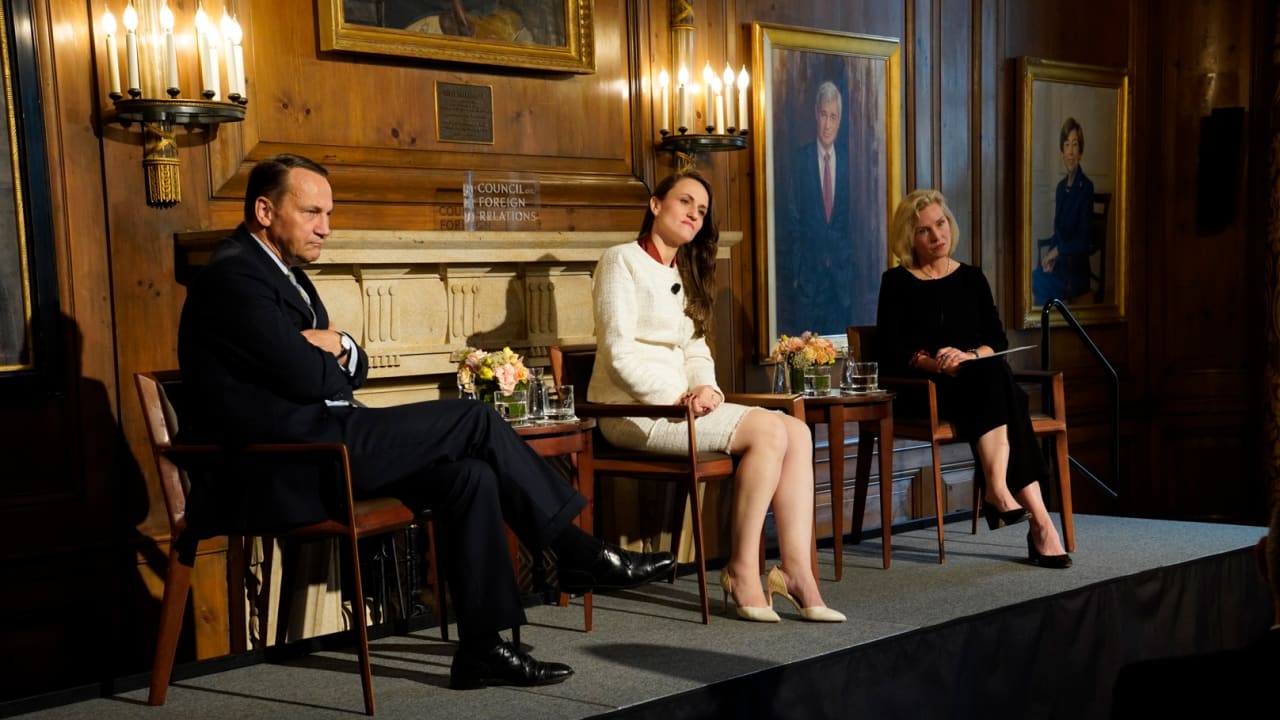
Event date
Speakers
- Minister of Foreign Affairs, Romania
- Deputy Prime Minister and Minister of Foreign Affairs, Poland
Presider
- Host, All Things Considered, NPR; CFR Member
Polish Deputy Prime Minister and Minister of Foreign Affairs Sikorski and Romanian Minister of Foreign Affairs Țoiu discuss the impact of Russian aggression against Ukraine on regional security, its global consequences, and the future of transatlantic relations.
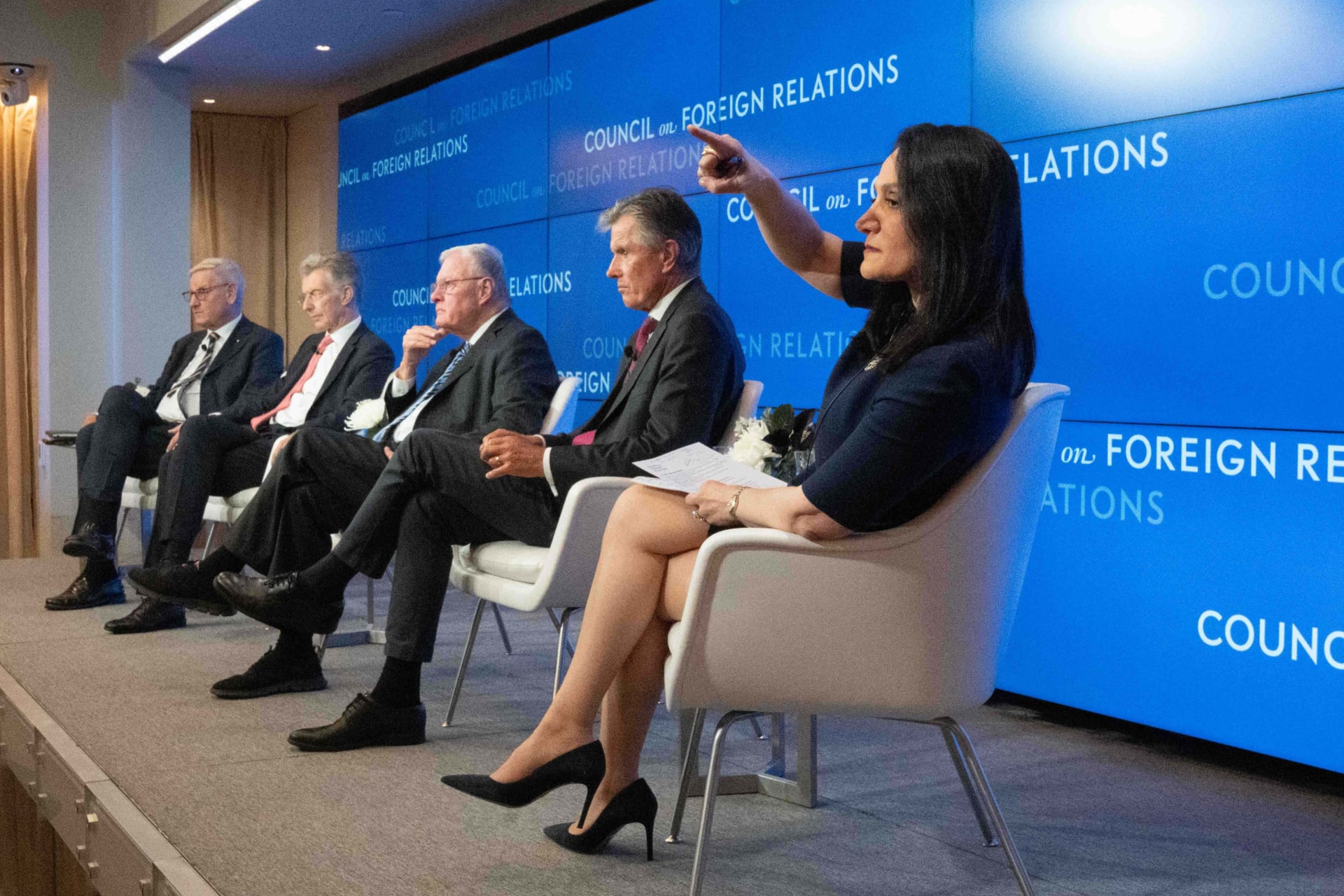
KELLY: Good morning, everybody. Happy UNGA week, to all who celebrate. (Laughter.) I want to say an especially warm welcome to my guests on stage today. To my right, Romania’s Foreign Minister Oana Țoiu. Welcome. And farther down from me, from Poland, Radek Sikorski, deputy prime minister and also minister of foreign affairs. Welcome to you both.
I’m Mary Louise Kelly, a host of NPR’s All Things Considered, also our national security podcast, Sources and Methods. I am particularly delighted to be up here today.
We’re going to talk through some of the matters that have been unfolding and being debated, discussed, and clashed over, in some cases, a few blocks from here at the U.N. General Assembly this week. Among them, Russia, Russian aggression, war, Ukraine, the future of the transatlantic relationship. And we’re going to do it with two diplomats who have a front-row seat to all of that. So here we go.
I want to start just by understanding what the threat looks like from both of your perches. How regularly are Russian drones and Russian missiles reaching your airspace? Please.
Țoiu: So thank you for having us. It is, I would say, a good moment for the conversation, inside the week at U.N. In our case, Romania has the longest border of a European Union member, of a NATO member, with the war. We have 650 kilometers that we share with Ukraine, and then, of course, the Black Sea that is absolutely instrumental. And we have talked throughout these days on the role that the Black Sea has on the grain exports. And maybe we can touch upon that a bit later.
In terms of the number of drone incursions, it has become quite frequent, unfortunately. There have been more than one hundred instances where you would, for example, find fragments, or we would see reports of drones into our airspace. Specifically, because we also share the Danube with Ukraine. And the Danube is essential as a transportation lane for grains as well. That’s where we see a lot of these incursions happening. And recently, in terms of maritime drones at the Black Sea and at the Port of Constanta, drifting drones have been neutralized by our teams.
So that is definitely now something that shows, not just to Romanians but to everyone, that Russia is fully responsible. Not that we didn’t know that already, but it is quite clear that we need to increase what we’re doing as a deterrence and defense factor, and also the instruments that we have to actually neutralize the drones and to protect from hybrid interferences, because we see that a lot as well.
KELLY: And just to add some context, I was looking up numbers from Romania’s Ministry of National Defense. Drone incursions this year are triple what they were compared with all of last year. And we, obviously, still have three months to go in 2026. So this is heading quite rapidly in the wrong direction from where you sit. How about in Poland?
SIKORSKI: Well, the big picture is that Russia miscalculated badly. They thought that Ukraine would fold. They thought—they believed in their own propaganda about Ukrainians not really being a separate nation. And instead, they are fighting in Donbas for the thirteenth year and trying to conquer Ukrainian territory in other places for the fifth year. And, actually, on land, the Ukrainians are making some gains. It’s a stalemate in the Black Sea and it’s a stalemate in the air. Neither air force can operate over the territory of the other. Ukraine has destroyed over 30 percent of Russia’s refining capacity, which is significant.
But Russia now has these long-range—these Shahed drones that they fit in with Chinese jet engines, which are faster, longer range, and more precise. And what I think they’re doing is they’re trying to cut off Ukraine from being supplied. And they’re hitting our border crossings on the Ukrainian side. Literally two of them this morning in Poland. But, of course, it’s causing alarm on our side of the border, because sometimes they miss. They also send cruise missiles, we think deliberately in July, a big one which exploded in Poland. And they do the state terrorism stuff all over Europe, which they probably think is going to intimidate us. It’s actually strengthening public support for larger defense budgets, and is uniting Europeans. Because when you attack Germany, the effect is that Western Europe sees that it’s not just an East European problem.
KELLY: So Russian drones have been crossing your borders for a while. This has been happening. Which makes me curious why your prime minister chose last week to come out and issue a very firm, very clear warning that made headlines around the world.
SIKORSKI: Because we are getting intelligence from multiple sources that they are—
KELLY: Said it was NATO, it was the U.S.?
SIKORSKI: We don’t identify sources, but it’s multiple—that Russia is cooking up something big this year. And we also think that you have public opinion even in dictatorships, that Putin needs a pretext for mobilization. And so they might do a false flag attack on themselves in order to say to their people, we are under attack and therefore we have to mobilize. This is standard Soviet and Russian behavior.
KELLY: Is that what you mean when you say they are cooking up something big? Is that what that would look like?
SIKORSKI: It’s one of the possibilities.
KELLY: What are the others?
SIKORSKI: And also, there are these—you know, drone warfare is transforming. We are seeing a revolution in military affairs. So literally the speculation this morning is that they might do to southern tier European countries what the Ukrainians did to them. Ukrainians sent a truck from Kazakhstan to near a Russian airfield. The container opened up, released a bunch of drones which hit their strategic bombers. You could very easily do that from a ship in the Mediterranean and attack critical infrastructure.
KELLY: Mmm hmm. And, just quickly, what would the other “cooking up something big” scenarios look like? What else are you worried about?
SIKORSKI: Well, the Belarusians are very concerned about being drawn into the war. As you know, they have Russian majority population in Narva in Estonia. They have Russian majorities in some towns in Latvia. They would love to have a land bridge from Belarus to the Kaliningrad exclave, in Lithuania. We don’t know what they will do, but we have to prepare to deter it.
KELLY: Yeah. So none of us are inside Vladimir Putin’s head, happily, but understanding your adversary obviously helps inform your planning and strategy. What do you think is going on here? Why escalate? Did you—does he believe that he is winning in Ukraine, so it’s becoming he can do what he wants? Or is this desperation because he is starting to feel some of the impact of this war not going his way?
ȚOIU: Well, first of all, he—they have famously said that they expected this to be a three-day war. And now it’s more than 1,670 days into it. That is obvious from any angle. And in the same time, what we see in terms of incursions are also a direct effect of the increased volume of attacks against Ukraine. And even if we are four years into the large-scale invasion, more than a decade into the war—because we need to remind ourselves that it has started with Crimea. So we need to remind ourselves that we’re more than a decade into this. Then, percentage-wise, what’s happening is the increased volume of attacks against Ukraine have an increased spillover effect on the border. That’s one thing.
And then the other is I don’t think he ever expected that the international community is going to be so united, so resilient, and perseverant. One of the reasons why we’re able to do that is because also our citizens see the courage, the resilience, the strength of the Ukrainians. And when you see what they’re doing to protect their children, to protect their independence, to protect their future, and that they cannot do it alone. And that means that all of us as countries are able to step up and consolidate and be perseverant in our support. And President Nicusor Dan has said this in the Romanian intervention in the plenary, that we are committed for how long it takes to support our neighbor.
Why am I mentioning this? It’s because we are very much focused on what’s happening on land, air, water. But Putin is also playing the game of hybrid interferences with the minds of citizens, not just his own citizens but he’s trying very much in the public sphere, in the online sphere, through influencers or fake accounts, coordinated campaigns, fake bots, using the platforms, to decrease the support that we’re able to give. And because he hasn’t managed to do that politically necessarily, we have seen also Orban lose in Hungary, he is consistently trying to do that by lowering citizen support.
And that’s why whenever we see incursions of drones, for example, into our airspace—and I think this has been the case with Poland and other countries as well—we also immediately see in the online conversation how that is used to try to decrease the support we can give to Ukraine, either by highlighting the heightened risks, either by trying to challenge the idea that NATO is strong and that the deterrence in NATO works. But at the political level, the effect is the opposite. We have increased the number of members of NATO. We have increased the budget. We have increased our level of political consultation and coordination. And we have increased our capacity to clarify to our citizens why is it that we need this to happen.
KELLY: So just one more before we move on to what the response might look like and dig into that. But just to fully understand the threat as you are perceiving it, do you see signs that Russia is beginning to run out of resources, to feel the pain of this? Whether it’s troops, whether it’s money, whether it’s time, weapons, any of it?
SIKORSKI: Well, the fact that he is considering mobilization means that he can’t recruit enough contract soldiers who have been fighting the wars hitherto. On resources, you know, these Shahed drones with Chinese engines, they are quite cheap and it’s quite easy to produce them. But the Russian economy is suffering. And I’m told he understands in detail the military position, but not quite the financial and economic position of Russia. Remember, he made money on the first year or two of the war. He’s now depleted his national reserve fund. He’s selling his gold reserves. He has petrol shortages. Civilian economy is underperforming, three-day weeks and so on. But he can probably still continue for a year or two, unless Ukraine can damage more than half of the refining capacity, in which case there will literally be not enough petrol and diesel to move stuff around.
So there are various dynamics. He thinks he has two more cards to play—mobilization and a harsh winter, and the destruction of Ukraine’s energy grid and heating systems and major companies, which is happening, which is destroying the Ukrainian economy. But the Ukrainians also have, as President Trump said, cards to play. (Laughter.)
KELLY: A question to both of you, and it boils down to a yes or no answer. There has been a lot of commentary over whether one of Vladimir Putin’s goals here may be to test Article 5. If it came down to this, are you both 100 percent confident that NATO would rush to your defense, that Article 5 would hold?
ȚOIU: Yes.
SIKORSKI: So what the Russians will do is not a land invasion, because that’s easy. We would respond immediately. And he, number one, doesn’t have the forces. Remember, when he was gathering his forces for the invasion of Ukraine, we saw it a year in advance, six months in advance. You know, you need hundreds of thousands of troops. So he will do something much more small scale, something that is ambiguous, because Article 5 is not a button in Brussels. It’s a political judgment as to the nature of the threat. And so he will try to drive a wedge between allies, particularly between Europeans and Americans. And Article 5 has hitherto only been effected once, in response to 9/11 on behalf of the United States. So we will have to make a judgment. And, of course, we hope that the United States will be with us.
KELLY: We’re speaking in New York, obviously. And the current occupant of the White House has made clear repeatedly that his enthusiasm for NATO is not unlimited.
SIKORSKI: Actually, in Ankara he was more positive than before.
KELLY: Say more.
SIKORSKI: It was curious at the NATO summit. You know, normally people argue internally and keep a united front on the outside. In Ankara, it was the other way around. (Laughter.)
KELLY: If it came to it, could you defend yourself without the U.S. being significantly engaged in a NATO response?
ȚOIU: Well, we focus a lot on Article 5, but there is also Article 3 and Article 4. And I think what has happened throughout the years, and especially even more the last year, is in Romania, in Europe, we have significantly increased not just the investments we have on defense, but the level of pressure we feel in terms of time to delivery. And what do I mean by that is when we looked at our previous procurement plans, we were quite patient. Delivery times from companies we were buying from, including U.S., were years ahead. Now we are way more aware that the risks are rather present already. And that has meant the way we have approached it is to prioritize also from a time perspective, and also from a co-production perspective on our own territory.
And this has been the—those have been the guidelines on how we use, for example, also the European investment. Poland and Romania are the top two countries that have financial allocation through the SAFE mechanism to increase our defense. And the way we have used it is specifically with that goal in mind, to be able to have our capacity for defense and deterrence. And also at the European level, what we’re doing increasingly more at the military and political level is to have a better awareness of the gaps, capabilities, complementarities on not just what we currently have, but also of what we’re planning to procure in the future.
KELLY: OK.
SIKORSKI: If I may?
KELLY: Please.
SIKORSKI: Russia celebrates its independence day to mark the anniversary of the day when they chased Polish troops out of the Kremlin in 1611. (Laughter.) I’m not kidding. So what I’m saying to you, we’ve been fighting the Russians since before the United States existed. (Laughter.) And if they attack us, we’re not going to give up. (Laughter.)
KELLY: That said, U.S. troops have been in Poland on a rotating basis. President Trump is leaning in, saying that he would—there’s progress being made on establishing a permanent U.S. military footprint in Poland. Does that square with your understanding? How significant is that?
SIKORSKI: We have a U.S. base in Poland already. I signed the agreement with Condi Rice for the missile defense base. And it protects Europe and the United States from Iranian intercontinental missiles, if they develop them in the future, but also from shorter-range ones. So we are discussing a second one. We don’t want—we have about 7,000 troops on a rotational basis in Poland right now. This would be a brigade-size base. You cannot invade Russia with one brigade, OK? (Laughter.) The Wehrmacht tried with 200 divisions and they failed. So we want the kind of U.S. presence that we would—that would reassure us, but not be threatening to Russia. And we hope that President Trump keeps the promise that he has made to this effect to our president.
KELLY: What would that be, a presence that would be reassuring but not threatening? What would that look like?
SIKORSKI: Well, we think two heavy brigades, so up to 10,000 troops, which is what we’ve had recently, more or less, would be sufficient.
KELLY: Let me zoom us out with a little bit of a bigger-picture question. We have three months left in 2026. Three months left in what has been a hell of a year in transatlantic relations. It opened in January with Canada’s Prime Minister Mark Carney at Davos describing a rupture in the world order and suggesting that this wasn’t transitory. That this was the new normal. Nine months into 2026, where are we? Rupture, is that the correct word, or what word would you use to describe where we find ourselves?
SIKORSKI: Well, President Trump inspired and cajoled us into spending more on defense, credit where credit is due. And, thanks to President Trump, we also now have a trade agreement with Mercosur, and we are about to have a trade agreement with India. (Laughter.)
ȚOIU: One thing that happened through the last year is something that we considered to be there, unchallenged, sort of like the status quo that was starting from in the transatlantic relationships has had a question mark. And I think that has been something that created significant worries in the financial markets, in terms of security, on the trade agreements. One year later, or where we are now, I think it’s a significantly better moment in time because there is a stronger understanding that the transatlantic relationship remains strong, but it transforms. And I think there were many people that had this nostalgia as a driver to their decision, trying to say nothing will change, everything is the same. And you also had the group that was a bit more pessimistic than reality, doom and gloom in the way they approached how they saw the future.
Where we are now, and I would say this based on the conversations I’ve had in Congress, as well with State officials, is there is a stronger understanding on both sides that the transatlantic relationship is strong, is essential, I would say, for both our economy and our security, but is significantly transforming. And part of that transformation is that U.S. and the European Union have the same strategy, I would dare to say, in terms of diversifying trade agreements, reaching out to the world, but very different tactics on how we achieve that. Very different tactics on how we achieve that.
On our European Union side, I have to say, though, that the increased competition we see from United States has accelerated decisions that were long time into the making. Mercosur, for example, has two decades of negotiation until we finished it. With India, again, it’s obvious that you want to have a trade deal with the largest democracy in the world. And if you look at their growth percentages, again, it is absolutely clear that there are a lot of opportunities there. For us, for example, for our car industry, which is one of our main exports, we see a lot of opportunities there, and so on. So at the end of the day, I think this new dynamic is actually going to generate more opportunities than risks.
KELLY: Please.
SIKORSKI: One of the secret doctrines of Polish foreign policy, which I will reveal in the privacy of this room—(laughter)—is that every U.S. administration learns Russia and the European Union afresh. (Laughter.) And the learning curve has been very steep.
KELLY: Hmm. Thank you for revealing that. And may I just push you for a second on—I’m a journalist. We notice words. I have been counting. And I have noticed a subtle shift when I interview European diplomats. That over the last year or so you’ll talk about the transatlantic relationship a lot more than the transatlantic alliance. You just did that. Is that an intentional choice of words?
ȚOIU: It is an intentional choice of words, but rather from our strategic approach to the relationship with the United States. So we have a strategic partnership for more than a quarter of a century. It started quite strongly on defense. U.S. has been absolutely essential to our path to joining NATO. I have met actually here in New York some of the experts that have worked together with Romania from the U.S. side for us joining NATO. So that is something very important in the relationship. The other side was our path towards democracy, freedom of speech, free market. Most of the diplomats that are here in New York, for example, still remember the visit of a U.S. president that has said in Bucharest, stay the course, the future is yours. And just because U.S. is also celebrating now 250 years of freedom, I think we acknowledge that also as a contribution to our own freedom, our own path to democracy and the free economy.
But why did I mention relationship rather than alliance is because we have realized, not just on the Romanian side but the partners that I talk to in Congress, governors, it’s a conversation I’ve had with Secretary of State Marco Rubio as well, with Secretary Greer, that we don’t use this strong partnership enough for the economic part of it. There are many investment opportunities in energy, for example, tech, data, key infrastructure, the connectivity we have with the region, where we want to work more with the United States. And I think in this new paradigm of the administration, the financial part of it, the investment part of it, the economic part of it, acts as an anchor for the way we analyze the defense decisions as well.
Which I think we need to acknowledge that they’re not looking at the defense analysis purely from a technical defense point of view. It is also—of course, it has always been also a political decision, but now it also has that factor more clearly into it. And that is why we’re also planning to have joint ventures, to have defense production together. In Romania, we also have conversations to have Romanian-U.S.-Ukrainian drone production, for example, on our territory. So we’re working more on that part of the relationship.
KELLY: I’m going to open this in just a second to all of your questions, both Council members here in the room and those who are joining us remotely via livestream. But I have just one more kind of basic one to throw to each of you. You’re both diplomats. You’re here engaging with other diplomats. But I wonder if there’s anything, while you were here in America, that you would wish to say directly to the American people. Anything that Americans should know about how the world looks from Warsaw or from Bucharest?
SIKORSKI: Well, allies are occasionally annoying. (Laughter.) But it’s better to have them than not to have them. And we’ve bought $65 billion worth of American weapons. We are building one U.S. nuclear plant, a big one. We’ve just signed an MOU to buy two dozen small modular reactors. We think we contribute to jobs in half U.S. states. We think this is a great economic relationship, and that Europe is also important for U.S. footprint in a larger area. So even if the love is has left the marriage, we think it’s a marriage. You can have affairs elsewhere, but to us you’re married. And we should keep it that way, out of—because we’re sensible. (Laughter.)
KELLY: That’s hard to follow, but give it your best shot. (Laughter.)
ȚOIU: Sorry. (Laughter.) I think for us, the love is still there. (Laughter.) But what we’re looking is to have in this marriage the capacity to buy a bigger house together, to use the analogy. (Laughter.) In that sense, for example, Romania’s perspective is that the U.S. presidency in Romania, the billion investments we have planned for the Kogălniceanu military base, which is one of the largest in Europe, the presence of the Deveselu Shield and our partnership with U.S. in defense to potential Iranian attacks. But what we have built together, as trust in this process, serves also the power projection and the security of U.S. I think if you look at our security and economic objectives, it’s as if you have something that works, and you have this amazing milkshake, for example. There’s no way to take the strawberries and the rest of the ingredients back out of the recipe. It doesn’t work like that. And I think that’s where we are now in the relationship.
But one thing that I want to say, though, because I’ve been here in Washington and many other places in U.S. throughout the campaign, as it happened, throughout the presidential campaign—not involved in the campaign, but hearing a lot of the debates and the direct conversations. I think the concern on one’s quality of life, on one’s cost of living, price of energy, security, salaries, access to public services is the priority of U.S. citizens, and most citizens around the world. So my message would be that what’s happening around the world and what we build together actually directly delivers to those objectives of daily cost of living, daily pressure on families and businesses. It’s not visible. It’s not immediate. It’s not always easy to connect in the political conversation. But the architecture of our economies, the architecture of our long-term investment is based on the strength of this relationship. So whenever these are challenged, they should become stronger, so they serve that. It’s not a competition between internal focus versus foreign affairs. It’s rather a complementarity of them.
KELLY: Questions. If you’ve got them, lay them on us. A reminder that we are on the record. And if you want to give your name, keep your question as short as you possibly can, and keep it a question, that would be super helpful so we can get to as many as possible. Yes, ma’am.
Q: My name is Lucy Komisar—my name is Lucy Komisar. I’m a journalist.
I say that Minister Sikorski’s comments have been much more nuanced than what I am normally hearing or reading from representatives of NATO countries. I was very interested in your comment that the war in Donbas has been—is now in its thirteenth year. You are a rare person that acknowledges that it started, though you didn’t mention specifically, with the U.S.-supported coup against the elected President Yanukovych, and which led to banning the Russian language in Donbas, which was one of the reasons why the people there rebelled. And then we had eighteen years of the Ukraine bombing Donbas, which led to the entrance of the Russian troops.
The second point that you made was you didn’t—you did not expect—or you don’t expect a ground troop Russian invasion of Europe. So what is the purpose of the military increases? What would they be for? Because your countries are also suffering economically. Look at the results in the German election. So what kind of military are you talking about when you don’t expect there would be a Russian invasion? So those were the two points which I found really, sir, very nuanced on your part.
SIKORSKI: I think you misunderstood what I said. (Laughter.) It’s true that the Russians have been—crossed the international border into Ukraine fourteen years ago, but it’s not true that there was a coup in Kyiv or that that Russia had to do it. I was explaining this to Mr. Lavrov, who I’m sure approves in your comments—(laughter)—that if you have concerns about the language, the rights of minorities, including language rights, there are established procedures in Europe to do this. We have a Council of Europe Convention on the Protection of Minorities, which says that if in any administrative region there is a minority more than 20 percent, then in that region you should have the minority language in courts, in schools, in offices, doubled street signs, double road signs.
And we have this all over Europe. Go to Alto Adige, which the Austrians called South Tyrol. You will actually see treble. Also, they have a local language called Ladino. Look in Poland around Opole. We have double Polish-German names, and so on. So the Russians are in their right to demand respect for minority rights. But it doesn’t give you the right to send in tanks and ballistic missiles. You see, Russia never invades. It didn’t invade Poland in the eighteenth century. Didn’t invade Poland with Nazi Germany in 1939. Russia always comes to the assistance of embattled national minorities. But it’s bullshit. (Laughter, applause.)
KELLY: We’ll make our way over to this side of the room and then come back.
Q: David Weinberg, Judd Enterprises, Chicago.
Under the leadership of both of you and your colleagues, Europe is adjusting to new realities, whether threats from the east or changes in the relationship with traditional allies. If this were an American baseball game with nine innings, what inning is Europe in, in that adjustment?
SIKORSKI: You’ve got me there. I don’t know the rules of baseball. (Laughter.)
ȚOIU: Yeah, me either. With football, though.
KELLY: Do you want to change it to a scale of one to ten? (Laughter.) Because you lost half of us at the sports analogy. Scale of one to ten, where are we?
ȚOIU: There’s no end to it. I mean, we are adapting to risks that are adapting, to a situation that’s changing. Maybe what hasn’t changed is the way our two countries, for example, understand Russia. If you look in Europe, one of the oldest defense partnerships, security partnerships, is between Romania and Poland. And we understood even back then that the risk might come from the east, and then we need to be together and coordinated in that in case it happens. And if you look at the invasion of Crimea, again, it was our countries that have come to NATO and have said, this is a very significant risk. We shouldn’t treat it lightly. It needs us all together. So that hasn’t changed.
And I agree with your point, and thank you for making it, that now it is a moment in time where I think the rest of Europe pays also more attention to the perspective of Eastern Europe, to the perspective of the Baltics, because of course we understand things better as we are faced with them. In the same time, we’re quite grateful, and it makes a lot of sense for the security of everyone, that we all stand united. Because you are going to hear leaders from many other countries that are not bordering Russia or Ukraine that say, this is for our own security that we are supporting Ukraine or stronger investments on the eastern flank, on the eastern regions.
So I don’t think there’s ever going to be a finish to that process. But I also am convinced that we need to work to lower the risks, not just adapt to them. Because it is true that the Hague Summit, which has been my first day on the job as a minister of foreign affairs, and the Ankara Summit, we are committed and we have proof that we allocate more money on defense. Romania, for example, now stands at 3.7 percent of GDP. We are going to reach the 5 percent target ahead of time. We have been one of the first countries, with President Donald Trump actually in his previous term, to raise our budgets to the 2 percent criteria.
But in the same time, we need to work to lower the risks, because there is also a significant need on financing on other public services, which are not traditionally perceived as being connected with security but indirectly they are. And I’m going to go back to my initial argument, that we invest a lot to protect the land, the sea, the air. And all that is absolutely needed. But there is also the territory of ideas, of opinions, of the public conversation. Which makes sense that there are opposing points of view. Our democracies are built on that. But, again, when you have hundreds of millions of dollars, or even a billion invested by Russia in their propaganda campaigns, when you have networks of fake accounts that are actually creating a battle on a territory of ideas outside the democratic spectrum, you need to do your work to lower that risk as well. And that means long-term and mid-term investment in education, but also immediately to have what we’re building in Europe, the democracy shield, to have a better regulation together with the platforms and to have the instruments to immediately react to that.
KELLY: Question over here? Yes, ma’am.
Q: Hi. I’m Daniella Cheslow, a journalist with Politico.
The European Commission says it’s cooperating more closely with the Board of Peace. And they signed onto two new projects in Gaza today. Do you each support this closer cooperation? And what’s your impression about how the board is handling itself and being perceived this year at UNGA, compared to earlier in the year?
SIKORSKI: I don’t know enough about the achievements of the Board of Peace. Poland still finances humanitarian assistance through UNRWA and our own national projects.
ȚOIU: OK. Romania is one of the few countries in the world that has among the longest-standing relationships, diplomatic relationships, with both Israel and Palestine. And we’re long-standing supporters of the two-state solution. Actually, I’ve come here directly from the two-state solution conversation. And I’ve spoken a bit with Mladenov of what our team has done at the Board of Peace meeting as well. What we are doing in connection with the Board of Peace is we are supporting—support for children in Gaza that are undergoing cancer treatment. We are flying them out of there to be able to have the proper medical treatment. And that’s something that President Nicusor Dan has committed to continue alongside building and supporting educational infrastructure.
We are not part of the Board of Peace as such, but the way we collaborate with it is under the U.N. mandate. We do acknowledge the fact that, especially in the region, the problem is so long-standing, the crisis of access to humanitarian aid has become so dire, that it was needed, and it continues to be needed, that U.S. is engaged in it. And they have chose to be engaged through the Board of Peace, and that is their choice. We do have significant hope that it works, especially on the part of creating the proper environment for the disarmament of Hamas, because citizens in Israel as well as citizens in Palestine have the absolute legitimate right for them and their children to be safe. Maybe they see different ways towards that, but I think we need to support whatever works and reallocate resources if it doesn’t work back into new solutions.
KELLY: Let’s get to this table down here. I saw you first, sir. We’ll get a mic coming just over your shoulder here. Yeah.
Q: David Andelman. I publish a Substack now, Unleashed.
But in the late 1970s—beginning in the late 1970s I covered both of your countries for the New York Times. So I have a long history there. And I remember that in the early 1980s Russian troops were actually poised on the Polish border, preparing, many thought, to invade. I’d like you to reflect back on that, and to think about today. And what kind of steps could Europe, and maybe even America under Trump, take to prevent such an action today and going forward? What would you like to see Europe and America do?
SIKORSKI: It would be crazy for Putin to attack NATO. I mean, our GDP is twenty-five times bigger than Russia’s. But was it wise to attack Ukraine? And when he says he’s not going to attack us, can we trust a man who told us, these are not my men in Crimea, and who told us, you know, through all channels, we have absolutely no intention of invading Ukraine? That’s the trouble with a leader who loses all credibility. That you—what we need to do is to do what President Trump, from his first day in office, told us to increase military spending. We have doubled, as Europe, since then. We are in the process of doubling again.
We will soon have defense spending about similar to U.S. spending today, by the end of the decade. And remember, our mission is much smaller than the United States. We only need to defend Europe itself. We don’t have a global military empire. And for Putin to conquer us, he would have to have advantage of between three-to-one and five-to-one. He has absolutely no hope of getting that. But so his capability has proven in Ukraine to be less than we thought, and that he thought. But his intent is much worse than some people thought. So unfortunately, we have to spend the money on deterring this.
KELLY: Let’s see. Mike Froman. I know that guy. Oh, I’m sorry. Did you want to answer, and then we’ll come to you?
ȚOIU: I agree with Radek that Putin has no chance of winning if he ever dares to attack NATO, or if he ever takes to attack our countries. The challenge, though, is that with the way Putin has handled Russia, it has created a disaster for his own citizens. But there is no free media anymore. And we have seen the fake elections happening. So I think he has the illusion still that he can partially create his own story of a victory, even if the reality is very different from that. And that’s where I think we need to—we need to pay attention. And that’s why I think what the U.S. is doing, or the statements that come from U.S., are very important not just from a military perspective, from a directly on the ground deterrence and defense capability, but also from the symbolic power they have. Because if you whisper in Washington, it’s a thunder in the rest of the parts of the world. And that power is significant.
Q: Mike Froman. I work at the Council on Foreign Relations.
First of all, thank you all for being here and for doing this. Your countries and the rest of the EU are to be commended for stepping up your defense spending. How comfortable are you that the money is going to be spent well? Is Europe prepared to make some of the difficult decisions about its defense industrial base to rationalize it, so not every country has to have its own tank or air defense system? And what percentage of that 5 percent is actually going to come to buy U.S. weapon systems?
SIKORSKI: Well, the U.S. is by far the biggest supplier to us. We’ve bought some howitzers from Korea, but from the U.S. it’s Abrams, F-16s, now F-35s, hundreds of HIMARS, ninety-six Apaches. We have the second largest fleet in the world after the U.S., and so on. And then we have this European SAFE mechanism, with which—it’s 160 billion (dollars), of which we are getting about 45 (billion dollars), and with which we can buy drone and anti-drone technology.
The real challenge on both sides of the Atlantic is not the traditional one, will you continue to buy American? Because your problem is you can’t produce enough for your own military, let alone for us. The real challenge is, will we take the lessons learned from the Russia-Ukraine war and implement them in our procurement policy, in our art of war, and in our training, and so on, so that we don’t spend the money on old platforms? And, as you know, militaries are quite conservative. So this is a huge challenge, to adjust to the new realities.
ȚOIU: It’s legitimate that we all want to bring money back into our economies and jobs back to our citizens. So I think that that’s something legitimate. And that, indeed, is something that creates a bit of a competition from European defense production and U.S. defense production. But something that we’ve done is, through the SAFE mechanism and procurement, we’ve created a partnership with U.S. For example, we are now building ammunition in Romania, that—with U.S. partners—that can also supply the European market. We are positioning ourselves, Romania and U.S., and I think it’s the case for other countries as well, not just in terms of what we buy, but also in terms of what we’re creating together and we’re offering to a market that has an increased demand. That’s one thing.
The other is our capacity in the startup environment of our engineers to create new defense capabilities. For example, we’re working on maritime boats and drones. One of the recent examples was the anti-missile capacity on sea. This is something that wasn’t present before. And that’s an innovation built in Romania together with U.S. and Ukrainian know-how. So this is how we’re looking at it into the future as well. But I think the conversation is going to continue because it is also a regulation conversation. In the European Union, the way we design the financing mechanism is not just a technical procedure. It has become, of course, significantly, a political conversation.
The way Romania approaches that is, first of all, we need to say whatever we’re creating in Europe needs to be compatible with NATO standards and immediately part of interoperability. That time to delivery is essential also in the help we provide to Ukraine. And that is why, for example, we’ve proposed inside the European Union, together with Netherlands and a couple of other countries, and now it’s a common rule, that the loan we give from the European Union to Ukraine for defense procurement allows Ukraine to buy from U.S., if that is what is fastest available and what they need in terms of the capacity that is needed in their army.
KELLY: Just to follow on the coordination piece of Mike’s question, and on your point of, you know, one of the major challenges for all of our militaries are how do we—if we’re spending money, how do we not spend it on a weapon that’s going to be outdated and obsolete by the time the production is finished? But the coordination piece that not every country in Europe needs to figure out how to build and produce the next generation of drones, for example. This is maybe a question better directed at defense ministers than foreign ministers, but are those conversations happening? What do they look like?
SIKORSKI: So in the area of defense procurement, we are not a single market. Defense industries are still national. And it’s politically almost impossible to force countries to combine forces to produce the traditional stuff. What we can combine to do together is the new stuff. So new satellite capabilities, or new refueling capabilities, or new drones. And this is happening. And the SAFE mechanism has financial inducements to do that.
KELLY: Market forces are going to help.
ȚOIU: Yeah. And there’s another thing I would add, which is on what we bought already, for example, we have 60 percent of our military procurement is based on U.S. procurement. The largest part of that now are F-35s that were—we have already bought. We’re waiting for them to be delivered. It’s going to take some time to be produced. Why am I mentioning that is I think we need to change part of our procurement and contract procedures, because what we have already bought but is not yet built can also have the next level of innovation built into it, if the contract is flexible enough. Which is now not the case, because the entire paradigm was you buy something, you’re very specific on what you buy. When it’s delivered, it’s going to be exactly what was written in the contract five, seven years ago. But in that timeframe, technology advances, and it might be possible, if we go back to create a more flexible frame, that innovations are put into what is already paid but not yet delivered.
KELLY: I believe we’re getting a question coming in via one of our members over the livestream. Let’s see if we can hear that.
OPERATOR: We will take a virtual question from Andrew Nagorski.
Q: Hello.
Minister Sikorski, history, of course, has always haunted Ukrainian-Polish relations. And to what extent have the recent disputes about UPA and the Volhynia massacre undermined support, popular support in Poland, for Ukraine? Certainly the mood is different than it was at the start of the Russian invasion.
SIKORSKI: Hi, Andrew. Yes. We had a spat, which was unnecessary. President Zelensky made a mistake, in my view. Ukraine has so many genuine heroes, it doesn’t need to celebrate heroes with flaws and people who committed atrocities. And unfortunately these disputes are exploited by politicians and reached to ordinary people. Of course, a huge Russian disinformation campaign and polarization campaign exploited these cracks. I think we’ve now overcome it. And both the presidents have met. The prime ministers have a good relationship. We are preparing the largest military support package for Ukraine soon. We need each other. And history is very important and must be studied and acknowledged. But as politicians, our only power is to prevent bad stuff from recurring. (Laughter.)
KELLY: Let me see if we can get one more in the room. Yes, sir, right here.
Q: Anthony Richter, Bard College.
Last week I was in Bukovel, the Ukrainian ski resort in the Carpathians. So was your prime minister, your president. And I was wondering, while NATO membership/EU accession are a bit of a stretch for Ukraine today, as much as we would like to see those come to pass, what is it that your states see can be done on the regional level to shore up security, economic development, and other regional benefits for your neighbor in trouble?
ȚOIU: What we’re doing now together is, for example, increasing the energy grid. And we have done that at an accelerated pace throughout the year, because we are also preparing for winter, of course. And fascinatingly enough, that’s not just an instrument to support Ukraine, but it has allowed Ukraine to sell to us, for example, nuclear energy when the draft on the Danube has pushed for the stop of some of the nuclear reactors. And that affected the energy price for those days for other countries as well.
On the security part, again, on defense we want to build together anti-drone capacity and drones in Romania. But we are looking also at the cybersecurity part. And we’re working in what we call the Odesa Triangle, Romania, Ukraine, and Moldova, together with Andrii from Ukraine and Mihai from Chisinau, we’ve launched it at the Munich Security Conference. And that’s something that’s becoming even stronger as an offering to the rest of the countries from the lessons we have learned as well.
And we see in the process of gradual integration how important it is that we focus on the economy side. Having Ukrainians that have fled the war be part of our homes, be part of our schools and our societies, also creates the opportunity to have stronger businesses together. Romania also has a Romanian minority in Ukraine. And that for us it’s also a basis for companies on the reconstruction path on what we can do together, for example.
SIKORSKI: EU membership is on track. Ukraine through its valor earned the right to be a candidate. And we are now negotiating. With every passing decade, joining the EU is harder, because you have to accept 70,000 pages of EU legislation, which creates the single market. You know, we are economically one country. I think Americans tend to think that the EU is a kind of NAFTA. No, it’s not. It’s where we are one market. And that takes both regulation and institutions to guard the regulations.
On NATO, I was at the Bucharest NATO summit in 2008 when Chancellor Merkel vetoed Ukraine being granted membership action plan. And I’d like you to remember one fact, because the Russian propaganda will persuade you that poor Russia had to invade because Ukraine was joining NATO. This is completely untrue. At the time of the anschluss of Crimea, Ukraine was a constitutionally neutral country. Russia actually has invaded because Ukraine wanted to sign an association agreement with the European Union. It’s because the Ukrainians want to have a more honest government, more responsive government, wants to be part of the European family. And Putin finds this threatening, because he’s right that if Ukraine makes a success of democracy and of being with Europe, then the Russian people might demand the same. And that can’t be—that can’t be allowed, can it?
KELLY: Minister Sikorski, Minister Țoiu, I hope you can tell from this packed room and from the many questions that, I’m so sorry, we’re not going to get, to how much interest there is in hearing from you both. So happy to have you in New York. Thank you for joining us at the Council. If your schedule permits, join us. There’s going to be lunch served. All the members are welcome, you’re very welcome to stay, just outside the room. Thank you.
ȚOIU: Thank you for having us.
SIKORSKI: Thank you. (Applause.)
(END)
This is an uncorrected transcript.