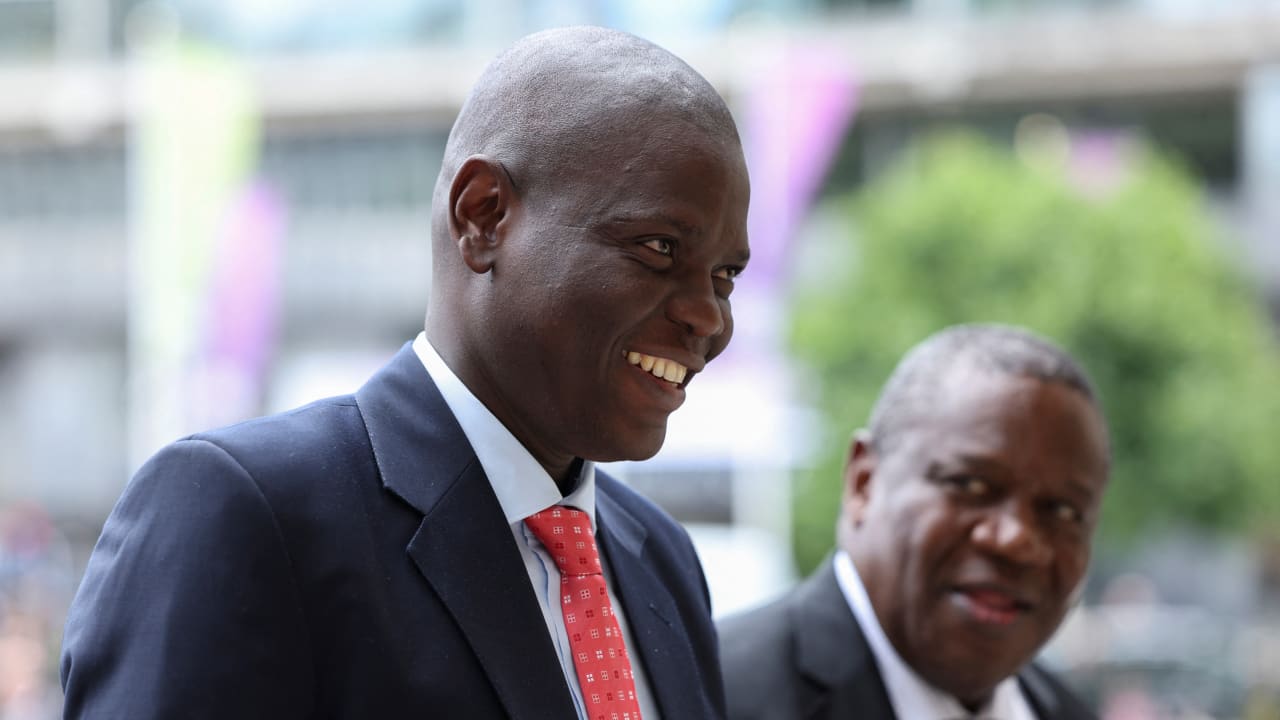
A Conversation With Foreign Minister Ronald Lamola of South Africa
Event date
Speaker
- Minister of International Relations and Cooperation, Republic of South Africa
Presider
- Peter J. and Frances Duignan Distinguished Visiting Fellow, Hoover Institution, Stanford University; Former Adjunct Senior Fellow for Africa Studies, Council on Foreign Relations; CFR Member
Foreign Minister Ronald Lamola discusses plans to improve U.S.-South Africa relations, South Africa’s role within the region, and the country’s development priorities.
FRAZER: Welcome to today’s Council on Foreign Relations meeting with Minister of International Relations and Cooperation Ronald Lamola of South Africa. I am Jendayi Frazer, the Peter J. and Frances Duignan distinguished visiting fellow at Hoover Institution, Stanford University, and I’ll be presiding over today’s discussion.
We are joined today by CFR members attending both virtually and in person in New York. A reminder that this meeting is on the record.
It is my great pleasure to introduce Minister Ronald Lamola. He’s minister of international relations and cooperation in South Africa. He previously served as minister of justice and correctional services from May 2019 to June 2024. He’s had a very long political career, which also includes serving as a member of the National Assembly since 22 May 2019, and also serving as the minister of justice and correctional services, as I said.
His public service also includes being an active member of the ANC Youth League, I think when Malema was there. You’ll have to explain that. (Laughter.) And he’s a lawyer by training, education, and profession, having established his own law firm. He obtained his law degree from the University of Venda, completed a practical legal training at the University of South Africa, and earned two master’s degrees from the University of Pretoria, specializing in corporate law and extractive law.
Welcome, Minister. I’m looking forward to our conversation today. There’s a lot at stake here. The United States and South Africa have had a long and strong relationship, particularly since the end of Apartheid. But it’s probably never been at such a low level in terms of the relations and the tension between the two countries. South Africa is the United States’s largest trading partner in Africa. There’s over 600 American companies there. There’s over 30,000 U.S. citizens there. I’ve had the privilege of living there, have a home there now. And I think that we all love South Africa. So we want to see our bilateral relations improve.
But, as I said, they’re at the lowest level. The United States accuses South Africa of having a genocide against Afrikaners. The administration says that there’s land expropriation without compensation. You say it’s land reform. The administration, the Trump administration, says that there’s race-based legislation—meaning the Black Economic Empowerment. And so you’ve called it an infringement on South African sovereignty and a mischaracterization pushed by fringe groups. What would you say to an American who’s only heard the U.S. government’s version of South Africa?
LAMOLA: Yeah. Thank you very much, and to everyone in the audience. Firstly, let me apologize for the late arrival. It’s due to other commitments that have overlapped.
Firstly, as you have already correctly stated, South Africa is a democracy with institutions that are working, are functioning, all three arms of the state, the executive, the judiciary, and the legislature. And we have worked very hard as a country to preserve our unity in diversity, where all colors can live together—Black, White, Indians, and every person who finds themselves within the constitutional parameters of our country. And it is against that background that our society strength is in that diversity. And it’s one of those countries where there is a large population of White people that, even after democracy, we live together.
And, as many of you are aware, it’s a project spearheaded by our former statesman President Nelson Mandela, for us to live together to build one nation. And that is what even all the predecessors of former President Nelson Mandela built on, including ourselves. We continue to build on that one nation. And that’s why it becomes very unfortunate for us to be accused of any form of genocide against White Afrikaners of South African origin. And what we can say to the people of the United States is that the story of White genocide does not exist. It’s fake news. It’s not there. There is no evidence to back it, either through any form of technology.
I know you have got capable technology here in the USA, where there was you are able to check in any part of the world through satellite imagery and so forth. So it has not been backed by anything, including your own field assessment. And that’s why even the new ambassador of the United States, Mr. Bozell, he can no longer now—since he has been in South Africa for almost three months or so—he can no longer be able to say with certainty what he used to say before he arrived in South Africa, that there is genocide. Now he knows there is no genocide. And that’s why he can’t confirm it even himself on record. He can just speak with ambiguity, because he still has to report to Washington. But the reality is that he knows now, deep in his heart, that it doesn’t exist.
So, as a country, we see the U.S. as an important strategic partner, as you have already said. Six hundred companies invested in our economy. Most of them with their regional offices as a gateway to the African continent. And the U.S. companies have brought new, modern technology into the South African market. And you can name all of them, the ones you have here, Microsoft, Amazon. You can name all of them. They are in South Africa operating throughout the African continent. And they are making money. And they do so with all these laws that are said to be excluding companies from the U.S. And they are making money. They have never complained about BEE.
In fact, we have got what is called BEE equivalent, which is an innovation that came from the U.S. companies when it was—it’s where companies can be able to still comply with the BEE Act, but on an equivalent basis. Some form of social improvement to the various sectors in which they operate in. And they are operating—Microsoft in the telecommunication space, Coke in the beverage sector, and many others. The sticking point is on mining, which the current U.S. administration wants us to also exempt it, to have no—American companies not comply with the BEE legislation.
And we’ve said, even in mining there is a number of U.S. companies doing mining in South Africa, complying with the BEE laws. And they have got no issue. And the telecommunication sector, as I have already said, despite Starlink not wanting to comply, Amazon has just been given a license in the same space that Starlink wants to operate in, with the low-orbit satellite. So it’s clear the South African laws are welcoming to the South Africa—to the American companies.
The Afrikaner Resettlement Program, which is clearly race based, is clearly targeted to those who are only Afrikaners. We have said that the South African government would do not agree with it, because it’s race-based, it’s clear, and there is no persecution. It’s the only program even the—it does not fit the U.N. definition of a refugee. Even the U.N. Refugee Committee says this is not a refugee program, where only the refugees can be processed from the country of origin. Some of them you might have seen in the recent news reports. They do visit South Africa. How can a refugee be on a vacation to the country where they come from as refugees? (Laughter.) You know? So it’s clearly—
FRAZER: Even some had to sell their houses before coming.
LAMOLA: (Laughs.) Yeah, yeah. I mean, it’s clearly not—it’s not based on persecution. It’s based on prejudice of race. So we have said we don’t agree with it, but we will not interfere with the program because, in terms of our constitutions, people have got the rights and the freedom of movement. If they want to come back to South Africa, they are welcome.
FRAZER: Thank you. Thank you, Minister. Let me ask you this question. You’ve given an explanation saying that we can all look at South Africa and see that there’s no genocide, saying that American companies have adapted to BEE. That maybe a particular company has not, but that the majority or most have. But yet, Secretary Rubio recently announced the visa restrictions. South Africa has also been singled out for 30 percent tariffs before the courts decided that IEEPA was incorrectly applied. But now it’s 12.5 percent, and 25 percent on your auto industry. Do you expect, with the extension of AGOA, that the administration could escalate and actually in review say that South Africa is no longer an AGOA-eligible country? Are you concerned about that? And secondly, let me just add on to that. You’ve said that you’ve offered the United States a generous trade package. What’s in it? What exactly is in that deal that you were offering the United States? And why hasn’t the administration taken it up?
LAMOLA: Yeah. With regards to AGOA, we want to thank Congress for having passed it through, with an understanding that we can all work together in a mutual, beneficial world, with also a beneficiation which is a key aspect from our side in terms of AGOA. Because we have got a youthful population in South Africa, almost 60 percent young people. But not only in South Africa, in most parts where AGOA is going to operate. So beneficiation, local manufacturing becomes key so that the entire supply chain, at least, can be able to support job creation in those countries. So it is a key program. And we look forward to President Trump signing it.
You ask whether we are concerned. Yes, we are concerned, because President Trump still has to sign the reauthorization. So we don’t know what will happen. As you are aware, it’s an unpredictable environment. But we are glad that Congress has passed it through. So we’re hopeful that even President Trump will sign. So that’s the only concern we have. But all in all, we think this is a mutually beneficial platform. And we want to continue in that regard. And the—
FRAZER: What about the trade? The trade deal that you’ve offered?
LAMOLA: As I’ve already said, American companies participate in the South African economy. And we have said that it will be mutually beneficial. And the key aspect of it will be in the critical minerals beneficiation in our economy. The laws allow them to come in. And we have got a base—universities, a youthful population—that could enhance a trade agreement between us and the U.S. And also, has being one of the most industrialized part of the continent. And it could be a good platform to work from. So those are part of the issues that are under discussion.
FRAZER: I wonder what leverage do you have? You’re talking about critical minerals. People talk about platinum in particular for South Africa. But is this something that’s attracting the administration? It obviously would attract American business. How are you trying to gain greater leverage in your relationship, the trade relationship but the broader bilateral relationship?
LAMOLA: Indeed, those critical minerals, most of them you can only find in South Africa. So that’s the leverage. It’s about six of them. And as you have said, platinum, rhodium, palladium, and others. So we host almost majority of them. And you already have an industrial base that can be leveraged by the South African government, the South African private sector both. And the American government and the American private sector is already there. And we think that is a good platform to engage on and to find each other with the American administration.
FRAZER: It’s certainly an administration that likes to do deals, right? The embassies have been charged with commercial diplomacy and to do deals. So I would think that that would be very helpful. Let’s move from our bilateral—yes, please go ahead.
LAMOLA: We have said we are a nonaligned country. We have got no problem with any trade agreement, as long as it’s fair, it’s transparent. We are a constitutional democracy. So any trade agreement must also be transparent, must be fair. And we don’t have a problem. But it must be open. The public must see.
FRAZER: Mutually beneficial—mutually—I said, mutually beneficial.
LAMOLA: Yes.
FRAZER: Yeah, but there are many African countries that are offering their critical minerals to the United States supposedly on an exclusive basis, right?
LAMOLA: We have also said to the African Union it will also be good that we engage at the same level, or as a collective in the African continent, with the current critical mineral strategy of the AU. And particularly if we engage at the multilateral collective level, our strength will be more enhanced.
FRAZER: So that’s where I wanted to go, in terms of trying to just position South Africa vis-à-vis addressing this critical bilateral relationship. What role does the continent have? You’re talking about a collective approach. We think about the Africa Continental Free Trade Agreement as the basis for that integration. But yet, I do feel that the administration is able to pick off countries one by one because of the asymmetry of power between them. And you see this both in terms of giving exclusive—claiming to give exclusive deals to American companies, but also what we’re seeing on the immigration side, right, where countries are taking deportees from the United States. There doesn’t seem to be a collective Africa position that can strengthen each one of these fifty-four countries, vis-à-vis a United States that is more coercive diplomacy than the type that we’re typically used to.
LAMOLA: And that’s why, when we hosted the G-20, we saw it as an Africa G-20. We took collective positions with the African Union. And we also brought and invited Africa’s big economies—Nigeria, Algeria, Egypt, Ethiopia, and Angola—to participate with us, so that we could bring to bear—or, to the fore Africa’s collective voice in the G-20. And its declaration reflected that, the Compact on Critical Minerals for the African Continent, the Compact on Artificial Intelligence, the compact in relations to financing for mitigation against climate change—because in the African continent, like in the Global South, we receive less than 3 percent of climate change financing, when we contribute less. So this was aimed to galvanize and to bring that common voice. And that declaration of the G-20 has now been made a declaration of the African Union, to speak to all these issues. And we continue to emphasize the importance of collective voice on these matters.
FRAZER: Yeah, you know, Minister, South Africa is credited with having carried out a very strong G-20, with a very strong and positive Africa agenda. You’re right. But then the administration, the Trump administration, has excluded you from the next G-20. And I understand that you have the declarations coming from the South Africa G-20, trying to embed them in the AU. But these are just words. You know, how much action is actually following from that? And aren’t you disappointed that other countries that are G-20 countries are not standing up and saying, no, you cannot exclude a member of the G-20? If you exclude them, you exclude us. I think maybe only Brazil. I don’t even think the African Union has had a strong voice. Maybe I’m wrong there.
LAMOLA: Yeah, no, we are disappointed because we can just speak for ourselves. And we also don’t want to impose ourselves to the G-20. But we are a founding member of the G-20. And we have got—by right, we have to be there. And we have stated it very clearly, even to the Trump administration, and to all G-20 members that we have met. I’ve just met Germany, U.K., all of them. When we engage with them, we remind them that we are full members of the G-20. And we stand ready to come to the G-20 if an invite is extended. What we will not do is to barge in, come uninvited, and all that. And also encourage a boycott of some sort. We will not encourage that. We think that they must raise it in the G-20 meeting.
What kind of G-20 will this be, when South Africa is not there? And can the declaration still be called a declaration of the G-20, when one of the founding members is not there? Can it curate? Can it really be having that force? Because unlike in South Africa, when the U.S. didn’t attend the G-20, they were welcome. We invited them. It was out of their own volition that they didn’t participate. Here is not out of our own volition. We are being excluded. So I do think that the members of the G-20 need to speak out. They need to be clear what will this meeting in Miami be called, and what that declaration will be. So we leave it to them, but we have said we are available. We will take the first flight out of Johannesburg if the invite is extended. (Laughs.)
FRAZER: We know South Africa is always ready to have dialogue and extend a hand. That’s in your tradition, that’s for sure. Let me ask you, though, about the BRICS, right? That’s another forum in which South Africa’s, I would say, power has been diminished, right? With the enlargement of the BRICS beyond the five, it seems to me that South Africa’s ability to position itself within that body to influence multilateralism has gone down. In particular last year, when we were talking about the U.N. Security Council and a permanent seat. Egypt and Ethiopia refused to back South Africa’s bid for that seat. How do you see positioning yourself within the BRICS now? We talked about the region, but what about the BRICS, in terms of trying to, one, get leverage over this bilateral relationship, but also maintain South Africa’s position in the world?
LAMOLA: Yeah. We don’t see it just for ourselves. While we have to maintain our own national interests, we want them to grow, but it’s an important voice of the Global South. So as many voices as we can get within the BRICS platform are very important. And not only just from the global south, also from the African continent. You will remember, it is South Africa that supported Ethiopia and Egypt joining BRICS, including Nigeria. So we support that as many African countries must come into the BRICS platform. And we don’t support them with conditions that, as they come in, they must come there to serve at all costs the interests of South Africa. We think they must come in to serve the interest of the Global South, to build that voice that is necessary on the issues that we have already spoken about, including the reform of the U.N. Security Council. Which we still support South Africa. And you will have seen it was also part of the declaration of the G-20.
There is Africa’s common position called Ezulwini Consensus. And our understanding was that Egypt and Ethiopia were raising their voice in line with Africa’s common position on the Ezulwini Consensus, which has said that there must be reform of the U.N. Security Council, and that the African countries must be represented by two countries—without mentioning which country. And then they raise the fact that if it mentions a country, it’s no longer in line with Africa’s common position. And that is what we call the Ezulwini Consensus. South Africa will continue to support the reform of the U.N. Security Council, and that Africa must be represented. And we will, when the right time comes, put the names that must be representing the African continent.
FRAZER: So I know—I know we’re here at the UNGA, but is the U.N. really relevant today? Why are we fighting to get on the Security Council? Why are African countries fighting to have a permanent seat on a Security Council that’s broken, right? I mean, when has the Security Council solved any peace issue, that’s what its mandate is, in a decade? What peace issue has the U.N.—why are you guys worried about that forum, in an international environment in which there’s fracturing across regions? Isn’t there a different strategy? Isn’t there new institutions that need to be created?
LAMOLA: Yeah, maybe it’s irrelevant because the African continent is not there. Because 60 percent of the conflict that the U.N. Security Council deals with are in the African continent, and the African continent doesn’t have that permanent representation. And when it was formed, most of our countries were still under colonial rule. So if we come in and be part of the U.N. Security Council, our voice will be there. We will be part of the solutions. As we have said, most of those conflicts, one of the biggest humanitarian crises, Sudan, Eastern DRC, and many parts of the continent are what constitute the agenda of the U.N. Security Council.
FRAZER: That’s true.
LAMOLA: So that’s why we need to be there, so that it can have the legitimacy, it can have the currency of relevancy by people who are affected being there offering solutions.
FRAZER: That’s very true. And I’m going to open up to questions in a minute. But there’s another solution, which is make the African Union actually work and solve these problems, right? That’s also a solution, right, where you are there. So—
LAMOLA: Yes. Yes. And—
FRAZER: Running after the U.N., which has its own—and in a world in which multilateralism has really been undermined by the creator of the Bretton Woods institutions—meaning the United States—which has always used its power and its—you know, its ability to support, that’s been taken away. The world is fractured. And you’re still running after the Security Council when the African Union is—and the Africa Continental Free Trade Agreement, and African institutions are right there to be empowered by African states.
LAMOLA: Yeah. We have to have a clear contrast to unilateralism and multilateralism. And for us, just to affirm the existence of the U.N., is an important step in affirming the supremacy of the United Nations and the multilateral institutions to resolve global disputes. They may not have worked in accordance with our expectations, but it does not mean it has not worked since the Second World War, since they were created. They have worked. We need to do our best to ensure that we return to that level of working. And that level will be to follow the reforms as outlined in the Pact of the Future, which clearly outlines how the U.N. Security Council can be reformed to find its relevance again.
And the African Union, indeed, is there. We participate in South Africa, and we are one of the biggest participants and its support in the various peace missions across the continent, to find peace in many parts of the continent. We support—we work with Africa—including to contribute not only with our resources, but also with the expertise diplomatically and, if necessary, through our peacekeeping missions. And you will also remember the resolution of the U.N. that has just been taken now to fund and reimburse peacekeeping missions in Africa.
We have been carrying them on our own, at our own cost. And in any parts of the world, those peacekeeping missions are funded through the U.N. Security Council and through the U.N. But in the continent, it’s ourselves. And sometimes through our own national fiscals, which we think it’s important that we are part of the U.N. Security Council so that these reforms becomes real, can be taken forward.
FRAZER: Thank you. Thank you, Minister.
At this time, I would like to invite members, both in person and virtually, to join our conversation with their questions. A reminder that this meeting is on the record. Who’s going to do the—it’s for me to do? OK, I’m going to start here. Let’s take two at a time, given the time. So here and here. And then we’ll go over here. Yes.
Q: Hi. Maryum Saifee. I am a CFR member. Most recently I was a Foreign Service officer at the State Department, and mainly focused on the Middle East.
So my question is related to the Middle East. You were in Riverside Church on Monday, historic Riverside Church. And you talked about the anti-Apartheid movement as a potential model for the region in terms of peace in Palestine. Could you talk also about the ICJ and, sort of, your position on the region and on Gaza specifically?
FRAZER: One more? It’s OK, Minister, to do that?
LAMOLA: Yeah, it’s fine.
Q: Hi. Thank you so much for being here, Mr. Minister.
Economic statecraft has surged in importance, eclipsing or complementing traditional diplomatic methods. Can you speak to how South Africa thinks about economic statecraft within the region? Thank you.
LAMOLA: Yeah. Thank you. Firstly, with regards to the Gaza matter, as she has already said we see it as a moral imperative for the people of the world, and for ourselves given our history of Apartheid. With our understanding of our own country, we see what is happening in Gaza as exactly what happened in South Africa during the Apartheid period. And that’s why we had—we felt we had a duty to approach the ICJ in terms of the Genocide Convention. Anyway, all member states of the U.N. who are signatories to that convention has that obligation. But we felt we had to act, and work to prevent it from happening, because it is—I think, is one of the most painful genocide to be happening, because it’s happening in full view of the whole world, on our fingertips.
We can see it, through modern technology. Everyone is able to. You can see it in real time. And by the time we went to the court, the numbers were very—were still very high. And they are—we are still counting. We think the world has a duty to stop it. Unfortunately, with the three provisional measures, the state of Israel is still not respecting that injunction of the court. But we are glad that there is a number of countries that have now joined us in the ICJ, while others are withdrawing. But there is a huge number that has joined. And not only joining, also the U.N. itself last year had a decision on the two-state solution, with many countries joining that. And we have heard voices also coming out of the U.K. and many other countries. It’s clear that the world is now waking up.
FRAZER: Thank you. The economic statecraft question.
LAMOLA: Oh, OK. Thank you. We see that being anchored by the regional integration, the Africa Free Trade Area, which has got various components, particularly on local beneficiation, manufacturing, and also on trading amongst ourselves. Within the SADC region we are trading together at about 20 percent. We want to see that increase twofold. And we also want to see trade within the continent increasing to levels which have not been seen before. But that will have to be anchored by infrastructure, the various corridors that are currently being built. And South Africa will participate in a number of them to enable the routes and the trading to happen, including infrastructure on the border posts, to modernize our ports. The concept of one-stop border posts that SADC is currently being involved in. South Africa is now building, I think, about six one-stop border posts within our country. But those border posts will be bordering Zimbabwe, Mozambique, Botswana, and Lesotho. So this is work in progress to support the AFCTA.
FRAZER: Thank you. Yes, sir.
Q: Hello. I’m Nelson Cunningham. Until last year with the State Department, before that with McClarty Associates. Ambassador Frazer, it’s so good to see you again.
FRAZER: Absolutely.
Q: My question. You spoke about relations between South Africa and the United States. I’d be interested in how you would characterize South Africa’s relations with Russia and China today.
FRAZER: Thank you. One more over here.
Q: Mr. Minister, Jean Monier. I’m a partner emeritus at McKinsey. And as a former rugby player, I want to congratulate the Bokke for the win in Baltimore.
LAMOLA: (Laughs.) Thank you.
Q: That’s right. Now let’s—I want to talk about AI and China. Because those of us who go now in Africa, especially in Africa, I see a lot of the DeepSeek model, see a lot of the China push to get their AI model into the continent. And I would like you just to comment about that. You, South Africa, was part of the China AI Forum. What’s your thoughts about, you know, what we should do, what the U.S. maybe is not doing, regarding, you know, the way to collaborate with South Africa on AI?
LAMOLA: Yeah. Thank you. Thank you very much. Our relationship with China and Russia is a long-standing relationship, since the day of—the days of Apartheid. But as South Africa after 1994, we came up and be very clear that our policy is a nonaligned policy, so that we can be able to engage with all countries of the world, including the United States of America. So we see them as a part of—partners in the trajectory of our development of our country. Which is also open to everyone, including the United States of America. And we have extended this message to Washington. We already have about 600 companies in the South African economy, which have got a long history. I believe when you were still working in the State Department, these are the relations that you were building. And maybe even at that time, our number-one trading partner could have been the U.S., which has now been overtaken by China.
So I do think that the U.S. itself, there are—as you have already said, there are things that you may want to examine that you are not doing that you could be doing for you to end up being overtaken in the South African economy, particularly with the long history of American companies in our economy. And up to now, almost all the datacenters we have that have been built in South Africa have been built by American companies—Amazon, Microsoft—which shows that the South African regulatory environment is welcoming to American investment. And even on AI, we remain unaligned.
We say, whoever brings us the solution, we are prepared to work with that person who brings the solution. Because we can’t afford to align with anyone. We need the technologies that comes from the U.S., that comes from China, that come from Japan, that come from any other country. But in the technology space and the datacenters, as we speak now, most American companies are invested in our country. And I think they can do more to add value, to research, to harness the youth of our country. Which I think Microsoft has done in a big way.
FRAZER: Thank you. Did you answer the other question?
LAMOLA: Yes.
FRAZER: You answered both.
LAMOLA: Yeah.
FRAZER: OK. Here.
Q: Hi. Jamie Garden, a term member here.
Just piggybacking off of Maryum’s question, and your response to it, South Africa had such an amazing emergence from Apartheid. I know, obviously, that you are not part of the Israeli government, but if you were Israeli foreign minister what would you recommend they do, given Gaza? I mean, the ICJ wasn’t involved in the South African Apartheid. What would you do in that state to exit the situation they find themselves in, with the threat of Hamas post-October 7, et cetera?
FRAZER: OK. Right here.
Q: Thanks. Hello. Michelle Gavin, with the Council on Foreign Relations.
I just wanted to quickly ask how South Africa’s vision of itself as a champion for African states has been affected by the xenophobic violence that’s swept through the country, and certainly soured, in the near term, some relations with some of your African partners. How do you think about that intersection between the domestic and the international?
FRAZER: Thank you.
LAMOLA: Yeah. If I was the state of Israel or the foreign minister, I will advocate for our government to stop the genocide, firstly, and go to the negotiation table and find a solution with all the partners. And ourselves, now speaking as South Africa’s foreign minister, we have condemned Hamas. We have no relations with Hamas. Even the South African, we have been very clear that the actions of October 7 must be condemned by all people of the world. And we also condemn such actions. There is no space for any form of violence. We are antiwar. And we—if I was, as you have said, in the Israel government, I will say, let’s stop the war. Let there be engagements. Let the issue of the two-state solution be put on the table, because any continued annexation, any continued bombardment—by the day, it’s clear that the idea of the two-state solution is fast extinguishing our eyes.
And what will then be of that state that will come out of this? How will it gain legitimacy, if it is not favored by all countries of the world, in terms of what we already have as the U.N. resolution on a two-state solution? So the legitimacy of the state of Israel, it’s also dependent on the solution which is already a resolution of the U.N., the two-state solution. So I do think that there is a space. There is a peace process that they have a chance to climb into and find a long-term solution to this situation. To kill everyone, including civilians, in the search of Hamas does not in any way justify the actions of an occupier. And this is a finding of the provisional measures of the ICJ, which will still be ventilated further in the normal court process.
With regards to the xenophobic attacks, as the South African government we have condemned the attacks. We have condemned it in the strongest terms. And there is about more than 300 people that have been arrested for being involved in these attacks against African immigrants, particularly in South Africa. We have also clarified that what has now also come out as a narrative in some of the African states, that there are individuals, for example, from Nigeria, that were killed as a result of this, and there was no one that was killed from Nigeria during this wave of attacks. There were people that were killed, some from Ghana, but investigations by the police have revealed that it was an act of criminality. It has nothing to do with xenophobia.
Those that were affected the most by the xenophobic attacks were Malawians. And I think about one or two of them, if I’m not mistaken, were killed during the real protest. So the people of the world also have to separate the facts on the matter. We do have a challenge of violent crime in South Africa. And violent crime affects everyone. The majority of those that are affected by violent crime in South Africa are Black South Africans. Black South Africans are affected by violent crime. And our African brothers and sisters, when they come to South Africa, as the highest receiving country in the continent, they reside with their own brothers, Black South Africans. So when they are—when the Black South Africans are affected by crime, it will affect everyone.
It does not mean that every Nigerian killed in South Africa is because of xenophobia, and also, every Ethiopian that is killed in South Africa is because of xenophobia. Some of them, investigations have shown that it’s intra-trade conflicts amongst themselves, particularly the case of five Ethiopian nationals that were murdered in Johannesburg. There is an ongoing case now that reveals these intra-trade disputes amongst themselves. So these are issues that, when we engage with our African brothers and sisters, we do raise that it does not mean that everyone that is killed in South Africa who is from Nigeria or Ghana is because of xenophobia. Some is because of crime affecting everyone. And this is similar incidents for White South Africans sometimes in the rural areas who gets affected. So the South African government has a responsibility to make everyone feel safe, and be safe, which includes South Africans.
FRAZER: Thank you, Minister. We certainly do wish you great success in your mission here, both in terms of the U.N. General Assembly but also in terms of the bilateral relationship between the United States. We all count on your efforts being successful. Join me in thanking the minister.
(END)
This is an uncorrected transcript.