A Conversation With President Netumbo Nandi-Ndaitwah of Namibia
Event date
Speaker
- President, Republic of Namibia
Presider
- President and Chief Executive Officer, CARE; CFR Member
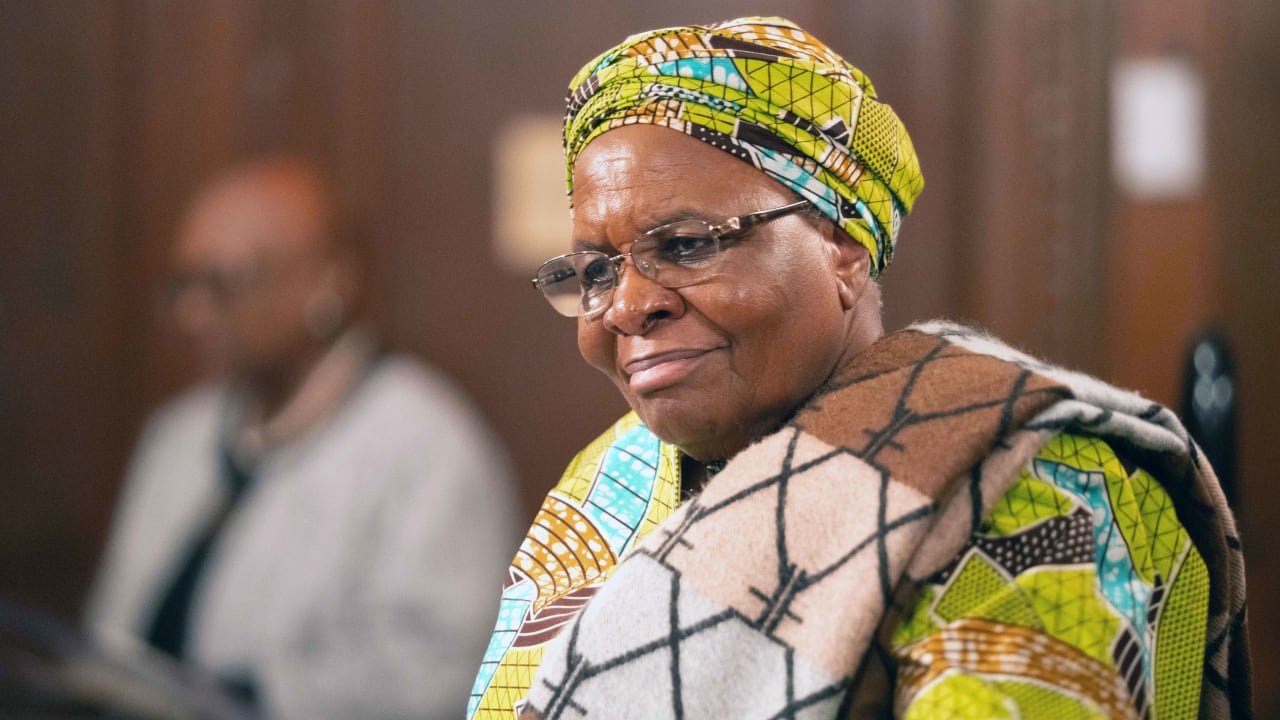
President Netumbo Nandi-Ndaitwah discusses Namibia’s economic and development priorities, the country’s role in the region, and relations with the United States.
NUNN: Good morning, everyone. Good morning. We have made it to one of the final days of this marathon week, and I think you all can take your seats now that the president has arrived. I’m Michelle Nunn. I’m the president and CEO of CARE. And I think we couldn’t have a better way of both beginning the last day and also really moving forward into our set of actions that come out of this week by being here today.
So just a reminder that that we have a lot of distinguished guests here. This is on the record. And so we ask you to please silence all those devices that you might have in your pocket.
But it is my great privilege and all of our privileges to welcome Her Excellency President Nandi-Ndaitwah of the Republic of Namibia, Her Excellency, here to the Council on Foreign Relations. I will not be able to cover the extraordinary scope of her accomplishments and life because we want to hear directly from her, but her public life spans the full arc of Namibia’s modern history. She joined SWAPO at age fourteen, she lived through exile, she returned to fight for independence, and she has held virtually every important leadership position within the country governmentally. She was inaugurated March 2025 as Namibia’s first woman president. And she has extended that history by ensuring that other women are also leading in the ranks of government; two-thirds of her Cabinet secretaries are women. Some of them are here today. So, yes, that deserves applause. (Applause.) She now leads Namibia at a genuine inflection point. The country is navigating a period of economic transition and renewal, and she has launched a very ambitious policy agenda.
So it is an incredible honor to have her with us today in what I know will be a fascinating and wide-ranging conversation. And the president will have opening remarks, and then we will have a short opportunity for question and answers. So, Her Excellency, please join us. And please join me in welcoming this extraordinary historic figure. (Applause.)
NANDI-NDAITWAH: Please take your seats. Thank you, Michelle.
The president of the Council on Foreign Relations, distinguished members of the Council, I’m pleased to return to the Council on Foreign Relations and to once again thank you for the invitation that you extended to me and my delegation, which composed of Cabinet members who are present here. You will see them in the process, maybe not now.
Yes, Namibia is at an important stage of its development. And our key focus is on natural resources beneficiation through value addition and skill transfer; and to turn opportunities on decent jobs, business, and better lives of our people. And this is how we want to see our coordination with the Council to take us.
So we are not just seeking for capital; we are really seeking for better partnership that will bring investment in our country, technology, and skill transfer, and also to have market for our products that we will be able to produce. So, therefore, we are coming here to work with the Council, whereby we believe that together we will have mutual benefit.
Our government value private sector as a critical partner in advancing our developmental agenda, particularly as we are coming closer to our Vision 2030. I have to share with the Council that as a government we have identified our priority areas—namely, agriculture, sports, youth empowerment, quality education and training, creative industry, health and social welfare, land and housing. And of course, these priorities are helped by our enablers that we have identified. These include mining, energy, oil and gas, tourism, agriculture, water, fishery, and transport and logistics. And these are the issues that we would want to expand on as we are engaging both our development partners as well as the business communities.
Namibia definitely had—has a significant deposit of natural resources, particularly mining. This even include rare earth and other critical minerals. And that’s why we felt it necessary that for our people to benefit value addition should be the guiding principle for anyone who want to partner with us.
We have also to develop our strategic infrastructures, such as the ports, the roads, the railway, as well as telecommunication infrastructure.
Finally, I can inform you we have a responsibility to invest in our human capital with focus on youth and women. Hence, our introduction of the National Youth Development Fund, which is to support young entrepreneurs. And we would like to see investors coming to Namibia also to link up with our young entrepreneurs so that they can learn from them and become successful entrepreneur.
Once again, I appreciate coming back. And together as part of the international system, we need to make our world safe for all by investing also on peace and security, and to understand the impact of climate change that disproportionately affecting small countries like Namibia, whereby we are asking that the big emitters need to pay for that based on the principle of common and differentiated responsibilities. I thank you for your attention.
And I say, my delegation and I, we are happy to be here. I am accompanied by our minister of international relations and trade. I am accompanied by our minister of agriculture, fishery, water, and land reforms; and of course, our ambassador to the United States of America. So this is the delegation. The rest are busy with the U.N. activities. Thank you very much. (Applause.)
NUNN: Madam President, thank you.
Well, there’s—you have a—you have a lot on your plate and I think we would love to hear. You specifically talked about the extraordinary natural resources of Namibia. And so how are you seeing—maybe we’ll get—just go a little deeper. How are you seeing that translate into the real jobs, the higher living standards for ordinary Namibians? And what do you hope that looks like for the young people that are living in villages and in communities?
NANDI-NDAITWAH: You see, Namibia is not an island. We are part of SADC. We are part of the AU. And the AU has developed our continental developmental map, which is Agenda 2063, which means by the year 2063 Africa must be an industrialized continent.
Now, the responsibility is with individual member states to make their contribution, and Namibia, we have to play our part. And the tool we have at our disposal is our resources—both natural resources in terms of our land, in terms of our minerals; and more importantly our people, which is a—strategic resources we have. And that’s where now we talk about our young people to be empowered, so that as we are now moving towards the industrialization where we talk about value addition, we want Namibians to be the one on the driving seat.
Of course, we cannot do it alone. We are mobilizing international capital. But we would want that capital to come and enrich our people through skill development and technological transfer, because currently we have a situation where unemployment is very high in Namibia, particularly among our youth, who are the majority of the population. So, with our natural resources and with our policy of value addition, it is going to make an impact whereby our developmental program should be felt up to the deep rural Namibia, where the young people will be able to take care of their parents.
Why we are focusing on the young people? We believe when young people are empowered, when young people have a means, they will take care of their parents. They will take care of their grandparents. In other words, we are seriously working in strengthening our social capital, which we have lost over the years, in order to be part of our economic transformation.
NUNN: Well, speaking of economic transformation, I know that you’ve been a(n) enormous champion, and a symbol, and also an extender of women’s rights and women’s economic power. Can you give a little bit of a vision of your agenda around women’s economic power and women’s uplift?
NANDI-NDAITWAH: Women empowerment has been part of our policy for generations. Even before our independence, as a liberation movement we had paid special attention to equality between men and women. We participated in all forms of our struggle, which is the political, the diplomatic, and the military. After independence, we built on that and we even had a very clear policy on gender mainstreaming. At one point I served as a minister of women affairs and child welfare, and the idea is to advance women empowerment.
We have made some progress, but of course we still have more kilometers to go. Currently, our parliament is—47 percent are women, and this is because our ruling party has adopted a policy of zebra list. Our parliament is proportional, and we decide when we take—we take our candidate to parliament the list has to be a man, a woman, a man, a woman. Now 47 percent is because of that policy. In our Cabinet today, 57 percent are women in our Cabinet. And this includes the minister for international relations and trade; the minister of agriculture, fishery, and marine resources and land reform; the minister of environment and tourism; the minister of finance; the minister of information; the minister of home affairs; the minister of health. So that is the setup of our Cabinet. It’s not a very big Cabinet, fifteen ministers. And also, when you look at our parastatals, even in our private sector, we are getting more women in position of leadership. Our speaker of the National Assembly is a woman. Our vice president of the Republic of Namibia is a woman. And it’s really becoming something that in Namibia we feel that both men and women can play an equal role.
I have also to share with you that in the process we realize that the boy child seems to feel neglected. But now we are coming back to that, and that’s why the first gentleman is having a specific project looking at the boy child. So, coming to Namibia as an investor, you are expected to engage both men and women entrepreneurs, and you get the same results.
NUNN: There’s much to learn in that agenda. Thank you for that.
So I’m going to turn it over to questions in just a minute, but maybe to ask you if you could just help us see one specific project that you are most focused on, that you most want to see cross the finish line in terms of the broader policy agenda in Namibia for you.
NANDI-NDAITWAH: Yes. One specific project that can be a multiplier effect to many others, particularly to develop our infrastructures and others, is the project for entrepreneurial development, particularly among our youth. And of course, that has to be supported by concrete infrastructural development which can support the sectors like the mining sector, like the tourism sector. For example, if I could have a conference convention center, as well as to have a strong railway network, that will really unlock a lot of activities when it comes to investment.
NUNN: Wonderful.
Well, we have a few minutes for questions, so we have somebody who has a microphone that’s going to get to folks. If you could make your question as brief as possible so that we can hear as—from as many people as possible, and if you could also introduce yourself when you ask your question.
Yeah, right here.
Q: Hi. Thank you very much. Martial Combari, Blaylock Van. I’m also a term member. Madam President, thank you for being here.
We had Tony Elumelu earlier this week talking about some of the challenges that Africa is facing for growth, and his top identification was access to power and energy as the impeding factor. How are you thinking about that in Namibia? And what is the government doing to help advance project related to energy and power from the development stage into the realization one? Thank you.
NANDI-NDAITWAH: Energy, as I’ve mentioned, is one of our great enablers, and energy has really been a focus for some times. And we are getting quite a number of proposals on the energy sector because energy is not only a gap in Namibia; it’s a gap in the region, it’s a gap in the continent. And as we are, we have decided as a country to go for mixed energy. But as I’ve mentioned earlier, there is quite a number of discussions around the energy efficiency, and we would like to see those discussions moving from discussions to real implementation because it has been on the card for some times. So it’s very critical. We’ll need it. We are working on it. And we want to see tangible results.
NUNN: Thank you.
Yes, right over here.
Q: Thank you, Madam President, for a very interesting presentation. My name is Jonathan Brewer.
I was a member of the U.K. Foreign Service posted to Luanda, Angola, in the 1980s. And I remember meetings between my ambassador and Mr. Sam Nujoma, who was always deeply unimpressed with Mrs. Thatcher’s stance on sanctions on South Africa. But I also had many dealings with Mr. Nahas Angula over a British Council scholarship program for Namibian and SWAPO students to go and study in the U.K., and there were discussions with Mr. Angula and his officials about the sort of education that was most appropriate for SWAPO students. And I just wondered if you could talk a little bit more about your educational priorities now, please.
NANDI-NDAITWAH: Yes. Education is one thing that at independence we make it a priority. When we got our independence, we have to face eleven separate educational system. And our immediate task was to combine and to have one educational system; that we have successful completed. We had also to deal with a high rate of illiterate, whereby we had a specific program—literacy programs that has also become successful to the point that now 98 percent of Namibian child have now access to education.
Where we are is to improve on the quality of our education. But education continues to be one sector where we are investing or our budget allocation is the highest because of the history, where we are coming from. So the quality of education.
And then now, with the new industries that are coming up, we have to reskill our labor force to make them appropriate for the new labor market. So we want to focus on—as much as we also focus on university qualification, we are setting up vocational training centers so that we can have the hand people who will be able to serve the industry better.
So it’s against that background that this year we have started and we have decided that every Namibian child, students going to universities and vocational training, the government has to hundred-percent subsidize their registration and tuition fees. So we really want more Namibians to have these skills. Hence, the expansion of vocational training, focusing on the new sectors like renewable energies, green hydrogen, oil and gas, value addition we talk about; and also to understand the different critical minerals that we are having; and also for them to be innovative so that they can really contribute into the overall development of the country. So we want to train more skilled labor force in specific areas of our economic development. It’s one of our priorities. I have mentioned it earlier, too.
NUNN: Yeah. Right here.
Q: Nyagaka Ongeri. I’m president of a U.S. investment bank called Blaylock Van that also have African operations. And thank you, Your Excellency, for your time here.
My question has to do with your comment which really resonated with me about being a member of SADC. We are advising on a gas port and an energy infrastructure project in Walvis Bay. And I’m curious to get your perspective on the role Namibia can play in providing power and electricity and energy to SADC.
NANDI-NDAITWAH: Yes. We have the SADC energy pool, and Namibia is a full member of that pool. With the oil and gas that is discovered in Namibia, particularly we have learnt that much of the oil that is discovered in Namibia has a lot of gas. Now our plan is to have projects which should lead to gas to power, gas to energy. That will enable us to play a role in feeding into the SADC energy pool, and this is the strategy.
When we talk about value addition, when we talk about beneficiation, we would want processing plants to be put up in Namibia that will then give us gas to power and others that are required for energy generation. And we are working closely with our neighbors—South Africa, Angola, Zambia, and Zimbabwe—being the countries where we have been also getting our energy for some times. Now we want to coordinate that.
In Namibia, we are well-positioned to be the hub of this program. If you can see where Walvis Bay is, it will also be easy not just to feed the region but also to feed the continent and the world at large. That is how we are positioning ourself, and that is how the discussions are within the SADC region.
NUNN: Yes. Any other final questions? I think we only probably have time for one, so right here, I guess? Right here at the right. Yeah.
Q: Thank you, Madam President, for your remarks today. My name is James Francis. I’m a term member here and principal at FSOC (ph) Capital Partners.
So, at nearly 34 percent, Namibia’s tax-to-GDP ratio is the second highest in Africa after Lesotho. Many people say that this success is attributed to the institutional strength of the Namibia Revenue Agency that was established just five years ago. Could you speak to us about the biggest challenges in setting up this institution? And what advice would you give other African countries who are looking to improve their tax collection—tax collection processes? Thank you.
NANDI-NDAITWAH: Thank you very much for the question.
First, Africa has been facing a challenge for capital outflow illegally from the continent. And I recall sometimes back there was even a report by—the Mbeki report, who was commissioned by the AU to find out how the illicit trafficking of capital from Africa is happening, and it proved that it’s true. There is a lot of money which is leaving Africa, not being detected.
Now, in Namibia, we tried. Then we set up our Namibia Revenue Agency, NamRA, which is now responsible for revenue collection. You are right, we have made progress. It requires a lot of preparation, it requires a lot of training, and also the discipline of those who are going to be involved, because when you are doing such work, unfortunately, in the world the way we are you have to be very strong, because you might have a lot of friends trying to make it differently from what the policy is saying. So if we can have the regional revenue agency which is well-equipped and well-trained, I’m sure we will be able to generate more, because even what we are getting now we cannot for sure to say that is what is due to us. There is an improvement, but we cannot say that we have closed all the loopholes. It’s still in a transition. It’s still being refined. And then we can see how—because since we started the NamRA, every year we are increasing our revenue collection. And that’s why we are saying it’s still in the process.
And we did so also learning from other countries in Africa and outside Africa. I can tell you this world would only be the best place if everyone who is included in the economic management of the world economy are focusing on supporting one another and not to be selfish, because it’s that selfishness that brings mistrust and things done outside the system that’s leaving some parts of the world suffering, and Africa is one of them.
We know that for too long Africa has been an exporter of raw material. We know also that this international world economic system that has put up different requirement for different regions is affecting Africa negatively. You’ll find that when multinationals are negotiating in Africa they want to be given special terms, not the same as they are getting in other parts of the continent—of the—of the globe. And that’s why in Namibia and in Africa we are saying we need to have—to democratize the world economic system so that what you get from each country or each region of the world will be the same.
We have our laws. We have our policies. And we are saying when you are—you are welcome to invest in Namibia, but you need also to make a thorough analysis and understand how we are operating. What are the benefits? What are our laws saying? Because you’ll find a situation when investors comes, some of them, they want to negotiate our laws. You can now imagine if you have to negotiate your laws with every investors coming, how are you going to run that country? It must be run with one law, and whoever is coming you have agreed to go in accordance to the laws and to the policy of this country. In that way, we will have a true partnership between the investor and the people of Namibia.
So I will keep saying to the world investors: You are welcome to Namibia. We are making Namibia a peaceful place for you to invest. We have our laws that makes you to repatriate your profit. But we want you to be sensitive to us so that it will be a mutual benefit to yourself and to us moving forward.
NUNN: Well, I think that was a perfect way to close our time together: a call to action, a call to partnership, a call for interdependence, and a recognition of the importance and imperative for democratizing our global economic systems.
Madam President, thank you for being with us. Ambassador Linda Thomas-Greenfield, a Council board member, said that this needs to become an annual tradition since you were here last year and here this year. We hope that we can welcome you back in the coming years. We’ll be following closely your project.
And so can I ask you all to, one, stay in your seats until the president has had the opportunity to depart; and, two, to celebrate—
NANDI-NDAITWAH: Yes. Yes, yes, it will—it will become a custom, but I would want at one point to point that this big project in Namibia has come as a result of our relationship with the Council. I would want to say that.
NUNN: Wonderful. (Applause.) That’s a great way of closing. Let’s celebrate Her Excellency President Nandi. We are—we are so delighted to have you here and grateful for your presence.
(END)
This is an uncorrected transcript.