Darryl G. Behrman Lecture on Africa Policy: A Conversation With Tony Elumelu
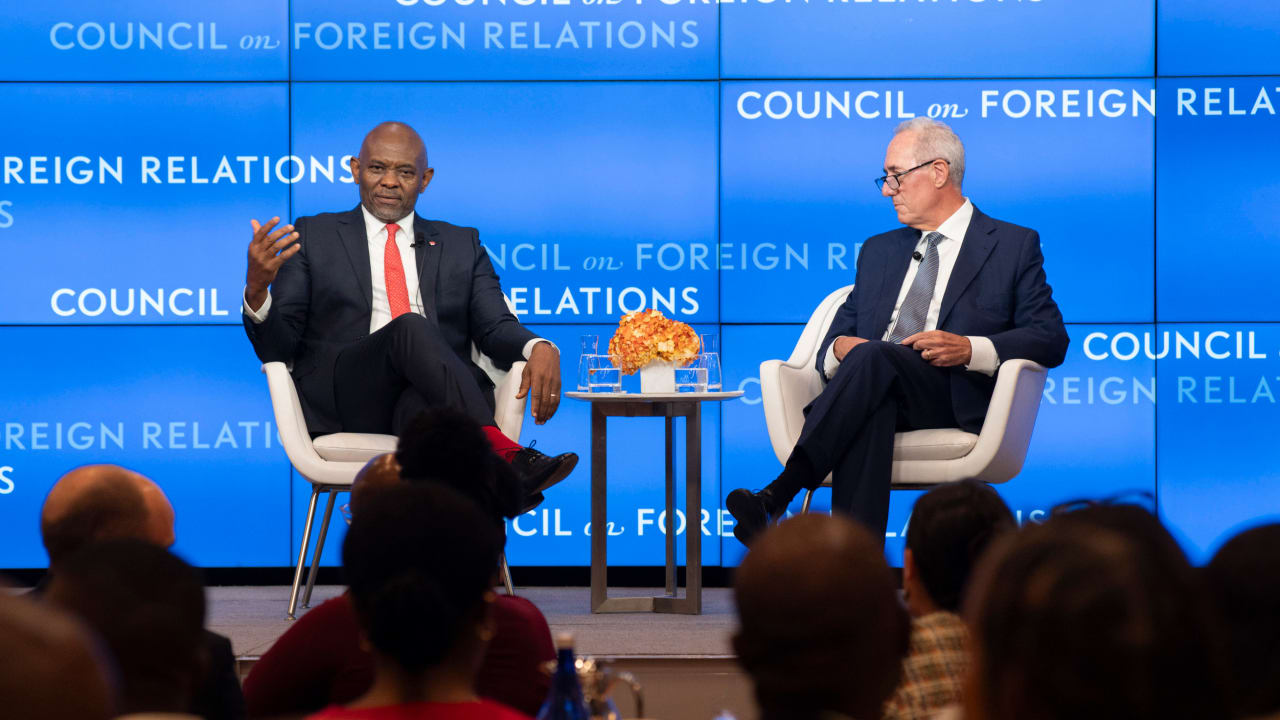
Event date
Speaker
- African Investor and Philanthropist; Founder and Chairman of Heirs Holdings; Founder, The Tony Elumelu Foundation
Presider
- Michael FromanCFR ExpertPresident, Council on Foreign Relations
Leading investor and philanthropist Tony Elumelu discusses Africa’s evolving role in the global economy including entrepreneurship as a catalyst for development, private sector-led growth, energy security, and the evolving U.S.-Africa partnership.
The Darryl G. Behrman Lecture on Africa Policy is held in memory of Darryl G. Behrman, who was originally from South Africa and had an abiding passion for Africa and international peace. The annual lecture is funded by members of the Behrman family.
FROMAN: Good afternoon, everybody. And welcome to day two of our UNGA-palooza week. We had a great session last night with the president of Finland and the prime minister of Norway. And I’m delighted to welcome an old friend, Tony Elumelu, one of the leading thinkers and businesspeople in Africa. Been focused for so long on U.S.-Africa relations. I think we first worked together during the Obama administration when you came to Camp David during the G-7 to talk about the needs of Africa and the relationship between the United States and the continent.
This is the Darryl G. Behrman Lecture on Africa Policy. It’s held in memory of Darryl G. Behrman, who was originally from South Africa, had an abiding passion for Africa and international peace. It’s funded by his family. We’re grateful to them for all their—for all their support.
So, Tony, you’ve been a long-time advocate of, for lack of a better term, trade, not aid. The Trump administration listened, kind of. (Laughter.) Is this what you wanted? Is this what you expected? And how do you evaluate the evolution of where the U.S. is right now on this issue of trade versus aid?
ELUMELU: You know, I think they say that—first, thanks so much, Michael, for this opportunity. Michael has been a great ally, friend of Africa, supporter. You all know he was the U.S. trade rep. And he did his best at the time. Thank you.
Well, for me, and as they say, necessity is a mother of invention. So what is bad today inadvertently could turn great for people. So for Africa, from where I see—the way I see things, I think it’s not what we bargained for, per se, but it’s the reality of the times. And we need to adjust to it. We believe that it actually gives gravity and validity to the fact that it should be about investment, trade, and not aid. We believe that in the twenty-first century what is important is to make everyone self-reliant. As a global community, we can work together to make it happen.
Africa has come of age. And African leaders are adjusting. The African private sector is rising to the occasion. If you look at what we do at the Tony Elumelu Foundation, we believe that no one but us will develop our continent. We believe that collaboration is good for the world. But we cannot rely on anyone for this. Trade between Africa and America, we would like to see it right grow. But we’re also seeing that Africa is fostering and forging trade relationships with other parts of the world. And so we hope that all of us at some point will become relevant to one another.
FROMAN: You know, is being less dependent on aid more of a blessing or a curse? And how do you see the role of the private sector—where you played such a leadership role, as well as in philanthropy—how do you see them stepping in? On what issues can the private sector substitute for aid? And on what issues do you fundamentally need public assistance for some of the challenges?
ELUMELU: Let me approach this from two perspectives. One is what we do in our group, the Heirs Holdings group, the Transcorp Group, United Bank for Africa; and also what another competitor, you know, the Dangote Group, has also done recently. Let’s even start from Dangote Group. Today from Africa, from Nigeria, we supply—Africa, because of Dangote, over 35 percent of jet fuel consumed in Europe today, which is different from what it used to be before. If you look at our own group, we are doing a lot to help address the energy deficit issue we have on the continent. And we soon hope to also start doing a lot more in LNG and supporting the rest of the world.
But the issue of aid is when you are fed too often, you soon become perpetually dependent on someone. You don’t even want to push yourself again. And we have seen that for decades a lot has been put into—pumped into Africa by way of aid. Yet, they’re still under development on the continent. So some of us are going to not question, per se. And that’s why we identify with you guys in the past. You know, that it’s about trade, investment, and not aid. How can we economically empower people and make them self-reliant? And this what we do at micro level at the Ton Elumelu Foundation. We identify young African entrepreneurs. Instead of the traditional grant, aid, we give them non-refundable seed capital, $5,000 each. And we train them for twelve weeks. We appoint mentors for them. And we say to them, your idea can change Africa. Take it from here, and with the training, take that this is proof of concept for you. Make success of it, and the world will look at you.
And today we’ve seen—we started in 2010. We’ve seen how it’s changing the landscape, how it’s helping to create employment, how it’s helping to economically empower young ones—women, men. And there’s no greater validity, again, no greater demonstration of the fact that the best way to develop or to empower someone is to make that person self-reliant. Teach that person how to fish, then progressively he can or she can take care of the family. So I believe that no aid, in my viewpoint, is a plus, is a positive. We have seen it well demonstrated. And that is the way to go.
And, again, another thing that’s happening on the continent of Africa, for instance, is we’re beginning to see African successful people now stand up to be counted. They are now also putting in their resources in helping to develop the continent beyond issue of economic benefits. They are—while realizing now that it’s a mutual destiny. If you do well alone, you leave the rest of the of the population, you will not enjoy it. So why don’t we all do it collectively simultaneously? Which there’s a lot we’ve done. Our philosophy of African capitalism is embedded in this. This is the background of it, how to create economic prosperity and social wealth at the same time so that—realizing that no one but us will develop Africa, no one is going to bring it to us. Why don’t we, amongst ourselves, support one another economically so that we can get there?
FROMAN: Let’s flesh that out a little bit. You referred to economic prosperity and social wealth. What’s the difference between them? Why are they both important? How do you manage a development trajectory that achieves both objectives?
ELUMELU: So there’s a history to that. So I have this philosophy. I championed the philosophy of Africa capitalism, which is the intersection of doing well and doing good, realizing that the private sector must play a role now in the twenty-first century in the transformation and development of the continent. And realizing that, again, no one would do it if we don’t do it ourselves. And so if you do business for the sake of economic benefit, profit only, you leave a lot behind. But you can do business to make economic benefits as well as impact humanity, society, positively. So long before the current ESG talk, et cetera, we long identified this. And, again, based on our own history, based on our own growth, our own story, seeing how we grew, how we got to where we are today. And the role of luck, role of society, role of entrepreneurship, and role of, yeah, hard work, and bringing it all together.
So if we invest, for instance, in electricity, we make profit. We create prosperity. We help support other businesses to do well. We help to industrialize. But at the same time, we help to power hospitals, which has significant social benefits. We help to power schools, which helps significantly in improving standard of living, in helping to make people more educated and more informed, a more learned and knowledgeable society. And in today’s era of AI it goes on and on. If you invest, also you make money, also you also are helping to create access to AI infrastructure and facility in the country.
So collectively, you’re making profit, but at the same time you’re imparting humanity in much more profound ways and manners, you know? So that is that. Doing business, making money, imparting humanity, mankind, in a sustainable and profound fashion. So it is—they are interrelated, because people who are educated and people who are healthy create sustainable prosperity. But there’s also a thin line, because at times businesses tend to focus only on profit, profit, profit. Focus on profit for sustainability, but more importantly focus also on larger societal social impact.
FROMAN: But for that to be successful, a government has to be able to mobilize domestic resources to invest them in these critical sectors, like health, like education. There’s governance issues, needless to say everywhere, but certainly Africa is not immune from that. How do you see the trajectory of this? And do you believe governance is getting better country to country in Africa? Do you feel that we are sort of entering a new phase of it by necessity, perhaps, because outside assistance is being cut? Or where do you see the biggest challenges in overcoming the domestic obstacles to achieving those objectives?
ELUMELU: I my advocacy and my preach everywhere every time is let us work together to create enabling environment that will attract private global capital. Capital goes where it’s welcomed. If you have an economy that has the right macroeconomic policies, frameworks, et cetera. the private sector and economy is doing well, people will be attracted to invest in the economy. And it’s through that investment that will create this kind of economic prosperity and social welfare I talked about. What I see across Africa is that things are getting better. Of course, Africa is a continent of fifty-four countries, to start with. So in a continent of fifty-four countries, maybe if 60-70 percent get it right, it’s not—you can’t say they are bad.
But the good thing is others who are struggling are learning from others, are catching up. If you look at my country, Nigeria, for instance, there was a time—we still have challenges, but you can tell that things are gradually also, in some areas, improving. There was a time foreign exchange was a major hindrance, constraint in the country. And this morning I had a meeting with an investor from the Gulf who wants to invest in Nigeria. And he said to me, one of the reasons we’re considering Nigeria strongly now is that your foreign exchange policy is now market driven. And that’s positive. There was a time there was a lot of opaqueness in that area, but things are gradually improving.
Other countries, we see—there are many countries in Africa that are beginning to get it right. Some, not so right. But my communication, my message to all every time is create—turn your country to a good destination for private global capital. You don’t need to travel to the U.S. to convince investors to come and invest in your country. Create the right conditions. Right condition will attract those investors to your country. The world is a global village today. People know what is happening everywhere. If you—in fact, for me to invest in a country, first thing I check—because we invest in so many countries—how the private—domestic private sector business is doing. If they are doing well in that country, it tells me that I can invest safely in that country. If they are not doing well, I won’t waste my time.
So things are improving, but there’s still room for more to be done. So, yes, we’re making progress, but we can do more. If you look at Africa today, I think—in reference to your question—the biggest constraint and hindrance we have is lack of adequate access to electricity. If we don’t deal with the issue of electricity on the continent, there’s a limit to how far we can go in achieving our transformation objectives for the continent. So that is a—is an area of immediate concern to me. Because if you look at again the AI revolution that is going on today, where would Africa be? Where are we today, and where will we be in future, if we don’t fix improvement in access to electricity? AI is about power to a large extent. And where are we on that?
And also, access to connectivity. If I have poor connectivity, poor access to electricity, that is a problem. Those are things that we should be—we should focus on. Those are things the African private sector—always changing, always improving—that we are not just complaining again. Before, always the complaint. (Laughs.) And that is also embedded in the philosophy of Africa capitalism. What are you doing? Yes, we hold government, we hold our development partners, but we too must do something. Some of us are making investments today that are strategic. That are strategic, and not just about profitability, but investment that helps to create more transformation, progress, and inclusiveness on the continent. That brings our women together, brings our young ones—protects our young ones.
I say to people that what we do at the Tony Elumelu Foundation is not out of surplus of wealth. But it’s just a commitment that poverty—and the realization, that poverty anywhere is a threat to all of us everywhere. So why are we going to believe in affluence, some of us, when majority of our people are not doing so well? And so that’s why we do what we’re doing. So democratize prosperity, bring others into it, give an opportunity to young ones who are coming—our young men and women. And through that, others who see that this is the way to prosperity. This is a path to economic transformation. And that not just by saying trade but not aid, but what else? What else is to invest in our young ones, young African entrepreneurs. That is the future. And that’s what we do.
FROMAN: You’ve said there’s no sustainable development without peace, and no lasting peace without economic opportunity.
ELUMELU: So true.
FROMAN: Nigeria has its share of conflicts—domestic internal conflicts. What role is the private sector playing in Nigeria to try and create those economic opportunities? And how is it spilling over and having effects on peace?
ELUMELU: Again, I’ll tell you what we do at the Tony Elumelu Foundation, because that is a demonstration—or, a direct answer to this. You know, yes, indeed, to me, if you look at the most troubled part of the world, even Africa, the Sahel, you know, and certain part of Nigeria also, is where poverty is at is extreme. And you can’t have peace if your neighbor is hungry. So we need to internalize and realize this. And so we decided, at the Tony Elumelu Foundation, that God has been kind to us. You know, at forty-seven. I retired—founded a bank, took that bank to combine with the third-largest bank in the continent at the time, turned it into one of the largest banks in Africa, with operation in twenty African countries, 750 million customers, and that United Bank for Africa, the only African bank that operates in United States of America here.
And I thought, what can I do? At forty-seven, I was leaving this. You know, significant investors also. And so I thought we should set up the Tony Elumelu Foundation to help democratize prosperity, create access to everyone. That’s desire. And so we started this. And we have today supported over 26,000 young Africans. Each one nonrefundable sed capital of $5,000, plus training, plus mentorship, et cetera. They realize, based on the facts, that we should do something. To answer your question, that there’s poverty. We blame government. We blame development partners. And we must hold government accountable. They must play their own role. But just that we too must show even the way.
And I like that what some of us have done, government is also approaching us for partnership, learning from it, et cetera. In Benin Republic, for instance, the government of Benin Republic has come to the Tony Elumelu Foundation and said, how can we work with you to economically empower young ones? And every year about 700 people from Benin Republic benefit from this, that prosperity. In Nigeria, we do this. And, by the way, what we do at the foundation is across all fifty-four African countries. In Nigeria, we have beneficiaries in northern part of the country, in southern part of the country. And in their communities, it’s signaling. It tells people in their community that there’s a glorious and better path to sustenance, to prosperity, than extremism.
And so we believe that through actions like this—and we know, you see it, we have created a lot of employment through these people that we support. People who have economic access, economic opportunity, will not lead to extremism. So we have created this. And others are learning. Young Africans are saying that if I have that—there are better ways to survive than just another—or even if you have migration, that I can’t survive within Africa if I have the right economic empowerment and support. And this is why other African business leaders are also picking up private sector. You know, things have changed, and changing fast too.
First, we’re all realizing now that it’s not just about you, your business. It’s not just—for your business to succeed, the community must succeed alongside. OK. We’re also realizing that prosperity is about peace. That you can’t live in peace, in spite of your wealth, if all there’s poverty and around you. All our businesses we try now to support—we try to support the community where we do business, so there’s mutual destiny, mutual prosperity, and not just one for them. So the private sector is realizing this. But we’re also holding government accountable to provide the things government must do. Government must do those so that private sector is able—energized, able to do more, succeed more. We’re making progress, but there’s still room for more.
FROMAN: You mentioned electricity and energy. You’ve been a big investor in that sector. And I remember working on Power Africa when it first got started, something that initially the Trump administration continued on beyond the first—beyond the Obama administration. The energy situation around the world is changing rapidly as we speak, with what’s going on in the Middle East, the emergence of new sources of energy, Guyana, elsewhere, Venezuela, et cetera. How is this all affecting Africa? And how do you think about Africa’s role in both the provision of energy, as a consumer of energy, and spreading electricity around the rest of the continent?
ELUMELU: So we are big as a group in energy. Transcorp, one of our businesses, has a 2,000 megawatts electric generating capacity—in a country that consumes 4,700 megawatts of electricity, for context. We also are into energy, oil. (Laughs.) And today we—our platform, our investment, as the single-largest producer of oil in Nigeria today, we do combined about 400,000 barrel of oil a day. So we understand the energy gap and deficit. We know where Africa is at. We know where Nigeria is at. We know that we need to do more to improve energy supply on the continent.
Electricity is a challenge, because a country like Nigeria, for instance, needs almost 100,000 megawatts of electricity. And our industrialization will be tamed, to a large extent, or be slowed by a lack of—enough, sufficient energy, power, on the continent. It’s a problem across Africa. And that’s why I said earlier that it is one of the—once I talked about a Marshall Plan for African industrialization. (Laughs.) And I said, key part of it is energy. If we can do—and I came to U.S. before to testify at the Senate, the Electrify Africa Act, to talk about the importance of electricity, what we need to do, for us as a world, come together to help transform Africa. Electricity is so critical. And therefore, as a group, we are working hard in that area.
Other African private sector leaders also come into that space. But it’s a combination approach. First, we need government, development partners, and our private sector to work together to make this happen. And then we need to look at the entire energy value chain and see how we can advance all. But we cannot talk of industrialization in Africa and Nigeria, in Africa in particular, in twenty-first century, without fixing our fair access to electricity. President Obama’s Electrify Africa initiative was wonderful. Our group, Heirs Holdings, we supported it massively. And we would like to see a reenactment of that interest, you know, by the U.S. and other parts of the world. Because we need to fix this to save the world.
FROMAN: You know, it’s hard to talk about energy, electricity, infrastructure, industrialization without talking about China, and its role in the global economy. How do you think about the role of Africa between China on one hand, U.S., Western Europe on the other hand? The common phrase we hear from everyone around the world is, we don’t want to have to choose. But oftentimes it does come down to a choice, which technology to deploy, telecom, et cetera. When it comes to AI, which tech stack to import? In a more complicated, what we call polyamorous, world out there—(laughter)—what role do you see Africa playing?
ELUMELU: I think, Michael, as I said, is more of—it’s more everyone has an interest. Africa needs to industrialize. Africa has to industrialize. Africa wants to industrialize. And I would say—Africa is therefore—partners that can assist to make this possible, make this happen in a true sense, OK? So it’s not more about technology for AI technology, et cetera. Who really cares about the technology, if I don’t have access at all? It’s when you have options that you can—when there’s availability, you can begin to talk of options. But I think that Africa—so, first, personally, my philosophy that no one but us will develop Africa. And we’ve seen it happen. What we do in our own group, what others are doing—we just talked about Dangote Refinery. We just started. And today it’s supplying 35 percent of jet fuel in Europe, and ambition to do a lot more beyond Europe and rest of the world.
It’s not relying on the West or China for this. But in making that happen, he buy technology, he acquires technology. Whoever has the most favorable terms, if one part is imposing significant tariff on what you buy from them or such, then if another part is making it affordable and giving you export credit guarantees, can give you—making it OK for you to invest, to acquire, you would be a stupid business leader not to do so. Go there. So it’s not issue of whether it’s west or east. What is my interest? What’s my medium to long-term interest? Who is meeting that interest? I will go with who is meeting that interest, and not necessarily whether it’s West or China. (Laughs.)
I think what is happening in the world today is, to some extent, also interesting. If you need gas, if you need jet fuel, if you need refinery, petroleum products, I think people would think less about where it’s coming from. It’s more about affordability and availability, OK? If it’s coming from Africa, or from the east, of from the West, it’s, to some extent, irrelevant. So I think that conversation is there for me, as an African private sector person. So our group we’re trying to roll out the FLNG. Because we see, we have significant abundance of gas. I want to monetize this.
When we want to make the investment decision, it’s going to be who is giving us the best terms, you know, and who is going to help us also in terms of when we want technology transfer, be more amenable to that. You know, so the way I see this is—but the truth is, both China and the West, Africa is in need of basic infrastructures. We need partners that can work with us to make this, to fix this. And those will be the long-term partners we embrace.
FROMAN: You know, I was always surprised—we worked on AGOA, and the renewal of AGOA. Some of the people here in the audience have been very active in this—the African Growth and Opportunity Act that gave duty-free access for African exports across many sectors to the United States. At the end of the day, Africa only exported about, as I recall, $4.5-5 billion worth of goods to the United States under AGOA, and most of them were from South Africa not the rest of the continent. What did we get right or wrong in terms of the trading relationship between the U.S. and Africa? When you look around the country, whether it’s with China or Europe or elsewhere, or within the continent—you now have a continental-wide free trade agreement—what do you think the right course is for Africa on trade policy?
ELUMELU: First is I think AGOA was useful, or is useful. And I hope it’s renewed by end of the year, when it’s due. And as you say, yes, the trade, between 8 (million dollars) and $10 million per annum, and largely from southern part of Africa, and textiles, et cetera. I think it boils down to the basics. Africa can only trade what they have. And for you to trade and produce, you need to fix electricity. And you need to fix transportation. The kind of transportation we have in Africa today, the transit system—again, I blame no one. All I just say to African leaders, create the right environment, create the right incentives, level the playing field, and let private sector go in there. Attract private global capital and let’s fix the transportation system, fix the electric transmission lines, and fix electricity. Because if we fix—if there’s improvement in access to electricity in Africa, Africa will take off.
And then next thing for me will be issue of transportation, because the railway system—the intra-Africa transportation system is a challenge. Even today, we have continental free trade agreement that we have on the continent. You know, I think first things first. We should first fix—solve the electricity challenge on the continent. Solve electricity challenge on the continent. Africa will produce what they need. They will serve themselves, and then export to the rest of the world.
What Dangote Refinery has done is, like, its own generating house—electricity house. (Laughs.) You create that—how many people can create that? We need small, medium-scale enterprises. We need them to start small and grow to be more in future. So we need to provide electricity for everyone, so that everyone. So if there’s any message I have for African leaders and our global friends, it is let us go back to basics. Let’s fix electricity. Let’s improve access to electricity. And Africa will take off, in the area of produce, in the area of finished products, in the area of employment, the area of economic inclusiveness. Everything independent, to a large extent—one single factor we need to fix to set Africa free is electricity. So if we fix that electricity, then under AGOA we’ll do more, we’ll produce more. What’s not there?
FROMAN: We’re going to open up in one second for questions, so please be ready with your questions.
One last point, though. As I look back over the last few decades, it feels like Africa’s gone through these phases of—I remember the cover of the Economist—
ELUMELU: Africa Rising.
FROMAN: Africa Rising, right? And then the—everything is disastrous in Africa. And then African Renaissance. And quite an uncertain risk profile for Africa. I remember African businesspeople, like yourself, complaining that outsiders view Africa with too much risk. They get their perceptions wrong. The market gets it wrong. Is that your perspective, that the market gets it wrong? Or that there are these risks that are still—make it very difficult, when investors are looking around the world as to where to put their capital, to make the choice to put it in Africa? And what could be done to mitigate that risk, or to create a more consistent trajectory of interest in Africa?
ELUMELU: I think the story of Africa is an interesting one. It’s about risk and returns, OK? So we, in 2012 or ’13, we invested our first investment in power sector as a group, the Heirs Holdings group, through Transcorp, in 2012 or ’13. Within twenty-four months we pay dividends to investors, significant dividends to investors. It doesn’t happen elsewhere in the world. There’s nowhere you get the kind of returns on investments as what you see in Africa. And this is in spite of—despite the risks I’m talking about. So the story of Africa is like a glass of water. Either you see half of it with water, or half it’s empty. The reality is there are challenges. There are risks. But equally, there are significant opportunities and returns.
But for a long time, the characterization and the narrative on Africa has been negative, OK? And some rightly, some also exaggeration. You know, stereotype, certain mindset, et cetera. I say, if you look at a country like Nigeria, for instance, a country of about 220 million people, if you have 1,000 that are fraudulent, that does not mean the entire country is fraudulent. That’s the story of Africa. I’ve got to start with, it’s a continent of fifty-four countries, and over 1.5-1.4 billion people. So to use one brush to just say everything about Africa is bad, is not so good. However, it’s a challenge. And a challenge that we’re taking on very well, rightly.
Today I’m the incoming chairman of a company, an oil production company in Nigeria, called Seplat. Listed on London Stock Exchange, diverse investor base—America, Asia, Africa, everywhere. And people are interested in—people are investing in the stock, buying, just showing confidence in the company. Dangote Group has just completed the refinery. Is currently doing its IPO. And interest is massive. But more importantly, I tune on—I put on my TV now, and I see the Dangote Industry—Dangote Refinery on screen. So there’s good news coming out of Africa. There’s United Bank for Africa operating in the United States of America here—a deposits-accepting bank.
These kind of positive stories out of Africa will help to address the kind of characterization and perception that people have of Africa. And that’s why, you know, platforms like this is also very good. You know, because what you and your team are doing, shining the light, letting people know what’s happening on the continent. That beyond what you read—you know, bad news spreads so fast, OK? And there are also good things coming out of Africa. That would change the narrative. You know, I’ve been here having meetings since Saturday, Sunday. And you can tell that the reception, the eagerness and willingness to partner, to do business in Africa, is changing and is improving.
What we need are political leaders to also help us. They must play their own part. They must ensure that the countries are well run, rule of law, security, ease of doing business, so that the private sector endeavors and efforts, and those partners out there who want to do business, are met. You know, and then collectively we keep changing. So for me, the good news, the good investment—the good returns on investment coming out of Africa will help to change that perception. It’s not how much we talk about it. It’s not what we say. It’s not by what we just said. It’s by a demonstration of it. And that’s what we change. And that’s what I’m happy with what is happening now.
A new Africa is emerging. New Africa is rising. The private sector in Africa is taking the center stage. We are showing the world. We are demonstrating to the world tare many good things coming out of Africa. And that is the future. And that is the way to go.
FROMAN: Terrific. We’re going to open it, up both to questions here in the room, and also to our 200 or so who are watching virtually. Just a reminder, this is on the record. I’ll ask you to please stand, wait for the microphone, introduce yourself, and ask a question—which is one of those things that usually ends with a question mark, it goes up at the end, versus a statement. Here we go. Why don’t we start right here?
Q: Hi. Oh, sorry. Kassia Yanosek with Bechtel. And thank you for being here.
ELUMELU: Slow—is that—
Q: Is it on? Yeah. OK. Kassia Yanosek with Bechtel.
FROMAN: Bechtel.
Q: And thank you for being here today with us.
My question is about critical minerals, which is a big topic here in the United States. And the United States has invested in the Lobito Corridor which, of course, connects the regions of copper-producing areas and cobalt-producing areas in Africa with the Atlantic port of Lobito. And the U.S. has supported financing of infrastructure there. But what would you like to see more done to address some of the issues that you mentioned earlier, such as investing in processing capacity, potentially, or energy? What would you like to see more, kind of, beyond just export investments?
ELUMELU: Honestly, again, I don’t believe in people being spoon-fed. I think that if the United States investors or development organizations, and help to address the infrastructure deficit in those countries, that is good enough. That is good enough. To do otherwise would become—will be to over-spoon-feed people. You know, for me—and we must—and at the heart of Africa capitalism is a realization that people must work hard, and people must roll their sleeves, and that people should not depend on handouts. You know, if you have poor access to electricity, and through the mining activity, investment, et cetera, this is helped—at country level, for instance, community, the country level—I think that can help go a long way, you know? Because, you know, access to electricity is so catalytic. It helps to unlock so many opportunities.
Even security challenges will be fixed if there’s improvement in electricity. So I think if—the issue though is that people come and exploit and do not—do not—local value creation does not occur. And that is what people complain about. They just come, they go to the mine, extract, take out. And so, but if you come and you invest, you know, for me, you know, remember we started this conversation with trade, investment, and not aid. If you come and you invest, you build facilities, infrastructure, et cetera, who cares? In fact, who cares who owns.
It is there and is helping to create jobs for community for our people. It’s helping to address—look at Nigeria today. Before we were heavily dependent on imported fuel. And then that also affected our foreign reserves, et cetera. Now, if you don’t import fuel again, you’re producing it locally, it’s creating jobs. It’s helping to create a whole ecosystem value chain. We, the country, will be the bigger beneficiary. Who are the investor? Who make the dividend? That’s secondary. No problem about that. So I would say if the way you painted it, that is the case, then it’s not bad. But it’s an issue if you extract and processing does not occur.
But for me, again, going back to this electricity conversation, if there’s reliable electricity, if the ease of doing business is right, you have minerals there, why would you want to extract and take it elsewhere? You want to extract and refine there, and you can send to anywhere, everywhere, every part of the world. It is the lack of those things that creates some of this exploitation. And that is, again, the message to governments, you know, especially in Africa. Create conducive investment climate at home so people come, and if they come, they will stay, you know.
FROMAN: This gentleman here, second table.
Q: Thank you very much for an insightful conversation. My name is Eddie Mandhry with Columbia University School of Engineering, originally from Kenya.
Strive Masiyiwa and NVIDIA are working to address Africa’s compute constraints. My question is on—when we think about AI and African AI talent, what needs to happen so that they are not just simply consuming models built somewhere else, but how can we cultivate African AI talent to be building at the frontiers to build companies of the future that impact the continent positively?
ELUMELU: No, I think—(laughs)—it’s almost like one is on auto repeat. Auto repeat, you know? (Laughs.) AI revolution is good for humanity, good for mankind, is good for all of us. My concern is that Africa should not be left behind. But unfortunately, that will be the case if nothing drastic is done about the basic ingredient for AI revolution. Two things in this AI revolution. First is power. Two is connectivity issue. We have these two issues on the continent, challenges on the continent. Strive called me a few weeks ago that he wants—because, you know, as I said, we have—we have the largest power generating capacity in Nigeria, our group, the Heirs Holdings group, through Transcorp. We have 2,000 megawatt generating capacity. And he says—he was, Tony, I would like—they are trying to set up a datacenter. If I can assure—if our group can help him with power supply. And I said, yes. So it’s a convention we’re having. I put them in touch with our team to advance that.
But the point is that AI datacenter is critical. It’s infrastructure. Our young Africans—you’re from Kenya. You know, we have a lot of beneficiaries of the Tony Elumelu Foundation from Kenya. Most of them, tech space. So Kenya is actually the tech center of Africa. Many people—our Africans are very knowledgeable, hardworking, and learn very quickly. And they are young. But they lack access to AI infrastructure and connectivity issues. So AI is good for us. AI is good for the world. But we need to make sure it’s inclusive. There are a lot of people on the continent who don’t have access to electricity even to power their phones. It’s a challenge, OK?
And so why I said it’s like one’s on auto repeat is, first things first. The basis before the superstructure. The basis is, let’s fix improvement in electricity. Let’s fix that. So all of us—it should be a concerted effort, all of us, everywhere. And for me, it’s a combination approach—hydro, renewal, thermal. Let’s just bring it all together to fix it. And I said, that will unleash the immense potential of Africa, and our youth in particular. That will help us to create jobs. You know, I say you don’t have eighty/twenty rule in everything life. You don’t have to do everything. Let us, as a continent, commit significant resources to electricity. I just wish our government could understand that electricity is the key to transformation.
FROMAN: Yes, the woman third table back. There you go. Right there, yeah.
Q: Thank you. Hi. My name is Moushumi Khan. I had the privilege of being at the inaugural Behrman lecture.
ELUMELU: Take the mic up.
Q: Can you hear me? Thank you. The inaugural lecture was excellent. So it’s very nice to be back.
My question is regarding multilateral development banks, DFIs. And I used to serve as the U.S. alternative executive director at the Asian Development Bank—
ELUMELU: At Asian Development Bank?
Q: Yes, in the last administration. So, what do you see as the role for DFIs and MDBs in terms of private capital mobilization? And what role are they playing now? What should they do? And how can they engender more private capital mobilization in infrastructure development, et cetera?
ELUMELU: Thank you very much. I think that is a valid question, because the type of capital we need in Africa to fix—address the infrastructure deficit is significantly huge. Unfortunately, and I must say this, most development financial institutions are more rating-minded, rate-minded. They’re more, what is Standard & Poor, what’s our rating, what is—actually helping to move the needle. And unless and until something is done about that—you know, and I don’t just get it. Development finance, you’re not—yes, you don’t have to use debt to catalyze investment and development. But oftentimes they focus on AAA rating. And so that drives so many things that they do.
And most of the—I mean, yesterday we were having dinner with Dangote. And we’re just talking about this story. And even—you know, and let’s go back a bit. So in Nigeria, let me tell a Nigerian story a bit. There was a time the banking sector in Nigeria was fragmented, so badly fragmented that you couldn’t even raise $100 million in the domestic market. Then the government. decided to restructure the banking, reform the banking system, and reform the banking sector. And the banking sector crashed from 170 banks to twenty-five banks, each with significant balance sheets, OK? And then these banks were able to lend locally. And because they understand the African risk, they could lend to African businesses.
Now, those African—yesterday—so let me fast-forward to yesterday. And I was saying at dinner yesterday that they have over $7 billion cash, free cash. And this is a company at some point that needed so much support to take off. Let’s go to the question you asked. And so today Dangote will be, I’m sure, AAA rated, et cetera. If a development finance institution, Asia Development Bank, African Development Bank, all the development banks are so minded by AAA rating, they won’t find the project. So you see all of them, they are investing—the money comes back to the U.S., U.S. Treasury. It’s not helping to develop the continent that there should be helping.
So we need to change our mindset. We don’t want you to have junk credit, but if you have AA, the AP, it’s not bad, because you have a developmental, catalytic aspiration or ambition or commitment. That is something they want to address. And that is why you have so much money. Money at 1 percent, 2 percent even some market, and some nothing. So we need to make it—anyway, so I think there’s a whole lot to be done in that space. If not, we keep complaining. That’s why some of us, you look at private capital. Because the development, they have trillions but it’s not being spent appropriately.
FROMAN: Yes, right here.
Q: Reynold Verret from Xavier University—
FROMAN: Here’s the microphone.
Q: Reynold Verret from Xavier University of Louisiana.
A slightly different question. I’m talking about intellectual capital.
ELUMELU: International—
FROMAN: Intellectual capital.
ELUMELU: Intellectual capital.
Q: Intellectual capital. As a scientist myself, meeting the talent coming out of Africa, and how do we create spaces for them to return to do translational investment, to also create? And also to transform the resources of Africa into value-added products as well. How do we create spaces for them? It’s not just—electricity is important, but also the spaces, and obviously the capital to make that happen, because the return is very difficult. And there is an eagerness for that talent to be there. But how do we create those spaces for them?
FROMAN: Great.
ELUMELU: Well, I will answer that question as a private sector person, not as a government or policymaker. But what we do in our group, we have operations in many countries. We have an operation in United Bank for Africa, for instance, operates in United South America, here in New York, operates in Dubai, operates in France, London. And we try to give opportunity to everyone, especially diaspora Africans, you know, to give the opportunity to work. And so why we do there is one way of also contributing for the development of the continent, OK? At Transcorp, we do the same. We give opportunity to people, you know, locals, diaspora, and foreign to come work there. And they work at attracting human capital back to the to the continent. At Seplat, one of the investment businesses we invested in, they do the same. They have offices in London.
So—but the right thing is, if we create a conducive environment at all—my daughter is here. You know, she’s studying medicine. And each time I converse with her, I tell her, I hope you know you’re coming back to work. She said, yeah, daddy, I’ll come back. But the right hospital, the right center will be there. If we create—if there’s improvement in electricity, you want to set up hospital, you set hospital. Rule of law in the country—in the countries on the continent, good security, of course, connectivity, availability, people will want to come back. Shola (sp), when is our daughter coming back to—when are you coming back to—are you coming back to Nigeria? (Laughter.) Let’s see, are you coming back?
Q: (Off mic.)
ELUMELU: Eventually. That is—that is what my daughter here says, eventually. (Laughs.) Eventually. So we need to create that which will attract them. But, yeah, intellectual capital so critical, attracting our people back home, very important. And there’s also—some of us also have supported—there’s a man who is in this room. We attracted him from Johns Hopkins University to come and help set up what we call National—NCCN, National Competitiveness Council of Nigeria. Our foundation, we—Chika Mordi—Professor Chika Mordi. Our foundation, we sponsored it. You know, we pushed government to set it up, again, as a way of creating the right operating environment that will help everyone. Not just our group, every business in Nigeria to do well. And also be able to attract others.
And so, one of the things they are doing also is—(inaudible)—the intellectual property law, you know, to make sure that the—because we need to protect people with creativity, ideas, et cetera, because that also is a huge economy on its own. We need to find a way of also attracting them, giving them the right—it’s all about ease of doing business, creating the right conditions that will enable people to succeed, in spite or irrespective of their areas, whatever. So it’s not just about hard areas, power areas, et cetera. Soft areas will need protection, rule of law, so that things will work well.
So I empathize with people in my own way. Through, like, the NCCN and advocacy, I try to say, let’s create the right environment. You know, today I’ve talked about power. I talked about rule of law. You know, very critical. These are essential ingredients that helps to create sustainable prosperity across.
FROMAN: Yes, the women in the back, hand up. There you are.
Q: Hello. So, first, just thank you for this wonderful discussion. My name is Felicia Appentaeng. I’m the president and CEO of the Africa-America Institute.
ELUMELU: Africa-America Institute?
Q: Yes. My question is around the youth bulge.
ELUMELU: What?
Q: Around the youth bulge.
ELUMELU: The youth bulge, correct.
Q: And so, much of the narrative and discussion around Africa’s changing demographics is very focused on the structures that will struggle, which is absolutely real. But I find that entrepreneurs and investors are always able to find opportunities and ideas. And I’m wondering what opportunities you see with Africa’s changing demographics and the youth bulge.
ELUMELU: If I heard you well, opportunities that will help us engage this bulge, right? Yeah. No, so there are many things. Technology is one of those areas. It takes place. You know, I see unicorns coming, right, emerging out of Nigeria, out of Africa now. Payment space. There’s a whole lot happening there. Actually, I think we’re leading the world, actually, in these spaces, et cetera. A company that started a few years back in Nigeria is OPay, they call it. I think, you know, $4-5 billion IPO here now. So there’s a whole lot happening, but—you know, not but. You know, there was one program I attended. And they put it in a class, and they say, today nobody will use “but.” Use “and.” And. (Laughs.) So I wanted to say “but.”
However, we need to fix improvement in electricity. People are surviving in spite of the challenges on the continent today. Just imagine what will happen if we lifted some of these hurdles out of the way. Africa will take off. Africa will actually—that bulge you see, that demography divide we talk about, will come through. That Africa rising narrative, it’s no longer Africa is going to rise. Africa is now rising, will happen. So let’s see. And the reason I’m emphasizing this, CFR is a global platform. People listen to what you say here. So if there’s one message I want to leave—I want to leave or drop on the table today, is that Africa must fix its energy deficit for Africa to develop in the twenty-first century. And that all must come together to make this work. All the questions we’re asking, everything, it’s all about poor access to electricity. We fix it, it will take off. So thanks for what you do. And the CEO of our foundation, Somachi, she will travel with you and see what we can do together.
FROMAN: Well, that’s a great, upbeat note on which to—on which to end this. It’s been really a great honor to have you, Tony Elumelu.
ELUMELU: Thank you.
FROMAN: Chair of the foundation, chair of so many businesses that have had such an impact in Africa and on U.S.-Africa relations. And it kicks off a week that includes leaders from Namibia, Somaliland, Ghana. I think the foreign minister of South Africa. Am I missing any for Africa programming this week? But so come for breakfast, lunch, and dinner here, CFR meal plan. (Laughter.) And please join me in thanking Tony Elumelu for sharing his views with us today. (Applause.)
ELUMELU: Thank you. Thank you, Mike. Thank you. Thank you. Thank you.
(END)
This is an uncorrected transcript.