What Iran’s Protests Mean for Countries in the Middle East
The protests in Iran could have a sweeping effect in a region already jolted by historic changes over the past year. Four CFR fellows assess how Israel, the Gulf States, Lebanon, and Turkey view the developing movement.
By experts and staff
- Published
 Elliott AbramsCFR ExpertSenior Fellow for Middle Eastern Studies
 Henri J. BarkeyCFR ExpertAdjunct Senior Fellow for Middle East Studies
 Steven A. CookCFR ExpertEni Enrico Mattei Senior Fellow for Middle East and Africa Studies
 Elisa EwersCFR ExpertSenior Fellow for Middle East Studies
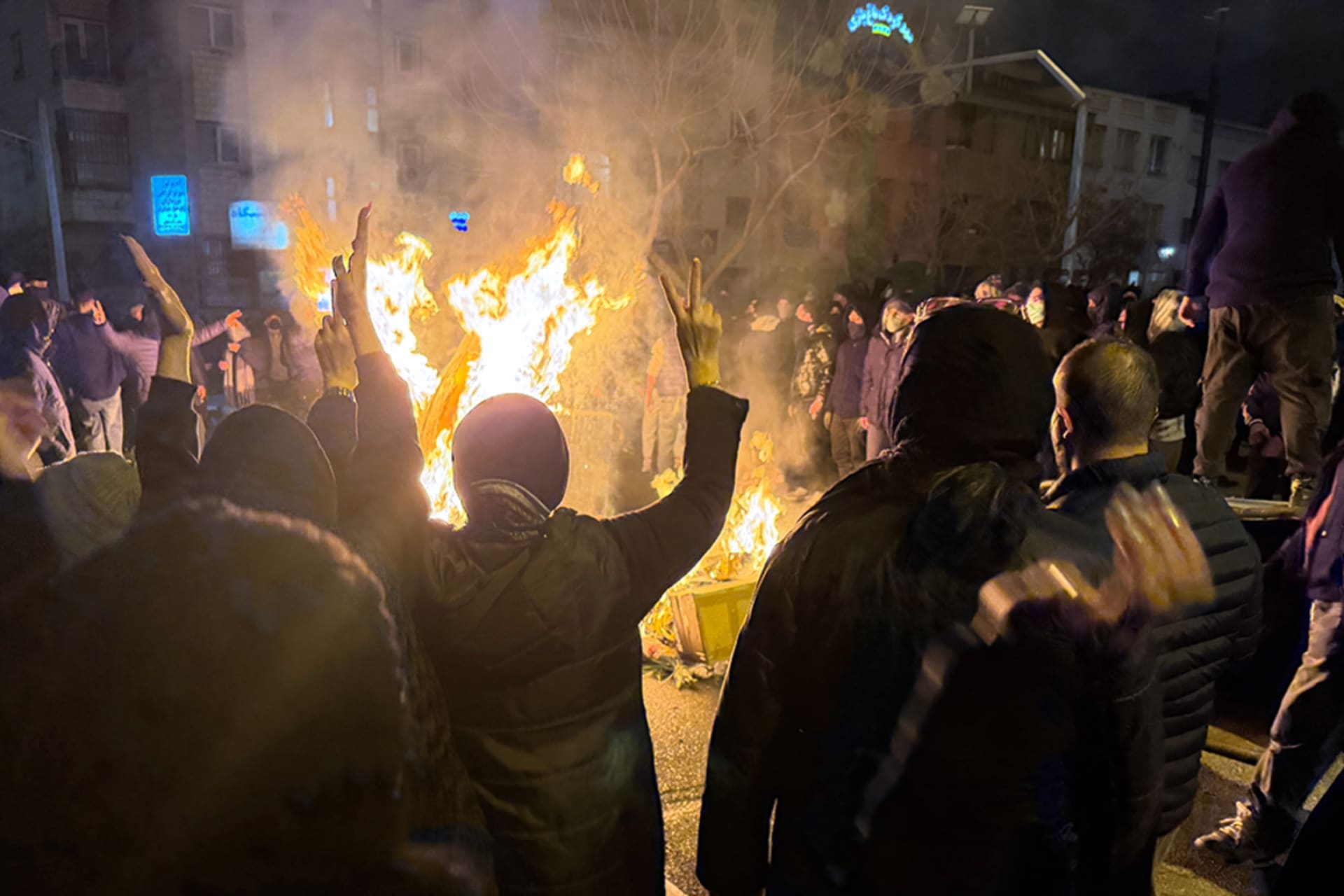
The protests in the Islamic Republic could shape up to be more than a domestic crisis. Demonstrations that began on December 28 with economic grievances have developed into an open call for regime change. The outcome of the protests could prove pivotal for the region and reshape dynamics in the Middle East.
The Iranian authorities have responded with a violent crackdown that includes an internet blackout and severed communications. The death and arrest figures vary due to the challenging information space, but the U.S.-based Human Rights Activists News Agency now estimates that at least two thousand people have been killed since the protests began.
President Donald Trump used social media to urge the protesters, promising that the United States would aid them—though he has not specified how. He has previously threatened to have the U.S. military intervene if Iran’s regime used lethal force.
The crisis is unfolding as the Islamic State’s regional influence has been significantly weakened. For neighboring states and regional powers, the country’s internal turmoil presents both new opportunities and profound uncertainties. Four CFR fellows take a closer look at the region, assessing how Israel, the Gulf States, Lebanon, and Turkey view the developing protests.
Israel: Hope for Regime Change in Iran, but Ready for Harsh Reality
Elliott Abrams is a senior fellow for Middle Eastern studies at the Council on Foreign Relations.
The Iranian regime is Israel’s enemy. Tehran’s “Death to Israel” policy, its nuclear weapons program, and its support for terrorist proxies like Hezbollah and Hamas, have put Iran at the center of Israel’s greatest national security challenges for decades.
Israelis therefore see the possible collapse of the Islamic Republic with hope—but also tempered expectations. Repeated outbursts of protest have proved that the Iranian people loathe the regime and its policies, and Israelis hope that, if it falls, the now forty-six-year confrontation between Israel and Iran will end. They recall the days under the Shah when relations were close and cooperative, so the emergence of his son, Reza Pahlavi, as a significant figure is another cause for optimism.
But the optimism is limited due to experience. The smashing of previous uprisings in Iran shows that the regime is willing to commit mass murder to stay in power, and has powerful and loyal security forces willing to do whatever Ayatollah Ali Khamenei demands. Israelis also lived through the Arab Spring and saw protests for fundamental change blunted in Egypt, Tunisia, Lebanon, Syria, and elsewhere (Lebanon and Syria may have only seen recent progress due to recent Israeli military actions). They also worry that the Islamic Republic could be followed by a less religious but equally hostile government. A military dictatorship could still seek large ballistic missile and nuclear weapons programs and remain hostile to the Jewish state.
There is also a nervousness in Israel about the possibility of new U.S.-Iran negotiations. Israel opposed the last deal—the Obama administration’s Joint Comprehensive Plan of Action (JCPOA)—because in their view it merely delayed the Iranian nuclear program and did nothing to stop Iran’s ballistic missile program or its support for terrorism. They fear a bad new deal that (whatever else it claimed to do) could leave the regime in place and end U.S. sanctions. They would then have to face a richer and more stable Islamic Republic that they cannot trust—no matter what the Iranian regime promised.
A Middle East where Iran seeks peace and stability would change not only the Iranian-Israeli relationship but have profound effects on the entire region. It could mean better Israeli relations with Israel’s neighbors, less fear of terrorism, and even a reduced Israeli defense budget. That’s the dream—but Israelis are used to the harsher realities that are more common in the Middle East.
Gulf States: Expect Iran’s Weakened Regime to Prevail
Steven A. Cook is Eni Enrico Mattei senior fellow for Middle East and Africa studies at the Council on Foreign Relations.
The countries of the Gulf have much to gain should Iran’s Islamist regime fall, but they would also be on the front lines of the potential chaos that could result.
The Gulf Cooperation Council’s heavyweights—Saudi Arabia, the United Arab Emirates (UAE), and Qatar—have kept a low-profile since late December as the protests roiling Iran developed. While the Qatari leadership has long maintained good ties with Tehran, the Saudis and Emiratis have been engaged in high-profile rapprochements with the Iranians after years of fractious relations.
These warming relations, which include the normalization of diplomatic ties and investment, have added a measure of stability to region. For example, once Iran and Saudi Arabia normalized ties in March 2023, Iran’s proxies in Yemen—the Houthis—stopped firing missiles and drones on Saudi population centers.
Despite positive changes, mistrust between Saudi Arabia and Iran, and the UAE and Iran, have continued. Both the Saudis and Emiratis have remained committed to their renewed ties to Iran, but they are quick to underline Iranian transgressions. This includes the Islamic Revolutionary Guard Corps efforts to smuggle weapons to the Houthis and funnel money to Hezbollah in Lebanon. And while they were also worried about potential instability and retaliation on their cities during the Twelve-Day War in July 2025, their public criticism of Israel concealed a quiet satisfaction that the Iranian regime—which has sown so much chaos across the region for decades—was getting payback.
Fast forward to the protests that have shaken Iran in recent weeks, and Gulf officials have said little publicly. Current thinking among them is that while the protests are more intense than uprisings of the recent past, they believe that the Iranian leadership will likely prevail. As a result, once the crisis passes, Gulf leaders will need to manage their ties with a relatively weaker—and possibly less predictable—leadership in Tehran. Even if they are miscalculating and the Iranian regime falls, their primary focus is to ensure the stability of their societies from the chaos that could envelop Iran.
The one outlier in the region has been Oman, which has often been the channel through which the United States and others have communicated with Iran’s leadership. Omani Foreign Minister Badr bin Hamad Al Busaidi met with his Iranian counterpart in Tehran on January 10. The readout of the meeting suggests business as usual with both sides affirming mutual cooperation and their desire to strengthen relations. They also “called for avoiding policies and practices that could inflame tensions” and “agreed on the importance of adopting dialogue and diplomacy.” This is standard fare, but it could be a signal to the United States that Iran wants to talk as Trump indicated on Air Force One a day later.
Beyond Oman’s apparent diplomacy, the Gulf states are doing little more than watching events in Iran warily and studiously, avoiding getting involved in any way that could harm their own stability.
Lebanon: An Existential Moment for Hezbollah
Elisa Ewers is a senior fellow for Middle East studies at the Council on Foreign Relations.
“No to Gaza; no to Lebanon; my life only for Iran.” This is not a new chant in Iran, but it is one that has taken on a more significant meaning as failing currency and ballooning inflation motivates brave Iranians to stay in the streets despite the security crackdown. Protesters across the Islamic Republic are making clear they no longer accept the Iranian regime’s plundering of the nation’s resources for the benefit of the terrorist proxy network that funds groups like Hezbollah and Hamas.
For Lebanon, these protests also represent something different. They come at a time when Israel has severely degraded Hezbollah militarily and continues to target Hezbollah assets throughout Lebanon. They come at a time when the Lebanese state has attempted (albeit slowly and incompletely) to extend its authority in the southern part of the country and try to establish itself as the sole bearer of arms. And they come at a time when Lebanon’s president says it is time for Hezbollah to “act wisely” and lay down the arms that have become “a burden on Lebanon.”
Hezbollah has resisted this choice until now, insisting its weapons are necessary. As the Iranian regime lashes out against protesters, it also appears to be looking for ways to distract from the violence, such as attempting to open negotiations with the United States. There are real concerns that Hezbollah, too, could be used as a distraction, provoking conflict and threatening the tenuous ceasefire with Israel.
For its part, Hezbollah seems to be downplaying the significance of the Iranian protests. But that strategy could falter quickly, as these protests continue to rock a weakened regime in Iran. The choice before Hezbollah over the last year is the choice it faces now: seek to survive literally and politically without its arms or continue to throw its lot in with the Islamic Republic and continue to be the target of Israeli military strikes.
Iranian protesters are making clear they want an end to providing financial lifelines to proxies like Hezbollah while their own country is plagued with hardship. Lebanese citizens are cheering them on.
Turkey: Government Warns Against Meddling in Iran
Henri J. Barkey is an adjunct senior fellow for Middle East studies at the Council on Foreign Relations.
Turkish government leaders have refrained from commenting on events in Iran. The only official statement was issued by government spokesperson Ömer Çelik. He carefully stated that while Turkey recognizes Iran’s problems, these should be resolved by the Iranians themselves. He also warned against any external intervention. Ignoring Trump’s direct public threats, he only singled out Israel as a potential provocateur.
The Iran crisis is difficult for Turkey to untangle. Historically, Ankara’s relations with Tehran have always been challenging. Iran’s influence in the Middle East has overshadowed Turkey’s; it was the region’s main anti-Western power and cast a long shadow over the area. However, Iran was significantly weakened by events over the past two years. After the fall of the Bashar al-Assad regime in Syria, then setbacks faced by its two critical allies, Hamas and Hezbollah, and finally the Twelve-Day War with Israel and the United States, Tehran has found itself isolated in the region.
The sidelining of Iran has benefited Turkey, whose leader, Recep Tayyip Erdoğan, has long aimed to take on a much larger role in both the region and on the world stage. Despite Turkey’s place in the Western alliance, Erdoğan has always envisioned a maverick leadership role for his country. The most immediate advantage for Ankara appeared in Syria, where the new Sunni-led government noticeably replaced Iran’s sway and dominance with Turkey’s. With its much more dynamic economy and global role, Turkey’s new influence now extends beyond Syria. Many people in Turkey, including politicians and opinion leaders, envision a two-power region—one comprising Turkey and Israel.
The challenge facing Ankara in Iran today is two-fold. If Iran were to slip into a civil war, the fallout—ranging from renewed refugee flows to revived Kurdish unrest along its borders to disruption to Iraq’s delicate balance—could unleash waves of instability across the region.
On the other hand, if Iran’s regime topples, would Turkey welcome its replacement by a new pro-Western government? Although Ankara would immediately benefit economically from such a change, a new Tehran could attract significant political attention and, once again, potentially become a new rival to Ankara.
Hence, spokesperson Çelik’s remarks could be reflecting at least the Turkish government’s wish that Iranians do indeed resolve their problems themselves and perhaps change little.
This work represents the views and opinions solely of the authors. The Council on Foreign Relations is an independent, nonpartisan membership organization, think tank, and publisher, and takes no institutional positions on matters of policy.