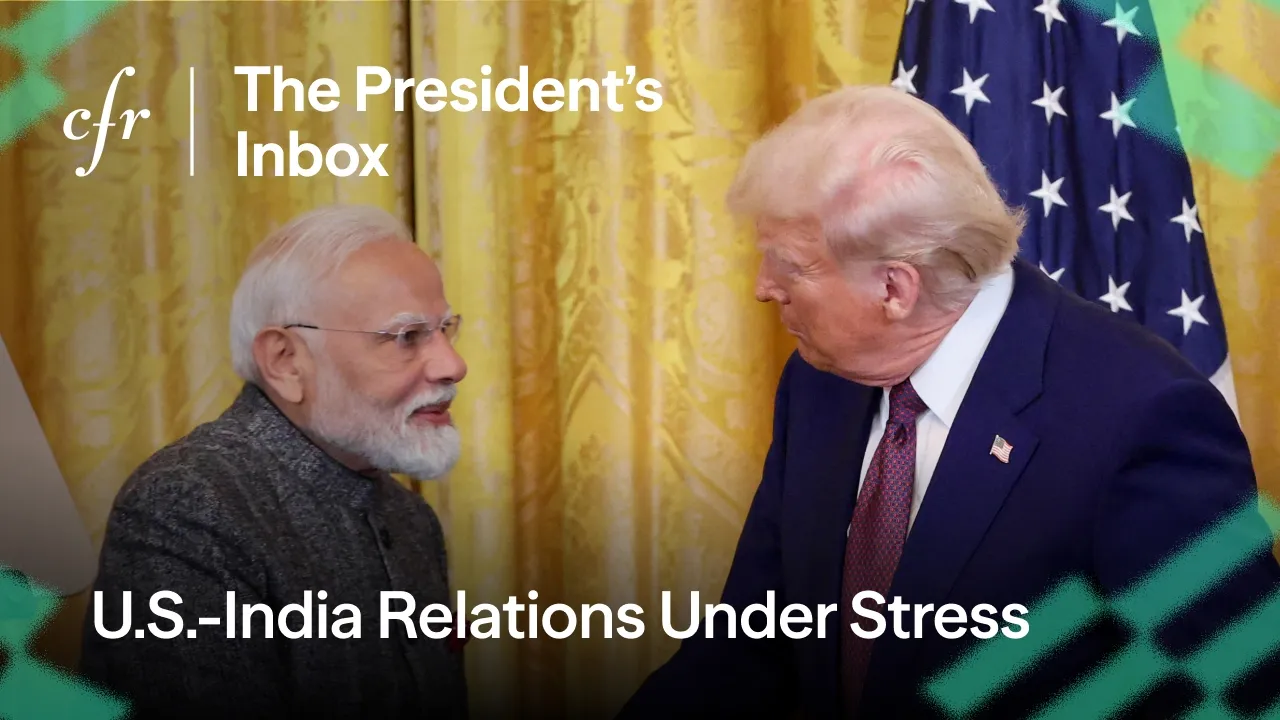
U.S.-India Relations Under Stress, With Sadanand Dhume
This episode unpacks why tariffs, security concerns, and a détente with China have reframed the importance of the U.S.-India relationship, and what it could take to put it back on track.
Published
Host
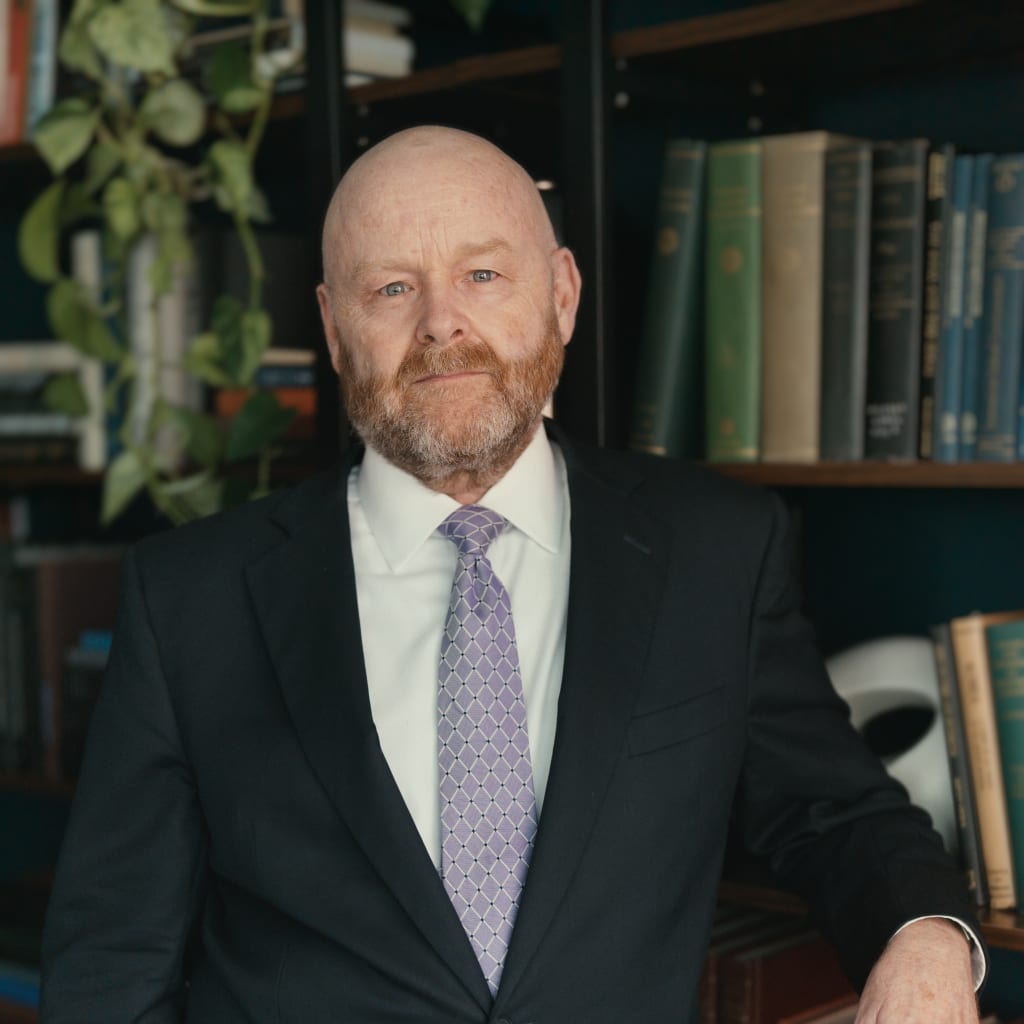 James M. LindsayCFR ExpertMary and David Boies Distinguished Senior Fellow in U.S. Foreign Policy
Guest
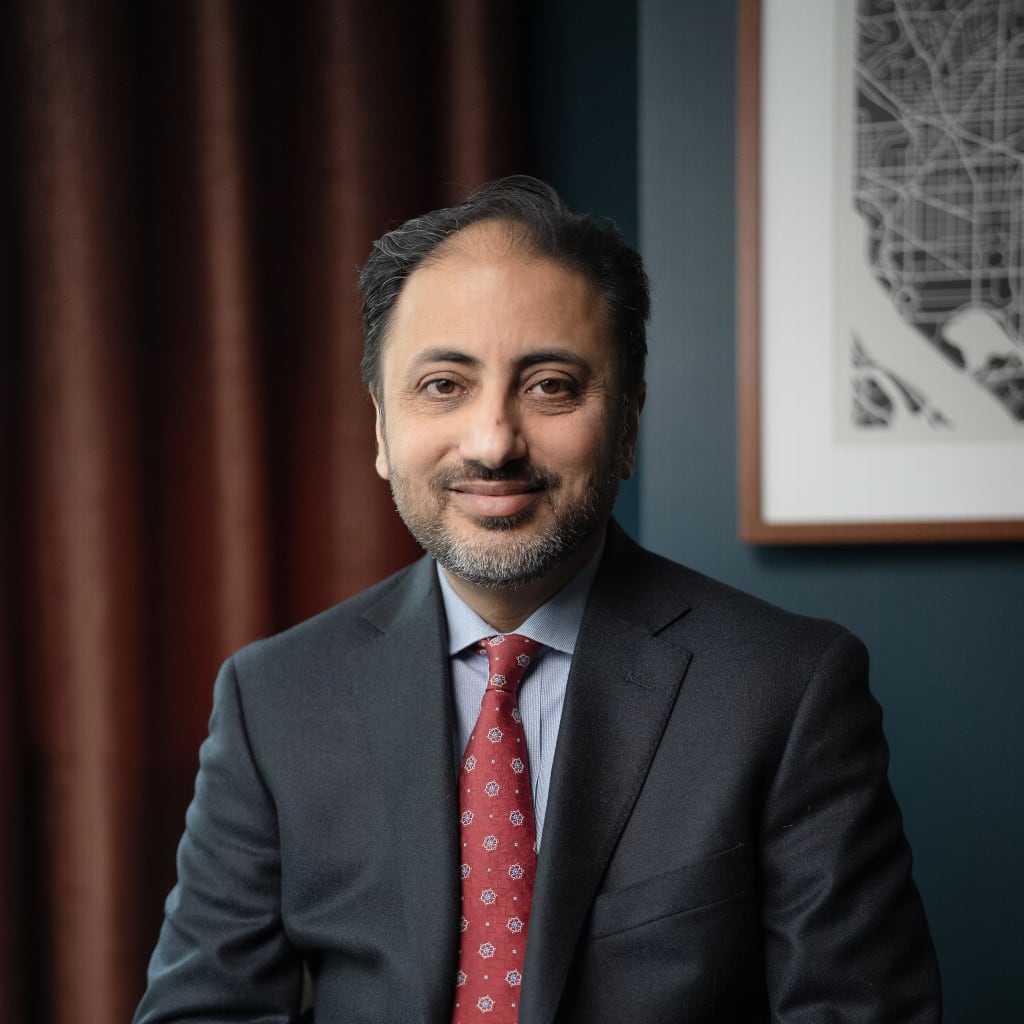 Sadanand DhumeCFR ExpertSenior Fellow for India, Pakistan, and South Asia
[Video: https://youtu.be/iINnASL0SQA]
Transcript
This transcript was generated using AI and may contain errors.
DHUME:
If we had had this conversation a little bit over a year ago, I would have said that U.S.-India relations were on a high. Fast forward to today, and I think that it’s fair to say that it’s been a bit of a roller coaster ride. What the Indians were expecting from the second Trump administration is not what they got.
LINDSAY:
The United States for years has cultivated India as a strategic partner and counterweight to growing Chinese power. President Donald Trump’s America First foreign policy has upset those plans. Changes in U.S. tariff and immigration policy, the war against Iran, and a seeming easing of U.S.-China tensions are among the developments testing relations between Washington and New Delhi. What does Trump want from India? How is the government of Indian Prime Minister Narendra Modi reacting to the changes in U.S. policy? And what changes, if any, are both capitals prepared to reach a new accord?
From the Council on Foreign Relations, welcome to the President’s Inbox. I’m Jim Lindsay. Today, I’m joined by my colleague Sadanand Dhume, Senior Fellow for India, Pakistan, and South Asia here at the Council.
Thank you, sir, for coming back on the podcast. It’s great to be back. I want to begin like big picture.
Give me a sense of what the relations are right now between the United States and India.
DHUME:
So before I answer that, let me rewind a little bit. Okay, I love rewinds. If we had had this conversation a little bit over a year ago, let’s just say in April 2025, I would have said that U.S.-India relations were on a high. Vice President Vance was in India with his wife and children. They had a very friendly…
LINDSAY:
I mean, she’s of Indian descent.
DHUME:
She’s of Indian descent. They had a very warm meeting with Prime Minister Modi, where Prime Minister Modi gave the children peacock feathers. There was a general sense of optimism in New Delhi that the Trump administration got India, got Modi, and the relationship was going to scale new heights.
Fast forward to today, and I think that it’s fair to say that it’s been a bit of a rollercoaster, right? There have been severe sort of setbacks in terms of public opinion. We can get into the numbers a little bit later.
But broadly speaking, what the Indians were expecting from the second Trump administration is not what they got. They got extremely high tariffs, punitive tariffs, which at one point were as high as 50% among the highest in the world. They got this…
LINDSAY:
And for India, the United States is the largest destination for export, correct?
DHUME:
Yes, if you count both goods and… Yes, it’s the largest trade partner counting goods and services and the largest export destination, both. Then you had the strange and sudden love affair between President Trump and Pakistan’s effective ruler, Field Marshal Asim Munir.
You had various members of the Trump cabinet who seemed at one point taking pot shots at India virtually every week. And then you had the Trump administration’s warmth towards the Chinese and in fact, the president himself talking about a G2 between the US and China. So all of these things taken together have really, in my view, put a question mark over the relationship.
LINDSAY:
Okay, so let’s sort of take that apart. There’s a lot there. And again, my sense is that when Donald Trump was elected, the New Delhi was very happy.
Prime Minister Modi was quite effusive in his praise for President-elect Trump, his tremendous victory and the rest. Is it your sense that Trump came in with a plan to reset US-Indian relations? Or is this just been a byproduct of decisions made for other reasons?
DHUME:
I don’t think he had any plan. And I think that if you were to ask him, he would probably say US-India relations are fine and he has a great relationship with Modi. In fact, he just met with Modi not long ago and sort of spoke about his friendship to Modi.
And throughout this time, he’s always had good things to say about Modi personally. So he would not have said that. I think a lot of it was just, you know, it was episodic.
There was a bit of an overhang where Trump for a long time, and in fairness to him with good reason, had looked at India as a particularly problematic trade partner. High tariffs, a lot of non-tariff barriers, and so on. So there was that overhang.
But the turning point seems to have been the clash between India and Pakistan, the four-day mini war in May 2025. And what happened coming out of that was that there was a ceasefire, which in fact was brokered by the Trump administration. India, for complicated domestic political reasons, did not want to acknowledge this up front.
The Pakistanis did acknowledge it, but not only did they acknowledge it, but they praised President Trump to the skies and nominated him for a Nobel Peace Prize.
LINDSAY:
So Islamabad went in a different direction.
DHUME:
A very different direction.
LINDSAY:
It embraced Trump’s talk of having solved the war.
DHUME:
So you have these two sides and, you know, Trump saying, I solved the war. India saying, no, you didn’t. And Pakistan saying, yes, you did.
Thank you, sir. And may we please nominate you for a Nobel Peace Prize.
LINDSAY:
So Modi didn’t look very good to President Trump, given that.
DHUME:
Exactly.
LINDSAY:
So how did that play out in Indian politics?
DHUME:
And then you had this sort of this at the same time as all this was going on, you had the two sides trying to make some progress towards a trade deal. And again, the Indians had gone into this very bullish. They thought that they would get, you know, a lower tariff than their key competitors.
They thought they’d have at least have a lower tariff rate compared to Vietnam. Certainly, they expected the lowest tariff in the subcontinent. And again, this got caught up in India’s relationship with Russia.
And India was buying, you know, oil imports from Russia. And so instead of getting a lower tariff, India, if you sort of counted, if you added all the tariffs up together at one point, the US had imposed 50 percent tariffs on India. This is probably a negotiating tactic for the Trump administration.
But again, it came as a real shock.
LINDSAY:
Yeah, my sense was, at least according to news reports, that Jamieson Greer, the USTR, US Trade Representative, reached a number of deals with New Delhi, brought it to President Trump for his sign off. And he said, no, not good enough. Try again.
DHUME:
Yes. And then the Indians were in shock because from their perspective, they were offering deals. And, you know, I’ve seen former US trade officials talk about this, that any previous administration, any other previous administration, US administration would have regarded as fantastic, because the best of the Indians have ever offered.
So from an Indian perspective, here they are offering the best possible deal according to them, only to see it rejected over and over. So that also caused a certain amount of shock and consternation.
LINDSAY:
So to get back to the sort of fallout from the border clash between India and Pakistan, why was it that Modi didn’t acknowledge Trump’s role in helping to broker this ceasefire? Again, in other areas, other issues, Modi showed no reluctance to lavishly praise Trump. But here’s a case in which not only was he reluctant to praise him, he went out of his way to say, no, the president had nothing to do with the outcome here.
Why was that?
DHUME:
So two big reasons. The first is that traditionally, India has taken the view that its relationship with Pakistan is a purely bilateral affair. And so it hasn’t really had a problem with the US playing a role behind the scenes, but it’s always expected it to be behind the scenes.
For domestic political consumption reasons, it likes to sort of maintain the fiction that no other power is involved in its relations with Pakistan.
LINDSAY:
It doesn’t need help.
DHUME:
It doesn’t want help. And that it’ll settle this directly with Pakistan. But there’s another complicated domestic political reason here, which is that, you know, Modi very much styles himself as a strong man.
And the clash that took place in May followed a pretty gruesome terrorist attack on Indian tourists at the end of April in Jammu and Kashmir, the Indian province of Jammu and Kashmir, the Indian part of Jammu and Kashmir. And when it ended, both India and Pakistan quickly claimed victory. It wasn’t really clear.
Sort of if you follow the international media coverage, and maybe India won on points, but it wasn’t a knockout at any rate, right? And so you had Modi anyway, facing this delicate situation where he has styled himself as this strong man who’s going to polarize Pakistan. He gets into it with them and doesn’t come away with a decisive victory, no matter what the domestic media is trying to sell.
LINDSAY:
Basically, that’s a draw.
DHUME:
It’s a draw. It’s draw-ish. If it’s a win for India, it’s a win on points.
Three-two, right? With an East German judge somewhere there. So it didn’t look good.
And then you have the US president who announces the ceasefire before Modi has had a chance to announce it to his own people. Now, all this is fine in Pakistan because the army is in control. They’re not worried about the public.
They don’t have to care, right? But for Modi, this is very sensitive stuff. So he did not have wiggle room.
I still think he misplayed his hand. I think if they had been more creative, I think the Indians could have found a way to thank President Trump without necessarily contradicting their long-held position. But they missed that trick and then the reverberations were felt right away.
LINDSAY:
One other point just about Pakistan, because Pakistan has also been involved this year in trying to broker a ceasefire in the US war with Iran. How much has Pakistan’s high-profile involvement in the results of Operation Epic Fury played into India’s thinking about some of these issues?
DHUME:
So, I mean, I think that if you made a list of the 193 members of the United Nations and you told India which is the one that India would least like to see play a very active and high-profile role, I think we all know which would be that country, right? So I don’t think the Indians have been pleased at all.
LINDSAY:
But are they worried that that gives Pakistan some sort of strategic advantage in dealing with India directly, or they just don’t like the fact that Pakistan is getting close to the United States fear that the United States will do something positive for Pakistan?
DHUME:
They’re worried specifically about two things based on historical patterns. The first is that they’re worried that if Pakistan is emboldened, there would be another major terrorist attack which would be traced most likely to groups that operate out of Pakistan, Islamist terrorist groups that operate. And then they’re also worried, and this, again, this is sort of, there’s a history of this, that a thaw between Pakistan and the US will lead to US arms sales to Pakistan.
And again, that sort of, you know, that affects that.
LINDSAY:
Historically, Pakistan’s bought a lot of weapons from the United States.
DHUME:
Exactly. So those are the two things that they’re worried about. And of course, you know, diplomatically, it puts India in a bit of a jam because Pakistan, as you know, has a very close and deep relationship with China.
And so the expectation in India, particularly over the last 25 years, was that, was not that the US was going to abandon Pakistan, but was that the US was going to clearly tilt towards India even as China and Pakistan had this extremely deep relationship.
LINDSAY:
Right. So there would be definite limits on US relations with Pakistan.
DHUME:
Exactly. And then that, I think, was called into question.
LINDSAY:
So you’ve just introduced the other great superpower, China. So let’s talk a little bit about that. To what extent has the rapprochement, if I can use that word, between Washington and Beijing set off alarm bells in New Delhi?
DHUME:
And to the greatest extent possible. Okay. Right.
So just by way of background, back in 2009, I don’t believe that President Obama ever actually used the term G2, but there were some people around him who may have alluded to this.
LINDSAY:
And this absolutely- Certainly in the pages of august foreign policy journals, there are articles speculating about that.
DHUME:
This absolutely freaked out the foreign policy establishment in New Delhi. And now fast forward 17 years later, and you have the US president himself musing aloud about a G2. So from an Indian perspective, this is extremely bad news because first of all, it resets the frame through which the US has viewed India, certainly in this century.
And that’s been very advantageous to India. And it’s also been very good for the US-India relationship, right? As long as China was front and center in US foreign policy thinking, it automatically elevated India in what used to be called the Indo-Pacific and now apparently is back to being called the Asia- No, I missed that memory.
LINDSAY:
We’re back to the Pacific.
DHUME:
Back to Asia-Pacific.
LINDSAY:
Okay.
DHUME:
The Indo has been dropped from Indo-PACOM by Secretary of War Pete Hegseth. So that’s just yet another sort of little data point, which if you sort of add up all the things that are causing concern. And so there was a sense that if great power competition with China is no longer the driving force, the animating idea behind US foreign policy, what does that mean for India?
LINDSAY:
Well, let me ask you a little bit about that, because one of the great innovations in the Biden administration that was building an initiative that goes back to Abe Shinzo, the prime minister of Japan, was the Quad, where you’re going to have the United States, India, Australia and Japan sit down and make strategic decisions. What’s happened to the Quad?
DHUME:
So I’d say the Quad isn’t quite dead, but it’s sort of…
LINDSAY:
It doesn’t seem to be holding any meetings, so the summits didn’t come off.
DHUME:
It’s in the zombie territory. So what’s basically happened is this, that they have not had a leadership level summit since 2024, when President Biden was in office. They were supposed to have a leadership summit in India in 2025.
But this all sort of… At that time, you had this downturn in US-India relations. You had all this uncertainty.
It wasn’t clear if President Trump wanted to travel to India. So that still hasn’t taken place. So as a result, they haven’t had a leadership level summit since 2024.
So symbolically, that affects the Quad. And it means the Quad is no longer, obviously, no longer as central to US foreign policy as it was under the Biden administration. That said, the Trump administration is kind of trying to keep it afloat.
They did have a Quad meeting at the foreign minister, secretary of state level while Marco Rubio was in India. And also India is deepening its relations with the two other parts of the Quad. So you had the Japanese prime minister who was recently in New Delhi, and then you had Prime Minister Modi recently visit Australia.
So what India is trying to do is to strengthen the other spokes, bring the relationship with the US back to even keel. And here it has to be said that the appointment of Sergio Gor as President Trump’s ambassador to New Delhi has kind of, you know, calmed the waters somewhat.
LINDSAY:
Why is that?
DHUME:
Because he’s seen as having it, and he does, in fact, have a direct line to the president. Some of the tariff issues seem to have been settled for now. They haven’t come to a deal, but there isn’t a 50 percent tariff on India right now.
So they kind of have, you know, things are in a holding pattern there. There was a meeting between Trump, a brief meeting between Trump and Modi. So some of the sort of, some of the optics, some of the statements that we’ve seen have just been much more positive.
And so there has been some kind of, you know, some of the tensions which had really been ratcheted up have come down, I would say, roughly since around February.
LINDSAY:
Are there any plans for summit meetings between President Trump and Prime Minister Modi? I’ll note that this year, the president and Xi of China are scheduled to meet, I think, four times.
DHUME:
So I think the question mark is on the Quad meeting, right? So will they hold a Quad summit meeting even if they don’t have, even if President Trump doesn’t go to India, because it’s not on the cards right now? Would they then hold one, maybe, say, in the United States and just to keep the Quad back on track?
But the short answer to your question is that there’s no planned summit meeting. Though Modi was one of the first Asian leaders to visit the U.S. after the president was inaugurated for a second term.
LINDSAY:
Well, that was back when we thought that the U.S.-India relationship was going to be deepened. We were going to be building, not reconstructing.
DHUME:
February 2025, yes.
LINDSAY:
Okay, so how has Modi reacted to all of this? Because obviously this is not where he thought U.S.-India relations were going to go.
DHUME:
So he’s been calm. I think he has, you know, figured out that it makes no sense to anger the president further. He’s been quite calm.
And I think what India has been doing is deepening some of its other relationships. So for example, it signed a free trade agreement with the EU. How much there is there?
Remains to be seen, but potentially it’s a large market. A lot of this sort of, a lot of this comes down to implementation in the end. Because it’s one thing to be able to negotiate a tariff rate down.
But then it’s a different thing to actually have a market that’s open and where imports are being allowed freely and so on. So that’s still up in the air.
LINDSAY:
It doesn’t cover agriculture, does it? My sense is that in India, the agricultural sector is pretty closed up and it’s important to Modi, given the size of the number of people that work in agriculture.
DHUME:
In the case of India and the EU, both of them have very protected agriculture.
LINDSAY:
The EU has a common agricultural policy.
DHUME:
Exactly. I don’t think either side was dying to reach a deal on agriculture.
LINDSAY:
Wine lakes and butter mountains, as they used to call it, with the EU’s policies. So Modi hasn’t sort of decided that he’s going to run against Trump. But where else is he looking?
Is he trying to distance himself from the United States? Or is it a case that for Modi, they’re looking beyond, or he’s looking beyond Trump’s presidency?
DHUME:
I think Modi recognizes that the U.S. remains the most important relationship for India by far. Strategically and economically. There is no close second.
And to his credit, he’s been quite statesmanlike. He hasn’t taken the bait. He’s been attacked a lot by the opposition.
He’s been portrayed as weak. He’s been portrayed as subservient. And that old Indian instinct, which we saw in the 1950s, 60s, and 70s, where many of Modi’s predecessors would have jumped at the opportunity to, as you put it, run against Trump.
Modi hasn’t done that. And over here, I think he’s put the sort of, he’s put India’s national interest ahead of his own short-term political interest, is my sense.
LINDSAY:
Has he responded by trying to close the gap between India and China? I ask that against the backdrop of the fact that he went to the Shanghai Cooperation Organization Summit last August, which was a big feat that she put on, I think, to sort of send signals about China’s centrality to world government. I know there are a lot of people here in Washington that took Modi’s, I think it was his first time in seven years to China, as trying to send a signal to the White House.
DHUME:
So some of that was already in train. So if you just look at the chronology, some of that was already in train since the end of 2024. So I don’t think it’s fair to say that…
LINDSAY:
So we’re finding patterns that don’t exist.
DHUME:
No, but I think it probably is fair to say that the urgency to get to some kind of normalization has increased because of the downturn in US-India relations. So I think it’s not right to say that… It’s not right to trace the origin to that, but I think you can certainly say that the speed of the normalization or the urgency behind it has increased because of that.
LINDSAY:
Are there any chances that India could decide that it’s better to bandwagon with China than to balance against it?
DHUME:
It’s very, very difficult, right? Because there’s a fundamental India-China problem that is independent of anything that’s going on with the US and India.
LINDSAY:
And what’s that?
DHUME:
And that is that the two countries can’t agree upon a shared boundary. And this goes back, it goes back to British rule of India. They’ve been talking about it since the 1950s.
We had armed clashes in 2020 in the Himalayas. And the Chinese seem to be in no mood to come to a compromise. And the Indians also find it very difficult to compromise for domestic political reasons.
So as long as the boundary issue remains real, these two countries can’t agree on that, it limits the room for complete normalization. That’s one thing. The second Indian concern is that the Chinese seem to be actually taking active measures to ensure that India does not, in fact, emerge as an economic competitor.
So for example, you’ve had stories of the Chinese trying to discourage Chinese managers from going to India, people who worked for Foxconn, for example, to pass on know-how. So there’s a sense that the Chinese are very clear about imposing limits on India’s ambitions. The Chinese relationship with Pakistan, again, is a factor.
It remains very close. So I think that you can have a degree of normalization and you are seeing that. For example, you’re seeing direct flights between the two countries resumed.
You’re going to see more people-to-people exchanges, exchanges of scholars, journalists, that kind of thing. The trade relationship is quite strong. You’ve seen an uptick of Indian export to China also.
The relationship between India and China is certainly better than it was six years ago, but there is a natural ceiling to just how much better that relationship can get.
LINDSAY:
Just to go back to the border issue, why has it been so hard to resolve? Are they fighting over large amounts of territory? Is it territory that has significant economic value?
Or is it simply a matter of national pride?
DHUME:
I think it goes back to the kind of stories that each country tells its own people. So for China, I mean, we all sort of, we spend so much time talking about the Taiwan issue and about China-Sino-Japanese relationship and so on. But the boundary that is disputed goes back to what the period of the Chinese referred to as the century of humiliation, 1839 to 1949, because that was a line that was drawn when India was a British colony.
So the British drew the line. So the Chinese don’t recognize it. So there are parts of, for example, the Indian state of Arunachal Pradesh, the Chinese refer to as South Tibet.
So for them to simply walk away from that claim is very difficult. And then similarly for India, which sees itself as the natural successor state of the British Raj, of British India, the idea of losing a chunk of territory, even though the large parts of that territory are not very heavily populated and don’t necessarily have- They’re almost inaccessible.
LINDSAY:
I mean, they’re on the roof of the world.
DHUME:
I mean, Arunachal Pradesh is a stupid, but yeah, other parts of that. So it would be, you know, seeing it, which I can’t imagine any Indian prime minister giving away a chunk of territory that is shown as Indian on Indian maps and winning the next election.
LINDSAY:
It does sound like it’s not a recipe for political success. Let’s talk about one other major partner ally for India over the years. And that’s Russia.
India has historically bought a lot of weapons from Russia before that from the Soviet Union. It’s a big recipient of Russian oil and gas. I think it’s been one of the issues with Washington DC.
Are we seeing Modi reconsider his willingness to distance India from Russia?
DHUME:
So I think the sort of simplest way of summarizing that is that India does not want to give up the relationship with Russia. It regards it as important. There’s a certain amount of wishful thinking here where you can see the logic from the Indian perspective, which is that they do not want the two largest powers on the Eurasian landmass, China and Russia to be together, particularly since India has a problem with China.
The wishful thinking in New Delhi is this sort of belief that the Russians are in a position to conduct an independent foreign policy, maintain their relationship with India, even when it comes into conflict with Chinese ambitions.
LINDSAY:
But that seems not to be the case.
DHUME:
I don’t believe that’s the case. I think that what’s happened is that the Russians have, there are other people who study Russia and China much more closely than I do, but my understanding is that Russia has become extremely dependent on China, particularly since the invasion of Ukraine in 2022. Now, in terms of arms sales, I think there is a recognition in India that it has to diversify and it is diversifying.
So for example, if you went back, say, about 15 years ago, about 72% of India’s arms imports were from Russia. And the last figures I saw from SIPRI, the Swedish Institute, was down to about 36%. So it’s halved over the last 15 years, gone from 72 to 36.
Still the largest chunk, but what India is doing is diversifying, buying more from France, buying more from Israel, buying more from the US, while maintaining a relationship with Russia. So Russia remains the single most important, but much less important than it was 15 years ago. And the trend line is very clearly towards less dependence on Russia.
LINDSAY:
So the strategic picture you’re laying out seems to be one that should be causing alarm in New Delhi. It has a border dispute with the world’s largest or second largest economy, depending on how you want to count that country. China is supporting and helping Pakistan, with which India has a longstanding dispute.
DHUME:
Including with weapons, Jim. So that clash in 2025, where the Pakistanis performed better than many people expected, that was largely because Pakistan’s air force and its ground radar had been modernized by China.
LINDSAY:
But you also have the issue that India previously had a relationship with Russia, but it’s maybe seeing that relationship become very limited in what it can produce, given Russia’s need for Chinese support. So what does that mean for India’s policy of strategic autonomy? I mean, I spent years reading about how New Delhi, in essence, wanted to sort of emerge as a major power, and it was going to play one off against another.
It had a lot of room to maneuver. This doesn’t sound like a world situation that gives New Delhi a lot of choices.
DHUME:
So let’s, one way to look at this is to go back in history, right? So if you go back to the years immediately following Indian independence, in many ways, India was a much weaker country. It was much poorer.
It had a much smaller economy. It had a much smaller military and so on. So if you look at India in terms of its own capacities, those have grown considerably over the last 75 to 80 years.
But if you look at the way the world has changed, I think you’re right. I think the world has become more dangerous from an Indian perspective for the simple reason that in 1947, when India became independent, it did not share a border with either of the two superpowers. And over time, it cultivated a fairly close relationship with one of the two superpowers, the Soviet Union, which was quite reliable as far as the Indians saw it.
Now it’s in a much trickier situation where it has a border with one of the two superpowers, which is hostile to it and is very close to its main historical adversary, Pakistan. And the relationship with the US, which has really been the main balancer from an Indian perspective over the last 25 years, appears to be more up in the air than it was before. So these are certainly uncertain times.
LINDSAY:
Well, that raises an interesting issue for American foreign policy, which is if India’s policy space has been shrunk, degrees of freedom have been reduced, maybe the wise thing for the United States is to put more pressure on India to give more to Washington, which seems to be part of the policy of the Trump administration.
DHUME:
I think there’s part of that calculation. And there’s another dimension which we haven’t spoken about, which is that what’s happening with the AI race. And again, I think there are two schools of thought out there, but at least one school of thought, which has many proponents, is that this is essentially a two-horse race.
LINDSAY:
The United States and China.
DHUME:
And if it is a two-horse race, then everybody else is going to have to bandwagon with one or the other, which again, because of India’s suspicions of China, India, in fact, has less wiggle room on the tech front than, say, a country like Indonesia, which has fewer fears of China. They have their own set of fears, it’s not quite the same immediate territorial claims that India faces. So I think that India does have less room for maneuver.
And that’s probably one reason why I think that they’ve kept their heads down and tried to keep the relationship with the U.S. on track. I don’t think it’s wise, however, from a U.S. perspective to deliberately alienate Indian public opinion, which had been quite favorable to the United States. And I think that was something that successive U.S. administrations, both Republican and Democratic, had worked on and done quite a good job of. And a lot of that has been shredded. I was just looking at the Pew numbers. So for example, the U.S. favorability rating in India in this past June is down at 45%, which is the lowest it’s been since Pew started doing these polls around 2002. The favorability rating for President Trump is 39%. Again, the lowest for a U.S. president since these polls were started in 2002. And down 13 points just from a year earlier.
And so I think that in terms of calculating, it’s certainly true that India has less wiggle room and therefore the U.S. can extract more concessions than it could earlier. But I think in terms of, especially in terms of managing the optics of this and recognizing that this is a long-term relationship that the U.S. has invested in over a long period of time, some of this may be a little bit short-sighted, at least in terms of how it’s being carried out.
LINDSAY:
As political scientists would say, we should pay attention to the shadow of the future.
DHUME:
Yes, absolutely.
LINDSAY:
So let me just ask you a concluding question. Is there some policy issue that the United States could pursue that would make a significant difference with how Indians and the Indian public view the United States? And we’ve gone through a number of things already.
We talked about AI, we talked about tariffs, we talked about mediation of efforts with Pakistan. We haven’t talked about immigration policy, which I think has also been a sore spot. President Trump floated the idea of making it harder to get H-1B visas.
Many Indian nationals have benefited from that program as American firms have benefited from it likewise. Do you see sort of a sweet spot, a set of policies where the United States is missing an opportunity to both serve its own interests and to sort of maybe re-knit some of the torn fabric in relations with Delhi?
DHUME:
I think the greatest area of opportunity is on tech cooperation. And that’s in large part because that’s led by the private sector in the US and because there’s such a large Indian component. For example, in Silicon Valley, a lot of Indian CEOs of large US tech companies and so on.
So I think that’s the good news story. And so if you want to sort of get away from this period of bad news and lean into a good news story, I think that would be the natural place to look.
LINDSAY:
On that point, I’m going to close up the president’s inbox for this week. My guest has been Sadanand Dhume, senior fellow here at the Council on Foreign Relations. Sadanand, thank you very much for joining me.
DHUME:
Thanks for having me, Jim.
LINDSAY:
Today’s episode was produced by Antonio Antonelli with director of video, Jeremy Sherlick, senior video producer, Grace Raver, and director of podcasting, Gabrielle Sierra. Our recording engineer was Bryan Mendives. Additional assistance was provided by Oscar Berry and Jay D’Alessio.
We Discuss:
- Why U.S.-India relations have been uncertain since mid-2025 after having slowly strengthened over many years.
- How the second Trump administration’s early actions and India’s multipolar diplomacy forced substantive confrontations thatTrump and Modi’s personal relationship could not overcome.
- Why U.S.-India trade negotiations stalled and the Trump administration imposed tariffs, despite India repeatedly offering concessions.
- How the May 2025 India-Pakistan conflict and Trump’s claim of forcing a ceasefire put Modi in a domestic political bind.
- How Pakistan’s prominent role in brokering the U.S.-Iran ceasefire has amplified Indian anxieties about a U.S.-Pakistan thaw.
- Why Trump’s talk of a Group of Two with China undermines its strategic desire to strengthen India as a counterweight to Chinese power.
- What the state of the Quad—an informal security dialogue among the United States, Australia, India, and Japan—and the United States’ de-emphasis of the Indo-Pacific framework reveal about U.S. strategy in Asia.
- How Modi is normalizing ties with China and whether there is a limit to normalization given the Himalayan border dispute and China’s efforts to constrain India’s growth.
- How India’s dependence on Russian arms has fallen over time, and why India is increasingly skeptical that Russia can act independently of China.
- Why Modi has resisted domestic political pressure to challenge Trump, and what that restraint reveals about India’s calculation of its long-term national interest.
- Where the greatest opportunity lies to rebuild the U.S.-India relationship, and why tech cooperation and Silicon Valley represent the most natural and promising place to start.
Mentioned in the Episode:
“How People in 24 Countries View India,” Pew Research Center
Mathew George, Katarina Djokic, Zain Hussain, Pieter D. Wezeman, and Siemon T. Wezeman, “Trends In International Arms Transfers, 2024,” Stockholm International Peace Research Institute
Opinions expressed on The President’s Inbox are solely those of the host or guests, not of CFR, which takes no institutional positions on matters of policy.
Associate Producer, Video
- Antonio Antonelli
Head of Production
- Director of Video
Editorial Director and Producer
- Director, Podcasting
Production Support
- Audio Producer & Sound Designer
Production Support
- Producer, Podcasts
More Episodes
 38:03Podcast
 33:42Podcast
 36:05Podcast
 41:07Podcast
 39:26Podcast
 35:04Podcast