Lessons From 250 Years of U.S. Foreign Policy, With Robert Kagan
This episode unpacks the history of 250 years of U.S. foreign policy and examines patterns of the United States’ engagement with the world.
Published
Host
 James M. LindsayCFR ExpertMary and David Boies Distinguished Senior Fellow in U.S. Foreign Policy
Guest
- Robert W. Kagan
[Video: https://youtu.be/EEhqPBcq2TA]
TRANSCRIPT
KAGAN:
You’re constantly wrestling with this paradox that Americans, unlike other countries, don’t have to be particularly involved with the rest of the world, but all kinds of elements push Americans out. And the result is sort of a constant oscillation between periods of high intervention and global involvement, followed by periods of retrenchment and disillusionment.
LINDSAY:
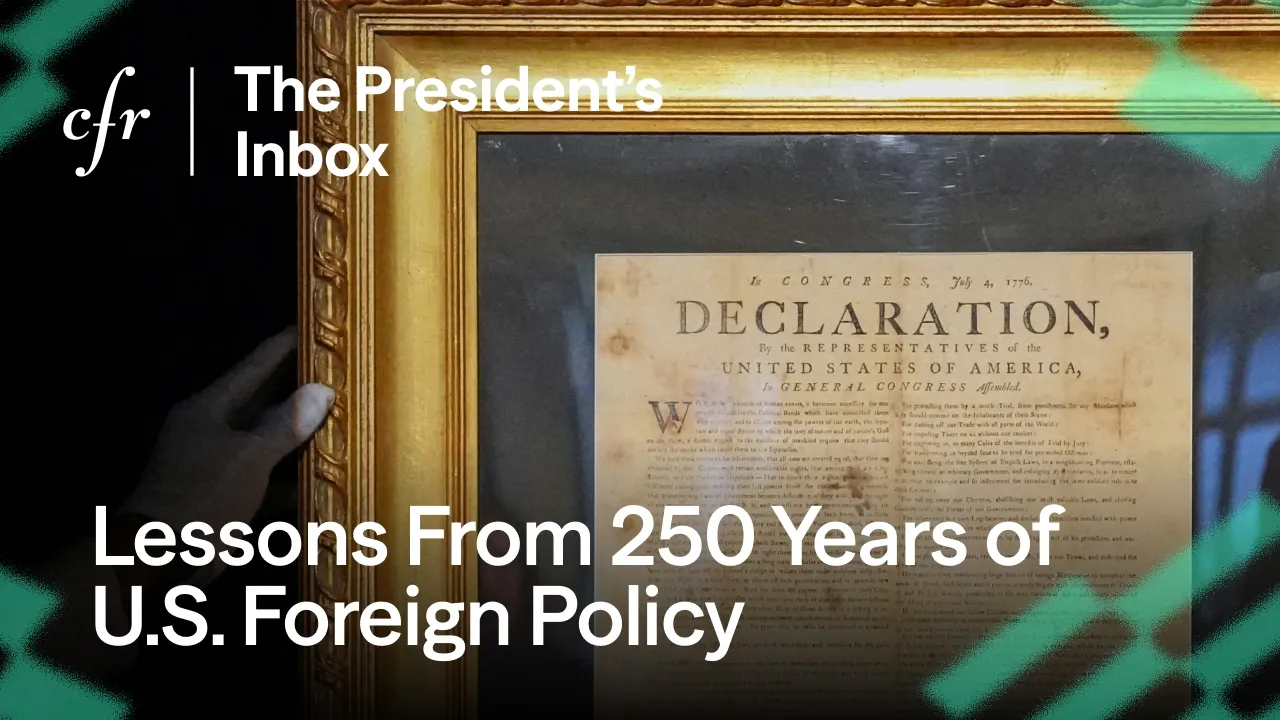
The United States is celebrating the 250th anniversary of the Declaration of Independence this year. The revolutionary decision to break from Britain succeeded against long odds and changed world history. The fragile collection of 13 colonies clinging to the Atlantic seaboard grew to become a global superpower.
How did U.S. foreign policy change as the country grew more powerful and the world grew smaller? What, if anything, remained the same? And what lessons can we take from the past to help us understand America’s future?
From the Council on Foreign Relations, welcome to the President’s Inbox. I’m Jim Lindsay. Today I am joined by Robert Kagan, a senior fellow at the Brookings Institution.
His many publications include two great histories of U.S. foreign policy, one which is Dangerous Nation, the other which is, if I can do this adroitly, The Ghost at the Feast. Bob, thank you very much for joining me.
KAGAN:
Thank you, great to be here.
LINDSAY:
At the start of Dangerous Nation, Bob, you wrote that Americans would be better off if they understood themselves, their nation and their nation’s history. That raises two questions for me. The first of which is, why would it help Americans to better understand their own history?
KAGAN:
Because I think Americans don’t really have a clear sense of their own motivations in foreign policy, and therefore they sometimes predict badly how they’re going to respond to various external events. And so I think it would be better if Americans sort of knew themselves a little better because they find themselves sort of backing into conflicts based on things that they desire but which they’re not really aware of. And so the biggest myth that Americans have about themselves is that they’re basically sitting on this continent minding their own business until somebody comes along and does something to them and then they have to respond, which of course is really almost the opposite of what the truth is.
The United States has been expanding and acting in the world for over two centuries, and the world responds to the United States as much as the United States responds to the world.
LINDSAY:
Well, let’s talk about that, Bob, because you just anticipated my second question, which is, what is it about America’s history in the world that most Americans don’t understand? So sort of develop your point and give me sort of, I guess, basic history that we’re missing as we sort of think about America as this insular, isolated place that wishes to avoid the world.
KAGAN:
Right. I mean, you know, the sort of mythology of the sort of basic American isolationism, you know, stems from, you know, the Washington Farewell Address, which allegedly wanted the United States to remain separate from the rest of the world. You know, there’s mythology about the Puritans who were escaping Europe and wanted to be left alone, build their shining city on the hill, etc.
And all of that is just, it’s not a good rendition of what the United States has actually done. And even Washington himself, as he says in the Farewell Address, expected the United States to become a really powerful nation one day and be able to bid defiance to any nation in the world. And so we have this sort of sense of ourselves as self-contained and minding our business.
But the truth is we’ve been first in the, you know, territorially expansionist, you know, including in the pre-revolutionary period even, but definitely after the revolution, expanding across the continent, which had us interacting with all kinds of great powers and pushing them off the continent, in some cases quite violently, you know. So, again, this image, that’s why I called it the book Dangerous Nation, because I think the rest of the world did regard the United States as a dangerous nation, but Americans are generally unconscious of that reality.
LINDSAY:
So, Bob, help me understand Washington’s great rule of conduct, because, as you mentioned, sort of the received wisdom was that George Washington laid down this rule that the United States, in essence, could interact with the world but to minimize its political connections with them as much as possible, and that was taken as gospel and held up as the sort of guiding premise of American foreign policy for at least a century and a half. Was that what Washington was seeking to do, or is he really trying to respond to more immediate political and strategic concerns that he faced?
KAGAN:
Exactly. I mean, you know, leaders, even Washington, generally don’t write documents that are meant to last 200 years. They’re usually responding to what’s going on right at the moment, and the Farewell Address is an unbelievably political document which is directly aimed at political unrest in the United States at the time.
We can talk about that. But as far as his attitude toward America and its role in the world, it’s very clear that what he was saying was, at the moment, we are too weak to get into entanglements with what were at the time the two world superpowers, England on one side and France on the other. They were the superpowers of the age.
They were massive empires. The United States, as you said in your introduction, was a tiny sliver of a population clinging to the end of the North American continent and really had no capacity. And so what he basically was saying, and other founders including Hamilton reiterated the same thing, which is, you know, keep your head down.
We’re not going to get into involved with these things right now. But in and they were talking about 20 years, 30 years time, the United States would then be able to emerge as a great power. And definitely they all imagined that the United States would emerge as a great power.
So the Farewell Address was really advice at the time not to get entangled in the war, in the wars and have the United States become implicated in that when it was too weak to do so. But it was not a council for all time. He did not intend it as that.
LINDSAY:
So tell me a little bit about the practical politics of the moment that Washington faced, Bob. And I ask it because it seems to me one of the great misunderstandings of American history is that there was some time in the past where politics stopped at the water’s edge, and everyone got along and that somehow we have fallen from this Eden. So tell me a little bit about Washington and who specifically he was thinking of when he and Hamilton drafted the Farewell Address.
KAGAN:
Yes. And by the way, good point. I mean, Hamilton really was the main drafter of the Farewell Address.
And Washington sort of went along, you know, agreed to it. But this is very much Hamilton. And at the time, Hamilton and Washington were engaged in a major battle over really the complexion of the country and the future of the country with Thomas Jefferson and James Madison on the other side.
It was the Federalists versus the Republicans. And the big debate that they had about foreign policy was really more or less, should you be sort of feeling nice about the French Revolution or should you be on England’s side? And Hamilton and Washington were very much hostile to the French Revolution.
The reason that Jefferson was in favor of the French Revolution is because he was worried that Hamilton was trying to establish a monarchy in the United States and that they were going to try to model themselves after England, which to some extent was true in Hamilton’s case. And he wanted to have a more radical democracy. And so he clung to the French Revolution.
Anyway, when Washington writes his Farewell Address, they are in the middle of that fight. And Washington’s Farewell Address, if you read it for what it was intended to say, was not, we should not have alliance with anybody ever at any time. It was that we should not have an alliance with the French against the British, because that would be foolish.
And also, I’m not helping Thomas Jefferson with his effort. So it was very much a political document of the moment about the fight that was going on at the time. And just to say, this is something that has been true about American foreign policy ever since.
American foreign policy debates are always also, and in many cases primarily, debates about domestic politics and the direction of the country domestically. And that was certainly true of that first fight between the Hamiltonians and the Jeffersonians.
LINDSAY:
Yeah, I don’t recall, Bob, when I took high school history that anyone made much of the fact that George Washington had a significant falling out with Thomas Jefferson and James Madison. And some of the accusations that the so-called Republican interest headed by Jefferson and Madison made against Washington were quite scurrilous. I mean, they accused him of seeking to be a king.
And I think Washington at some point wrote that he had no interest in being a king or an emperor. He would much rather go back to Mount Vernon, intend to his fields.
KAGAN:
Yeah, yeah. No, it was a knock-down, drag-out, polarized. You know how we talk about polarization?
It was an immensely polarized time in American politics, which gives you some indication of what the norm of American politics actually is.
LINDSAY:
So why do you think it is, Bob, that Americans like to think of themselves as this insular, isolationist nation that would prefer not to get dragged into the messiness of the world, but often does against its better judgment?
KAGAN:
Well, I would say the first thing to be said is there are elements of what the United States has been certainly since the founding that naturally draw Americans out into the world. And there’s no avoiding it. Part of it is economics.
The United States was always a trading nation, even though it didn’t depend as much as other nations on trade. And nevertheless, Americans wanted to trade. And that pulled them out into the world and got them involved in the rest of the world.
And then America’s universalist values also tend to pull it out into the world and make Americans care about what’s going on, even despite themselves, in other parts of the world. And that was certainly true even in the early 19th century, when the sort of autocratic, holy alliance in Europe was trying to spread autocracy and fight the sort of revolutions of liberalism that the United States had begun. And so they saw the world in very ideological terms.
And so those two things have always tended to pull Americans out. And finally, power pulls Americans out. When you wield a lot of power, it’s very hard not to use that power to influence your environment.
Weak nations have no say over how the world works. Strong nations do have some say. So as the United States got stronger, it wanted to have more say in, I think, just a natural evolution.
So all three of those elements tend to pull the United States out. And what works against that is the fact that it’s also the case that certainly by the end of the 19th century, Americans were completely secure in the continent and were not required, really, to be involved in the world at all. So you’re constantly wrestling with this paradox that Americans, unlike other countries, don’t have to be particularly involved with the rest of the world, but all kinds of elements push Americans out.
And the result at the end is sort of a constant oscillation back and forth between periods of high intervention and global involvement, followed by periods of retrenchment and disillusionment. We saw that in the first half of the 20th century, and we’ve seen it again basically since the end of the Cold War.
LINDSAY:
Bob, I’m glad you raised the issue of American foreign policy in the first half of the 20th century, particularly in the years immediately following the Spanish-American War, where the United States engages in, I guess, what is it John Hay called, the splendid little war that gave the United States, Puerto Rico control of the Philippines and also pushed the Spanish out of Cuba. And you see sort of a growing U.S. intervention in Latin America, the Roosevelt corollary to the Monroe Doctrine. Of course, today there’s a lot of talk about sort of that doctrine being updated, but sort of help me understand Theodore Roosevelt’s geopolitical, strategic, political predicament at the beginning of the 20th century.
KAGAN:
Well, this is probably, you know, somebody, a historian once wrote an essay which maybe you’ve heard of called The Worst Chapter in American History, which is this period of American imperialism at the end of the 19th century. It’s really one of the most misunderstood periods of our widely misunderstood history, and what’s misunderstood is that, you know, the United States intervened in Cuba almost entirely for humanitarian reasons. It was, what was happening in Cuba was horrific, you can go into details, but basically Cuba lost a fifth of its population as a result of the war that it was fighting with Spain, and Americans were very emotionally involved in it and wound up intervening, and then accidentally acquiring in the process the Philippines, etc.
But the most important thing about this period was this general expansion of American internationalism, and the idea which is articulated by Roosevelt, but also by William McKinley and by Woodrow Wilson and others of that period, that basically with great power comes great responsibility, and the idea that America had become a powerful nation and there and stood for certain things in the world, and that it was in a sense to be dishonorable for the United States not to defend the principles that it claimed to stand for, and that was very much what happened in the case of Cuba and going forward. And I think the thing that was remarkable about this period, if you think about it, the United States had basically the three most internationalist presidents in their history, basically one right after another in that period.
And so Americans really were anything but isolationist at that moment, and it was of course the consequences of World War I that that led to the oscillation back, or at least or toward a kind of new isolationism in the 20s and 30s.
LINDSAY:
Before we talk about World War I and World War II, Bob, can you help me understand as you look at U.S. intervention in Latin America in the first couple decades of the 20th century, and it was significant, numerous countries sustained occupation. Was it driven by economic interest? Was it driven by strategic calculation?
As you know, there’s a whole school of historians who would argue it was all about promoting American exports and benefiting the American economy, whereas others would argue that Roosevelt found himself in a situation in which he wanted to keep European countries from going into Latin America because of mishandling of debts and loans and things like that, and so it was more defensive in nature. Sort of help me understand how you parse all that out.
KAGAN:
Well, it certainly was the latter explanation more than the former. I mean, at the end of the day, American exports to Latin America were trivial compared to the American trade with Europe, first and foremost, and then secondarily with Asia, and American government officials had to work very hard to entice American businessmen to come in, and this phrase that became popular in those days, which I think people still learn about, was dollar diplomacy, and the amusing thing about dollar diplomacy was it was not aimed actually at using American power to get dollars. It was aimed at using American dollars to get power. I mean, it was a way of trying to get money flowing into these countries so that they could maintain stability, but your point is correct.
The initial concern of Roosevelt and the reason for the Roosevelt corollary was not that Americans were dying to get involved in Latin America, because I can assure you, American presidents, including Roosevelt, were not dying to get involved other than Panama, which was a separate case, but what he worried about was something that there was worth worrying about, which is the debt problem that Europeans were engaged in collecting debts from small debtor countries using armed force to do so.
England was occupying Egypt for 20 years in this period over a debt settlement, and the British, by the way, were very clear and said to the Americans, if you could just kindly clean up this area, we wouldn’t have to be involved, and in a way that was what Roosevelt was saying, that we had an obligation, the United States had an obligation to make sure that these countries were relatively well-behaved. Yes, that was paternalistic and dominant and hegemonic and all those things, that they were reasonably well-behaved so that they would not invite the European intervention, which would then lead to crises between the United States and European powers.
The other thing that was going on, though, and I mean, this is what I would attribute to someone like Elihu Root, who was Roosevelt’s Secretary of War, but who also was heavily involved in Latin America. I hate to tell you, he really thought he wanted to help the Latin American people. He wanted the United States to be a good neighbor.
He wanted them to achieve prosperity and stability, just the way we often talk these days, and he spent a lot of his time worrying about Latin America and genuinely caring about it. Now, ultimately, he passes from the scene and we have less enlightened people involved in these policies, but it would be wrong to think of it purely as economically driven. It was very much geopolitically driven, but also politically and almost, you know, morally driven as well, as is always the case with America.
The blend of these motives was the factor, the key factor of the particular blend.
LINDSAY:
You know, what strikes me, Bob, as I read about America’s policy in Latin America in the early 20th century, is that it prefigured a lot of the challenges the United States discovered in the first decades of the 21st century. That is, the United States intervened, it thought it was going to fix things, all of a sudden it discovered that it had become enmeshed in local politics, in all the choices it made, pleased some, angered others, and at the end, in the case of, you know, Lake Monroe, as it was called, the United States, by the late 1920s, decides it wants to get up and out and you get the good neighbor policy from FDR. Is there some general lesson there for the United States that we have failed to learn?
KAGAN:
Most definitely. I mean, that has always been, there was a central paradox to American policy, particularly in Latin America, because the goal was always to stand these, this is the way they would put it, that to stand these countries up, get them all set up, ideally with democratic elections in the interest of stability, because the alternative was revolution followed by dictatorship followed by revolution. And so they really were, you know, seeking stability, but what they discovered was that the United States could go in, establish stability, get everybody holding elections, and then the minute the United States leaves, it all falls apart again, and so the United States is drawn back in again.
And so there’s this endless cycle of, you know, you can never stop being involved, you never solve the problem, and I think that is something that, yes, that did became our issue writ large. And if, you know, if you look at some of America’s most successful policies, they are, in fact, in places where the United States never left. I mean, you know, the deployment in Korea, the deployments in Japan and Germany, I mean, America never left.
And this has always been the paradox, you know, in other interventions. We go into a place like Vietnam because we want to, like, try to stabilize it so that we can get out again. We go into Iraq, Rumsfeld had his foot out the door the minute we stepped into the door, and that’s always American policy, which is different from sort of British imperialism, where they move into a place, they build clubs, and they have a whole, you know, colonial service to take care of it.
But Americans have never regarded themselves as an imperial power, so they’re always looking for, we have to get in, fix this, and then ideally get out. And it just, unfortunately, the world doesn’t work that way.
LINDSAY:
You know, Bob, it strikes me, just going back to where we began the conversation, you spoke about things Americans either never learned or forgot. It seems that particularly with the use of force, Americans are often gung-ho at the start, and then have very deep second thoughts, and it’s maybe sort of captured by the fact that we refer sometimes to the War of 1812 as Mr. Madison’s War, the Mexican-American War was Mr. Polk’s War, so on and so forth, Mr. Bush’s War, and the like. Why is it that you think Americans at the beginning are gung-ho, and then all of a sudden have second thoughts?
KAGAN:
Well, you know, it’s the two sides of the American personality to some extent, but the first side is the sort of reaction to something that is happening that Americans find horrific. So, you know, even when the United States didn’t get involved in World War I initially and were neutral, there was no question about how Americans felt about the conflict, overwhelmingly, unless you were German or Irish. But if you were not German or Irish, you generally felt that, you know, that Germany was a militaristic aggressor, and Britain and France were sort of democracies trying to hold on.
And then, you know, something like the Lusitania happens, and although the United States doesn’t go to war immediately as a result of the Lusitania, the mood it sets is one of increasingly injured honor and maybe even genuine fear of what would happen of a German military victory. A lot of this has been suppressed by our histories, but it was very much that. And so the Americans went into World War I with enormous enthusiasm.
There was opposition, there were some 50 members of Congress who voted against, but otherwise, you know, it was a raucous standing ovation and celebrations across the country. And the United States actually won that war, but the disillusionment settling in after the Versailles Agreement and the nature of the Versailles Agreement and the nature of the way the war ended, it sort of ended without a clear victory in a certain sense from the American point of view. Anyway, left a very bad taste in their mouths, and then Americans went completely in the other direction, sort of rejected any idea of involvement in the war in Europe, even though they had just sent two and a half million troops to fight in Europe.
And so then what kicks in is, wait a second, we didn’t need to do that. We weren’t really directly threatened by anything Germany was doing, and all of the fears and the sort of ideological fervor that was driving the war, including for people like Roosevelt and Lodge, is forgotten. And now all we remember is we don’t like the way the peace turned out, and our guys are still stuck in Europe, and the whole thing.
And then of course, you know, there’s a whole other dimension which we haven’t discussed of American foreign policy, which is based on what’s happening domestically, because the United States is also swinging back and forth between sort of liberal progressive periods and conservative reactionary periods, but we can work our way into that as well.
LINDSAY:
Well, explain what you mean by that, Bob.
KAGAN:
Well, it just so happened that at the same time that the United States, that the American Congress was rejecting the League of Nations and the Versailles Treaty, that the United States is also swinging into a tremendously conservative period, particularly in response to waves of immigration, which had been filling the country full of people who were not sort of Nordic white Americans, and there was a big reaction against that. But the 1920s are the closest thing we’ve, you know, we’ve ever had to sort of a real return to sort of anti-liberal, conservative, the Ku Klux Klan was running rampant in that period, very popular organization.
Eugenics was in vogue in those days. And so there was a general xenophobia and opposition to all things foreign, which feels to me very familiar with where we are right now, which was driven by political domestic issues, but then became entangled with the whole, what is America’s role in the world as well? So, you know, America’s role in the world going into the war was the defender of democracy.
America’s role coming out of the war was to stay away from the rest of the world as much as possible.
LINDSAY:
Why do you think it is, Bob, that sort of the direction American foreign policy changed so sharply after World War II? Was it because this was a case of a war in which there was a decisive victory, clearly had a clear cause, Pearl Harbor, so there was no talk about merchants of death and things like that, or was there something else that sort of drove the American reaction and the lessons it took from World War II?
KAGAN:
It was very much the lessons. And, you know, it’s interesting to look at the generation that established the post-World War II order. You know, if you think about Harry Truman and Dean Acheson and Franklin Roosevelt and, you know, Walter Lippmann, I could go on and on, Reinhold Niebuhr, et cetera, all those people shared a common experiences, which they were all, which is that they were all active politically from before World War I up through, obviously, World War II and into the early Cold War.
And they had a common generational experience, and they had looked at it from every side that you could look at it from. They had been internationalists, they’d been Wilsonians, then they were disillusioned isolationists, then became realists or communists or Marxists, et cetera, only to then have the experience of the late 1930s and ultimately Pearl Harbor. And so, yes, even before the war was over, you read what people are writing in 1942 and 1943.
Walter Lippmann wrote a book called Shield of the Republic in that period. There’s a lot of people writing about what we learned, what they learned, and what it meant going forward. And Pearl Harbor in particular had a huge psychological, but therefore, and therefore strategic impact on American thinking, because even though the United States itself had really brought on Pearl Harbor through its policies of embargoing Japan, everybody knew that could lead to war, even though the nature of the sort of deceptive surprise attack left Americans with the impression that they, and this goes back to what we were talking about earlier, that Americans are sort of unaware of their effect on others, but they sure are aware of what others have done to them.
And so Americans sort of came out of Pearl Harbor thinking, we could get hit from anywhere at any time, and therefore, we need to be out there. That was the big lesson of Pearl Harbor, is that we can’t, and the events leading up to World War II in general, we can’t sit back and wait, was the conclusion, for a Germany or a Japan to conquer their region, because then they would come after us. Now, I don’t even know if this was true, and Pearl Harbor didn’t prove that that was true, but that was definitely the American attitude.
And so you see people like Walter Lippmann saying, we have to have bases everywhere. We have to have bases in Asia. We have to have bases in Europe.
And I mean, the whole notion of America having overseas bases by itself was revolutionary. And so in a way, everything that comes after World War II is based on lessons learned in the 20 years preceding.
LINDSAY:
Do you think, Bob, we’re at a point now in the history of U.S. foreign policy that we are either forgetting or rightfully turning away from those lessons that American leaders took from World War II?
KAGAN:
Yeah, we’ve certainly forgotten them, and this happens periodically. I mean, in the years right before World War I in Europe, there hadn’t been a major war since the Franco-Prussian War of 1870-71, and there was this ingrowing sense that peace, that humankind had moved into a new phase. And this was, of course, sort of epitomized by the book by Norman Angell, The Great Illusion, which was that the illusion was that war could accomplish anything, and war had actually become obsolete.
And so long periods of peace frequently lead to the perception that peace has become the norm. And that’s what happened to us after 1989. And the whole, not to single out Francis Fukuyama, but because everybody felt this way. The whole end-of-history idea, the idea that things had fundamentally changed, that we’d moved from a period of geopolitics to geoeconomics, that the nation-state was fading away. You remember all the things that were being written in the 1990s about how the world was changing.
And so in a way, as usual, I think very normally, we had gotten used to the idea that the world that we saw around us was not the creation, and I would say artificial creation, of a particular configuration of power and a particular sequence of events as a result of World War II, but rather was a new normal in human existence. And therefore we have been very unready, as has also happened in the past, for the unfortunate and obvious reality that the struggle of international relations never stops. I mean, I’m not always a quoter of Hans Morgenthau, but I do quote him, I do approve of when he said, Americans are always waiting for the final curtain on great power politics to come down, and now we move into some stable utopian phase, and we’re never ready for the fact that, nope, now it’s just on to the next challenge.
LINDSAY:
Or as you have written, the jungle grows back.
KAGAN:
Right. And the point of that is that this has been an aberrant period, the post-World War II period. Historically, it is unlike any other period.
No country has ever played a role of the kind that the United States played, and the world has never enjoyed a particular configuration of power, which is now over, because Trump has killed it.
LINDSAY:
So, Bob, as we now mark the 250th anniversary of the Declaration of Independence, is there one point or lesson you would want Americans to reflect about on this great anniversary?
KAGAN:
Yeah, and that is that the struggle for that also never ends, that the Declaration of Independence is an aspiration. The principles of the Declaration, Lincoln understood this, that we would always be needing to improve and perfect and to struggle against natural human tendencies which work against liberal democracy. And we’re seeing those now emerging here in the United States, but also around the world.
Tribalism is more basic and more human than the idea of equal rights and equal protection under the law. That is a very great artificial creation. When the founders said, we hold these truths to be self-evident, they were not proving that it was true.
They were just asserting that it was true. And it’s the most fragile thing in the world. And I think we just haven’t understood how much we needed to be protecting it, not just internationally, but also at home.
LINDSAY:
On that note, I’ll close up this episode of The President’s Inbox. My guest has been Robert Kagan, Senior Fellow at the Brookings Institution and the author of Dangerous Nation and The Ghost at the Feast, among many other books. Bob, as always, a delight to chat.
KAGAN:
Thank you. I enjoyed it.
LINDSAY:
Today’s episode was produced by Justin Schuster with Head of Production Jeremy Sherlick, Senior Video Producer Grace Raver, and Director of Podcasting Gabrielle Sierra.
This transcript was generated using AI and may contain errors.
We Discuss:
- Why Robert Kagan argues that Americans misunderstand their own history and have long been a “dangerous nation” rather than an insular one.
- How American foreign policy debates have always been entangled with domestic politics, and what the polarized fights of the founding era reveal about the true norm of American political life.
- Which forces have consistently pulled the United States outward, producing an oscillation between intervention and retrenchment.
- Why the era of American imperialism following the Spanish-American War, including the humanitarian motives behind U.S. intervention in Cuba, is among the most misunderstood chapters of U.S. history.
- Why Americans tend to enter wars with enthusiasm only to sour on them afterward.
- Whether the United States is forgetting the lessons of the postwar order.
- What the 250th anniversary of the Declaration of Independence should teach Americans about the fragility of liberal democracy.
Mentioned on the Episode:
Robert Kagan, Dangerous Nation: America’s Place in the World From Its Earliest Days to the Dawn of the Twentieth Century, Knopf
Robert Kagan, The Ghost at the Feast: America and the Collapse of World Order, 1900–1941, Knopf
Robert Kagan, The Jungle Grows Back: America and Our Imperiled World, Knopf
Walter Lippmann, U.S. Foreign Policy: Shield of the Republic, Little, Brown
Norman Angell, The Great Illusion, G.P. Putnam’s Sons
Francis Fukuyama, The End of History and the Last Man, Free Press
James A. Field Jr., “American Imperialism: The Worst Chapter in Almost Any Book,” American Historical Review
“Declaration of Independence,” National Archives
George Washington, “Farewell Address,” 1796
Opinions expressed on The President’s Inbox are solely those of the host or guests, not of CFR, which takes no institutional positions on matters of policy.
Associate Producer, Video and Audio
- Associate Producer, Video and Audio
Head of Production
- Director of Video
Editorial Director and Producer
- Director, Podcasting
More Episodes
 33:42Podcast
 36:05Podcast
 41:07Podcast
 39:26Podcast
 35:04Podcast
 31:46Podcast