Maximum Pressure on Cuba, With Will Freeman
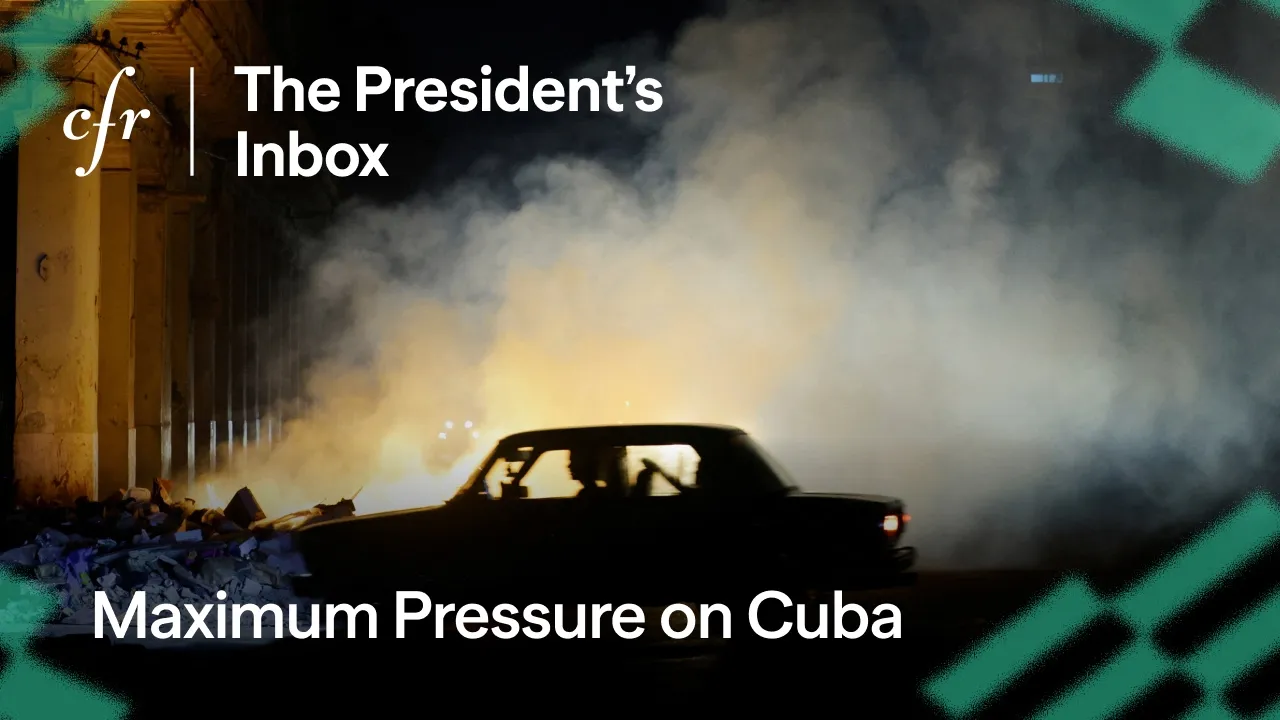
This episode unpacks how the Trump administration’s maximum pressure campaign is accelerating Cuba’s economic collapse and what a firsthand trip to the country reveals about life amidst the crisis.
Published
Host
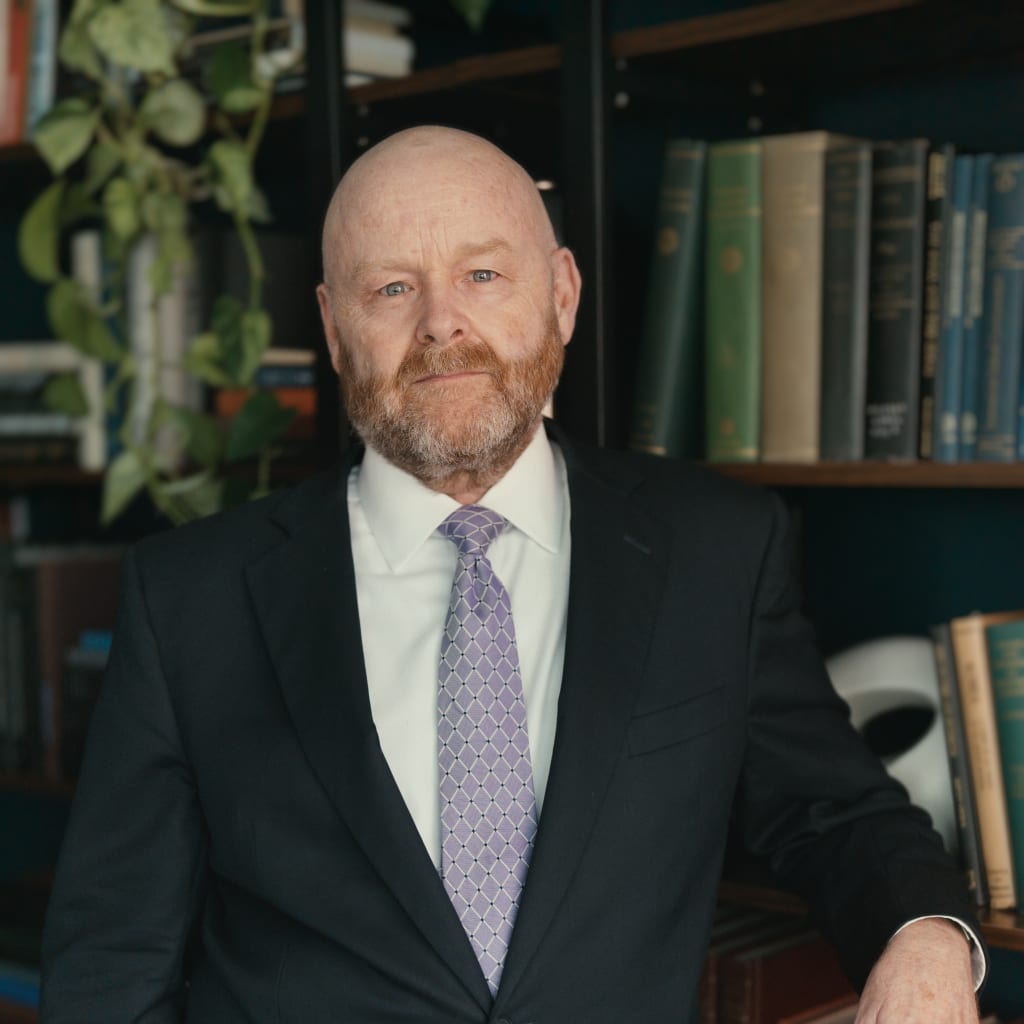 James M. LindsayCFR ExpertMary and David Boies Distinguished Senior Fellow in U.S. Foreign Policy
Guest
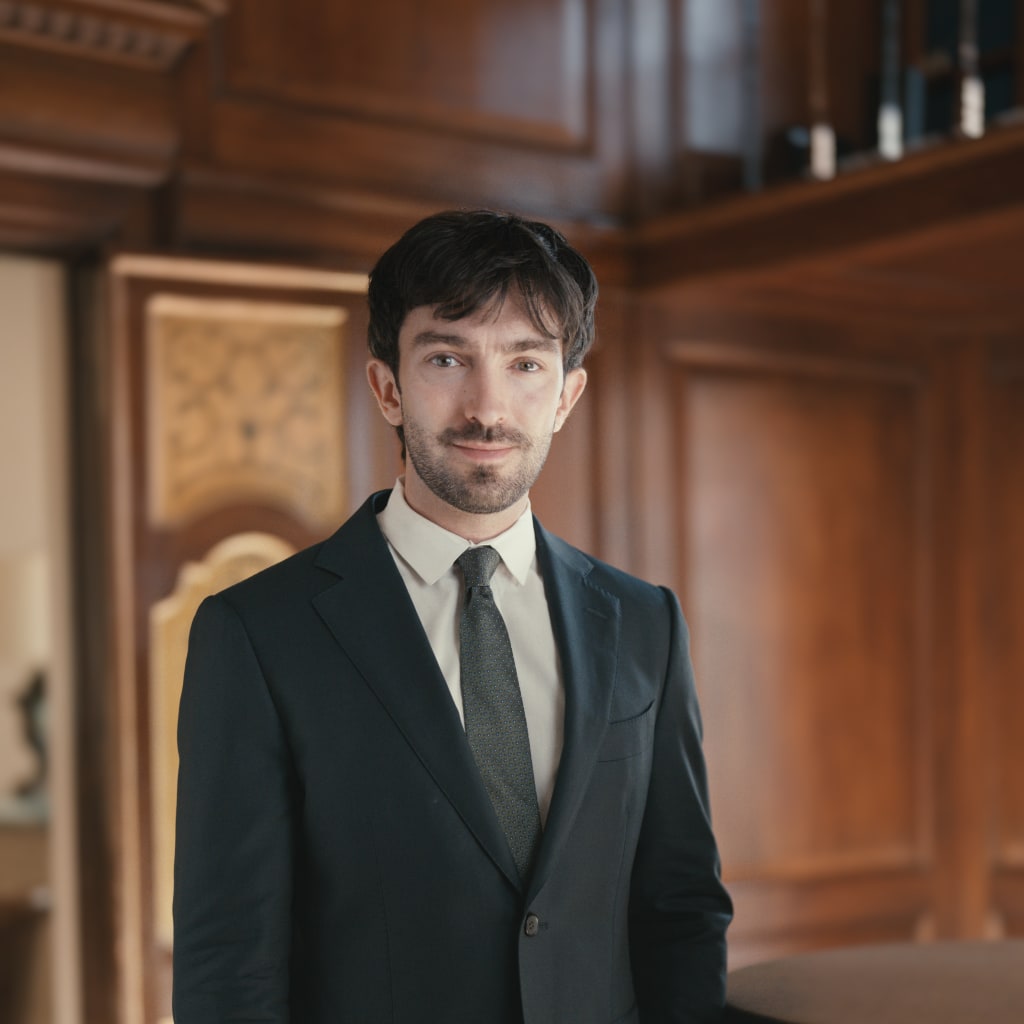 Will FreemanCFR ExpertFellow for Latin America Studies
[Video: https://youtu.be/pAol31FT498]
TRANSCRIPT
FREEMAN:
Cuba’s crisis is so much worse than any of those countries at the end of communism, right? The kind of severe hunger you’re seeing, the breakdown in electricity transmission, to the point that even if you start the fuel flowing again, you might not be able to turn on the lights. The spread of communicable disease on every dimension, or practically every dimension, Cuba is going to have to dig its way out of a deeper hole.
LINDSAY:
Cuba is in crisis. The Trump administration’s maximum pressure policy has triggered fuel shortages, electricity blackouts, and economic disarray. U.S. pressure on Cuba may go beyond economic coercion. President Donald Trump has threatened to invade the island country. U.S. officials are calling its communist government not just a threat to the Cuban people, but a national security threat to the United States.
What is the Trump administration seeking to accomplish with its policy toward Cuba? Will President Trump opt to use military force? And what might come next if the United States succeeds in changing the regime in Havana?
From the Council on Foreign Relations, welcome to the President’s Inbox. I’m Jim Lindsay. Joining me today is Will Freeman, Fellow for Latin America Studies here at the Council on Foreign Relations, who has just returned from a trip to Cuba. And Will, it’s a pleasure to have you on here as we have our last recording before we take a two-week summer break to recharge our batteries and get back at big topics.
But I’m very happy to start by talking about Cuba.
FREEMAN:
Thanks for having me on.
LINDSAY:
Well, let’s begin with the big question, Will. What is the Trump administration seeking to accomplish with its economic pressure on Cuba?
FREEMAN:
I think from a number of different figures in the Trump administration, it’s fairly clear they’re seeking regime change, as the United States has been seeking in Cuba for over six decades now. But the methods that they’re applying are somewhat different. On top of the broad trade embargo that’s already existed for many decades, they’ve applied secondary sanctions meant to push out, which have been successful, by the way, at pushing out.
LINDSAY:
Okay, so what are secondary sanctions? If I could stop you right there.
FREEMAN:
Those are sanctions on companies and entities that are investing in Cuba that are not U.S. owned, right? But it’s saying if you go and invest in Cuba and if you partner with the state there on anything, it’s going to be a lot harder for you, maybe impossible to enter the U.S. You could even face a court case here. So they’re seeking the same old goal of regime change, but they’re applying a heck of a lot more pressure.
There’s also the fuel blockade, which has been in place since February. That started with a cutoff of Venezuelan fuel that was being shipped to Cuba. Mexican fuel was cut off next.
And at this point, because of those same secondary sanctions, there’s essentially no country that wants to send Cuba fuel. And at the same time, the Cuban government barely has any money to pay for it. So you’re just seeing, you know, this is maximum, maximum pressure.
And now with the threats of invasion, you just mentioned.
LINDSAY:
Well, I mentioned you were just in Cuba. So give me a sense of what you’re seeing or what you saw on the ground.
FREEMAN:
It was unbelievable to me. Of course, I’d read a lot about Cuba, but studied it over the years. I thought I had a concept of the humanitarian crisis and need there.
But I couldn’t even imagine it before I was actually there on the ground. We’re talking about visible borderline starvation level conditions, especially among the elderly. You go into a poor neighborhood of Havana, which is almost all of them, say 90%.
And you can see the elderly visibly wasting away. We’re talking about now in Havana, which was historically sheltered from the blackouts that hit the rest of the island starting years ago. You have in most neighborhoods an hour or two of electricity every 20, every 40.
So people are living in almost entire darkness. Instead of streetlights, people are carrying flashlights if they have them at night to light their way. You have gaping holes in the roads in central Havana where people have tunneled in to rip out public water pipeline and divert that into private water sales on the black market.
So it’s really, it’s a country coming apart in a way that I think is, you know, we know that in the 1990s, when Soviet support fell away, Cuba had a very hard time. There was an economic depression. That’s certainly true.
But everyone I spoke to said this is different.
LINDSAY:
Now, were you able to get outside of Havana or were you just in the city itself?
FREEMAN:
So I was. And that’s interesting because you’d think, OK, there’s essentially a fuel blockade. Like how in the world did you do that?
Well, the Trump administration created certain exceptions where some medium sized private companies, which are relatively new in Cuba, they can import fuel and distribute it not through the normal gas stations, which the state owns, but through their own channels. So the fuel is very expensive. But if you have money, you can buy it and you can go places.
That means that essentially the roads are dead silent, they’re empty day and night. But there happens to be a few cars. I don’t know how people have the money, but they’re going around.
They’re able to travel. So through that method, essentially, I was able to get to a couple cities east of Havana, a couple hours east into a more rural area. One is Matanzas, the other is Cárdenas.
And, you know, you see places that have lived with the blackouts for much longer, where you have substantially higher crime, it seems, which we get into first for a number of reasons. But some areas where a violent crime is really taking off in a way that the Cubans had never seen before. And we also had a lot of people coming out to protest three years ago during those historic July 11th, 2021.
I was a little more than three years, but July 11, 2021 protests. And so, you know, it’s somewhat a different reality, I would say. In some ways, these places have it worse than Havana.
They’re visibly depopulated. They were, you know, two cities where many people left during the last five years, this massive wave of out migration. But in other ways, they’re living the exact same challenges as Havana and the rest of the country.
LINDSAY:
And so what did you hear from the Cubans you met? Do they blame the government? Do they blame the United States?
Is it just resignation? What’s the mood?
FREEMAN:
The mood is total exhaustion. So just to put this in perspective, because people don’t have power, they can’t, if they have a fan, they can’t use it. They certainly don’t have AC.
It’s boiling hot in Cuba and high humidity. So people aren’t sleeping, right? Most people aren’t eating.
They’re maybe eating once or twice a day. And they’re spending virtually all their time trying just to figure out just how to survive, right? So the mood is exhaustion and frustration.
When you dig a little deeper into the politics of it. Well, first, I was surprised people will discuss politics now. And not everyone told me as a change in the last six months to a year, they’re willing to stand out on a on a public street corner within earshot of their neighbors and say this government has been a failure that didn’t exist before.
It’s interesting that they’re now willing to do so. And when I asked people, why are you willing to take this risk and stand your talking to me like this? They say it’s so obvious, no one can deny this anymore.
Right? Now, I think there’s a long way to go from that to protest. When I asked people about that, would you go out and demonstrate, you know, the mood quickly shifted.
And people said, look, no, they’re still the security services are still capable of locating anyone who organizes a protest, they’ll find you, they’ll put you in jail for several years. So, um, so they, you know, you reach a certain obstacle there. But in terms of blame, virtually to a person, and I talked to a few dozen people over over my week there, no one blames the Trump administration, largely or exclusively, literally no one.
I mean, you have older people who supported Fidel Castro, and who consider themselves Fidelistas, even they blame the government, they say the government has squandered and destroyed what was good in the revolution. And young people blame the government 100% of the way. So, you know, I even encountered people who I’d say, do you think since the fuel blockade in February, you know, life has gotten harder here?
And they’d say, what are you talking about? We don’t believe that there’s been a fuel blockade, that’s propaganda by the regime. Right?
So I mean, this was it was stunning to me that people actually had gotten to the point of not believing that certain US sanctions were in place, because their own government has told them this line, again, and again, and again, that the sanctions are the reason for your misery, right? So even if that is causing some of the misery, and I happen to think it is, people have been fed that so many times that they’re just at the point of thinking everything is a government manipulation and a lie.
LINDSAY:
So where do you think this public anger is going to go? Well, you’re talking about people living under hellacious conditions. Among other things, the electrical grid has collapsed, I think, three times so far this month.
If you don’t have electricity, you can’t have things like refrigerated goods, water pumps don’t work. I mean, we can sort of multiply the list. Yet I don’t get the sense from what you’ve said, and from what I’ve read, that the Cuban people are ready to rise up and demand a change in government, in good part, because the security services from their point of view, will still carry out the government’s bidding.
FREEMAN:
Right. And I think those protests of July 11, from several years ago, I mean, they sent a really powerful example, you had over 1000 people put in prison after that for their participation. I went into several neighborhoods where some had only recently gotten out.
So there’s this sense that even if you rise up massively, as people did in July 2021, we already know the end of that story. And you know, I mean, a lot of countries have been in this position, and everyone thinks the system is going to last forever. And then suddenly, something snaps, I think of Eastern Europe in the late 1980s, early 1990s, I think of a Romania, for instance, where it was also thought that civil society was just destroyed, right?
And there was no one to organize mass protests. And then all of a sudden, it happened. But yeah, most Cubans themselves do not believe that, that there’s going to be an uprising from below.
LINDSAY:
So where do you think the politics of Cuba is going to go? If the people aren’t likely to rise up and demand change in the government, or demand a new government? Is Cuba just going to limp through this crisis, even as the economy comes apart at the seams?
FREEMAN:
Well, you know, I think we’re actually seeing the leaders in government take the lead here. They just passed in June 176 measures. And you know, you might be thinking, okay, this is a one-party communist system.
They’re probably passing measures every day. What is more writing on a page mean? But in this case, there were really significant steps towards liberalizing the economy, ending price controls, allowing private ownership of land and plenty of other assets, allowing much greater business activity, both domestic and foreign.
So it seems that whether or not they have the capacity to implement it, the Cuban leadership in place today is trying to shift to some kind of model that might look more like China or Vietnam, a state capitalism that they can control and where they can be the winners. Cubans also believe this is happening. They don’t think this is all a bluff.
Most people I talked to said they think this is real. It’s a real attempt to install a kind of Cuban capitalism and turn essentially the bureaucrats into the oligarchs. So I think we’re going to have to see if that’s what happens next.
That’s my guess, that if anything fundamental changes, it’s going to be in that direction, which comes with a whole host of other problems and dynamics. But potentially, we see the regime take things in that direction.
LINDSAY:
Well, how would that work? Well, because I don’t get a sense that the Trump administration is looking for its economic pressure to lead Havana to open up markets a little bit more than they were. As you said, they’re not interested in changing the regime’s behavior.
They’re interested in changing the regime. So what’s going to give?
FREEMAN:
Well, I think that, you know, what I heard, and of course, I can’t, it’s not as if I can back this up with, you know, firsthand sourcing, but that the Cuban officials are waiting for November. They’re waiting for the midterms. They’re basically making a play this very long term, as they often do, and saying essentially, we’ll open the economy this much.
We’re not changing the politics. Once you realize that for practical and political purposes, you can’t invade us, you can’t do a wholesale occupation and de-Baathification of the Cuban state. Now, once you’ve accepted that, you’re going to have to work with us on our terms.
And, you know, maybe you can get some investment in there too. Maybe it’ll be a win-win. So I think that’s the kind of bet that the Cuban government side is placing.
And we’ll have to see if the Trump administration takes it. I mean, there’s a lot of speculation in Cuba. Maybe Trump would take that deal and Rubio wouldn’t.
So what happens then?
LINDSAY:
Well, let me ask you about that, because that seems to be the big question. Do you think that calculation by government officials in Cuba is the right one? Do you think that President Trump is just bluffing when he talks about how he might be willing to use force to change the regime in Cuba?
FREEMAN:
I don’t think we can conclude that he’s bluffing. I don’t think that the Cuban officials think that he’s bluffing either, by the way. After Venezuela, you know, I think we all know there could be some kind of surgical strike or some kind of rendition.
That’s possible. Now, I do think a wholesale Iraq or Afghanistan-style invasion is extremely unlikely and would face pushback from within the Republican Party. It would be very unpopular with the U.S. public. So I don’t think we’re going to see that. But some amount of military force? Certainly possible.
And, you know, just the other day in an interview, President Trump said, Cuba, we’re going to see big changes in the next two months. That was the first time that I remember him putting such a specific time frame on all this.
LINDSAY:
Right. I’ll note that the president also said it probably wouldn’t be like Venezuela. So that left me wondering what it’s going to be.
Obviously, I think an Iraq-style invasion isn’t in the cards, particularly because the United States is in some sense pinned down in Iran with Operation Epic Fury. But I also get a sense that the administration is really looking for ways to turn the pressure up on the regime in Havana. There’s been seemingly a full court press to talk about how Havana, Cuba poses a national security threat to the United States.
Do you see any sort of middle ground in terms of the use of military force? You mentioned a rendition. I’m not sure who they would actually target and take away.
FREEMAN:
That’s the thing, because Díaz-Canel, the president of Cuba, does not occupy an analogous place to Maduro in that regime. Nor do you have, as many people have said, a Delcy Rodriguez, right? You know, in Venezuela, excuse me, you had genuinely discrete power centers, one of which was Delcy and her brother.
And some even speculate that they were working secretly with the United States, preparing this ouster of Maduro in a sort of behind-the-scenes palace coup. I think that’s just very unlikely to imagine that something like that is happening in Cuba. As far as I’m aware, it’s a better-structured counterintelligence operation.
The armed forces in Cuba are actually divided in three, and they all mutually keep tabs on one another. And you have the Ministry of the Interior doing the same across the state. So I don’t see there being a sort of Venezuela-like play in the cards, and maybe that’s what President Trump is acknowledging there.
LINDSAY:
What about arguments that what the Trump administration is trying to do in the near term is to put pressure on Havana to essentially cut links or ties with the Russians and with the Chinese? Again, intelligence officials, White House officials have said repeatedly that Cuba is being used as a base to spy against the United States. Talk about how Cuba has acquired drones from Iran, which seems to be a reasonable expectation.
Do you see the administration being willing to settle for a change in Cuba’s foreign policy, if not a change in its domestic policy?
FREEMAN:
That’s a good question. I don’t think that the foreign policy or the geopolitical considerations are really what’s primarily driving this. Cuba’s just not that important to Russia or China.
And look, it’s obvious because they haven’t been willing to step up and rescue Cuba for the last many years. Cuba is in debt to virtually everyone. Other communist countries, China, Vietnam, they’ve told them again and again, open up your markets, do a reform like we did, and Cuba’s kicked that can down the road so many times.
So I think that everyone’s at the end of their rope with Cuba. And I don’t think that it’s not like the days of the Cuban Missile Crisis, when it was really a vital staging ground for the United States adversaries. I don’t think the Trump administration, by the same token, would be happy with just that, with a change in the foreign policy.
I think that they’re looking for much expanded investment opportunities and or some move towards political change.
LINDSAY:
So Will, I understand that Havana’s calculation may be that it can satisfy the Trump administration by offering opportunities to invest in hotel properties or export more goods to Cuba. But that doesn’t seem to me that it’s going to answer the mail for the administration, certainly not for Secretary of State Marco Rubio, who has made his career on opposition to the communist government in Cuba. So how do you see this playing out?
FREEMAN:
I think a few things could be possible. So one is, I was hearing this a lot in Cuba myself, that just this frustration from especially the private sector, why can’t the Trump administration say X amount is enough of concessions, right? And then the, presumably if they were really willing to, the government in Cuba could make those concessions and you’d have the beginning of the lifting of sanctions and some more economic movement.
So you’re right, that does not seem to be happening. Why? I mean, it could be that this Marco Rubio has decided that the strategy here is, you know, first really pry open the economy as much as possible, flood in US investment, and then use that as leverage in the long term.
He’s made some comments to that effect, so that maybe he really actually just has changed his view here. And this is, you know, a very long strategy that he’s pursuing. And the other, I think, is that the Trump administration hasn’t decided exactly what they’re doing.
They’re saying, you know, jump and expecting the Cubans to ask how high, but Cuba is not quite Venezuela again. So they’re not asking that question. They’re essentially saying, we’ll go exactly this far and no further for now.
And you’re sort of in a stalemate.
LINDSAY:
Well, help me understand the role played by this military consortium. I’m not sure the exact letters, GAESA, I’m not really sure. GAESA.
GAESA. So help me understand its role in all of this, because it seems to be an incredibly powerful economic actor in Cuba. And I can’t really tell whether the Communist Party actually controls it or not.
FREEMAN:
So the, and that’s important because it gets us to the way this regime is structured, right? I said earlier, there’s not discrete competing factions around personalities or families that you can really identify as in Venezuela, but there are different parts of the state, right? So there’s the Communist Party, there’s the bureaucracy, there’s the military.
And then GAESA, some people consider its own part of the state, although it’s very much tied to, and in some sense, controlled by certain generals. So GAESA is a conglomerate, a business conglomerate that runs the most lucrative parts of the Cuban economy. Some put it at a third of the Cuban economy.
This is hotels, often until recently with foreign partnerships. It’s in some ways resource extraction. It’s a lot of infrastructure.
So GAESA, and this was all just in the past 20 or 30 years, essentially, that it became this kind of juggernaut. And it’s at the heart of a lot of the debates on what happens next. I mean, many people argue to have any kind of meaningful liberalization and reform of the Cuban economy, you need to break up GAESA, maybe allow it to keep some parts of the economy, but not extremely critical ones.
You certainly need to reduce its power. But if you imagine yourself being a Cuban general, you’d ask, well, why would I concede to that, right? So it’s a huge stumbling block in any kind of path towards reform in Cuba.
LINDSAY:
So who actually controls GAESA? That’s what I don’t understand.
FREEMAN:
We know, for instance, the name of the director, but in terms of which exact generals are positioned in different parts of its structure, who ultimately benefits, where the money ends up, we can only speculate. The Miami Herald has published on this, but others have pushed back disputing that they’re citing anonymous sources on the destination of the billions of dollars GAESA allegedly has that it sends abroad into tax havens. It’s one of the biggest questions, but it’s one, honestly, I don’t think anyone fully understands who isn’t part of the structure.
LINDSAY:
Do we get a sense as to whether or not the Trump administration’s policy of turning up economic pressure on Cuba is targeting GAESA?
FREEMAN:
I’d say it’s indisputable that it is targeting it, at least indirectly. I mean, well, you’ve had direct sanctions on GAESA and certain members attached to it, but you’ve also had these secondary sanctions that have driven out hotel companies, for instance, European hotel companies, which had some business activities with the conglomerate. So it’s from both sides, and I think it must be weakened by what’s happening.
I mean, you can’t have a wholesale economic collapse in a country and have a business conglomerate not suffering.
LINDSAY:
One of the things that happens in countries that succeed in overthrowing regimes is that an anti-government leader emerges. But I’m sort of struck by the fact that we don’t seem to have voices in Cuba who are leading the anti-government charge. Partly that’s because, as you pointed out, how effective Cuban security services are.
Anyone who emerges as a threat gets thrown into jail. At the same time, I think it’s probably very difficult, if there’s no electricity, to use the modern means of organizing protests, social media, and the rest. So what is happening in Cuba in terms of an opposition?
FREEMAN:
There isn’t one. The dissidents, there are a number that are still on the island. One just flew to the United States a few days ago, a famous artist.
But for the most part, the dissidents are very marginal. They’re brave, and in some cases respected, but they’re not considered political rivals of the system by most people. I think that’s just the effect of living under over 67 years of one-party rule.
I mean, you had something similar in a number of countries that spent that long under authoritarianism. I guess in the former Soviet Union and Russia, you had some intellectuals and artists, but there wasn’t necessarily a mass political party like María Corina Machado’s movement in Venezuela waiting in the wings. So I think it’s much harder to exit, to build an opposition under true one-party rule than under some kind of competitive authoritarianism like you’ve seen in Venezuela or Mexico in the 20th century.
I mean, those systems do provide some avenues for people to establish reputations and organize in a way that just Cuba does not. You’ve also had mass migration. 10 to 20 percent of the population has left in the last five years.
So you can imagine that.
LINDSAY:
Yeah, that is remarkable. I read something that something like 10 percent of the population sought to emigrate to Spain alone. So I mean, that’s a stunning number to see.
But that actually raises the question of what is happening with the Cuban diaspora. Do we see any coherent organization developing on that front? Because obviously, we have a very large Cuban-American community here in the United States.
But I’m just wondering, for Cubans living whether in Latin America or in Europe, whether we see any sort of bridge-building political coalition development happening.
FREEMAN:
Political organization as such, I’m not aware of. I mean, there’s polling, for instance, in South Florida, which shows that these new arrivals are as or more hardline in some cases than even the older Cuban-American exiles. But in terms of kind of a shadow government or something like that, we don’t see it.
LINDSAY:
And is no one sort of emerging in the diaspora as sort of the go-to person who can speak on behalf of a lot of Cubans?
FREEMAN:
No. And I mean, I think that speaks to the disconnect between Cubans who’ve left and Cubans who remain on the island. And a number of Cubans told me that themselves on the ground.
No, if you’re not in Cuba, you don’t know Cuba. You don’t understand Cuba. And I think there’s a sense of a gulf too, where I’m not sure that Cubans on the island would be willing to accept a would-be opposition leader who spent years or even decades in exile or abroad.
LINDSAY:
And why is that?
FREEMAN:
I think there’s just some sense that the difference in conditions is so great, right? That they’ve been there living through this humanitarian crisis. By the way, you now have a real division between people who’ve left or at least have family abroad and those who are so poor that none of their family has been able to migrate.
So if you’ve had family that’s gone abroad in the last five years, you’re now probably getting a stream of remittances in foreign currency. You might be opening one of the new legally recognized micro or small businesses that are popping up on every street corner in Havana. Those are the well-stocked stores with exorbitant prices, right?
But that are keeping people clothed, fed, where you can at least buy something unlike the state stores. So that’s one world. And the other world is no one in your family tree has been able to migrate.
So you have no access to foreign currency, right? And you’re almost an underclass.
LINDSAY:
And so I think that’s- So sort of like the have and have nots.
FREEMAN:
And it was remarkably apparent when I was there. I mean, in the neighborhood in which I was staying in Havana, there were a few restaurants that had generators, solar panels, music playing, lights on, full every night or almost full. Because some people are managing, have found niches within this economic crisis to just resell goods or to import, right?
So that world does exist, but it’s one to 5% of the population. And so I think for the majority, the question is, who represents us? And there’s not a clear answer either from inside or outside the country.
LINDSAY:
Help me think about this, Will. Imagine that the Trump administration gets its wish, and it’s been a wish for a US policy for almost all of my life, that the government in Havana is tossed out. Have people been thinking about what comes next?
FREEMAN:
There’s a number of different initiatives underway now that look more at the economic side, look more at the political side, but it’s going to be really hard to implement any of that without a state structure and without organization. So I think the chances that we see some kind of wholesale change from night to morning in terms of a total removal of the state, I mean, I don’t know where we’ve ever seen that, right? Except for under countries under complete military occupation.
So the ability to come in with a pre-designed plan and just apply it, copy and paste, I don’t think that’s going to be there. What maybe is most useful are recommendations that accept the real constraints in place today, and the possibility that you’re going to be working with a partially transformed economy, a partially transformed political system. What will you do in that case?
So I think those are the really critical questions to ask.
LINDSAY:
Yeah. I mean, I think if you look back in history, certainly after the collapse of communism in Eastern Europe, different countries had different experiences in terms of the roads they traveled in trying to build what we would recognize as a capitalist democracies, and some further along in that than others, and a lot of sort of historical antecedents probably influenced that. But I guess I’m sort of left wondering, you know, is there, do we know of certain lessons that people thinking about this issue should be focused on?
Either things to avoid, you know, maybe it’s, we learned this from Ukraine, or we learned this from the Czech Republic, or maybe it’s a positive story, we learned this from Poland, or maybe the Czech Republic. I don’t want to prejudice the tail on that score.
FREEMAN:
I don’t mean for this to sound like a cop-out, but Cuba’s crisis is so much worse than any of those countries at the mass borderline severe hunger you’re seeing, the breakdown in electricity transmission, to the point that even if you start the fuel flowing again, you might not be able to turn on the lights, the spread of communicable disease. On every dimension, or practically every dimension, Cuba is going to have to dig its way out of a deeper hole than those other transitional stories. So I’m not sure that their lessons are particularly, no, one would be that they’re, that the kind of transition to oligarchic markets, right, where the old bureaucrats now become the capitalists, is a painful one to walk.
Many people in Cuba, as I said, already believe that that’s what’s essentially primed to happen in the country. That is how they read, or that’s the meaning they find in these recent 176 reforms. That said, it was interesting to me that people said, many people said, although I’m never going to benefit from this kind of wild free market economy that could explode here, I still want it to happen, because it’s anything is better than what we have today.
So I mean, I find that interesting. I guess, could the lesson from Eastern Europe be that you want to try to, you certainly want to avoid this sort of wild west capitalism. But if you’re going to get out of this somehow, are there ways that you can constrain that path or create a kind of floor of conditions, prevent the worst of humanitarian crisis, as you accept that markets are going to be quite disruptive, and eventually get somewhere towards where the economy is more functional?
I wonder if there’s a way you can accept that some of that’s inevitable, but also try to prevent the floor from completely falling out from below the majority.
LINDSAY:
I think, well, you’re right to stress it’s important to be aware of the differences in circumstances and situations, as well as the similarities. And I would imagine one element that is going to make a post-communist Cuba a complex situation is going to be the fact that there are so many Cubans who live in exile, that are part of the diaspora, who are going to come back home. And I infer from what you said earlier, that for Cubans who stuck it out, aren’t necessarily going to be as happy that Cubans who’ve left, whether it was five years ago, 15 years ago, or 60 years ago, are going to come in and try to have a say.
FREEMAN:
I mean, there’s even the issue of the property restitution. There’s many unresolved property claims from the 1959 revolution. Well, guess what?
You walk around Havana, there are thousands of people living in these buildings. What are you going to do? If you insist on reclaiming them, where are they going to go live?
So it affects everything. One more lesson I would say, and this is actually from the neighboring countries, is if you dismantle or fire large numbers of the security apparatus, that might be liberalizing for politics, but it creates a real problem for rule of law, which is that many of those same people, I mean, what are the experts in? Espionage, coercion, violence.
They can very easily take those assets and skills and become organized crime groups. It’s what you saw all over Central America after the end of those dictatorships.
LINDSAY:
You said earlier that violence has spiked in Cuba in a way we haven’t seen before.
FREEMAN:
I was struck by this because Cuba won achievement that it could still hold on to after all these years and everything else is that the murder rate is quite low. I felt palpably it is safer than many places in Latin America. I don’t mean safe from the government, I mean safe from violent crime, even to this day.
However, when I was in Cárdenas, that small city, people told me they’re off the streets by 8 p.m. and I saw it with my own eyes. I mean, there was still sun in the sky and people completely cleared out. They told me this was something new from the last year or two, that violent robberies, assaults, that become so much more common, they didn’t feel safe going out at night.
You even heard about vigilante justice, both there and in other cases, turning deadly. I do think Cuba is at a precipice there. If you suddenly expelled a bunch of the security apparatus without any plan for what to do with them, the chance that they would actually form organized crime groups or move into that underworld is quite high.
LINDSAY:
I think you put your finger on something very important there, Will. Hopefully, as we go forward, the U.S. government is doing some planning on just these issues because the outcome could go sideways very quickly. And on that note, I’m going to close up the President’s Inbox for this week.
My guest has been Will Freeman, Fellow for Latin America Studies here at the Council on Foreign Relations. Will, thank you again for joining me.
FREEMAN:
Thanks for having me on.
LINDSAY:
Today’s episode was produced by Justin Schuster with Head of Production Jeremy Sherlick, Senior Video Producer Grace Raver, and Director of Podcasting Gabrielle Sierra. Our recording engineer was Jorge Flores. Research assistance was provided by Jack Patton. Additional assistance was provided by Jade Aulestia and Oscar Berry.
This transcript was generated using AI and may contain errors.
We Discuss:
- What the Trump administration is ultimately seeking to accomplish with its Cuba policy.
- How secondary sanctions differ from the existing trade embargo.
- What life on the ground in Cuba looks like today, with a mass economic crisis including widespread malnutrition and near-total electricity blackouts.
- Whether ordinary Cubans blame the United States or their own government for the crisis.
- Whether Cuba’s government is attempting to pivot toward a China-style state capitalist system.
- What Grupo de Administración Empresarial S.A. (GAESA) is, why it controls so much of Cuba’s economy, and who actually benefits from it.
- Whether the Trump administration’s pressure is targeting GAESA directly.
- Why a Venezuela-style external coup or regime collapse is harder to engineer in Cuba.
Mentioned on the Episode:
“Cuba’s 176 Market-Liberalization Measures,” NBC News, June 20, 2026
“July 11, 2021 Protests in Cuba,” WOLA, July 2022
“Miami Herald Investigation: GAESA’s Secret Dollar Reserves,” Miami Herald, August 6, 2025
This work represents the views solely of the host(s) and guest(s). The Council on Foreign Relations is an independent, nonpartisan membership organization, think tank, and publisher, and takes no institutional positions on matters of policy.
Associate Producer, Video and Audio
- Associate Producer, Video and Audio
Head of Production
- Director of Video
Editorial Director and Producer
- Director, Podcasting
More Episodes
 33:42Podcast
 36:05Podcast
 41:07Podcast
 39:26Podcast
 35:04Podcast
 31:46Podcast