America’s Ebola Preparedness, With Thomas Bollyky
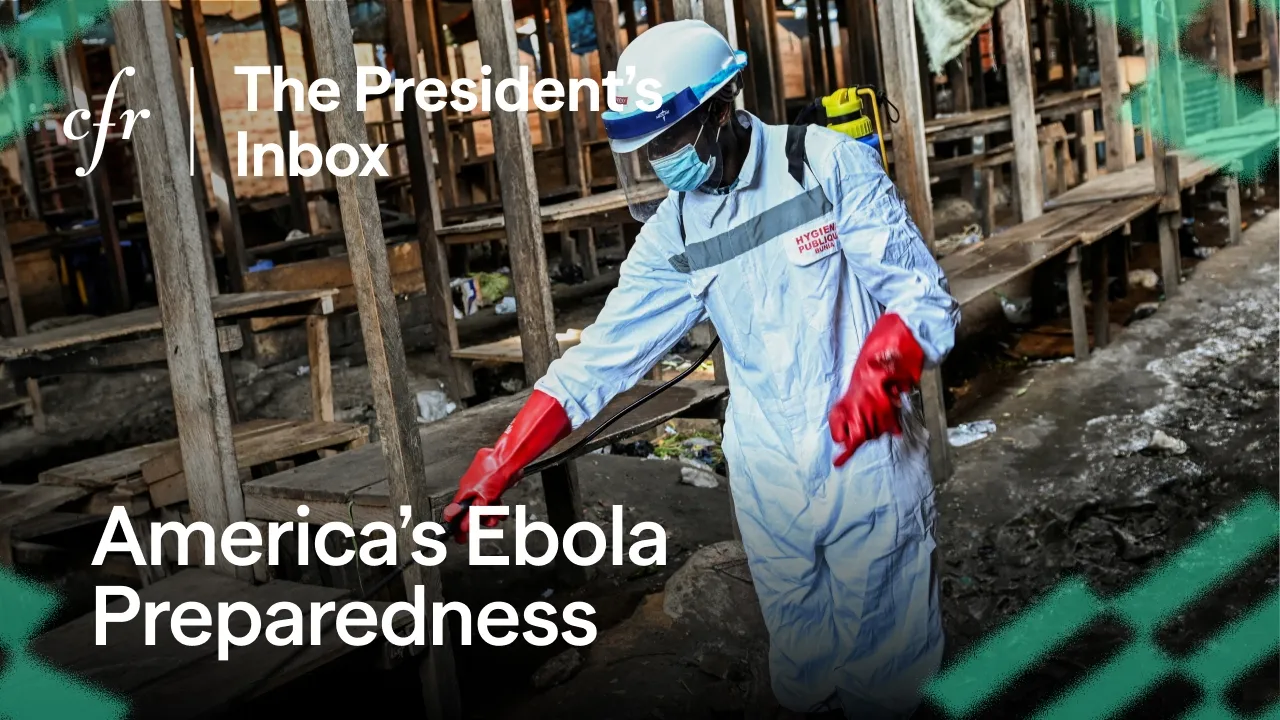
This episode unpacks how a major Ebola outbreak in Central Africa exposed critical gaps in global health surveillance and assesses U.S. preparedness for future biological threats.
Published
Host
 James M. LindsayCFR ExpertMary and David Boies Distinguished Senior Fellow in U.S. Foreign Policy
Guest
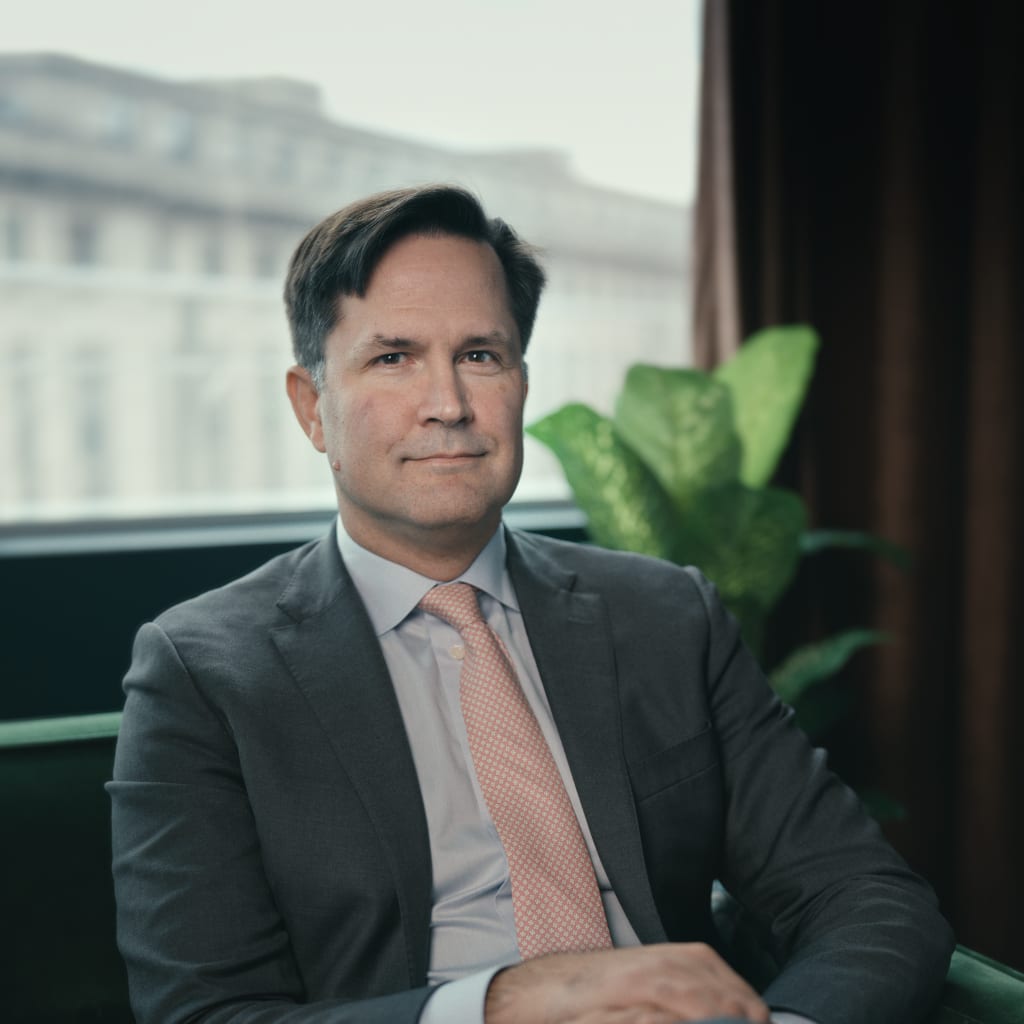 Thomas J. BollykyCFR ExpertBloomberg Chair in Global Health; Senior Fellow for International Economics, Law, and Development; and Director of the Global Health Program
[Video: https://youtu.be/PuU9Io-eU64]
TRANSCRIPT
BOLLYKY:
This really gets at an issue of why we engage in global health. Is it a matter of protecting Americans directly? Or is it a matter of mitigating the results of conflict and poverty in other settings because we can? And that’s really brought to bear in this case.
KTVU FOX 2 SAN FRANCISCO:
The World Health Organization warns the Ebola virus is spreading rapidly.
ABC NEWS:
Number of cases and fatalities surging tonight.
WION:
Nearly 500 confirmed cases now reported in the Democratic Republic of Congo and Uganda.
LINDSAY:
A major Ebola outbreak has hit Central Africa. National governments and international health organizations are scrambling to contain the lethal disease. Are these containment efforts working?
What role is the United States playing? And what does the current Ebola crisis and the recent outbreak of other infectious diseases tell us about the state of U.S. preparedness to respond to global health threats? From the Council on Foreign Relations, welcome to the President’s Inbox.
I’m Jim Lindsay. Today, I’m joined by Tom Bollyky, the Bloomberg Chair in Global Health and Director of the Global Health Program here at the Council on Foreign Relations. Tom, thank you for joining me.
BOLLYKY:
My great pleasure. Thanks for having me.
LINDSAY:
Tom, as I mentioned, we’re dealing with the outbreak of Ebola. It’s the largest outbreak in Africa in a decade. Can you just give us the current situation?
BOLLYKY:
We are at least six weeks since the first known case of this outbreak. As of June 6, we have 534 confirmed cases, 93 deaths. That’s a case fatality rate of about 17 percent, fairly typical.
For previous outbreaks, at least 17 people have recovered from the disease. Ninety-four percent of those cases are in the Democratic Republic of Congo, mostly in the Ituri province.
LINDSAY:
This is in the northeast portion of the Democratic Republic of Congo.
BOLLYKY:
That’s correct. So this is a conflict-ridden region. It started, it appears, in a mining town right near the border with Uganda.
Uganda does have, at this point, 17 cases as of yet and two reported deaths.
LINDSAY:
OK, so the virus has crossed the border there. Can you tell me a little bit about the specific strain of Ebola? As I understand it, this is not the same strain of the virus that we saw back in 2014, where we had the massive crisis in Western Africa.
BOLLYKY:
So this is the Bundibugyo species of the Ebola virus, less common. It is a species of Ebola virus for which we do not have established diagnostics, or at least not point-of-care diagnostics.
LINDSAY:
What does that mean you don’t have an established diagnostic?
BOLLYKY:
Since the West Africa Ebola outbreak, we have developed countermeasures against a number of the species of the Ebola virus that have allowed us to more quickly identify cases and to use vaccines to prevent them and to slow down the spread of outbreaks. Unfortunately, this is a less common species of the Ebola virus, and for that reason, we do not have those tools. So part of the story of why we have so many cases in this outbreak, once it was notified and when it was notified in mid-May, there are already 260 suspected cases.
That’s much larger in terms of when this outbreak was reported than previous outbreaks, and part of that story is the lack of diagnostics to be able to identify them in the field.
LINDSAY:
So help me understand, Tom, do we know where the virus emerged? Is there a patient zero we can point to and say, aha, this is where the crisis began?
BOLLYKY:
So according to the World Health Organization, our first known case of this outbreak, it dates back to April 24th. No one thinks that’s the first case in this outbreak. So the CDC has estimated that the start of this outbreak may have been as early as the first week of April.
The Red Cross says that they have two staff members that they suspect perished of Ebola in March. There are epidemiologists who suspect that this may go back as far as January.
LINDSAY:
As far as January?
BOLLYKY:
Yes, Peter Piot at the London School of Hygiene and Tropical Medicine, famously the person who first isolated the Ebola virus in 1976, he thinks it might go back as far as January.
LINDSAY:
So how can a virus sort of simmer like that and then all of a sudden erupt? What is sort of the chain of causation?
BOLLYKY:
So in this case, normally infection begins with the spread from a animal reservoir for this species of Ebola, typically fruit bats.
LINDSAY:
Okay, fruit bats.
BOLLYKY:
Fruit bats, secretion spread to a person either through a bite or there have been episodes of bushmeat consumption, hard to know in this case. But spread from an animal to a person and then it spreads through secretions to other people.
LINDSAY:
So when you say secretions, is Ebola simply a bloodborne disease or saliva excrement? Does that also convey the virus?
BOLLYKY:
All of those, typically blood or excrement. It is often referred to as a disease of compassion. Much of the way people become affected are treating sick loved ones, burying sick loved ones.
And it is really through that contact that one gets the Ebola virus.
LINDSAY:
But it’s not a respiratory disease like COVID. It is not. So it doesn’t spread as rapidly, I take it.
BOLLYKY:
It does not. And in fact, we’ve been pretty successful in particularly when the virus, should the virus come to high income settings, we’ve been pretty successful in isolating those cases and cutting transmission. We have had some success over the years in doing that in other settings as well.
But it does require a lot of work again because so much of the treatment of ill individuals in poor settings is done by family members. And you really have to work with communities to convey to people how to protect themselves. There’s also less limited, everybody knows after COVID, of personal protective equipment, but there’s limited supplies of that kind of personal protective equipment to protect people in these settings as well.
And that’s another reason in addition to the household care that people receive, the lack of personal protective equipment is another factor.
LINDSAY:
So help me understand, Tom, doctors are in the field, they start to see people dying, they suspect the symptoms, they think it might be Ebola, they do a test, they discover, yes, it is Ebola. What happens then?
BOLLYKY:
So it’s that last part that really was the gap, the test. So because there weren’t effective diagnostics in this case, really what you could do is take samples and then send them to a faraway laboratory to be assessed.
LINDSAY:
Okay, so you’re not doing this on scene or in a local hospital? You are not.
BOLLYKY:
Not yet. You can do it with other species of Ebola virus, but not this one. So that is part of the reason why there has been a delay.
To be fair, in many previous Ebola outbreaks, governments have been reluctant to report cases.
LINDSAY:
Why is that?
BOLLYKY:
Well, because typically the announcement of cases leads to a number of outcomes, none of which are advantageous to local officials. One is a lot of scrutiny in terms of how the public health emergency has been handled at a local level. It often also leads to restrictions on travel and trade, which have economic consequences in this case.
It is hard to know how much of a role that played in this instance. Again, there is reason to suspect that at least for a month, cases were circulating in that environment. We don’t know who knew and when.
Really up until the World Health Organization is told. By the local government, which occurred on May 5th. And then the World Health Organization waited 10 days before those cases could be confirmed as Ebola, before telling anyone else.
LINDSAY:
Okay, I’m going to stop you right there. Why would the WHO wait 10 days to tell anybody else? I would think that given what we saw in 2014 to 2016 with the Ebola crisis in West Africa, that once you get a report, that Ebola is existing or affecting human beings, somebody would bang the drum, hit the alarm.
BOLLYKY:
Yeah, so what they have said is they waited until the cases were confirmed. 10 days is a long time. And one of the areas where we will need scrutiny after this outbreak is what led to that 10-day delay.
And then what were the reasons for the delay prior to that in terms of when cases appeared to have been circulating before anybody knew about it?
LINDSAY:
So Tom, 10 days passes before the WHO acts. What did the WHO do when it did act?
BOLLYKY:
So the WHO then notified other governments, made a public announcement of the outbreak that it had been confirmed as Ebola. And then subsequently they’ve announced a public health emergency of international concern. Let me just stop you right there.
LINDSAY:
What exactly does that mean?
BOLLYKY:
So a public health emergency of international concern is a power under the international health regulations that empowers the director general on the advice of emergency committee to make this announcement and provide recommendations to other governments on how they should respond and to begin to coordinate the international response. So typically they provide guidance on whether other countries should use trade and travel restrictions, which they have discouraged in this case, as well as calls for resources and how countries can work together to stop an outbreak.
LINDSAY:
First question, why would the WHO discourage the use of trade or travel restrictions? Because I think for most people carrying this, the first thing we’d want to do is to quarantine the site to keep it from spreading. Great.
BOLLYKY:
So historically, travel restrictions haven’t been effective. They could be, but they haven’t. And the reason why is in many outbreaks, what countries have done with travel restrictions in the past is to declare them and then do nothing at home to prepare for the eventual arrival of cases.
This most famously occurred during COVID-19, where not just in the US, other countries as well announced travel restrictions if they were not an island nation like New Zealand, which can effectively keep cases out. Cases by the time those travel restrictions, and at least in the US case, were already here.
LINDSAY:
And we’re closing the door after the horses had fled the barn.
BOLLYKY:
The horses have already fled the barn. And what travel restrictions typically do is they give the perception of action rather than the reality. And then because of that, they tend to undermine popular support for actually doing things that would be more effective.
LINDSAY:
Okay. So the WHO doesn’t go down the trade and travel restrictions route. What did the WHO do proactively?
BOLLYKY:
So they have started coordinating with the Africa CDC, which is a body also, there are many things that will come up in this outbreak that were created as a result of the West Africa Ebola outbreak. One of them is the Africa CDC. So WHO starts working with the Africa CDC to mobilize a international response to work with local actors.
They have now recently made a call for $512 million in emergency response for supplies and logistics.
LINDSAY:
512 million from whom?
BOLLYKY:
They have not specified from whom that should come.
LINDSAY:
It’s in essence saying this is our goal and they’re asking countries to kick in funds.
BOLLYKY:
That’s what this will cost is what they’re saying. And we will need support to do that. They have an emergency fund that was meant to help provide resources in emergencies, but that fund had $5 million prior to the outbreak and was immediately expended.
LINDSAY:
So tell me a little bit about the US role and the US reaction to this because my recollection of the Ebola crisis in West Africa that began in 2014 is that the United States led the international response. I think the Obama administration spent something on the order of a billion dollars responding to the crisis and that included sending US troops to help build sort of medical infrastructure to try to contain it. Now, of course, President Trump took the United States out of the World Health Organization when he came back in office for a second term and that withdrawal became official in January of this year.
So what was the US response this time? What has it been?
BOLLYKY:
Great. So there are many fascinating dimensions of this. This Ebola outbreak in many ways lies on the fault line of the new global health post the US disruption.
Ebola is a terrible disease. We should care about it because it brings devastation to local communities. It is a terrible thing for the people infected and loved ones.
That said, this is a virus that, or an outbreak in particular, that we do not expect to put Americans at risk.
LINDSAY:
So this is not like COVID.
BOLLYKY:
So this is not like COVID. The CDC just in the last few days has released an assessment. They consider the risk of cases arriving in the US to be low and the risks of harm to Americans, even if those cases were to arrive, to also be low.
This is really gets at an issue of why we engage in global health. Is it a matter of protecting Americans directly against threats that might emerge abroad but come here? Or is it a matter of mitigating the results of conflict and poverty in other settings?
Because we can, and we have the resources, the expertise, the medical countermeasures that could make a difference. And that’s really brought to bear in this case. The administration, to their credit, once this outbreak was notified by the WHO, has responded in a timely way.
There’s been a lot of scrutiny about whether or not the effective dismantling of USAID would affect the US’s response, the firings that have occurred at the US CDC. When you look at the timelines relative to previous responses, US responses to Ebola outbreaks, once the outbreak was notified, this is as fast as really any of the other ones. The administration has announced in the last couple of days that overall they have provided $162 million in their response that they are mobilizing CDC staff in the DRC in Uganda, which I’m told by administration officials, numbers close to 100, hasn’t changed significantly.
In this administration, they maintain they have also provided $350 million through the UN Office of Coordination Humanitarian Affairs, OCHA fund, that they have relied on to move funding bilaterally. So they’re providing those pooled funds to the DRC, Uganda, and South Sudan. They’re also doing a number of things that would seem incongruous with the shift in strategy of the US global health response.
They are relying heavily on UN agencies other than the World Health Organization for this response. So they’ve relied on UNICEF to deliver personal protective equipment. They’ve relied on the International Organization of Migration to do the same.
They are working with local NGOs to help bolster diagnostic response and again, to provide protective equipment on the ground. So they are, as opposed to what had been outlined in the new US global health strategy under this administration, working more with bilateral governments and to move away from multilateral institutions and NGOs. They seem in a crisis to have embraced that.
LINDSAY:
Why do you think that is, Tom? Is it because they have yet to develop the kind of bilateral structures and procedures you would need? Or is it because multilateral are simply more effective and efficient for these sort of crises?
BOLLYKY:
Certainly the latter and a bit the former too. Ultimately, these are transnational threats. It’s not efficient to provide this type of personal protective equipment or expertise or response teams on a country by country basis.
It makes sense to be able to respond to transnational threats with multilateral and international resources. And they seem to have embraced that in this case. I think in the long run, they would like to see more domestic capacity to respond to threats.
But I think in the case of outbreaks, we’re a good ways away from that.
LINDSAY:
Tom, I want to go back to this question of the responsibility of the United States for responding. And I take the argument that has been made, not just by people in the administration, that the United States in some of these crises leans too heavily into them. People become dependent upon the United States to do something, sort of wait for Washington to take the lead.
And it would be great if other countries would learn to develop that kind of skill. That being said, there seems to be, for the United States, an incentive or a benefit from taking the lead in these things because you never know when the next crisis may come up that is going to directly affect the United States. In some sense, these other crises are a chance to, in essence, hone your skills.
Am I reading too much into that here?
BOLLYKY:
You are not. And it’s a great point. And this is really the other side of the response to this issue.
So there’s this question of, do we respond on a humanitarian basis, just on the basis of our values, to reduce terrible suffering in an area where we can is one reason to do this. The other is to shore up our system of surveillance and response to outbreaks, generally, your question. And having countries have confidence, particularly in an area known for producing zoonotic spillovers, threats, diseases that start from animals and spread to human and may spread internationally, having people have retained confidence in that system, having that system work capably, is crucially important.
So part of what is driving U.S. response, presumably in this instance, is that as well. Okay.
LINDSAY:
Let me ask you about another superpower, that is China. China obviously has a similar incentive to want to protect its own people to gain the skill for responding to infectious diseases. The United States has left WHO.
China is still part of the WHO. I think it’s fair to say the Chinese have aspirations to be leading global power. Do we see China stepping up in a significant way during this current Ebola crisis?
BOLLYKY:
We do not. And it is notable in this instance because people have been waiting for China to emerge as a global health force for a long time. They have the science, they have the manufacturing capacity, they have the interest in regions that have traditionally had global health concerns like Africa.
And famously in the West Africa epidemic of Ebola, China and the United States worked side by side in a laboratory. And many people took that as maybe a sign that China would become more involved in global health. But when you look at what China actually did in that outbreak and then what they’re doing currently, you get a better sense of what China’s real interests are in global health.
So even in the West Africa Ebola outbreak, China did not attend the meetings organized by the Ministry of Health of Liberia that coordinated the international actors in that space. Of the multi-donor trust fund that was set up for the $3.6 million that was set up for the West Africa Ebola response, China provided 1% of that while the US provided half. Many people commented that heading this last year after the disruption or dismantling of USAID that China would move into global health and they would certainly do so with the US’s withdrawal from the World Health Organization.
Well, the US’s withdrawal from the World Health Organization left a $600 million US hole in the World Health Organization’s budget leading to 20% of the staff being cut. Many people pointed to the fact that China announced that it would contribute $500 million to the World Health Organization, but that’s over five years.
LINDSAY:
So a small fraction- $500 million over five years is not going to fill a $600 million hole in one year.
BOLLYKY:
It is not. And we do now have the numbers of what China provided for development assistance for health last year and it was flat on the previous year. The previous year was the lowest amount China has provided in development assistance for health since 2010.
So they have not rushed into the space. What they have done is they have shown up in humanitarian crises where the US has also had disruption, particularly in Southeast Asia to announce support. What they have not done is filled the gap on emergency response to health outbreaks like this one or in funding the international architecture that provides countermeasures, whether it’s for pediatric vaccination or preparing for the next pandemic.
China is not showing any signs of wanting to fill that space.
LINDSAY:
So are there any other countries that are stepping up? European Union, the Gulf countries, someone else?
BOLLYKY:
So unfortunately, they are not. And the US is not the only country to have cut development assistance for health over the last year. We’ve seen a number of other countries, notably the United Kingdom, France, the Netherlands, Germany.
LINDSAY:
So the so-called usual suspects are sort of being a bit tighter with the purse strings.
BOLLYKY:
They are. In their case, what they have done is shifted more of those resources to defense, arguably because of the US cutting funds to support Ukraine. In its conflict, European nations have felt the need to spend more on defense and response.
And that has come at the expense of development assistance for health. But even in this current outbreak, leaving aside the money issue, it really does seem to be the US yet again in driving the response to, the international response, I should say. To this outbreak.
LINDSAY:
So, Tom, put this in a bigger picture for me, if you can. We have a current Ebola crisis, but recently there was a flare-up of Hantavirus, which I don’t believe is as infectious. There’s a lingering concern about avian flu and what that could do.
There are also a variety of infectious diseases that don’t infect people, but can infect animal and livestock. We’re dealing with a new world screwworm problem affecting livestock. The United States could be devastating for American ranchers.
How should the United States be thinking about the threats it faces going forward?
BOLLYKY:
So I am often asked whether or not the United States is safer for having had the experience of COVID-19. And in some ways we are. We have a infrastructure that, and this is relevant for the Ebola conversation as well, that can support the rapid development of countermeasures.
Vaccines, therapeutics, diagnostics to respond to dangerous pathogens. We are already mobilizing that infrastructure. International actors are mobilizing that infrastructure to respond to the current Ebola outbreak.
Develop new diagnostics to develop new vaccines. We have the platforms, mRNA platforms for vaccines to put those in the field quickly once we’ve developed them.
LINDSAY:
This was the technology used during Operation Warp Speed?
BOLLYKY:
The primary one, yes, absolutely. And, you know, frankly, that the ability to develop countermeasures on the timeframe we did in that case is nothing short of miraculous. Not just to develop them, but to produce them at scale within a timeframe that had never been seen before.
The fastest novel vaccine to go from identify or clinical trials rather to field had been done in four years prior to COVID. We did it in less than a year and we produced billions of doses globally.
LINDSAY:
Well, I have to ask you right there because I know a lot of people in the United States are really skeptical about the vaccines developed for dealing with COVID. I take it you dismiss that out of hand. What would be your counter argument?
Because, again, I can hear people saying we shouldn’t have rushed that fast producing a vaccine.
BOLLYKY:
Yeah, so study after study in reputable journals, we did one in The Lancet that looked at differences between how U.S. states performed in the COVID-19 pandemic. There is very strong evidence that those differences are associated with vaccination rates.
LINDSAY:
So the data backs it up.
BOLLYKY:
The data backs it up in study after study after study. But to tie back to the original point about whether we are safer, we have the tools, we have the platforms to adapt them for new threats. The fundamental challenges we had in COVID-19 around people and how we respond to crises and institutions and how they respond to crises have not been addressed.
And if anything, matters have gotten worse. So one of the concerns you see in many outbreaks that you’re seeing in Ebola is how quickly do we detect the threat? And then what are we able to do to mobilize communities to protect themselves and to mobilize the international community to provide them the resources to protect themselves?
On the detection side, it does appear we were yet again slow in this case. Institutions that perhaps should have rang the alarm earlier, whether those are local institutions or international institutions. WHO on the international side did not do so.
And the medium and long-term response, we will see. But one concern we have is that vaccinations in this case will depend on mRNA technologies that have been politicized. So what will happen?
The U.S. has shown a unwillingness to continue to support some of those platforms for political reasons. What will we do in this case?
LINDSAY:
Well, you’re also going to have a problem with people’s willingness to take vaccines. My sense is, from talking to people, there’s a fairly large second American public that won’t take them.
BOLLYKY:
Yeah, so that would be a concern and a threat that spread here is whether people will actually take the tools. And will we do the kinds of things that keep us safe until we have those tools? So there is good reason to fear in the U.S., but also elsewhere, that the willingness and appetite to do that has diminished significantly. And from that standpoint, it’s hard, despite all the tools, despite the triumph of science, really, and our ability to mobilize resources to support that science. It’s hard to make the case that we are safer, nevertheless, because of the issue we continue to have with people and institutions.
LINDSAY:
Let me ask you about another piece of technology. A lot in the news recently about artificial intelligence and the breakthrough that it is going to produce. And there’s a lot of optimism about the benefits, the positive benefits that could come from AI finding, you know, cures to existing diseases and the rest.
But there’s also a great deal of concern about the fact that that same technology can be used to create super pathogens. From your perspective, you spent a lot of time in your career worrying about these sort of issues. Help me sort of separate fact from fiction.
How worried should we be about this?
BOLLYKY:
So I think we should be worried. And as you alluded to in your question, we should also be excited. There are opportunities as well to use these tools for good.
I am more concerned currently that we will forego those opportunities than we will fail to effectively respond to the threats. And I’ll unpack that in a second. Historically, the tools, new technologies that we developed for health don’t disseminate to lower middle income countries by themselves.
They need to be facilitated to do so and to address the kinds of problems you see in those spaces. For AI, you need effective data sets, you need the ability to compute, and you need the direction towards problems that can use those resources. We really lack that currently in that space.
So it’s a little hard to see how that happens themselves. This seems to open up yet another frontier of yawning inequities to emerge in that space. On the risk side, it’s not that I think we will be more effective in mobilizing a collective response.
I just think there is actually a limited amount that we can effectively do collectively on those threats. So people look at how do we prevent the dissemination of sequencers or other things that might use information generated by AI to do new threats. That seems something feasible for physical things that move.
The idea that many have put forward that we should do guardrails and pretest AI models in the government to assess what their risk might be, I am less confident that we will have the agility in our government agencies to effectively pretest those models as they continue to iterate themselves or to monitor open source models for that. So I think we are more likely to be able to mobilize a collective response to address the dissemination of equipment that might misuse AI than we are to mobilize a collective response to assure the benefits reach global health threats.
LINDSAY:
Just one final question is we sort of ponder what it is that AI might unleash. Does it matter, as a practical point, as a matter of public policy, that an infectious disease originates naturally or comes out of genetic manipulation? Or do you, in both cases, really require a robust ability both to detect changes, the emergence of diseases, and an effective way to communicate and mobilize action?
BOLLYKY:
So this came up a lot in this question was did COVID begin with an intentional or an accidental lab theory, or was this a naturally occurring spillover? And I fall in the camp that we should assume all of them are possible. And from the prevention side, it absolutely does matter as to how it emerges, because what we do to prevent the reoccurrence of that depends on how it’s happened.
So if it’s an accidental lab leak, this is around biosafety procedures in laboratory settings and supporting the adoption of those, making it easier in low-resource settings, a difficult agenda for sure, but there are things we could do. If it’s naturally occurring, it’s about wet markets. It’s about when you talk about Ebola and those kinds of instances, it’s about bushmeat consumption.
It’s about trying to ensure we have point-of-care diagnostics for likely threats and the laboratory facilities networked so that they can be able to process those diagnoses quickly. But much of what we ultimately have to do is really about response and what we can do from the countermeasure side to generate the resources to support the development of effective countermeasures, put them in the field in an expeditious way and to convince people to take them. And it is that response that is agnostic, as you suggested, to whether it is naturally occurring, deliberate or accidental.
And it is likely that area where we have fallen behind most in the last five years.
LINDSAY:
On that note, I’ll close up the president’s inbox for this week. My guest has been Tom Bollyky, senior fellow and director of the Council’s Global Health Program. Tom, thank you very much for joining me.
BOLLYKY:
Thanks so much for having me.
LINDSAY:
Today’s episode was produced by Justin Schuster with Head of Production Jeremy Sherlick, Senior Video Producer Grace Raver, and Director of Podcasting Gabrielle Sierra. Our recording engineer was Bryan Mendives. Additional assistance was provided by Oscar Berry.
This transcript was generated using AI and may contain errors.
We Discuss:
- The current state of the Ebola outbreak in the DRC and Uganda, and why the case count was already high by the time authorities reported it.
- Why governments are often slow to report cases during outbreaks, and what delayed reporting may have cost in this instance.
- Why the WHO has discouraged trade and travel restrictions.
- How the U.S. withdrawal from the WHO is shaping a more limited response.
- Whether China is stepping in to fill the global health leadership gap left by U.S. institutional withdrawal.
- What the politicization of mRNA vaccine technology means for the U.S. ability to respond to future outbreaks that require rapid vaccine deployment.
- How artificial intelligence creates opportunities to accelerate global health responses, but also introduces new risks like engineered pathogens.
Mentioned on the Episode:
CDC Health Alert: Ebola Disease Outbreak in the DRC and Uganda, May 19, 2026
WHO Disease Outbreak News: Ebola caused by Bundibugyo Virus, DRC and Uganda, May 21, 2026
Bollyky et al., “Assessing COVID-19 pandemic policies and behaviours and their economic and educational trade-offs across US states from Jan 1, 2020, to July 31, 2022: an observational analysis,” The Lancet
Opinions expressed on The President’s Inbox are solely those of the host or guests, not of CFR, which takes no institutional positions on matters of policy.
Associate Producer, Video and Audio
- Associate Producer, Video and Audio
Head of Production
- Director of Video
Editorial Director and Producer
- Director, Podcasting
More Episodes
 33:42Podcast
 36:05Podcast
 41:07Podcast
 39:26Podcast
 35:04Podcast
 31:46Podcast