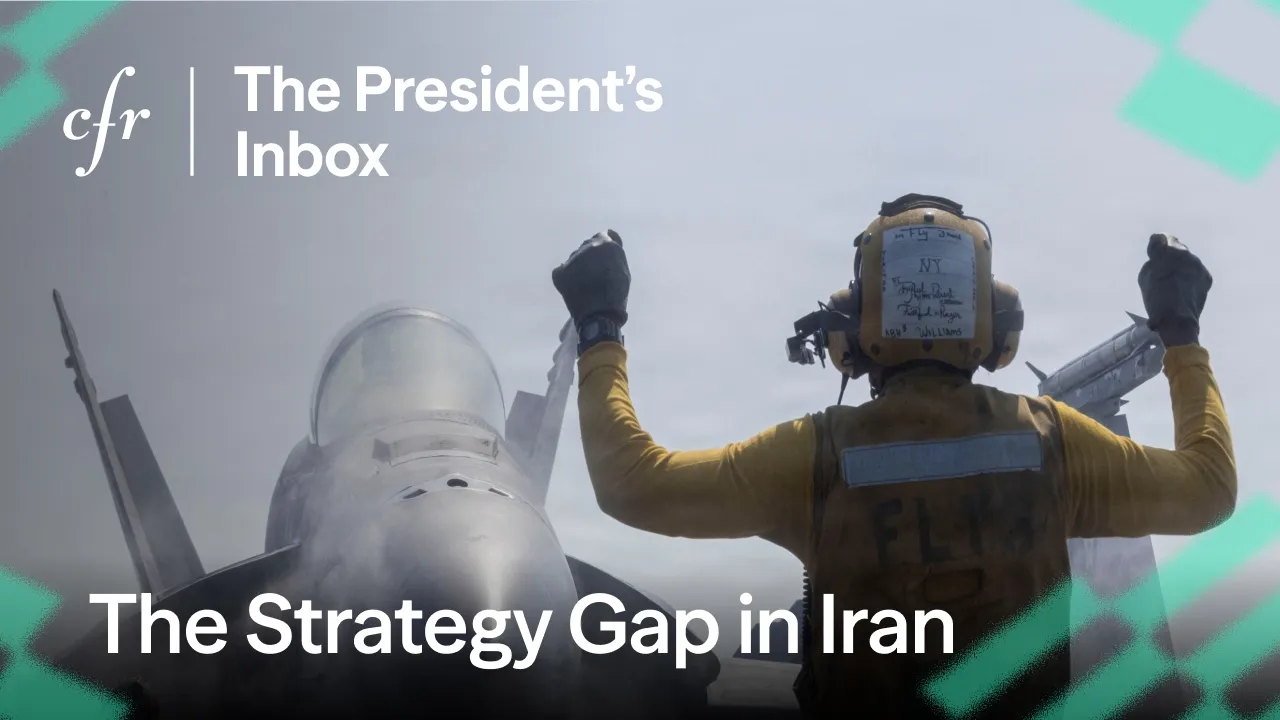
The Strategy Gap in Iran, With Max Boot
This episode unpacks the tactical and strategic lessons learned from the U.S. and Israeli military operations against Iran.
Published
Host
 James M. LindsayCFR ExpertMary and David Boies Distinguished Senior Fellow in U.S. Foreign Policy
Guest
 Max BootCFR ExpertJeane J. Kirkpatrick Senior Fellow for National Security Studies
[Video: https://youtu.be/CCM5g1ekUJA?si=OGGjDmVRY52WGZ9Y]
Transcript
BOOT:
This is a war of choice, this is not a war of necessity. There doesn’t seem to be any kind of objective metric by which you can judge the success or failure of this endeavor. This is really, I think, revealing the limits of American military power.
LINDSAY:
Operation Epic Fury is now in its third week. U.S. and Israeli airstrikes have killed senior Iranian leaders and degraded much of the country’s military infrastructure. Tehran, however, has not yielded.
Instead, it has expanded the war to hit neighboring countries. It accuses them of aiding Washington and Jerusalem. The Strait of Hormuz, through which one-fifth of the world’s oil passes, remains closed, putting the global economy in jeopardy.
Is an end to the conflict in sight? What lessons does the fighting so far offer for U.S. military strategy? And is Operation Epic Fury creating new vulnerabilities for the United States elsewhere in the world?
From the Council on Foreign Relations, welcome to The President’s Inbox. I’m Jim Lindsay. Today, I’m joined by Max Boot, Senior Fellow for National Security Studies here at the Council on Foreign Relations.
Max, thank you very much for joining me.
BOOT:
Thanks for having me.
LINDSAY:
Max, let’s jump into it. Let’s sort of begin big picture here. We’re now in week three of Operation Epic Fury.
Do we know what it is the United States is trying to accomplish with this military operation?
BOOT:
Great question to which there is no easy answer because the explanation is constantly shifting. Sometimes you hear from President Trump that he is after regime change. He talks about seeking unconditional surrender.
He also talks about inciting a revolution in the streets of Iran. But at the same time, he also has engaged in wishful thinking about finding an Iranian, Delcy Rodríguez, with whom he can make a deal. And if you listen to what the Pentagon is saying, they’re not talking about any of that.
Their focus seems to be exclusively on degrading Iran’s military capabilities so that whatever regime it has, it presents less of a threat to its neighbors. So, you know, the objective of this operation is kind of a moving target, which is why President Trump said last week that he would know in his gut when it’s over because there doesn’t seem to be any kind of objective metric by which you can judge the success or failure of this endeavor. But I think right now, given the way the war has gone, another crucial aspect of quote-unquote winning this war is reopening the Strait of Hormuz.
And it’s far from clear that we have any strategy for doing that.
LINDSAY:
Max, does it matter that the United States hasn’t articulated a clear goal in the war? I’ve been to a lot of dialogues about military strategy, and one of the messages is begin with the end in mind. Know what you’re trying to accomplish so you can right-size the mission and you can assess how things are proceeding.
But again, as you suggested, that’s not the approach that President Trump takes. Does it matter in terms of how combat is playing out?
BOOT:
I think it does matter because you have to tell the military what it is they’re trying to achieve. And it’s very hard to arrive at a destination if you don’t know what that destination is. But I think this is very much in keeping with President Trump’s kind of improvisational deal-making approach to everything.
He doesn’t set out clear boundaries. He doesn’t chart out fixed objectives. He’s always kind of in deal-making mode.
And I think from his perspective, the advantage of this is almost anything that happens, he can claim it’s a huge victory because it’s not clear what he was actually trying to achieve. But I think the way the world will look at this objectively is if Iran still retains nearly 1,000 pounds of highly enriched uranium, if Iran still has a very hostile clerical regime in power, and if Iran has shown an ability to close the Strait of Hormuz at will, none of that is going to look very much like a victory for the U.S., however hard Trump tries to spin it.
LINDSAY:
I want to come back to the big picture later in our conversation. But right now, Max, if we could, let’s drill down on the tactical aspect of this war. How would you assess what you know of U.S. military operations so far? What have they sought to do and how successful have they been?
BOOT:
As expected, I think this war has been a showcase for the effectiveness of U.S. and Israeli precision targeting technology. I mean, there is nobody in the world that is as good as the U.S. Armed Forces at putting warheads on foreheads, as they like to say in the Pentagon. Of course, this war began with an Israeli airstrike that killed Ayatollah Khamenei, the Supreme Leader of Iran, and a bunch of other Iranian leaders.
Then, of course, it’s followed up with weeks of bombing on Friday. I think Pete Hegseth said that they had hit over 15,000 targets between the U.S. and Israel, heavily degrading the Iranian military forces, their naval forces, their security forces, their ballistic missile forces, now going after missile production sites. So from a very purely narrow tactical military perspective, I think the war has been very successful.
I think the difficulty lies in trying to translate those very narrow tactical military gains into some kind of larger strategic outcome. It’s far from clear that the administration has any roadmap for how to get from here to there.
LINDSAY:
Max, as we talk about U.S. airstrikes and Israeli airstrikes, do we have a sense of how the two countries have divvied up operations? Are they hitting the same targets? Have they carved out essentially exclusive targets that you do one thing, we’ll do another, whether because of particular expertise or interest?
BOOT:
It’s not clear to me. I don’t think they’ve been very transparent about the division of responsibility, although it does seem like the Israelis have focused more on regime leadership targets. Note that it was an Israeli airstrike that took out Ayatollah Khamenei, not a U.S. airstrike, whereas the U.S. seems to be more narrowly focused on Iranian military capabilities. It seems like the Israelis are targeting more the political leadership and perhaps the security forces. It’s hard to generalize, it’s hard to know what’s really going on in the conversations between Netanyahu and Trump and between the Israeli generals and the American generals, but it does seem like the Israelis are more focused on regime change, whereas the U.S. military is more focused on degrading the military capabilities of the existing regime.
LINDSAY:
How would you assess the Iranian response, Max? They clearly haven’t limited themselves to attacking U.S. and Israeli targets. They’ve essentially expanded horizontally.
I believe it’s now nine countries that have been hit with either Iranian ballistic missiles or drones. So what are the Iranians trying to do by expanding the war in that way?
BOOT:
Well, the Iranians know that they’re much too weak militarily to go toe-to-toe with the United States or Israel. And so instead of engaging in a conventional military battle, what they’re trying to do is to expand the battlefield in order to inflict pain on the U.S. and its regional allies and to increase the cost economically from waging this conflict. And I think they’ve been pretty successful in achieving those objectives, despite all of the Pentagon claims about how they managed to decrease Iranian missile and drone launches.
That’s true. But Iran is still able to launch drones and missiles, and it’s still wreaking havoc in the Gulf and particularly in the Strait of Hormuz, where they basically managed to close it to traffic that they don’t approve of. They’re able to get their own oil out, get oil to China, but everybody else has basically been blockaded.
And it doesn’t take much to do that because it’s such a narrow waterway. So very few drones, very few missiles are wreaking havoc. And you’re seeing the price of oil skyrocket, flirting with $100 a barrel this weekend.
You’re seeing major uncertainty in the U.S. stock market. So I think the Iranians are making their point that they’re able to inflict damage and to raise the cost of this war. And I think, therefore, they’re really the economic pressure.
If President Trump ends the bombing soon, I think it’ll be primarily because of the economic pressure that Iran is exerting.
LINDSAY:
Max, would it be fair to say that we often think about war in terms of who can inflict the most pain when the outcome of wars may be determined by who can tolerate the most pain?
BOOT:
Yeah, I think that’s a very astute point. I think it’s really a test of staying power and willingness to hang in there. And we’ve seen this repeatedly in U.S. military history, where we inflicted massive pain on adversaries like North Vietnam and the Taliban, but we still lost those wars because they were able to take everything that we dished out and to keep on fighting for year after year, decade after decade. And the big advantage that the Iranians have, that the Iranian regime has, for them, this is an existential struggle. The Iranian regime knows that Trump wants to overthrow them. They know they can’t afford to be defeated.
And so they have every incentive to hang in there. And this is a conflict on their home field, so to speak. Whereas for the U.S., as with most of our wars, this is an away game. As our former boss Richard Haass would say, this is a war of choice. This is not a war of necessity. I don’t think there was any necessity for Trump to launch this war.
And now I think the major necessity for the U.S. is to figure out an exit strategy. So it’s clear that the Iranians have greater pain tolerance than the U.S., and it’s clear that they have a greater staying power. That doesn’t necessarily mean they’re going to prevail, but I think those are the important advantages that tend to get ignored if we only look at war as a targeting exercise.
LINDSAY:
So, Max, I want to go back to this question of the Strait of Hormuz, because people have been talking about the Iranian ability to close down the Strait of Hormuz for four decades now. So this could not have been a surprise to the U.S. military, certainly not to the United States Navy. As you’ve noted, the American operation so far has significantly degraded Iran’s ballistic missile capabilities, its drone strikes, yet Iran is still able to shut down the Strait of Hormuz.
Why is that the case? Why isn’t, for example, the United States Navy sending in minesweepers or larger naval vessels to provide escorts and to attack anyone who seeks to attack shipping?
BOOT:
I think the U.S. military has long recognized this is an extremely difficult problem, and I think this is part of the reason why previous presidents did not go to war with Iran, because they’re very aware of the risks of a conflict, the principal one being the closure of the Strait of Hormuz, through which, as you noted, 20% of the world’s oil flows. And there’s not an obvious military solution to this problem. The last time we tried escorting tankers through the Gulf was during the Iran-Iraq War in the 1980s, and at that point, we had one U.S. warship heavily damaged by an Iranian mine, another one heavily damaged by an Iraqi Exocet missile. And since then, what’s happened is that the U.S. Navy has gotten much smaller, and the Iranians have added many new capabilities for shutting down the Strait, including drones that they didn’t have in the 1980s. They’ve expanded their missile arsenal. They even have sea drones similar to the kind that the Ukrainians used in the Black Sea.
And fundamentally, what doesn’t change over the years is the geography of the Persian Gulf, because the Strait of Hormuz is about 20 to 30 miles wide at its narrowest point, and so that becomes very dangerous waters for any naval force trying to operate in there, because if the Iranians are launching missiles or drones, or they also have mining capabilities, you have very little warning time, very little time to react, and perhaps not enough time to activate defensive systems.
And the other problem that the U.S. Navy is confronting is that it’s just so small. It’s much smaller than it was in the 1980s when we had a Navy around 500 ships. It’s much smaller than that today, and they just don’t have a lot of destroyers sitting around available for escort duty.
If you were using destroyers for escort duty, you’d be pulling them off other assignments, including being part of these aircraft carrier strike groups that are operating in the region as well. And by the way, just a few months ago, the dedicated minesweepers that the U.S. had stationed in the Persian Gulf for decades were sent home to Philadelphia to be scrapped for iron, and so we don’t have dedicated minesweepers in the Persian Gulf either, as we used to have. So this is really, I think, revealing the limits of American military power.
There’s a lot of things we do very well, like, you know, bombing targets in Iran, but in terms of actually trying to reopen the Strait of Hormuz, the Navy is clearly shying away from that mission, which is why you got President Trump imploring U.S. allies and even adversaries like China to come in and do the job for us.
LINDSAY:
Do you think other countries are going to send their navies into harm’s way for a war the United States started?
BOOT:
I think the question sort of answers itself, and it’s obviously the answer is no. I mean, this is why presidents normally try to win international support and to assemble coalitions for military action, because they know that if something goes wrong, they will then be able to work with other countries to rectify that situation. But President Trump’s MO seems to be to be, you know, unilateralism on steroids.
He goes in coordinating with nobody except for Israel. He basically insults other countries. A week ago, he was telling the UK, no need to send your ships.
We’ve already won the war. But now I think he’s starting to panic and say, oh my goodness, there’s no way we can reopen the Strait of Hormuz and I’m hostage to the world oil market. So now he’s, you know, begging other countries to come in there.
But I think the odds that other countries are going to send their navies where the U.S. Navy, the world’s most powerful Navy, is afraid to go. I think the odds of that happening are pretty remote.
LINDSAY:
But wouldn’t the release of oil from strategic petroleum reserves around the world lower the price of oil, Max?
BOOT:
They did do a release about a week ago. I don’t think it’s had a massive impact because I think the volumes you’re talking about from the strategic oil reserves are pretty paltry compared to the amount of oil that’s not coming out of the Strait of Hormuz right now.
LINDSAY:
What about the president’s claim that it doesn’t matter to the United States what happens to oil coming out of the Persian Gulf because we’re the world’s largest producer?
BOOT:
I think we’re seeing the limits of that theory being tested right now. I mean, it is definitely true that we are not reliant on the Persian Gulf for U.S. oil as we were in the past. We’re largely energy self-sufficient.
We’re an oil exporter now. But it’s a global oil market. And so if you take 20 percent of the oil off the market, prices are going to spike.
LINDSAY:
Supply and demand. Supply and demand.
BOOT:
You’re seeing it spike right now in the U.S. And remember, I mean, what makes this, I think, particularly horrifying from a political standpoint for Trump is two of his biggest selling points are, A, I’m going to keep us out of Middle East wars, and B, I’m going to lower the price of gasoline. And both of those are being invalidated by this conflict.
LINDSAY:
So, Max, to this point, to the best of our knowledge, U.S. military operations have only involved airstrikes, no boots on the ground. However, the president has made a thing of saying that he’s not afraid of putting boots on the ground. I think he said, I have no yips about doing so.
And there’s been speculation that the United States may be putting troops on the ground, perhaps small numbers. I know there was, I think it was an 82nd Airborne military exercise that was canceled, which led to rampant speculation that they were being deployed. I just saw that a Marine expeditionary force has been ordered to the Gulf.
There’s been talk that they may land perhaps at Kharg Island. I have no idea whether that comes from any real sourcing. There’s just rampant speculation.
Do you think it is plausible that we will see the United States resort to ground troops of whatever magnitude?
BOOT:
I think it’s possible that they may use very limited numbers of ground troops, really special operations forces or a small number of marines for very discrete tasks. I mean, one of those theoretically could be the seizure of Kharg Island, which is, I think would be a risky operation. There’s also talk about potentially using special operations troops inside Iran to try to secure Iran’s stockpile of nearly 1000 pounds of highly enriched uranium.
But they haven’t done either of those operations so far because I think they’re very risky. I think there’s a huge concern in the Trump administration, rightly so, about U.S. casualties. That makes it very unlikely that we’re going to have any large scale use of U.S. ground forces.
The Iranians aren’t stupid. They’re aware of that. They know that the only way that the U.S. can be certain of overthrowing the Iranian regime is by marching on Tehran.
And the Iranian regime is pretty confident, and I think rightly so, that we’re not going to march on Tehran. We’re not even going to, in the context of the Strait of Hormuz, one of the ways you could potentially try to open the Strait of Hormuz would be to send U.S. troops to occupy the Iranian shoreline to prevent them from deploying drones or mines or what have you. But even that, I think, is somewhat far-fetched because any time you put a substantial number of ground troops into Iran, you’re running the substantial risk of serious casualties.
And remember, the Iranians are masters of guerrilla warfare. They masterminded years of hit-and-run attacks against Israeli forces in Lebanon, against U.S. forces in Iraq. So they know how to do this, and they know how to inflict casualties.
And I would say that the two major pain points for the U.S. are, one, economic turmoil, oil prices, and two is casualties, losing troops in action. I think the Iranians are aware of that, and so I don’t think that, I don’t see much prospect that President Trump is going to use a lot of ground forces. And I think the limited numbers of ground forces he might use are probably not going to make a massive difference to the outcome of this conflict.
LINDSAY:
So Max, one of the things the war has put a spotlight on is on drones. And I have to say I’ve been a bit surprised at the U.S. military’s reaction because several days into the war, the Pentagon suddenly took a great deal of interest in drone warfare and what the Ukrainians had learned in their four years of both waging drone warfare and being the victim of drone warfare. Help me understand why it is that the U.S. military wasn’t already drawing on Kyiv’s expertise from the get-go as opposed to waiting until after they discovered they had a problem that every military publication I can think of has spent a lot of time talking about.
BOOT:
Great question, to which there’s no great answer. It’s especially puzzling because so many of the drones that have been used to attack Ukraine are Shahed drones that were designed by Iran now being built in Russia. And it’s precisely the same Shahed drones which are now being deployed against U.S. bases, embassies, against civilian infrastructure in the Persian Gulf region.
So why weren’t we better prepared for that? I don’t think there’s a great question. I think these kinds of surprises often happen in war and you find that you prepare for one kind of conflict and you actually wind up waging another.
And I think for the U.S. forces and their allies in the Gulf, they found themselves on the wrong side of a cost curve here because if you’re using Patriot missiles to take down Shaheds- Three million a piece. Three million, yeah. Three million a piece and the Shaheds are probably $25,000 to $50,000.
So that’s not something you can do for long. And so you need much cheaper air defenses to deal with these drone swarms. And that’s something that the Ukrainians have developed and it’s only very belatedly that the U.S. military and the Gulf states are starting to tap into that Ukrainian expertise.
LINDSAY:
And I’ll note the Ukrainians have been very willing all along to share their technology. My understanding is that in the aftermath of the rather unfortunate Oval Office conversation between President Trump and President Zelensky, that Ukraine offered the United States access to its anti-drone technology and the United States, I’m not sure whether it was the White House or the Pentagon, turned it down.
BOOT:
Yeah, this is another study in American hubris, which has been sort of a recurring feature of American military and foreign policy for more than a century, ever since we’ve been a great power. There’s kind of a tendency in the halls of the U.S. government to think we’re the biggest, baddest kid on the block and we don’t have anything to learn from anybody else. And that’s an illusion of which we have been repeatedly disabused in war after war.
LINDSAY:
But we seem to be slow learners on that score, Max.
BOOT:
It does seem like it.
LINDSAY:
Maybe bright students, but slow learners.
BOOT:
Yes.
LINDSAY:
So as we talk about this exchange problem in which you’re using very expensive technology to defeat far less expensive technology, my sense is you can do that as long as you have really deep pockets. The United States has deep pockets. But there’s another aspect of that problem, which is, can you actually replenish your stores?
And my sense is that we’re talking about these high-tech interceptors. The defense industrial base in the United States simply can’t meet the demand. I’ve seen that the United States went through something like 800 Patriot interceptors in the first two weeks of the war.
And to put that in perspective, as I understand it, in 2025, the U.S. defense industrial base produced for all countries that purchased them just around 600 Patriot missiles. Help me understand, again, why we’re in this situation, relying on a technology that clearly you could deplete quite quickly.
BOOT:
This is another huge U.S. vulnerability, which is once again being revealed, which is our lack of magazine depth, our lack of munitions. And this is a byproduct of the downsizing of the defense industrial base after the end of the Cold War. And there have been attempts to increase production in the last few years, especially since the onset of the Ukraine war in 2022, showed how quickly nations burn through munitions in a conflict these days.
But it’s a very, very slow process because these are, you know, the guided missiles that we use are very high-tech products. And we just don’t have the capacity to ramp up production very quickly. I think we are starting to ramp up production, but it’s a multi-year process.
And in the meantime, as you point out, in the course of this conflict, we are burning through years of production, which is creating potential U.S. vulnerabilities elsewhere because, you know, the missiles that we’re expending in this conflict, this war of choice with Iran, that means they’re not available for dealing with China. They’re not available for dealing with Russia. And I think one of the huge opportunity costs of this conflict is, as President Zelensky pointed out, the U.S. in the first few days of this conflict employed more Patriot missiles than Ukraine has had since the beginning of their conflict in 2022.
So imagine if we had sent more of these weapons to Ukraine, how many lives might’ve been saved, how much civilian infrastructure might’ve been saved, and how much the end of the war might’ve been hastened. But instead, we’re expending massive amounts of resources on a war that I think we didn’t need to fight.
LINDSAY:
On this issue of sort of expending Patriot missiles in particular, the Pentagon released a report, I think it was last July, which said that the Department of Defense only had 25% of the Patriot missiles that it said it needed. And of course, since then, we’ve had a rapid drawdown of Patriot missiles. So I assume our overall stocks are even lower in terms of what we think is ideal than it was just three weeks ago.
But I want you to sort of spell out for me, Max, where you think the greatest vulnerabilities may now be for the U.S. military? Because my understanding is it’s not just that we are taking weapons stocks from bases around the world to apply here in the war against Iran, but that we’re also asking for a drawing on stocks held by our allies. My sense is, for example, in South Korea, they’re a bit unnerved that we may be creating a vulnerability for South Korea facing nuclear-armed North Korea by the way this war is going and how the United States is in essence scavenging for munitions around the world.
BOOT:
Yeah, I think this is something that General Dan Caine, the Chairman of the Joint Chiefs, tried to warn about right before the war started. There were a bunch of news leaks about Pentagon briefings about how a conflict with Iran would dangerously draw down U.S. weapons stockpiles. And I think we’re seeing that come to pass.
The Pentagon, for example, just moved a THAAD battery, which is one of the most powerful missile defense systems we have. They just moved a THAAD battery from South Korea to the Middle East, leaving South Korea more vulnerable. And I think this is a major concern, especially with Taiwan, because that’s a contingency where the U.S. needs to be ready at all times.
And it’s not clear what our level of readiness is. Even before the Iran war, a few years ago, the Center for Strategic and International Studies did some war games where they found that after about a week of high-intensity conflict with China, the U.S. was running low on guided munitions on its most advanced missiles. And that was before all this Iran stuff started.
We already had pretty limited stockpiles and probably insufficient to wage a conflict against the major adversary like China. All those problems are now being exacerbated by the conflict with Iran. And so, you know, if you think that weakness is provocative, we are definitely right now provoking China.
LINDSAY:
And I would note, Max, that the Pentagon would say right now, we’re using many fewer of the very expensive interceptors, whether THAAD or Patriot to go after Iran, because we have so degraded Iran’s military capabilities. We can now use less sophisticated, less advanced ways of shooting down missiles and also shooting down drones. But I take your point that it’s going to take a long time to rebuild those stocks.
And again, how that ripples across the globe, I’m not quite sure. But are there any sort of broad lessons you draw from the fighting for how the United States should be thinking about its national security strategy going forward? And I say that against the backdrop of, I have to assume that very smart people in Beijing, very smart people in Moscow and in Pyongyang and elsewhere are trying to draw lessons from this fighting and what it means about both what the United States military can do, but also how the American political system operates.
Do you have any sense of what those lessons might be?
BOOT:
I mean, I think one obvious lesson will be in our favor, which is simply the potency of U.S. airpower and our ability to generate tremendous intelligence and to act upon it. I think that to some extent could have a deterrent effect, but on future adversaries. But some of the weaknesses that we’re talking about, including the U.S. lack of magazine depth, the U.S. lack of preparation for asymmetric warfare, in particular for drone warfare. These are all takeaways that adversaries like China and Russia are going to go to town on. They’re going to try to exploit those to the greatest extent possible. And keeping in mind that Iran is a second or third-rate military power that’s already been severely degraded by the June war last year, fighting an adversary like China is going to be a whole different order of magnitude.
But I think my big takeaway from this is to basically confirm the lesson that we’ve seen repeatedly played out since the end of the Cold War, which is simply the difficulty of translating U.S. tactical military success into long-term strategic or political success. And I think there’s been a tendency on the part of this administration, in particular Donald Trump and Pete Hegseth, to blame the U.S. military for those failures, to blame so-called woke generals. And it wouldn’t surprise me, by the way, to see a backlash from this administration against the military after the Iran war, where a lot of things have gone wrong.
But fundamentally, I don’t think it’s a U.S. military problem. It’s a U.S. political problem where administration after administration gives the military objectives that cannot really be achieved by military force, like transforming Iraq, transforming Afghanistan, trying to do regime change from the air in Iran. And every time we fall short, there are recriminations and second guessing.
For me, the big takeaway, as somebody who supported the Iraq war and regrets doing so, is we should really only go to war if we have to. We should not go to war because we feel like it. We should only go to war when we need to.
And I think we should be much more cautious in the exercise of military force, especially in such a major conflict. And I think President Trump has been as reckless and trigger-happy, or perhaps even more so than many of his predecessors. And I think now we’re struggling to find a strategy to get out of this war, because it’s always much easier to get into a conflict than to get out of it.
LINDSAY:
That does seem to be one overarching lesson that we’ve taught time and time again, Max. On that note, I’ll close up this episode of The President’s Inbox. My guest has been Max Boot, Senior Fellow for National Security Studies here at the Council on Foreign Relations.
Max, thank you for joining me.
BOOT:
Thanks for having me.
LINDSAY:
Today’s episode was produced by Justin Schuster with Director of Video Jeremy Sherlick and Director of Podcasting Gabrielle Sierra. Molly McAnany was our recording engineer. Production assistance was provided by Oscar Berry and Kaleah Haddock.
Note: This transcript was automatically generated. It may contain errors.
Max Boot, Jeane J. Kirkpatrick senior fellow for national security studies at the Council, sits down with James M. Lindsay to analyze what tactical and strategic lessons can be drawn from the U.S. and Israeli military operations against Iran.
Mentioned on the Episode:
Alexander Ward, Lara Seligman, Alex Leary, and Vera Bergengruen, “Trump Knew the Risk of Iran Blocking the Strait of Hormuz. He Still Went to War,” Wall Street Journal
Hugo Lowell, “U.S. Only Has 25% of All Patriot Missile Interceptors Needed for Pentagon’s Military Plans,” The Guardian
Seth Jones, “Empty Bins in a Wartime Environment: The Challenge to the U.S. Defense Industrial Base,” Center for Strategic and International Studies
Opinions expressed on The President’s Inbox are solely those of the host or our guests, not of CFR, which takes no institutional positions on matters of policy.
Associate Producer, Video and Audio
- Associate Producer, Video and Audio
Editorial Director and Producer
- Director, Podcasting
Director of Video
- Director of Video
More Episodes
 33:42Podcast
 36:05Podcast
 41:07Podcast
 39:26Podcast
 35:04Podcast
 31:46Podcast