Iran War Spirals + Oil Shocks Keep Coming + China’s Advantage
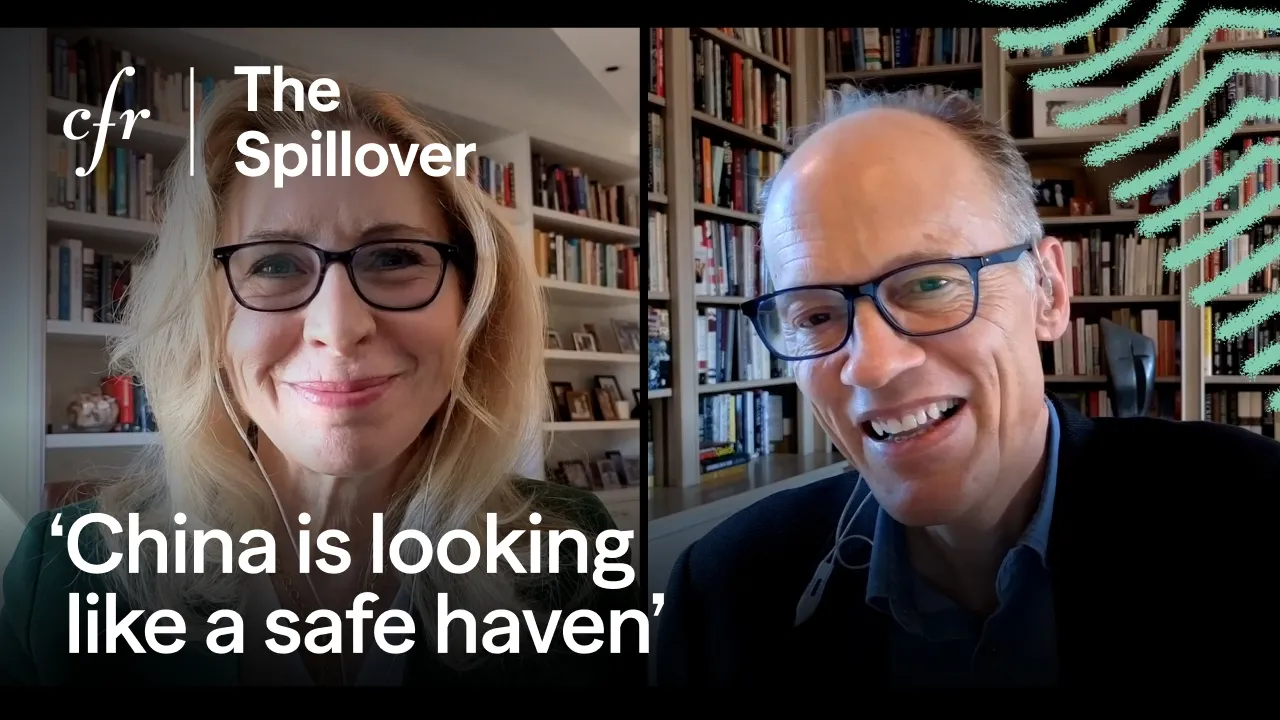
As the U.S.-Israel conflict with Iran escalates, global markets are absorbing the shocks: oil prices are swinging, inflation expectations are rising, and safe-haven assumptions are being tested. China, by contrast, is looking relatively resilient, buoyed by strategic energy reserves, diversified supply chains, and policy flexibility. This episode examines how the conflict is driving inflation, complicating monetary policy, and handing China a geoeconomic edge.
Published
Hosts
 Sebastian MallabyCFR ExpertPaul A. Volcker Senior Fellow for International Economics
 Rebecca PattersonCFR ExpertSenior Fellow
[Video: https://www.youtube.com/watch?v=s09FGwg90oc]
Transcript
MALLABY:
I’m Sebastian Mallaby.
PATTERSON:
And I’m Rebecca Patterson.
MALLABY:
Welcome to The Spillover. In each episode, we examine the ripple effects of global events. We cover everything from technology and finance to policy and geopolitics, connecting the dots on why, for example, a snap election in one country might have effects on the bond market halfway around the world, or why AI might affect everything from jobs to the competition between China and the United States. Today, we’re going to look again at the US and Israeli war with Iran and how that is spilling over into economies, markets and policymaking. And then we’re going to zoom in on China.
PATTERSON:
And I think I already know the answer to this, Sebastian, but just for our listeners today, why are we looking at China?
MALLABY:
Well, so far at least, I think the Iran war is revealing something super interesting about China. Obviously, China is a major importer of energy, so we’d expect it to suffer from a big jump in the oil price. I mean, if you look at other countries in East Asia, they’re in panic mode. You’ve got countries which are doing work from home to save costs of people commuting into work. They’re closing schools, they’re closing factories. And since the start of the war, South Korea stock market is off 20%. But China is kind of a contrast. It’s looking more like a safe haven. Neither the stock market nor the currency has really taken much of a hit since the start of the war. So we want to explain and explore why that is and what it might mean for US-China competition.
PATTERSON:
Yeah. I’m looking forward to doing the China deep dive today, Sebastian. Two other reasons as well as that relative stability right now. I think first, we just got the country’s latest five-year plan. And I think for many people, it’s just been overshadowed by the war. So you haven’t had as much parsing of the plan as you normally get. And then I think secondly, you, Sebastian, just got back from a trip to China. And personally, through my career, I’ve always found that I learned more when I’m on the ground someplace talking to locals and seeing things with my own eyes and whatever I can learn by reading. So I’m looking forward to whatever your takeaways are from the trip. I know we’re going to get into it more, but just off the bat, anything surprising to you or just memorable that you want to share right now?
MALLABY:
Yeah. Well, I mean, it was my first trip to China since 2019. I went right before COVID. Obviously, a lot has changed in China. A lot has changed in the relationship between the US and China. Over those six or seven years, I haven’t been there. And zooming out slightly, I think big picture, two things. One is that Chinese growth has slowed pretty consistently in the last 25 years. You had 10% growth rates in the 2000s. That goes down to seven or 8% in the 2010s. Last couple of years, it’s been more like 5%. But the paradox has been that as China has grown less quickly, the debate in Washington has made it sound more threatening. And I think one of the effects of going there is that you’re just reminded that China is not actually the grim monolith that the US debate sometimes makes it out to be.
I mean, if you go for a walk in Shanghai, you notice a few things as you are strolling along the riverbank. One is that there are EVs everywhere. And so because of electric vehicles, it’s quiet and civilized, and you can hear actually the birds singing.
PATTERSON:
I can hear ambulances out my window here in Manhattan. So
MALLABY:
It’s almost
PATTERSON:
The same,
MALLABY:
Right? Yeah. And my sort of signature experience in Manhattan when I fly in from London is being woken up at four in the morning by the garbage trucks and not being able to go back to sleep because I’m jet lagged. Shanghai is weirdly livable. And so I’m not saying that Birdsong takes away from the reality that it’s an authoritarian system, but I am saying that it shows that China listens to its people. And if they’re upset about air pollution and so forth, they actually deliver some improvements. And it’s not merely a soul crushing dictatorship.
PATTERSON:
Yeah. No, I am very jealous of your trip actually. Before the pandemic, I was probably there once a year and I just found it fascinating and educational plus I love the food. Let’s get more into China in a few minutes. And I think we should start off just with where we left this conversation two weeks ago. Our podcast episode two weeks ago, we talked about some of the initial spillovers we were seeing and that we expected from the war in Iran and how the oil market dynamics globally have just structurally changed from past decades. So I think rather than give everyone a recap, I’m sure everyone listening watches the news just like we do, so that’s not useful, but maybe we can just highlight two or three things that really stand out to us now that we’re in week three of the war. And maybe I’ll kick us off, Sebastian, then you jump in.
I think one of the things that’s been striking to me how quickly it’s changed is market expectations around monetary policy globally. Before the war started, financial markets were discounting, for example, with the Federal Reserve that we would get two rate cuts this year, the first one in June and then a second one in the second half of the year. So 50 basis points for the year. Now we barely have one rate cut penciled in and that’s for December this year. And I know this episode’s going to come out Wednesday. We have a monetary policy decision that day. So I don’t think it’s actually going out on a limb this time to say, “I feel pretty confident we’re not going to get any rate changes this week.” I think it’ll be interesting though in their dots in the statement and certainly in the press conference to hear how they’re thinking about this.
Will this be quote unquote transitory inflation? We don’t know how long the war will last. How are they thinking about growth, all those trade offs. So I think that’s going to be an important meeting just in terms of signaling how central banks generally are thinking about the war. But already this week, the Reserve Bank of Australia raised rates for a second time this year. That wasn’t a huge surprise, but they did highlight inflation in their statement afterwards. And then we just have a slew of other central banks this week. We have the European Central Bank, the Bank of Canada, the Bank of England, the Bank of Japan, among others. And I think again, with this switch, with the war and the inflation shock, we’re already seeing markets now discounting rate hikes later this year from the European Central Bank and the Bank of England. And of course, Japan, we were already expecting a rate hike.
I think that’s still expected, although more likely in April than at the meeting this week.
MALLABY:
Right. So the Fed is slightly an outlier because the next move is still expected to be down even if there’s going to be fewer move downs than we might’ve thought before.
PATTERSON:
That’s right. I think the best news, frankly, in terms of the Fed and the United States generally is that even though inflation sentiment over the short term has changed and that’s flowing through into interest rate markets, longer term measures of inflation, things like five year, five year forwards, if you want to get really wonky, they’ve stayed very anchored. And I think that’s happening for two main reasons. One, people expect this war to be relatively short. So the hit to inflation is more just a one-off jolt than something sustained. But secondly, and critically, it means the market still believes in Fed independence and that Fed credibility to do the right thing on inflation. If inflation gets too high, too sticky, the Fed will tighten, even if it’s not a politically popular decision.
MALLABY:
Well, yeah, I guess one major debate though is whether this war really will be short, because it’s one thing President Trump might have political reasons to try to make it short, but what if the Iranians don’t agree with him? And I think the thing that worries me here is if you recall the whole story of the Houthi militia attacking shipping and the Red Sea, other powerful countries, including the US, tried to shut them down. And it’s very difficult when you’ve got a few clusters of fighters with small drones that they can hide and figure this pop up suddenly and hit a ship. It’s pretty tough to eradicate that kind of threat. And if it’s the case that Iran can carry on help by just the geography of the Strait of Hormuz, they have a whole long shoreline they can operate from and it’s relatively easy to do these hit and run attacks.
That means that the spillovers from this war could carry on way beyond the point where President Trump would like to stop it. And that means the spillovers continue, oil prices could go up more once these talk about $150 oil, even higher than that maybe. And it leads you all to the kind of Suez 1956 comparison where Britain at that time, a big power in the Middle East tried to take control of a key waterway, the Suez Canal, and ended up instead in its own financial crisis revealing the limits to its power.
PATTERSON:
So are you saying that this is America’s Suez moment, Sebastian? That’s a big statement. I
MALLABY:
Think it’s a non-zero possibility that this happens just because of what I said about the Houthis. You can maybe wipe out all the Iranian larger missile launch capacity, but I’m not a military expert, but from what I understand, these small drones, it’s very, very hard to close that down. So we’ll see how that plays out. But I’d like to pick up on your monetary point too. I guess there’s two different things we have to think about here on inflation and monetary policy. One is the direct hit to oil prices for a more expensive oil, but the other is just the cost of the war because the cost is going to feed through into higher government spending. I believe the Pentagon told lawmakers that the first week, just the first week of the direct cost of the military action was more than $11 billion. And so that feeds through into a bigger budget deficit, a bigger national debt.
And the question is, is the US, given that it already has a big budget deficit and a big national debt, is it in a position to absorb an even bigger one? I mean, back in 1973, we had the first oil shock. Debt to GDP was 32%. Now it’s pretty much quadrupled, 122%, right?
PATTERSON:
Yeah, gross debt, right? Net debt’s still 100% of GDP, but the point is still the same. We’re in a very different place today than we were in 73. Yes.
MALLABY:
And we discussed the fragile four on the first of our podcasts, I think, France, Britain, Japan, and the US. And one of the things that came out of that is that if the debt is too big and it’s not sustainable because there’s also higher interest rates on that debt, you’ve got three options. Either the government can default, which nobody wants, or it does austerity to cut the budget deficit, but that’s politically off the cards these days, given populism. And then the third option is inflation. You inflate your way out of the debt, and that feels like the most likely. So the bond market, to go back to where we were, the expectations around interest rates, it’s got to be higher. The more the budget deficit goes up, the bigger the pressure to inflate your way out of the national debt problem. The more we’re going to see expectations of inflation rationally increase, so that means higher bond market interest rates.
PATTERSON:
Yeah. This has been one of the big things we highlighted two weeks ago in that normally if you had a shock like this, stock markets are going down, uncertainty is rising. You would see a flow of capital into the bond market and yields would fall. It would be a safe haven trade, so to speak. And we’re not seeing that this time. The 10-year yield is up. It’s fluctuating with the price of oil, but it’s definitely higher. So something is offsetting that safe haven flow, and it’s likely a combination of what you’re saying, Sebastian. It’s that changing expectations for inflation and the Fed funds rate, and it’s also changing expectations about the need for more bond supply to fund a bigger deficit, but it could not come at a worse time. And I think this gets back to why everyone expects this to be a short war.
At the end of the day, everything comes back to politics. And with the midterm election this year and so many opinion polls saying that voters are worried about their cost of living, I can’t imagine the White House or the administration wants to push this war any longer than necessary. They want to get oil prices down. They want to get interest rates down quickly. If you just look as of this morning, when I got up, gasoline prices in the US had already risen 28% since the end of February, and the 30-year fixed mortgage rate in the US had risen to 6.32%. Just several weeks ago, it had gotten down below 6%, and that had triggered a pickup in people buying homes. So we’re going the wrong way if you’re trying to make voters happy about affordability. And again, I think part of the sense that the war must be short is that it was Kevin Hassett was on television this morning, and it was interesting.
He kept referring to the war being a four to five week plan and they’re ahead of plan. And again, Sebastian, I go back to your earlier comment, the US may decide they’ve achieved something and declare victory, but what if Iran doesn’t? What if some of these rebel factions don’t? What if Israel doesn’t? I think there’s more risk there than perhaps the markets are pricing in. But anyway.
MALLABY:
I’m always humbled when we talk because I’m in London, you’re in the New York, I’m supposed to be four hours ahead of you at the moment. Normally it’s five, but you’ve clearly been out for longer than I have.
PATTERSON:
Well, you’re a night owl. I’m a morning person. I’m basically like a farmer. The sun comes up, I’m up. So that’s okay. We get the work done. That’s all that matters.
MALLABY:
But listen, I think we should throw one more thing into this mix, which is a kind of depressing mix, but we got to do it. And that is that it’s not just what oil does to direct inflation hit, what the war does to the budget deficit and how that plays through, but there’s also spillovers from food. And one of the things that people are realizing, the more the war goes on, there are more and more of these spillovers that maybe people didn’t notice initially. So first of all, it was natural gas and oil. Then food, as I say, fertilizer, a lot of that comes from the Middle East. If you’ve got shortage of fertilizer, it means planting seasons are coming up and it’s going to be much more expensive for those farmers that want to get hold of fertilizer. And so that implies both less planting and more expensive planting when it happens.
And then by the way, it’s not just that. If you can go down the list, helium, who’d have thought it, but it appears to be now in short supply and that’s important for making semiconductors. Sulfur is important for copper smelting. So it’s like that. It reminds me of that saying that when the tide goes out, you see who’s not wearing shorts. And this is a Warren Buffett thing about the markets, but it’s also true of spillovers during a war. When really you get into a hard place, you start to realize all these dependencies that people didn’t talk about before and they’re there. Yeah.
PATTERSON:
I mean, you mentioned the Houthis earlier. If they go after the Red Sea and we have that shipping lane closed in addition to the Strait of Hormuz, you’re going to see shipping costs and risk sentiment, both just getting significantly worse very, very quickly. And we are seeing a lot of places around the world, again, week three, either subsidizing export controls, price caps. Of course, they had the strategic petroleum reserve release that’s now begun. So there’s all these things happening to try to mitigate effects. The US, of course, continues to ask allies to please come help so they can get ships through the strait. So far allies are demurring, which in some ways you can’t blame them. They didn’t choose the war. And if you’re Denmark, especially, you’re probably not in the mood to help much right now. But if the war continues, these mitigating effects are just going to be at the margin.
They’re not going to really do much to help us.
MALLABY:
Yeah. I mean, the spillovers all over the place with this one. I mean, the UAE built a growth strategy on the idea that it was a haven of stability in a troubled world. Yeah, well, not so much when Iran is launching drones and missiles at you. Europeans had a good run last year and the stock market especially because relative to the US, their policy environment seemed very stable, but there are big oil importers, so the shine has come off that story as well. But maybe this is a good segue to China because I guess when you look at China, two big things stand out. One is, as we mentioned before, it’s an energy importer, and yet it’s been pretty resilient. The other thing is, geopolitically speaking, one of the reasons why people expected a short war was that the idea was Trump was going to go to China on March 31st.
And the idea was he would want to get the war finished before then because he wants to have a negotiation sum mega deal, which he hasn’t really specified, but the distraction and complication of the war was going to make that difficult. But Trump in the last 24, 48 hours has flipped out on its head, far from making the China visit a forcing mechanism to get the war finished, he seems to be accepting that the war might not finish. And so he’s formerly asked the Chinese to postpone his meeting with Xi Jinping, and I guess now he’ll go in late April or May or something.
PATTERSON:
Well, yeah, and that easily could get postponed as well, depending on what’s going on with the war. It wouldn’t surprise me. I think what we’ve learned is that the visit is not a gating factor. I’d be curious, Sebastian, in terms of the war in China, when you were chatting with people on your trip, what were they thinking about the war? Is China concerned about the war? I mean, I know that the ships that do get through the Strait of Hormuz are mainly Iranian, and most of that appears to be going to China. So maybe they’re not in that bad place, but what was just kind of the man on the street view?
MALLABY:
Well, you’re right. I mean, China buys more than 80% of Iran’s crude exports. So we can assume that when ships do go through the strait, China’s probably where they’re headed for. But to your question, the amazing thing was, I was there for eight days. I had conversations all the time with all kinds of people. And frankly, the oil shock and the spillovers just didn’t feature in the conversation. People were talking about all kinds of things, but even if you brought up the economy and we’ll get into the two sessions which were going on when I was there, even an economic discussion didn’t cause people to say, “Ooh, maybe what we were thinking a week ago has to be rethought now because oil has just spiked in price and natural gas supplies and Qatar have been attacked.” No, it just didn’t come up. I guess the obvious first reason is that China does have a very large strategic oil reserve.
It’s got enough oil stashed away for a hundred days of zero imports, so it can survive for quite a while. I mean, put that in perspective, the Chinese strategic oil reserve is fully 12 times bigger than South Koreas. So maybe they just feel they can wait this out.
PATTERSON:
Yeah, but they’re still vulnerable in lots of other ways, right?
MALLABY:
That’s true. Even though Iran by itself is actually just 10% of the imports that China has. So it’s a big deal for Iran that’s that way around. It’s more than 80% of their exports, but from a China perspective, it’s just 10%. But you’re right, China is vulnerable. If you look at the larger region, half its imported oil comes from Middle East, 40% has to go through the straighter for moose. China gets liquid and natural gas from Qatar and Iran has attacked the facilities there, so that supply is offline for the moment. So there are vulnerabilities, but I think the more striking thing is the way that China has managed those vulnerabilities really well. So yes, it gets half of its oil from the Middle East, but Japan gets more than 90% of its oil from the Middle East. And if you look at natural gas, China’s reliance on liquid national gas is actually a lot lower than the Japan or South Korea reliance.
Japan, South Korea, the number’s like 20% of the total energy mix. In China, it’s half that, more like 10%. And what’s more, all of the gas in Japan and South Korea comes in as LNG, and so that’s what’s being cut off, whereas half of China’s gas is coming through pipelines from Russia. So they’ve just sort of set things up in a way that they’ve thought proactively about how the structure of their economy and their energy imports could affect their strategic position, just as they’ve thought carefully about how to weaponize their position in rare earths, turn that into a geoeconomic weapon. So they’ve thought equally meticulously about how to avoid being the object of a weaponization of a key input. And so they’re just smart about this stuff. And I think one takeaway from this is that people in the US often when they debate supply chains and globalization, I think they make the wrong point.
After COVID, there was a sense, well, we’ve got to make everything in America and be self-reliant. The way that Chinese do it is that they do the opposite. They sort of double down on global supply chains and they have as many as possible so that yes, if the Strait of Hormuz is interrupted, that’s bad, but you still got a lot of pipeline energy coming in from Russia. And so the answer to a vulnerable supply chain is to have three other supply chains is the message from China’s experience.
PATTERSON:
It’s interesting that IMF put out a report, I want to say it was last year, but one thing they had studied is after COVID, after Russia’s invasion of Ukraine, how have we seen supply chain shift? And one of the biggest takeaways they had is that yes, China is continuing to rely on neighbors, et cetera, but the shift has been less reshoring and more friend shoring, ally shoring, neighbor shoring, and it tends to be where you have similar geopolitical views. So the US is doing less with Russia, China, it’s doing more with Mexico, it’s doing more with Japan, it’s doing more with Vietnam, Europe, China is doing more with Russia, I would guess, but the geopolitical alignment is there. And one big takeaway from all this that the IMF and others have already concluded, and I think reasonably so is that it pushes up inflation. If you are changing your supply chains because you don’t agree with someone geopolitically or you’re worried about a conflict, you’re getting not the lowest cost provider anymore.
Maybe it’s the second lowest or the third lowest. So all else equal, you’re talking about a higher structural rate of inflation. And I think as we think about budget deficits and inflating away a deficit or a debt, this is another piece of that inflation puzzle coming to bear. Everything you’ve just said, Sebastian, it’s so interesting. And I think it just underscores how important it is maybe when in the United States, when TSA gets paid again and the lines at airports aren’t three hours long, but we should all be getting on airplanes and going overseas or even going around this country in the United States because the more you can talk to people on the ground, the more fulsome a picture you get.
MALLABY:
Yeah, I certainly had that feeling it was good to be back in China. Should we move to the five-year plan and these meetings?
PATTERSON:
I think that’s a great idea. So I’ve been staring at the markets and how things have been reacting to the war. And as you said earlier, Sebastian, it is interesting that when you look at currencies of oil importing countries, places like South Korea, places like Japan, the currencies of weekend, Europe, and oil exporters or commodity exporters, generally places like Brazil, Mexico, the currencies have done relatively better. Australian dollar has actually gone up against the US dollar. The renminbi is basically flat against the US dollar since the start of the war and year to date, the renminbi is actually stronger. And so I was thinking, okay, we know it’s partly just a relative value, a trade that’s happening on a short-term basis, but maybe there’s something going on with growth as well. I mean, I appreciate that China just reduced its growth target to four and a half, 5%, which is interesting that they’re actually acknowledging that growth is continuing to moderate.
But if we just look at last week, and I know there’s a lot of noise around lunar New Year with that data, but you did see some positive surprises in exports. Exports were very strong versus consensus, but even retail sales, industrial production were better than expected in China for that January, February period versus December. And again, I’m not saying the consumer in China is waking up and spending again, but it does seem like whether it’s government stimulus that’s helping or demand for Chinese goods overseas, that may be part of the strength in the equity market and the currency is a little bit of at least tactically some growth optimism. We’ll see. And the other thing, I guess I would add real quick, Sebastian, the AEPA decision. So we saw this last time around last year when there was a pause in the trade war, American and other countries just front loaded as many imports as they could to get ahead of a possible tariff increase.
It’s possible that we’re seeing a little bit of that again helping things in China. I don’t know. I’m just throwing that out there as something to noodle on.
MALLABY:
I think that’s all interesting and right. I also think there is a sort of maybe slightly more central banky kind of point here, which is that 4.5 to 5% growth target you just mentioned, which they threw out at the recent meetings, that’s the lowest that the Chinese government has offered up in 35 years. And there’s a point of view which is quite popular among outside Western observers of China that it’s a mistake.You ought to be more ambitious in terms of your growth. And the reason is that China has been mired in deflation for a bit more than three years. I mean, actually in the last two, three months, consumer price inflation has turned positive, but if you look at the factory grade prices, the producer price index, that’s been consistently below zero for more than 40 months. And we know from Japan that especially if you’ve got a demographic situation where the workforce working age population is declining and that’s going to be a negative for growth anyway, you get into a position where everybody knows that if they wait to buy that car or that refrigerator a couple of months, it’s going to be cheaper, everybody is delaying consumption and then that low consumption feeds into lower growth and the lower growth feeds into lower consumption.
And you get this vicious cycle. So the Western prescription is often, hey, stimulate demand, government spending, government tax breaks, and you have to get yourself out of this low demand trap. And I raised this question with economists when I was in China, and I thought the answer was interesting, which is one person said, “The composition of growth matters more than the level of growth.” And it’s sort of different point, which probably same point, but different way of saying it, was that the main thing the regime is rightly concerned about is that there was a real estate bubble, and a few years ago, people were worrying about China’s Lehman Brothers moment because falling real estate prices were feeding through into these big real estate companies, construction companies, the financiers of the real estate. A house of cards seemed that it might fall. And so what macro policy has been aimed at is keeping a lid on demand, letting the economy cool down because you’re trying to take the air gradually out of that bubble.
And that actually might be more important than running growth at the highest possible level that would be consistent with 2% inflation target.
PATTERSON:
I mean, I hear you. I hear you. And I think ideologically, it would be very difficult for President Xi Jinping to flood the zone and support consumers the way a lot of Western governments did in 2008, 2009. So probably just isn’t going to happen. And the composition of growth point is a good one because Japan, for example, has had low growth until recently for a long time, and yet Japanese people would elect similar politicians over and over and their quality of life was okay. And so it worked. It didn’t look great at a headline level for GDP, but people on the street were generally okay. Again, this was until the last couple of years that this was the case, and that surprised me. But I think with China, two things. If you think about the sources of growth, if you don’t have a bigger contribution from the consumer, then you’re constantly relying on investment-led growth.
Now, maybe that’s going to be investment from the government and privates to … Sector that creates wonderful productivity growth through technology, and we’re going to get to that. Otherwise, it’s going to be fixed asset investment bridges to nowhere, probably not a good return on investment there, or it’s going to be exports, and we know the rest of the world is going to have a limit to how much they’re going to absorb from China. So I still think eventually China has to solve the consumption problem. Maybe it’ll happen naturally when the property market bottoms out, but they can’t keep things going indefinitely the way they are. The second quick point I’d make, Sebastian, on this is that Xi Jinping has promised to double per capita income over a certain time period. And he reiterates this. This is a hard and fast goal. And so something’s going to have to give sooner rather than later to turn this ship around to meet that goal.
I think it’s going to be hard for him to achieve it, frankly.
MALLABY:
Yeah, I think it’s a good point that what he’s doing with growth is not consistent with that goal of doubling GDP per capita, that’s for sure. But I do think there is, you laid out three sources of growth, investment, exports, and consumption. One response to that three-way choice is to say, “Fine, I’m not doing any of that. I’m just going to accept lower growth.” And I think what’s interesting about, just maybe as a thought experiment to think about with China is that after the 08 crisis, particularly, there was this whole debate in the US about whether monetary policy should respond to asset bubbles. Personally, I thought that was a good question to raise because the US had had two recessions thus far in the 21st century. There was the 2001 recession, which was coming off the back of the NASDAQ tech crash in 2000. And then of course, there was a much deeper recession after the real estate bubble burst in 2008.
And so it showed that it’s not just the business cycle that can lead to a recession. Bubbles that burst actually really matter. And central banks maybe shouldn’t just care about the price of eggs. They should care about the price of nest eggs if they’re trying to stabilize the economy. If you’re China and your real objective function is to avoid political instability and kind of maintain the regime’s position, you have to choose, are you more worried about youth unemployment in the cities, which is a thing. And they stop publishing the data on, I think, urban youth unemployment. They just stop publishing it. So it did show they were worried, but on the other hand, maybe it’s even more worrying if you had a full-on financial crisis arising out of a real estate bubble. And I suspect that yes, the real estate bubble was a bigger threat.
And it sort of gets to this point that we were making earlier about their strategy on critical minerals, their strategy on diversifying the sources of energy imports. They’re very careful to set up their economic policy in a way that’s not going to undermine their power. And power includes domestic legitimacy and a full-on bubble would be very bad. So anyway, I just thought that was an interesting reflection, the kind of China version of the leaning against the wind in asset bubbles debate that we had after 2008 in the United States.
I have a question for you, Rebecca. Yeah. This is all happening before the Trump Xi meeting, which I guess now has been delayed probably till late April, May.
And people want to know where this thing is going to go because last year there was this tit for tat cycle. US tariffs on China got as high as 145%. China hit back, 125% tariff response. Then we had that reset in October, she and Trump met in South Korea and Trump said, China is “the biggest partner of the US.” And he said the two countries always have quote a fantastic relationship. And that’s when he said there should be this meeting in the spring, presumably to deliver on this vision of a fantastic relationship with China. And there’s been a lot of thinking and speculation about, does that just mean a traditional trade deal with China where they promised to buy more soybeans and Boeings or something, or is something bigger maybe including Taiwan? And what’s your reading of that?
PATTERSON:
The only kind of concrete information we’ve gotten over the prep talks that took place in Paris this past weekend was that they are considering something called a board of trade, which would be, I guess, some sort of bilateral group of officials who would monitor that each other is doing what they said they would do. So if China buys 500 Boeings or imports X times more soybeans, are they keeping to their end of their bargain? And then I guess a question for that would be, if they don’t, then what? So are we basically taking the World Trade Organization and gutting it and turning into some sort of bilateral monitoring? And I’m not sure how that would work. I also am not sure how that would work given the US political cycle. Four year cycle, we have a new president, new administration. Is there a smooth transition with that board of trade if it’s established or does the next administration want to go back to the WTO or something else?
So I have more questions and answers around that.
MALLABY:
It sounds nuts is my take. I mean, if you had to have guessed, if it was 10 years ago and you said, okay, so there’s the US-China negotiations and one side is going to propose management of specific kind of how much of each sector gets traded in which direction. Surely it would’ve been the state is Chinese that would’ve proposed this.
PATTERSON:
It is hard to believe that we’ve come to this point. But again, back to the question, what are we expecting when these talks eventually happen? I think aside from US getting China to keep delivering critical minerals because we clearly need them, that is a choke point for us. We get China to buy more of something from us. I do think Taiwan is going to be on the agenda. There is a potential arm sale to Taiwan from the US that China would really like not to happen. And so how that conversation goes when these talks happen, I think will be pretty important for their relationship. I think it’s also interesting the US has asked China to send a ship to the strait of hormones. And so far, China is demurring as are most countries. So now that the meeting has been postponed, we’ll see if there are additional prep meetings.
We’ll see if we get more color about what the actual agenda is going to be now that they have a little more time to prepare. I’m not sure what we’ll see, but there will definitely be more color coming out. I want to go back again to the political economy angle of all this. President Trump, again, he’s focusing on foreign policy a lot so far this year, but he’s also very cognizant that he has this important midterm election coming up and the polls are not in his favor. So getting China to buy something like soybeans quickly right now, trying to help US farmers, I think that becomes increasingly important. You mentioned fertilizer earlier. We’re just getting into spring planting season in the United States and polls. There was a good pull out by Purdue and the CME showing sentiment among the US agriculture community is continuing to go down.
So farmers who are supporting Trump are very unhappy and he’s going to be aware of that and he’s going to want to do something to shore up that support.
MALLABY:
Well, there are a lot of podcasters out there, Rebecca, but few can boast of having a podcast cohost who can cite the Purdue farming seven.
PATTERSON:
It’s actually, their sentiment is the lowest level since the fall of 2024, before President Trump won the election. And they got very excited about him winning the election. He positioned himself as the farmer’s friend. So all that hope has been erased. So he needs to act on that one.
MALLABY:
But
PATTERSON:
Anyway, Sebastian, we know what the US wants. The US wants China’s help with Iran. The US wants China to buy soybeans, buy Boeings. The US wants to make sure it keeps getting critical minerals. What else do you think we’re going to hear when President Xi and President Trump finally get together? Well,
MALLABY:
When I was in China, I spent quite a lot of time with AI leaders, technology leaders, both in academia and industry. And this question of advanced semiconductors is super important. I mean, that has bitten, I think, hasn’t stopped China from making cutting edge AI models, but the lack of Nvidia’s most advanced generation semiconductors, the three nanometer chips, is a problem in terms of the performance of, say, a Huawei smartphone or an AI data center. And so I think that might well be something that China pushes on a further relaxation of the chip export controls. But I mean, beyond the meeting, Rebecca, I think we should talk a little bit more about the two sessions that we were just having in Beijing a week ago. So this two sessions terminology refers to the fact that you have two meetings. One is the National People’s Congress, which is the rubber stamp parliament.
And then there’s also the Chinese People’s Political Consultative Conference, which is a group of elite kind of some party members, some non-party members who are more sort of university presidents or other grandees, and they’re supposed to give advice on policy as opposed to decide it. And anyway, the outcome of these two meetings is always a bunch of policy targets, including the five-year plan, but also growth targets and budgets and all that. And the reason to focus on this is that China being China, what they say they’re going to do is normally actually what they do then do. It’s not like a Western system where something gets held up in Congress, because as I said, the parliament they have is a rubber stamp parliament. It’s not going to smell anything up. And so if you go back and look at, let’s say, a meeting a year ago, there was talk of creating more urban jobs.
And yes, 12 million have been created. They promised more defense spending. Yes, it’s up 7%. They promised more R&D and tech and manufacturing, and that’s happened too.
PATTERSON:
Yeah. No, I agree with you. If we’re looking for benefits of not having a democracy, that is one. It’s just easier to make your policy priorities a reality. But even in China, we both know nothing is guaranteed. The government makes mistakes. Sometimes they might directionally make progress, but they don’t hit their goals. And I think we saw that this year, for example, with inflation, which we talked about a little bit earlier, just the risk of a Japanese type deflationary spiral in China. Oh, it struggled partly because of that cautious consumer and the lingering housing market drag. And also because of competition between the Chinese firms, they just kept lowering prices so they could get volume out the door. I mean, headline inflation in China last year averaged zero, and that’s pretty significant. The IMF has pointed out, you can’t have a healthy growing economy with resilient demand if you’re simultaneously experiencing deflation for consecutive years.
When I think about the Chinese consumer this year, it sounds from your trip that at least people there might not be that worried about it. When I look at the government plan, the consumer is mentioned, but it doesn’t feature that highly. It’s not the first thing. The support for the consumer this year feels more incremental just like last year. So it feels like we might have more of the same. There’s a program for consumers to trade in durable goods and electronics, but it’s even smaller than what they had last year. There’s a hundred billion renminbi so- called … This is great. I love Chinese terms. I’m reading my notes here for a minute. Fiscal financial coordination program. It’s subsidized loans basically, but they need property markets to stabilize and turn up so they have confidence again in that place to store their wealth and save for retirement.
And without that, I just don’t think they’re going to get rid of much of their savings. They’re going to sit on their savings and consumption is going to stay pretty lackluster. So yeah, four and a half percent growth this year, that sounds about right.
MALLABY:
Yeah. Well, we in the West are always waiting for that big boost to consumer behavior in China because that would be good for everybody in the world. Everybody would be benefiting. And instead, the Chinese always fall back or often fall back on more exports. They’d like to borrow our demand because they have inadequate demand in their own economy. And so the current account surplus hit 3.3% of GDP in 2025. That was up from 2024. So nevermind all that pressure from President Trump. It didn’t stop China from going in the opposite direction. I think that could easily come up in the Trump Xi meeting. I mean, what the five-year plan did do is it didn’t deliver much in terms of confidence about a consumer stimulus, but there was talk about technology.
PATTERSON:
Yeah, I agree. I mean, that was loud and clear from the plan. And if you think about the building blocks of GDP, it’s labor and productivity growth. How many workers you have, and China has fewer, and how much output do you get per worker? And so if China isn’t going to suddenly have a ton more people, immigrants or native born, they’ve got to double down on technology to try to increase productivity. So it’s not surprising to me from that perspective that we’re seeing that focus on AI and technology, but I know next week, Sebastian, you’re going to dig more into the US-China tech race. So for now, in terms of technology, what stood out to you from the plan?
MALLABY:
Yeah, we’re going to miss you next week. I know you’re traveling, but we’ve got Chris McGuire, our great colleague from the Council on Foreign Relations who was a policymaker in the White House on China and semiconductors. So we’ll do our best without you. But in terms of the five-year plan, I mean, AI got its own section for the first time, and it’s a broad strategy, mostly about disseminating AI across industries and through the economy. I did visit the Huawei campus, interesting kind of cognitive dissonance you feel when you go there, because on the one hand, it’s sort of scurrying with smart, dedicated people who want to do a great job, and they’ve got some quite cool products. I went in an autonomous car that drove me around for 15 minutes, and it was a pretty good car. So you kind of feel admiration, but then you kind of remember, yes, these guys are a pillar of Chinese national power.
They’re under US sanctions. And so there’s this weird sort of split screen divide in my reactions. But anyway, one thing I did see at Huawei is this focus on using their cloud services to deliver AI applications to all kinds of different industrial sectors from maintenance on high speed trains to mining applications, logistics, transport, healthcare. You go down the list. And it just stopped me looking at this, this may not be a point reserved nearly to China, but 30 years ago, if you’d asked the question, when the manufacturing economy improves is more intelligently managed, where are those ideas coming from? The answer might have been management consultants going in and giving advice and all that. Now, I feel like the way economies become more intelligent is that intelligence is delivered to them through the cloud, through AI applications. Cloud services are the new McKinsey. And it was funny to see this at Huawei because they famously built their company up based on management consultants they brought in from IBM, and now they’re turning around and delivering improvements to other Chinese companies, but through a totally different route.
So anyway, the Chinese five-year plan reflects that kind of stuff that’s already going on in Huawei. And there’s also a little bit about governance and safety of AI. They’re concerned about job numbers and so on.
PATTERSON:
Yeah. I mean, that’s so interesting, the idea that AI apps, AI agents take the place of workers, consultants. There was a South China Morning Post article I read just over the weekend, I think it was, and it highlighted that you have a big fallen job vacancies in Hong Kong, and the article suggests that AI is contributing to the slower job market in Hong Kong. So maybe China needs AI more because labor market’s shrinking, but there still are a lot of people. You mentioned youth unemployment earlier who would like to have jobs, and if the AI bandwagon gets going too fast too soon, that’s not great for Chinese social stability.
MALLABY:
I mean, when I was in China, the thing that surprised me the most was that it’s not just people worrying about jobs being destroyed by AI. There’s a proper discussion about the machines going rogue, developing their own objectives, the need to align AI with human priorities, the possibility that open source AI models, which you can just download, and then you’ve got control of them and no one can take them away from you, that could be dangerous because you’re putting a dangerous technology into the hands of people and you don’t know what they’re going to do with it. So these kinds of concerns, I think even a few months ago, if you had talked to an outside expert on China and said, “Well, how much concern do you think there is about AI?” They would’ve said, “No, they just want to build it. They want to go fast.” That whole history is wired towards wanting to make sure you don’t fall behind for your rivals technologically because then you’ll be dominated.
But now I really did hear a lot of discussion about AI safety. And it sort of suggests to me that there might be an opening, not immediately, but for a US-China collaboration on AI safety, which I think we’re going to need in the end. Maybe just to come full circle in our conversation today, even if the pace of Chinese growth keeps slowing and the focus on high value added exports and technology, it suggests a continued Chinese need for commodities and that gets us back to the Iran war. China’s going to be very careful about diversifying its sources and avoiding geopolitical vulnerabilities as it gets those commodities.
PATTERSON:
Yeah. No, I couldn’t agree more with you. Well, look, I think we’ve covered a lot of ground as we always try to do. There’s always lots of spillovers. So just to make sure our listeners can say, “All right, what do I need to remember from this conversation?” Let’s go back and underscore a couple points. So first, back to the beginning, the spillovers from Iran are spreading, getting more numerous. We would’ve expected that. I think increasing worries over food supply, changing expectations to monetary policy because of higher inflation, those are both noteworthy. And this week’s group of central bank policy decisions are going to provide some very useful color on how they’re thinking about the inflation growth trade-off and are they willing to look through the commodity-driven inflation? Do they see it as transitory? I’m going to use the word. I think the Fed will avoid the word, but we’ll see what happens.
I’d also note the rise in long-term bond yields. That’s happening globally and some of that’s related to policy and some of it’s also likely related to needed government spending on defense that’s going to come on the back of this. So that would be point one. Watch the spillovers from Iran. Second, China stands out in this war so far. It’s a major energy importer, and yet its financial markets, its currency are holding up significantly better than other importers, and frankly, relatively well compared to even some exporters. And I think some of that might be some recent positive data surprises, but it’s probably also the expectation that Chinese policymakers will intervene, the national team, in markets if a shock threatens to destabilize things. And of course, China has those enormous stockpiles of energy and electricity. As you said earlier, Sebastian, they prepare well in advance. They have strategic plans to get through periods like this.
It’s not bulletproof, but it gives them a lot of wiggle room compared to other countries. And then I guess my last point I want to underscore is just when we think about China’s latest five-year plan, there’s no major change and approach to the consumer. It’s incremental support, but there is a big deal in this plan, the first time ever that AI has its own section. Technology is highlighted. And I cannot imagine the US is going to love that having China pushing hard on technology and AI, but to your point, they also care about governance. And maybe that is going to be an opening to start moving the ball down the road on some global governance around AI, which I think we both agree ultimately is going to be very needed.
MALLABY:
Great summary. Thank you. So we always try to end our podcast each week with a tidbit, something interesting, quirky, which has piqued our interest. Mine is a bit grim, I’m afraid, but I thought we ought to mention it. And that is simply the fact that just about nobody in Cuba right now has electricity or power in their home. I mean, it’s just quite shocking, right? In the time since the Venezuelan regime was decapitated with the abduction of Maduro, the dictator there, oil from Venezuela flowing into Cuba has been cut off. And Cuba as a result is absolutely spiraling downwards. I think if it wasn’t for the Iran war, this would be really dominating discussions. And I thought we should at least give it a mention on the podcast.
PATTERSON:
No, that’s fair. I’m glad you did. And I would note on Venezuela that they just released some economic statistics for the first time in several years. Part of the conditionality to getting some US help, I guess, to get the oil flow going again there and infrastructure rebuilt. But my little tidbit this week goes back to our technology and China theme. Sebastian, I’ve been thinking a lot about lobsters lately. I have good, good friends who took my husband and I to this place downtown over the weekend called Penny. It’s all seafood. And the lobster was one of the best I’ve had in my life, but the lobster I’m mentioning today is, I’m sure you were talking about it in China. It’s the Red Lobster logo for Open Claw. And if anyone listening today is not yet familiar with Open Claw, you should be. It’s a very popular open source AI agent kind of framework that it can take over a computer or a phone independently and perform multi-step tasks.
And it’s become a big enough deal in China that the government now has issued not one, but two, frameworks of guidance to protect, to have cybersecurity and governance around this stuff. Again, it’s interesting that they’re taking those precautions compared to what we’re not doing yet in the United States. But I am excited, Sebastian, to hear more about your trip and more about your conversation with Chris McGuire next week on the US-China Tech Race. Well, for now, thanks to everyone for listening. Please don’t forget to like and subscribe on all platforms and leave us a review. It really helps us to get the show out there.
MALLABY:
Thank you for listening, and we will see you all next week. Want to stay up to date on a new episode of The Spillover? Sign up to receive an email alert when new episodes drop at cfr.org/newsletters, or click the link in our show notes. If you have an idea or you just want to chat with us, email [email protected]. Be sure to include the spillover in the subject line. This episode was produced by Gabrielle Sierra, Jeremy Sherlick, and Molly McAnany. Our video editor is Claire Seaton, our sound designer and audio engineer is Markus Zakaria. You can subscribe to the show on Apple Podcasts, Spotify, YouTube, or wherever you listen to podcast. Research for this episode was provided by Liza Jacob, Ishaan Thakker and Daniel Hadi.
Note: This transcript was automatically generated. It may contain errors.
The Hook: The war in Iran is pushing oil prices higher and disrupting energy flows worldwide, revealing potential vulnerabilities in China’s economy.
The Spillovers: Energy shocks are leading to higher bond yields and reduced expectations for interest rate cuts, as markets price in more persistent inflation. Supply chain disruptions are spreading beyond oil into natural gas, fertilizer, and food, amplifying cost pressures globally. Equity markets are reacting negatively, with sharp selloffs tied to rising oil prices and geopolitical uncertainty. Still, despite being a major energy importer, China has remained relatively stable, benefiting from oil stockpiles, diversified energy sourcing, and the shift to electric vehicles.
The Spillover is a production of the Council on Foreign Relations. The opinions expressed on the show are solely those of the hosts and guests, not of the Council, which takes no institutional positions on matters of policy.
Mentioned on the Episode:
Sebastian Mallaby, The Infinity Machine: Demis Hassabis, DeepMind, and the Quest for Superintelligence, Penguin Random House
Coco Feng, “China Issues New Safety Rules for OpenClaw. Here Are the Dos and Don’ts” South China Morning Post
Hany Abdel-Latif and Adina Popescu, “Spillovers From Large Emerging Economies: How Dominant Is China?,” International Monetary Fund (IMF)
Michael Langemeier and Joana Colussi, “Farmer Sentiment Drops Sharply at the Start of 2026 as Economic Concerns Increase,” Purdue University/CME Group
Producer
- Producer, Podcasts
Supervising Producer
- Director, Podcasting
Supervising Producer
- Director of Video
Audio Producer
- Audio Producer & Sound Designer
Researcher
- Research Associate, Finance, Business, and Technology
More Episodes
 35:24Podcast
 48:01Podcast
 47:25Podcast
 50:17Podcast
 47:25Podcast
 52:31Podcast