Trump-Xi + Mutually Assured Disruption + Boeing, Beef, and Beans
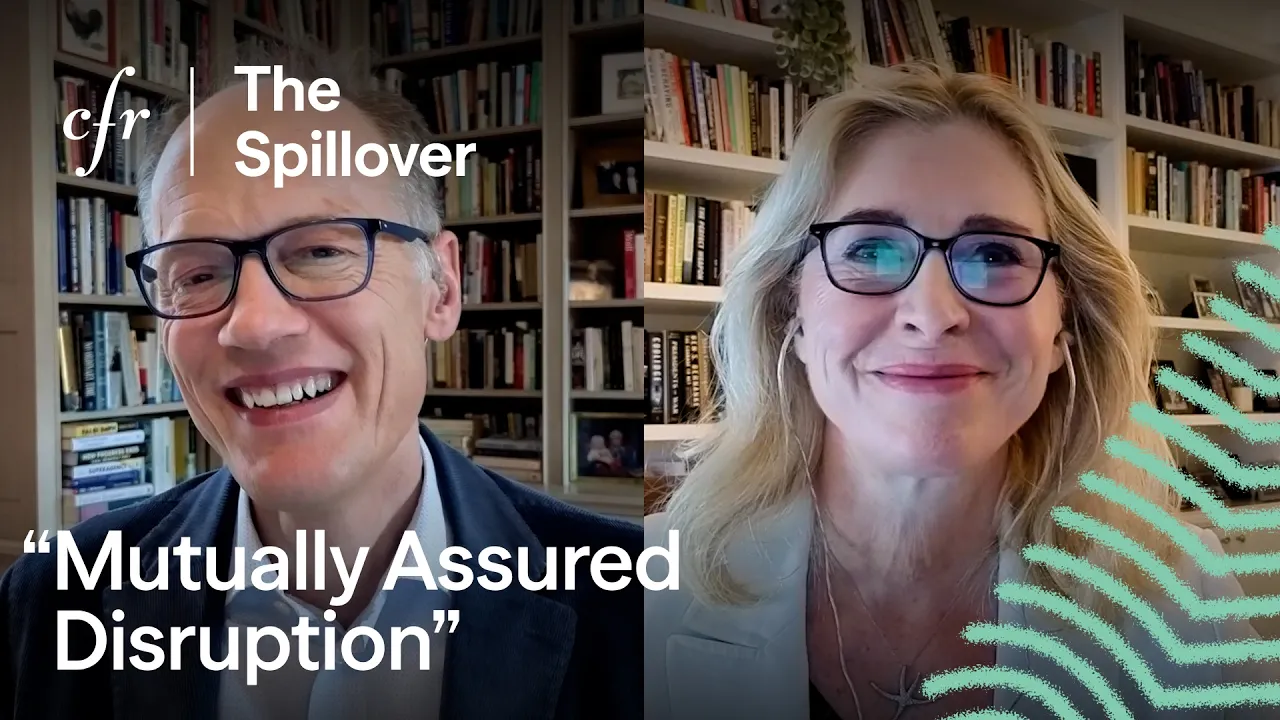
President Donald Trump is set to meet with Xi Jinping in Beijing for a high-stakes summit shaped by Iran war tensions, trade disputes, critical mineral flows, semiconductor controls, and an intensifying AI race. This episode breaks down the growing U.S.-China rivalry, the risks facing global markets and supply chains, and whether the world is entering a new era of economic fragmentation and technological competition.

Published
Hosts
 Rebecca PattersonCFR ExpertSenior Fellow
 Sebastian MallabyCFR ExpertPaul A. Volcker Senior Fellow for International Economics
[Video: https://youtu.be/38zTq0gP6NM]
Transcript
PATTERSON:
President Trump and a U.S. delegation of more than a dozen American CEOs are in Beijing this week for a round of high-level talks on topics from technology to Taiwan to trade.
MALLABY:
This is the first U.S. presidential visit to China since 2017, and Trump has suggested Chinese President Xi will give him a big hug. It’s hard to believe that just a year ago, the prospect of 100% plus tariffs in both directions on U.S.-China trade was terrifying investors. But underneath this week’s display of friendly accommodation, the U.S.-China rivalry may actually be at its fiercest point in a long time. I’m Sebastian Mallaby.
PATTERSON:
And I’m Rebecca Patterson. And this is The Spillover. It’s cute if we do it together.
While expectations for material progress at this week’s bilateral meeting in Beijing are pretty low, it’s still a really important catalyst to discuss spillovers from the U.S.-China relationship. Sebastian and I thought we’d spend some time digging into the Taiwan question and broader geopolitics as well as trade. Obviously, they’re all interrelated.
But first, we want to spend some time on technology in context of this meeting. You know, Sebastian, we know there’s a few items that will certainly be on the table. China wants more advanced U.S. chips and related equipment, which had been approved, but it hasn’t really happened. And then the U.S. wants to make sure it can keep getting access to critical minerals, rare earths, magnets, etc. But both countries want to, quote-unquote, win the AI race. And that kind of goes against either one giving too much of these things to the other side.
So I want you to start off by helping everybody listening today. How do we square that circle? Can they each give like a little bit to each other and still preserve some leverage?
And one last thing I’m piling on here is the fact that Jensen Huang, NVIDIA’s CEO, is not part of the entourage this week. Does that mean anything in terms of chip sales?
MALLABY:
I’m not sure about the Jensen Huang point, but that makes sense, actually, that you wouldn’t bring him with you if you were then going to disappoint his company by not offering more chances to sell to China. But, you know, basically, I would say that when you look at this balance between the Chinese geoeconomic weapon of rare earths embargo versus the U.S. geoeconomic weapon of semiconductor chip controls, you’ve got this sort of mutually assured disruption, right? Both is disrupting the other.
It’s kind of a balance. And I think that equilibrium is not a happy one. Neither side likes it, but it’s probably what we got.
You could argue that if you look at the Iran war, the U.S. vulnerability to not getting enough rare earth has gone up, right, because the U.S. has used up a lot of munitions, a lot of missiles, a lot of interceptors. And to replenish those military stocks, you’re going to need a whole fresh bunch of rare earths to build them. So in that sense, Chinese leverage has gone up.
On the other hand, actually, the American counter to that, the export controls, shows some signs of working a bit better. Just recently, I saw, actually this morning, a U.S. government analysis of the gap between where the frontier is in China in terms of AI models. That’s the recent DeepSeek version 4 versus the U.S. frontier. And the Chinese are now said to be eight months behind, which is a little bit longer than they had been before. I owe it a thank you to our CFR colleague, Chris McGuire, for pointing out this U.S. government study that shows this. So maybe, you know, there’s kind of parity basically on this standoff where, you know, the rare earths weapon is a bit more effective, the chip export controls may be working a little bit better.
And so neither side really has the upper hand.
PATTERSON:
Just real quick on the eight months lead of the U.S. over China, though, Sebastian, I was reading a different piece this morning that was talking about how DeepSeek is now, knowing that it might not get the advanced chips it needs, is just kind of looking differently at all the LLMs it’s building and saying, okay, how can we build a frontier model with different chips? How can we change our approach to the whole thing? I mean, do you worry that China can narrow the gap with the U.S. from eight months to something less just by rethinking the problem?
MALLABY:
You know, I think they’ve been trying as hard as they possibly can to rethink the problem right from the start of this race. What I worry about more in terms of the U.S. lead is that, okay, let’s just posit that this U.S. government, it’s the U.S. AI, what used to be called the U.S. AI Safety Institute, which is now called CAISI, produced this comparison. Let’s just posit that it’s correct, that it’s an eight month gap.
What I’m worried about is that’s the frontier. What about actual deployment of AI? Maybe China is faster at turning the frontier model into a usable product.
And it’s also important to say that the Chinese models are a lot cheaper to use. And therefore, in terms of deployment through the economy, that’s a big advantage. And so I think when you net those two things out, America ahead with the frontier model, China probably faster at deployment.
Maybe there’s rough parity between the two sides.
PATTERSON:
That’s a really good point. You’re not the only author among us, although you’re seven bestsellers ahead of me. But beyond that, I just submitted a chapter for a book that there’s a Johns Hopkins professor, Hal Brands, working on a collaboration.
And my chapter was thinking about which economies win the AI race economically. And the point you just made is one that I felt strongly about, too. There’s a difference between development and deployment.
So the U.S., we can is leading on development. China is number two. But on deployment, the U.S., I think, even though it’s making progress, is certainly not in the lead. When you look at different studies showing which countries have the best deployment, the best environment for deployment, the U.S. isn’t in the top three or five. It’s countries like the UAE and Singapore that have done a lot to educate their citizens, to encourage it. So it’s interesting to me on that point.
But I don’t want to get us onto a big AI conversation today, although that’s a big part of this. The AI safety piece of this is definitely going to be a bigger topic today than it would have been a month ago because of Anthropic’s Mythos. So, you know, the fact that this model came out and Anthropic was so nervous about the cybersecurity implications, it isn’t even making it publicly available yet.
It’s a huge deal. And President Biden, in his defense, he tried to get this dialogue going. Back in 2024, there was a U.S.-China meeting of technical experts to start thinking about how can we collaborate? How can we come up with some sort of agreement to make sure that AI is used for good, not evil, so to speak? And, you know, I’m just curious where you land on that. Do you think we could get something like arms control for AI?
MALLABY:
Well, look, we have an interesting debate here within CFR on this question because Chris McGuire, who I mentioned before, who worked on semiconductor export controls back in the Biden administration.
PATTERSON:
And was on an episode of our show.
MALLABY:
Indeed. Yeah, right. You know, we had that debate on the show and we still have that debate as recently as this morning.
And the debate is basically as follows, right? So Chris believes that in order to negotiate a safety deal with China, you need to do so from a position of significant strength because China is basically not to be trusted on these safety negotiations. They’ll promise to do one thing.
They won’t actually deliver on it. And so if you are kind of hoodwinked into a safety deal when you don’t have a substantial lead in terms of frontier models, it’s risky because they’ll use the pause or whatever it is you negotiate to leverage it to their advantage to catch up with us and so on. And so he thinks, you know, look, the emphasis should be on tightening the loopholes in the current chip export regime.
You know, at the moment, China can actually train its AI models on American chips, which might be in a cluster in Malaysia. And so that’s a huge loophole. So if you close that type of loophole, you extend the lead from the current eight months to maybe 24.
And at that point, China is desperate and terrified and really needs to cut a deal with us. And then you get a sort of, you know, a safety regime. I think that it’s kind of a long time to wait to get a 24 month lead or even a 12 month lead.
And therefore, I think we should at least try to do what was done in the Cold War, which is whilst racing with the Soviet Union, in terms of nuclear power, you also negotiate a non-proliferation regime. The key treaties were in 1956, they create the IAEA, the International Atomic Energy Agency, and then 68, the non-proliferation regime. And this is sort of at the height of the Cold War with the Cuban missile crisis right in the middle.
You can be a rival of China, the point is, and also negotiate an attempt to prevent this powerful AI getting into the hands of, you know, criminals, terrorists, rogue states, et cetera. China and US have a joint interest in that. When I went to China in March, I was struck by how many people in China, you know, who are involved in AI did talk to me about safety.
So I think we should at least try that negotiation immediately. I think Chris’s emphasis is, yeah, sure, talk to them, but just remember, don’t give away too much, because you can’t trust them.
PATTERSON:
Right. I totally agree with you for what it’s worth. I don’t think either China nor the United States have any interest in a bad actor creating a bioweapon with AI that could be used against both countries.
And I do hope that the conversation that maybe begins this week is something that is continued going forward. Before we get off AI, I know I did not go to LA this year. You did go to LA for the Milken Conference, which is basically the equivalent of Davos, maybe slightly smaller, with a big emphasis on technology and finance and healthcare.
I’m curious, I know you had AI conversations along the West Coast last week. Any good anecdotes from that you want to share? It’s always fun to get color on the ground.
MALLABY:
Yeah, so actually, anecdote number one comes from when I just left the Milken Conference. I was in San Francisco by this point, talking to some venture capitalists. And then I had a coffee with a young, by young, I mean sort of 29 or something, 30, I’m guessing.
PATTERSON:
Increasingly young. Increasingly, yeah, right, right.
MALLABY:
A young PhD AI researcher who works at Google DeepMind, and he was saying, well, he had these friends who had left big labs and set up startups, what they call neo labs, to try to become the next anthropic. And this small group of friends, I don’t know whether it was three, four, five people, something like that, left, and they immediately raised a billion dollars. And what’s more, not only did they raise this crazy amount of money, their plan, get this, their plan is to put the money in the bank and then collect interest on it.
And that’s basically, you can take out 5%, so that’s 50 million a year. That’s a very comfortable endowment for a three or four person research team. And you can just basically never go back to your venture capitalists, do your AI research.
And then, great, if you have a great breakthrough after five years, you build it out into a company and you monetize it and so forth. But if you don’t, you’re very comfortable, right? You’ve just been endowed forever.
And I wrote a book about the history of venture capital. This is the opposite of how that system is meant to work. You’re supposed to give the entrepreneurs a little bit of money, enough to last for one year, right?
And then they’re supposed to come back to you and show some progress. And then if they’re making progress, you give them some more money. You don’t just endow them with a billion dollars right off the bat.
That to me was really a sign of a bubble. And I’ve been a bit skeptical that there’s a general AI bubble. But when you hear that kind of story, you have to think again.
PATTERSON:
I’m just debating in my head if it’s a sign of an AI bubble and or is it a sign of very desperate private equity VC shops wanting to get money out the door to show their investors that there’s movement?
MALLABY:
Yeah. Well, I mean, the other story I was going to share does come from Milken. While I was there, a lot of the talk was on this news that open AI, particularly Anthropic also a bit, are pouring money into these special funds that will subsidize private equity shops to deploy AI models in their portfolio companies.
So, you know, PE firm puts in whatever, four billion or something, open AI tops it up with some money. And then they jointly go out and proselytize to the portfolio companies to say, hey, you know, use open AI products, use ChatGPT or whatever iteration. But the key point here is that in the deal, open AI guarantees the PE guys a fixed return quite high, I think it’s 17.5% a year on the four billion that they’re putting into this fund. So that is a big subsidy, financing at a 17.5% interest rate. And that essentially makes sense. If you are open AI and you’re trying to impress the markets, the investors, the investors with these labs look at the ARR, the annual recurring revenue.
They don’t look at profits because there aren’t any, there’s negative profits. So they’re looking at revenues only. So if you can use this weird opaque fund structure to boost revenues, the fact that it’s actually losing you more money may be overlooked because your revenues will be going up.
And that kind of circular self-financing of your sales, again, that felt very bubbly.
PATTERSON:
Yeah, no, that, yes, that anytime I hear the word guarantee next to a very high rate of return, my spidey sense goes off. It has been amazing. I mean, when you just look at this year and especially since the war began, I keep hearing day after day, this disconnect between the war and the equity market, but it’s not a disconnect.
It’s just a confusion, right? AI is leading the equity market in one piece of the equity market. There was a good UBS report that came out in the last couple of days, just saying that the bounds we’ve seen since the March low in the stock market was driven by the smallest number of stocks ever on record.
And that’s just the handful of AI companies. So if you look under the hood of the stock market, there’s AI leading things in part because of this magical thinking and magical finance that’s allowing this to keep going. And then there’s everyone else.
And if you look at consumer discretionary, you look at airlines, you look at things that you know are affected by the war, they’re really struggling. And private equity and private credit aren’t doing that great either, which is just something I would note on the side. And it just means to me that the equity market is somewhat vulnerable.
Even if expectations are low for the summit this week, equity markets are still vulnerable if we get some bad news on anything tied to technology trade or Taiwan that ties back to technology. So I think we need to keep a close eye on the summit for all of that.
MALLABY:
I wonder, what is the China summit outcome that could upset this AI bubble applecart? To mix my metaphors.
PATTERSON:
Yes, it’s all good. On the tech side, especially, I would say if there’s not a happy hug between Trump and Xi on rare earth minerals and or chips. If there’s any sign that they’re holding back and not being a good partner to the other, that might be problematic.
I’d be surprised if that happened this time. But I think the bigger issue is Taiwan. So let me just put a pin in that, Sebastian.
And let’s talk about Taiwan a little bit, because I think that’s the big risk for stock markets everywhere, not just in Taiwan, everywhere, especially the AI trade. So let’s get in there. We know that President Xi wants to get the U.S. to soften its stance on Taiwan. He has been very clear about that over the last several months leading up to the summit. Either a softening in language and or some pause in arms sales that go to Taiwan from the United States. So, you know, I think, you know, those are the two big issues.
Do you see any others? Or are those the two issues you’re looking at as well in terms of the Taiwan part of the summit this week?
MALLABY:
Yeah, look, I agree on the diplomacy on the language around Taiwan. I think the Chinese aspiration is to get Trump to shift from saying that the U.S. is not supporting Taiwan’s independence to saying that it actually opposes it. And then, as you say, maybe a promise to pre-negotiate any weapons sales to Taiwan with Beijing first.
The question is, what happens after that, right? I mean, simply changing the language or delaying arms sale matters only if it then means that China makes a move against Taiwan. And then that threatens to disrupt the supply of cutting-edge semiconductors from TSMC, which, as we know, produces nearly all of them.
PATTERSON:
Right.
MALLABY:
And so I guess that’s, you know, if China is just changing the mood music around that question but doesn’t act, and then if it does act, what is the action? I don’t think it’s a full-on invasion. I mean, that’s not people.
I hope not. Ever since Beijing purged all the generals in the army, it didn’t feel like Xi was in a position to initiate a national invasion. It’s more likely, you know, a blockade, a set of threats, an attempt to persuade the Taiwanese people that they’ve got no alternative but to accept, you know, being sort of absorbed maybe bit by bit into a Chinese sphere of control.
It’s kind of a gradual thing. And if it’s gradual, what happens to the semiconductors? Could you exfiltrate the top engineering talent to the U.S. whilst that encirclement is, you know, tightening slowly?
PATTERSON:
Yeah, maybe, maybe. I mean, I agree with you. A couple things.
One on the timing, you know, the date that has been trotted out for the last few years is 2027. That was kind of a date with a circle around it that people worried China might try to do something by that date, certainly by the end of President Trump’s term. And we know what you just said is that it’s an issue of timing for the U.S. Right now, we don’t have enough chips on our own, even though TSMC is building plants like crazy in Arizona and other things are happening. We’re not close. We need years. So the slower this risk builds, the better for the United States.
But I think that there’s still a market implication here, even if, even if at the end of the talks this week, if you got, let’s say, President Trump. So there was an arms sale that took place or was agreed upon late last year, I believe. And then there’s another one that’s been agreed upon that’s supposed to happen this summer, $14 billion arms sale.
If President Trump, let’s say, paused that $14 billion sale, that alone, I think, just putting my old hedge fund hat on, would probably get a lot of investors simply to change their probability of an event. Right. If they detect there’s a softening in the U.S. posture, all else equal, that pushes up the probability of the event. Maybe by not a lot. Maybe it’s still very low, but it’s higher. And again, getting back to the equity stuff, it matters so much because Taiwan’s stock market this year is up 44%.
That’s year to date. That’s just through the first four months and change of the year. And the KOSPI, Korea’s stock market, is up 85% over that same period.
I mean, these are crazy numbers. What’s happening in the U.S., what’s happening in these other countries is all semiconductor and AI related. And again, we get back to your bubble point earlier.
If you had the probability of something happening in Taiwan, maybe not this year, maybe not in 27, to your point on the generals, maybe it’s a slow squeeze, but anything that could threaten the chip supply to the U.S., I think you would see people reprice some of those stocks, at least tactically, at least to a degree. So, I do think there’s a spillover here.
MALLABY:
Yeah. I mean, I wonder though, if the Taiwanese supplier of semiconductors was threatened, wouldn’t that be positive for other suppliers of semiconductors who would step into the breach? I mean, the value of the KOSPI in Korea might go up.
The value of Intel in the U.S. or Micron in the U.S. or perhaps anybody else who can make any kind of chip anywhere, all of a sudden they become much more valuable.
PATTERSON:
If they can be substitutable one for one, and if the degree of supply is there, but maybe, maybe, I think it’s a fair question.
MALLABY:
Well, look, we’ll see.
PATTERSON:
Let’s get to a different spillover from Taiwan, and that’s just the regional defense question and global defense for that matter. So, we’ll get into the geopolitics a teeny bit, which is still tied to the markets. Depending on how these conversations go this week, it could just underscore the need for some of the other countries, especially in the region, but with everything going on globally, I’m sure it’s not just Asia, to increase defense spending.
I know Japan now is trying to get defense spending a 2% of GDP over the next year or two. I’m actually going to Japan tomorrow, Sebastian. I have some meetings with something called the Trilateral Commission, and we’re going to hear from a couple of Japanese policymakers as well as other policymakers from Asia and Europe.
And I guarantee defense is going to be a big topic, as will tech. And when I come back, I can obviously no attribution to names, but I’d be happy to share whatever interesting color I get broadly on that. And then the bigger one, the really big one is the nuclear question.
And countries we’re not talking much about now, like North Korea. China is planning to continue increasing its nuclear warhead stockpile. North Korea is doing a lot of missile testing this year.
Countries that hadn’t been thinking about going nuclear are now reconsidering. And of course, we still have the Iran war going on. That’s a lot about uranium and nukes.
I mean, how are you processing the whole weapons and nuclear specifically part of this conversation?
MALLABY:
I mean, the thing that strikes me is that you’ve got Trump saying, I’m going to get a big fat hug from President Xi. And then at the same time, the reality is that the US Navy is blocking ships from exiting the Strait of Hormuz and carrying oil to China, which is the biggest buyer of Iranian oil. And it’s blocking Chinese supplies.
And then on the other hand, if you look at what’s going on in Ukraine, China is backing Russia through economic assistance, trade, and probably also provision of some spare parts and so forth that are of military use. And so you’ve got both sides effectively waging kind of indirect war against the other. At the time that you have this sort of happy optics of, oh, we have a summit going on and look, we’re hugging each other.
And so even the sort of attempt to reassure people, it feels to me is so transparently hollow that it’s kind of scary, is my bottom line.
PATTERSON:
Okay.
MALLABY:
Well, yeah. Anyway, maybe we’ll move on to a different aspect. We’ve done tech, we’ve done the geopolitics and Taiwan.
What about trade? And that, my sense is that what I was saying earlier about the kind of balance of disruption between the rare earths on the one hand, the chip controls on the other, is kind of true for trade in general. You’ve got last year an escalation on both sides of a threat of tariffs of more than a hundred percent, and then a de-escalation.
And so you know, it’s kind of like a acknowledgement of mutual dependence, a wary truce, but that’s about it. Do you agree with that framing?
PATTERSON:
Yeah, I think wary truce is a good way to put it. You know, the crazy tariffs that we saw last spring on both sides, which basically stopped trade between these two countries, I mean, it showed that we’re definitely dependent on some key critical inputs like rare earths, like chips. You know, it was, I remember vividly after the liberation day and then the escalation when the Ford CEO came out and said that production at a plant had to be shut down.
I thought, wow, that was fast. And that’s a material, material impact. And then he came out later that summer and fine-tuned his comments to say that actually some plants, not just one, were shut down for three weeks because of that.
MALLABY:
Because of rare earths?
PATTERSON:
Because of that curve. Right, right. I mean, it was fast and it was broad, right?
It wasn’t just one or two things. It was to a lot of different industries. So there’s that critical dependency, but then there’s also general dependency.
You know, at the end of the day, since China joined the WTO in 2001, we’ve had decades where these trade relationships and supply chains have been built. And, you know, even if it’s something as innocuous as a t-shirt or a Barbie doll, you know, it’s not easy to unwind those. So that dependency is still there too.
And I think those experiences from last year, I think the court decisions ruling some of the tariffs illegal, the rising inflation, we got inflation data out this morning. It’s May 12th today as we’re recording. We know the oil price is part of this, but core CPI in the United States went up more than expected this last month.
So you’ve got the production shutdowns from dependencies. You’ve got the court decisions. You’ve got inflation hurting voters.
All of those things I think are pushing President Trump on that de-escalation and the wary truce and maybe a focus this week on like, just keep it calm for now. I feel like that’s kind of where we are for the moment, especially going into the midterm election.
MALLABY:
So you’re talking about the logic of de-escalation, but actually, you know, the effective tariff rate on Chinese goods coming into the U.S. is still, you know, comfortably in double digits, right? I’ve seen numbers 20, 24% for the average effective tariff rate. I’m not sure which is quite right, but the point is it’s way higher than it used to be.
I mean, does this achieve anything useful from the U.S. point of view?
PATTERSON:
Yeah, it has. Revenue is probably the obvious thing. You know, even with the emergency reciprocal tariffs, the IEPA tariffs being struck down, and it looks like this new section 122 balance of payments tariff will probably get struck down.
You have new ones coming. But part of this is being done to help plug the U.S.‘s budget deficit gap, which I believe this year is probably going to be around 6.3% of GDP or so, maybe bigger given the war costs. So revenue is key.
We need it. And then I’d say there’s also a benefit, if you will, I guess, from these tariffs is that it just underscores the need for American companies and Western companies broadly to either de-risk or decouple from China in order to make sure they can continue to sell into the enormous U.S. consumer market. So we have seen China’s exports to the U.S. come down about 30%. But, you know, you and I have talked about this before. We know some of that is a mirage. It’s just being rerouted through other countries.
So and I guess if there’s a third benefit to the tariffs for the U.S., it’s just that there is some degree of leverage. You know, China right now obviously does not want tariffs. And there is a possibility later this summer, I believe it’s Section 301 investigations primarily, when they finish up, it’s possible you could see a higher tariff rate on China.
So the U.S. does still have some leverage, even though the tariff rate is no longer above 100%.
MALLABY:
I guess what strikes me, though, and I’d love to get your reaction on this, is that the ambition that underlay the tariff strategy has very much deflated. So there was an aspiration. You know, if you’d asked Donald Trump, you know, the day he took office in 2025, hey, what’s the point of the tariffs?
He wouldn’t have just said revenue. He would have said, you know, we’re going to restructure, you know, teach China a lesson, make them depend less on exports. Right?
And China’s overall multilateral trade surplus with the rest of the world is actually at a record high in terms of share of global GDP. So that ambition is gone. So is that right?
We’re left to console ourselves with these smaller gains?
PATTERSON:
Yeah, I mean, look, similar to the war in Iran, you know, the goals of that war are changing, the goals of this trade war have been changing over time. Initially, the hope was that we would see a lot of reshoring of manufacturing jobs back to the United States that would create high paying, respectable jobs for a lot of U.S. workers who had felt left behind. And the reality on that one is that when you look since Liberation Day last April, we’ve actually seen a loss of manufacturing jobs.
Manufacturing as a share of GDP has held relatively steady, but the number of jobs actually has gone down, not up. Now, the White House would come back and say, hey, it takes time for this to happen. And that might be true.
Maybe a year or two from now, the numbers look different. But for now, it’s not working. And we know and it’s gotten written about ad nauseum in the press that it comes with a cost for a lot of Americans, including a lot of people who voted for President Trump and the Republican Party.
And that’s inflation. You know, there was research published by the New York Federal Reserve and Columbia University, and they found it stopped in November 2025. But that period from April to November, 90 percent of the economic burden of the tariffs fell on U.S. companies and consumers, not on China. So the idea that China would pay for this hasn’t borne out either. So, yeah, I mean, the main goal, reshoring, creating jobs, narrowing the bilateral deficit, that’s happened a little bit. We’ve gotten some wins, but I would say it’s definitely disappointed the original ambition.
MALLABY:
Right. So what’s the political consequence, as far as you can tell from the polls and so forth, or maybe the prediction markets, which we talked about last week?
PATTERSON:
Yeah, yeah, yeah. I didn’t look at Kalshi this morning. Shame on me.
I will do that for the next time.
MALLABY:
I guess I’m figuring out from that comment that you’re not a male aged 18 to 24.
PATTERSON:
How did you know? I mean, again, it’s probably not a big surprise that President Trump’s poll numbers have not been doing that well lately. I think the rising inflation, rising inflation expectations as well in the short term, largely because of the war, maybe a little bit because of tariffs earlier on, those are hitting him.
You know, the latest poll I saw, which was late April, had his economy approval rating. So what kind of job is he doing for the economy at 37 percent? And that’s part of the reason you’ve seen Democrats looking like they have better odds to pick up seats at the midterm election this fall, maybe take the House.
Of course, we’re seeing all sorts of redistricting and fun gerrymandering taking place in both red and blue states now. So Lord knows where we’re going to be. But the bottom line, Sebastian, is that, yeah, this is hurting Trump and his party going into a midterm.
So it certainly isn’t getting him the accolades and voter love, he thought.
MALLABY:
Right. So going back to the summit, we’ve got a trade policy that’s costing him politically. We’ve got a trade policy that may have raised some revenue.
But essentially, as you were saying when you were citing the New York Fed study, that revenue is mostly coming out of the pockets of Americans. It’s basically a domestic tax.
PATTERSON:
Correct.
MALLABY:
So what does Trump want to get out of this summit, which will ameliorate the situation from his point of view?
PATTERSON:
I mean, he wants wins. And the cute alliteration I’ve seen on this one is Boeing’s beef and beans. So I know, I know it’s awful.
So the scuttlebutt is that you could see as many as 600 airplane purchases from China on this trip. And that would be Boeing’s first major order from China since 2017. And the fact that Boeing CEO is going along on the trip makes me think that one’s probably a check.
And then soybeans are a big deal. Remember Trump’s first big trade deal with China and his first administration, China had promised to buy a lot of agricultural goods and never really met those goals. Now, COVID was part of it, but still they shifted a lot of demand to Brazil and it stayed there.
So soybeans and other agricultural goods and then beef. The beef one’s interesting to me because President Trump wants to walk away saying he’s gotten more access for U.S. ranchers to China. So new source of demand.
But more demand pushes up prices. And right now in the United States, beef prices are already high and upsetting voters. And because of that, President Trump is trying to do some deals with South America to import more beef to lower prices.
So that one to me is frankly, super convoluted. Yeah. So I, he’s hoping to have some headline wins and I think he will.
I mean, he’ll probably get this, he’ll probably get some sort of ag goods and he’ll get the Boeing’s at least.
MALLABY:
Yeah. And what does China want in return?
PATTERSON:
That’s a good question. You know, I feel like they’re playing a slightly different game. I mean, obviously they want to get access to the advanced U.S. chips if they can, and they’d love to get something on Taiwan. I think Taiwan is goal number one and chips is probably number two. But I feel like what China is really playing for is stability and time. You know, the more time China has to shore up its own domestic economy, which is not doing great outside of exports, and the more time it has to reinforce its own resilience in terms of industrial production and technology, the better off it is in terms of this competition with the United States.
So if it can just get Trump to kind of respect the truce, the wary truce, and again, we have a deadline November 10th on the bilateral tariffs between the U.S. and China, maybe we get some happy talk about extending that further. I think they’d be very happy if those are their takeaways this week.
MALLABY:
Well, what does that deadline really mean there? I mean, since Trump, you know, randomly changes his mind the whole time, does that deadline actually constrain him?
PATTERSON:
As we get closer to it, depending on what’s going on in the world, he might use it as a point of leverage, especially because it’ll be right around the midterm election. But I hear you. I mean, I think right now we have a truce with Iran.
MALLABY:
Right. You know, the other thing which has come up is this idea for a board of trade, which apparently would sort of manage the trade, you know, set targets for different categories of good moving in each direction. It reminds me of when I was the correspondent for the Economist in Japan in the early 1990s, there was again managed trade and, you know, the U.S. delegation would show up, the USTR in Tokyo and sort of negotiate some deal where you’d have this much auto glass for windscreens would be, you know, purchased from the U.S. more. And it just always put my free trading hackles up. The whole point of trade is that you’re supposed to, you know, allow comparative advantage to decide, not have some government bureaucrat randomly pick a target. But what do you think about the board of trade?
Is there any merit to it?
PATTERSON:
Well, first of all, I’m still picturing your free trading hackles. That’s a great line. You always have great lines.
Look, I think that basically this I agree. This is a platform that USTR Jamieson Greer can announce to say, we have a structure, we have a platform to manage trade. You know, there’s some things he wants to get out of this.
He wants to make sure whatever commitments are made this time, they’re actually met. He wants to have a place to resolve disputes. And I think both sides are hoping that they can identify some sectors that are not sensitive and encourage more trade in those things.
So whether that’s your, you know, your Barbie doll or your tea or what have you, you know, are there areas they can do more on? So I think that’s the purpose of it. But it’s definitely getting announced.
MALLABY:
If the goal is to have a dispute settlement mechanism, there actually is one at the WTO, but that seems to be not so popular with these guys.
PATTERSON:
Yeah, well, you know, it’s it’ll depend on who you speak to. You know, last month when I was in Washington, I had a chance to speak with a couple different officials from the WTO. They share the frustration, but they, you know, look, they’re talking their own book, of course, but they also believe that they still have 166 members.
They have 20 countries. This is this surprised me. 20 countries trying to join the WTO today.
MALLABY:
So they didn’t get the memo.
PATTERSON:
I guess not. Or they think there’s still some value to be part of it. So, you know, it’s the WTO is it desperately needs reform.
I think people within the WTO know that they’re working on it. I think one of the biggest challenges is it’s a membership organization and they have a decision by consensus. But the reality is consensus doesn’t mean majority or someone in charge says, I heard you now we’re going this direction.
It literally means that one member can have a veto.
MALLABY:
But look, this is a good segue to the issue of, you know, let’s assume that this summit between the U.S. and China changes the trade situation bilaterally only at the margin. You get some deals to buy more. What do you say?
Beans and.
PATTERSON:
Boeings, beans and beef.
MALLABY:
Yes. Yeah. OK.
Triple B. Right.
PATTERSON:
Yes.
MALLABY:
But what does that mean more broadly for the global economy?
PATTERSON:
I mean, China right now is so reliant on trade, given that the consumer is still in the doldrums. The property market is still, you know, in a coma. So they’re going to keep exporting even if they can’t export as much to the U.S. And that does create an important spillover because lots of other countries around the world are being flooded with cheap Chinese goods, and that hurts their own domestic producers. So there’s limits, I think, to how far this can go for China. Other countries increasingly are going to push back. You said earlier the records for China’s trade surplus.
I mean, it’s extraordinary. China had a one point one nine trillion trade surplus last year, and that broke the record of the year before. And that’s with all these tariffs and very little trade or less trade with the United States.
So so that creates a bunch of challenges. And then there’s another interesting one here I just want to highlight for our audience because it’s not getting as much attention right now. But this issue, too, of China looking to buy stability and time, I think, and trade also comes to currency.
Right. If China’s trying to trade more with non-U.S. countries, it also wants to do business in those local currencies. Historically, a lot of trade between China and, say, Indonesia or Philippines or whoever was done in dollars because it was a cheaper, more liquid currency to transact in.
China’s trying to change that and make the renminbi more attractive to trade in for these regional partners. And I’ll just give you one quick, quick, quick example that I just read over the weekend. So China and Indonesia just launched a new cross-border QR payment system.
This one is is more, I believe, for retail, but they’re doing stuff on the retail and wholesale level. So basically now if I’m in Jakarta, I can use my mobile app, you know, or if I’m a Chinese person, I can use my Alipay and I can scan a QR code and I can make payments in either the rupiah or the renminbi. And they’re doing steps like this all the time.
It was a big focus of their latest five-year plan. So as they do more trade with these countries, and it is going up, they also want to do more currency transactions in these countries. It’s not going to mean they replace the dollar anytime soon, but it just keeps slowly reducing that dependency.
MALLABY:
So that’s about China cutting the U.S. out, like cutting the dollar out of some trade transaction with Indonesia. But what about if we just take China aside for a moment, you know, the rest of the world is looking at this U.S.-China summit, the U.S.-China trade conflict, you know, how is Canada processing this? How are other countries processing it?
PATTERSON:
Yeah, I mean, it’s not just the U.S.-China volatility, it’s all the volatility, it’s the war, it’s questions about NATO, it’s questions about Ukraine, about Greenland, about China. President Trump, I had missed this one, but he had made some comment about possibly having Venezuela as a U.S. state now. I mean, I don’t take those things very seriously, but the talk, you know…
MALLABY:
No, that Canada is not available, you mean.
PATTERSON:
I guess, yeah, Canada said no, thank you, so now we’re seeing if someone else wants to come in. But it does change companies’ and countries’ perceptions of the U.S., and over time, that might mean less trade or foreign direct investment into the U.S., which all else equal is going to limit U.S. growth versus what it would have been otherwise. So it’s an opportunity cost.
So that’s part of it. And I think we are seeing some of that, you know, Canada making sure it has pipelines to get more of its energy exports to the Pacific, rather than simply going south to the United States. It’s diversifying.
EU doing trade deals with countries like India or the countries of the Mercosur region. You know, and my favorite, you told me this one, Sebastian, and you’ll have to do, if you know more about it, you can tell me. What is this speculation, I guess I should say, of Canada even talking about joining the European Union?
Is that real or is that just like someone having fun on the Internet?
MALLABY:
I think Mark Carney, the leader of Canada, made a joke about, you know, how Canada was the most European country not in Europe. And then this sort of spiraled into some, you know, comic speculation about the idea of Canada joining the EU. It’s not going to happen.
But it is a sort of illustration of the mood that, as Mark Carney said in his famous speech at Davos, you know, that middle countries have to step up, band together. They can’t rely on the US to lead the international system, look at its arbitrary and bullying policy. You know, therefore, Canada needs to work with Japan, work with Europe, and middle countries need to kind of, you know, do stuff together.
So I think there’s a serious point to the joke, but it is just a joke. I guess I was just wondering, as I was listening to you talking about how countries might be reacting against US behavior in terms of starting this trade war with China. But there’s also a risk, perhaps, that from China’s point of view, if they are rerouting all their exports away from the US, but let’s say 30%, I think it is, and that 30% that isn’t going to the US is instead going to Europe to, you know, Southeast Asia, wherever, those countries may feel that they’re being flooded too much by Chinese exports, and it might actually cause pushback.
And so traditionally, the sort of burden of lecturing the Chinese on being less export dependent, less mercantilist, that burden was, you know, carried by the US. But maybe Europe gets into the game if it feels, you know, overwhelmed by Chinese goods.
PATTERSON:
I guess my reflection on that right now is that Europe’s trying to play both sides of it. On one hand, they need to protect their domestic industries and not get flooded. On the other hand, if they can’t trust the US to the same degree as they have historically, and they need access to other large consumer markets, China’s number two.
And so if you can’t beat them, join them. I don’t think it’s quite as strong or black and white as that, but you are seeing a lot of German and other European leaders going pretty frequently to China and trying to talk about managed trade there too. So no, they don’t want to be flooded.
And maybe they have to get more protectionist at the end of the day. But I think they’re also trying to figure out, is there a way to balance it just like the US is? And I wonder, I don’t have a good answer to this, Sebastian, but I wonder how much what the US is doing is pushing them.
And if the US weren’t in the position it’s in, would they be partnering more with the US and maybe have more success vis-a-vis China because they’d all be working together? I feel like that was the case previous to this administration, and we’ve lost that.
MALLABY:
And do you think that the model provided by this Board of Trade would have any relevance to this, like, you know, be a way for Europe to try to manage its relations with China? It would affect the international system. And I’m just curious your thoughts more broadly.
We’re in a world where different aspects of the global trading system are up for renegotiation, the US-Mexico-Canada agreement and all that. How do you see the larger trading system being influenced?
PATTERSON:
I mean, we talked a little bit about how this is, at the margin, pushing out things like the WTO, and the WTO needs to be reinvigorated to make sure it can continue to play its role. But I think there’s some other implications. You know, the fact that we have all these shifting trade relationships at the margin, but they are shifting all else equal, it’s stagflationary, right?
You’re no longer trading with the lowest cost partner, which is often China, not always, but often. Now you’re making sure you’re trading with friends, with allies, or you’re bringing stuff home that costs more. So that’s inflation.
And you’re adding friction to the global supply chain and all else equal, that’s going to slow growth. So what we’re doing today works against disinflationary growth, again, incrementally at the margin, but it’s there. And then I think it also hurts growth by creating more uncertainty.
You know, I speak to lots and lots of different types of companies, you do too. And one thing I hear all the time is, you know, companies are always doing their year ahead plan, but they also do three, five, even 10 year ahead plans. And right now, if you’re thinking further out, it’s very hard to have confidence.
Where do you make an investment? Is it Mexico? Is it China?
Is it India? How much do you want to invest given all the things that could change overnight? So you’re seeing relatively less investment, and that means relatively fewer jobs.
And that tends to hit growth and financial markets in the end. So I think everything we’re seeing here today does work against a strong global economy. I think the IMF kind of reflected that in its last set of meetings in April.
I think we’ve covered a lot of ground here, frankly. Look, I want to end our week always on a happy note or something interesting, at least. And mine this week is called, ready?
The Apocalypse Early Warning System. Something everyone can get excited about. Now, this is a web-based tool that uses FAA data, so that’s the U.S. airline agency, to track unusually high volumes of luxury private jets. So the idea here, the thesis is that if billionaires of the world, they have better intel than we do. So if you see a bunch of fancy jets within a half hour, all suddenly taking off to go to safer, quieter places, it might be a good signal that something really bad is about to happen.
MALLABY:
Oh my God, they’re all going to New Zealand, I’m going to put my earplugs in. What am I supposed to do at that point?
PATTERSON:
Exactly. Northern Canada or New Zealand or wherever. You know, if you see that, I’m not quite sure what you do with that information, but at least you know your days may be numbered.
Anyway, I saw that and I thought that was a clever use of technology.
MALLABY:
Well, since I got back from California at the weekend, I’ve been back in Britain and everybody, you know, the conversation has gone from obsession with AI and is it a bubble and how many billions can you raise to, you know, Keir Starmer, the Prime Minister, and how many more minutes will he remain Prime Minister?
PATTERSON:
Or how many heads of lettuce, right?
MALLABY:
There’s a full on political revolt, you know, but hey, that’s probably not terribly interesting to the rest of the world. So I’ve been trying to think about other stuff. And so back on AI for a second, picture this, I’m coming off the plane in San Francisco, I’m walking through the airport and there’s a bit of a line at the coffee place.
And so then I see in the distance, another coffee place, but this one is empty. Nobody’s there. And it’s being run by a robotic arm.
Have you seen this before?
PATTERSON:
No, no. Okay.
MALLABY:
So there’s one of those machines that will automatically fill a paper cup with your cappuccino. But that machine is behind a glass screen. And then there’s this big robotic arm that kind of waves at you happily, and then sort of does a twizzle in the air and then picks up this little paper cup very elegantly and delicately, and then serves it to you.
So two things strike me about this. One is you’ve got robots that can serve you coffee. Second thing is nobody cares, nobody’s lining up, people actually prefer to go to the other place where you’re served by a human being.
And I think this is a sort of metaphor for AI adoption, right? There’s all kinds of fancy technology. Sometimes people just prefer to, you know, get their coffee from another human being.
PATTERSON:
Yeah, I’m good with that. I do want to try it, though. Next time I’m out in San Francisco, I’m going to go find the robotic arm.
MALLABY:
Okay. Well, with that, if you want to stay up to date on the latest episode of The Spillover, then sign up to receive an email alert when new episodes drop at cfr.org forward slash newsletters, or click the link in our show notes. If you have an idea or you just want to chat with us, email podcasts at cfr.org, and be sure to include The Spillover in the subject line.
This episode was produced by Molly McAnany, Gabrielle Sierra, and Jeremy Sherlick. Our video editor is Claire Seaton. Our sound designer and audio engineer is Markus Zakaria.
And research for this episode was provided by Liza Jacob. You can subscribe to the show on Apple Podcasts, Spotify, YouTube, or wherever you listen to podcasts.
This transcript was generated using AI and may contain errors or inaccuracies.
We discuss:
- How President Trump’s high-stakes summit with Chinese President Xi Jinping comes at a moment of intense rivalry over AI, trade, semiconductors, and Taiwan.
- How the United States and China are locked into “mutually assured disruption” when it comes to trade, with China controlling critical rare-earth minerals and the U.S. restricting advanced AI chip exports.
- As Rebecca Patterson puts it: “If there’s not a happy hug between Trump and Xi on rare-earth minerals and chips, that might be problematic.”
- Whether Chinese AI firms like DeepSeek are catching up to American companies such as OpenAI and Anthropic despite U.S. semiconductor restrictions.
- The growing debate over AI safety and whether Washington and Beijing can cooperate on preventing dangerous applications of artificial intelligence while still competing for dominance.
- Why Taiwan remains the single biggest geopolitical risk hanging over global markets, semiconductor supply chains, and the future of the AI economy.
- How fears of a Taiwan crisis could ripple through global stock markets, especially tech and semiconductor companies tied to firms like TSMC, Nvidia, Intel, and Samsung.
- Why tariffs and supply chain disruptions continue to reshape global trade, with companies and governments from Europe to Southeast Asia forced to navigate a more fragmented global economy.
Mentioned on the Episode:
Chris McGuire, “How Trump Should Approach AI Talks With China: Targeted Dialogue, Maximum Pressure,” CFR.org
“Global Supply Chain Pressure Index (GSCPI),” Federal Reserve Bank of New York
Ryan Mancini, “Trump’s Approval on Economy Hits New Low; 7 in 10 Expect Recession Next Year: Poll,” The Hill
Xinyi Wu, “China, Indonesia Launch Cross-Border QR Payments – A Boost for the Global Yuan?,” South China Morning Post
The Spillover is a production of the Council on Foreign Relations. The opinions expressed on the show are solely those of the hosts and guests, not of the Council, which takes no institutional positions on matters of policy.
Producer
- Producer, Podcasts
Supervising Producer
- Director, Podcasting
Supervising Producer
- Director of Video
Audio Producer
- Audio Producer & Sound Designer
Researcher
- Research Associate, Finance, Business, and Technology
More Episodes
 48:01Podcast
 47:25Podcast
 50:17Podcast
 47:25Podcast
 52:31Podcast
 48:40Podcast