K-Shaped Everything + Affordability Crisis + Trump vs. Mamdani Populism
This episode unpacks the concept of a K-shaped economy, examines how AI, war, and climate shocks may be widening inequality within and between countries, and explains why the divide is so hard to measure. It also explores competing responses to the affordability crisis—from Trump’s to Mamdani’s—and asks if a more centrist path could offer better solutions.

Published
Hosts
 Rebecca PattersonCFR ExpertSenior Fellow
 Sebastian MallabyCFR ExpertPaul A. Volcker Senior Fellow for International Economics
[Video: https://youtu.be/FYujXyOLQ_Y]
Transcript
MALLABY:
I’m Sebastian Mallaby.
PATTERSON:
And I’m Rebecca Patterson.
MALLABY:
Welcome to The Spillover. Each episode, we examine the intersection of finance, economics, technology, and geopolitics, connecting the dots between the events shaping our world.
PATTERSON:
And Sebastian, it looks like you’re back in London this week, correct?
MALLABY:
Yep, I’m back on home turf, makes a change. No travel for at least about five days, so that’s nice.
PATTERSON:
That is nice. Well, same here. And as much as I’m always happy to be home with my family, my cat, my comfy bed, I have to say I still appreciate getting out on the road.
I always feel like I learn more face-to-face with people, just kind of checking things out on the ground.
MALLABY:
You could try the old, you know, George W. Bush trick. When he went on the road for the campaign, he brought his own pillow with him, and that made him feel okay.
But no, I feel the same. I was recording The Spillover last week in Boise, Idaho, a city distinguished mostly by the presence of Micron, the main, I think only actually, semiconductor maker who actually makes the chips in the US. Maybe Intel is there now as well.
But for a long time, Micron was the only one. And I was speaking in a room, which I went to after recording with you, and the view was of a blue American football pitch. And I was told that this was the only, the first blue turf in the whole of college football.
And so I learned about an important piece of American culture, which I didn’t know about before.
PATTERSON:
So you were in Boise with a blue pitch, and I think it’s the Broncos. So you’ve got three Bs there, and you know I love alliterations. But Sebastian, this week, we’re going to go with a different letter.
And I’m going back deep into the recesses of my brain to pull out my Sesame Street knowledge. So here we go. The episode of today’s Spillover is brought to you by the letter K.
How’s that? Yes. Sweet.
I’m not sure if you watch Sesame Street, but it was definitely something that formed most American kids’ lives.
MALLABY:
Cookie Monster.
PATTERSON:
Oh, you got it. Yay. All right.
MALLABY:
It’s global. Sesame Street’s global. Rebecca, I lived in Manhattan between the age of seven and 10.
You didn’t know that.
PATTERSON:
But were you watching Sesame Street at age 10?
MALLABY:
Well, maybe seven. Okay.
PATTERSON:
Anyway, back to K. So I want to talk about the K-shaped economy. And you and I have been talking about this for a while.
We know this isn’t something new, but it really first coming into the popular macro circles around the start of the pandemic. And it seems in recent years that it’s just getting used more and more frequently. In fact, I hear it so much that I think it’s now getting misused sometimes.
People talk about it in the sense of inequality or the Gini coefficient, but that’s not actually correct. And it feels like it’s getting noisy. And I’ve also been thinking with the Iran war and the recent IMF World Bank meetings down in D.C., where you’re talking about advanced versus emerging economies, can the K concept be applied even more broadly? Like, is there a mega K? Should we have Ks for entire countries or the global economy where you have some doing better and accelerating while others are increasingly left behind? So anyway, let’s do this today.
Let’s unpack what people should really understand when we talk about a K-shaped economy. Let’s talk about the spillovers that are coming from the K-shaped economy and what’s causing the K-shaped economy. And I know you and I are not policymakers, but let’s try to put our policymaker hats on a little bit today and think about what can be done to mitigate this.
I mean, it’s clearly a big economic problem that has, as we talk about, some spillovers. But let’s start with your definition. So why don’t you walk us through what people should be thinking about when we talk about the K?
MALLABY:
Sure. So for a long time, economists have had a lot of fun using these letters, a bit like Sesame Street, to describe different conditions in the economy. So a V-shaped recovery, obviously, is when it collapses fast and recovers fast.
A U-shaped recovery is when it collapses fast, bumps along the bottom for an uncomfortably extended period, and then goes up again. For a while, I think after the 2008 financial crisis, you know, there was that slow recovery in the 2010s. And so people talked about the Nike swoosh economy.
So it collapsed fast, and then there was a sort of agonizingly drawn-out recovery process. And with that background, the K-shaped economy is the one that came next, sort of during COVID. And what it referred to is that, you know, you’ve got these two lines, two prongs of the K sticking out in opposite directions.
And the point is they are diverging from each other. So it’s not merely that there’s a gap between the upper line representing the wealthier sections of society, where things are going up and to the right, and they’re doing better and better. And then the bottom line of that K, which is going downwards, so that’s the less well-off people who are doing, you know, worse and worse.
The point is not just that there’s a gap, it’s actually the gap is growing.
PATTERSON:
Exactly, right. So when we talk about affordability, when we talk about inequality, when we talk about Gini coefficients, we’re just talking about a gap or a challenge for one part of the K or the other. We’re not talking about these things actually accelerating in two different directions.
MALLABY:
Yeah, so we’re homing in on things where the K is actually, you know, extending and the two parts of society are growing further apart.
PATTERSON:
Okay, great. So we’re on the same page. K is about a widening divide between the haves and have-nots, if you will.
But then there’s the next issue. What do those two prongs of the K refer to? So are we measuring income?
Are we measuring wealth, consumption? Some combo? Is it pre or post-tax?
I’ve seen some people measure it pre and post fiscal transfers. And one of the challenges with this is that whatever choice you make in your definition, your methodology, you’re going to have very different results. And that’s even before we get into the quality of the data, which have been questioned, especially I think on the top end of the K, the upper income, if you will, or the wealthier households, especially if you have some of those high-income earners who either don’t always clearly report everything they’re spending or everything they’re making, maybe for tax or other reasons.
Sebastian, there’s an example I want to point to here that’s been cited a lot and I think kind of highlights what we’re talking about. Mark Zandi is the chief economist at Moody’s Analytics. He’s someone I respect very deeply.
He’s a very credible economist. His analysis suggested that the top 10% of American income earners account for about half of all consumer spending in the U.S. That’s a huge number. And it’s striking.
It gets quoted all the time. People refer to it. They don’t even cite them anymore.
But then you have the Bureau of Labor Statistics, which is government data, gold star data, also very credible. And they come up with the same question and the number’s 23% instead of Zandi’s 50%. So you could drive a truck through the difference in that.
And it’s all about the methodology and the data they use. The BLS is looking at household surveys and the people self-report. So that might skew, right?
Especially at the top end. And then Mark Zandi is using Federal Reserve data. And without getting in the weeds, it requires him to do some colorful math and back into his answer.
So the truth is probably somewhere in the middle between 23 and 50%. But again, it just highlights that you can have legitimate studies out there about the K, about inequality, about these issues and get different responses.
MALLABY:
Right, right. And, you know, I mean, that’s a huge graph, as you say, but that’s really about the top end of the distribution. And you also get some uncertainty and debate around the bottom end of the distribution.
I mean, people talk about the affordability crisis as though the bottom part of that K is heading downwards and things are getting worse. On the other hand, you know, there’s quite a lot of credible people who look at the data. I mean, The Economist magazine did a good review of this back in December and argue that this whole notion that the less well-off are getting worse off is statistical fiction.
That really, yes, there was an inflation shock. People were upset about the cost of living. But real wages adjusted for inflation were actually doing fine.
And I think actually the data basically do support that view. If you go back to 2019, you look at the cumulative wage rises in the US through 2024 and you adjust for the inflation, the bottom has actually seen more gains than the top. I mean, the Economic Policy Institute, which is a sort of progressive labor union affiliated think tank, put out a report saying that the hourly wage for the lowest paid workers at the bottom 10% grew 15.3% over this period. In other words, 2019 to 2024. So 15.3% cumulative after inflation. So that’s really a big gain.
And so what that means is that for most of the recent past, at least the period in which this K-shaped discussion has arisen, the real inflation adjusted wages at the bottom of society have done fine. They haven’t supported the K-shaped story. In fact, they’ve contradicted it.
And, you know, that raises an interesting question, which is why do people believe the story, even if the data aren’t with it? I mean, the New York Times, pretty much in the same week as that economist piece I referenced back in December, you know, came out with a long article stressing how a lot of Americans were having to trade down to lower versions of the goods they like to buy. They were financing holiday purchases based on credit cards while the wealthy were still, you know, spending confidently.
And I think what this points you to is a divergence sometimes between wage trends on the one hand and consumption trends on the other, especially when there is an economic shock, which, you know, COVID obviously was. So in the face of the shock, you know, the rich can basically draw on savings and carry on buying whatever they used to buy before. They might even actually consume more because they’re sort of cushioning themselves from the shock of COVID.
I mean, I’d say that in my own family’s case, you know, when going into COVID, we didn’t own a car. We used to take the train. But then COVID came, don’t want to sit in a crowded train.
So, you know, we’ve got some savings so we can buy a nice Land Rover, right? And that’s not a privilege that is common to everybody in Britain. So I think that’s why, you know, we get this division between what the wage data say on the one hand and what the lived experience is for people on the other.
PATTERSON:
Right. And I think COVID is a great period to talk about because it also helps us see that we’re comparing apples and oranges sometimes with this K-shaped idea. If you have a very slow real economy, like we did, obviously, at the beginning of COVID, we got fiscal and monetary stimulus.
And the fiscal stimulus, especially in the US where people were getting checks up to a certain income level, that helped the lower part of the K. But the monetary and fiscal stimulus, but especially the monetary stimulus, you know, cutting interest rates, adding liquidity to the system tends to boost risk assets like equities. And so the people who own the equities do better.
And that tends to be the top end of the K. You know, the Federal Reserve data suggests that the top 10% of US households own about 87% of equities. So clearly they’re going to benefit relatively more from this.
So you also had the wealthy benefit from lower interest rates because they had enough savings and the wherewithal to either buy a home, second homes in some cases, or lock in cheaper mortgages and benefit from lower payments or home equity. Again, the lower income households didn’t have the same ability. So, you know, the fiscal helped everybody.
The monetary tend to help people on the upper end more at the lower end.
MALLABY:
Right, right. So, I mean, what we’re saying in a way is that this statistically pure apples to apples comparison where you compare wages at the top with wages at the bottom isn’t actually capturing what’s really going on out there in terms of how the top and the bottom are experiencing something like COVID.
PATTERSON:
Right. I think, you know, if we want to keep it apples to apples, it almost has to be wages plus investment income. You know, in the United States, the reality is that lower income households have a lower rate of home ownership.
They have a lower rate of equity ownership and they have less savings. So when mortgage rates fall, they’re not as quickly able to buy a home. They tend to be renters relatively more.
And that difference can absolutely exacerbate the widening K when risk assets are doing well as they did after the early months of COVID. I also, before we move on from this though, just a tiny little, it’s not a nitpick because I agree with the economist’s overall argument. On the K, but I do think we just need to highlight for a second after 30 years of doing economic and macro research, timeframe matters a ton.
So when we take 2019 to 2024, 2025, you’re capturing that whole period. If you look just at 2025 and so far this year, 2026, the K is getting worse and lower income households are doing worse. So it’s just a gentle reminder for our listeners that when we’re thinking about the K, we have to think about what data are we looking at, the methodology and the timeframe.
And there’s going to be very valid reasons why different economists could get different answers on this stuff.
MALLABY:
And zooming out, I mean, I think the big takeaway here is that even the possibility that there might be a K if you think about it in terms of wages plus investment income, and you factor in that point about who owns the real estate, who can access the cheap mortgages when interest rates are cut, just the fact that there might be a K is new because from basically the Second World War through the late 70s, the middle class was doing very well. The gap between the top and the bottom was actually shrinking.
There was this long period of kind of shared prosperity. And so even a disputed K is newsy K, right? And then there’s the question like, where do we go from now?
Because I think, and this is what we should, I think, discuss next in the episode is that if there’s a disputed K already, like a possible K already, the future may bring a much more pronounced K. So maybe we’ll go into a forward-looking segment now.
PATTERSON:
Yeah, let’s do that. Let’s do that. Let’s talk about wherever we are now, if the K is getting worse, or we’re just kind of stable, but it’s there, that inequality exists, what are the factors that could make it worse as we look ahead?
And we already talked a little bit about financial market gains helping the top end of the K relatively more. And then there’s labor market trends, of course, right? Are companies hiring?
And if they are hiring, what kind of workers are most in demand? So what kind of wages you get? How many of you in your cohort are employed?
Those are going to be obviously important cyclical contributors that’ll help us know where the K is going. But I think there’s another near-term factor that could worsen the K, so to speak, and that’s the Iran war and what it’s doing to energy and food prices. You know, poorer countries, lower income households, they get hit harder.
I heard that when I had the privilege of interviewing Ajay Banga, the president of the World Bank, a few weeks ago at the IMF meetings, IMF World Bank meetings, and he was talking exactly about this divide between the advanced and the emerging economies and what happens when you have something like a supply chain shock from the Iran war, how it trickles through to those lower income countries. And we see it here in the United States too, right? The lowest income households spend about a third of their after-tax income on food.
When you look at the highest income households, it’s about 8%. So big, big difference. Same price spike, same thing hitting everybody, but it hits the lower income, the bottom part of the K more.
MALLABY:
Yeah, and I read an amazing statistic which kind of rhymes with that, is that the Ukraine war is thought to have killed more people in the global South than on the battlefields of Eastern Europe. And the reason is that the hit to global food prices and energy prices, which happened in the Ukraine war, just like it has done in the Iran war, meant that you had food scarcity in the global South and that actually caused this mortality spike. And this gets to a point, I think, on a sort of nerdier level.
Rebecca, if you’ll forgive me for a second.
PATTERSON:
It’s all relatively nerdy, but we love nerdy, so it’s all good.
MALLABY:
Keep going. So I think this gets to another issue people need to be aware of in looking at the K and looking at aggregate real wage statistics. It does matter how you deflate the wages.
So when you take headline nominal growth in wages and you subtract the inflation rate to get the real wage gain, if you just take the average CPI inflation and you subtract it from everybody, that’s not capturing what you were just talking about, which is that if food prices go up a lot, then it’s going to affect the people at the bottom much more than people at the top because they spend more of their income on food. So their own consumption basket is radically different to the consumption basket of some professional software coder who lives in San Francisco. Now, having said that, I want to reiterate that between 2019 and 2024, even when you adjusted for that kind of variation in the inflation experience, the bottom still made gains.
But that doesn’t mean that the same thing will be true going forward.
PATTERSON:
Absolutely. I actually did this exercise when I was the chief investment officer at Bessemer Trust. We heard feedback all the time from clients who tended to be upper income families and individuals that the CPI, the consumer price index, did not match their lives.
And so we actually looked at CPI and we looked at what they spent on. We got all of their spending month by month and we created a new inflation basket. And we just saw firsthand that your inflation experience really depends on so many variables.
The CPI, PCE, the main inflation measures in the U.S., they’re national aggregates. They’re never going to fully capture either side of the K. But OK, off my soapbox, I think we have some cyclical factors that could make the K worse.
We have financial markets, which is a good problem, but it could make the wealthy wealthier. We have job and inflation trends. We have the war.
But Sebastian, you’ve been thinking about some structural issues as well. I know you’re going to have something to say about artificial intelligence, right?
MALLABY:
Yeah, we keep coming back to AI. I mean, on AI, so far, there’s not much statistical evidence that it has disrupted the labor market, contrary to what a lot of people think. So there have certainly been striking anecdotes of companies that have laid off a lot of workers and said, well, it’s AI, what done it?
But I think these are layoffs that might have happened anyway because companies were not doing well and sort of AI was the convenient scapegoat. So I think thus far, K has not been exacerbated by AI, but I totally think that in the future, it probably will be because there’s going to be this enormous amount of disruption to labor. It’s going to be, first of all, people who do relatively repetitive screen-based jobs.
So if you are, I’m afraid, a call center operator sitting at your screen and taking calls, that’s something that AI is going to be pretty good at, probably already is pretty good at. And it’s just a question of how long it takes the companies to implement the AI in their systems. There are almost 3 million call center operators just in the United States, and that’s not counting all the ones who are offshore doing this remotely in the Philippines or whatever.
So I think that’s sort of vulnerable group number one. And then there’s sort of other groups where they’re also doing something which can be automated. If you take a driver, a truck driver, even an Uber driver or something, we know that autonomous cars are already a reality in San Francisco and some other places, that they are much safer than human drivers.
Now, existing drivers are not going to be displaced immediately because we have this big stock of capital goods, i.e. cars and trucks, and we’re not just going to drive them into the Pacific Ocean and let them sink. We’re going to replace that stock bit by bit with autonomous vehicles. So that’s going to be a slow-burning change.
But in the end, it will be a big change. And the winners from all this will be the companies that save costs by not having human drivers on their payroll. But the losers will be the workers who are put out of work.
PATTERSON:
So this gets me back to the many worlds of K, right? So we have Ks for different income wealth cohorts. We have Ks for economies.
Now, I feel like we have a K for corporations versus labor, almost. The corporations do better and better, i.e. profit margins keep going up and the top officials of the company get trillionaires versus everyone else. But let’s leave that aside for now.
I want to get to your point on repetitive tasks because I agree with that, but I do want to ask, I mean, you’ve been so deep in AI for the last few years and still now with your book launch. What about the top of the K in AI? My sense is that AI also has the ability to do quite a lot of white collar work and those are roles that pay more.
So a bank that used to have 10 research analysts, they get good money even when they’re junior. Now they need one or two analysts. So how do you put the higher income AI disruption into your mix?
MALLABY:
That’s a good question. I think definitely there will be lawyers, there will be financial analysts who are doing more complicated, better paid jobs in front of screens. And those also are going to be disrupted.
So it’s not like it’s a neat thing where only the bottom part of the K is hit by AI disruption. It’s going to be messier and more complicated than that. But I still think that as a generalization, the top of the K is going to be in better shape coming through AI than the bottom part.
And the reason is, first of all, jobs typically consists of a basket of different tasks. And the more highly paid and complex a job is, the more it’s likely, I think, that somebody can de-emphasize tasks that now the computer is taking over with AI and do something a bit different. So if you’re, let’s say, a physician, you used to do the diagnosis.
In the future, the AI is going to be better than you at diagnosing. But the other part of your job was explaining the diagnosis to a human patient, sort of slightly holding their hand, trying to tailor the diagnosis to the particular circumstances of the patient’s life and aims and fears and so forth. And that human communication, kind of human to human, I think the human doctor still wins, even if the AI wins at the diagnosis.
So I just think first point is that the flexibility to kind of adapt around the AI is probably higher in the higher paying jobs. And then the second thing is simply, kind of goes back to what we were saying before, the owners of capital, the investors who hold stocks in companies, are going to benefit because of that corporate versus worker K. And so if you’re in the top part of the distribution, you probably own stocks in companies.
And so anything bad that happens to in your wage income is offset by maybe an improvement in your investment income.
PATTERSON:
Yeah, I don’t know if that makes me hopeful or depressed, but anyway.
MALLABY:
Okay, so maybe let’s get to yet another reason, the third reason, I think, why the future of this K-shape could be more disturbing. You know, we’ve talked about the structural changes from AI, we’ve talked about the Iran war, but I would add climate. And this isn’t sort of some theoretical future concern.
It’s already the case that the World Bank reports that you’ve got 74 low income countries that are responsible for just one 10th of global greenhouse gas emissions. And those same 74 low income countries have experienced roughly eight times as many natural disasters in the past decade as they did back in the 1980s. So that’s, I mean, you know, eight times more natural disasters.
That’s a K-expanding event right there.
PATTERSON:
Oh, absolutely. No, and I’d even build more on that one. Yes, it’s longer term, more violent weather events, climate.
But I was just looking at a report. I grew up in Florida. When we get to hurricane season, I always become a little weather obsessed.
And there was a report from the World Meteorological Organization about El Nino, or El Nino. Anyway, you know what I mean.
MALLABY:
Nino, I’m sure.
PATTERSON:
Nino, that’s what I want to say. Anyway, this year is expected to be one of these unusual years where it temporarily warms the planet. It’s temporarily, but still.
The issue here is that these strong El Nino years can really devastate farming in places closer to the equator, Latin America, Africa in particular. In Sub-Saharan Africa, about 30% of GDP is agriculture. So when you have milder winters, less storm damage, better growing conditions, you can benefit.
So California, which will be hit differently by El Nino, can actually do well in years like this. But places like Africa that I just mentioned, or parts of Latin America that depend on agriculture for their overall economy, that can worsen our K. So again, we get back to the country K, the mega K.
MALLABY:
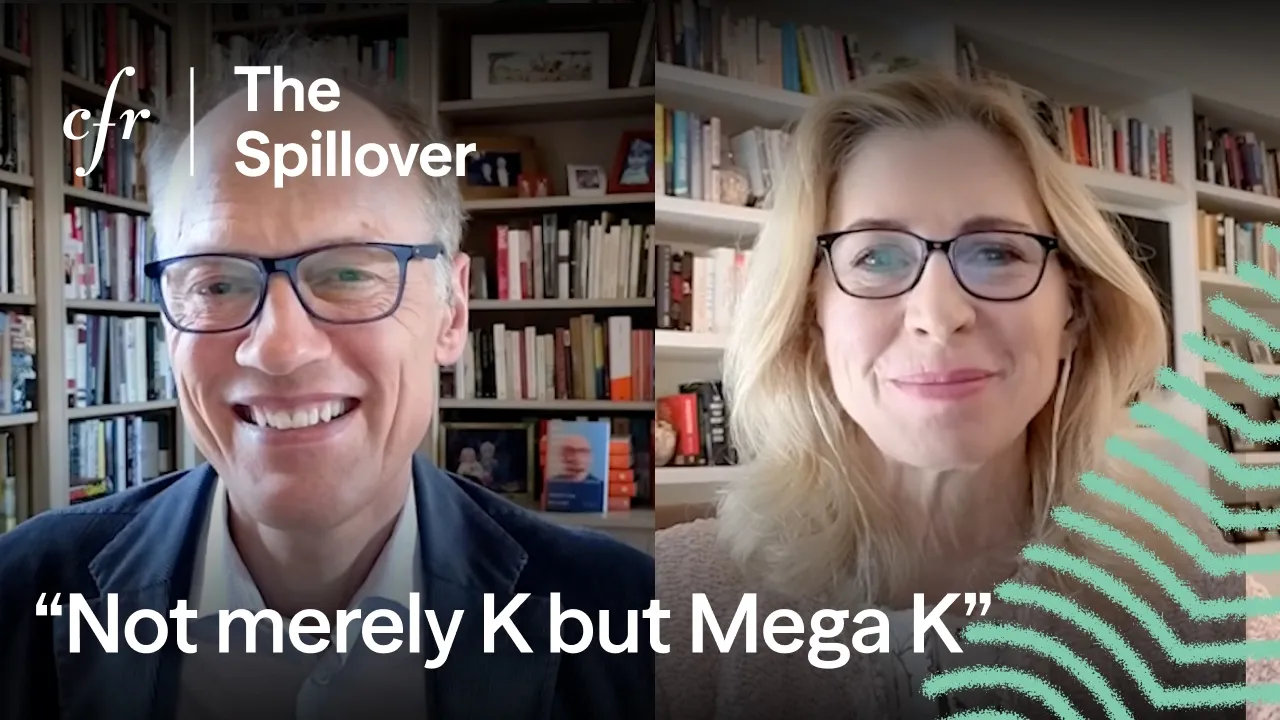
Right, right. That goes back to what you were saying about what you were thinking at the World Bank IMF meetings. Yeah, not merely K, but mega K.
PATTERSON:
So we’ve talked about what the K is, and we’ve talked about the definitional challenges. We’ve talked about some of the key forces driving it now and maybe into the future. I think, Sebastian, let’s try to get to one more question today, and probably that’s the hardest one, which is the spillover that the K creates, and then what the heck do you do about it?
There’s no shortage of policy responses being thrown out there to address, politicians might call it K, they might call it affordability, inequality, opportunity gaps. We’re talking about the K, which is actually the worst one, but there’s just a lot of ideas. Do any of them actually close the gap, or is it all just political posturing?
MALLABY:
I’m afraid there is a lot of political posturing, and this is almost the definition of what populism is. It’s a politics that proposes, you know, ideas or slogans that sort of assuage people psychologically for a moment, but don’t address the underlying cause of the problem. And it’s popular, but it’s not actually substantive.
So I’m afraid there is a lot of noise.
PATTERSON:
And it feels to me when we think about what are the spillovers from a K-shaped economy, populism is probably the biggest thing. The fact that you have this growing divide between have and have-nots results in a political force and policies, and it’s unclear how much they help. And what’s crazy, or maybe it’s not crazy, is we are seeing it on both sides of the political spectrum, I think, in different countries.
You know, part of President Trump’s plan to help the lower part of the K has been things like tariffs and, you know, trying to reduce immigration. And the aim of that was to increase wages and to bring back jobs to the United States for the lower part of the K. You know, deregulation’s part of it, too.
But deregulation takes time. And for now, the evidence we see is that the tariffs, the immigration reform, they’re not bringing back jobs. They aren’t necessarily doing much for wages.
And at the same time, you’re seeing those policies and other things like the war making it worse by pushing up prices on things like gasoline and food. I’m not trying to pick on the Republicans at all here. I mean, we see it on the left as well.
You have more and more policymakers. I’ll pick on my own city, New York City Mayor Mamdani. He’s talking about serious tax hikes on billionaires as part of his answer.
So a few weeks ago, he proposed a tax on New York City’s second homes, calls it a pied-à-terre tax. So second homes worth 5 million or more to help address housing affordability. And, you know, when you think Trump versus Mamdani, these are very different policy prescriptions.
And to me, it’s not clear if any of them are going to be effective or even feasible.
MALLABY:
Yeah, Rebecca, I get that, you know, in terms of the immigration restrictions and the tariffs, both of these policies tend to push up prices of consumer goods and that can hit low-income households in particular. I once wrote a very unpopular Washington Post column back in the day about, you know, Walmart is good for poor people, which absolutely infuriated a lot of readers. I think I got more emails and hate mail than I did for any other column.
But the point was, you know, Walmart, because it exploits the efficiencies of global supply chains, delivers very, very cheap goods for folks. And it’s particularly low-income people whose, you know, CPI basket, as we were saying before, is skewed towards, you know, everyday consumer goods that benefit from Walmart. And so I get that.
But Rebecca, I don’t quite get the other point, which is that, you know, what’s wrong with Mamdani, frankly, putting a tax on second homes worth more than $5 million? I mean, you know, if AI is coming, we don’t want to tax labor too much because labor is already going to be displaced by capital. We do want to tax capital.
Real estate is a form of capital. In particular, second homes would seem to be a legitimate target since they are owned by the richer people. So what’s wrong with that?
PATTERSON:
So look, I agree. You know, if we’re trying to find, if part of the answer to this is redistribution, trying to give more resources to people in the lower part of the K or reduce costs for people in the lower part of the K, you need revenue. And a tax has to be part of the answer.
And taxing people with more money, that’s reasonable too. I think the devil is in the details with this New York City proposal specifically. You know, the tax is going to depend on the value of the real estate.
So then does the property owner or the city set the taxable value? Do I get to pick how much my second home is worth or is the city going to decide for me? Do owners have to pay for appraisers to do this every single year?
How is the city going to handle the legal challenges? Because I guarantee there will be a lot of legal challenges on the values if there’s disagreement. But beyond all that, in this particular case anyway, they’re saying that this tax would bring in roughly $500 million a year.
That’s not nothing, but it’s a drop in the bucket compared to the city’s budget deficit. So if you’re trying to redistribute, you need to have enough revenue that it’s going to actually make a difference for the people in the lower part of the K. And you also need to have your fiscal house in order.
I mean, what’s going on in New York, the amount of spending, we’re going in the wrong… We have our own budget. It’s not a K, I don’t know.
It’s just an upside down V at this point. It’s a mess. I don’t want to get political, but it goes back to your first comment.
You know, these policies address anger of the voters, but it’s not clear, at least with some of them, how much they’re going to effectively address underlying issues.
MALLABY:
Yeah, we actually had our own version of the same thing in London in the last year or so, where the new Labour government imposed a tax on foreigners who lived in London long-term and used to get these very generous tax exemptions. It’s called the non-domicile regime. And, you know, in some sense, I sympathize with, you know, taxing a French or Italian or American resident of London the same way that a Londoner, British Londoner might be taxed because they both, you know, benefit from the same national public goods and they’ve been there for a long time in both cases.
But in practice, when you try to hit these wealthy foreigners, they leave, they escape. It doesn’t actually raise much revenue. It just drives some talented people out of the city and it really isn’t helping anybody.
So, you know, one has to be practical about one’s tax policy and not just go on some, you know, blind principle. But then I guess, you know, going back to what we were saying about different types of populist responses to the K problem, you’ve also got sort of, you know, these sort of populist tax proposals from Democrats who sound kind of Republican all of a sudden. So Senator Cory Booker, Democratic member of the Senate and likely presidential aspirant has a new tax plan act, which is basically tax cuts for everybody which are deficit funded.
So that’s kind of like an old school, you know, Republican tax giveaway. Interesting to see that coming from a Democrat.
PATTERSON:
Yeah, I was surprised when that proposal came out and I’m especially surprised because I think all of these people are smart enough to understand that our debt to GDP in the U.S. is already 100% and it’s headed towards 120% and at a certain point it is unsustainable. But there you go. And my great worry is that we could be in a populist trap.
And what I mean by that is, you know, in the United States a few years ago, President Trump was elected to a second term, partly on the policies he proposed, which were quite populist and aimed at helping the K. But then he’s not getting the results as quickly as people wanted. And so his poll numbers are coming down.
And now here we go into the midterm election and the Democrats, according to the polls, look like they’re gonna gain some seats. But then if the policy response is something like Cory Booker proposed or Mamdani proposed, and we just get tax hikes that don’t move the needle or tax cuts that blow up the deficit, do we just flip-flop? No one’s happy.
There’s not enough time for these policies to have an effect. And we just get stuck, again, in this cycle of populism going back and forth.
MALLABY:
Yeah, and what we really need, I think, is sort of a revitalized center, which we used to have.
PATTERSON:
Oh, I miss the center.
MALLABY:
So, you know, I always think about the 2000s in Germany where Gerhard Schröder’s government put through a bunch of pretty unpopular and tough labor market deregulations, you know, which for a center-left leader was brave to do that. It was not popular, but it worked. And Germany’s economy did pretty well in the wake of that because it had this extra productivity coming from that deregulation.
Or you go back a bit further to the 1990s when you had Tony Blair in Britain and Bill Clinton in the US both offering kind of fiscally responsible, deficit-reducing, but also inequality-reducing mixtures of policies. And, you know, I think it shows it can be done. You can have this sort of third-way politics, which is neither left nor right, and is not populist, but it’s kind of radical centrist, and it has substance behind it.
And, you know, that energy is just, these days, totally gone. You look at, you know, Keir Starmer in Britain, the labor leader elected as a centrist with a massive majority in parliament. He really hasn’t got anything done more than a year in.
And it’s just been depressing to see. Or you look at Emmanuel Macron, at times a very inspiring centrist leader with lots of ideas, but the politics just, you know, trip him up and he can’t get much of his program actually enacted. And, you know, at one point he was losing a prime minister, you know, every couple of months or so.
It was total mayhem. So I think, you know, the point here is that, you know, it’s not just populism that’s on the rise. It’s a vacuum that is being left by ineffective centrists.
You know, we could change that and turn it around if we had more centrist ideas coming forward.
PATTERSON:
I don’t want to blindly defend centrists here, but I do think some of the challenge is outside of their control. You have to have absolutely extraordinary powers of communication in today’s world. And you have to be able to get policies through at lightning speed because voters expect results immediately.
It’s this 24-7 social media, I want everything all at once. You know, in France, they talk about raising the retirement age, which is reasonable. We live longer.
We have a budget deficit. It’ll be phased in over time. You get protests in the streets.
In the US, I think voters are more and more conditioned that if anything bad happens, the government’s going to write checks. So if you go to the center and you try to have fiscally responsible policies that could have some pain attached for some group, one group or another, how do you get it done quickly enough before the election cycle? In the US, it’s basically every two years.
So again, I agree the centrists have to have compelling ideas. I think they also have to be absolutely extraordinary communicators or have great PR machines. And somehow they have to get those policies rolled out quickly and have some benefit to show quickly, to get people to believe.
I think it’s hard. Again, that’s why I don’t want to be too depressed in our podcast today, but I’m nervous about getting out of this populist trap.
MALLABY:
And look, I don’t want to minimize the challenges, but I do think there are ideas out there that really would amount to a good non-populist response to the K-shaped challenge.
PATTERSON:
Okay, good. I want a ray of hope. It’s spring.
Bring it on. Let’s go. What do you got?
MALLABY:
Well, I think just the big picture principle is go back to that third way, Bill Clinton and Tony Blair, and what they used to say in different language, but kind of the same idea that if you work hard and play by the rules, you’ll have a fair shot at the American dream or the British dream or the German, whichever country you’re talking about. And I think what that in practice translates into in policy terms today is that first of all, you want to minimize taxes on labor, particularly at the low end, because you don’t want to speed the AI transition in which labor is just squeezed out of the production system. And so at the low end, you want to maybe enlarge the earned income tax credit, which is like a sort of top up and negative income tax for people who join the workforce, but they’re not being paid very much.
So that encourages and helps people to join the workforce at the lower end. You maybe introduce wage insurance, which was an idea that was kind of popular and in vogue in the Obama years and was a bit experimented with. And the idea here is that, if a worker loses a job and then the new job which is on offer is paying like half as much, the worker might often say, well, that’s below my dignity.
I’m not doing that. I’m just, I’d rather be unemployed. But that’s a bad choice because once you’re unemployed for too long, you become unemployable.
And so wage insurance comes in and says to that person, listen, if you take this job, this insurance policy is going to top your wages up, maybe not all the way to where you were before, but at least it will kind of halve the gap. And so that encourages people to take that new job. And once they’re in the new job, hopefully they acquire new skills, new knowledge and new motivation and they can build their way towards a better position in the workforce.
And this insurance only lasts for a couple of years, but it transitions people through a negative shock from an economic transition. And David Autor, the economist at MIT, talks about this idea. He’s pretty persuasive.
And I think that trying to encourage work, make it easier for people to stay in work, these would be good ideas even without AI. And with AI coming and that big displacement that I was talking about looming over the horizon, I think they become all the more urgent.
PATTERSON:
Yeah, but then even if you are cutting taxes on labor, we still, I’m gonna keep being the fiscal hawk today, we have to figure out how to do that without expanding the deficit further, especially in countries like the UK, France and US these days. So you’re gonna have to raise income somewhere, right? I personally think in the United States, our corporate tax rate, initially it was quite high at 35%.
It got cut once and then it got permanently cut again. We’re now near the bottom of the OECD corporate tax rate. So there might be a little room there.
And then as you were talking about earlier, possibly some taxes on capital.
MALLABY:
Yeah, I mean, I do think that property taxes, I mean, maybe Mamdani hasn’t got the design right, but some sort of property taxes which raise revenue and then also discourage people from occupying more space than they really need, right? If you raise the property tax and you’re living in a big house and your kids have now moved out because they’re adults and maybe you trade down to a smaller place and that liberates space in the housing stock for somebody else to use. So it makes a more efficient use of housing stock that should reduce the price of shelter overall.
And I also think that the robot tax, which is an idea that Bill Gates brought up some years ago makes sense. I mean, right now a company that employs a worker has to pay payroll taxes for the worker and the worker has to pay income tax probably unless they’re below the threshold. And so you’ve got two kinds of tax on that choice to employ a human.
If you employ the machine, both those taxes disappear. So the tax system in a way is skewing the economy in favor of automation. And when you’ve got this massive, you know, gale force wind from AI coming down the pike and pushing automation, I don’t think we need public policy that doubles down on that.
We want to actually lean against that wind.
PATTERSON:
Right. That one’s going to be tricky, I think. I mean, companies will say, how do I have to define a robot?
Is this a robot? Is that a robot? So I can imagine the legal challenges would be colorful.
And then you’ll have the pro-AI lobby group, pro-robot or humanoid robot lobby group saying, well, you’re going to slow growth if you do this. If you tax us, then we don’t have as much money to invest. And if we’re not investing and growing the economy, everyone gets hurt.
I’m already picturing the debate that’s going to follow. I’m not disagreeing with you. I just, again, this is, it’s not easy.
And there’s just so many pros and cons of the different policy proposals. But look, I think it’s good to talk about policy. And we have to find revenue.
We have to think about simplifying the tax code and finding revenue sources and finding ways to redistribute that make sense. I also think, you know, we could look at some of the firms making the most money from AI, going back to AI. And I feel like Anthropic actually said this publicly, that maybe some of those top, top, top leaders of those companies who are literally becoming trillionaires or on the road to that could pay slightly higher taxes.
I mean, look, it might be a political stunt, but it would go a long way to making people more comfortable with AI coming in mass. And personally, I’d always be looking at the bottom part of the K on healthcare, education, training, the Trump accounts, which give each child born for the next few years, $1,000 that gets invested and they can’t touch it till they’re 18. And other companies or parents or relatives can put more money in.
I think it needs some development, but I like the idea because if part of the K is that the lower income don’t have the ability to benefit from risk assets going up as they do 80% of the time over history, you need to get them in and you want to get them in early so it can compound. That was also coupled with financial education. So these people know how to save and invest and borrow wisely.
That could also help us with the K on the lower end. So it’s not just about spending and tax policy. I think there’s some other social policies that probably could also help.
MALLABY:
Yeah, that’s a great point. And I actually think that the enactment of these Trump savings accounts where each child upon birth gets a certain amount of money in an account and starts compounding and in future sort of understands and benefits from the upside of having investment income. That idea has been around a long time.
It’s telling that it finally happened now. I think it happened because we are in this moment when people are worried about a K-shaped economy and they’re worried about AI and they’re worried about all these other things. And so I think actually that the political obstacles that we were talking about to doing some of this reform may turn out in 2028 to be less powerful than expected.
That the candidate who comes forward with a sort of non-crazy reformist agenda and says instead of maybe a Mamdani uncollectible tax on second homes in Manhattan, maybe that doesn’t work for the reasons you said, but maybe a robot tax could be designed in a way that works or something will work. I think the political climate, both if you look at the polling on AI, which people are very skeptical of, and if you look at the upswell of support for populists on the left like Mamdani, this could be a moment in the next sort of election cycle or two where a sort of rebirth of radical centrism becomes possible.
PATTERSON:
I love the concept of radical centrism. That’s something I’m going to use. I may or may not give you credit, but I really like it.
Hey, before we call it a day here, I want to get to the fun part of our episode where we talk about something we read or did or learned in the previous week that our listeners can use or benefit from. And I have to say, I’m going to AI. I was pondering a Reuters story I read this past week.
Meta is installing software on employees’ computers that will monitor everything, their keystrokes, their clicks. It’ll even take screenshots randomly during the day. It’s to help them train their AI models, but gosh, it feels kind of big brother to me.
I mean, Sebastian, you’re deeper in this world than I am. Have you heard of that elsewhere? Have I just missed it till now?
MALLABY:
I had not heard of it, and it’s super creepy. I mean, the idea that people participate in their own sort of obsolescence by having to train the AI directly to replace them through their keystrokes, that is a bit creepy.
PATTERSON:
What’s yours this week?
MALLABY:
Yeah, so mine actually is also a brief AI snapshot, which is that there’s a company, which I probably will mispronounce despite having actually looked up the pronunciation before, called Weyerhaeuser, which is making autonomous logging equipment. And I just think this is a neat example of how we look for AI to bring benefits to those famous Silicon Valley companies, the Googles, the NVIDIAs, and so forth. But actually all across the economy, even in forestry and logging, for goodness sake, you’ve got companies which are trying to get the most out of AI.
PATTERSON:
Very cool.
MALLABY:
I guess that’s a wrap. Thank you to our listeners for tuning in, and we will see you next week for another episode of The Spillover. at cfr.org.
And be sure to include The Spillover in the subject line. This episode was produced by Molly McAnany, Gabrielle Sierra, and Jeremy Sherlick. Our video editor is Claire Seaton.
Our audio producer is Markus Zakaria. Research for this episode was provided by Liza Jacob. You can subscribe to the show on Apple Podcasts, Spotify, YouTube, or wherever you listen to podcasts.
This transcript was generated using AI and may contain errors or inaccuracies.
We discuss:
- How a true K-shaped economy features a widening divergence in which some groups accelerate upward while others fall behind.
- Why measuring the K-shaped economy is complicated, with major disagreements over data and methodology.
- How asset ownership, not just wages, helps explain why wealthier households pulled ahead during and after COVID through equities, housing, and cheap credit.
- Why inflation, war-driven energy and food shocks, and different household spending patterns can deepen economic divergence, especially for lower-income households.
- How the “mega K” concept applies globally, with geopolitical shocks like the Iran and Ukraine wars worsening divides between rich and poor countries.
- How artificial intelligence and climate change could worsen the K phenomenon, disproportionately pressuring workers, poorer countries, and those without capital.
- How contrasting policy prescriptions—from Trump’s tariffs and immigration restrictions to Mamdani’s proposed taxes on wealthy second-home owners—reflect competing populist approaches to affordability.
- How a revival of “radical centrism,” combining fiscally responsible reforms with practical policies to manage inequality, AI disruption, and long-term economic inclusion might help.
Mentioned on the Episode:
“America’s Affordability Crisis Is (Mostly) a Mirage,” The Economist
“Going Bananas Over Affordability,” Inside Economics
“Compare Wealth Components Across Groups,” The Federal Reserve
The Spillover is a production of the Council on Foreign Relations. The opinions expressed on the show are solely those of the hosts and guests, not of the Council, which takes no institutional positions on matters of policy.
Producer
- Producer, Podcasts
Supervising Producer
- Director, Podcasting
Supervising Producer
- Director of Video
Audio Producer
- Audio Producer & Sound Designer
Researcher
- Research Associate, Finance, Business, and Technology
More Episodes
 35:24Podcast
 48:01Podcast
 47:25Podcast
 50:17Podcast
 47:25Podcast
 52:31Podcast